The Evidence-Based Fitness Supplements Guide: What Works, What's Overhyped & What's a Waste of Money
The best fitness supplements science supports, ranked in three tiers. See what works, what is overhyped, and which ones to skip, with every study linked.
TL;DR. The short answer
- Only a handful of supplements have good human evidence for training: creatine, caffeine, and in specific situations buffering agents and nitrate. The IOC consensus statement says so directly, and even those give small to moderate gains.
- Protein powder is simply food in a tub. Vitamin D, omega-3, magnesium, citrulline and ashwagandha are conditional: they may help when your diet or blood work shows a gap, and do little when it does not.
- BCAAs, testosterone boosters, commercial fat burners and proprietary-blend pre-workouts are the weakest value. Human studies on test booster ingredients mostly show no effect, and a 2021 meta-analysis found no clear fat-loss benefit from thermogenic supplements.
- Supplements can be contaminated or mislabelled. Prefer single-ingredient products with the dose on the label and independent testing.
- No supplement replaces training, enough protein, calories and sleep. If you have a medical condition, are pregnant, or take medication, check with a doctor before adding anything.
Table of contents
Most supplements do little for people who already train, eat and sleep well. A few do something modest, and a handful are mostly marketing. This guide sorts the best fitness supplements science supports from the ones you can safely skip, so you stop paying for the label and start paying for the evidence.
Here is the short version. Creatine and caffeine are the clear winners. Protein powder is food in a tub. Vitamin D, omega-3, magnesium, citrulline and ashwagandha are “maybe, depending on you.” BCAAs, test boosters, fat burners and proprietary-blend pre-workouts are where most of the money gets wasted.
No supplement fixes a weak plan. If you have not sorted your protein intake, your calories and your sleep, start there. Our guide to creatine, protein powders and caffeine goes deeper on the three biggest names, so this article covers the wider landscape.
What do the experts say about supplements that actually work?
The best single source here is the International Olympic Committee consensus statement, written by a panel of sports nutrition researchers. Their view is blunt. Nutrition makes a small but potentially valuable contribution to performance, and supplements make a minor contribution on top of that. Only a few (caffeine, creatine, specific buffering agents and nitrate) have good evidence of benefit (Maughan et al., 2018).
Read that again. That is the Olympic panel, talking about elite athletes who get paid to optimise everything. For a lifter in Pune or Delhi with a desk job and four sessions a week, the margin supplements can add is smaller still.
The same statement adds two cautions that most supplement ads skip. Responses vary a lot between people. And a complete nutritional assessment should come before any decision to use a supplement.
How I sort supplements: Tier 1, Tier 2 and Tier 3
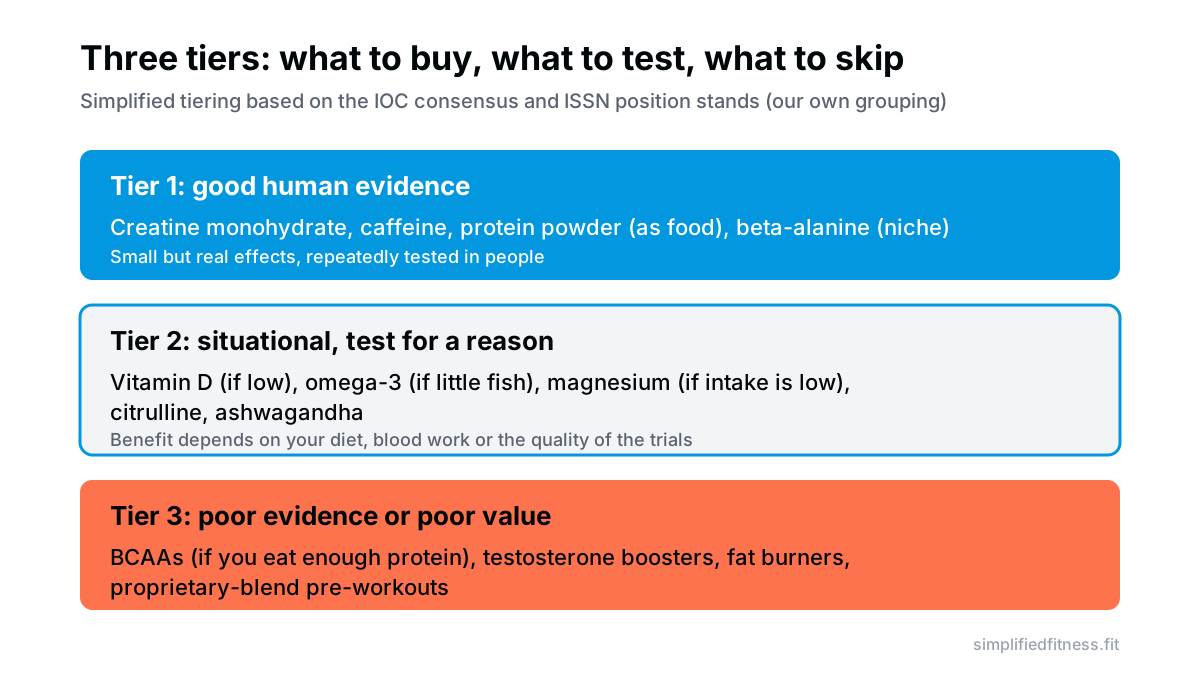
The tiers below are our own grouping, built on the IOC statement and the individual studies linked in each section. They are a shortcut for decision-making, not an official ranking.
| Tier | Examples | Typical effect | Who it is for |
|---|---|---|---|
| 1: good human evidence | Creatine monohydrate, caffeine | Small to moderate | Most lifters |
| 1 (niche) | Beta-alanine | Mainly 1-4 minute efforts | Hard-interval athletes |
| 2: conditional | Vitamin D, omega-3, magnesium, citrulline, ashwagandha | Small, depends on status or trial quality | People with a gap or a specific goal |
| 3: weak or poor value | BCAAs, test boosters, fat burners, proprietary blends | Little to none shown | Almost nobody |
Tier 1: the supplements with real evidence
Creatine monohydrate
Creatine is the most studied sports supplement. The ISSN position stand reports that creatine supplementation increases muscle creatine and improves high-intensity exercise performance, and that supplementation of up to 30 g/day for 5 years was safe and well tolerated in healthy individuals (Kreider et al., 2017). Typical use is much lower, around 3-5 g a day.
Hair loss and kidney fears get a full treatment in our creatine myths article, so I will not repeat them here. Work out your dose with the creatine dosage calculator. If you have kidney disease, talk to your doctor before starting.
Caffeine
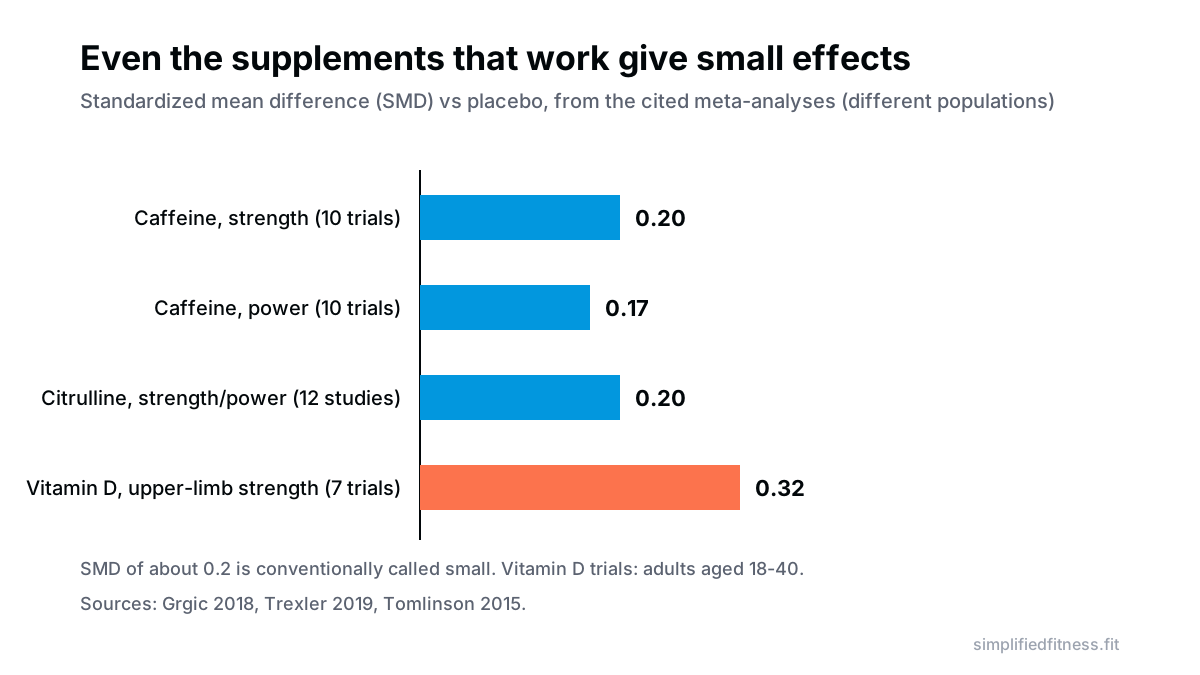
Caffeine is the other clear winner, and you probably already take it. A 2018 meta-analysis found it modestly improved maximal strength (SMD 0.20) and power (SMD 0.17). The strength benefit was significant for the upper body but not for the lower body (Grgic et al., 2018).
The ISSN position stand says doses of 3-6 mg/kg body weight consistently improve performance, that the minimal effective dose may be as low as 2 mg/kg, and that very high doses of about 9 mg/kg bring more side effects without needing to be there (Guest et al., 2021). For a 70 kg person, 3 mg/kg is roughly 210 mg. Use the caffeine dosage calculator to get your number.
The same position stand also notes that individual responses and effects on sleep and anxiety vary, partly with genetics and habitual intake. If a late session wrecks your sleep, the performance gain is not worth it. For tolerance and timing, see how to reset caffeine tolerance.
Protein powder (as food)
Protein powder is not magic, it is convenient. What drives muscle gain is hitting your daily protein number, and powder is one way to get there. If dal, paneer, curd, eggs, chicken and soya already get you to the target, you do not need it. If your budget or schedule makes that hard, a scoop helps. The full breakdown is in our protein guide, and the protein calculator gives your number.
Beta-alanine (niche)
Beta-alanine raises muscle carnosine, which helps buffer acid during hard efforts. The ISSN position stand reports that 4-6 g daily for at least 2-4 weeks improves exercise performance, with more pronounced effects in tasks lasting about 1-4 minutes. The only reported side effect is paraesthesia (tingling), which can be reduced with smaller divided doses or a sustained-release form (Trexler et al., 2015).
Most strength training sets last well under a minute, so the case for typical lifters is weaker than the marketing implies. I see it as useful for hard intervals, rowing or combat-style conditioning, and optional elsewhere. More on dosing and the tingles in our beta-alanine guide.
Tier 2: conditional supplements (depends on you)
These can help, but only if the situation fits. Here the honest answer to “should I take it?” is “it depends on your diet, your blood work and your goal.”
Vitamin D (and the K2 add-on)
Vitamin D is the clearest “get tested, then decide” supplement. A 2015 systematic review and meta-analysis pooled 7 trials (310 adults aged 18-40) and found that supplementation increased upper and lower limb strength, with an SMD of 0.32 for each (Tomlinson et al., 2015). The abstract does not split deficient from sufficient people, so I would not assume the same gain applies if your level is already fine.
The practical move is a blood test (25-hydroxyvitamin D) and a doctor-guided dose, especially because high-dose weekly products are common in India and more is not better. The K2 pairing is popular, but in my PubMed search I did not find good lifting-specific evidence for it, so I treat it as unproven for training. Details in our vitamin D3 and K2 guide.
Omega-3 (fish oil)
Fish oil gets sold as a muscle builder. The best evidence I found is in older adults. A 2020 meta-analysis of 10 randomized trials in the elderly found minor muscle mass gains (0.33 kg), with a larger effect for doses above 2 g a day (0.67 kg) (Huang et al., 2020).
Two caveats matter. These were elderly participants, not young lifters, and the effect was small. If you eat fish rarely, omega-3 is a general-health conversation for your doctor, not a physique shortcut. See the fish oil dosing guide.
Magnesium
Magnesium takes part in energy metabolism and normal muscle function. A 2017 review found that some surveys linked better magnesium status with muscle performance, and some intervention studies showed improvements such as quadriceps torque. It also noted that most human studies looked at physiological markers such as blood pressure and VO2 max, not direct performance (Zhang et al., 2017).
So the evidence is suggestive, not decisive. If your diet is low in dal, nuts, seeds and green leafy vegetables, a modest supplement is reasonable. People with kidney disease should check with a doctor first. The form debate (glycinate, citrate, oxide) is covered in our magnesium guide.
Citrulline
Citrulline is the active part of many “pump” pre-workouts. A 2019 meta-analysis pooled 12 studies (198 participants) and found a small benefit for high-intensity strength and power (SMD 0.20). Each individual study’s confidence interval crossed the line of no effect, and the authors called the effect size small (Trexler et al., 2019). Studies included in that analysis used at least 3 g, taken at least 30 minutes before testing.
My read: a small bonus that is probably more noticeable for pumps and rep endurance than for max strength. Pure citrulline versus citrulline malate is explained in this comparison.
Ashwagandha
Ashwagandha is an Indian adaptogen with a lot of buzz. A 2021 Bayesian meta-analysis of 12 trials in healthy people concluded it was more efficacious than placebo for variables related to physical performance. It also said more comparable studies in athletic populations were needed to get a stable estimate (Bonilla et al., 2021).
Note the conflict-of-interest disclosures in that paper: some authors reported industry ties, including to companies that sell ashwagandha. That does not invalidate the work, but it is another reason to stay cautious. Extract types and cycling are covered in the ashwagandha guide. If you are pregnant, have a thyroid condition, or take regular medication, ask your doctor first.
Tier 3: where most of the money goes to waste
BCAAs: the myth that will not die
BCAAs (leucine, isoleucine, valine) were sold on the idea that they switch on muscle building. Wolfe’s review looked at the theory and the data. In theory, BCAAs alone cannot stimulate much new protein because the other essential amino acids needed to build it are not supplied. In practice, he found no human studies where muscle protein synthesis was measured after oral BCAAs alone, and only two intravenous studies, which found that BCAAs decreased muscle protein synthesis as well as breakdown. His conclusion was that the claim that dietary BCAAs stimulate muscle protein synthesis is unwarranted (Wolfe, 2017).
Note that the author discloses funding or honoraria from beef, nutrition and food companies, so you may weigh the paper accordingly. But the logic is hard to argue with: a complete protein, whether whey, eggs or a good dal and paneer meal, already contains the BCAAs plus everything else. The full argument is in BCAAs vs EAAs.
Testosterone boosters
The “test booster” pitch is that a herb blend raises your testosterone and therefore your muscle. The evidence does not back it. A 2019 analysis of the five top-ranked test boosters on Amazon identified 19 unique ingredients. For the 10 most common, they found 191 studies, of which only 19% were in humans. Among 37 human studies, 30% observed a testosterone increase, 3% a decrease, 46% no effect, and 22% were indeterminate (Balasubramanian et al., 2019).
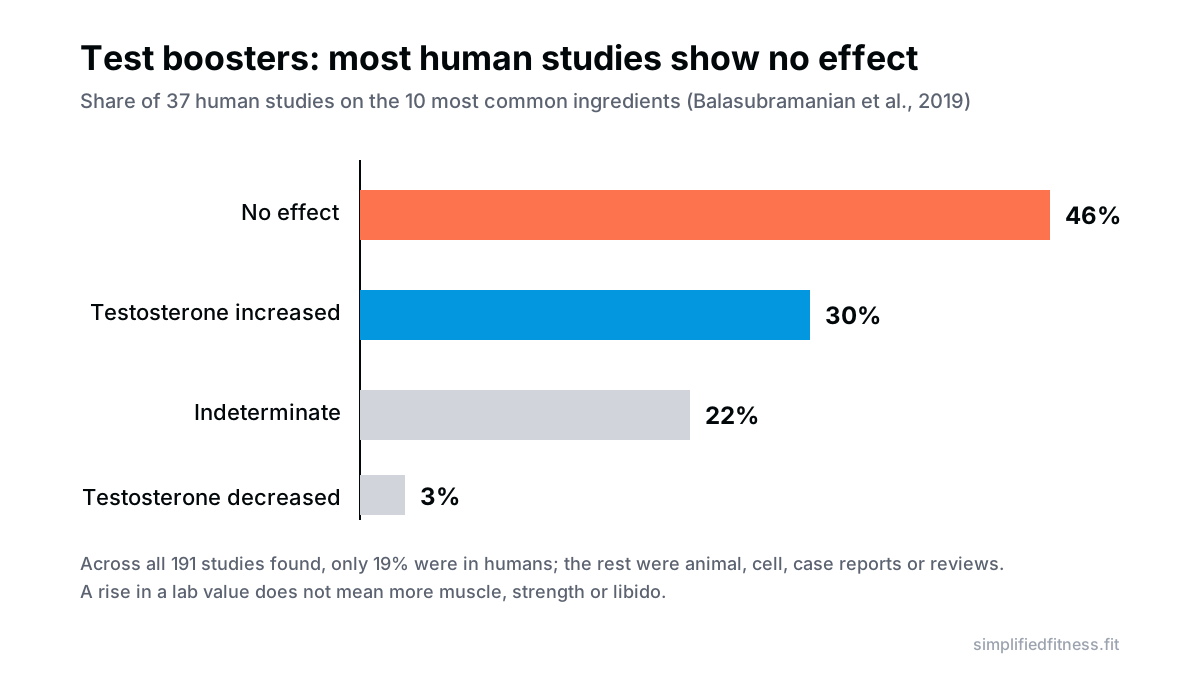
The same paper reported that after filtering untrustworthy reviews, reported benefits dropped sharply (for example, a 93% decrease in users reporting improved strength or endurance). That is a hint that online ratings are a poor guide. The authors concluded there were no definitive findings of efficacy.
If you genuinely suspect low testosterone (low drive, persistent fatigue, low mood), see a doctor for proper blood tests. Do not diagnose yourself from a supplement ad. For ingredient-by-ingredient detail, see our natural testosterone booster audit.
Fat burners and thermogenics
A 2021 systematic review and meta-analysis of 21 studies (longer than 8 weeks, in people with BMI above 24.9) found a general trend toward effectiveness, but the confidence intervals crossed zero. The authors concluded that thermogenic supplements were less effective than exercise, or diet and exercise, and that the benefit appears limited (Clark et al., 2021).
Green tea is a good example of a “natural” fat burner. A Cochrane review found it produced a small, statistically non-significant weight loss in overweight or obese adults that was not likely to be clinically important (Jurgens et al., 2012). Your best “fat burner” is a sustainable calorie deficit, covered in our energy balance guide, plus walking and lifting. The ingredient breakdown is in commercial fat burners exposed.
Proprietary-blend pre-workouts
A multi-ingredient pre-workout may genuinely help, mostly because of caffeine. A 2018 review found that acute pre-exercise use may positively influence muscular endurance and mood, with mixed results on force and power. It also pointed out that “proprietary blends” that do not disclose specific amounts make direct comparison between formulations challenging, and that most safety studies lasted less than eight weeks (Harty et al., 2018).
Here is how the trick works in plain terms. A blend lists a total weight and the ingredients in order of amount, but not how much of each. A 3 g “performance matrix” can be mostly cheap filler with a pinch of the expensive ingredient. You cannot check it against the doses used in research. Learn more in our guide to proprietary blends and underdosing tricks, or build your own with the DIY pre-workout guide.
How do I check whether a supplement is worth buying?
Before you add anything, run it through five questions. They take two minutes and can stop you paying for products that have nothing behind them.
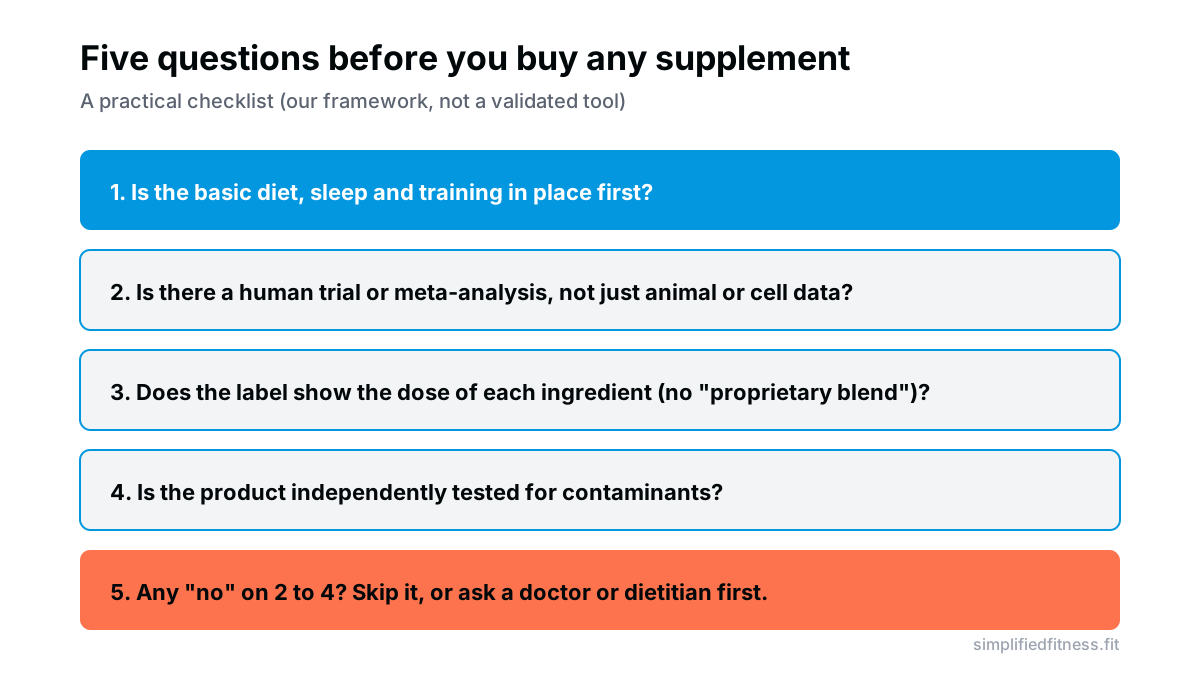
The IOC consensus statement warns that inadvertent ingestion of prohibited substances is a known risk with some supplements, which is why independent testing matters. We explain what the logos mean in the third-party certification guide, and the FSSAI angle for India.
A simple, budget-friendly order of operations
If you want a plan, not a lecture, here is how I would sequence it.
- Lock in training, calories, protein and sleep for at least 8-12 weeks. Use the free workout plans if you need structure.
- Add creatine monohydrate. It is cheap per serving and well studied.
- Add caffeine only if you like it and it does not hurt your sleep.
- Get a blood test before buying vitamin D, iron or similar products.
- Try one Tier 2 item at a time, with a clear reason, and stop if you notice nothing.
- Skip BCAAs, test boosters, fat burners and blend-based pre-workouts.
On a tight budget, the best spend is food: dal, eggs, curd, paneer, soya chunks and seasonal vegetables. Our budget supplement guide shows what to prioritise when money is limited.
Who should be careful with supplements
- People who are pregnant or breastfeeding.
- Anyone with kidney, liver, heart or thyroid conditions.
- Those taking regular medication, because of possible interactions.
- Anyone under 18, where research is limited.
- Competitive athletes subject to drug testing, because of contamination risk.
If you are in any of these groups, check with a doctor or registered dietitian before starting. This article is general education, not medical advice.
The bottom line
The best fitness supplements science supports are a short list. Creatine and caffeine have good evidence and modest effects. Protein powder is a convenient food. Vitamin D, omega-3, magnesium, citrulline and ashwagandha are worth considering only when your situation or the trial quality justifies it. BCAAs, test boosters, fat burners and proprietary blends are where most people lose money.
The more useful question than “which supplement?” is “what is actually limiting my progress?” Usually it is consistency, protein, sleep or program design. Fix those, and use the protein calculator and our sleep and recovery guide as your next steps.
Go deeper: every guide in this topic
- Ashwagandha KSM-66 vs Sensoril: Which Extract, What Dose, and Do You Need to Cycle?
- BCAAs vs EAAs: Why BCAAs Are a Waste of Money If Your Protein Is Covered
- Beetroot Juice for Running and Lifting: How Dietary Nitrate Works (and the Mouthwash Trap)
- Beta-Alanine Benefits: Carnosine Buffering, High-Rep Gains and Why It Makes You Tingle
- Betaine (TMG) for Strength and Power: What the Research Really Shows
- Best Budget Supplement Stack: What to Buy for Under $25 (₹2,000) a Month
- Citrulline Malate vs Pure L-Citrulline: Dosing, Nitric Oxide and Muscle Pumps
- Collagen Peptides and Vitamin C for Tendons: A Pre-Loading Protocol to Take to Your Physio
- Commercial Fat Burners Exposed: Weak Ingredients, Stimulant Spikes and Health Risks
- Curcumin and Turmeric for Lifters: Does It Cut Soreness, and Does Piperine Matter?
- CYP1A2 Genetics and Caffeine: Why Fast and Slow Metabolizers Respond Differently in the Gym
- Decoding Supplement Proprietary Blends: Under-Dosing Tricks and Deceptive Labels
- DIY Pre-Workout Guide: Check the Label for Fairy-Dusting, Then Mix Your Own
- Electrolyte Supplements: Do Gym Trainees Need Electrolyte Powders or Simple Salt and Water?
- Fish Oil and Omega-3 for Lifters: How Much EPA and DHA You Actually Need
- FSSAI Supplement Regulations: How to Spot Fake Protein in India
- Does Glutamine Build Muscle? Why Oral Glutamine Is Mostly a Waste for Lifters
- Glycerol Hyperhydration for Bodybuilding Pumps: What the Science Says
- Intra-Workout Carbs for Bodybuilding: Who Needs Sugar in the Gym and Who Is Wasting Calories
- Joint Health Supplements for Lifters: What Glucosamine, MSM and UC-II Collagen Really Do
- L-Glutamine for Gut Health: The Real Story Behind the Gym Myth
- Leucine Trigger Hypothesis: How Much Leucine Per Meal Do You Need?
- Magnesium Glycinate vs Citrate vs Oxide: Which Form Helps Sleep and Cramps?
- Melatonin for Lifters: Why a Low Dose (0.3-1 mg) Beats the 10 mg Gummy
- Casein Protein Before Bed: Does Micellar Casein Really Work?
- Multivitamins for Lifters: Cheap Insurance or Expensive Urine?
- Do Natural Testosterone Boosters Work? Tribulus, Tongkat Ali, Fadogia and D-AA Audited
- Probiotics and Digestive Enzymes for Protein Absorption: Do Healthy Lifters Need Them?
- Baking Soda for Athletic Performance: Dose, Timing and Stomach Protection
- Sodium Loading Before Training: Plasma Volume, Aldosterone and the Pump Claim
- The Supplement Hierarchy: Tier 1 (Proven), Tier 2 (Contextual), Tier 3 (Skip)
- Taurine for Lifters: Is It a Stimulant, and Does It Prevent Cramps?
- Third-Party Supplement Certifications: Informed-Choice, NSF Certified for Sport, and Banned Substances
- Vitamin D3 and K2 Synergy: Dosage, Blood Targets and Bone Health for Lifters
- Zinc Supplementation: Does It Raise Testosterone, and What About Copper?
Frequently Asked Questions
What are the best supplements for building muscle?
Creatine monohydrate has the strongest evidence, followed by getting enough total protein (powder is just a convenient way to do it). The IOC consensus statement lists caffeine and creatine among the few supplements with good evidence of benefit. Start with those two, and only add others if you have a specific reason.
Do supplements actually work?
A few do, modestly, and most do not do much for people who already eat and train well. The IOC consensus statement concludes that nutrition makes a small but valuable contribution and supplements a minor one on top of that. Fix training, protein, calories and sleep first, then consider one or two proven options.
Is creatine worth it?
Yes for most healthy adults who lift. The ISSN position stand reports that creatine raises muscle creatine stores and improves high-intensity exercise performance, with safety data in healthy people up to 5 years. A plain creatine monohydrate dose of 3-5 g a day is the standard approach, and our creatine dosage calculator can give you a number.
Are BCAAs worth taking?
Usually not if you already eat enough protein. Wolfe's 2017 review found no human studies showing that BCAAs alone raise muscle protein synthesis, because the other essential amino acids needed to build new protein are missing. Spend that money on whole protein foods or a protein powder instead.
Do testosterone boosters work?
There is no good evidence that over-the-counter test boosters raise testosterone in a way that matters for muscle. A 2019 analysis of the top Amazon products found that among 37 human studies on their common ingredients, 30% saw a testosterone increase and 46% saw no effect. If you suspect low testosterone, see a doctor for blood tests rather than guessing with supplements.
Do fat burners work?
Not in any way that beats diet and exercise. A 2021 systematic review of 21 studies found thermogenic supplements showed a general trend toward benefit but confidence intervals crossed zero, and results were less effective than diet and exercise alone. If fat loss is the goal, a calorie deficit and consistent training do the work.
Is pre-workout necessary?
No. The useful parts of most pre-workouts are caffeine and sometimes citrulline or beta-alanine, which you can get on their own. A 2018 review noted that proprietary blends make it impossible to compare formulations, so you cannot tell if the doses are effective. A measured caffeine dose, such as coffee, about 60 minutes before training covers the main evidence-based ingredient for much less.
How much caffeine should I take before a workout?
The ISSN position stand reports that doses of 3-6 mg/kg body weight consistently improve performance, and that effects may begin at about 2 mg/kg. Very high doses (about 9 mg/kg) produce more side effects without a clear extra benefit. For a 70 kg person that means roughly 140-420 mg, so start low and use the caffeine dosage calculator, especially if you train in the evening.
Does caffeine improve strength?
Slightly. A 2018 meta-analysis found a small improvement in maximal strength (SMD 0.20) and power (SMD 0.17), with the strength effect significant for the upper body but not the lower body. The effect is modest, so treat caffeine as a small bonus, not a replacement for good sleep.
What is beta-alanine and do I need it?
Beta-alanine raises muscle carnosine, which buffers acid during hard efforts. The ISSN position stand reports that 4-6 g daily for 2-4 weeks improves exercise performance, with the clearest effects in efforts lasting 1-4 minutes. Most lifters doing sets of 5-12 reps may notice little, and the tingling side effect can be reduced with smaller split doses.
Is citrulline malate worth it?
It might help a little, but the evidence is modest. A 2019 meta-analysis of 12 studies (198 participants) found a small benefit for high-intensity strength and power (SMD 0.20), though each individual study's confidence interval crossed zero. If you like the pump and the price is fine, it is a reasonable optional extra, not a priority.
Does ashwagandha increase testosterone or muscle?
The evidence is promising but not strong. A 2021 Bayesian meta-analysis of 12 trials found ashwagandha beat placebo for physical performance outcomes in healthy people, but the authors, some with industry ties, said more comparable studies in trained people were needed. Treat it as optional, and avoid it if you are pregnant, have a thyroid condition, or take medication without checking with a doctor.
Should I take vitamin D?
Only if you are low or have little sun exposure, and a blood test is the best way to know. A 2015 meta-analysis of 7 trials in healthy adults aged 18-40 found vitamin D supplementation increased upper and lower limb strength (SMD 0.32), but it did not separate deficient from sufficient participants. Ask your doctor to check your level before taking high-dose weekly products.
Is fish oil worth taking for muscle gain?
Probably not for muscle itself in young lifters. A 2020 meta-analysis found minor muscle mass gains in older adults, with benefits clearer above 2 g a day, but that was an elderly population and the effect was small. If you rarely eat fish, omega-3 may still be worth discussing with your doctor for general health, but do not expect a physique change.
Do I need magnesium?
Only if your intake is low, since magnesium is an essential mineral involved in energy metabolism and muscle function. A 2017 review found positive links between magnesium status and muscle performance, though many of those were cross-sectional surveys rather than trials. Eating dal, nuts, seeds and leafy greens covers most people, and anyone with kidney disease should check with a doctor first.
Do I need a multivitamin?
Not automatically. The IOC consensus statement says a complete nutritional assessment should come before any decision to use supplements, and one use is managing a proven deficiency. If your diet is very restricted, for example a limited vegetarian diet, ask a doctor or dietitian about blood tests.
What does a proprietary blend mean on a supplement label?
It means the company lists the total weight of a mix but not the dose of each ingredient. A 2018 review notes that such blends make it challenging or impossible to compare formulations with research doses. Choose products that list the amount of every active ingredient so you can check it against the studies.
Are supplements regulated or tested?
Regulation varies by country and does not guarantee that a product contains what the label says. The IOC consensus statement warns that inadvertent ingestion of prohibited substances is a known risk with some supplements. Prefer products that carry independent third-party testing, and see our guide to certifications for what to look for.
Can supplements be contaminated or fake?
Yes, contamination and mislabelling are documented risks. The IOC consensus statement notes that supplements may contain prohibited substances that cause an anti-doping violation, which is a particular concern for competitive athletes. Buy from authorised sellers, check the batch code, and prefer products with third-party certification.
Are protein powders a supplement or food?
They are best treated as food, a convenient way to reach your daily protein target. The muscle-building effect depends mainly on total daily protein, not on the powder form itself. If you struggle to hit your number with dal, paneer, eggs, curd and chicken, a scoop of whey or a plant protein is a practical shortcut, and our protein calculator shows your target.
Can I just rely on food instead of supplements?
For most nutrients, yes. The IOC consensus statement frames supplements as a minor contribution on top of good nutrition, not a replacement for it. Build meals around dal, eggs, curd, paneer, soya and lean meat first, and add a supplement only when it fills a gap you can name.
How do I choose a supplement without wasting money?
Ask whether a human trial supports it, whether the dose is on the label, and whether it is independently tested. A supplement that fails any of those checks is usually not worth the cost. Start with one product at a time so you can judge whether it did anything for you.
Are supplements safe to take together?
Often yes for the basics, but combinations raise the odds of side effects and make it hard to know what is working. Stacking several stimulants, such as caffeine plus a stimulant-heavy pre-workout, is a common way to overdo it. Add one thing at a time, keep total caffeine in mind, and speak to a doctor if you take medication or have a heart, kidney or thyroid condition.
When should I see a doctor before taking supplements?
See a doctor first if you are pregnant or breastfeeding, have kidney, liver, heart or thyroid problems, take regular medication, or are under 18. Some supplements interact with medicines or are untested in these groups. A doctor can also check for deficiencies with blood tests so you only take what you actually need.
Sources & References
Every claim above is checked against peer-reviewed research (PubMed, U.S. National Library of Medicine) or guidance from established health bodies. How we fact-check.
- Maughan RJ, et al. IOC consensus statement: dietary supplements and the high-performance athlete. Br J Sports Med. 2018. PMID: 29540367
- Kreider RB, et al. International Society of Sports Nutrition position stand: safety and efficacy of creatine supplementation in exercise, sport, and medicine. J Int Soc Sports Nutr. 2017. PMID: 28615996
- Grgic J, et al. Effects of caffeine intake on muscle strength and power: a systematic review and meta-analysis. J Int Soc Sports Nutr. 2018. PMID: 29527137
- Guest NS, et al. International society of sports nutrition position stand: caffeine and exercise performance. J Int Soc Sports Nutr. 2021. PMID: 33388079
- Trexler ET, et al. International society of sports nutrition position stand: Beta-Alanine. J Int Soc Sports Nutr. 2015. PMID: 26175657
- Trexler ET, et al. Acute effects of citrulline supplementation on high-intensity strength and power performance: a systematic review and meta-analysis. Sports Med. 2019. PMID: 30895562
- Bonilla DA, et al. Effects of Ashwagandha (Withania somnifera) on physical performance: systematic review and Bayesian meta-analysis. J Funct Morphol Kinesiol. 2021. PMID: 33670194
- Wolfe RR. Branched-chain amino acids and muscle protein synthesis in humans: myth or reality? J Int Soc Sports Nutr. 2017. PMID: 28852372
- Tomlinson PB, et al. Effects of vitamin D supplementation on upper and lower body muscle strength levels in healthy individuals. A systematic review with meta-analysis. J Sci Med Sport. 2015. PMID: 25156880
- Clark JE, et al. Comparing effectiveness of fat burners and thermogenic supplements to diet and exercise for weight loss and cardiometabolic health: systematic review and meta-analysis. Nutr Health. 2021. PMID: 33427571
- Jurgens TM, et al. Green tea for weight loss and weight maintenance in overweight or obese adults. Cochrane Database Syst Rev. 2012. PMID: 23235664
- Balasubramanian A, et al. Testosterone imposters: an analysis of popular online testosterone boosting supplements. J Sex Med. 2019. PMID: 30770069
- Harty PS, et al. Multi-ingredient pre-workout supplements, safety implications, and performance outcomes: a brief review. J Int Soc Sports Nutr. 2018. PMID: 30089501
- Huang YH, et al. Effects of omega-3 fatty acids on muscle mass, muscle strength and muscle performance among the elderly: a meta-analysis. Nutrients. 2020. PMID: 33291698
- Zhang Y, et al. Can magnesium enhance exercise performance? Nutrients. 2017. PMID: 28846654

Umair Hazrami · Founder & Head Coach, Simplified Fitness
Umair Hazrami founded Simplified Fitness and the Simplified Lifter channel to cut through fitness noise. With 4+ years of consistent training and 10+ coaching clients, he writes every guide from the peer-reviewed research and links the sources so you can check them. Our editorial standards.
Educational content only, not medical advice. If you have a medical condition, are pregnant, or take medication, talk to a qualified doctor before changing your diet, supplements or training. Full disclaimer.
Keep reading
Supplements
Alpha-GPC and Huperzine A Pre-Workout: Do Cholinergic Nootropics Help Lifting?
Does an alpha GPC pre workout add power or focus? See what small trials found, why Huperzine A is a poor lifting bet, and the safety flags to know first.
10 min read

Supplements
The Antioxidant Paradox: Can Vitamin C and E Pills Blunt Muscle Growth and Endurance?
Does vitamin C blunt muscle growth? See what trials of 1000 mg vitamin C plus E found for strength, hypertrophy and endurance, and when pills are worth taking.
8 min read
Supplements
Ashwagandha KSM-66 vs Sensoril: Which Extract, What Dose, and Do You Need to Cycle?
Ashwagandha KSM-66 vs Sensoril for lifters: what the strength trials show, realistic cortisol effects, liver safety and whether to cycle. Every study linked.
8 min read
Supplements
BCAAs vs EAAs: Why BCAAs Are a Waste of Money If Your Protein Is Covered
BCAA vs EAA for muscle growth: BCAAs are only 3 of the 9 essential amino acids. See what Wolfe 2017 and Jackman 2017 found and when EAAs or whey make sense.
8 min read