Curcumin and Turmeric for Lifters: Does It Cut Soreness, and Does Piperine Matter?
Curcumin for muscle soreness: what meta-analyses show, why piperine raises absorption, how much to take, and the liver safety flag most lifters never hear.
TL;DR. The short answer
- Curcumin may modestly reduce soreness and muscle damage markers after hard training. One 2022 meta-analysis of 10 trials found a small drop, but a 2024 meta-analysis of 16 papers found no significant effect, so the evidence is mixed.
- Plain curcumin is poorly absorbed. In healthy volunteers, 2 g alone gave undetectable or very low blood levels, while adding 20 mg of piperine raised absorption by about 2000%.
- No human trial has shown that curcumin blunts muscle growth. The only direct training data are in mice, where it did not reverse hypertrophy, so treat this as reassuring but unproven.
- Curcumin is not a proven replacement for painkillers, and high-dose, high-absorption products have been linked to rare cases of liver injury.
- Cooking with haldi is fine and cheap. A supplement is optional, and sleep, protein and sensible volume will beat any capsule for recovery.
Part of our complete guide: The Evidence-Based Fitness Supplements Guide: What Works, What's Overhyped & What's a Waste of Money
Table of contents
Curcumin for muscle soreness has some support, but it is weaker and more inconsistent than the marketing suggests. Pooled trials show a small average drop in soreness in some reviews and no significant effect in others. Absorption is a real problem, piperine really does fix a lot of it, and so far nothing suggests curcumin hurts muscle growth in people.
This article sits inside our evidence-based supplements guide, where curcumin lands in the “maybe, optional” bucket rather than the “proven” one. Let’s look at what the research actually says, and where the hype runs ahead of it.
What curcumin is (and why lifters care)
Turmeric is the yellow root behind haldi in every Indian kitchen. Curcumin is the main active polyphenol in it. Lab and animal work suggests curcumin can dampen inflammatory signalling, including NF-kB and cytokines like TNF-alpha, and that is the pitch to lifters: less inflammation after hard sessions, less soreness, faster return to training.
Reasonable idea. But “reduces inflammation in a petri dish” and “makes your quads feel better on day two” are different claims. Only trials in people can answer the second one.
Does curcumin help muscle soreness? The conflicting evidence
Here the research genuinely splits.
A 2022 systematic review and meta-analysis pooled 10 randomized trials. Curcumin lowered soreness scores (weighted mean difference of -0.56 on a visual analogue scale), creatine kinase (-65.98 IU/L, a blood marker of muscle damage) and TNF-alpha, and was linked to small gains in maximal voluntary contraction and range of motion (Beba et al., 2022). IL-6 and IL-8 did not change significantly. The authors called for larger, higher-quality studies.
Then a 2024 meta-analysis of 16 papers looked at the same question over time points from immediately after exercise to 96 hours. No effect size was statistically significant for muscle damage, soreness or inflammation. Soreness p-values ranged from 0.054 to 0.908 depending on the time point, so some were borderline (Oxley and Peart, 2024).
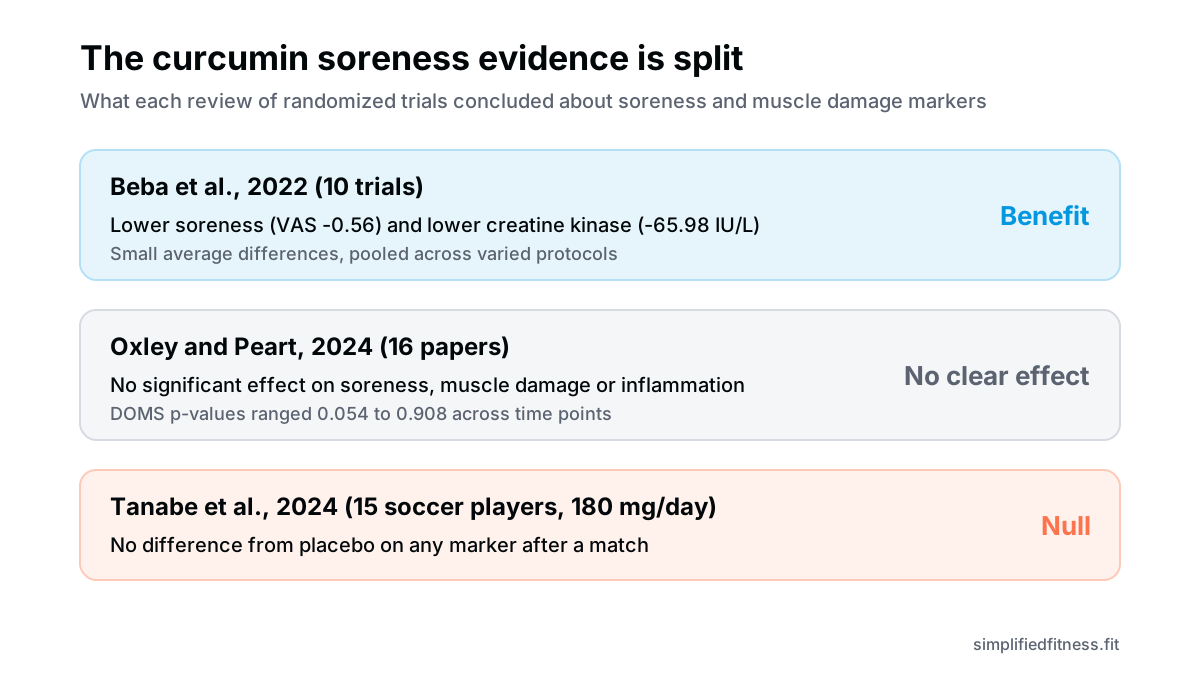
Why might they differ? Different inclusion rules, different time points, very different doses and curcumin formulations, and small studies with noisy soreness scores. A well-controlled 2024 crossover trial in 15 collegiate soccer players gave 180 mg a day starting an hour before a match. Soreness, jump performance, CRP, creatine kinase and a muscle damage marker in urine were all similar to placebo (Tanabe et al., 2024). That was a low dose, so it does not rule out an effect at higher ones.
Which brings us to dose.
Notice what that means. Feeling better and performing better on day two are not the same thing.
What a “small” soreness effect looks like in practice
Even the positive review found an average soreness drop of 0.56 on a visual analogue scale, and the pooled trials used different scales, products and exercise protocols (Beba et al., 2022). Day-to-day soreness also swings with sleep, how new the exercise is and how many eccentric reps you did. So a capsule that shaves half a point off is easy to miss and easy to imagine. That is why the tracking method below matters more than the brand you choose. If a supplement quiets soreness but you lift worse tomorrow, you did not win.
Why turmeric powder barely gets absorbed
This is the part supplement companies get right.
Curcumin has poor bioavailability because the liver and gut wall metabolise it quickly. In a human study, 2 g of curcumin alone produced serum levels that were either undetectable or very low (Shoba et al., 1998). So the haldi you stir into dal is lovely for flavour, but it is not delivering a “dose” in the way a trial capsule does.
Does piperine (black pepper) really boost curcumin absorption?
Yes, at least in that study. Piperine, the compound that gives black pepper its bite, inhibits glucuronidation, one of the routes your body uses to clear curcumin. In the same paper, healthy volunteers who took 2 g of curcumin with 20 mg of piperine had much higher serum concentrations between 15 minutes and an hour after dosing, and the authors estimated the bioavailability increase at 2000%. In rats the increase was 154% (Shoba et al., 1998).
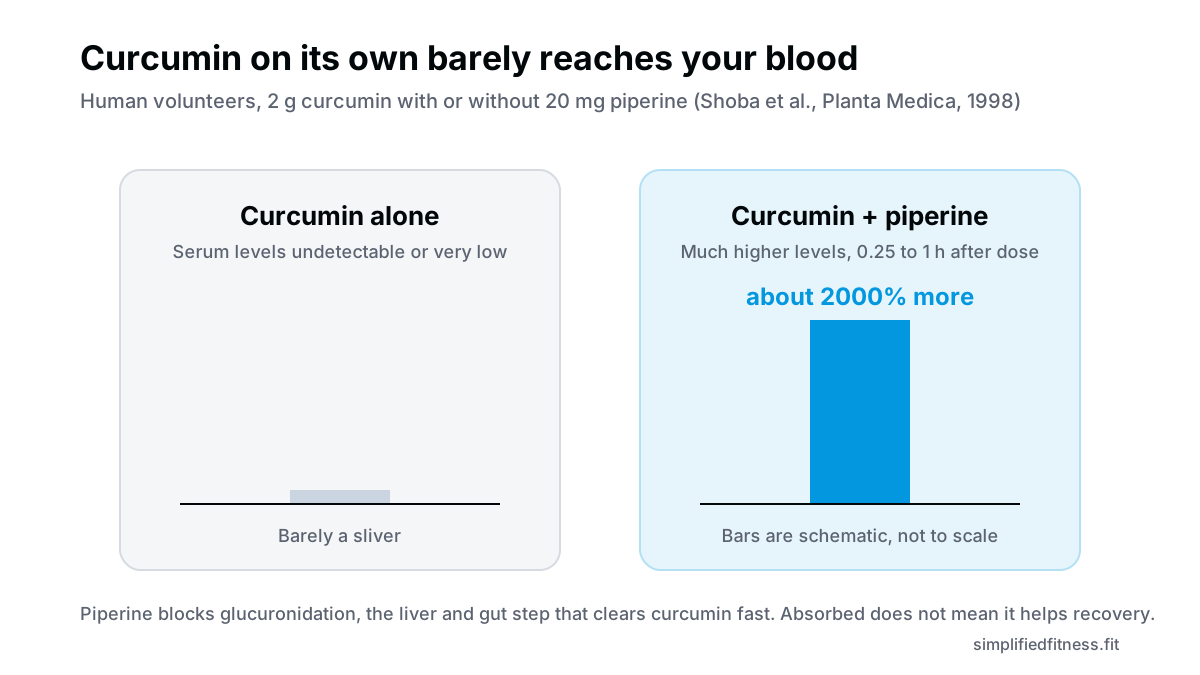
Two cautions. First, that is a short-window blood level result from one old study, not a recovery trial. Second, a pinch of black pepper in your sabzi is nowhere near 20 mg of purified piperine, so do not assume your tadka solves the problem.
Modern products use other tricks too (hydrolyzed forms, phospholipid complexes, nanoparticles). They are different formulations, and the trial doses in this article are not interchangeable between them. That is partly why the meta-analyses disagree.
Does curcumin blunt muscle growth?
This is the worry behind the “natural NSAID” idea. Heavy painkiller use around training is a debated topic, and we cover it separately in NSAIDs and muscle growth. The fear is that if you dampen inflammation too aggressively, you dampen the adaptation signal too.
What we actually have for curcumin is thin. In 66 mice doing 8 weeks of stair-climbing strength training, theracurmin did not reverse muscle hypertrophy, though it lowered tissue CCL2 and lipid peroxidation (Pontes et al., 2025). That is animal data, and we found no long-term human trial measuring muscle size with curcumin versus placebo. Our curcumin for joint pain and gains article goes deeper on the growth question; for soreness, the practical point is to watch your training numbers, not just how you feel.
Can curcumin help sore joints?
Joint pain is a different problem from day-two soreness, and the evidence comes from a different population. A 2024 umbrella review of 11 meta-analyses in knee osteoarthritis reported lower pain, stiffness and function scores with curcumin, while noting earlier reviews had disagreed (Bideshki et al., 2024). That does not automatically apply to a 25-year-old with achy elbows. We cover joints in curcumin for joint pain when lifting; also see our guide to glucosamine, MSM and other joint supplements, and get persistent pain looked at.
Is curcumin safe? The liver flag
Short answer for most people: well tolerated in trials. But there is a real, rare risk that gets skipped in the product ads.
A 2021 analysis of Italian phytovigilance reports described seven cases of acute hepatitis in Tuscany linked to turmeric supplements, all with high-bioavailability, high-dose formulations. The review of published literature added 23 more cases, and in many a positive dechallenge (liver recovered after stopping) was seen (Lombardi et al., 2021). These are case reports, so they cannot give a rate, and many patients were also on other medicines. But it is a reason not to treat strong curcumin products as candy.
See a doctor first if you have liver or gallbladder disease, take regular medication, are pregnant, or have an upcoming surgery. Stop and get checked if you notice yellow skin or eyes, dark urine, pale stools or pain under the right ribs.
How to use curcumin if you try it
If you are already sleeping, eating enough protein and not doing heroic volume, and you want to run an experiment, keep it simple.
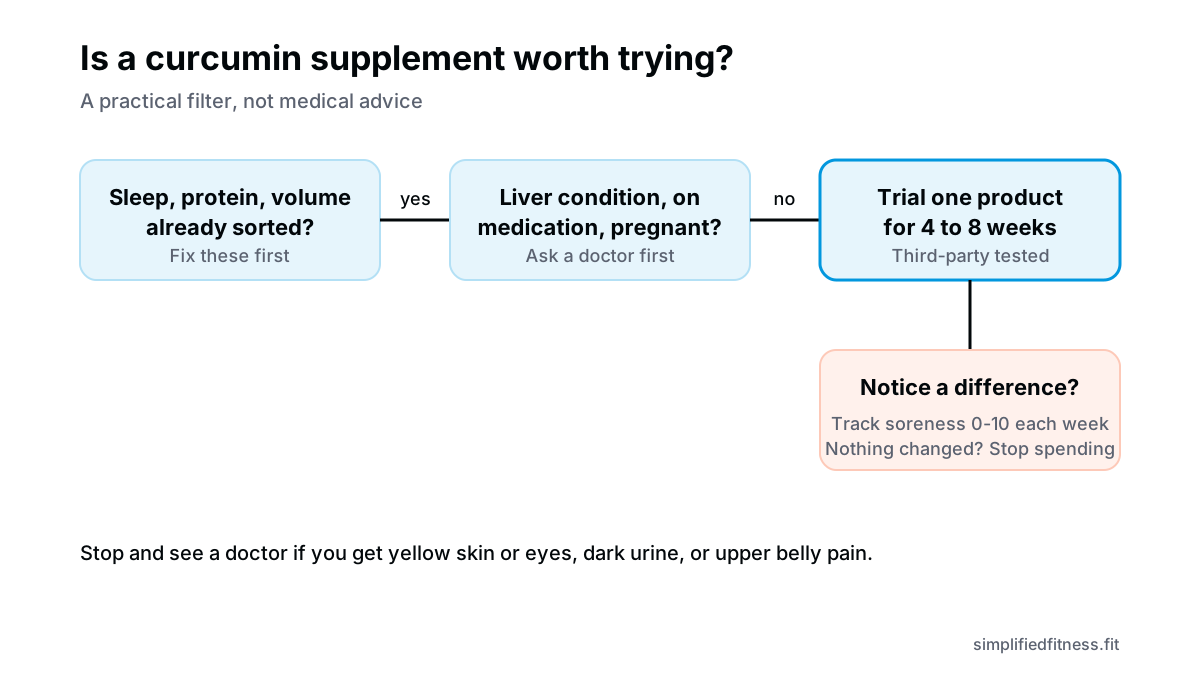
- One product, one trial. Choose a single product from a brand with third-party testing, and follow the label dose.
- Track it. Rate soreness 0-10 at 24 and 48 hours after your hardest session, and note your training numbers.
- Give it 4-8 weeks. If you cannot feel a difference, stop. You have saved money.
- Take it with a meal that has some fat. Curcumin is fat-soluble, so this is a reasonable habit, though the trials do not prove an optimal timing.
- Skip the rest of the stack if your basics are shaky. Our free training plans and the soreness guide below do more for recovery than a capsule.
Budget matters too. Quality curcumin extracts are not the cheapest items on the shelf, and the other recovery levers cost almost nothing: a consistent bedtime, dal, paneer, eggs or soya for protein, and not adding junk sets.
What to do instead (or as well)
For soreness itself, our guide on muscle soreness, heat and cold, and recovery methods covers what actually has support. If you want other dietary angles, see nutrition for muscle soreness, including tart cherry and omega-3, and remember that soreness does not equal muscle growth. Chasing less soreness is not the goal. Progressive training is.
The bottom line
Curcumin might shave a little off soreness for some people. The evidence is conflicting, effects are small, and dose and formulation vary a lot between studies. Piperine does improve absorption, but better absorption alone does not prove better recovery. There is no human evidence that curcumin ruins muscle gain, and no strong human evidence either way beyond that. The liver risk is rare but real with strong products.
Use haldi in your cooking because it is good food. Treat a curcumin capsule as an optional, tracked experiment, and only after the basics are covered.
Frequently Asked Questions
Does curcumin help with muscle soreness?
It might, a little. A 2022 meta-analysis of 10 randomized trials found curcumin lowered soreness scores by about 0.56 points on a visual scale, while a 2024 meta-analysis of 16 papers found no significant effect. If you want to test it, track your soreness for a few weeks and keep it only if you notice a clear difference.
Does turmeric work as well as curcumin supplements?
Probably not for recovery. The studies use concentrated curcumin extracts, and curcumin on its own is poorly absorbed, with very low or undetectable blood levels in volunteers taking 2 g. Haldi in your food is still a good spice, so enjoy it without expecting a recovery effect.
Does piperine really increase curcumin absorption?
Yes, in the one human pharmacokinetic study most often cited. Healthy volunteers taking 2 g of curcumin with 20 mg of piperine had much higher blood levels than with curcumin alone, an increase of about 2000%, because piperine slows how fast the liver and gut clear curcumin. Higher blood levels are not proof of better recovery, so choose a product for evidence of benefit, not just absorption claims.
Does curcumin blunt muscle growth?
There is no good human evidence that it does. A mouse study of strength training found theracurmin did not reverse muscle hypertrophy while lowering some inflammatory markers, but mice are not lifters. Until long-term human trials exist, use moderate doses and do not treat it as risk-free.
How much curcumin should I take?
The trials vary widely, from 180 mg a day in soccer players to 1,500 mg of a hydrolyzed form in a leg press study. The right amount depends on the product's formulation, so follow the label of a well-made product and do not stack several curcumin products. More is not better, because a high dose in that leg press study also coincided with slower muscle endurance recovery at 24 hours.
When should I take curcumin, before or after training?
Trials have used both daily dosing for several days and doses around the exercise bout, and no single timing has proven best. The mechanism suggests it acts on soreness and damage markers rather than on training adaptation directly. Pick a consistent time, ideally with a meal containing some fat, and judge it over weeks.
Is curcumin better than ibuprofen?
There is no head-to-head evidence in lifters, so nobody can say it is better. Ibuprofen works fast for pain, while curcumin's effects on soreness are small and inconsistent. Do not swap prescribed medication for a supplement, and see our guide on NSAIDs and muscle growth before taking painkillers around every workout.
Can curcumin damage the liver?
Rarely, but it is documented. A review of Italian cases and the published literature linked turmeric supplements, especially high-bioavailability, high-dose products, to acute hepatitis, with recovery after stopping in most cases reviewed. Stop and see a doctor if you notice yellow skin or eyes, dark urine, or pain in the upper right belly.
How big is the soreness effect from curcumin?
Small. The positive 2022 meta-analysis found an average drop of 0.56 points on a visual analogue soreness scale, and the trials it pooled used different scales and products. If you rate soreness 0 to 10, expect at most a slight change, and possibly none.
Can I take curcumin with other medications?
Ask your doctor or pharmacist first. Piperine slows how the liver and gut process curcumin, and that kind of effect on drug handling is the reason to check, especially with blood thinners, diabetes medication or anything with a narrow safe range. Bring the product label with you.
Is haldi doodh (turmeric milk) good for recovery?
It is a comforting, cheap habit, but there is no evidence it speeds muscle recovery. The curcumin content of a spoonful of haldi is small compared with supplement doses, and absorption of unformulated curcumin is poor. A glass of milk before bed does give you protein, which is the part that counts.
Who should avoid curcumin supplements?
Anyone with liver disease, gallbladder problems, or a bleeding disorder, anyone on regular medication, and anyone pregnant or breastfeeding should talk to a doctor first. Evidence in these groups is limited. If you are healthy and still unsure, a food-first approach carries less risk.
Sources & References
Every claim above is checked against peer-reviewed research (PubMed, U.S. National Library of Medicine) or guidance from established health bodies. How we fact-check.
- Beba M, et al. The effect of curcumin supplementation on delayed-onset muscle soreness, inflammation, muscle strength, and joint flexibility: A systematic review and dose-response meta-analysis of randomized controlled trials. Phytother Res. 2022. PMID: 35574627
- Oxley RA, et al. The effect of curcumin supplementation on functional strength outcomes and markers of exercise-induced muscle damage: A systematic review and meta-analysis. Nutr Health. 2024. PMID: 37408367
- Helder TA, et al. The dose-response effects of hydrolyzed curcumin on recovery, inflammation, and oxidative stress following exercise-induced muscle damage in males. Physiol Rep. 2025. PMID: 40781899
- Tanabe Y, et al. Impact of curcumin supplementation on exercise performance and muscle damage after a soccer match: a double-blind placebo-controlled cross-over study. Eur J Appl Physiol. 2024. PMID: 38436665
- Shoba G, et al. Influence of piperine on the pharmacokinetics of curcumin in animals and human volunteers. Planta Med. 1998. PMID: 9619120
- Pontes WM, et al. Inflammatory and oxidative patterns regulated by theracurmin intake in an experimental model of hypertrophic training and detraining. Int J Sport Nutr Exerc Metab. 2025. PMID: 39746352
- Bideshki MV, et al. The efficacy of curcumin in relieving osteoarthritis: A meta-analysis of meta-analyses. Phytother Res. 2024. PMID: 38576215
- Lombardi N, et al. Acute liver injury following turmeric use in Tuscany: An analysis of the Italian Phytovigilance database and systematic review of case reports. Br J Clin Pharmacol. 2021. PMID: 32656820

Umair Hazrami · Founder & Head Coach, Simplified Fitness
Umair Hazrami founded Simplified Fitness and the Simplified Lifter channel to cut through fitness noise. With 4+ years of consistent training and 10+ coaching clients, he writes every guide from the peer-reviewed research and links the sources so you can check them. Our editorial standards.
Educational content only, not medical advice. If you have a medical condition, are pregnant, or take medication, talk to a qualified doctor before changing your diet, supplements or training. Full disclaimer.
Keep reading
Supplements
Ashwagandha KSM-66 vs Sensoril: Which Extract, What Dose, and Do You Need to Cycle?
Ashwagandha KSM-66 vs Sensoril for lifters: what the strength trials show, realistic cortisol effects, liver safety and whether to cycle. Every study linked.
8 min read
Supplements
BCAAs vs EAAs: Why BCAAs Are a Waste of Money If Your Protein Is Covered
BCAA vs EAA for muscle growth: BCAAs are only 3 of the 9 essential amino acids. See what Wolfe 2017 and Jackman 2017 found and when EAAs or whey make sense.
8 min read
Supplements
Beetroot Juice for Running and Lifting: How Dietary Nitrate Works (and the Mouthwash Trap)
Does beetroot juice for running actually work? See what meta-analyses show, the 2-3 hour timing and dose, who benefits, and why mouthwash can cancel the effect.
9 min read
Supplements
Beta-Alanine Benefits: Carnosine Buffering, High-Rep Gains and Why It Makes You Tingle
Beta-alanine benefits explained: why pre-workout makes your skin tingle, how carnosine buffers acid, what dose works, and who should skip it. Studies linked.
8 min read