Sodium Loading Before Training: Plasma Volume, Aldosterone and the Pump Claim
Sodium loading before training explained: the dose the plasma volume study used, how aldosterone responds to salt intake, and why the pump claim is untested.

TL;DR. The short answer
- Salt before a workout can expand blood plasma volume, but no study has tested it on the muscle pump in lifters. The pump benefit is a reasonable idea, not a proven result.
- The key plasma volume trial gave 14 men a sodium load reported as 164 mEq (several grams of sodium, roughly 3 to 3.8 g) and found a 3.1% rise in plasma volume. That is far above the 500-1,000 mg often quoted online.
- Aldosterone, the sodium-saving hormone, rises on a low-salt diet and falls on a high-salt one. Two small trials agree on that, but disagree on whether it changes how you perform.
- The average Indian diet already contains around 9 g of salt a day, so many lifters do not need extra. A low-salt diet plus long, hot sessions is where it is most plausible.
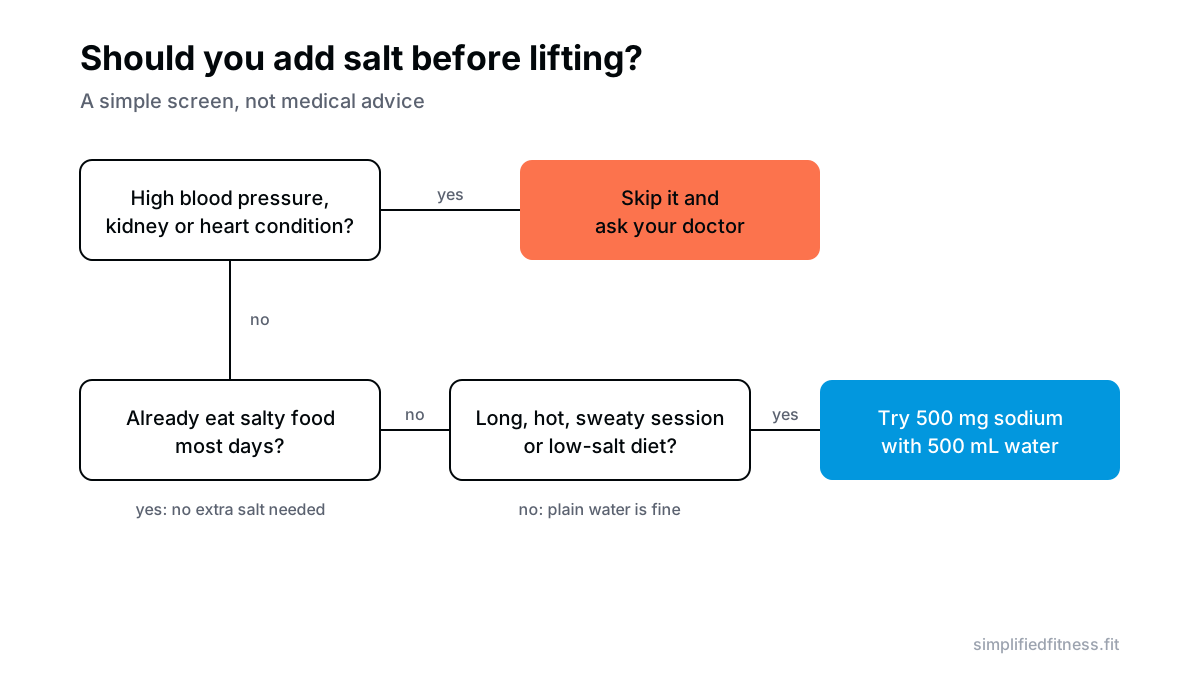
- Skip this if you have high blood pressure, kidney or heart disease, or take BP medication, and talk to your doctor first.
Part of our complete guide: The Evidence-Based Fitness Supplements Guide: What Works, What's Overhyped & What's a Waste of Money
Table of contents
Sodium loading, meaning a salty drink before training to expand blood volume, is one of the cheapest gym hacks going, and one of the most over-sold. Sodium does pull water into your bloodstream, so the idea is physiologically reasonable. But no study I could find has tested it on the muscle pump in lifters, and the doses people quote online are not the doses that were studied.
So here is the honest version. A salty drink can expand plasma volume, a few hundred milligrams of sodium is a low-risk experiment for healthy people, and it is not worth doing if your blood pressure is high. This sits inside our wider guide to evidence-based fitness supplements. This piece digs into the physiology: what the plasma volume study actually used and what aldosterone does. If you just want a simple salt-water routine to try, our pre-workout sodium strategy covers the practical protocol.
How does sodium change blood volume?
Sodium is the main positive ion in the fluid outside your cells, including blood plasma. Water follows sodium, so more sodium in the body means your body holds more water in that outside compartment. One review described sodium as a sponge that draws fluid into the extracellular space, including plasma (Luetkemeier et al., 1997).
Intravascular volume is just the amount of fluid inside your blood vessels. When it is higher, the heart has more to pump and muscle blood flow is easier to maintain. That is the logic behind the gym idea: more volume in the vessels, fuller muscles.
The same review noted that saline drunk before exercise expands plasma volume at rest and through the following bout. Its performance discussion centred on endurance exercise, not lifting.
What does the actual evidence show?
The cleanest study I can point to is a small randomized trial in 14 men (Coles and Luetkemeier, 2005). Each man drank either a near-isotonic sodium drink (a sodium load reported as 164 mEq, given as 10 mL per kg of body weight) or a sodium-free drink before cycling.
The sodium drink raised resting plasma volume by 3.1%. The sodium-free drink lowered it by 4.7%. During a 45 minute ride at 70% of maximal work rate, plasma volume was kept up better with sodium at 15 and 30 minutes but not at 45. A 15 minute time trial afterwards was about 7.8% better with sodium.
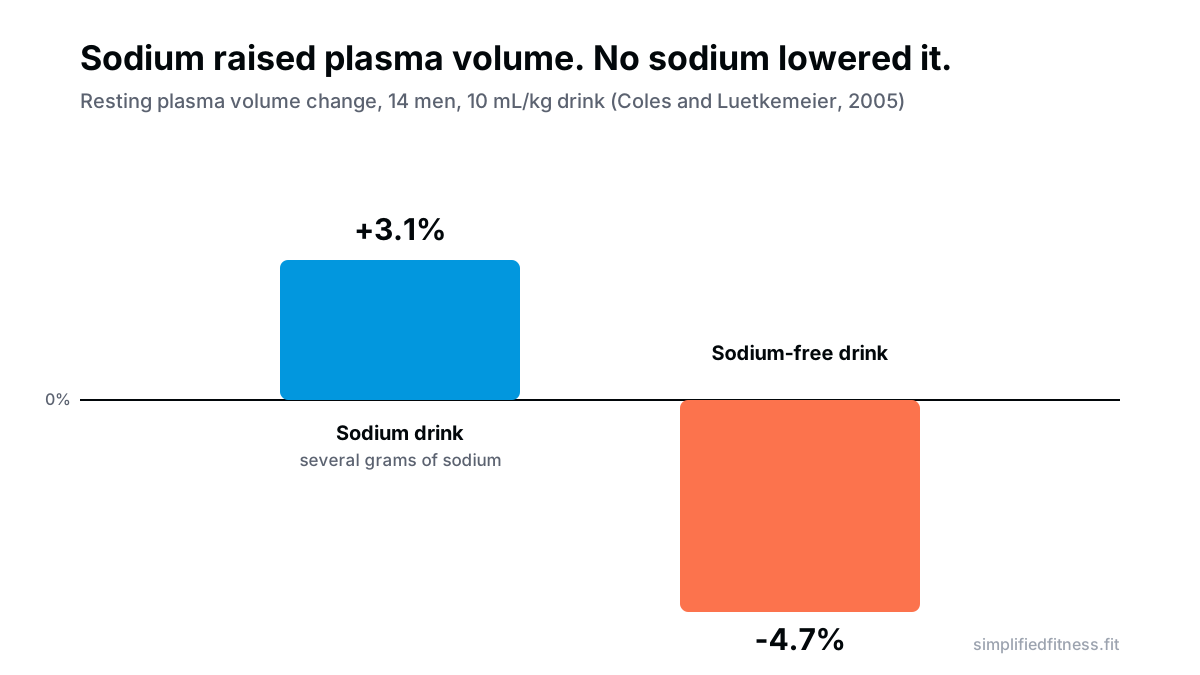
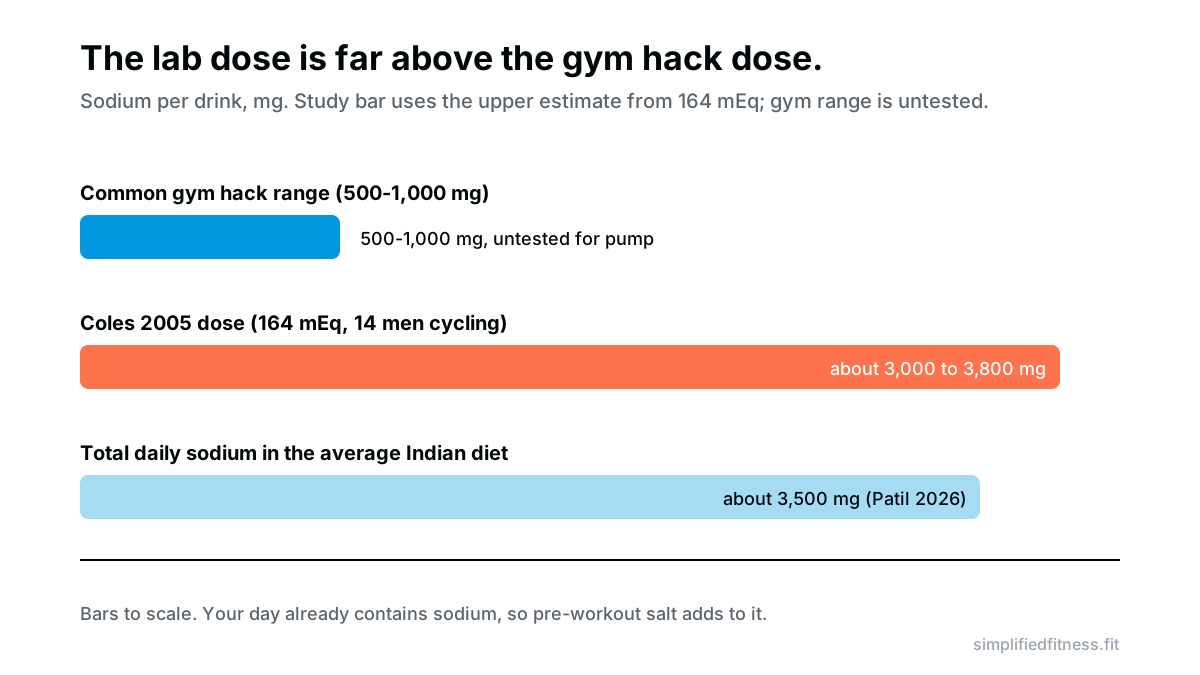
The abstract does not make clear whether 164 mEq was the total load or the concentration per litre. As a total load it works out to roughly 3.8 g of sodium. As a concentration, an 80 kg lifter drinking 800 mL would get about 3 g. Either way, it is several times the 500-1,000 mg dose that gym forums recommend.
How much sodium before lifting?
There is no tested dose for pump. The 500-1,000 mg of sodium with 500-750 mL of water, 30-45 minutes before training, is a gym convention, not a research finding. I would treat it as a cautious, low-risk range for healthy people, and I would start at the bottom of it.
For a rough translation, table salt is about 39% sodium by weight. So 1 g of salt is roughly 390 mg of sodium, and a quarter teaspoon of salt (around 1.5 g) gives about 600 mg. That is a quick estimate, not a measured dose, so a pinch more or less will not matter.
Why do some lifters feel flat on low sodium?
A lot of cutting-phase lifters report feeling flat and sluggish when they slash salt. The research is thin, so this is mostly anecdote plus plausible physiology. When sodium intake falls, aldosterone rises and your kidneys hold on to sodium.
In a randomized trial of 15 male endurance athletes, three days on a low-sodium diet gave higher pre-exercise aldosterone than a high-sodium diet, and total body water was greater after the high-sodium diet (McCubbin et al., 2019). Rectal temperature rose faster on low sodium early in a 2 hour hot session, but there was no difference in perceived exertion or heart rate.
An older study found a different picture. In 8 healthy adults, two weeks of low salt (50 mmol/day) versus normal salt (150 mmol/day) made no difference to exercise in a 35 degree room, though aldosterone stayed higher on low salt (Hargreaves et al., 1989).
So the two studies agree on the hormone and disagree about how much it matters. The samples are tiny, the subjects were not lifters, and the sessions were steady endurance exercise. A fair reading is that moderate salt restriction does not wreck performance, but a sudden crash in sodium may change how you feel and sweat.
Aldosterone and ADH: what do they do while you train?
Think of aldosterone as the sodium saver. Low intake or heavy sweat pushes it up, and it tells your kidneys to keep sodium. Antidiuretic hormone (ADH) is the water saver and tells your kidneys to hold water.
Together they protect blood volume. If you drink a lot of plain water, you dilute your sodium and the system pushes some water out. That is partly why plain water alone may leave plasma volume lower than a drink with sodium, as seen in the cycling trial above.
I would not over-engineer this. For normal gym sessions, your hormones do the job well. Sodium loading is a small nudge to a system that already works.
Does the type of salt matter?
Not for fluid balance. Pink, sea and table salt are all mostly sodium chloride, and the sodium is what drives the plasma volume effect. A 2023 lab analysis of ten gourmet salts, including Himalayan pink, found trace element levels varied by type and origin, and lead exceeded the maximum limit in all samples tested (Di Salvo et al., 2023). That is one Italian study, so it does not mean your salt is unsafe, but “more minerals” is not automatically better. Many specialty salts are also not iodised, so check the label if you rely on salt for iodine.
Who should not do this?
Sodium raises blood pressure. In a dose-response meta-analysis of 85 trials, the relationship between sodium intake and blood pressure was approximately linear, with no flattening at low or high intake. The effect was larger in people who already had higher blood pressure (Filippini et al., 2021).
That analysis looked at sodium changes over at least 4 weeks, not a single pre-workout drink. A one-off dose is different from a daily habit. Still, it is a good reason to be careful if you add salt before training every day.
Skip pre-workout salt and speak to your doctor if you have:
- High blood pressure, or you take BP medication
- Kidney disease
- Heart failure or other heart conditions
- Been told to follow a low-sodium diet
Seek medical help if you get a severe headache, chest pain, swelling in your legs or unusual breathlessness. This article is not a diagnosis or treatment plan.
Do you even need extra salt on an Indian diet?
Probably not. A 2026 meta-analysis of 83 Indian studies found a pooled mean salt intake of 9.01 g per day and sodium intake of 3.49 g per day, both above WHO-recommended limits, and a pooled 61% prevalence of high salt intake (Patil et al., 2026). Intake was higher in rural populations, males and people with hypertension.
Pickles, papad, chutneys, namkeen, packaged biscuits, restaurant gravies and instant noodles all add up. Even a plain roti-dal-sabzi day with generous table salt can reach that range.
Who might plausibly benefit? Mostly people who eat unusually low sodium (very plain home food, cutting-phase diets), train for long sessions in heat and sweat heavily, and have a healthy blood pressure. For many of them, your daily water intake and sensible meals matter more than the salt trick.
Salt water or electrolyte powder?
Sodium is the main electrolyte lost in sweat, and a pinch of salt in water supplies it for almost nothing. The ACSM position stand notes that drinks with electrolytes and carbohydrate can help over water alone under certain circumstances, and that sweat rates and sweat sodium vary a lot between people (Sawka et al., 2007). For a 60-75 minute lifting session, you rarely need more than that.
If you want a flavoured option, see our breakdown of electrolyte powders versus simple salt water. For longer, hotter sessions where carbohydrate also matters, the intra-workout carbs guide covers the fuel side.
Will salt stop cramps?
Not reliably. In a small crossover study of 13 men with a history of cramps, 9 cramped while drinking a carbohydrate-electrolyte drink with added sodium chloride and 7 cramped while dehydrated (Jung et al., 2005). The drink delayed onset in those who cramped in both trials, but the authors concluded dehydration and electrolyte loss are not the only causes.
So salt is not a cramp cure. If cramps are frequent, look at fatigue, warm-up, training load and your overall intake, and read our piece on taurine and cramp prevention.
How salt fits with other pump strategies
Salt is one lever among several. A big meal with carbohydrate, adequate fluids, a proper warm-up and training close to failure with short rests probably matter more for how full a muscle feels than any single supplement.
For the vessel-widening side, see citrulline malate versus pure L-citrulline. For another hyperhydration method with its own trade-offs, there is glycerol hyperhydration. The wider carbohydrates, fats and hydration guide explains how these pieces connect.
A cautious way to test it
- Check you are not in the “skip” group above.
- Pick a day with a normal meal 2-3 hours earlier.
- Drink about 600 mg sodium (a quarter teaspoon of salt) in 500 mL of water 30-45 minutes before training.
- Train as usual and note the pump, any nausea and any headache.
- Repeat for 3-4 sessions and compare with sessions without it.
Keep notes on what you changed. If nothing improves, stop. If you feel unwell, stop and speak to a doctor.
The bottom line
Sodium does expand plasma volume, and in one small cycling trial a sodium load of several grams helped a 15 minute time trial. It has not been shown to improve the muscle pump in lifters, and the common 500-1,000 mg dose is a convention rather than a tested protocol. Pink salt is not special.
For most people eating a typical Indian diet, you already get plenty of sodium. If your blood pressure is healthy and you eat low-salt food or sweat heavily, a small dose is a cheap experiment. If you have high blood pressure or kidney or heart disease, skip it and ask your doctor.
Frequently Asked Questions
Does salt before a workout improve your pump?
It might, but this has not been tested directly in lifters. A small trial showed that a salty drink raised plasma volume before exercise, which is the logical route to a fuller pump. Treat it as a low-cost experiment, not a guaranteed effect, and only if your blood pressure is healthy.
How much sodium should I take before lifting?
There is no tested dose for pump. A common gym range is 500-1,000 mg of sodium taken with 500 mL of water. A quarter teaspoon of table salt gives roughly 600 mg. Start at the low end and remember your meals already contain sodium.
How long before training should I take salt water?
Most people take it 30-45 minutes before training so the drink has time to empty from the stomach. The plasma volume trial measured effects right after ingestion and into a 45 minute ride, so that window is a practical guess. If it sits heavily, move it earlier.
Does sodium cause a flat muscle look?
Very low sodium intake can leave you feeling flat and sluggish for some people, but the research is thin. A 2-week trial in 8 healthy adults found low salt (50 mmol/day) did not impair exercise in the heat, even though aldosterone rose. Eating normal food with normal salt is usually enough.
What does aldosterone do during exercise?
Aldosterone is a hormone that tells your kidneys to hold on to sodium. When salt intake is low, aldosterone rises, and in a 2019 trial it was higher after a low-sodium diet and lower after a high-sodium one. Higher intake dials it down, and in the same trial sweat sodium was higher after the high-sodium diet.
Does salt water hydrate you better than plain water?
Sodium helps your body hold on to the fluid you drink instead of losing it as urine. The ACSM position stand says drinks with electrolytes can help more than water alone under certain circumstances, mainly heavy sweating and long sessions. For a normal gym session with a normal diet, plain water is fine.
Can too much salt before a workout be dangerous?
Yes, for some people. Sodium and blood pressure rise together in a roughly linear way across 85 trials, and the effect is larger in people who already have higher blood pressure. If you have hypertension or kidney or heart disease, do not do this without your doctor's advice.
Should I avoid salt to get a leaner look?
Cutting salt sharply for aesthetics is not well supported and can leave you feeling worse in training. Fluid shifts are mostly cosmetic and short term, while fat loss depends on your calorie deficit. Keep sodium steady and normal rather than swinging it up and down.
Does salt prevent muscle cramps in the gym?
Not reliably. In one small study of men with a cramp history, 69% still cramped despite drinking a carbohydrate-electrolyte drink with added salt. Cramps have several causes, including fatigue. Fix the basics first: warm-up, rest between sets and enough total fluids.
Can I use salt instead of an electrolyte powder?
For most gym sessions, yes. Sodium is the electrolyte lost in the largest amount in sweat, and a pinch of salt in water supplies it cheaply. Powders add convenience and flavour, but they are not essential.
Is salt before a workout safe in the Indian summer?
It is more plausible in heat because sweat losses are higher, but it is not automatically safe. Your normal Indian diet likely already supplies plenty of sodium, and heat does not cancel blood pressure risk. Use a small amount, drink to thirst and stop if you feel dizzy or unwell.
Sources & References
Every claim above is checked against peer-reviewed research (PubMed, U.S. National Library of Medicine) or guidance from established health bodies. How we fact-check.
- Coles MG, et al. Sodium-facilitated hypervolemia, endurance performance, and thermoregulation. Int J Sports Med. 2005. PMID: 15776333
- Luetkemeier MJ, et al. Dietary sodium and plasma volume levels with exercise. Sports Med. 1997. PMID: 9181666
- Sawka MN, et al. American College of Sports Medicine position stand. Exercise and fluid replacement. Med Sci Sports Exerc. 2007. PMID: 17277604
- Hargreaves M, et al. Exercise tolerance in the heat on low and normal salt intakes. Clin Sci (Lond). 1989. PMID: 2656071
- McCubbin AJ, et al. Impact of 3-day high and low dietary sodium intake on sodium status in response to exertional-heat stress: a double-blind randomized control trial. Eur J Appl Physiol. 2019. PMID: 31377851
- Filippini T, et al. Blood pressure effects of sodium reduction: dose-response meta-analysis of experimental studies. Circulation. 2021. PMID: 33586450
- Patil AR, et al. A systematic review and meta-analysis on the salt and sodium intake in India. Indian J Public Health. 2026. PMID: 42429521
- Di Salvo E, et al. Gourmet table salts: the mineral composition showdown. Toxics. 2023. PMID: 37624210
- Jung AP, et al. Influence of hydration and electrolyte supplementation on incidence and time to onset of exercise-associated muscle cramps. J Athl Train. 2005. PMID: 15970952

Umair Hazrami · Founder & Head Coach, Simplified Fitness
Umair Hazrami founded Simplified Fitness and the Simplified Lifter channel to cut through fitness noise. With 4+ years of consistent training and 10+ coaching clients, he writes every guide from the peer-reviewed research and links the sources so you can check them. Our editorial standards.
Educational content only, not medical advice. If you have a medical condition, are pregnant, or take medication, talk to a qualified doctor before changing your diet, supplements or training. Full disclaimer.
Keep reading
Supplements
Ashwagandha KSM-66 vs Sensoril: Which Extract, What Dose, and Do You Need to Cycle?
Ashwagandha KSM-66 vs Sensoril for lifters: what the strength trials show, realistic cortisol effects, liver safety and whether to cycle. Every study linked.
8 min read
Supplements
BCAAs vs EAAs: Why BCAAs Are a Waste of Money If Your Protein Is Covered
BCAA vs EAA for muscle growth: BCAAs are only 3 of the 9 essential amino acids. See what Wolfe 2017 and Jackman 2017 found and when EAAs or whey make sense.
8 min read
Supplements
Beetroot Juice for Running and Lifting: How Dietary Nitrate Works (and the Mouthwash Trap)
Does beetroot juice for running actually work? See what meta-analyses show, the 2-3 hour timing and dose, who benefits, and why mouthwash can cancel the effect.
9 min read

Supplements
Beta-Alanine Benefits: Carnosine Buffering, High-Rep Gains and Why It Makes You Tingle
Beta-alanine benefits explained: why pre-workout makes your skin tingle, how carnosine buffers acid, what dose works, and who should skip it. Studies linked.
8 min read