Joint Health Supplements for Lifters: What Glucosamine, MSM and UC-II Collagen Really Do
Do joint health supplements work for lifters with achy knees? We review trials on glucosamine, chondroitin, MSM and UC-II collagen, with realistic expectations.

TL;DR. The short answer
- Joint health supplements do not rebuild cartilage in any trial cited here. At best they modestly reduce pain, and the evidence is weaker than the labels suggest.
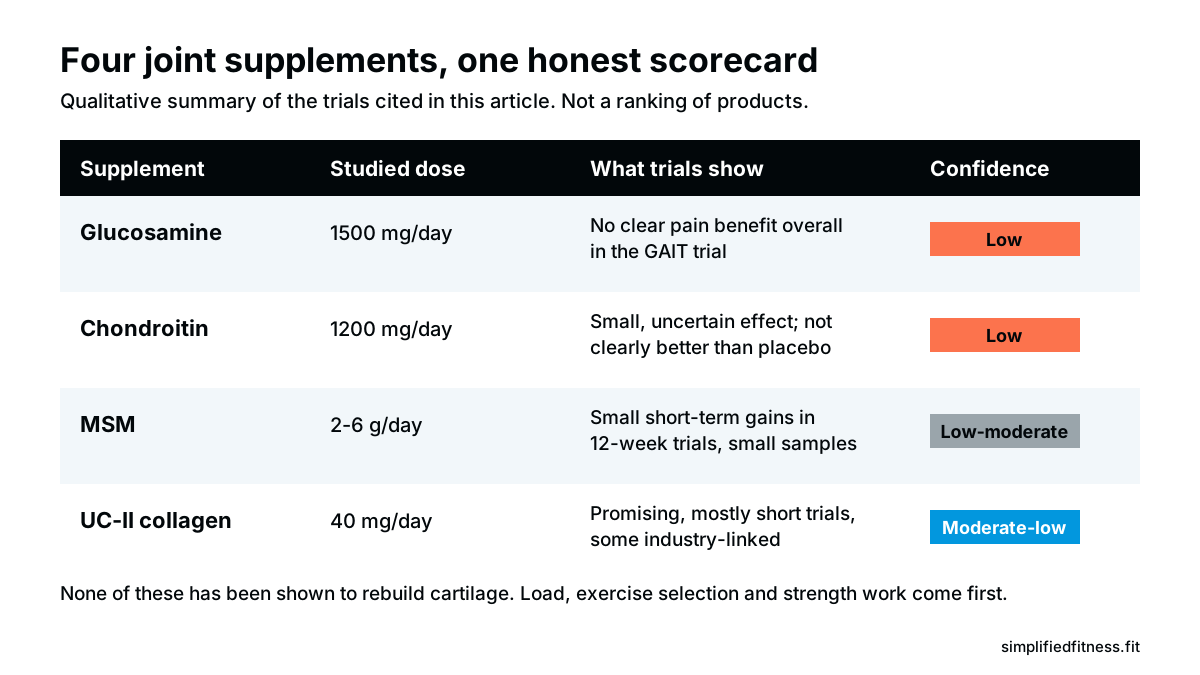
- Glucosamine and chondroitin did not beat placebo for knee pain overall in the large GAIT trial (1583 adults, 24 weeks). A pooled review also found small effects of unclear clinical importance.
- MSM and UC-II collagen look more promising in short trials (12 weeks to 120 days), but samples are small and the studies are brief, so treat them as low-cost experiments, not fixes.
- Exercise, strength training and weight management are what knee osteoarthritis guidelines rate as appropriate for everyone. Smarter load and exercise selection apply the same logic to gym knees. A supplement is an optional extra on top.
- Pain that is sharp, swollen, locking, night-time or lasting more than a few weeks needs a doctor or physio, not another tub of pills.
Part of our complete guide: The Evidence-Based Fitness Supplements Guide: What Works, What's Overhyped & What's a Waste of Money
Table of contents
Do joint health supplements work? Modestly at best. None of the trials we cite shows glucosamine, chondroitin, MSM or UC-II collagen rebuilding cartilage, and the pain relief they report is small, short-term and often from low-quality studies. If your knees ache from lifting, supplements are an optional extra, not the plan.
This article sits inside our evidence-based guide to fitness supplements. Here we go through the trials for four common joint compounds, then cover what to do about your knees that has stronger support.
Do joint health supplements rebuild cartilage?
No supplement in this article has been shown to regrow cartilage in lifters. The trials measure pain and function, usually on questionnaires, not new tissue on a scan. The one structural result in our sources was for chondroitin, and it was statistically significant but judged not clinically important (Liu et al., 2018).
Two caveats shape everything below. First, most trials enrol middle-aged or older adults with knee osteoarthritis (OA), not 25-year-olds with sore knees from squats. Second, pain is subjective and placebo response in knee trials is high (more on that below). Whenever a result comes from older adults, small samples or short follow-up, we will say so.
What does the glucosamine and chondroitin research show?
This is the biggest trial in the field. The NIH-funded GAIT study randomised 1583 adults with painful knee OA to glucosamine 1500 mg, chondroitin sulfate 1200 mg, both, celecoxib (an anti-inflammatory drug) or placebo for 24 weeks. The mean age was 59 (Clegg et al., 2006).
Placebo response was 60.1 percent (at least 20 percent less knee pain). Glucosamine was 3.9 points higher (P=0.30), chondroitin 5.3 points higher (P=0.17) and the combination 6.5 points higher (P=0.09). None reached statistical significance, while celecoxib did (10.0 points, P=0.008).
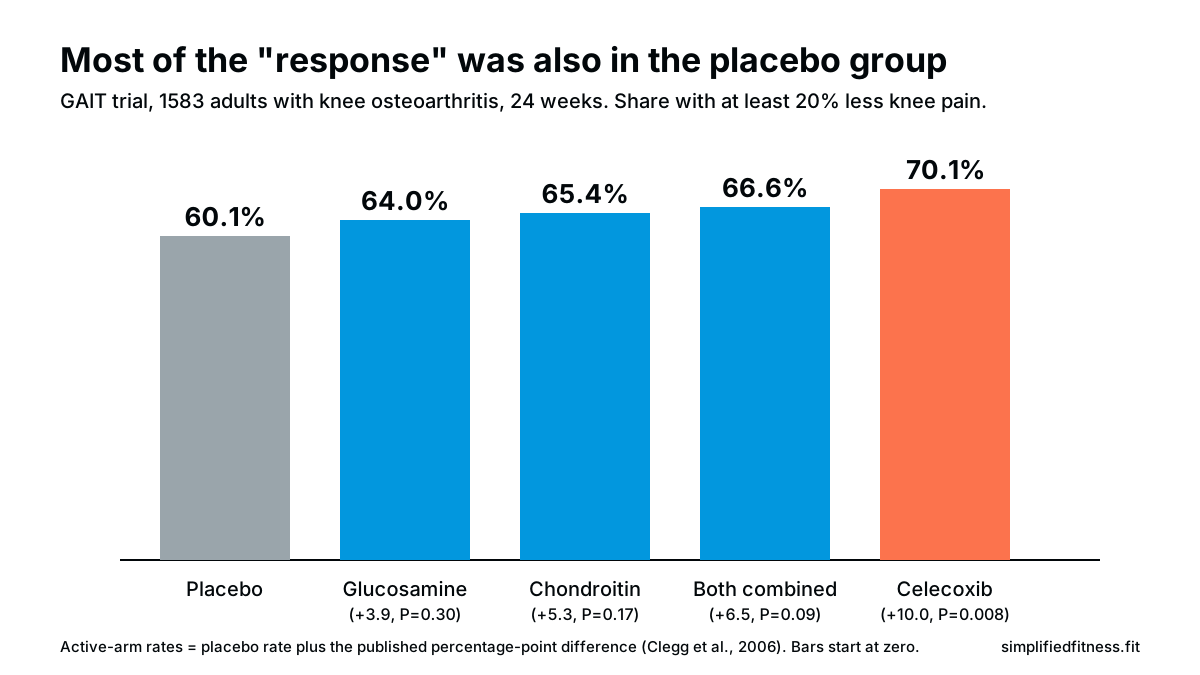
There is a twist worth knowing. In a pre-planned subgroup with moderate-to-severe pain (354 people), the combination did better: 79.2 percent versus 54.3 percent on placebo (P=0.002). The authors call this exploratory, meaning it generates a hypothesis rather than proves one.
A pooled analysis of 69 trials lands in a similar place. Glucosamine and chondroitin showed statistically significant pain improvements but of unclear clinical importance, and across all supplements, no clinically important effect on pain remained at long-term follow-up. The authors also rated the evidence quality as very low to high depending on the supplement (Liu et al., 2018).
Why do studies disagree? Different products, doses, trial quality and patient severity all matter, and the pooled review rated much of the evidence as low quality. A fair summary: if there is a benefit, it is small and may be limited to people with more severe pain.
The OARSI guidelines for knee OA classify both glucosamine and chondroitin as “uncertain” in appropriateness, not as recommended treatments (McAlindon et al., 2014).
Does MSM help sore joints?
MSM (methylsulfonylmethane) is a sulfur compound sold as an anti-inflammatory. The trials are small and short, but mostly lean positive.
- 2006 pilot, 50 adults with knee OA pain: 6 g a day for 12 weeks lowered WOMAC pain and physical function scores versus placebo. The authors call it a pilot and say long-term benefit and safety cannot be confirmed (Kim et al., 2006).
- 2011 trial, 49 adults aged 45-90: 1.125 g three times daily for 12 weeks improved WOMAC physical function and total score, but not WOMAC pain or stiffness. The authors called the improvements small, with clinical significance unknown (Debbi et al., 2011).
- 2023 trial, 88 healthy Japanese adults with mild knee pain: 2 g a day for 12 weeks gave a modest, significant difference in a knee questionnaire total score (P=0.046). Three of the four authors work for a supplement company (Toguchi et al., 2023).
Those three results are consistent in direction but not in which outcome moved. That pattern often means a small real effect, a placebo effect, or noise. In the pooled review, MSM improved pain with statistical significance but unclear clinical importance (Liu et al., 2018).
Does UC-II collagen reduce knee pain from lifting?
UC-II is undenatured type II collagen, normally studied at 40 mg a day. The proposed mechanism is oral tolerance: small amounts of intact collagen reaching the gut may nudge the immune system to calm down its attack on joint cartilage. That is a theory from mechanism and animal work, not proof in humans.
The trial closest to a lifter’s situation tested 55 healthy people who had knee pain after a standard stepmill test, giving 40 mg UC-II or placebo for 120 days. UC-II improved knee extension (81.0 versus 74.0 degrees, P=0.011) and the UC-II group exercised longer before first joint discomfort at day 120 than at baseline (P=0.019). Five UC-II users reported no pain after the test versus one on placebo (Lugo et al., 2013).
The pooled review found UC-II was one of only two supplements with clinically important pain effects at medium term (Liu et al., 2018). A 2025 review of 12 studies describes 40 mg daily as safe and effective in the short and mid term, but says larger, longer, better-powered trials are needed before routine clinical use is justified (Gupta and Maffulli, 2025).
Be cautious here. The 2013 study is small, the evidence base is mostly short trials, and at least one author of the 2025 review is affiliated with a biologics company, so read the enthusiasm with that in mind. UC-II is promising, not proven.
What should a lifter do about achy knees first?
Guidelines put the effort here, not in a pill. The OARSI knee OA guidelines list exercise, strength training, weight management, self-management and biomechanical interventions as appropriate for all individuals with knee OA (McAlindon et al., 2014). That is guidance for diagnosed OA, but the logic carries over to lifters: stronger muscles, sensible load and fewer irritating reps.
The most common mistake is to keep every lift identical, add a supplement and hope. A better order:
- Find the trigger. Is it deep knee flexion under load, leg extensions, lunges, running or stairs? Change one thing at a time.
- Lower the dose of stress, not the whole session. Trim sets, reduce load slightly or shorten range of motion on the aggravating lift. Our guide to knee-pain leg workout modifications shows how.
- Keep training the leg. Complete rest tends to leave you weaker. See joint-friendly lifting myths and whether squats are bad for your knees.
- Use pain rules. Aches that stay low and settle within a day are a different category from sharp or worsening pain. We explain this in good pain versus bad pain.
- Manage total volume. Our training volume calculator can show whether you recently jumped your weekly sets.
- Then consider a supplement, if you still want to.
Why placebo matters so much in knee pain trials
Look back at GAIT: 60.1 percent of people on placebo reported at least 20 percent less knee pain. That is not because sugar pills heal joints. Osteoarthritis pain naturally rises and falls, people enrol when they feel worst, and expecting to improve changes how pain is reported. This is regression to the mean plus expectation.
For you, the lesson is practical. If your knee feels better two weeks after starting a supplement, that tells you very little. Many knee aches also settle simply because you slept better, trained a little less or changed footwear. This is why the testing method below uses a fixed duration, one product and weekly scoring, and why a supplement that “worked for my friend” is weak evidence for your own knees.
How to test a joint supplement sensibly
If you decide to try one, run it like an experiment.
- Pick one product. Stacking three makes it impossible to know what helped.
- Use trial-style doses and durations. Examples: UC-II 40 mg a day, MSM within label directions. Run it for 8-12 weeks.
- Keep training steady. Same lifts, similar volume.
- Score pain weekly from 0 to 10 during your worst movement.
- Stop if nothing changes. Money in India is better spent on protein, dal, paneer, curd or a physio session.
- Buy third-party tested products. Contents of unregulated supplements can vary. See certifications like NSF and Informed Choice.
If you are exploring other recovery options, our guides to curcumin and turmeric and fish oil dosing cover two others people ask about. Both are separate topics with their own evidence.
When to see a doctor
Supplements are not diagnosis or treatment. Get assessed if you have:
- Sharp or worsening pain, or pain that has lasted more than a few weeks
- Visible swelling, warmth or redness around the joint
- Locking, catching or the knee giving way
- Pain at night or at rest
- A recent injury or a pop at the time
Also check with a doctor before starting any supplement if you are pregnant or breastfeeding, take blood thinners or other regular medication, or have kidney or liver conditions.
The bottom line
The evidence says joint health supplements are a small, uncertain extra. Glucosamine and chondroitin did not clearly beat placebo in the biggest trial. MSM and UC-II look better in short studies, but those studies are small and brief. None has been shown to rebuild cartilage.
Fix load, exercise selection and leg strength first. If you want a structured plan, start with our free training plans.
Frequently Asked Questions
Do joint supplements actually work?
Mostly they work modestly, if at all. A 2018 meta-analysis of 69 trials found that widely used supplements such as glucosamine and chondroitin were either ineffective or had small, arguably unimportant effects on pain, and the overall quality of evidence was very low. If you want to test one, pick a single product, track your pain for 8-12 weeks and stop if nothing changes.
Does glucosamine rebuild cartilage?
There is no good evidence that it does. The GAIT trial measured pain, not cartilage regrowth, and found glucosamine was not significantly better than placebo for reducing knee pain. Do not buy glucosamine hoping to repair a damaged joint.
Is chondroitin better than glucosamine?
Neither clearly won. In GAIT, chondroitin raised the pain response rate by 5.3 percentage points over placebo and glucosamine by 3.9, and neither difference was statistically significant. A 2018 review found chondroitin showed a statistically significant but not clinically important structural change, so the gap between them is small.
Is the glucosamine and chondroitin combination worth taking?
Probably not for most lifters. Overall the combination was 6.5 percentage points above placebo (P=0.09), which did not reach significance, though an exploratory subgroup with moderate-to-severe pain did better (79.2 percent versus 54.3 percent). If your pain is that severe, see a doctor rather than self-treating with a supplement.
What is UC-II collagen and how does it differ from collagen peptides?
UC-II is undenatured type II collagen, usually studied at 40 mg a day, and the proposed mechanism is oral tolerance, an immune effect, rather than supplying building blocks. Hydrolysed collagen peptides are broken down and used at gram-level doses, which is a different product. Check the label so you know which one you are buying.
Does UC-II help knee pain during exercise?
One 120-day trial in 55 healthy people with exercise-related knee pain found improved knee extension and a longer time to first joint discomfort versus placebo. The sample was small and the study was short, so it is encouraging rather than conclusive. If you try it, keep your training load stable so you can tell whether anything changed.
How much MSM should I take?
Trials have used very different amounts: about 3.4 g a day in a 2011 trial, 6 g a day in a 2006 pilot, and 2 g a day in a 2023 trial in mild knee pain. Results were small and sample sizes were limited. If you try it, start low, stay within label directions and ask your doctor if you take other medicines.
How long should I take a joint supplement before judging it?
Give it 8-12 weeks, since the MSM trials ran 12 weeks and the UC-II exercise trial ran 120 days. Pain naturally fluctuates, so a short test can fool you. Note your pain on a 0-10 scale weekly and drop the product if there is no clear change.
Are joint supplements safe?
In the trials cited here, adverse events were mild and similar to placebo. A 2018 meta-analysis found no safety differences between supplements and placebo apart from diacerein, which is not a common gym supplement. Still, check with a doctor if you are pregnant, on blood thinners or have a medical condition, and buy third-party tested products.
What is the best joint supplement for gym knees?
No single product has strong enough evidence to be called best. UC-II and MSM have the more encouraging short-term data, while glucosamine and chondroitin have the weakest large-trial results. A cheaper and better-supported first move is changing your squat depth, load and exercise choice.
What actually helps achy knees from lifting?
Guidelines for knee osteoarthritis list exercise, strength training, weight management, self-management and biomechanical interventions as appropriate for everyone. They help by improving muscle support and reducing load per rep. Start by trimming volume on the aggravating lift and keeping the pain at a low, stable level during sets.
When should I see a doctor about joint pain?
See a doctor for sharp pain, visible swelling, locking, giving way, pain at night or pain that persists beyond a few weeks. These can point to problems a supplement will not touch. A physio or sports doctor can diagnose the cause and give you a safe training plan.
Sources & References
Every claim above is checked against peer-reviewed research (PubMed, U.S. National Library of Medicine) or guidance from established health bodies. How we fact-check.
- Clegg DO, et al. Glucosamine, chondroitin sulfate, and the two in combination for painful knee osteoarthritis. N Engl J Med. 2006. PMID: 16495392
- Liu X, et al. Dietary supplements for treating osteoarthritis: a systematic review and meta-analysis. Br J Sports Med. 2018. PMID: 29018060
- Gupta A, et al. Undenatured type II collagen for knee osteoarthritis. Ann Med. 2025. PMID: 40253594
- Lugo JP, et al. Undenatured type II collagen (UC-II) for joint support: a randomized, double-blind, placebo-controlled study in healthy volunteers. J Int Soc Sports Nutr. 2013. PMID: 24153020
- Toguchi A, et al. Methylsulfonylmethane improves knee quality of life in participants with mild knee pain: a randomized, double-blind, placebo-controlled trial. Nutrients. 2023. PMID: 37447322
- Debbi EM, et al. Efficacy of methylsulfonylmethane supplementation on osteoarthritis of the knee: a randomized controlled study. BMC Complement Altern Med. 2011. PMID: 21708034
- Kim LS, et al. Efficacy of methylsulfonylmethane (MSM) in osteoarthritis pain of the knee: a pilot clinical trial. Osteoarthritis Cartilage. 2006. PMID: 16309928
- McAlindon TE, et al. OARSI guidelines for the non-surgical management of knee osteoarthritis. Osteoarthritis Cartilage. 2014. PMID: 24462672

Umair Hazrami · Founder & Head Coach, Simplified Fitness
Umair Hazrami founded Simplified Fitness and the Simplified Lifter channel to cut through fitness noise. With 4+ years of consistent training and 10+ coaching clients, he writes every guide from the peer-reviewed research and links the sources so you can check them. Our editorial standards.
Educational content only, not medical advice. If you have a medical condition, are pregnant, or take medication, talk to a qualified doctor before changing your diet, supplements or training. Full disclaimer.
Keep reading

Supplements
Ashwagandha KSM-66 vs Sensoril: Which Extract, What Dose, and Do You Need to Cycle?
Ashwagandha KSM-66 vs Sensoril for lifters: what the strength trials show, realistic cortisol effects, liver safety and whether to cycle. Every study linked.
8 min read
Supplements
BCAAs vs EAAs: Why BCAAs Are a Waste of Money If Your Protein Is Covered
BCAA vs EAA for muscle growth: BCAAs are only 3 of the 9 essential amino acids. See what Wolfe 2017 and Jackman 2017 found and when EAAs or whey make sense.
8 min read
Supplements
Beetroot Juice for Running and Lifting: How Dietary Nitrate Works (and the Mouthwash Trap)
Does beetroot juice for running actually work? See what meta-analyses show, the 2-3 hour timing and dose, who benefits, and why mouthwash can cancel the effect.
9 min read

Supplements
Beta-Alanine Benefits: Carnosine Buffering, High-Rep Gains and Why It Makes You Tingle
Beta-alanine benefits explained: why pre-workout makes your skin tingle, how carnosine buffers acid, what dose works, and who should skip it. Studies linked.
8 min read