Creatine, Protein Powders, Pre-Workouts and Caffeine: The Science and Safety Guide
Creatine, protein powder and caffeine decoded: what the research says on safety, dose, timing and label tricks, with Indian diet context and every study linked.
TL;DR. The short answer
- Creatine monohydrate at 3-5 g a day is the best-supported of the three. The ISSN position stand reports it safe and well tolerated in healthy people, and the only trial that measured hair directly found no effect.
- Protein powder is food, not magic. A 49-study meta-analysis found supplementation adds only a small amount of lean mass, and gains stopped improving above roughly 1.6 g/kg of total daily protein.
- Caffeine works best at about 3-6 mg/kg body weight, taken around 60 minutes before training. The strength benefit is real but small, and regular use blunts it.
- A pre-workout is mostly caffeine plus filler. Buy the ingredients you need, check for third-party testing, and skip proprietary blends.
- See a doctor first if you have kidney disease, heart rhythm problems, high blood pressure, or you are pregnant. Supplements are not a substitute for that conversation.
Table of contents
Of the three supplements most lifters buy first, creatine has the strongest case, protein powder is a convenience, and caffeine is a small but real performance boost. Creatine protein powder caffeine questions all come down to the same thing: what does the evidence support, what is marketing, and what is it worth paying for?
This guide covers all three in one place: creatine dose and safety, whey isolate versus concentrate, label tricks like amino spiking, and how to time and dose caffeine. It sits inside our wider evidence-based supplements guide, and where a topic deserves its own deep dive, we link to it.
Short version first. Then the detail.
How to take creatine: the dose, timing and form that matter
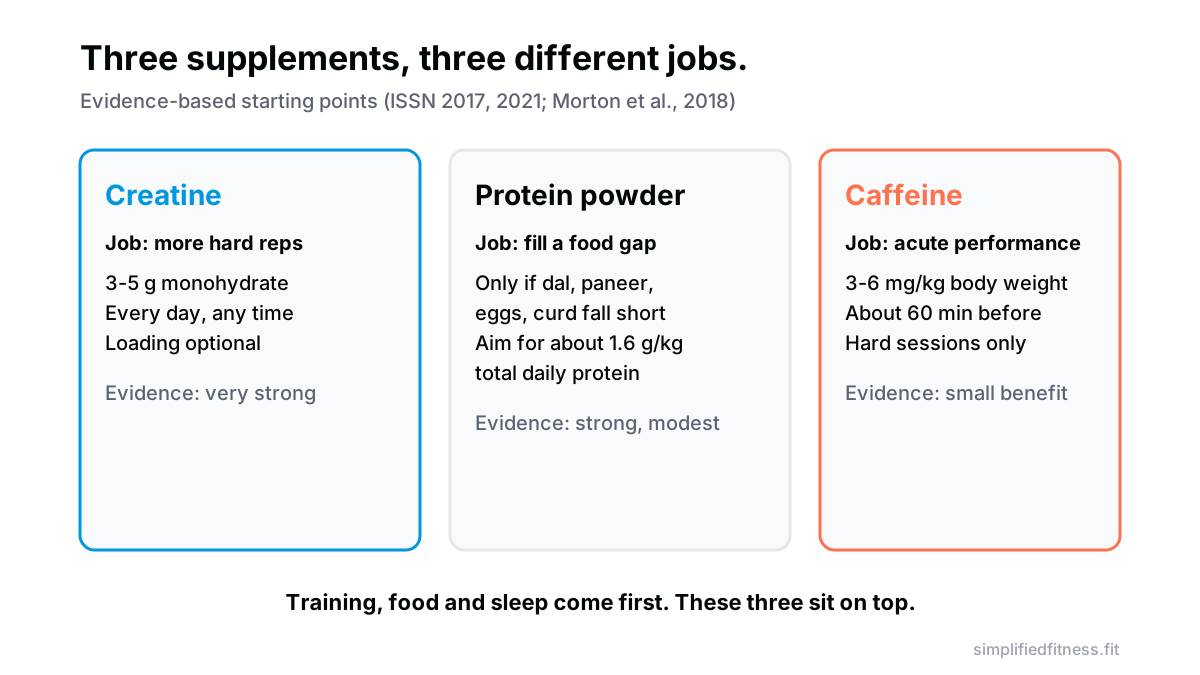
The simple protocol is 3-5 g of creatine monohydrate per day, every day. That is it.
Here is why that works. Muscle holds a small reserve of phosphocreatine that rebuilds ATP during short, heavy efforts, which is what a hard set is. Supplementing tops up that reserve, so you can squeeze out an extra rep or two at a given load. We explain the biochemistry in how creatine monohydrate works at the cellular level.
An extra rep or two sounds small. Across a few months it adds up. A 2022 meta-analysis of 35 randomized trials (1,192 participants) found creatine raised lean body mass by 0.68 kg overall, and by 1.10 kg when it was combined with resistance training. Without exercise, the effect was not significant (Delpino et al., 2022). The same analysis found males on creatine gained more (1.46 kg) than females (a non-significant 0.29 kg), though it is unclear whether that gap reflects biology, study design or both.
The ISSN position stand describes the research as showing that short- and long-term creatine use, up to 30 g a day for five years, is safe and well tolerated in healthy people (Kreider et al., 2017). You will not need anything near that amount.
Do you need to load creatine?
No. Loading is just faster.
In a classic 31-man study, about 20 g a day for 6 days raised muscle total creatine by roughly 20%, and a similar rise took about 28 days at 3 g a day. The authors concluded 3 g a day is likely to be as effective in the long term (Hultman et al., 1996). Muscle levels returned to baseline about 30 days after stopping.
So loading buys you a couple of weeks of head start. It also tends to cause stomach upset in some people. If you are not racing to a competition, skip it. The full comparison is in creatine loading versus daily maintenance.
Timing and form
Creatine works by filling a store over weeks, so the daily habit matters more than the clock. Any time of day is fine. If you want to dig into the pre versus post debate, see creatine timing: pre or post-workout.
On form, monohydrate is the version behind nearly all of the research and it is the cheapest. Buffered, HCl and other branded forms are marketed hard, but I am not aware of good evidence that they outperform it. We compare them in creatine forms compared. Get your personal number from the creatine dosage calculator.
Does creatine cause hair loss? The DHT study, audited
This is the claim that keeps more men away from creatine than any other. Let us look at where it started.
In 2009, a double-blind, placebo-controlled crossover study followed 20 college rugby players. They loaded with 25 g a day of creatine for 7 days, then took 5 g a day for 14 days. Serum DHT rose by 56% after the loading week and stayed 40% above baseline after maintenance, while testosterone did not change (van der Merwe et al., 2009).
Now the part that gets lost. The study measured hormones. It did not measure hair.
Sixteen years later, a team ran the experiment that was missing. Forty-five resistance-trained men (38 finished) took either 5 g a day of creatine or a placebo for 12 weeks. Researchers measured testosterone, free testosterone and DHT, and assessed hair with a trichogram and a FotoFinder system (density, follicular unit count, cumulative thickness). There were no group-by-time differences in any hormone or hair outcome (Lak et al., 2025). The authors called it the first study to directly assess hair follicle health after creatine and “strong evidence against” the hair loss claim.
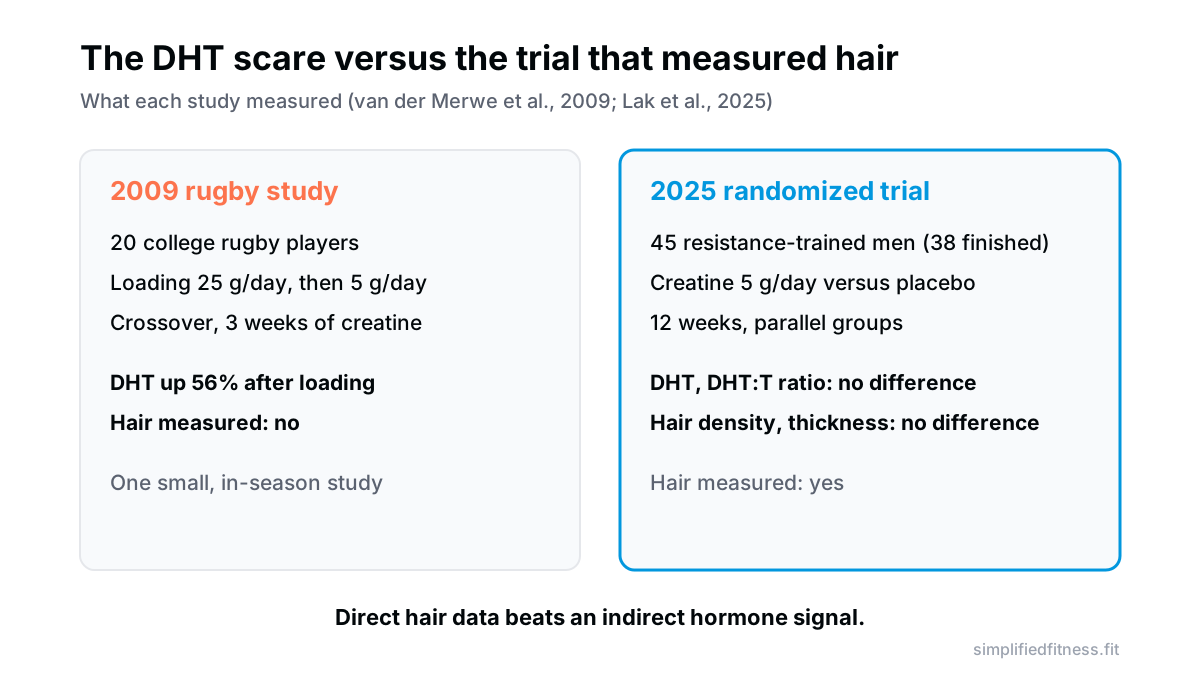
Why might the two differ? The 2009 study used a much heavier loading dose, a small sample and a competitive-season population. The 2025 trial used 5 g a day and was longer. Neither is perfect, and 38 completers is not huge. Still, direct hair outcomes with no effect carry more weight than an indirect hormone signal.
Practical takeaway: if you are genetically prone to male pattern hair loss, creatine is not the likely cause of what happens next. If you are worried about hair, see a doctor or dermatologist rather than guessing. The longer treatment is in our original creatine myths article on hair loss and kidney health.
Does creatine cause kidney damage? Creatinine versus GFR
This one starts with a lab report. Doctors estimate kidney function partly from serum creatinine. Creatine turns into creatinine in the body, so taking creatine can push the number up a little without any harm to the kidney itself.
A 2025 systematic review and meta-analysis pooled 12 studies (177 creatine participants, 263 controls) for serum creatinine. It found a small but statistically significant increase in serum creatinine, but a non-significant difference in glomerular filtration rate (GFR), the measure that reflects how well the kidneys filter. The review included 21 studies in total. The creatinine rise was significant in studies of a week or less and again in those longer than 12 weeks, but not in between. The authors concluded it is a modest effect likely due to metabolic turnover rather than kidney impairment (Naeini et al., 2025).
There is a catch. Most of those studies were short and in healthy people. They tell us a lot about healthy lifters at normal doses and almost nothing about someone with existing kidney disease. That is the group that should speak to a doctor first.
We unpack the markers in more depth in the creatine myths article, and the water-weight side of the story in creatine water weight versus bloating. If you are curious about non-muscle effects, creatine and cognitive function covers the brain research.
Do you need protein powder? What the meta-analysis says
Protein powder is food in a tub. It is not a muscle-building drug.
The cleanest evidence comes from a 2018 meta-analysis and meta-regression of 49 randomized trials with 1,863 participants. Protein supplementation during resistance training, lasting 6 weeks or more, increased fat-free mass by 0.30 kg, 1RM strength by 2.49 kg, and muscle fibre cross-sectional area. The benefit shrank with age and was larger in resistance-trained people. Supplementing beyond total protein intakes of about 1.62 g/kg/day produced no further gain in fat-free mass (Morton et al., 2018).
Read that carefully. The gain is real but small, and it flattens once your overall diet is adequate. So the first question is not “which powder?” It is “how much protein do I already eat?”
For a 70 kg lifter, 1.6 g/kg is around 112 g a day. A realistic Indian vegetarian day, with dal, curd, paneer, soya chunks and eggs if you eat them, can reach this without a tub, but it takes planning and some people find it tiring. That is where powder helps. Use the protein calculator for your number, and see the complete protein guide for hypertrophy and Indian high-protein nutrition guide for food-first strategies.
Whey protein isolate versus concentrate
Both are whey, which is the liquid left over from cheese making. The difference is how much it is filtered.
Concentrate is processed less, so it keeps a bit more lactose and fat and usually has a lower protein percentage per scoop. Isolate is filtered further, so protein per scoop is typically higher and lactose is typically lower. That is the general picture, though individual products vary, so read the label rather than trusting the name.
Which matters for muscle? For most people, neither, as long as total daily protein is right. Isolate costs more, and the extra spend mostly buys you less lactose and slightly fewer calories per gram of protein.
My practical rule:
- Dairy sits fine and budget matters: concentrate.
- Gas, cramps or loose stools after whey: try isolate, which may be easier to tolerate.
- Still bothered by dairy: see the plant options below.
- Cutting hard and counting every gram: isolate may be worth the premium.
The full lactose and value breakdown is in whey isolate versus concentrate, with a separate look at whether hydrolyzed whey is worth the cost and plant-based protein powders.
Protein powder purity: amino spiking and heavy metals
Here is the bigger risk with powders: not isolate versus concentrate, but whether the tub contains what the label says.
Amino spiking (or nitrogen spiking) means adding cheap nitrogen-rich ingredients so the lab test for protein looks higher than the real protein content. In 2025, a crowd-funded Indian study analysed 18 medical-pharmaceutical and 16 nutraceutical whey powders. The nutraceutical products averaged 75.6 g protein per 100 g and agreed closely with their labels. The pharmaceutical products averaged 29.1 g per 100 g, 83% were mislabelled by more than 5%, and taurine-based nitrogen spiking was detected in 89% of them versus 12.5% of the nutraceutical products. Cadmium, arsenic and copper outliers were also more frequent in the pharmaceutical group, and no product had detectable mercury or pesticides (Philips et al., 2025).
That is one observational study of 34 products, so do not read it as a ranking of brands or as proof that every powder is bad. It does show that label claims in the Indian market can be unreliable, and that a product’s category or price is not a guarantee.
What you can do:
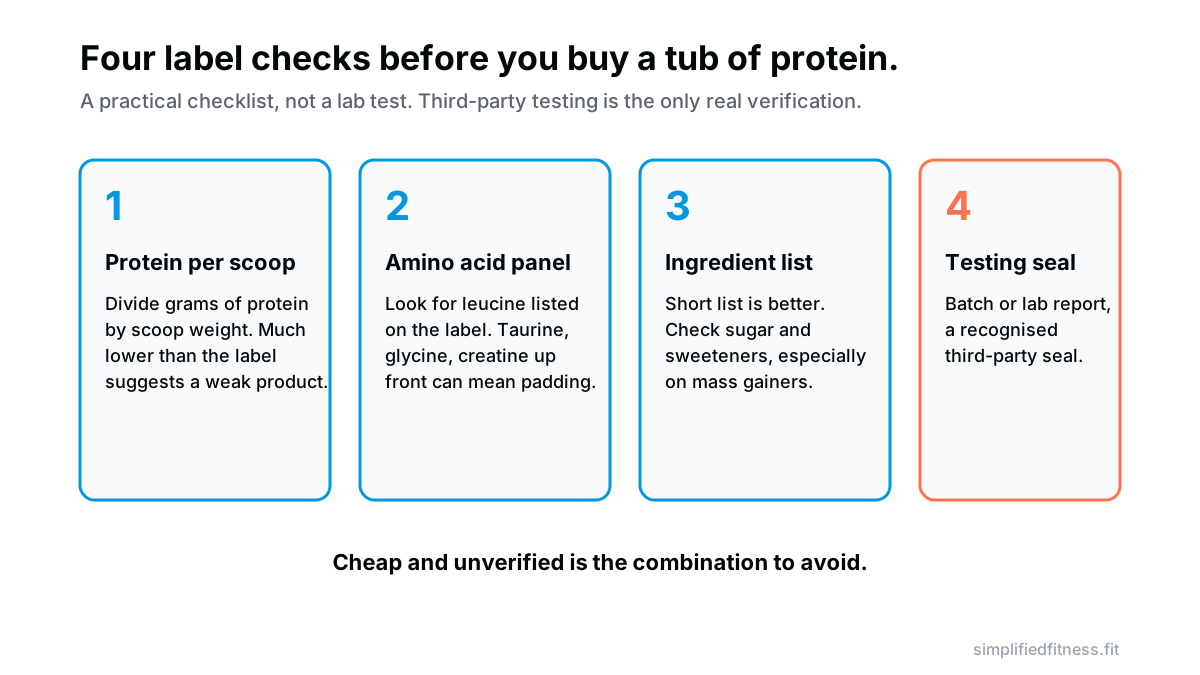
- Divide the grams of protein by scoop weight. A big gap against the claim is a flag.
- Be wary of a very low price for a “premium” label.
- Prefer products with batch test reports or a recognised third-party testing programme.
- Keep the receipt and batch number.
We go deeper in how to detect amino spiking and heavy metal contamination in protein powders.
Caffeine for lifting: what it does and how big the effect is
Caffeine blocks adenosine receptors, which lowers perceived effort and raises alertness. It is not a fat burner or a strength drug. It is a small, reliable nudge.
The best summary of the field is the ISSN position stand. It concludes caffeine acutely enhances performance in many but not all studies, with small to moderate benefits for muscular endurance, movement velocity, strength, sprinting and jumping, and the most consistent benefits for aerobic endurance. It also says caffeine appears to help both trained and untrained people (Guest et al., 2021).
For strength specifically, a meta-analysis of 10 studies on 1RM and 10 on vertical jump found small effects: strength SMD 0.20 and power SMD 0.17. The strength benefit was significant for upper body (0.21) but not lower body (0.15, with a confidence interval that crossed zero) (Grgic et al., 2018). Small effect sizes like this are real on average, but you will feel them more on some days than others.
Honest framing: caffeine takes the edge off a hard session. It will not rescue a bad plan.
Caffeine pre-workout timing and dose
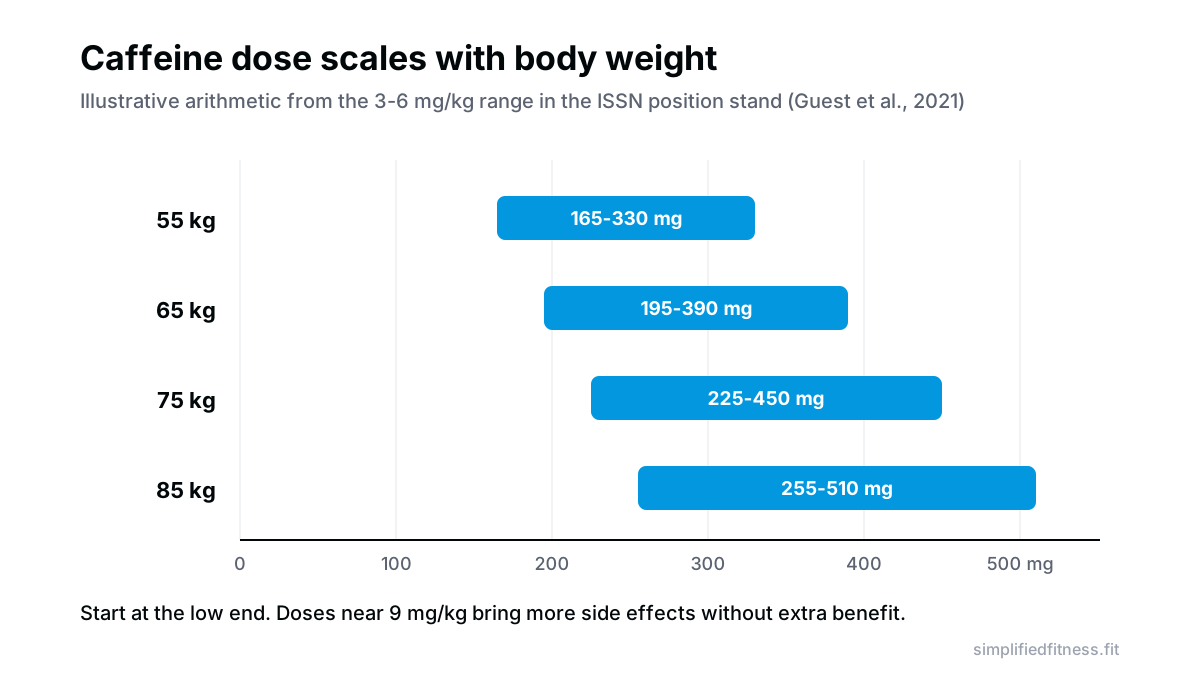
The ISSN position stand reports consistent benefit at 3-6 mg/kg body mass, with minimum effective doses possibly as low as 2 mg/kg. Very high doses like 9 mg/kg are linked with a high incidence of side effects and do not seem necessary. The most common timing used is 60 minutes before exercise, and the best timing probably depends on the source (Guest et al., 2021).
Faster sources exist. A 2026 meta-analysis of 21 studies found caffeinated chewing gum gave small benefits for dynamic strength (SMD 0.26), isometric strength (0.18) and jump height (0.16), with no significant effect on muscular endurance, when taken about 5-25 minutes before exercise (Varovic and Grgic, 2026).
How I would apply it:
- Work out 3 mg/kg for your weight. Try that first.
- Take it about 60 minutes before the session, or use gum closer to the start.
- Keep it for hard, important sessions.
- Do not train late at night on it. The ISSN notes sleep effects vary with genetics, and our afternoon caffeine cutoff guide covers the sleep side.
For the source debate, see caffeine anhydrous versus natural caffeine and the 3-6 mg/kg dosing guide. Run your own number in the caffeine dosage calculator.
Caffeine tolerance: why your pre-workout stopped working
If your morning chai, coffee and a pre-workout all stack up, your body adapts. The evidence here is thinner than for dose, and the studies are small, but it points one way.
One 4-week randomized trial gave 18 low-habitual caffeine consumers (under 75 mg a day) either caffeine (1.5-3.0 mg/kg a day) or placebo. In the caffeine group, the performance benefit seen at the start was no longer clear after 28 days, while the placebo group’s response was unchanged. The authors suggested low-habitual consumers avoid chronic supplementation to protect the acute benefit (Beaumont et al., 2017).
A separate 2025 trial in 80 inactive men found 3 mg/kg of caffeine improved a 3-km run and Wingate power at all stages, but habitual caffeine intake reduced that effect (Khodadadi et al., 2025). These are not identical populations, so conclusions are tentative. The practical takeaway is consistent though: heavy daily caffeine use blunts the boost.
Options: lower your baseline intake, save the pre-workout for your hardest days, or take a short break if it has stopped doing anything. Genetic differences in caffeine handling matter here too, covered in our caffeine sensitivity and cycling guide and the tolerance reset article.
Pre-workout supplements: what is in the tub and is it worth it?
Most pre-workouts are caffeine plus a handful of others, often at doses too low to matter, sometimes hidden inside a proprietary blend. The ISSN notes energy drinks and caffeine-containing pre-workouts have been shown to enhance performance, so the caffeine part is evidence-based (Guest et al., 2021). The rest is much less certain.
Side effects are common. In a 2019 survey of 872 regular pre-workout users, 54% reported side effects, including skin reactions, heart abnormalities and nausea, with females reporting them more often. The authors also flagged the large variability in caffeine content between products and advised not exceeding the recommended serving (Jagim et al., 2019). It is self-reported survey data, so it shows what users notice, not how often harm occurs.
A cheaper, more controllable setup: your daily creatine, a measured caffeine dose, and a carb-containing meal an hour or two before training. Learn more in pre-workout formulation and clinical dosages, non-stimulant pump pre-workouts, and pre-workout side effects and fixes.
A simple supplement schedule
Here is how the three fit into a normal day. For a fuller version, see our daily supplement protocol.
| Supplement | Dose | When | Evidence strength |
|---|---|---|---|
| Creatine monohydrate | 3-5 g | Any time, daily | Very strong |
| Protein powder | Enough to hit about 1.6 g/kg total | With a meal or after training | Strong but modest |
| Caffeine | 3-6 mg/kg (start at 3) | About 60 min before hard sessions | Small, reliable benefit |
| Pre-workout blend | Check label | Optional | Weaker beyond caffeine |
Pair this with a program that actually progresses. Our free push, pull and legs plans are a good start, because no supplement fixes a weak plan.
Who should be careful
Check with a doctor first if you:
- have kidney disease or reduced kidney function
- have a heart rhythm condition, high blood pressure or chest pain on exertion
- are pregnant or breastfeeding
- take regular medication that affects the kidneys or the heart
- struggle with anxiety or insomnia that caffeine makes worse
- compete in a tested sport (check anti-doping rules for every product)
Supplements do not diagnose or treat anything. New symptoms deserve a medical opinion.
The bottom line
Creatine monohydrate is the one worth adding first: cheap, well studied, and not linked to hair loss or kidney harm in healthy people on the evidence we have. Protein powder is a convenience that matters less once your food covers about 1.6 g/kg. Caffeine is a small, genuine edge when dosed by body weight and not overused.
Everything else on the shelf is optional. Check the label, check for third-party testing, and put your money into food, sleep and a program you can follow.
Go deeper: every guide in this topic
- Alpha-GPC and Huperzine A Pre-Workout: Do Cholinergic Nootropics Help Lifting?
- The Antioxidant Paradox: Can Vitamin C and E Pills Blunt Muscle Growth and Endurance?
- Caffeine Powder vs Coffee Before Lifting: Does the Source Really Matter?
- Caffeine Dosing for Strength and Power: 3-6 mg/kg and When to Take It
- Caffeine Tolerance and Cycling: Adenosine, Withdrawal and a Reset Without the Crash
- Calcium and Vitamin D for Lifters: Do You Need a Supplement for Strong Bones?
- CoQ10 (Ubiquinol) for Athletes: Statin Muscle Pain, Performance and Where It Falls Short
- Creatine for Cognitive Function: Does It Really Boost Memory and Focus?
- Creatine Forms Compared: Monohydrate vs HCl vs Kre-Alkalyn vs Nitrate
- Creatine Loading Phase vs Daily 3-5 g: Do You Need to Load?
- Creatine Monohydrate Mechanisms: Cellular Phosphocreatine Resynthesis and ATP Recycling
- Creatine Timing: Pre-Workout vs Post-Workout vs Anytime, Does It Matter?
- Creatine Water Weight: Muscle Fullness or Puffy Bloat? What the Research Shows
- Curcumin and Piperine for Joint Pain: Does Turmeric Help Lifters or Hurt Gains?
- Daily Supplement Protocol: What to Take Morning, Pre-Workout, Post-Workout and at Night
- Digestive Enzymes for Bodybuilding: Do Lifters Need Them to Bulk Without Bloat?
- Green Tea Extract Fat Loss Myth: What the Reviews and Liver Data Say
- Heavy Metal Contamination in Protein Powders: Lead, Cadmium, and Arsenic Testing Reality
- Does HMB Build Muscle? What the Research Says for Natural Lifters
- How to Detect Amino Spiking (Nitrogen Spiking) in Protein Powders
- Hydrolyzed Whey Protein: Is Pre-Digested Whey Worth the Higher Cost?
- Iron Deficiency and Ferritin in Athletes: Why You Feel Flat Despite Normal Hemoglobin
- L-Carnitine L-Tartrate: Does It Aid Recovery or Burn Fat?
- L-Tyrosine for Stress and Sleep Loss: Focus Aid, Not a Gym Booster
- Non-Stimulant Pump Pre-Workouts: What Works Without Caffeine
- Plant-Based Protein Powders: Do Pea and Rice Blends Really Match Whey?
- Pre-Workout Formulation Science: Clinical Dosages of Caffeine, Citrulline, and Beta-Alanine
- Pre-Workout Side Effects Fixes: Jitters, Stomach Cramps, Palpitations and the Crash
- Probiotics for Athletes: Do Lifters Need Them for Immunity and Gut Health?
- Isabgol for Weight Loss: Does Psyllium Husk Really Make a Cut Easier?
- Rhodiola Rosea for the Gym: Does This Adaptogen Really Cut Workout Fatigue?
- Best Sleep Supplements for Lifters: Melatonin, Glycine, Magnesium and Apigenin Audited
- Tart Cherry Juice for Muscle Recovery: What the Research Says (and Where Ibuprofen Fits)
- Vitamin D for Muscle Strength: Fix a Deficiency, Skip the Mega-Dose
- Whey Protein Isolate vs Concentrate: Lactose, Purity and Real Value
- The Truth About Creatine: Hair Loss, Kidney Health, and Other Myths
Frequently Asked Questions
How do I take creatine?
Take 3-5 g of creatine monohydrate once a day, every day, including rest days. Muscle stores fill gradually whether you load or not, so consistency matters more than timing. Mix it into water, milk, a shake or curd and attach it to a meal you never skip.
Does creatine cause hair loss?
Current evidence says no. A 2025 randomized trial gave resistance-trained men 5 g a day for 12 weeks and found no difference from placebo in DHT or in hair density, thickness or follicle measures. The scare came from a 2009 study that measured DHT but never looked at hair, so if you are prone to pattern baldness it will follow its own course either way.
Does creatine damage your kidneys?
In healthy people at normal doses, research has not shown kidney damage. A 2025 meta-analysis found a small rise in serum creatinine but no significant change in filtration rate (GFR). If you have kidney disease or take medicines that affect the kidneys, talk to your doctor before starting.
Why does creatine raise creatinine on blood tests?
Creatine breaks down into creatinine in your body, so taking more of it nudges the blood marker up even when the kidneys work normally. Doctors use creatinine to estimate kidney function, so the number can look worse than the reality. Tell your doctor you take creatine before any blood test.
Do I need a creatine loading phase?
No. Taking about 20 g a day for 6 days raised muscle creatine by roughly 20% in one classic study, while 3 g a day reached a similar rise over 28 days. Loading is faster, not better, and large doses can upset the stomach, so most people are fine skipping it.
Is creatine monohydrate the best form?
Monohydrate is the form behind almost all of the safety and performance research, and it is also the cheapest. Newer forms have not been shown to outperform it in the studies I am aware of. Buy a plain monohydrate with a third-party testing label.
Does creatine make you gain fat?
No. Creatine has essentially no calories, and meta-analyses show lean mass gains rather than fat gain when it is paired with resistance training. Early scale weight is mostly water stored inside muscle. Track waist and strength rather than week-one scale changes.
Is whey isolate better than whey concentrate?
Isolate is filtered further, so it usually has a higher protein percentage and less lactose, but total daily protein matters far more for muscle than the type of whey. Concentrate is cheaper and fine for most people who tolerate dairy. Choose isolate mainly if lactose upsets your stomach or you are tracking calories tightly.
Do I even need protein powder?
No, it is a convenience tool. A meta-analysis of 49 trials found protein supplements add a small extra gain in lean mass, and the benefit disappeared once total intake exceeded about 1.6 g/kg a day. If dal, eggs, paneer, curd and chicken already get you there, a tub adds little.
How much protein powder per day is enough?
Use powder only to cover the gap between your food and your daily target, which is often one scoop of about 20-25 g. Total daily protein of roughly 1.6 g/kg is where gains stopped improving in a large meta-analysis. Work out your number with the protein calculator and fill only the shortfall.
What is amino spiking?
Amino spiking, or nitrogen spiking, means adding cheap nitrogen-rich compounds like taurine or glycine so a powder tests as higher protein than it is. A 2025 analysis of whey powders sold in India detected taurine-based spiking in 89% of the pharmaceutical-brand products but 12.5% of the nutraceutical ones. Prefer brands that publish batch lab reports or carry third-party testing.
Are protein powders contaminated with heavy metals?
Some products contain heavy-metal outliers, and quality varies widely by brand. The same 2025 Indian study found cadmium, arsenic and copper outliers more often in pharmaceutical-brand powders, and no detectable mercury or pesticides in any product. Pick tested brands, and do not assume a high price guarantees purity.
How much caffeine should I take before a workout?
The ISSN position stand reports consistent benefit at 3-6 mg/kg of body weight, with effects possibly starting as low as 2 mg/kg. For a 70 kg lifter that is roughly 210-420 mg, though starting near the low end is sensible. Very high doses around 9 mg/kg mainly add side effects.
When should I take caffeine before training?
About 60 minutes before training is the most common timing in the research. Caffeinated chewing gum can work faster, with a meta-analysis describing a small benefit when taken roughly 5-25 minutes before exercise. If you are sensitive or train late, test a lower dose and watch your sleep.
Does caffeine actually improve strength?
Yes, but modestly. A meta-analysis found small improvements in upper-body strength (SMD about 0.21) and power (about 0.17), with no clear benefit for lower-body strength. Expect a slight edge on a hard day, not a transformation.
Does caffeine tolerance mean I need to cycle off?
Regular intake blunts the performance effect in the studies available. One 4-week trial in low-habitual consumers found the benefit was gone after taking low-dose caffeine daily. Save caffeine for your hardest sessions and consider keeping your daily intake modest.
Is a pre-workout worth buying?
Mostly it is caffeine in a more expensive tub. A survey of 872 regular users found over half reported side effects, and caffeine content varies between products. Plain caffeine plus creatine you already take covers most of the evidence-based benefit.
What are the side effects of pre-workout supplements?
A 2019 survey of regular users listed skin reactions, heart abnormalities and nausea among the side effects reported, and the authors warned about high caffeine and niacin intake from stacking products. Over half of respondents reported at least one side effect, and females reported them more often. Stay at or below one serving and stop if you get chest pain or palpitations.
Can I take creatine and caffeine together?
Yes, most lifters do, and there is no strong evidence of a harmful interaction at normal doses. They work through different mechanisms, creatine on muscle energy stores and caffeine on perceived effort and alertness. Keep creatine daily and caffeine for hard sessions.
Are these supplements safe for women?
Creatine and caffeine have been studied in women, and the research in some areas, such as caffeinated gum and strength, is thinner than in men. Women lifters generally use the same doses scaled to body weight. Pregnant or breastfeeding women should check with a doctor first.
What about vegetarian lifters in India?
Vegetarians eat little dietary creatine because it comes mainly from meat and fish, so supplementation is a reasonable option. Pair 3-5 g of creatine with a protein plan built on dal, curd, paneer, soya and eggs if you eat them. Use whey or a plant blend only for the leftover gap.
Who should avoid these supplements?
Anyone with kidney disease, uncontrolled high blood pressure, a heart rhythm condition, anxiety or sleep problems made worse by stimulants, or pregnancy should talk to a doctor first. Competitive athletes should check anti-doping rules for each product. A supplement is never a reason to ignore symptoms.
What order should I add supplements?
Start with sleep, food and training, then creatine, then protein powder only if food falls short, then caffeine for hard sessions. This order follows how strong the evidence is and how much each costs. Add one at a time so you can tell what causes any side effect.
Sources & References
Every claim above is checked against peer-reviewed research (PubMed, U.S. National Library of Medicine) or guidance from established health bodies. How we fact-check.
- Kreider RB, et al. International Society of Sports Nutrition position stand: safety and efficacy of creatine supplementation in exercise, sport, and medicine. J Int Soc Sports Nutr. 2017. PMID: 28615996
- van der Merwe J, et al. Three weeks of creatine monohydrate supplementation affects dihydrotestosterone to testosterone ratio in college-aged rugby players. Clin J Sport Med. 2009. PMID: 19741313
- Lak M, et al. Does creatine cause hair loss? A 12-week randomized controlled trial. J Int Soc Sports Nutr. 2025. PMID: 40265319
- Naeini EK, et al. Effect of creatine supplementation on kidney function: a systematic review and meta-analysis. BMC Nephrol. 2025. PMID: 41199218
- Delpino FM, et al. Influence of age, sex, and type of exercise on the efficacy of creatine supplementation on lean body mass: a systematic review and meta-analysis of randomized clinical trials. Nutrition. 2022. PMID: 35986981
- Hultman E, et al. Muscle creatine loading in men. J Appl Physiol. 1996. PMID: 8828669
- Morton RW, et al. A systematic review, meta-analysis and meta-regression of the effect of protein supplementation on resistance training-induced gains in muscle mass and strength in healthy adults. Br J Sports Med. 2018. PMID: 28698222
- Philips CA, et al. The Citizens Protein Project 2: the first publicly crowd-funded observational study on exhaustive analysis of popular whey protein supplements in India. Medicine (Baltimore). 2025. PMID: 41239695
- Guest NS, et al. International society of sports nutrition position stand: caffeine and exercise performance. J Int Soc Sports Nutr. 2021. PMID: 33388079
- Grgic J, et al. Effects of caffeine intake on muscle strength and power: a systematic review and meta-analysis. J Int Soc Sports Nutr. 2018. PMID: 29527137
- Varovic D, et al. Fast-acting caffeine: does caffeinated chewing gum enhance muscular strength, endurance, and jumping performance? A systematic review and meta-analysis. J Strength Cond Res. 2026. PMID: 42228847
- Beaumont R, et al. Chronic ingestion of a low dose of caffeine induces tolerance to the performance benefits of caffeine. J Sports Sci. 2017. PMID: 27762662
- Khodadadi D, et al. Habitual caffeine consumption and training status affect the ergogenicity of acute caffeine intake on exercise performance. Sports Health. 2025. PMID: 39905628
- Jagim AR, et al. Common habits, adverse events, and opinions regarding pre-workout supplement use among regular consumers. Nutrients. 2019. PMID: 31014016

Umair Hazrami · Founder & Head Coach, Simplified Fitness
Umair Hazrami founded Simplified Fitness and the Simplified Lifter channel to cut through fitness noise. With 4+ years of consistent training and 10+ coaching clients, he writes every guide from the peer-reviewed research and links the sources so you can check them. Our editorial standards.
Educational content only, not medical advice. If you have a medical condition, are pregnant, or take medication, talk to a qualified doctor before changing your diet, supplements or training. Full disclaimer.
Keep reading
Supplements
Alpha-GPC and Huperzine A Pre-Workout: Do Cholinergic Nootropics Help Lifting?
Does an alpha GPC pre workout add power or focus? See what small trials found, why Huperzine A is a poor lifting bet, and the safety flags to know first.
10 min read

Supplements
The Antioxidant Paradox: Can Vitamin C and E Pills Blunt Muscle Growth and Endurance?
Does vitamin C blunt muscle growth? See what trials of 1000 mg vitamin C plus E found for strength, hypertrophy and endurance, and when pills are worth taking.
8 min read
Supplements
Ashwagandha KSM-66 vs Sensoril: Which Extract, What Dose, and Do You Need to Cycle?
Ashwagandha KSM-66 vs Sensoril for lifters: what the strength trials show, realistic cortisol effects, liver safety and whether to cycle. Every study linked.
8 min read
Supplements
BCAAs vs EAAs: Why BCAAs Are a Waste of Money If Your Protein Is Covered
BCAA vs EAA for muscle growth: BCAAs are only 3 of the 9 essential amino acids. See what Wolfe 2017 and Jackman 2017 found and when EAAs or whey make sense.
8 min read