Best Budget Supplement Stack: What to Buy for Under $25 (₹2,000) a Month
The best budget supplement stack is plain creatine, whey only if food falls short, and vitamin D only if low. Cost-per-gram maths and ₹ examples inside.
TL;DR. The short answer
- The best budget supplement stack is plain creatine monohydrate (3-5 g a day), protein powder only if food leaves you short, and vitamin D only if you are low or get little sun. Everything else is optional.
- Raw unflavored creatine can cost a fraction of branded flavored tubs per gram (illustrative example: ₹1.4 vs ₹4.4 per gram), and the research is on plain monohydrate anyway.
- Judge protein powder by price per gram of protein (price divided by servings times grams per serving), not price per tub.
- In a 49-study meta-analysis, protein supplements added only a small amount of lean mass, and no extra gains showed up beyond about 1.62 g/kg/day of total protein.
- A realistic budget is about ₹300 a month for the bare minimum, ₹1,500-2,000 for a core stack, and the money saved is better spent on food, gym access and sleep.
Part of our complete guide: The Evidence-Based Fitness Supplements Guide: What Works, What's Overhyped & What's a Waste of Money
Table of contents
The best budget supplement stack is short: plain creatine monohydrate, protein powder only if your meals leave you short, and vitamin D only if a blood test or your lifestyle says you need it. That is roughly ₹300 to ₹2,000 a month (about $4 to $25), and the research behind each item is far stronger than the research behind most of what sits on a supplement shop shelf.
This guide is the money side of our complete evidence-based supplement guide. It shows you how to compare prices honestly, what each budget tier buys, and where the saved rupees do more good.
One note before the numbers. All prices in this article are illustrative examples I picked to show the maths. Your local prices will differ, so use the formulas with what you actually see on the pack.
What is the best budget supplement stack?
Three questions decide everything. Is the thing proven? Is it cheap per useful dose? Does your situation actually need it?
Run supplements through those and you land on a small list:
- Creatine monohydrate, 3-5 g a day. The ISSN position stand (Kreider et al., 2017) reviews a large body of evidence and concludes that short and long-term supplementation, up to 30 g/day for 5 years, was safe and well tolerated in healthy individuals. You will never need anywhere near 30 g. Our creatine dosage calculator gives you a number for your body weight.
- Protein powder, only to fill a gap. It is a convenience food, not a muscle drug.
- Vitamin D3, only if low. A deficiency is worth fixing. A normal level is not worth topping up.
- Optional extras such as omega-3 if you rarely eat fish, or coffee or tea for caffeine.
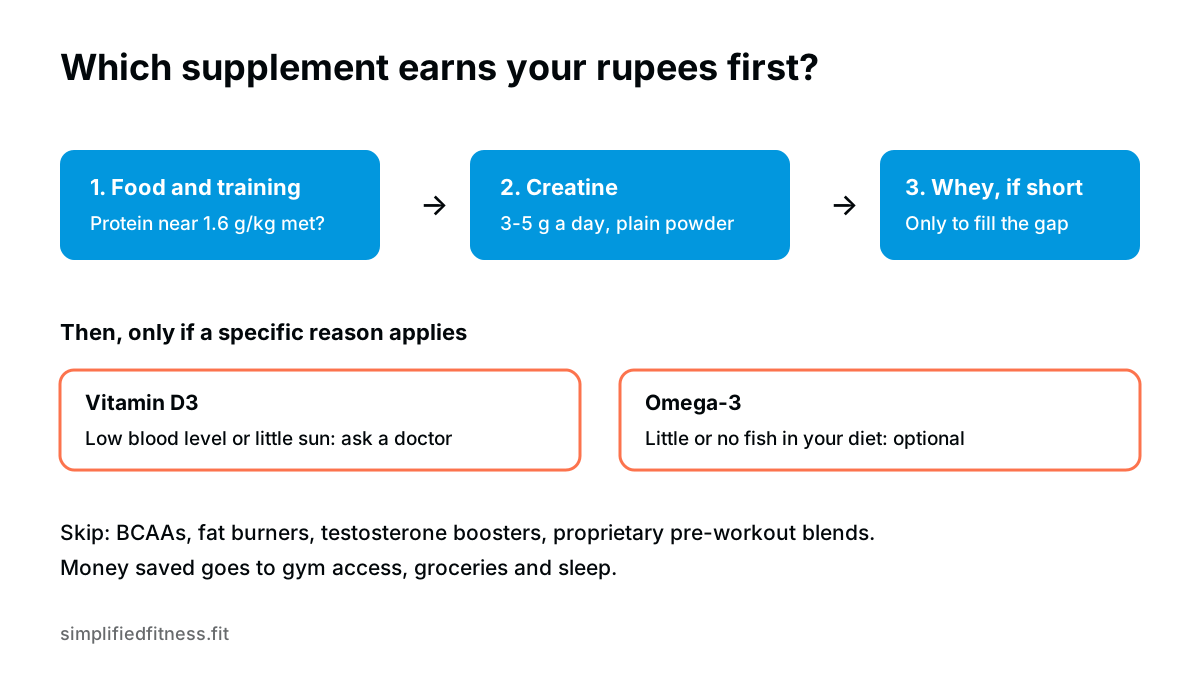
Everything else, which covers most of the retail aisle, is where budgets leak. For how we rank the rest, see the supplement hierarchy from proven to waste of money.
How much do supplements really cost per month?
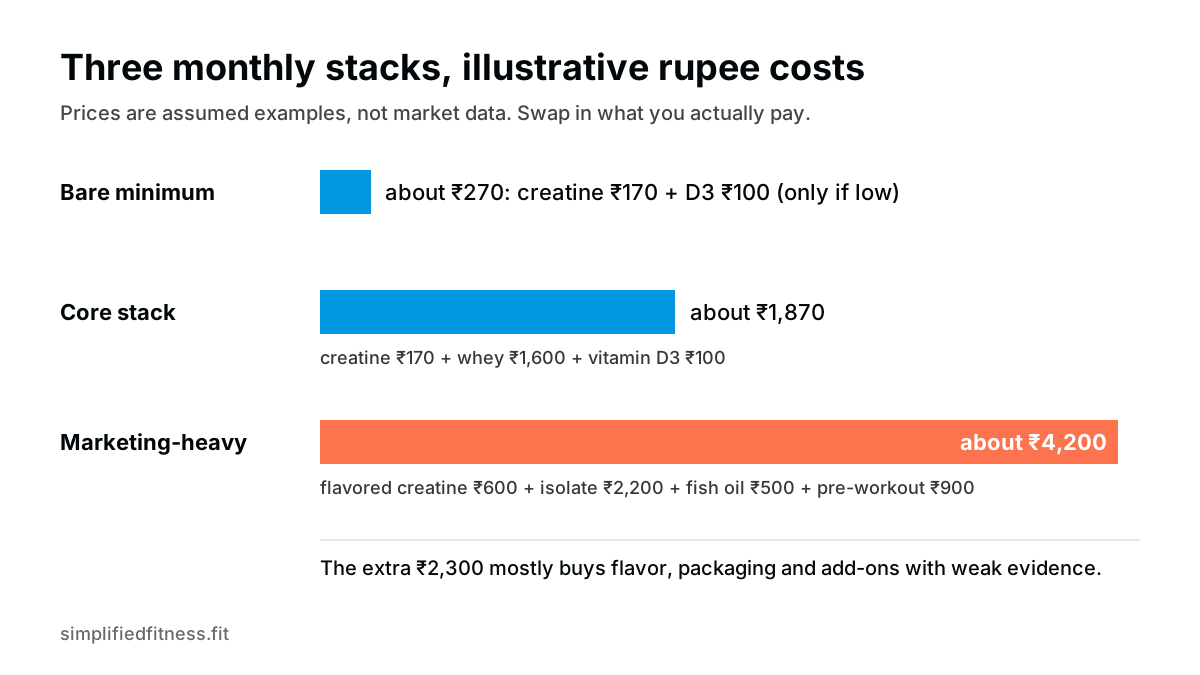
Here are three monthly stacks using assumed prices. The point is the shape, not the exact rupees.
| Stack | What is in it (illustrative) | Approx. monthly cost |
|---|---|---|
| Bare minimum (about $3) | Raw creatine ₹170, vitamin D3 ₹100 if needed | ₹270 |
| Core (about $22) | Raw creatine ₹170, one scoop of whey a day ₹1,600, vitamin D3 ₹100 | ₹1,870 |
| Marketing-heavy (about $50) | Flavored creatine ₹600, isolate ₹2,200, fish oil ₹500, pre-workout ₹900 | ₹4,200 |
In the bare minimum tier, protein comes from food: dal, curd, paneer, eggs, soya chunks, chicken or fish, depending on your diet. You do not need a tub to do this. Plenty of vegetarians hit their protein target with a plan built around dal, curd, paneer and soya, and our free diet plan shows how meals can be put together.
The core tier is what I would suggest for someone who trains four days a week, is short on protein most days, and can afford about ₹2,000. The third tier is not wrong, it is just poor value. The extra ₹2,300 or so mostly buys convenience and branding rather than anything the research supports.
Why is plain creatine so much cheaper per gram?
Because you are not paying for the extras. Creatine monohydrate is a white, nearly tasteless powder. The flavored, branded tubs add sweeteners, flavoring, a designed container and a marketing budget on top of the same molecule.
I cannot tell you the exact markup, because it varies by brand and I have no verified figure for it. What you can do is work it out yourself in 30 seconds.
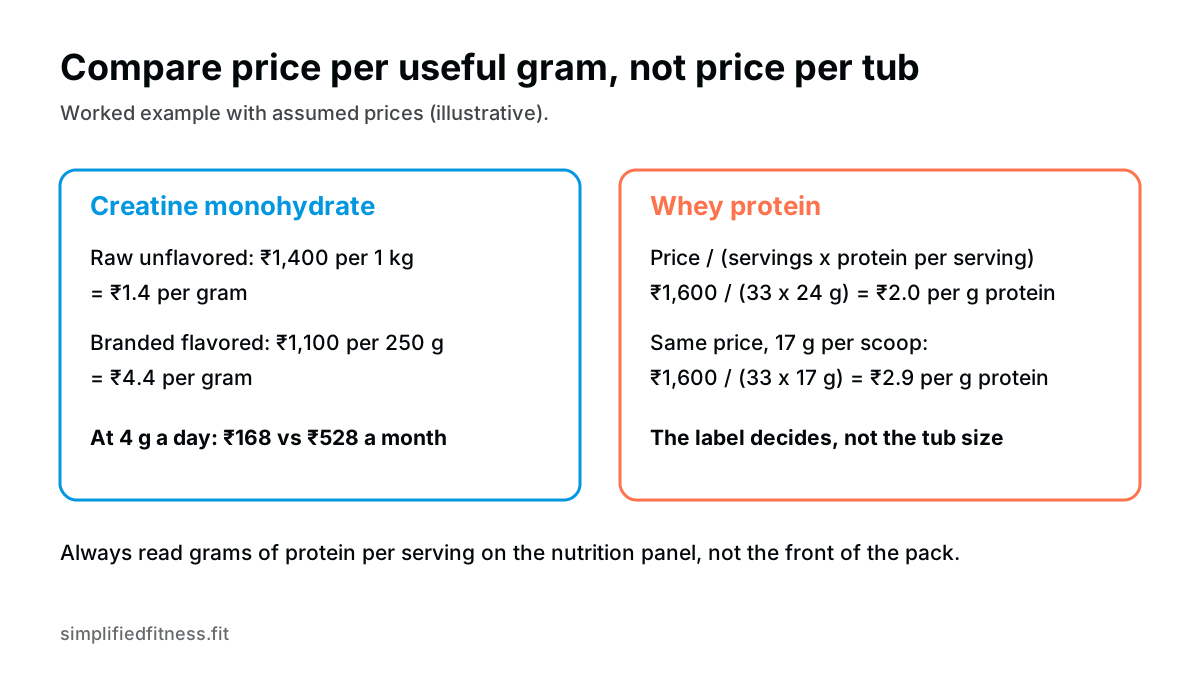
Creatine, worked example (assumed prices). Raw unflavored powder at ₹1,400 per kg is ₹1.4 per gram. A branded flavored tub at ₹1,100 for 250 g is ₹4.4 per gram. At 4 g a day, that is ₹168 versus ₹528 a month for the same active ingredient.
The research is on plain monohydrate, so paying more for another form does not buy you a proven advantage. We cover that in creatine monohydrate versus HCl, nitrate and other forms.
The one real risk of cheap powder
The risk with very cheap creatine is not that it works worse. It is whether the tub contains what it says. Prefer sellers who publish batch tests or products with independent testing, and buy from the brand’s own store or an authorized seller. Our guides to third-party supplement certifications and spotting fake protein in India go into how to check.
What is the cheapest way to get enough protein?
The cheapest protein is usually food. The next cheapest is a powder you choose by price per gram of protein.
First, how much do you need? The ISSN protein position stand (Jager et al., 2017) says 1.4-2.0 g/kg/day is sufficient for most exercising people to build and maintain muscle. A 2018 meta-analysis of 49 trials (1,863 participants) found no further gains in fat-free mass from supplemental protein beyond total intakes of about 1.62 g/kg/day (Morton et al., 2018). For a 70 kg person, 1.6 g/kg is about 112 g a day. Our protein calculator does the sum for you.
Now the part that matters for your wallet. That same meta-analysis found protein supplements raised fat-free mass by 0.30 kg on average and 1RM strength by 2.49 kg, and the effect on lean mass was larger in resistance-trained people (0.75 kg) and smaller with increasing age. So the benefit is real but modest. It tells you powder is helpful when you are short, not magic when you are not. Note too that one author reports funding from the US National Dairy Council, which supported some of the trials reviewed, so read this as one good source, not the last word.
How to calculate cost per gram of protein
The formula is simple: price / (servings x grams of protein per serving).
In the worked example, a 1 kg tub at ₹1,600 with 33 servings and 24 g of protein each costs ₹2.0 per gram of protein. A tub at the same price with 17 g of protein per scoop costs about ₹2.9 per gram. Same tub size, same price, about 40% more per gram of protein. The front of the pack never tells you that. The nutrition panel does.
Use the same formula on your own foods. Work out price per gram of protein for eggs, soya chunks, paneer, curd, dal and chicken in your city, then compare. In many Indian households, a mix of these beats powder on cost, though powder wins on convenience and calories per gram of protein.
If you are vegetarian or vegan and use powder, plant blends can work too. We compare them in pea and rice protein versus whey.
Do I need vitamin D and omega-3?
Possibly, but not by default, and the evidence is weaker than for creatine.
Vitamin D. A 2024 systematic review in elite athletes included 14 placebo-controlled trials with 482 athletes (Wyatt et al., 2024). It concluded the greatest benefit may be to aerobic endurance, anaerobic power and strength, but bone health results were conflicting and more research is needed. Those were elite athletes, many of whom may have had low baseline levels, so it does not tell us what a normal-level recreational lifter would gain.
The practical read: if you rarely get sunlight, work indoors all day, or a blood test shows a low level, a low-cost vitamin D3 supplement is reasonable. Ask a doctor for the test and the dose, because more is not better. Our vitamin D3 and K2 guide goes deeper.
Omega-3. A 2023 meta-analysis of 14 studies and 1,443 healthy adults found omega-3 supplements produced a very small increase in muscle strength (SMD 0.12) and no significant effect on muscle mass or function (Santo Andre et al., 2023). The authors noted a high overall risk of bias across the studies. For muscle, that is not a strong reason to spend. If you do not eat fish, an inexpensive supplement can still make sense for general health, which is a conversation for your doctor. See fish oil and omega-3 dosing.
Are pre-workouts worth it? Try coffee first
The best-supported ingredient in most pre-workouts is caffeine. The ISSN position stand on caffeine (Guest et al., 2021) says caffeine improves exercise performance acutely in many but not all studies, with consistent benefits at 3-6 mg/kg body mass.
So the cheap move is to take caffeine from tea or coffee about an hour before training. Cup sizes and strengths vary a lot, so check roughly how much you are getting. The same position stand notes that some people get worse sleep or anxiety from caffeine, and that very high doses (around 9 mg/kg) bring a high rate of side effects without being needed for a benefit. If you train in the evening, test whether it costs you sleep, and check with a doctor first if you have a heart condition, high blood pressure or are pregnant.
The bigger trap is the proprietary blend, where the label lists a total weight but not the dose of each ingredient. You cannot judge value when you cannot see the doses. Our guide on decoding proprietary blends shows how to spot it.
What should I skip to save money?
Here are the usual money leaks and why they are on the skip list:
- BCAAs when your daily protein is already adequate, because the protein you eat already contains them.
- Fat burners and testosterone boosters, which are mostly stimulants or under-researched herbs. We examine them in commercial fat burners exposed.
- Multi-ingredient “stacks” where every item is underdosed.
- Extra flavored versions of things you can buy plain.
None of this means these products are always useless. It means the evidence does not justify the cost compared with food, training and sleep.
Where should the money you save actually go?
If you spend ₹2,000 on supplements and skip the groceries, the maths is backward. Supplements add small increments. These three do more:
- Gym access. A consistent membership, or even a basic home setup, beats any tub. If you need a plan, start with our free workout plans.
- Protein-rich groceries. Eggs, dal, curd, paneer, soya, chicken or fish. The most common mistake here is buying a flashy powder while the dinner plate is still low in protein.
- Sleep. It is free, and I would rather see you gain an extra hour of it than a third supplement.
When to talk to a doctor
Check with a doctor before starting any supplement if you have kidney disease, are pregnant or breastfeeding, take regular medication, or have a medical condition. Get vitamin D tested rather than guessing, and do not self-prescribe high doses. Supplements are not a treatment for any condition, and this article is not medical advice.
Evidence limits to keep in mind
The creatine safety data comes from healthy individuals and a range of patient groups, and the ISSN position stand is a narrative review rather than a single trial. The protein meta-analysis covers supplementation trials of at least 6 weeks, and its effects are small on average. The vitamin D evidence is from elite athletes and small trials. The omega-3 meta-analysis rated the overall risk of bias as high. None of this overturns the practical advice, but it is a reason to stay modest about what any supplement can do.
A simple monthly budget plan
- Track your protein for three days using your normal meals.
- If you reach roughly 1.6 g/kg/day, skip protein powder.
- Buy 500 g to 1 kg of raw creatine monohydrate and take 3-5 g daily.
- Get a vitamin D test if sun exposure is low, and act on the result with your doctor.
- Redirect the rest of your supplement budget to food, gym access and sleep.
Review once a quarter. If a supplement is not doing a specific job for you, cancel it.
Frequently Asked Questions
What is the best budget supplement stack for a beginner?
Plain creatine monohydrate is the best first purchase, with protein powder added only if your meals fall short of your protein target. Creatine is one of the most researched sport supplements and costs very little per day at 3-5 g. Use our creatine dosage calculator, then stop buying until a specific gap shows up.
Can I build muscle without any supplements?
Yes. Supplements add small increments on top of training, enough calories and enough protein from food. A meta-analysis of 49 trials found protein supplements raised fat-free mass by only about 0.30 kg on average, which tells you how much the basics matter more. Put your money into food and consistent training first.
How much should I spend on supplements per month?
For most people, roughly ₹300 to ₹2,000 a month covers everything with real evidence behind it. The low end is creatine plus vitamin D if needed, and the high end adds one daily serving of whey. If your supplement bill passes your grocery spend on protein foods, it is time to rethink.
Is cheap unflavored creatine as good as expensive branded creatine?
Yes, as long as it is genuine creatine monohydrate. The research, including the ISSN position stand, is on monohydrate itself, and flavors, tub design and extra ingredients do not add benefit. Choose a seller with third-party testing or a verifiable batch report, because the risk with very cheap powder is authenticity, not chemistry.
What is the cheapest way to take creatine?
Buy raw creatine monohydrate in a 500 g or 1 kg pouch and take 3-5 g a day with water or tea. A flat teaspoon is often close to 3-5 g, but weigh it once on a kitchen scale to check. Bulk powder lowers the per-gram price and removes the flavor markup.
Do I need protein powder if I eat dal, paneer and eggs?
Not necessarily. If you already reach roughly 1.6 g/kg/day of protein from food, a powder adds convenience more than muscle. The ISSN position stand says whole foods can meet needs, and powder is a practical way to fill gaps. Track your protein for a few days and buy powder only for the shortfall.
How do I calculate the cost per gram of protein in a whey tub?
Divide the tub price by the number of servings, then divide that by grams of protein per serving. Two tubs at the same price can differ by 40% or more in protein cost if one gives 17 g per scoop and the other 24 g. Read the nutrition panel, not the front label.
Is whey isolate worth the extra money?
For most people, no. Isolate is more filtered and usually lower in lactose, which matters mainly if concentrate upsets your stomach. Total daily protein drives results far more than the whey type, so start with concentrate and upgrade only if you have digestive trouble.
Do I need vitamin D supplements?
Only if you are low or have limited sun exposure, and the way to know is a blood test. A 2024 systematic review in elite athletes found possible benefits for endurance, power and strength, but it was 14 small trials (482 athletes), so the evidence is moderate at best. Ask a doctor before starting, especially at higher doses.
Is fish oil worth buying on a budget?
It is optional rather than essential for muscle. A meta-analysis of 14 studies in healthy adults found omega-3 gave a very small strength increase and no change in muscle mass or function. If you eat fish or other omega-3 sources a few times a week, skip it and spend elsewhere.
Are pre-workouts worth the money?
Mostly no. The ingredient with solid evidence is caffeine, shown in the ISSN position stand to improve performance at 3-6 mg/kg in many but not all studies. Many pre-workouts hide doses behind proprietary blends, so black coffee or tea gets you the same active ingredient for less.
What supplements should I skip completely to save money?
Skip fat burners, testosterone boosters, BCAAs when protein is adequate, and proprietary-blend products. They either have weak evidence or hide doses, so you cannot tell what you are buying. Use the saved money for groceries, gym access or a better mattress.
Where should I spend the money I save on supplements?
On things that move results more: a gym you will actually attend, protein-rich groceries, and sleep. Supplements tweak the margin, while those three form the base of progress. A month of eggs, dal, curd and paneer usually does more for you than a third tub of powder.
Are Indian supplement prices on marketplaces trustworthy?
Be careful, because counterfeits and relabelled products are a real risk on any marketplace. Buy from the brand's own store or an authorized seller, check the batch number, and prefer products with independent lab testing. If a price looks far below everyone else, assume there is a reason.
Sources & References
Every claim above is checked against peer-reviewed research (PubMed, U.S. National Library of Medicine) or guidance from established health bodies. How we fact-check.
- Kreider RB, et al. International Society of Sports Nutrition position stand: safety and efficacy of creatine supplementation in exercise, sport, and medicine. J Int Soc Sports Nutr. 2017. PMID: 28615996
- Morton RW, et al. A systematic review, meta-analysis and meta-regression of the effect of protein supplementation on resistance training-induced gains in muscle mass and strength in healthy adults. Br J Sports Med. 2018. PMID: 28698222
- Guest NS, et al. International society of sports nutrition position stand: caffeine and exercise performance. J Int Soc Sports Nutr. 2021. PMID: 33388079
- Jager R, et al. International Society of Sports Nutrition Position Stand: protein and exercise. J Int Soc Sports Nutr. 2017. PMID: 28642676
- Wyatt PB, et al. Effects of Vitamin D Supplementation in Elite Athletes: A Systematic Review. Orthop J Sports Med. 2024. PMID: 38188620
- Santo Andre HC, et al. The Influence of n-3PUFA Supplementation on Muscle Strength, Mass, and Function: A Systematic Review and Meta-Analysis. Adv Nutr. 2023. PMID: 36811583

Umair Hazrami · Founder & Head Coach, Simplified Fitness
Umair Hazrami founded Simplified Fitness and the Simplified Lifter channel to cut through fitness noise. With 4+ years of consistent training and 10+ coaching clients, he writes every guide from the peer-reviewed research and links the sources so you can check them. Our editorial standards.
Educational content only, not medical advice. If you have a medical condition, are pregnant, or take medication, talk to a qualified doctor before changing your diet, supplements or training. Full disclaimer.
Keep reading

Supplements
Ashwagandha KSM-66 vs Sensoril: Which Extract, What Dose, and Do You Need to Cycle?
Ashwagandha KSM-66 vs Sensoril for lifters: what the strength trials show, realistic cortisol effects, liver safety and whether to cycle. Every study linked.
8 min read
Supplements
BCAAs vs EAAs: Why BCAAs Are a Waste of Money If Your Protein Is Covered
BCAA vs EAA for muscle growth: BCAAs are only 3 of the 9 essential amino acids. See what Wolfe 2017 and Jackman 2017 found and when EAAs or whey make sense.
8 min read
Supplements
Beetroot Juice for Running and Lifting: How Dietary Nitrate Works (and the Mouthwash Trap)
Does beetroot juice for running actually work? See what meta-analyses show, the 2-3 hour timing and dose, who benefits, and why mouthwash can cancel the effect.
9 min read

Supplements
Beta-Alanine Benefits: Carnosine Buffering, High-Rep Gains and Why It Makes You Tingle
Beta-alanine benefits explained: why pre-workout makes your skin tingle, how carnosine buffers acid, what dose works, and who should skip it. Studies linked.
8 min read