FSSAI Supplement Regulations: How to Spot Fake Protein in India
FSSAI supplement regulations explained for lifters: what labels must show, how to check fake protein powder in India, and what a 2025 lab study found in tubs.
TL;DR. The short answer
- FSSAI is the body that regulates health supplements and nutraceuticals in India. Its rules cover approvals, labeling and claims, but the rules only protect you if the product in your hand is genuine and actually follows them.
- A 2025 lab study of 34 whey powders sold in India found large differences by product type: nutraceutical powders averaged 75.6 g protein per 100 g, while medical-pharmaceutical powders averaged 29.1 g and 83% were mislabeled by more than 5%.
- No single check proves a tub is genuine. Combine a trusted seller, an intact seal, a batch code check on the brand's own site, a visible FSSAI licence number, and a price that makes sense.
- Counterfeiting, weak products and banned-substance contamination are three separate problems. Third-party batch testing is the best protection for tested athletes.
- Eating enough dal, paneer, curd, eggs and soya covers most of your protein, so skipping a doubtful tub costs you very little.
Part of our complete guide: The Evidence-Based Fitness Supplements Guide: What Works, What's Overhyped & What's a Waste of Money
Table of contents
FSSAI supplement regulations set the rules for what a health supplement or nutraceutical can claim and how it must be labeled in India, but the rules only help if the tub in your hand is genuine. Checking a tub means combining a few things: a trusted seller, an intact seal, a batch code you can verify, a visible FSSAI licence number and a price that makes sense. No single check is foolproof, and counterfeits copy the easy ones first.
This is a consumer-protection guide, not legal advice. It sits inside our complete guide to evidence-based fitness supplements, and it focuses on the Indian market. Global third-party testing is covered separately in our explainer on Informed-Choice and NSF Certified for Sport.
One honest note up front. FSSAI’s own pages would not load while I was preparing this article, so I have not quoted exact ingredient limits or notification numbers. Those change. Where a rule matters to you, I point you to what to look for and tell you to confirm it on the official site.
What do FSSAI supplement regulations actually cover?
FSSAI, the Food Safety and Standards Authority of India, regulates health supplements and nutraceuticals as a category of food. A 2023 review of nutraceuticals in India describes the authority as solely responsible for approvals, promotions and labeling standards for these products. The same review says regulations are becoming stricter and calls for tighter monitoring of substandard and counterfeit products.
In practice, for a gym-goer, the rules touch three things:
- What may go in the product. Permitted ingredients and upper limits for vitamins and minerals are set by notification. They are not the same as the figures printed on US or EU labels, so an imported tub can list doses that are fine abroad and not designed around Indian rules.
- What the label must show. Typical declarations include ingredient list, nutrition information, batch and manufacturing dates, the licence or registration number, and the vegetarian or non-vegetarian symbol. Products with caffeine and certain other ingredients are expected to carry advisory statements. Confirm the current list on the FSSAI site.
- What the brand may claim. Claims about disease, or about dramatic results, are exactly what regulators tighten on.
Fake, weak or contaminated: three different problems
People say “fake protein” for several things. They have different causes, so they have different fixes.
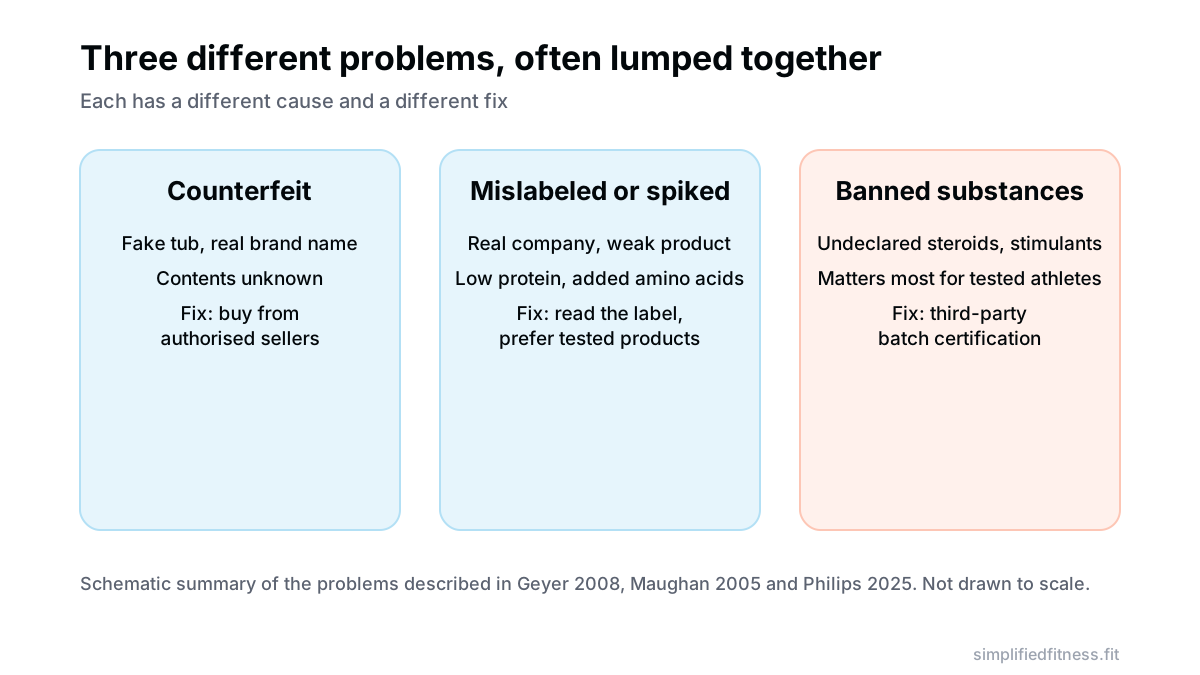
Counterfeit means a copy of a real brand, often repacked in an unorganised warehouse. You cannot tell what is inside, because nobody accountable made it.
Mislabeled or spiked means a real company sells a product that does not match its label, for example less protein than claimed.
Contaminated with banned substances is mainly an issue for athletes who are drug tested, though it is also a health issue for everyone.
What did a lab find inside whey powders sold in India?
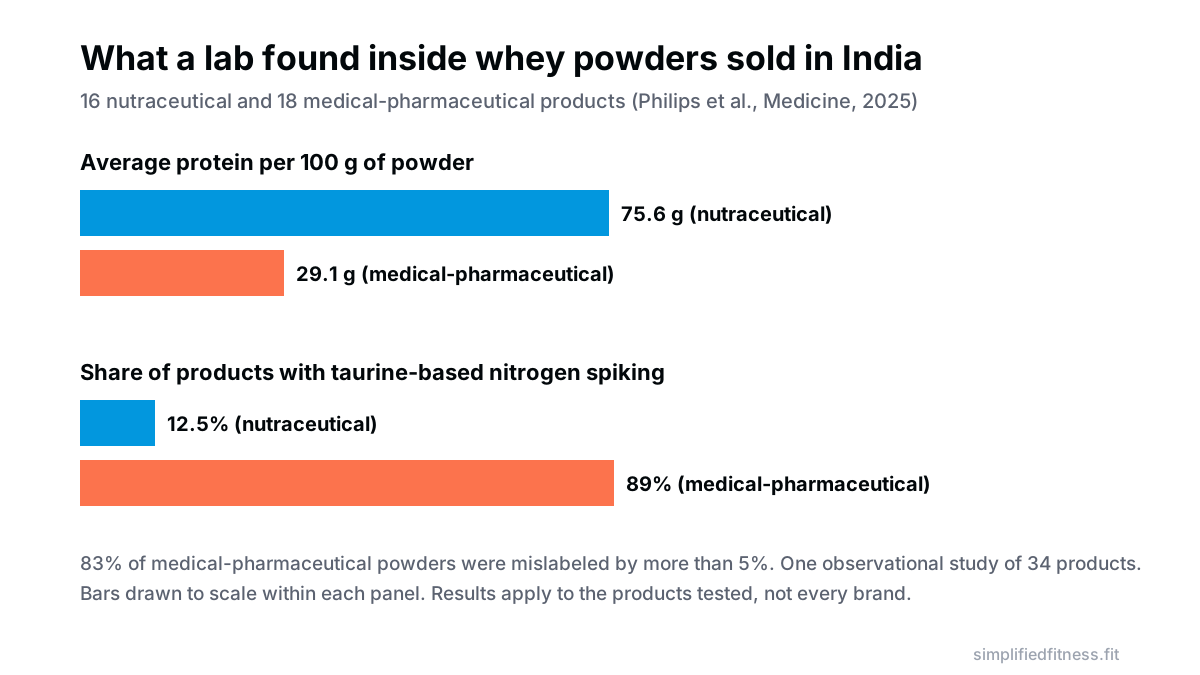
This is the most useful Indian evidence I could verify. A 2025 crowd-funded laboratory study analysed 18 medical-pharmaceutical and 16 nutraceutical whey protein powders sold in India. The authors measured macronutrients, amino acid profiles, sugars, heavy metals, mycotoxins, hormones, pesticides and undeclared additives.
The results split sharply by product type:
- Nutraceutical powders averaged 75.6 g protein per 100 g and matched their label claims closely. 94% met the 60 g per 100 g threshold the authors used.
- Medical-pharmaceutical powders averaged 29.1 g protein per 100 g. 83% were mislabeled by more than 5%, and only one reached the quality benchmark.
- 44% of the pharmaceutical powders contained at least 2 g of sucrose or fructose per 100 g, often unlabeled.
- Taurine-based nitrogen spiking was detected in 89% of the pharmaceutical powders versus 12.5% of the nutraceutical ones.
- Heavy metal outliers (cadmium, arsenic, copper), aflatoxin and progesterone appeared more often in pharmaceutical brands. No product had detectable pesticides or mercury.
Spiking is worth understanding. Basic protein tests estimate protein from total nitrogen. Cheap nitrogen-rich compounds such as taurine raise the nitrogen reading without adding real muscle-building protein. A lab that looks at the amino acid profile can catch it. A label cannot.
How to check fake protein powder in India: a five-step routine
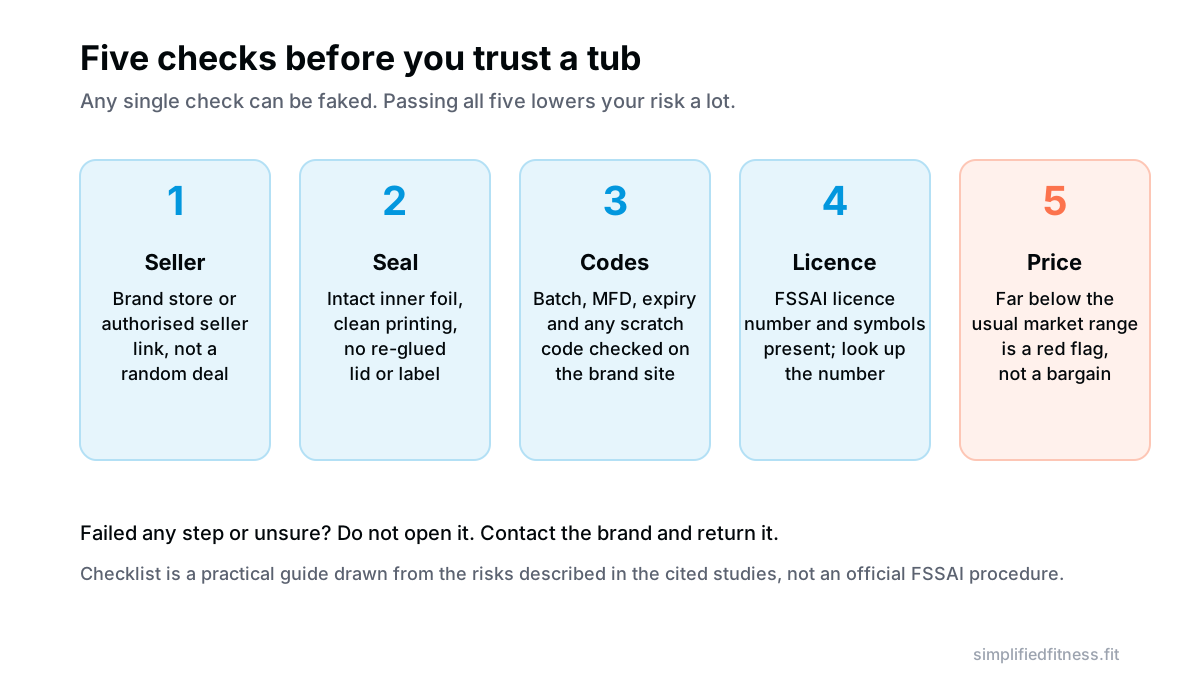
1. Check the seller first. An unauthorised reseller or an unfamiliar marketplace seller is the obvious weak link, because nobody accountable stands behind the stock. Open the brand’s own website and use the store or authorised-seller list it provides.
2. Inspect the tub and seal. Look for an intact inner foil, even printing, a lid that has not been re-glued, and a label that is not peeling or misaligned. Compare it with a photo from the brand’s own site.
3. Verify codes. Note the batch number, manufacturing date and expiry date. If the brand offers a scratch code or batch lookup, use it on the brand’s own website only, never via a link on the tub or a message from a seller. Brand portals differ, and I cannot confirm any individual brand’s system, so ask the brand how it works.
4. Look for the FSSAI licence number. A product sold in India is expected to show the manufacturer or packer’s licence or registration details. FSSAI has an online licence look-up (FoSCoS), but confirm the current steps on the official site. A valid licence tells you the business is registered. It does not tell you this batch was tested.
5. Sanity-check the price. If the price is far below the usual market range, think about why. Genuine whey has a real production cost, so a deep discount needs an explanation.
Imported supplements and authorised importers
Imported does not mean safer. A tub from abroad can be genuine, but grey-market imports often come without the brand’s local checks, may have travelled in heat, and carry doses written for other countries’ rules.
For imported brands sold in India, ask the brand which importers or distributors it authorises, and look for that name on the label or the seller’s page. I am deliberately not listing importers here. Authorisations change, and I cannot verify them from official sources. The brand’s own website is the right source.
In a hot Indian summer, storage matters too. A genuine tub left in a hot warehouse or a delivery van for weeks can degrade, so buy from sellers with fast turnover and check the manufacturing date.
Banned substances: why tested athletes need more than a licence
Contamination with doping agents is well documented, though not common in every product. A 2008 review in the Journal of Mass Spectrometry described an international study, run in 2001 and 2002, of 634 supplements bought in 13 countries. About 15% of the non-hormonal products contained anabolic-androgenic steroids, mainly prohormones, not declared on the label.
A 2005 review by Maughan found contamination mostly linked to poor manufacturing practice, with some evidence of deliberate adulteration, and noted that strict liability in sport means innocent ingestion is not an excuse. A 2020 review reached a similar conclusion and points to cross-contamination from substandard manufacturing, as well as deliberate admixture.
These data are older and come from specific markets, so they do not tell you the rate in India today. A 2021 French analysis of items seized from the bodybuilding black market is a useful contrast. Of 35 dietary supplements, only one (3%) was adulterated with a doping substance, while most of the problems were in pharmaceutical products sold illegally. Different samples, different answers.
What this means practically:
- If you compete in a tested sport, a licence number is not enough. Look for third-party batch certification, covered in our guide to Informed-Choice and NSF.
- If a product promises “pro-hormone” or “anabolic” effects, it is a red flag for any lifter.
- A 2025 narrative review notes that some protein supplements for athletes may be adulterated with steroids and prohormones, and that doing so will produce a positive anti-doping result.
What about heavy metals?
The evidence is mixed, so here is both sides. A 2025 Hungarian analysis of 22 protein powders (whey, vegan and beef) tested 16 elements and found no significant heavy metal content above regulatory limits. The Indian study above found cadmium, arsenic and copper outliers, more often in the pharmaceutical powders.
Why might they differ? Different countries, different brands, different sample sizes and different testing methods. Both are snapshots. The authors of the Hungarian paper themselves argue that routine, mandatory heavy metal testing is prudent. For you, the takeaway is not panic. It is to prefer brands that publish batch testing and to avoid unknown-origin powders.
How to read the label like a buyer
Before you buy, check these on the tub:
| Label item | What to check | Why it matters |
|---|---|---|
| Protein per serving and per 100 g | Is it plausible for a whey powder (the study’s benchmark was 60 g per 100 g or more)? | The Indian lab study used 60 g per 100 g as a benchmark |
| Ingredient list | Is whey the first ingredient? Any unlabeled sugar, or amino acids like taurine added to the protein? | Spiking and added sugars were found in some products |
| FSSAI licence details | Present and readable | Basic traceability |
| Batch, MFD, expiry | Matches the tub and any brand lookup | Detects reused or fake batches |
| Veg or non-veg symbol | Matches the ingredients | Matters for vegetarians |
| Caffeine or other advisories | Clear dose and warning | Basic safety |
If the label is hard to decode, our guide to proprietary blends and underdosing shows what to watch for in formulas that hide doses, and our comparison of concentrate, isolate and hydrolysate explains what protein content to expect from each type.
Do you even need the tub?
Maybe not. A powder is a convenience. If your doubts about a tub outweigh the benefit, the cost of skipping it is low, because dal, paneer, curd, eggs, chicken, fish and soya chunks cover most protein needs on Indian budgets. Use our protein calculator to see your daily target, then decide how much a powder really needs to cover. If your budget is tight, our budget supplement guide walks through what is worth buying first.
Anyone with kidney, liver or other medical conditions, or who is pregnant, should speak to a doctor before using any supplement. If you feel unwell after taking a product, such as persistent nausea, jaundice, palpitations or an unusual rash, stop using it and see a doctor, and take the tub with you.
What to take from this
- FSSAI sets the rules, but you verify the tub. Rules do not prove a particular batch is clean.
- Seller trust beats any sticker. Buy from the brand or an authorised seller.
- One Indian lab study showed large gaps between label and contents in some products, but it is a single observational study of 34 whey powders.
- Tested athletes should look for third-party batch certification, not only a licence.
- When in doubt, food first. The cost of skipping a suspicious tub is close to zero.
Frequently Asked Questions
What do FSSAI supplement regulations cover?
FSSAI regulates the approval, labeling and promotion of health supplements and nutraceuticals sold in India. A 2023 review describes the authority as solely responsible for these areas and notes that rules are becoming stricter. Check the current FSSAI notifications for exact ingredient lists and limits, because they are updated from time to time.
How do I check if my protein powder is fake in India?
No single check is enough, so combine several. Buy from the brand's own store or an authorised seller, inspect the seal and printing, verify the batch code on the brand's website where offered, and confirm an FSSAI licence number is printed. Treat a price far below normal market range as a warning sign rather than a bargain.
Is whey protein from Amazon or Flipkart genuine?
It can be, but the platform alone does not guarantee it. What matters is who the actual seller is. An unfamiliar third-party seller carries more risk than the brand's own storefront or an authorised reseller. Go to the brand's official storefront or use the authorised-seller link listed on the brand's own website.
Can I check an FSSAI licence number online?
Yes, FSSAI runs an online system called FoSCoS where licences can be looked up. I could not load FSSAI pages while preparing this article, so confirm the current lookup steps on the official site. A licence shows the business is registered, not that every batch is tested.
Are Indian whey protein powders good quality?
It depends heavily on the product. In a 2025 laboratory study of 34 whey powders sold in India, nutraceutical powders matched their label claims closely, while most medical-pharmaceutical powders did not. Tested batches from established brands are the safer bet, but this is one observational study, so treat it as a warning rather than a ranking.
What is amino spiking in protein powder?
Amino spiking means adding cheap nitrogen-rich compounds such as taurine so the protein test number looks higher than the real protein content. A lab measuring total nitrogen would be fooled, while an amino acid profile would not. The 2025 Indian study detected taurine-based nitrogen spiking in 89% of the medical-pharmaceutical powders and 12.5% of nutraceutical powders.
Can fake supplements contain steroids?
Yes, it has happened. A 2008 review described an international study from 2001 and 2002 of 634 supplements bought in 13 countries, in which about 15% of non-hormonal products contained undeclared anabolic-androgenic steroids, mostly prohormones. Choose products with third-party batch certification and avoid anything promising dramatic muscle gains.
What do the green and brown symbols on supplements mean?
The Indian food labeling system uses a green dot for vegetarian and a brown symbol for non-vegetarian products. This matters because some supplement ingredients, such as certain capsule shells or collagen, come from animal sources. Check the symbol and the ingredient list, and confirm current rules on the FSSAI site.
Is imported protein powder safer than Indian protein powder?
Not automatically. A tub being imported says nothing about whether it is genuine, fresh or stored properly, and grey-market imports bypass the brand's own checks. Look for an authorised importer or distributor named by the brand itself.
Do protein powders contain heavy metals?
Some may, but a 2025 analysis of 22 protein powders in Hungary found no significant heavy metal content above regulatory limits for the 16 elements tested. The Indian 2025 study found cadmium, arsenic and copper outliers more often in medical-pharmaceutical powders. Both studies are small snapshots, so batch testing by the brand is more reassuring than any general claim.
What should I do if I think I bought a fake supplement?
Stop using it, keep the packaging and your order record, and contact the brand with photos of the batch code. Brands can often confirm whether a batch number is real. If you feel unwell after using a product, see a doctor and show them the label.
Do I need protein powder at all?
No. Powder is a convenience, not a requirement, and most people can reach their target with dal, paneer, curd, eggs, chicken, fish and soya. Use our protein calculator to see your target and decide how much of it a powder actually needs to cover.
Can I trust a tub that has no FSSAI number?
I would not. A legitimately sold food product is expected to carry the licence or registration details of the manufacturer or packer on the label. Missing details, blurry printing or a foreign-language-only label on a product sold in India are reasons to return it.
Sources & References
Every claim above is checked against peer-reviewed research (PubMed, U.S. National Library of Medicine) or guidance from established health bodies. How we fact-check.
- Philips CA, et al. The Citizens Protein Project 2: The first publicly crowd-funded observational study on exhaustive analysis of popular whey protein supplements in India reveal poor quality and deceptive marketing claims of medical pharmaceutical- compared to nutraceutical- industry powders. Medicine (Baltimore). 2025. PMID: 41239695
- Malve H, et al. Past, Present, and Likely Future of Nutraceuticals in India: Evolving Role of Pharmaceutical Physicians. J Pharm Bioallied Sci. 2023. PMID: 37469644
- Geyer H, et al. Nutritional supplements cross-contaminated and faked with doping substances. J Mass Spectrom. 2008. PMID: 18563865
- Maughan RJ. Contamination of dietary supplements and positive drug tests in sport. J Sports Sci. 2005. PMID: 16195040
- Walpurgis K, et al. Dietary Supplement and Food Contaminations and Their Implications for Doping Controls. Foods. 2020. PMID: 32727139
- Horvath IL, et al. Analysis of heavy metal content in protein powders available on the Hungarian market: a reassuring snapshot, but not a reassuring quality guarantee. J Nutr Sci. 2025. PMID: 40703701
- Fabresse N, et al. Analysis of pharmaceutical products and dietary supplements seized from the black market among bodybuilders. Forensic Sci Int. 2021. PMID: 33838562
- Puscasiu D, et al. Adulteration of Sports Supplements with Anabolic Steroids-From Innocent Athlete to Vicious Cheater. Nutrients. 2025. PMID: 41097223

Umair Hazrami · Founder & Head Coach, Simplified Fitness
Umair Hazrami founded Simplified Fitness and the Simplified Lifter channel to cut through fitness noise. With 4+ years of consistent training and 10+ coaching clients, he writes every guide from the peer-reviewed research and links the sources so you can check them. Our editorial standards.
Educational content only, not medical advice. If you have a medical condition, are pregnant, or take medication, talk to a qualified doctor before changing your diet, supplements or training. Full disclaimer.
Keep reading
Supplements
Ashwagandha KSM-66 vs Sensoril: Which Extract, What Dose, and Do You Need to Cycle?
Ashwagandha KSM-66 vs Sensoril for lifters: what the strength trials show, realistic cortisol effects, liver safety and whether to cycle. Every study linked.
8 min read
Supplements
BCAAs vs EAAs: Why BCAAs Are a Waste of Money If Your Protein Is Covered
BCAA vs EAA for muscle growth: BCAAs are only 3 of the 9 essential amino acids. See what Wolfe 2017 and Jackman 2017 found and when EAAs or whey make sense.
8 min read
Supplements
Beetroot Juice for Running and Lifting: How Dietary Nitrate Works (and the Mouthwash Trap)
Does beetroot juice for running actually work? See what meta-analyses show, the 2-3 hour timing and dose, who benefits, and why mouthwash can cancel the effect.
9 min read

Supplements
Beta-Alanine Benefits: Carnosine Buffering, High-Rep Gains and Why It Makes You Tingle
Beta-alanine benefits explained: why pre-workout makes your skin tingle, how carnosine buffers acid, what dose works, and who should skip it. Studies linked.
8 min read