Complete Protein Guide: How Much, What Type, and When to Eat It for Muscle Growth
How much protein per day do you need to build muscle? The evidence on grams per kg, meal spread, leucine, protein quality, plant vs whey and kidney safety.
TL;DR. The short answer
- For most people lifting to build muscle, about 1.6-2.2 g of protein per kg of body weight per day is a sensible target. Meta-analysis data suggest extra muscle gain levels off at roughly 1.6 g/kg.
- Lean lifters in a hard calorie deficit may benefit from more, with a review suggesting 2.3-3.1 g/kg of fat-free mass. This is a recommendation from limited, small studies.
- Spreading protein over 3-5 meals of roughly 0.25-0.55 g/kg each is a reasonable pattern, but your daily total matters more than the exact meal split.
- Plant and animal protein support similar muscle gain when total protein is adequate. Animal protein may have a small edge in some analyses, especially in younger adults.
- In healthy adults, higher-protein diets have not been shown to harm kidney function. If you have kidney disease, talk to your doctor before raising protein.
Table of contents
How much protein per day do you need to build muscle? For most healthy people who lift, about 1.6-2.2 g per kg of body weight per day is a sensible target, and gains in muscle mass level off around the bottom of that range. That works out to roughly 110-155 g a day for a 70 kg lifter.
Everything else, meal timing, leucine, whey versus dal, “can the body only absorb 30 g,” matters far less than hitting that daily number for most people. This guide covers the lot, with the studies linked so you can read them yourself. If you want the training side of the equation, start with our muscle hypertrophy guide for natural lifters.
How much protein per day do you need for muscle growth?
Let’s start with the best evidence we have: meta-analyses, which pool many trials.
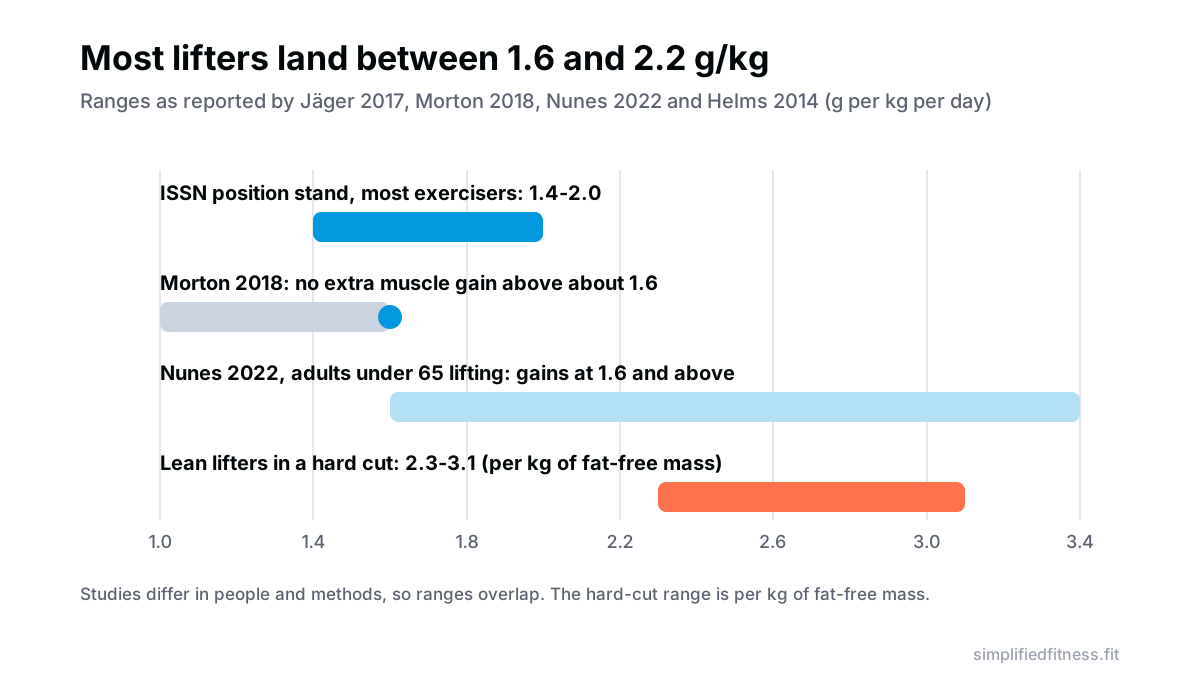
A 2018 meta-analysis of 49 randomised trials with 1,863 participants looked at protein supplementation during resistance training lasting at least six weeks. Supplementing protein increased fat-free mass by about 0.30 kg on average, plus small gains in strength and muscle fibre size. The benefit was bigger in people who were already resistance trained, and it shrank with age. Importantly, no further gains in fat-free mass were seen once total protein intake went beyond about 1.62 g/kg/day (Morton et al., 2018).
A 2022 meta-analysis of 74 randomised trials in healthy adults reached a compatible picture. Higher protein intake gave a small additional gain in lean mass for people doing resistance training, and in adults under 65 the effect was significant at 1.6 g/kg/day and above. Adults 65 and over saw significant lean mass gains at 1.2-1.59 g/kg/day (Nunes et al., 2022). Note the authors graded the evidence as moderate for lean mass and low for several strength outcomes.
The International Society of Sports Nutrition (ISSN) position stand lands in a similar place: 1.4-2.0 g/kg/day is sufficient for most exercising individuals to build and maintain muscle (Jäger et al., 2017).
So what number should you actually use?
Here is a simple way to work it out:
- Starting point: 1.6 g/kg of body weight per day.
- If you want a safety margin: 1.8-2.2 g/kg, which also covers the top of the commonly quoted range.
- If you are cutting hard and already lean: go toward the upper end (more on this below).
Use our free protein calculator to get a number for your body weight and goal, and our macro calculator to fit it into your calories.
If you want the full meta-analysis story, we unpack it in optimal daily protein intake for hypertrophy.
Do you need more protein when cutting?
Possibly, yes. When you eat in a calorie deficit, your body is more likely to break down muscle for fuel, and a higher protein intake may help hold on to lean mass.
A systematic review of six studies in lean, resistance-trained athletes who restricted calories found body fat fell in all 13 study groups and fat-free mass fell in nine. Six groups gained, held or lost only a non-significant amount of fat-free mass, and five of those six were among the highest in body fat, in the smallest deficits, or doing new training. The one lean group in a hard deficit that still held on to muscle ate the most protein (2.5-2.6 g/kg). The review concluded protein needs are likely 2.3-3.1 g/kg of fat-free mass, scaled up with the severity of the deficit and leanness (Helms et al., 2014). The ISSN position stand repeats this range for hypocaloric periods (Jäger et al., 2017).
Two cautions. First, this is a small body of evidence on a niche group (lean, already trained athletes), not a general rule for everyone cutting. Second, the range is per kg of fat-free mass, not total body weight, so it is a different number from the one in the previous section.
For most gym-goers with some body fat to lose, staying in the top half of 1.6-2.2 g/kg of body weight is a practical approach. For the full deficit playbook, see high protein during caloric restriction and our pillar on energy balance for fat loss, bulking and recomp.
How should you spread protein across meals?
Once you know your daily total, the next question is how to divide it.
One review of acute and long-term studies proposed that, to maximise muscle building, you could aim for roughly 0.4 g/kg per meal across at least four meals to reach 1.6 g/kg/day. At the upper daily intake of 2.2 g/kg, the same four meals would need up to 0.55 g/kg each (Schoenfeld and Aragon, 2018). The ISSN suggests about 0.25 g/kg per meal, or an absolute 20-40 g, spaced roughly every 3-4 hours (Jäger et al., 2017).
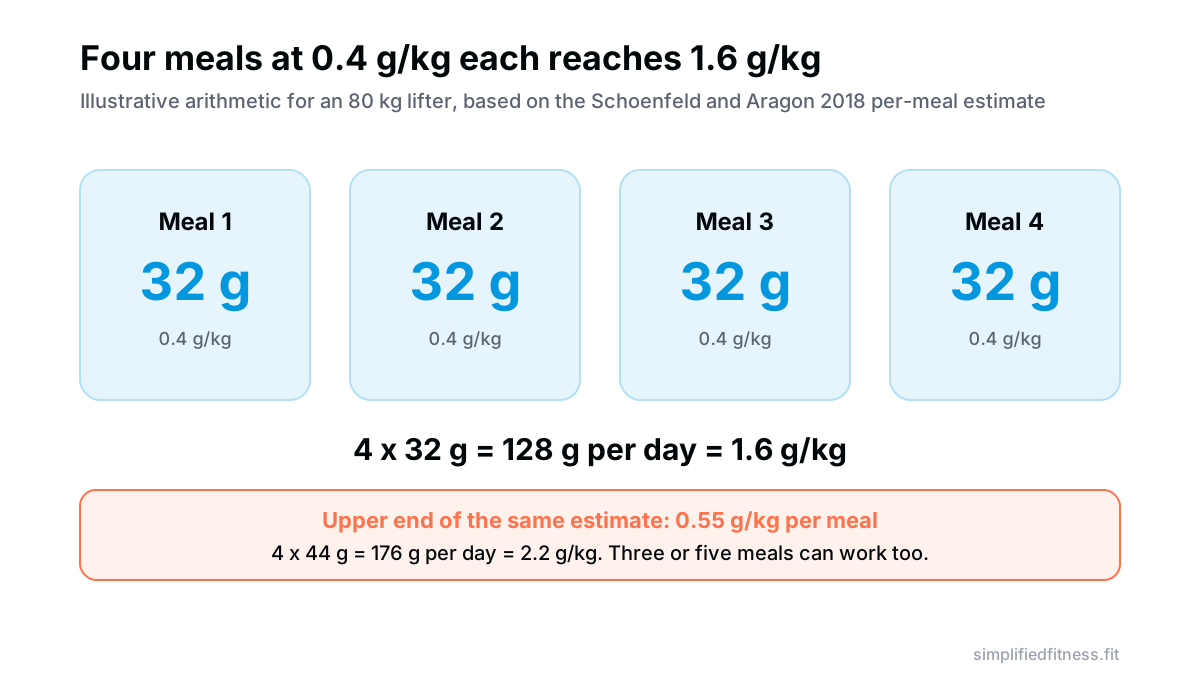
In plain terms, that looks like this for an 80 kg lifter: roughly 30-45 g of protein at each of three to four main meals, plus a snack if needed. Three meals can work if each is on the larger side, and five smaller ones work too. It is a pattern, not a rule.
Is the exact distribution a big deal? Probably not as big as the daily total. Distribution reviews describe a reasonable pattern rather than a cliff edge. If your life only allows three meals, make sure each has a proper protein source rather than loading everything at dinner. We compare these approaches in daily protein distribution: 3 vs 5 meals.
Can the body only absorb 30 g of protein at a time?
No, that is a myth, and it comes from a real finding that got stretched.
In a trial of 48 resistance-trained young men, 20 g of whey protein isolate after leg training maximally stimulated myofibrillar muscle protein synthesis, and 40 g did not add more in that measure, though amino acid oxidation and urea production rose at 40 g (Witard et al., 2014). But a separate study of 30 resistance-trained men found that after whole-body training, 40 g of whey stimulated a greater response than 20 g (Macnaughton et al., 2016).
Why the difference? Study design, the amount of muscle trained, and the protein source likely play a role. Also, “absorption” is not the limit: your gut absorbs far more than 30 g. What changes is how the extra amino acids are used. The review above notes that although larger doses lead to more oxidation, not all the extra amino acids are burned, and some are used for tissue building (Schoenfeld and Aragon, 2018). We dig into this in protein absorption ceilings.
Does leucine really matter? The leucine threshold explained
Leucine is one of the essential amino acids and is often described as the “trigger” that switches on muscle protein synthesis, partly through a signalling pathway called mTOR. The idea behind the leucine threshold is that each meal needs enough leucine to flip that switch. The ISSN position stand suggests protein doses containing roughly 700-3,000 mg of leucine, alongside a balanced mix of essential amino acids (Jäger et al., 2017).
But how well does the theory hold? A systematic review of 29 studies measuring blood leucine and muscle protein synthesis found that 16 of 29 supported the leucine trigger hypothesis, mostly studies in older adults using isolated proteins. The authors concluded it is most relevant for older adults and for isolated protein sources rather than protein-rich whole foods (Zaromskyte et al., 2021).
What does that mean for you?
- You do not need to count leucine. Getting 20-40 g of good-quality protein per meal generally covers it.
- If you eat plant-heavy meals, a slightly larger portion or a protein source higher in leucine (soya, dairy, eggs) may help.
- A leucine supplement on top of an adequate diet has no clear evidence behind it for healthy lifters.
For the mechanism in more depth, see the leucine threshold and mTOR.
Is the anabolic window real? Protein timing, debunked
You have probably heard that you must drink a shake within 30 minutes of finishing your last rep. That idea is called the anabolic window, and the evidence suggests it is much wider than that.
A review on nutrient timing noted that the importance, and even the existence, of a narrow post-exercise window varies with several factors, and that recent evidence has directly challenged the classical view (Aragon and Schoenfeld, 2013). The ISSN states that protein before or after resistance exercise works synergistically with training, and that the anabolic effect of exercise is long-lasting, at least 24 hours, though it likely diminishes with time after training (Jäger et al., 2017).
The practical takeaway: a protein-containing meal within a few hours before or after training is a sensible habit. A shake the moment you leave the gym is fine but not essential. More in the anabolic window myth.
What about protein before bed?
Pre-sleep protein is a different story. A review from Maastricht found that protein eaten before sleep is digested and absorbed overnight, raises overnight muscle protein synthesis, and, when used over a prolonged period with resistance training, has a beneficial effect on muscle mass and strength (Snijders et al., 2019). The ISSN mentions 30-40 g of casein before sleep (Jäger et al., 2017).
It is a reasonable extra, not a necessity. If your day is already at target, curd, milk or a casein shake before bed is optional. Details are in pre-bed protein and overnight anabolism and casein and slow digestion. For speed of digestion more broadly, see fast vs slow absorbing proteins.
Protein quality: what DIAAS does and does not tell you
Not all proteins are equal in how well they supply essential amino acids. Scientists use protein quality scores to compare them.
The newer one is the Digestible Indispensable Amino Acid Score (DIAAS), which the FAO endorsed to replace the older PDCAAS. It looks at the digestible content of essential amino acids rather than total protein. But a 2021 review lists real limitations, particularly for plant-based diets: limited coverage of commonly eaten plant foods, little credit for the improved digestibility of cooked or processed foods, and a focus on single foods rather than the whole meal. The authors even argue it should ideally be avoided when assessing protein quality in plant-based diets, and caution against using it in exercise settings (Craddock et al., 2021).
So treat DIAAS as a rough guide to food quality, not a score for building your meal plan. We cover the scoring systems in protein quality scores: DIAAS vs PDCAAS.
Whey vs plant protein: does the source matter for muscle?
This is where lab results and real-world results differ.
In acute studies, animal proteins often stimulate muscle protein synthesis more than plant proteins. But long-term trials ask a different question: do you actually build more muscle?
- Soy vs animal protein: a meta-analysis of nine studies (266 participants) found whey or soy supplementation produced similar gains in strength and lean mass with resistance training, with no significant difference between groups (Messina et al., 2018).
- Vegan vs omnivore diet: in a 12-week trial, 19 habitual vegans and 19 omnivores trained twice weekly with protein adjusted to 1.6 g/kg/day (soy for vegans, whey for omnivores). Both groups gained similar leg lean mass (1.2 kg each) and strength, with no between-group differences (Hevia-Larraín et al., 2021). The participants were untrained young men, so we cannot assume the same for advanced lifters.
- Animal vs plant overall: a meta-analysis of 16 trials (from 18 reviewed) found protein source did not change absolute lean mass or strength, but animal protein favoured percent lean mass, and younger adults (under 50) gained about 0.41 kg more absolute lean mass with animal protein (Lim et al., 2021).
Why might these studies differ? Study length, participants’ age and training status, protein doses and the specific plant protein used all vary. A fair summary: with enough total protein, plant-based diets can work very well, and animal protein may have a small edge in some groups.
| Source | Typical use in India | Practical notes |
|---|---|---|
| Whey protein | Shake after training or between meals | Fast digesting, convenient, well studied |
| Paneer, curd, milk | Everyday vegetarian staples | Dairy protein, easy to spread across meals |
| Eggs | Breakfast, snacks | Good-quality protein if you eat them |
| Soya chunks, soy protein | Budget protein for vegetarians | Matched whey in trials for muscle gain |
| Dal, chana, rajma with rice or roti | Daily meals | Moderate protein per serving, variety matters |
The practical advice for vegetarians is simple: combine sources through the day, eat larger portions when relying on plants, and consider a powder if you struggle to reach your target. For deeper dives, see plant vs animal protein for hypertrophy, vegan protein powder blends, whey concentrate vs isolate vs hydrolysate, soy protein and testosterone myths, collagen protein: joints vs muscle and whole eggs vs egg whites.
What does 1.6-2.2 g/kg look like on an Indian plate?
Here is where many vegetarians hit a wall. Dal and rice feel like a protein meal, but a katori of cooked dal gives only roughly 6-9 g of protein. Food values vary by recipe and brand, so check labels where possible.
A rough way to build a day for a 70 kg vegetarian aiming near 120-130 g:
- Breakfast: eggs or paneer bhurji, or curd with oats, aiming for about 25-30 g.
- Lunch: dal, a protein side like paneer or soya, and roti or rice, aiming for 30-35 g.
- Evening snack: curd, milk, roasted chana or a protein shake, aiming for 20-25 g.
- Dinner: another protein-led plate, aiming for 30-35 g.
Soya chunks are one of the cheapest protein-dense foods in India, and paneer and curd spread easily across the day. For shopping lists, budgets and meal prep, see our pillars on Indian high-protein nutrition and high-protein foods, meal prep and cost, and the free diet plan.
Is high protein safe for your kidneys?
For healthy people, the evidence says yes.
A 2018 systematic review and meta-analysis pooled 28 randomised trials with 1,358 participants comparing higher-protein diets (at least 1.5 g/kg, or 20% of energy, or 100 g a day) with lower-protein ones in adults without kidney disease. Higher protein did not adversely affect kidney function as measured by glomerular filtration rate (GFR). The change in GFR did not differ between diets, though the authors note an unclear risk of selection bias in the included trials (Devries et al., 2018).
Two things to keep in mind. These trials were mostly short, so they cannot tell us about decades of very high intake. And the finding applies to people without kidney disease. If you have kidney disease, reduced kidney function, or diabetes affecting your kidneys, protein targets are a medical decision, so talk to your doctor before changing your intake. Our full breakdown is in high-protein diets and kidney function. The related bone-health question is covered in high protein and bone density.
Protein for older adults and special groups
Age changes the picture. The 2018 meta-analysis found protein supplementation was less effective for fat-free mass gain as age increased (Morton et al., 2018), and the 2022 analysis found benefits in adults 65 and over at 1.2-1.59 g/kg/day (Nunes et al., 2022). Older adults may need larger per-meal doses, and the leucine trigger idea seems most relevant here (Zaromskyte et al., 2021). See protein requirements in older adults.
Many of the trials above used young adults, and this guide does not give individual medical advice. If you are pregnant, have a medical condition or take medication, ask your doctor or a registered dietitian before changing your protein intake.
Does protein help with hunger?
Many lifters find higher-protein meals keep them fuller, which can make a calorie deficit easier. The evidence here is separate from the muscle-building data, so we keep the detail in satiety and the thermic effect of protein. The short version: spreading protein across meals is a practical tool for appetite control as well as muscle.
Putting it together: a simple protein plan
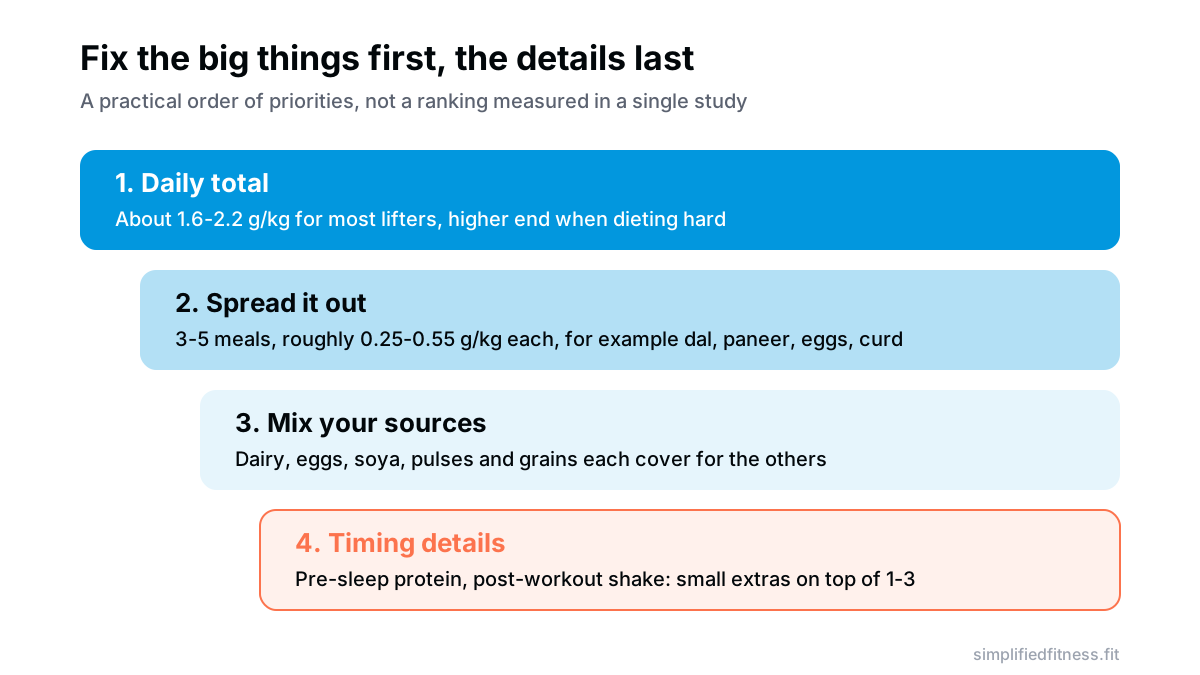
- Pick your number: 1.6 g/kg to start, up to 2.2 g/kg if you like a margin. Use the protein calculator.
- Split it: 3-5 meals, each with a clear protein source (roughly 0.25-0.55 g/kg).
- Mix sources: dairy, eggs, soya, pulses, and a shake when needed.
- Time it sensibly: a protein meal within a few hours of training, with optional pre-sleep protein.
- Check your kidneys if relevant: if you have a kidney condition, ask your doctor first.
- Track for two weeks: log your normal days and compare with the target, then adjust.
Pair this with sound training. Protein only supports adaptation if the training stimulus is there, so see our guide on training volume and frequency for hypertrophy, and fuel your sessions with the right carbohydrates, fats and hydration. Our free workout plans are a good place to start.
When to see a doctor
See a doctor or registered dietitian before raising protein if you have kidney disease, reduced kidney function, diabetes with kidney involvement, liver disease, or a medical condition that changes your diet. Also check in if you notice swelling, foamy urine, or persistent unexplained fatigue. This article is general education, not a diagnosis or personal medical advice.
Go deeper: every guide in this topic
- The Anabolic Window Myth: Do You Really Need a Shake Within 30 Minutes?
- Casein Protein: Slow Digestion, Nighttime Satiety and Muscle Growth
- Collagen Protein: Joint and Tendon Support vs Muscle Building Protein
- Protein Distribution: 3 Meals vs 5 Meals and the 'Muscle Full' Effect
- Fast vs Slow Absorbing Proteins: Digestion Rates and Muscle Protein Breakdown
- High-Protein Diets and Bone Density: Does Protein Really Leach Calcium?
- High-Protein Diets and Kidney Function: What the Evidence Says for Healthy Lifters
- High Protein While Cutting: How Much You Need to Keep Muscle
- The Leucine Threshold: How 2.5-3.0 g of Leucine Signals Muscle Protein Synthesis via mTORC1
- Optimal Daily Protein Intake for Hypertrophy: What the Meta-Analyses Say
- Plant vs Animal Protein for Hypertrophy: Do Vegans Build Less Muscle?
- Pre-Bed Protein: Does 30-40 g of Casein Before Sleep Build Muscle?
- Can the Body Absorb More Than 30g of Protein in One Meal? What the Research Shows
- Protein Quality Scores: DIAAS vs PDCAAS Explained for Lifters
- Protein Requirements for Older Adults: Beating Anabolic Resistance
- Satiety and Thermic Effect of Protein (TEF): Why Protein Makes Dieting Easier
- Soy Protein and Phytoestrogens: Does Soy Lower Testosterone in Men?
- Pea and Rice Protein Blend Ratio: What a Good Vegan Powder Formula Looks Like
- Whey Protein Comparison: Whey Concentrate vs Whey Isolate vs Whey Hydrolysate
- Whole Eggs vs Egg Whites for Muscle Growth: What the Trials Show
Frequently Asked Questions
How much protein per day do I need to build muscle?
Most lifters do well with about 1.6-2.2 g of protein per kg of body weight per day. A meta-analysis of 49 trials found that extra muscle gain from protein supplementation levelled off at about 1.6 g/kg/day. A 70 kg lifter can aim for roughly 110-155 g a day and adjust based on appetite and progress.
Is 1 g of protein per pound of body weight too much?
One gram per pound is about 2.2 g/kg, which sits at the top of the commonly used range rather than beyond it. The ISSN position stand describes 1.4-2.0 g/kg as sufficient for most exercisers, so 2.2 g/kg is not harmful for healthy people but is likely more than needed. If it feels like a chore, aiming for 1.6-1.8 g/kg is a simpler target.
How much protein should I eat in one meal?
A practical target is about 0.25-0.55 g/kg per meal, which is roughly 20-40 g for many people. One review estimated 0.4 g/kg per meal across at least four meals to reach 1.6 g/kg a day. Pick a number that fits your day and keep it fairly consistent.
Can your body only absorb 30 g of protein per meal?
No, your body absorbs protein from larger meals too. Acute studies show muscle protein synthesis does not keep rising indefinitely with dose, but one trial found 40 g of whey stimulated more synthesis than 20 g after whole-body training. If you eat 40-50 g in one sitting, you are not wasting it.
Is the anabolic window real?
The window exists but it is much wider than the old 30-60 minute claim. The ISSN notes that the effect of exercise on muscle building lasts at least 24 hours, though it likely fades with time. Eat a protein-containing meal within a few hours either side of training and move on.
Do I need a protein shake right after my workout?
No, a shake is a convenience rather than a requirement. Protein before or after resistance training both help, and your daily total matters more than the exact minute you drink it. A shake is useful when you cannot get a proper meal soon after training.
What is the leucine threshold?
The leucine threshold is the idea that a meal needs enough of the amino acid leucine to switch on muscle protein synthesis. A systematic review of 29 studies found about half supported the idea, mostly in older adults and with isolated proteins. In practice, 20-40 g of a good-quality protein at each meal covers it without counting leucine.
Does leucine activate mTOR?
Leucine is linked to signalling through mTOR, a pathway involved in muscle protein synthesis, but whole-food results are less clear-cut than lab models suggest. The leucine trigger hypothesis has been challenged by studies showing blood leucine does not always match muscle protein synthesis. You do not need a leucine supplement if your meals contain enough protein.
How much protein do I need when cutting?
Lean lifters in a hard deficit may need more, with one review suggesting 2.3-3.1 g/kg of fat-free mass, scaled up with leanness and the size of the deficit. This is based on six studies and the authors note it is a likely range rather than a proven one. If you are cutting, aim for the upper half of 1.6-2.2 g/kg of body weight and keep your lifting heavy.
Is whey protein better than plant protein?
Whey digests quickly and is well studied, but in long-term trials plant and animal protein often give similar gains when total protein is adequate. A meta-analysis found no difference in absolute lean mass or strength by source, though animal protein favoured percent lean mass, especially in people under 50. If you are vegetarian, soya, dairy, eggs and pulses can all work, and a soy or pea blend powder is a reasonable option.
Can vegetarians build muscle with enough protein?
Yes, a vegetarian or plant-based diet can support muscle gain if total protein and variety are adequate. In a 12-week trial, young men eating a high-protein vegan diet gained similar muscle to those eating a protein-matched omnivorous diet, though they were untrained at the start. Combine dal, rice, paneer, curd, soya and eggs if you eat them.
What is DIAAS and does it matter?
DIAAS, the Digestible Indispensable Amino Acid Score, rates a protein by how well it supplies the essential amino acids you can actually digest. It was endorsed by the FAO to replace PDCAAS, but reviewers describe limitations, especially for mixed plant-based diets. Treat it as a rough guide to food quality, not a score to optimise your meals around.
Is whey concentrate or isolate better?
For most people the difference is small, and the bigger factor is whether the product fits your budget and digestion. Isolate is more filtered and usually lower in lactose and fat, which can help if concentrate upsets your stomach. Choose whichever you tolerate and can afford, and check protein per serving on the label.
Is eating protein before bed useful?
It can be a small bonus. A review found that pre-sleep protein increases overnight muscle protein synthesis and, over time, supports training gains, and the ISSN mentions 30-40 g of casein. Treat it as an optional extra if you struggle to hit your daily total, with curd or milk as practical options.
Does high protein damage the kidneys?
In healthy adults, there is no evidence that higher protein intake damages the kidneys. A meta-analysis of 28 randomised trials in people without kidney disease found no adverse effect of higher protein on GFR, a measure of kidney filtration. If you have kidney disease, diabetes affecting the kidneys or reduced kidney function, speak to your doctor before raising protein.
Should I drink more water on a high-protein diet?
Normal hydration is generally enough for healthy people, and we are not aware of good evidence that a high-protein diet needs a specific extra amount of water. Thirst and pale urine are practical guides. In hot Indian summers, drink more during and after training anyway.
Do older adults need more protein?
Older adults may need to aim a little higher, though evidence is still developing. A meta-analysis found significant lean mass benefit in people 65 and over eating 1.2-1.59 g/kg/day, and protein supplementation was less effective at building muscle with increasing age. If you are over 65, check with your doctor, especially if you have kidney issues.
Can I get enough protein from an Indian vegetarian diet?
Yes, but it takes planning because dal and rice are moderate in protein per serving. Paneer, curd, milk, soya chunks, eggs if you eat them, and a protein powder can raise the total. Plan a protein-rich food in each meal rather than one big dinner.
Does protein make you gain fat?
Protein itself is not a special fat-gain food, but any food adds calories and fat gain follows a calorie surplus. In the cutting evidence, higher protein was linked with preserving lean mass during energy restriction. Track your weekly average weight and adjust calories rather than blaming protein.
Do I need protein on rest days?
Yes, aim for roughly the same daily protein on rest days. The ISSN notes that the muscle-building effect of exercise lasts at least 24 hours, so recovery still needs amino acids. Keep your usual meal pattern.
Is more protein always better for muscle?
No, there are diminishing returns. In a meta-analysis of 49 trials, protein supplementation beyond a total of about 1.6 g/kg/day did not give further gains in fat-free mass. Once you reach that range, put spare effort into training quality, calories and sleep.
Can women follow the same protein targets?
The ranges in this guide come from mixed or mostly male samples, and women are included in many meta-analyses, so the same g/kg targets are a reasonable starting point. Individual needs vary with body size, training and calories. Start at 1.6 g/kg and adjust with progress.
What are signs I am not eating enough protein?
Stalled strength, slow recovery and constant hunger can hint at low protein, but they are not specific, since low calories or poor sleep cause the same signs. The reliable check is to log a few normal days and compare your average with your g/kg target. If you have unexplained fatigue or swelling, see a doctor rather than guessing.
Sources & References
Every claim above is checked against peer-reviewed research (PubMed, U.S. National Library of Medicine) or guidance from established health bodies. How we fact-check.
- Morton RW, et al. A systematic review, meta-analysis and meta-regression of the effect of protein supplementation on resistance training-induced gains in muscle mass and strength in healthy adults. Br J Sports Med. 2018. PMID: 28698222
- Nunes EA, et al. Systematic review and meta-analysis of protein intake to support muscle mass and function in healthy adults. J Cachexia Sarcopenia Muscle. 2022. PMID: 35187864
- Jäger R, et al. International Society of Sports Nutrition Position Stand: protein and exercise. J Int Soc Sports Nutr. 2017. PMID: 28642676
- Helms ER, et al. A systematic review of dietary protein during caloric restriction in resistance trained lean athletes: a case for higher intakes. Int J Sport Nutr Exerc Metab. 2014. PMID: 24092765
- Aragon AA, et al. Nutrient timing revisited: is there a post-exercise anabolic window? J Int Soc Sports Nutr. 2013. PMID: 23360586
- Snijders T, et al. The impact of pre-sleep protein ingestion on the skeletal muscle adaptive response to exercise in humans: an update. Front Nutr. 2019. PMID: 30895177
- Schoenfeld BJ, et al. How much protein can the body use in a single meal for muscle-building? Implications for daily protein distribution. J Int Soc Sports Nutr. 2018. PMID: 29497353
- Witard OC, et al. Myofibrillar muscle protein synthesis rates subsequent to a meal in response to increasing doses of whey protein at rest and after resistance exercise. Am J Clin Nutr. 2014. PMID: 24257722
- Macnaughton LS, et al. The response of muscle protein synthesis following whole-body resistance exercise is greater following 40 g than 20 g of ingested whey protein. Physiol Rep. 2016. PMID: 27511985
- Zaromskyte G, et al. Evaluating the leucine trigger hypothesis to explain the post-prandial regulation of muscle protein synthesis in young and older adults: a systematic review. Front Nutr. 2021. PMID: 34307436
- Devries MC, et al. Changes in kidney function do not differ between healthy adults consuming higher- compared with lower- or normal-protein diets: a systematic review and meta-analysis. J Nutr. 2018. PMID: 30383278
- Hevia-Larraín V, et al. High-protein plant-based diet versus a protein-matched omnivorous diet to support resistance training adaptations: a comparison between habitual vegans and omnivores. Sports Med. 2021. PMID: 33599941
- Messina M, et al. No difference between the effects of supplementing with soy protein versus animal protein on gains in muscle mass and strength in response to resistance exercise. Int J Sport Nutr Exerc Metab. 2018. PMID: 29722584
- Lim MT, et al. Animal protein versus plant protein in supporting lean mass and muscle strength: a systematic review and meta-analysis of randomized controlled trials. Nutrients. 2021. PMID: 33670701
- Craddock JC, et al. Limitations with the Digestible Indispensable Amino Acid Score (DIAAS) with special attention to plant-based diets: a review. Curr Nutr Rep. 2021. PMID: 33409931

Umair Hazrami · Founder & Head Coach, Simplified Fitness
Umair Hazrami founded Simplified Fitness and the Simplified Lifter channel to cut through fitness noise. With 4+ years of consistent training and 10+ coaching clients, he writes every guide from the peer-reviewed research and links the sources so you can check them. Our editorial standards.
Educational content only, not medical advice. If you have a medical condition, are pregnant, or take medication, talk to a qualified doctor before changing your diet, supplements or training. Full disclaimer.
Keep reading
Nutrition
Alcohol and Muscle Growth: What a Heavy Night Does to MPS, Sleep and Recovery
Alcohol and muscle growth: does a heavy Saturday night wipe out your week? See what research says on MPS, REM sleep and recovery, and how to limit the damage.
7 min read
Nutrition
The Anabolic Window Myth: Do You Really Need a Shake Within 30 Minutes?
The anabolic window myth, debunked: what meta-analyses show about the 30-minute post-workout shake, how wide your real window is, and when timing still matters.
8 min read
Nutrition
Ashwagandha and Cortisol: Does It Lower Stress and Boost Strength in the Gym?
Ashwagandha for lifting: what the trials show on cortisol, stress and strength gains, realistic dose (300-600 mg), who should skip it and how to buy it safely.
7 min read
Nutrition
Body Recomposition: Who Can Lose Fat and Build Muscle at the Same Time?
How to do body recomposition: who can lose fat and build muscle at once, what the trials show, and a protein, training and calorie protocol you can start today.
8 min read