CYP1A2 Genetics and Caffeine: Why Fast and Slow Metabolizers Respond Differently in the Gym
CYP1A2 gene caffeine performance explained: what the Guest 2018 trial found, why later studies disagree, and how to find your dose without a DNA test.
TL;DR. The short answer
- CYP1A2 is the liver enzyme that clears most caffeine. In one 2018 trial of 101 male cyclists, 4 mg/kg made AA genotype athletes 6.8% faster, did nothing for AC, and made CC athletes 13.7% slower.
- Later work is less dramatic. A 2024 meta-analysis found a similar pattern, but the CC result disappeared once studies with reported conflicts of interest were removed, and a trial in resistance-trained men found no genotype effect.
- Caffeine's side effects (jitters, anxiety, poor sleep) are a separate question from performance. ADORA2A gene variants have been linked to caffeine-induced anxiety, but the evidence is small-sample.
- You do not need a DNA test. Start at 2 mg/kg about 60 minutes before training, track reps, jitters and sleep for three sessions, and adjust within the 2-6 mg/kg range.
- Racing heart, chest pain or fainting is a reason to stop and see a doctor, not a reason to push the dose.
Part of our complete guide: The Evidence-Based Fitness Supplements Guide: What Works, What's Overhyped & What's a Waste of Money
Table of contents
CYP1A2 gene caffeine performance is a real research topic, but the headline version (fast metabolizers win, slow metabolizers get hurt) is only partly true. Your CYP1A2 gene sets how quickly your liver clears caffeine, and in a few well-known trials that changed how athletes performed. Later studies show smaller, less consistent differences, so genetics is one factor among several, not a verdict.
This is a supporting piece in our evidence-based supplements guide. Here we look at one question: why 200 mg of caffeine gives one lifter a PR and gives another a pounding heart and a bad night’s sleep, and what you can do about it without paying for a DNA test.
What does the CYP1A2 gene actually do?
CYP1A2 codes for an enzyme in your liver that breaks caffeine down. Researchers usually look at one spot in the gene, called rs762551 or the -163A>C variant. You inherit one version from each parent, which gives three combinations: AA, AC or CC.
The common shorthand is that AA people are “fast metabolizers” and people carrying a C are “slower.” That shorthand is a simplification. The studies below test whether those groups differ in performance, and the answer turns out to depend on which study you read.
Caffeine also works through brain receptors, not just the liver. It blocks adenosine receptors, which is how it makes you feel alert. So there are two separate ideas here: how fast you clear caffeine (CYP1A2), and how your brain reacts to it (receptor genes such as ADORA2A). Do not mix them up.
What did the landmark 2018 trial find?
The study behind most of the headlines is Guest et al. (2018). Researchers had 101 competitive male athletes (average age 25) do a 10 km cycling time trial three times: on placebo, on 2 mg/kg of caffeine and on 4 mg/kg. It was randomized, double-blind and placebo-controlled, and DNA from saliva was used to sort everyone by CYP1A2 genotype.
Across the whole group, 4 mg/kg made riders about 3% faster. But the genotype split was striking:
- AA genotype: 4.8% faster at 2 mg/kg and 6.8% faster at 4 mg/kg.
- AC genotype: no effect.
- CC genotype: 13.7% slower at 4 mg/kg than on placebo.
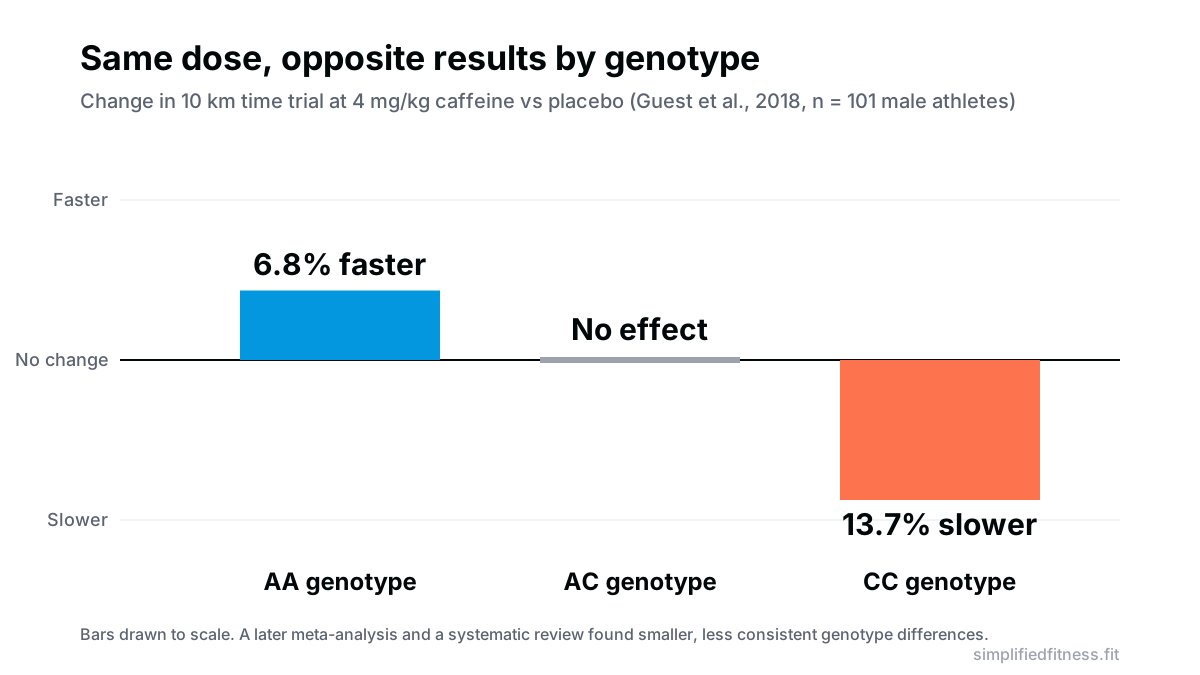
The authors concluded that genotype should be considered when deciding whether an athlete uses caffeine for endurance. That is the origin of the claim that caffeine can hurt performance in slow metabolizers. It is a real result. It is also one trial, in young male cyclists, on one type of exercise.
Do other studies agree? Conflicting evidence, explained
Not entirely. This is where the “caffeine hurts slow metabolizers” story gets more careful.
A 2024 meta-analysis agreed on direction. Pooling 13 studies and 440 participants (233 AA, 175 AC, 34 CC), Barreto et al. (2024) found caffeine improved performance in AA (SMD 0.30) and AC (SMD 0.16) but worsened it in CC (SMD -0.22). Dose and timing mattered only for CC, with higher doses and a longer wait before exercise giving better results.
But the CC finding was fragile. The same analysis found that studies with reported conflicts of interest drove the CC result. After excluding them, no influence of genotype was seen. The authors urged caution, and only 34 CC participants were in the whole pool.
A systematic review found small, patchy differences. Grgic et al. (2021) reviewed 17 studies. Where genotype differences appeared, they favoured AA over AC/CC, but they were small, inconsistent, or limited to specific scenarios, such as male cyclists doing 10 km or longer time trials.
Two trials found no genotype effect at all. In 40 cyclists, 5 mg/kg of caffeine improved a roughly 30 minute time trial regardless of CYP1A2 or ADORA2A genotype (Glaister et al., 2021). And in 22 resistance-trained men, 3 mg/kg improved bench press velocity and power, rep performance, jump height and Wingate output with no significant genotype by caffeine interaction (Grgic et al., 2020).
Why might the studies disagree? Different doses (2 to 5 mg/kg), different exercise (time trials versus lifts), small groups of CC carriers, different timing, and differences in how much coffee people drank day to day. The honest summary: a genotype effect may exist, especially for endurance, but it is smaller and less certain than the first trial suggested.
Does this apply to lifting and bodybuilding?
Mostly, caffeine still works for lifters. The ISSN position stand says caffeine acutely enhances many aspects of performance, including muscular endurance, movement velocity, strength, sprinting and jumping, in many but not all studies. Aerobic endurance shows the most consistent benefit.
The same position stand lists genetic variation as one possible reason people differ in performance and in side effects such as poor sleep or anxiety. It also lists habitual intake as another. Note that several authors disclosed ties to supplement or genetic testing companies, which is worth knowing when weighing how strongly these topics get promoted.
For a deeper look at dosing for strength work, see our guide to caffeine dosing for strength and power.
Where does ADORA2A fit in?
ADORA2A codes for the A2A adenosine receptor, one of the targets of caffeine in the brain. It is mostly discussed for side effects rather than performance. In Childs et al. (2008), 102 light caffeine users took 0, 50, 150 and 450 mg under double-blind conditions. At 150 mg, anxiety ratings were associated with several ADORA2A variants, while 450 mg raised anxiety in most people regardless.
For performance, the cycling trial above found no ADORA2A effect. So dose is a bigger lever than this gene, and the anxiety link is a plausible explanation for jitters, not a diagnosis. If anxiety is your main problem with pre-workout, our guide to caffeine sensitivity genetics covers that side in depth. If you have an anxiety disorder, talk to a doctor before using stimulant pre-workouts.
Why do I feel wired or sleepless hours later?
Slow clearance would mean caffeine sticks around longer, which would fit the experience of being awake at midnight after a 6 pm session. We do not have a clean study proving that for gym-goers, but the sleep effect itself is well documented. In a trial of 400 mg of caffeine given at bedtime, 3 hours before, or 6 hours before, all three reduced sleep versus placebo, and the authors advised avoiding substantial caffeine for at least 6 hours before bed (Drake et al., 2013).
If you train in the evening after work, chai after the gym adds up quickly. Count the caffeine in your tea, coffee, cola and pre-workout together. Our article on the afternoon caffeine cutoff covers timing in more detail, and poor sleep costs you more recovery than a missed pre-workout ever gains.
Signs you may be a slow responder
None of these prove your genotype. They are patterns worth noticing:
- Jitters, a pounding heart or anxiety after a modest dose
- Feeling wired for many hours after a single serving
- Sleep suffering after afternoon or evening caffeine
- Flat or worse training on the days you take it
- Needing very little to feel the effect
If several apply, treat caffeine as something to dose carefully. If you get chest pain, fainting or a heartbeat that stays fast or irregular, stop and see a doctor. If you are pregnant, have a heart condition or take regular medication, check your caffeine limit with your doctor before using pre-workouts at all.
What about heart health?
One large case-control study in Costa Rica (2,014 heart attack cases and 2,014 controls) found that drinking 4 or more cups of coffee a day was linked to higher odds of a non-fatal heart attack only in people carrying the slow allele, with an odds ratio of 1.64 versus 0.99 in rapid AA carriers (Cornelis et al., 2006). This is observational data on heavy coffee intake, so it cannot prove cause, and it does not mean a pre-workout scoop is dangerous for you. It is a reminder to keep total caffeine moderate and to ask a doctor if you have heart disease, palpitations or high blood pressure.
How to personalise caffeine without a genetic test
A gene report tells you about one factor. A short experiment tells you about your whole body, habits included.
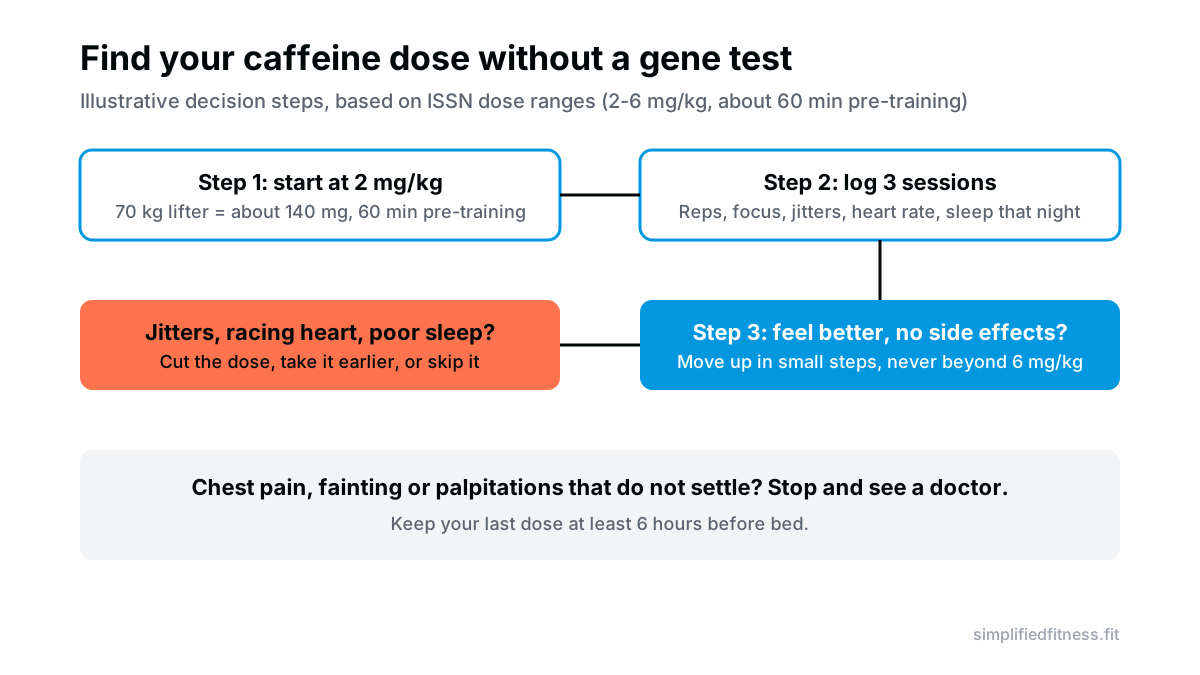
- Pick a starting dose. The ISSN says minimal effective doses may be as low as 2 mg/kg, with the reliable range at 3-6 mg/kg, taken about 60 minutes before exercise. A 70 kg lifter at 2 mg/kg is about 140 mg. Use our caffeine dosage calculator for your weight.
- Log three sessions. Note top-set reps, focus, jitters, resting heart rate feel and how you slept that night.
- Adjust. If you feel better with no side effects, move up in small steps. If you get jitters or poor sleep, drop back or take it earlier.
- Do not stack. Some tubs pack a lot of caffeine plus extra stimulants per scoop. Read the label or compare options in our DIY pre-workout guide.
- Reset if you drink a lot. If caffeine has stopped working, see how to reset caffeine tolerance.
Common mistakes
- Treating a gene result as a prescription. The performance evidence is mixed.
- Assuming more caffeine fixes a weak response. Very high doses (the ISSN mentions about 9 mg/kg) bring a high rate of side effects without being needed.
- Ignoring sleep. A pre-workout that wrecks sleep can cost more than it gives.
- Blaming genetics for everything. Dose, tolerance and total daily intake matter too.
The bottom line
CYP1A2 may change how you respond to caffeine, and the 2018 Guest trial is a striking example. But the broader evidence shows smaller, more variable differences, and resistance-trained men in the studies we have mostly benefit regardless of genotype. ADORA2A links to anxiety are plausible but based on small samples.
Start low, track what happens, keep caffeine away from bedtime, and see a doctor for any heart symptoms. If caffeine is not working for you, it is fine to skip it and put the effort into training, protein and sleep, for example with our free push day plan.
Frequently Asked Questions
What is the CYP1A2 gene and why does it matter for caffeine?
CYP1A2 makes a liver enzyme that breaks down most of the caffeine you drink. Different versions of the gene (called AA, AC and CC at the rs762551 spot) are linked to faster or slower clearance. How fast you clear caffeine can change how long it stays active in your body, which is why one coffee suits one lifter and rattles another.
What is the difference between fast and slow caffeine metabolizers?
Fast metabolizers (AA genotype) clear caffeine more quickly, while carriers of the C variant are often described as slower. The practical effect is mainly how long the stimulation lasts and how it feels. Pay attention to whether your jitters and sleep problems last for hours after a dose, because that is the clearest day-to-day sign.
Does caffeine hurt performance in slow metabolizers?
Sometimes, in some studies. In the 2018 Guest trial, athletes with the CC genotype cycled 13.7% slower on 4 mg/kg than on placebo, but a 2024 meta-analysis cautioned that this result depended on studies with reported conflicts of interest. Treat it as a possibility rather than a rule, and test a lower dose on yourself before assuming caffeine helps.
Can I find out my CYP1A2 genotype?
Yes, consumer and clinical DNA tests can report rs762551, but the result only predicts a tendency and the performance evidence is mixed. A 2021 systematic review concluded that genotype differences were small, inconsistent or limited to specific exercise scenarios. A simple self-test of dose and response tells you more than a gene report does.
What is ADORA2A and how does it relate to caffeine anxiety?
ADORA2A codes for the adenosine A2A receptor, one of the receptors caffeine blocks in the brain. In a double-blind study of 102 people, certain ADORA2A variants were associated with more anxiety after 150 mg of caffeine. The sample was small, so if caffeine makes you anxious, simply lower the dose or drop it before hard sessions.
Why does caffeine keep me awake for hours after training?
Caffeine has a long half-life, and slower clearance can stretch that further. A trial found that 400 mg taken even 6 hours before bedtime measurably disrupted sleep. Finish your last caffeine at least 6 hours before bed, and earlier if you notice you sleep badly after evening sessions.
How much caffeine should a slow metabolizer take before the gym?
There is no validated dose by genotype. The ISSN says minimal effective doses may be as low as 2 mg/kg, and the performance range is 3-6 mg/kg. If you suspect you are sensitive, start at 2 mg/kg (about 140 mg for a 70 kg person) and only go up if it clearly helps without side effects.
Does CYP1A2 affect strength training as well as endurance?
Less clearly. In a trial of 22 resistance-trained men, 3 mg/kg of caffeine improved bench press velocity, power, rep performance and jump height, with no significant difference between AA and AC/CC genotypes. The sample was small, so a modest genotype effect cannot be ruled out, but most lifters should expect caffeine to help if they tolerate it.
Is coffee riskier for slow metabolizers?
In one large Costa Rican case-control study, heavy coffee drinking was linked to higher odds of a non-fatal heart attack only in carriers of the slow allele. That is observational data about coffee habits, not about pre-workout, and it does not prove caffeine caused the difference. If you have heart disease or palpitations, ask your doctor about your caffeine limit.
Do I need a genetic test to personalise my pre-workout?
No. A three-session log of reps, jitters and sleep gives you the information that matters. The mechanism is that your response depends on your gene variants, your habitual intake, your body weight and the dose, and a gene test covers only one of those. Use our caffeine dosage calculator for a starting number, then adjust.
Could habitual coffee intake change how I respond?
Yes. The ISSN position stand notes that habitual caffeine intake may also explain differences between people, alongside genetics. If you drink several chais a day, your response to a pre-workout dose may differ from someone who rarely has caffeine, so a short reset can help.
When should I see a doctor about caffeine side effects?
See a doctor if caffeine causes chest pain, fainting, a heartbeat that stays fast or irregular, or severe anxiety. Caffeine acts on the nervous system and the heart, so persistent symptoms deserve a proper check rather than a supplement tweak. Until then, stop caffeine and do not use pre-workouts.
Sources & References
Every claim above is checked against peer-reviewed research (PubMed, U.S. National Library of Medicine) or guidance from established health bodies. How we fact-check.
- Guest N, et al. Caffeine, CYP1A2 Genotype, and Endurance Performance in Athletes. Med Sci Sports Exerc. 2018. PMID: 29509641
- Barreto G, et al. Caffeine, CYP1A2 Genotype, and Exercise Performance: A Systematic Review and Meta-analysis. Med Sci Sports Exerc. 2024. PMID: 37844569
- Grgic J, et al. CYP1A2 genotype and acute effects of caffeine on resistance exercise, jumping, and sprinting performance. J Int Soc Sports Nutr. 2020. PMID: 32295624
- Glaister M, et al. Caffeine, exercise physiology, and time-trial performance: no effect of ADORA2A or CYP1A2 genotypes. Appl Physiol Nutr Metab. 2021. PMID: 33170731
- Grgic J, et al. CYP1A2 genotype and acute ergogenic effects of caffeine intake on exercise performance: a systematic review. Eur J Nutr. 2021. PMID: 33137206
- Childs E, et al. Association between ADORA2A and DRD2 polymorphisms and caffeine-induced anxiety. Neuropsychopharmacology. 2008. PMID: 18305461
- Cornelis MC, et al. Coffee, CYP1A2 genotype, and risk of myocardial infarction. JAMA. 2006. PMID: 16522833
- Drake C, et al. Caffeine effects on sleep taken 0, 3, or 6 hours before going to bed. J Clin Sleep Med. 2013. PMID: 24235903
- Guest NS, et al. International society of sports nutrition position stand: caffeine and exercise performance. J Int Soc Sports Nutr. 2021. PMID: 33388079

Umair Hazrami · Founder & Head Coach, Simplified Fitness
Umair Hazrami founded Simplified Fitness and the Simplified Lifter channel to cut through fitness noise. With 4+ years of consistent training and 10+ coaching clients, he writes every guide from the peer-reviewed research and links the sources so you can check them. Our editorial standards.
Educational content only, not medical advice. If you have a medical condition, are pregnant, or take medication, talk to a qualified doctor before changing your diet, supplements or training. Full disclaimer.
Keep reading
Supplements
Ashwagandha KSM-66 vs Sensoril: Which Extract, What Dose, and Do You Need to Cycle?
Ashwagandha KSM-66 vs Sensoril for lifters: what the strength trials show, realistic cortisol effects, liver safety and whether to cycle. Every study linked.
8 min read
Supplements
BCAAs vs EAAs: Why BCAAs Are a Waste of Money If Your Protein Is Covered
BCAA vs EAA for muscle growth: BCAAs are only 3 of the 9 essential amino acids. See what Wolfe 2017 and Jackman 2017 found and when EAAs or whey make sense.
8 min read
Supplements
Beetroot Juice for Running and Lifting: How Dietary Nitrate Works (and the Mouthwash Trap)
Does beetroot juice for running actually work? See what meta-analyses show, the 2-3 hour timing and dose, who benefits, and why mouthwash can cancel the effect.
9 min read

Supplements
Beta-Alanine Benefits: Carnosine Buffering, High-Rep Gains and Why It Makes You Tingle
Beta-alanine benefits explained: why pre-workout makes your skin tingle, how carnosine buffers acid, what dose works, and who should skip it. Studies linked.
8 min read