The Antioxidant Paradox: Can Vitamin C and E Pills Blunt Muscle Growth and Endurance?
Does vitamin C blunt muscle growth? See what trials of 1000 mg vitamin C plus E found for strength, hypertrophy and endurance, and when pills are worth taking.

TL;DR. The short answer
- High-dose vitamin C plus E (about 1000 mg of C with 235 mg to 400 IU of E daily) blunted muscle adaptation markers in several endurance trials, and some resistance trials, but results are mixed and one 2025 trial in older women found the opposite.
- Reactive oxygen species made during hard training act as signals for adaptation, which is why mopping them up with mega-doses can backfire.
- In the best-known endurance trial, VO2 max rose 8% on both supplements and placebo, so the damage showed up in muscle biopsies, not in the performance test.
- Food sources of vitamin C and polyphenols are not shown to cause the same problem, and the ISSN prefers whole foods over antioxidant pills.
- If you are not deficient, skipping routine 1000 mg tablets around training is the lower-risk choice. Ask a doctor before changing any medically advised supplement.
Part of our complete guide: Creatine, Protein Powders, Pre-Workouts and Caffeine: The Science and Safety Guide
Table of contents
Does vitamin C blunt muscle growth? Possibly, when it is taken as a daily mega-dose alongside vitamin E during a training block. Several trials found weaker adaptation signals in muscle, and some resistance training studies found smaller gains, but the evidence is mixed and not every trial agrees.
That makes “antioxidants kill gym gains” too strong. It also makes “free antioxidants are harmless” too weak. This article walks through what the studies actually did, what they found, and what to do about that daily effervescent tablet. It sits inside our complete guide to creatine, protein powders and caffeine, which covers the supplements that do have strong evidence.
Why would an antioxidant hurt training?
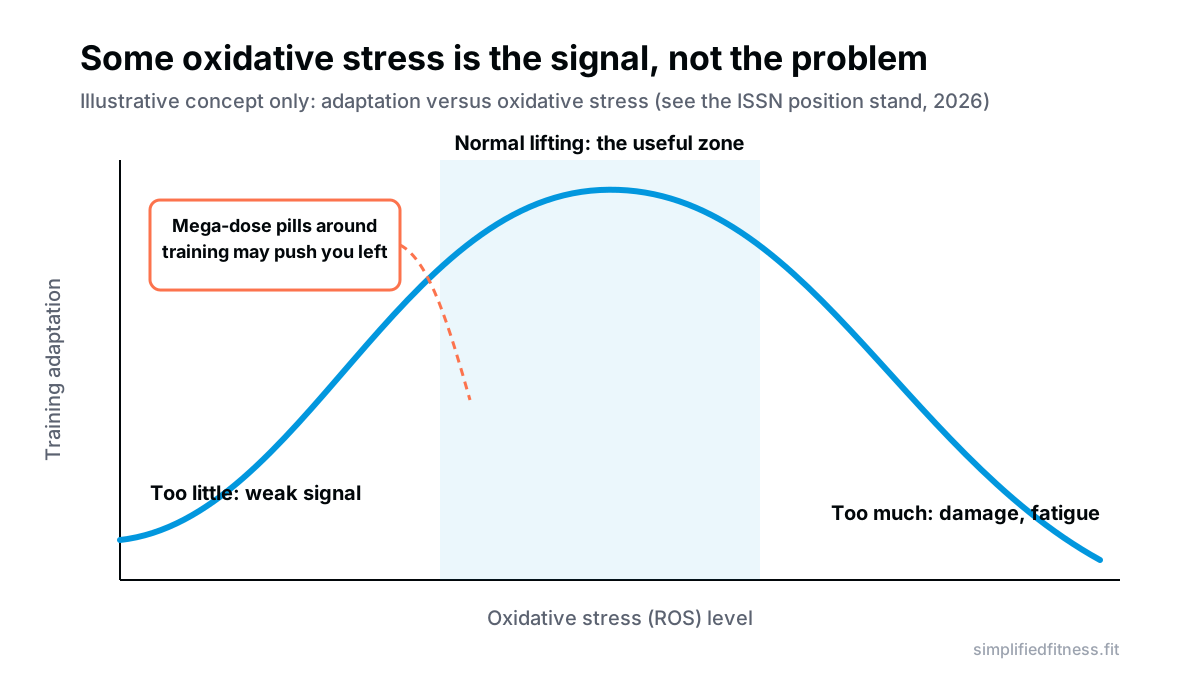
Lifting is a controlled stress. Contracting muscle makes reactive oxygen species (ROS), the “free radicals” that supplement labels warn about. A 2020 review describes this contraction-driven ROS as being linked to oxidant damage and fatigue, and also to the activation of signalling pathways that contribute to adaptation in the muscle fibre (Powers et al., 2020).
So the same molecules do two jobs. Too many cause damage. A moderate amount works like a message: this muscle was stressed, rebuild it better.
The mechanism people point to is that ROS help switch on adaptation regulators such as PGC-1alpha, which is involved in building mitochondria. Mop up the signal and the message arrives quieter. That is the antioxidant paradox. The ISSN calls it a spectrum: mild oxidative stress drives adaptation, while excessive levels impair recovery and performance (Gonzalez et al., 2026).
What did the endurance trials find?
The most-quoted human work is on endurance training, so start there.
In 2008, 14 men aged 27 to 36 trained for 8 weeks, and 5 of them took 1 g of vitamin C daily. The vitamin C group had hampered endurance capacity and lower expression of the factors involved in mitochondrial biogenesis. The sample was tiny, and the paper also included a rat study (Gomez-Cabrera et al., 2008).
A bigger trial followed. In 2014, 54 young men and women took 1000 mg of vitamin C plus 235 mg of vitamin E or placebo for 11 weeks of running-based training. VO2 max rose 8% in both groups, and the shuttle test improved in both. But the mitochondrial marker COX4 rose 59% in the placebo group versus a 13% fall with the vitamins, and PGC-1alpha rose 19% versus a 13% fall (Paulsen et al., 2014).
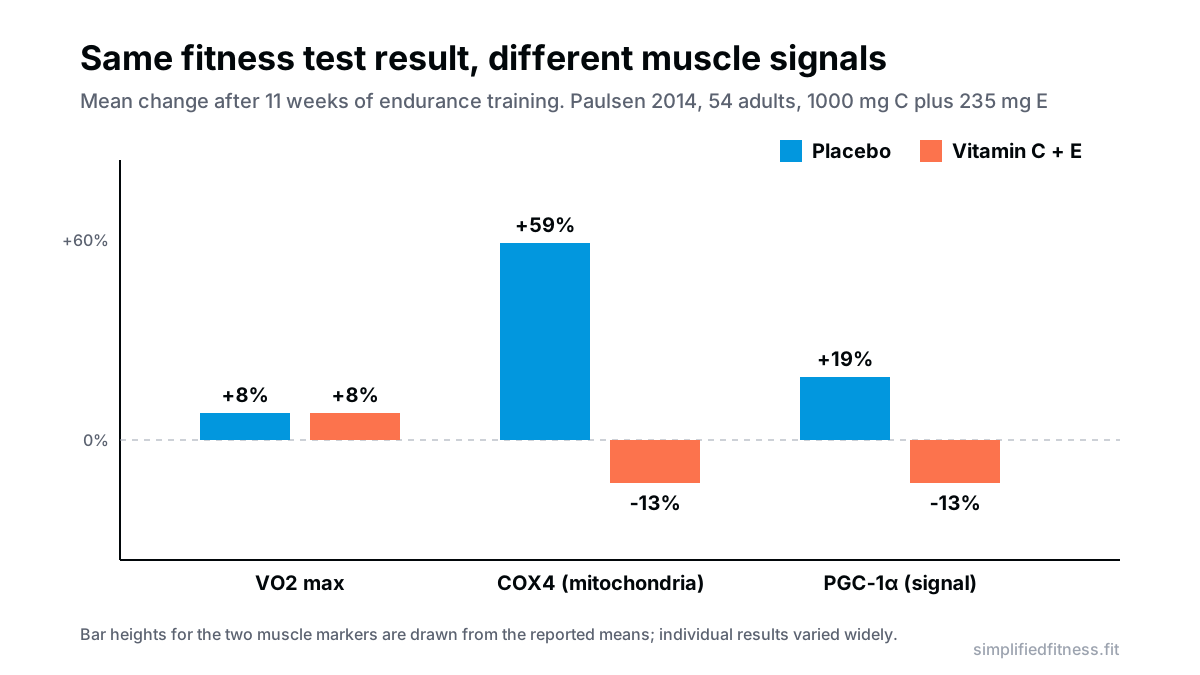
Read that carefully. The study did not show worse running. It showed a weaker cellular response, and the authors advised caution.
Another trial adds nuance. In 11 young men, vitamin C (1000 mg a day) plus E (400 IU) did not stop VO2peak from rising and did not block several mitochondrial markers, but it did dampen increases in SOD2 and TFAM after four weeks of training (Morrison et al., 2015). So even among the studies showing an effect, the picture is “some adaptations blunted”, not “training cancelled”.
Does vitamin C blunt muscle growth in lifters?
This is where the story gets messier, and I would rather show you the mess than hide it.
Studies that point toward a blunting effect:
- A 2018 trial in 42 young women compared 1 g vitamin C plus 400 IU vitamin E with placebo and a no-training control over 10 weeks of twice-weekly strength training. Muscle thickness rose similarly in both trained groups, but the authors concluded that chronic supplementation may attenuate gains in peak torque and total work (Dutra et al., 2018).
- A 2023 trial in trained men (12 on vitamins, 11 on placebo) ran 10 weeks with a small calorie surplus. Both groups improved their lifts, but fat-free mass in the upper body rose significantly only on placebo, and the authors said the vitamins seemed to blunt upper body strength and hypertrophy (Martinez-Ferran et al., 2023). With 23 people, treat it as a signal.
- A 2020 systematic review included seven trials. Its strength meta-analysis (three studies) found no effect on force production, and it concluded that most evidence suggests the vitamins do not help growth and could possibly attenuate hypertrophy over time (Dutra et al., 2020).
A study that points the other way:
- In 60 older women with sarcopenia, 12 weeks of elastic-band training plus 1000 mg vitamin C and 335 mg vitamin E produced larger gains in arm lean mass, skeletal muscle mass index, handgrip and knee extension strength than placebo (Liu et al., 2025).
Why the disagreement? The populations differ. Older women with sarcopenia may carry higher baseline oxidative stress and inflammation, and the authors link their result to reduced oxidative stress and inflammation. Training programmes also differed: elastic bands versus barbell work, 10 versus 12 weeks. Some trials were small. And muscle thickness or lean mass methods differ between labs.
Does it affect health benefits beyond muscle?
One often-cited trial looked at insulin sensitivity, not size. In 39 healthy young men, 4 weeks of exercise improved insulin sensitivity only in people not taking 1000 mg vitamin C plus 400 IU vitamin E, in both previously untrained and pretrained groups (Ristow et al., 2009). That is a small, short trial, so treat it as a flag worth following up. It does matter for anyone taking antioxidants “for health” while training.
Do vitamin C pills at least help soreness?
If you are going to risk some adaptation, you would hope for a payoff. The payoff is thin.
A meta-analysis of 18 trials (313 people, median age 24) found vitamin C lowered some oxidative stress and IL-6 markers after a single bout, but no effect on creatine kinase, muscle soreness or strength (Righi et al., 2020). A systematic review of 14 DOMS trials found soreness significantly reduced in only 3, and called the evidence insufficient to confirm a benefit (Torre et al., 2021).
So the best case is a marker that moves in a lab with no felt difference in the gym. For the real drivers of soreness, see our piece on DOMS and muscle growth.
Taking vitamin C after a workout: does timing fix it?
A common follow-up after hearing “avoid antioxidants” is: “so I just take it at night, right?”
Honest answer: no trial I found tested “post-workout only” or “rest days only” against placebo for long-term hypertrophy. The trials that found blunted markers dosed daily for 4 to 12 weeks. If the supplement stays elevated in the body across the training block, moving it a few hours may not change much. That is a reasonable inference, not a proven fact.
The lower-risk plan is simpler:
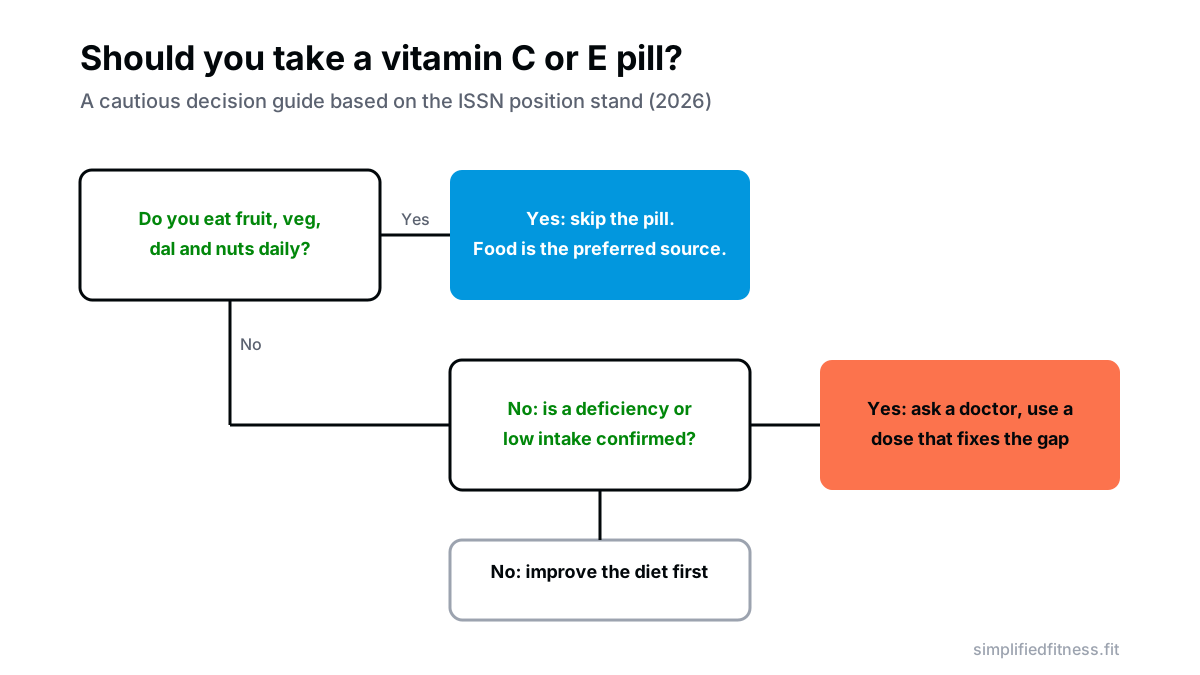
- Get vitamin C from food, such as citrus, guava, amla, tomato and leafy greens.
- Skip routine 1000 mg tablets unless a doctor has found a gap.
- If you do take one, keep it away from the hardest training block and check the dose.
Whole foods versus mega-dose pills
The studies above used isolated vitamins at doses far above food levels. Nothing in them shows that eating fruit and vegetables blunts training. The ISSN states that long-term exercise itself builds endogenous antioxidant defence, that whole foods rich in flavonoids, polyphenols, carotenoids and vitamins are the preferred source, and that supplements are best kept for deficiency, inadequate intake or high training distress (Gonzalez et al., 2026).
It also lists a few antioxidant-type nutrients with moderate-to-high-quality evidence that do not interfere with adaptation, including creatine monohydrate (0.1 g/kg/day), omega-3 fatty acids, tart cherry and astaxanthin. Worth knowing: several authors report supplement industry funding, and one works for an astaxanthin maker. For the tart cherry case, see our tart cherry juice recovery guide.
| Source | Typical situation | Concern for training adaptation |
|---|---|---|
| Fruit, vegetables, dal, nuts | Daily meals | No evidence of blunting; preferred by the ISSN |
| Moderate multivitamin | Low-dose insurance | Not the mega-doses used in trials, but check the label |
| 1000 mg vitamin C plus 235 mg to 400 IU vitamin E | Daily for weeks | Blunted some adaptation markers in several trials |
| Prescribed or deficiency-correcting doses | Doctor-guided | Different goal; follow medical advice |
Who should be careful, and when to see a doctor
Do not stop a vitamin your doctor prescribed, such as for anaemia, malabsorption or a deficiency, because you read this article. Vegetarian and vegan lifters, people on very low-calorie diets, smokers and people with absorption problems may have genuine gaps. If you suspect one, get tested instead of guessing. Our guide on micronutrient gaps in lifters covers the common ones.
Older adults and people with diabetes or sarcopenia should talk to their doctor before adding or removing antioxidant pills, because the evidence in these groups is limited and the 2025 trial points a different direction.
A practical plan
- Eat two or three servings of fruit and a couple of vegetable portions most days. Lemon in water, a guava, an orange or an amla chutney all count.
- If you currently take 1000 mg vitamin C or 400 IU vitamin E daily, ask yourself why. If the answer is “to be safe,” that reason is weak.
- Set protein and calories correctly first; use our protein calculator, since that drives growth far more than any vitamin.
- If you take a supplement for a diagnosed deficiency, keep taking it as advised.
None of this is dramatic. The upside of the research is modest and the downside risk is probably modest too, but a pill with no clear benefit and some signal of harm is an easy one to drop.
Frequently Asked Questions
Does vitamin C blunt muscle growth?
It might, but the evidence is mixed. A 2020 systematic review concluded that vitamin C and E do not boost muscle growth and could possibly attenuate hypertrophy over time, while a 2025 trial in older women with sarcopenia found larger gains with the vitamins. If you are not deficient, skipping high-dose pills is the cautious choice.
Do antioxidants kill gym gains?
Not all antioxidants, and not in every study. The concern is mainly synthetic high-dose vitamin C and E, which can dampen the reactive oxygen signals that drive adaptation. Food sources and normal intakes are a different situation, so build your diet around fruit, vegetables and dal rather than pills.
Is it bad to take vitamin C after a workout?
Normal amounts from food after a workout are not a problem. The worry is with supplements around 1000 mg daily taken during a training block, because trials used daily dosing for weeks, not a single dose. Get your vitamin C from a meal with fruit or vegetables and skip the megadose tablet.
What is the antioxidant paradox in exercise?
It is the finding that antioxidants, which neutralize free radicals, can reduce the benefits of exercise that depend on those same free radicals. Reactive oxygen species made in contracting muscle help switch on adaptation pathways such as PGC-1alpha. Blocking too much of that signal may blunt some training adaptations.
How much vitamin C and E blunted adaptations in studies?
Trials used about 1000 mg of vitamin C with 235 mg to 400 IU of vitamin E daily for 4 to 12 weeks. Those doses are far above what a normal diet provides. If your supplement label shows a similar dose, check whether you actually need it.
Does vitamin E affect hypertrophy?
Vitamin E has mostly been tested together with vitamin C, so its separate effect is hard to isolate. In combination, a 2023 trial in trained men found upper body strength and lean mass gains looked blunted. Without a deficiency, there is no strong reason to take extra vitamin E for muscle.
Do vitamin C pills reduce muscle soreness?
Probably not by much. A meta-analysis of 18 trials found no effect of vitamin C on muscle soreness or strength after a single exercise bout, and a systematic review found soreness reduced in only 3 of 14 studies. Sleep, protein and sensible training progression do more.
Are fruits and vegetables also a problem for muscle gains?
There is no good evidence that eating fruit and vegetables blunts adaptation. The ISSN position stand names whole foods as the preferred source of antioxidants. The risk signal comes from isolated high-dose supplements, so keep eating your fruit.
Can I take antioxidants on rest days only?
There is no trial that proves a rest-day-only schedule is safe or better. Daily dosing for weeks was the pattern in studies that found blunted markers, so timing may not fix the concern. If you are not deficient, the simplest option is to skip the pill.
Should vegetarians in India take a vitamin C supplement?
Usually not. A vegetarian diet that regularly includes citrus, guava, amla, tomatoes and leafy greens is rich in vitamin C. If a blood test or doctor shows a gap, a modest dose that corrects it is a different case from a 1000 mg daily habit. Ask your doctor before starting.
Do antioxidants help older adults lift?
Evidence in older people is limited and conflicting. A 2025 trial in 60 older women with sarcopenia found larger muscle and strength gains with vitamins C and E plus training, which goes against the young-adult findings. Older adults should discuss supplements with their doctor rather than copying studies in young people.
Do antioxidants hurt endurance training?
They can blunt some muscle adaptations, though performance tests often do not show it. In a tiny 2008 trial, the 5 men taking 1 g of vitamin C daily gained less endurance capacity than the 9 who did not, but a 2014 trial found VO2 max rose equally with or without the vitamins. Be cautious with mega-doses if endurance is a main goal.
Do antioxidants affect insulin sensitivity gains from exercise?
In one 4-week trial of 39 young men, insulin sensitivity improved with exercise only in the group not taking vitamin C and E. It was a small study, so treat it as a warning signal, not proof. If you have diabetes, talk to your doctor before adding antioxidant pills.
Sources & References
Every claim above is checked against peer-reviewed research (PubMed, U.S. National Library of Medicine) or guidance from established health bodies. How we fact-check.
- Paulsen G, et al. Vitamin C and E supplementation hampers cellular adaptation to endurance training in humans: a double-blind, randomised, controlled trial. J Physiol. 2014. PMID: 24492839
- Gomez-Cabrera MC, et al. Oral administration of vitamin C decreases muscle mitochondrial biogenesis and hampers training-induced adaptations in endurance performance. Am J Clin Nutr. 2008. PMID: 18175748
- Ristow M, et al. Antioxidants prevent health-promoting effects of physical exercise in humans. Proc Natl Acad Sci U S A. 2009. PMID: 19433800
- Morrison D, et al. Vitamin C and E supplementation prevents some of the cellular adaptations to endurance-training in humans. Free Radic Biol Med. 2015. PMID: 26482865
- Dutra MT, et al. The effects of strength training combined with vitamin C and E supplementation on skeletal muscle mass and strength: a systematic review and meta-analysis. J Sports Med. 2020. PMID: 31970196
- Dutra MT, et al. Effect of strength training combined with antioxidant supplementation on muscular performance. Appl Physiol Nutr Metab. 2018. PMID: 29939770
- Martinez-Ferran M, et al. Antioxidant vitamin supplementation on muscle adaptations to resistance training: a double-blind, randomized controlled trial. Nutrition. 2023. PMID: 36283241
- Liu X, et al. Effects of vitamins C and E supplementation combined with 12-week resistance training in older women with sarcopenia: a randomized, double-blind, placebo-controlled trial. Medicine. 2025. PMID: 40859523
- Righi NC, et al. Effects of vitamin C on oxidative stress, inflammation, muscle soreness, and strength following acute exercise: meta-analyses of randomized clinical trials. Eur J Nutr. 2020. PMID: 32162041
- Torre MF, et al. Supplementation with vitamins C and E and exercise-induced delayed-onset muscle soreness: a systematic review. Antioxidants. 2021. PMID: 33673055
- Gonzalez DE, et al. International Society of Sports Nutrition position stand: effects of dietary antioxidants on exercise and sports performance. J Int Soc Sports Nutr. 2026. PMID: 41701327
- Powers SK, et al. Exercise-induced oxidative stress: friend or foe? J Sport Health Sci. 2020. PMID: 32380253

Umair Hazrami · Founder & Head Coach, Simplified Fitness
Umair Hazrami founded Simplified Fitness and the Simplified Lifter channel to cut through fitness noise. With 4+ years of consistent training and 10+ coaching clients, he writes every guide from the peer-reviewed research and links the sources so you can check them. Our editorial standards.
Educational content only, not medical advice. If you have a medical condition, are pregnant, or take medication, talk to a qualified doctor before changing your diet, supplements or training. Full disclaimer.
Keep reading

Recovery
DOMS Explained: Why Muscle Soreness Does Not Equal Muscle Growth
Does soreness mean muscle growth? Not reliably. See what causes DOMS, why you stop getting sore, and how to judge a workout without relying on pain.
7 min read

Supplements
Multivitamins for Lifters: Cheap Insurance or Expensive Urine?
Do multivitamins for lifters help strength or energy? See what the research says, who may benefit from a low-dose multi, and who is wasting money.
9 min read
Supplements
Alpha-GPC and Huperzine A Pre-Workout: Do Cholinergic Nootropics Help Lifting?
Does an alpha GPC pre workout add power or focus? See what small trials found, why Huperzine A is a poor lifting bet, and the safety flags to know first.
10 min read

Supplements
Caffeine Powder vs Coffee Before Lifting: Does the Source Really Matter?
Caffeine anhydrous vs coffee for lifting: what research says on absorption speed, peak levels and stomach upset, and whether pills beat your daily cup.
7 min read