Betaine (TMG) for Strength and Power: What the Research Really Shows
Does betaine build muscle or boost power? We review the trials and meta-analyses on betaine TMG, the 2.5 g dose, betaine vs creatine, and betaine HCl.

TL;DR. The short answer
- Betaine TMG (trimethylglycine) is not a muscle builder. A 2022 meta-analysis found no significant effect on fat-free mass or fat mass, so the early body composition headlines have not held up.
- A 2024 meta-analysis of 17 trials found a modest benefit for maximal strength (SMD 0.47, wide confidence interval), mainly in the lower body, with no clear effect on upper-body strength, sprint power or endurance.
- The dose used in most lifting trials is about 2.5 g a day of betaine anhydrous, taken daily for at least a week or more. Betaine HCl is a different product and should not be used as a swap.
- Betaine does not replace creatine. In a 10-day trial it did not raise muscle phosphocreatine, and adding it to creatine gave nothing extra.
- Doses of 4 g a day or more may raise total cholesterol modestly. If you have heart, liver or kidney conditions, check with your doctor first.
Part of our complete guide: The Evidence-Based Fitness Supplements Guide: What Works, What's Overhyped & What's a Waste of Money
Table of contents
Betaine TMG gets sold as a cheap, steroid-like muscle builder. It is not. The best current evidence says it is a modest supplement that may add a little to maximal strength, mostly in the legs, and does little for muscle size.
This page sits inside our evidence-based supplements guide, and betaine belongs in the “interesting, optional” bucket there, well below creatine. Below we go through what it is, what each study actually found, the dose, and the betaine HCl confusion.
What is betaine TMG, and how does it work?
Betaine is trimethylglycine (TMG), a small molecule found in grain-based foods and vegetables. Your body also makes it from choline. It has two jobs that supplement companies like to talk about.
Osmolyte. An osmolyte helps a cell hold water and keep its volume under stress, such as heat or hard exercise. The theory is that better-hydrated muscle cells may work a bit better. This is a plausible mechanism, not a proven one in lifters.
Methyl donor. Betaine can donate a methyl group to turn homocysteine back into methionine. In one trial of strength-trained men, betaine blunted a rise in a homocysteine-related marker during training (Cholewa et al., 2013). That shows a biochemical effect. It does not by itself show more strength or muscle.
Does betaine build muscle? The 2013 study and what came after
The claim started with a 6-week trial in 23 strength-trained men (4.8 years of training on average). Half took 2.5 g a day of betaine, half took placebo. Betaine users improved body composition and arm size, and bench press training volume was higher in two of the three micro-cycles. But there were no differences in bench, squat or vertical jump performance, only a non-significant trend (p = 0.07) for jump power (Cholewa et al., 2013).
Notice the sample size. Eleven people took betaine. Body composition and arm and thigh size were estimated from skinfold calipers, which are not precise.
When researchers pooled the trials, the picture flattened. A 2022 meta-analysis found betaine did not significantly change body mass, body fat percentage, fat mass or fat-free mass (fat-free mass: +0.61 kg, 95% CI -1.27 to 2.49) (Ashtary-Larky et al., 2022). Results were similar across age, sex, trial length and dose. To be fair, a 2024 narrative review read the trials more kindly, concluding that betaine improves body composition when combined with exercise (Nikrandt & Chmurzynska, 2024). A pooled meta-analysis is the stronger form of evidence here, but it is a reminder that the question is not fully closed.
Why the gap? Small trials with noisy measures can produce striking results that shrink as more studies arrive. Betaine can also shift fluid in the body, which some body composition methods read as lean mass. That second point is a possible explanation, not something these studies tested directly.
Does betaine improve strength and power?
Here the evidence is more favourable, though still mixed.
A 2017 systematic review of 7 randomized trials (all rated excellent quality) found only 2 reported strength or power gains, while 5 found no change. The author concluded there was no clear ergogenic effect, though more research was needed (Ismaeel, 2017).
A newer 2024 meta-analysis pooled 17 trials with 317 participants (21% female) using chronic betaine versus placebo. It found a significant effect on maximal strength (SMD 0.47, 95% CI 0.04 to 0.89), especially lower-body strength (SMD 0.49, 95% CI 0.01 to 0.98). There were no significant effects on upper-body strength, cycling sprint power, bench press throw power or muscular endurance. Vertical jump improved (SMD 0.36) only after one low-quality study was excluded (Zawieja et al., 2024).
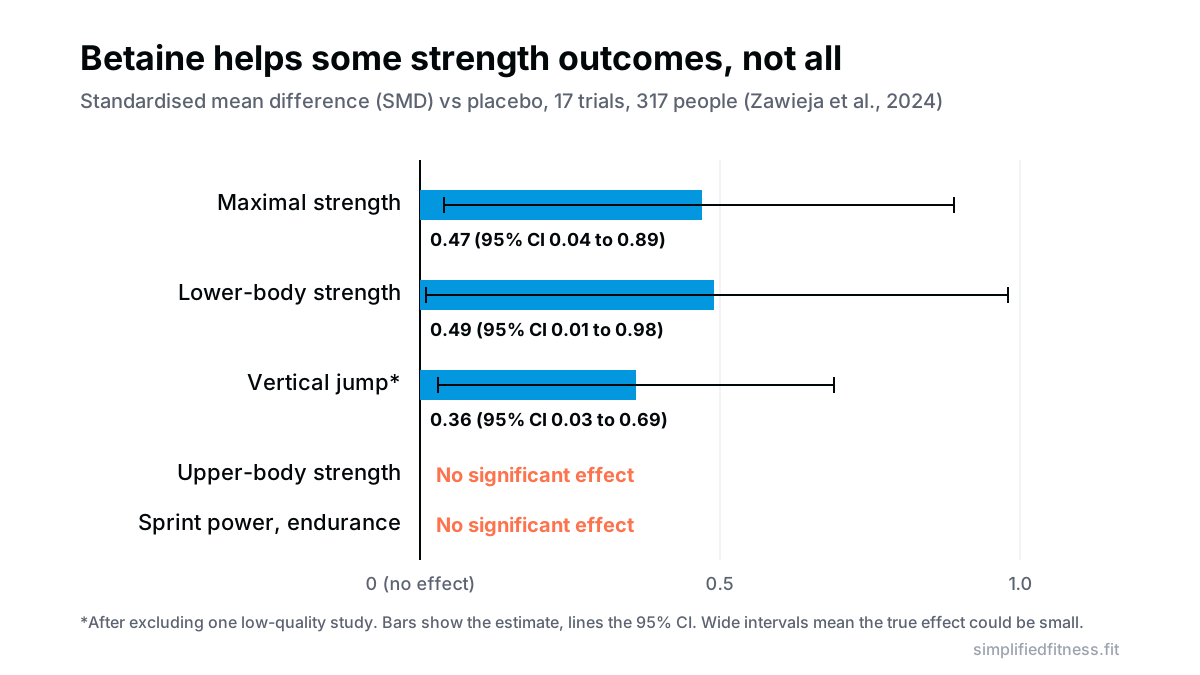
Why do the two reviews disagree? The 2024 analysis had more trials, and it pooled different outcomes together, which gives more statistical power. The confidence intervals are wide, with lower bounds barely above zero, so a real effect could be tiny. A sensible reading: betaine might help a little, the effect is not guaranteed, and it is far smaller than what you get from simply adding sets, sleeping well or eating enough protein.
You will sometimes see “3-5% more power” quoted for betaine. The sources above do not give a single reliable figure like that, so treat any exact percentage with suspicion.
Betaine vs creatine: do they stack?
Creatine raises the phosphocreatine stored in your muscle. Does betaine do the same, or add to it? One 10-day, double-blind trial in untrained people tested betaine (2 g a day), creatine (20 g a day), both together, and placebo.
Creatine and creatine plus betaine raised muscle phosphocreatine and improved 1RM and power. Betaine alone did not raise phosphocreatine and did not change strength or power versus placebo. Adding betaine to creatine gave no difference over creatine alone (del Favero et al., 2012).
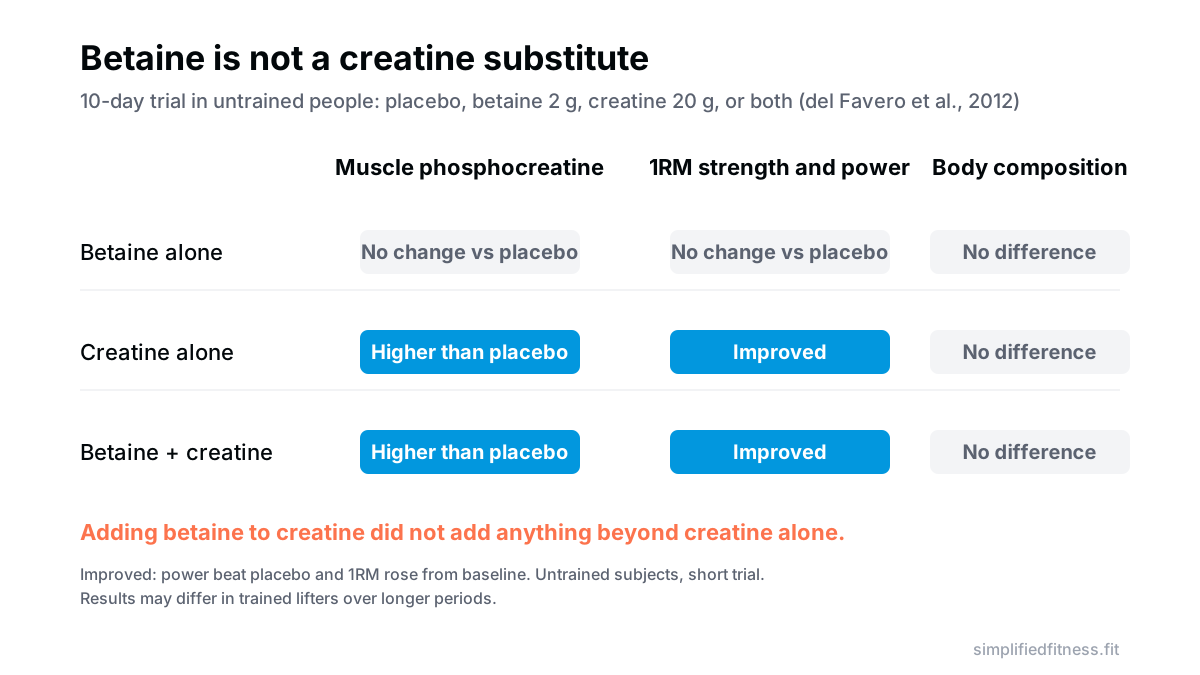
Caveats matter here: the participants were untrained, the trial was short, and the betaine dose was 2 g. It does not rule out small effects in trained lifters over weeks. Still, it supports a clear ranking. Start with creatine monohydrate and use our creatine dosage calculator to set the dose. Betaine is a maybe-later extra.
Betaine anhydrous dose: how much and for how long?
The trials in lifters mostly used about 2.5 g a day of betaine anhydrous, taken daily rather than just before training (Cholewa et al., 2013). The 2024 meta-analysis only included chronic supplementation and reported benefits with at least 7 days of use (Zawieja et al., 2024).
More is not clearly better. A meta-analysis of six trials using at least 4 g a day for 6 to 24 weeks found total cholesterol rose by about 0.34 mmol/L (95% CI 0.02 to 0.65), with no significant change in LDL, HDL or triglycerides (Zawieja et al., 2021). A later narrative review described total and LDL cholesterol increases at 4 g a day or more (Nikrandt & Chmurzynska, 2024). The two summaries differ on LDL, which is a good reason to stay near 2.5 g and not chase bigger numbers.
Betaine anhydrous vs betaine HCl: the stomach acid warning
These are different products with similar names. Betaine anhydrous is the form used in the sports studies above. Betaine HCl (hydrochloride) is generally sold to add stomach acid, and none of the trials in this article tested it for strength or power.
Do not treat HCl as a cheaper swap. The extra acid can irritate the stomach lining. If you have reflux, gastritis, an ulcer, or take anti-inflammatory painkillers regularly, speak to a doctor before using it. Check the label for “betaine anhydrous” or “trimethylglycine” and an exact milligram amount.
Is betaine in pre-workout worth it?
Many pre-workouts list betaine, often inside a proprietary blend that hides how much is in it. The studies used about 2.5 g daily, and a single pre-workout scoop may contain much less. Our guides on spotting proprietary blends and underdosing tricks show how to read these labels.
How to take betaine if you decide to try it
Keep it simple. Buy plain betaine anhydrous powder from a brand that publishes third-party test results, and measure 2.5 g with a scale or a scoop you have checked. None of the studies above tested timing, so take it whenever you will remember, in one go or split between two meals. Mix it into water, a shake or curd.
Do not stack three new things at once. Add betaine on its own, keep your training the same, and write down your top-set squat or leg press weight each week. A change smaller than your normal week-to-week swing is not evidence that it works. Because the likely benefit is small, a fair test needs several weeks, not a few sessions.
Who should skip betaine, or ask a doctor first?
Nothing on this page is medical advice. Talk to your doctor before using it if you:
- have high cholesterol or heart disease, given the cholesterol findings at higher doses
- have kidney or liver disease, or a metabolic condition such as homocystinuria
- are pregnant or breastfeeding, since there is little research on lifters in those groups
- take regular medication and are unsure about interactions
Evidence in women is thin. A single 8-week trial in 23 untrained young women found no extra strength benefit from betaine, though fat mass and body fat percentage dropped more than on placebo (Cholewa et al., 2018). One small study is a hint, not a recommendation.
The bottom line on betaine TMG
Betaine TMG is a small, optional extra. It does not build muscle on its own, it does not replace creatine, and the strength effect is modest and uncertain. A 2024 review of the market also noted that betaine is promoted for many different uses while clinical efficacy remains unclear (Nikrandt & Chmurzynska, 2024).
If your training, protein (dal, paneer, curd, eggs, soya), sleep and creatine are already sorted, 2.5 g of betaine anhydrous daily is a low-risk experiment for lower-body strength. Until then, put that money into food. For the full ranking, see our supplement hierarchy from proven to scam, and build the training side with our free leg day plan.
Frequently Asked Questions
What is betaine (TMG) and what does it do?
Betaine, also called trimethylglycine (TMG), is a small molecule found in grains, spinach and beets that your body also makes. It acts as an osmolyte, helping cells hold water under stress, and as a methyl donor that helps convert homocysteine back to methionine. Whether those roles translate into better lifting is the open question, and most of the evidence says only modestly.
Does betaine build muscle?
Probably not in any meaningful way. One 6-week trial in 23 trained men reported improved body composition, but a 2022 meta-analysis of the wider literature found no significant change in fat-free mass or fat mass. If you want more muscle, put your effort into progressive training, protein and sleep first.
How much betaine should I take per day?
Most lifting studies used about 2.5 g a day of betaine anhydrous. There is no strong evidence that more is better, and doses of 4 g a day or more were linked to a modest rise in total cholesterol in a meta-analysis. Start at 2.5 g, take it daily, and skip it if you have a medical condition your doctor is monitoring.
Is betaine better than creatine?
No, creatine has far stronger evidence. In a 10-day trial in untrained people, creatine raised muscle phosphocreatine and improved strength and power, while betaine did not. If your budget allows only one, choose creatine monohydrate.
Can you take betaine and creatine together?
Yes, nothing in the studies suggests a safety problem with the combination in healthy adults. But the one trial that tested the pair found no extra benefit from betaine on top of creatine. Treat betaine as an optional extra, not part of a core stack.
How long does betaine take to work?
Betaine is not a one-off pre-workout hit. The 2024 meta-analysis included only chronic supplementation and reported benefits with at least 7 days of use, and many trials ran 2 to 8 weeks. Take it daily rather than only on training days.
Is betaine anhydrous the same as betaine HCl?
No. Betaine anhydrous is the form used in sports studies, while betaine HCl is sold to supply stomach acid and was not the tested form in these trials. Extra acid may irritate the stomach, so do not use it as a performance supplement, and ask a doctor first if you have reflux or ulcers.
Is betaine in pre-workouts worth it?
Often not, because many pre-workouts use proprietary blends that hide the actual dose. A systematic review noted betaine is a common peri-workout ingredient, but the benefits in studies came from around 2.5 g a day. Check the label for an exact amount or buy plain betaine anhydrous instead.
Does betaine work for women?
The evidence is thin. One 8-week trial in 23 untrained young women found no extra strength benefit, though fat mass and body fat percentage fell more with betaine. That is a single small study, so treat it as a hint, not a promise.
Does betaine have side effects?
At around 2.5 g a day most trials report no problems, but higher doses (4 g a day or more) were linked to a moderate rise in total cholesterol. Stay near 2.5 g and get your lipids checked if you plan to stay on it long term.
Can I get betaine from food instead?
Partly. Average dietary intake in observational studies was about 182 mg a day, mostly from grain-based foods and vegetables, which is far below the 2.5 g used in trials. Roti, wheat products, spinach and beets contribute, but food will not match a supplement dose.
Is betaine worth the money for Indian lifters on a budget?
It is low priority. Creatine monohydrate, enough protein from dal, paneer, curd, eggs or soya, and good sleep all have stronger evidence per rupee. Consider betaine only after those basics are covered and if you accept the gain may be small.
Sources & References
Every claim above is checked against peer-reviewed research (PubMed, U.S. National Library of Medicine) or guidance from established health bodies. How we fact-check.
- Cholewa JM, et al. Effects of betaine on body composition, performance, and homocysteine thiolactone. J Int Soc Sports Nutr. 2013. PMID: 23967897
- Ismaeel A. Effects of betaine supplementation on muscle strength and power: a systematic review. J Strength Cond Res. 2017. PMID: 28426517
- Zawieja E, et al. Effects of chronic betaine supplementation on exercise performance: systematic review and meta-analysis. J Sports Sci. 2024. PMID: 39514262
- Ashtary-Larky D, et al. Betaine supplementation fails to improve body composition: a systematic review and meta-analysis. Br J Nutr. 2022. PMID: 34743773
- del Favero S, et al. Creatine but not betaine supplementation increases muscle phosphorylcreatine content and strength performance. Amino Acids. 2012. PMID: 21744011
- Cholewa JM, et al. The effects of chronic betaine supplementation on body composition and performance in collegiate females: a double-blind, randomized, placebo controlled trial. J Int Soc Sports Nutr. 2018. PMID: 30064450
- Zawieja EE, et al. Betaine supplementation moderately increases total cholesterol levels: a systematic review and meta-analysis. J Diet Suppl. 2021. PMID: 31809615
- Nikrandt G, Chmurzynska A. Decoding betaine: a critical analysis of therapeutic potential compared with marketing hype, a narrative review. J Nutr. 2024. PMID: 39270852

Umair Hazrami · Founder & Head Coach, Simplified Fitness
Umair Hazrami founded Simplified Fitness and the Simplified Lifter channel to cut through fitness noise. With 4+ years of consistent training and 10+ coaching clients, he writes every guide from the peer-reviewed research and links the sources so you can check them. Our editorial standards.
Educational content only, not medical advice. If you have a medical condition, are pregnant, or take medication, talk to a qualified doctor before changing your diet, supplements or training. Full disclaimer.
Keep reading
Supplements
Ashwagandha KSM-66 vs Sensoril: Which Extract, What Dose, and Do You Need to Cycle?
Ashwagandha KSM-66 vs Sensoril for lifters: what the strength trials show, realistic cortisol effects, liver safety and whether to cycle. Every study linked.
8 min read
Supplements
BCAAs vs EAAs: Why BCAAs Are a Waste of Money If Your Protein Is Covered
BCAA vs EAA for muscle growth: BCAAs are only 3 of the 9 essential amino acids. See what Wolfe 2017 and Jackman 2017 found and when EAAs or whey make sense.
8 min read
Supplements
Beetroot Juice for Running and Lifting: How Dietary Nitrate Works (and the Mouthwash Trap)
Does beetroot juice for running actually work? See what meta-analyses show, the 2-3 hour timing and dose, who benefits, and why mouthwash can cancel the effect.
9 min read

Supplements
Beta-Alanine Benefits: Carnosine Buffering, High-Rep Gains and Why It Makes You Tingle
Beta-alanine benefits explained: why pre-workout makes your skin tingle, how carnosine buffers acid, what dose works, and who should skip it. Studies linked.
8 min read