Taurine for Lifters: Is It a Stimulant, and Does It Prevent Cramps?
Taurine benefits for the gym explained: it is not a stimulant, gains are small, and cramp data come from liver patients. Dose and safety inside.
TL;DR. The short answer
- Taurine is not a stimulant. It is an amino acid found at high concentration in muscle that helps regulate cell volume and calcium handling, and it adds no energy kick on its own.
- Meta-analyses find small average gains in endurance performance (Hedges' g about 0.40 in 2018, 0.25 for single doses in 2025), but the certainty of evidence is low to very low and some trials in trained athletes found nothing.
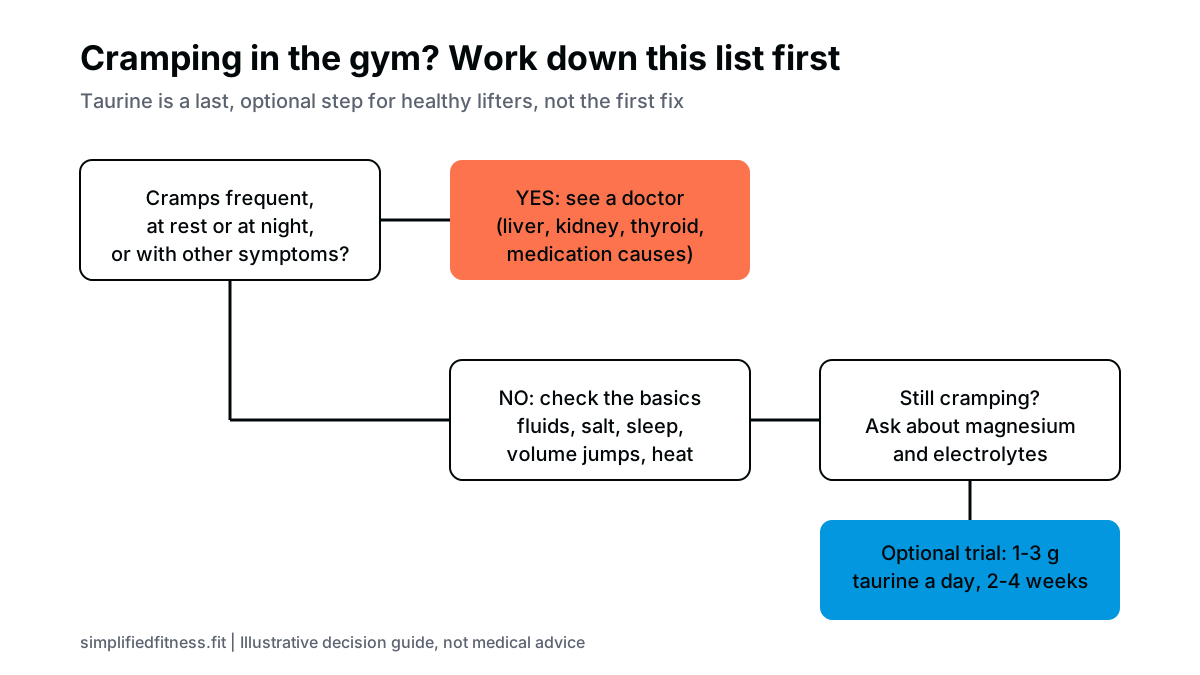
- The only good trial evidence that taurine reduces muscle cramps is in people with chronic liver disease taking 2 g a day. There are no direct trials in healthy lifters with gym cramps or lower back pumps.
- Studied doses are 1-3 g a day, and a risk assessment found strong evidence of no adverse effects up to 3 g a day in healthy adults.
- Frequent, severe or night-time cramps deserve a doctor's visit before any supplement.
Part of our complete guide: The Evidence-Based Fitness Supplements Guide: What Works, What's Overhyped & What's a Waste of Money
Table of contents
Taurine is not a stimulant, and the taurine benefits gym marketing promises are much bigger than the research supports. It is an amino acid that sits at high concentration in your muscle, and the best data show small, uncertain gains in endurance, plus a cramp benefit that has only been tested in people with liver disease.
That is the honest summary. If you were hoping for a magic fix for lower back pumps or a hidden energy boost in your energy drink, read on, because the real story is more interesting and less exciting. This article is part of our evidence-based supplements guide, where taurine sits firmly in the “optional, not essential” bucket.
Is taurine a stimulant? Why is it in energy drinks?
No. Caffeine is the stimulant. Taurine is an amino acid that your body makes and also gets from meat and fish. Lifters ask why they feel wired from a taurine energy drink. The answer is almost always the caffeine in the can.
So why is taurine on the label? Mostly because it has a plausible story and a long history in the category. The International Society of Sports Nutrition reviewed the evidence on energy drinks and concluded that the primary ergogenic nutrients in most of them appear to be caffeine and carbohydrate, while any added benefit from the other ingredients remains to be determined (Jagim et al., 2023).
If you want the caffeine side of the story, our guide on caffeine dosing for strength and power covers it properly.
What does taurine actually do in muscle?
Think of taurine as a cell-volume and calcium-handling helper rather than a fuel. A 2021 systematic review describes it as involved in regulating ion channels, cell volume and membrane stabilization (Chen et al., 2021).
The contraction part is where it gets interesting. Every rep depends on calcium being released from an internal store (the sarcoplasmic reticulum) and then pumped back in so the muscle can relax. Two lab studies looked at what taurine does to that store:
- In skinned fibres taken from rat muscle, 20 mM taurine increased calcium accumulation by about 35% and boosted triggered force responses, though it slightly lowered maximum force (Bakker and Berg, 2002).
- In skinned segments of human thigh muscle (vastus lateralis), taurine sped up calcium uptake into the store in both fibre types, but only after prolonged exposure, and it did not change maximum force (Dutka et al., 2014).
Read those carefully. These are isolated muscle fibres in a dish, exposed to taurine concentrations applied directly inside the cell. They show a mechanism is possible. They do not show that swallowing 2 g of taurine powder changes what happens in your quads in the middle of a set.
Does taurine improve performance? What the meta-analyses say
You will see neat percentage gains quoted online for taurine. The meta-analyses do not report a single figure like that, so here are the numbers they actually give.
A 2018 meta-analysis of 10 studies found oral taurine improved endurance performance with an effect size (Hedges’ g) of 0.40, and 0.43 in the 7 time-to-exhaustion trials. Doses of 1-6 g were used, and there was no difference between a single dose and supplementing for up to two weeks, and no dose effect (Waldron et al., 2018).
A 2025 meta-analysis of 23 randomized trials (N = 308) looked only at single doses. It found a smaller average effect (g = 0.25), more visible in males, and across endurance, strength and power tasks. But the certainty of evidence was rated low to very low, several subgroup effects shrank when influential studies were removed, and prediction intervals often included zero (Deng et al., 2025).
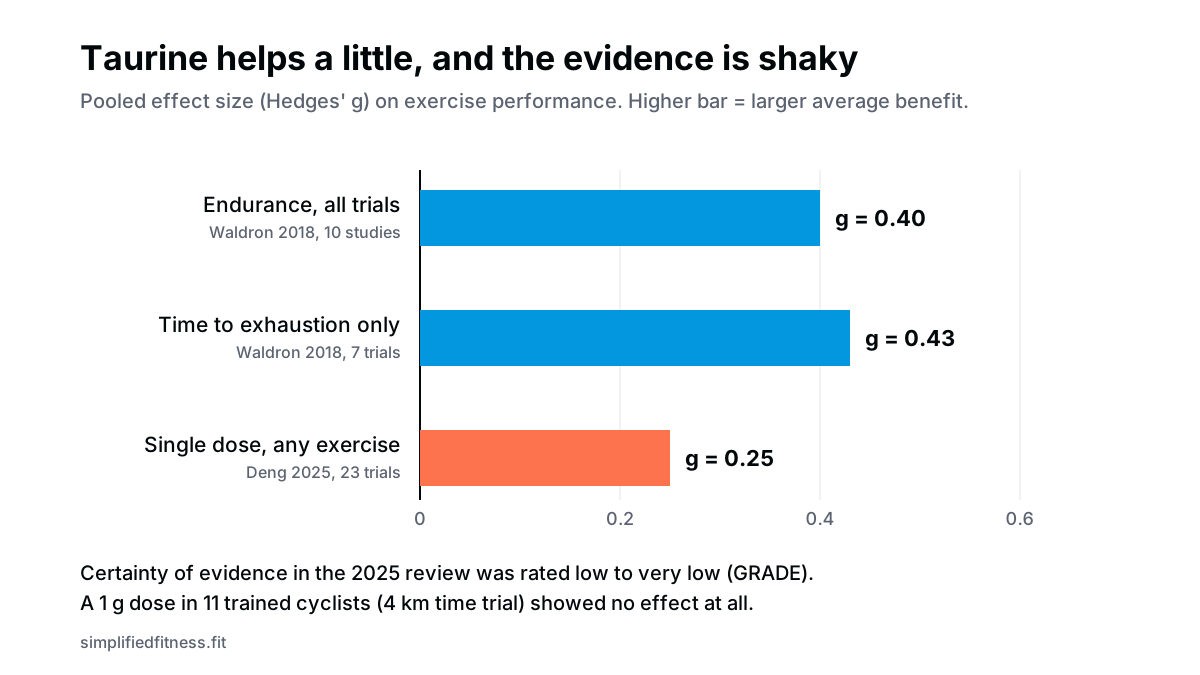
Individual trials back up that caution. In 11 trained male cyclists, a 1 g dose two hours before a 4 km time trial made no difference to performance or blood buffering (Ward et al., 2016). A 2021 review of 19 studies concluded that limited and varied findings prevent definitive conclusions, and that results seem to depend on timing and the type of exercise (Kurtz et al., 2021).
Why the mixed picture? Small samples, different doses, different fitness levels, and mostly endurance tests rather than lifting. A bigger caveat for lifters: very little of this was done in people doing hypertrophy training, so I would not extrapolate to muscle growth.
Here is the practical read. If taurine helps you at all, think of it as a small nudge, not a gain you can feel on the bar.
Taurine and muscle soreness: what is the evidence?
There is a hint of benefit here, with big caveats. In 21 young men, two weeks of taurine before an eccentric elbow-flexor session was linked to lower soreness, lower creatine kinase and lactate dehydrogenase, and higher strength afterwards (da Silva et al., 2014). In 36 untrained men, the group taking taurine (2 g three times a day) plus BCAA had lower soreness and muscle damage markers than placebo. The paper reports that result for the combined group only, so it does not show that taurine alone works, and the 6 g daily total is above the 3 g level with the strongest safety data (Ra et al., 2013).
Both were small trials in young men, and the 2021 review calls the recovery evidence mixed. Nice idea, not proven. For recovery that actually moves the needle, sleep and protein still win (see our guide to the supplement hierarchy).
Does taurine prevent muscle cramps?
This is the claim most people search for, so here is exactly what the evidence does and does not show.
The randomized evidence for taurine and cramps is in patients with chronic liver disease, not in lifters. In a double-blind crossover trial, 49 patients with three or more cramps a week were enrolled and 30 completed the protocol. Those taking 2 g of taurine a day had fewer cramps (seven fewer per fortnight), shorter cramps and less severe cramps than on placebo, with no adverse effects reported. The 19 people who dropped out were not included in the analysis, which can flatter the result (Vidot et al., 2018). A small single-arm pilot of 10 Korean patients with cirrhosis used 3 g a day for 4 weeks and saw improvements in 7 of them, though the drop in cramp scores was not statistically significant and there was no control group (Jang et al., 2021).
That is encouraging for that group. It does not tell us that healthy lifters with exercise cramps will respond the same way. I could not find a trial testing taurine for cramps during or after training in healthy people, so any “taurine cures gym cramps” line is an extrapolation.
What about painful back pumps?
Lifters often describe a lower back pump as the erectors cramping up during high-volume work like deadlift variations or heavy rows. The pitch for taurine is that it helps calcium handling and cell volume, so it should calm the muscle down.
Here is the problem. That is a theory built on the lab work above. No study I found tests taurine for lower back pumps, so I cannot tell you it works. What tends to cause a locked-up back in the gym is more mundane: a sudden jump in volume, poor bracing, tired erectors after other lifts, and being under-fuelled or under-salted in a hot, sweaty hall.
Fix those first. Then, if you want to experiment, our guides to magnesium for cramps and sleep and electrolytes for gym performance cover options with their own (also limited) evidence. If you are chasing a skin-tight pump, also read why a pump is not the same as hypertrophy.
Does taurine give a “cellular hydration” pump?
Taurine is an osmolyte, so people jump from “regulates cell volume” to “swells your muscles”. That jump is not supported by trials in lifters. Nothing I found shows a supplement dose of taurine produces a measurable pump or better hydration. For pump claims with actual trial evidence, look at citrulline instead.
Taurine dose and safety
Practical doses from the research:
| Question | What the evidence says |
|---|---|
| Typical study dose | 1-3 g a day, per a 2021 review (Kurtz et al., 2021) |
| Timing | Often 1-3 hours before exercise (Kurtz et al., 2021); no clear difference between a single dose and up to 2 weeks of use (Waldron et al., 2018) |
| Higher is better? | No clear dose effect between 1 and 6 g in meta-analyses |
| Safe intake | Strong evidence of no adverse effects up to 3 g a day in healthy adults (Shao and Hathcock, 2008) |
The risk assessment is worth reading in full: it could not set a conventional upper limit because there was no systematic pattern of adverse effects, and it used an “observed safe level” of 3 g a day instead. Much higher intakes have been tested without harm, but long-term data are not enough for a confident limit (Shao and Hathcock, 2008).
Doctor flag: if you have kidney or liver disease, are pregnant or breastfeeding, or take regular medication, speak to a doctor before adding any amino acid supplement.
Should Indian lifters bother with taurine?
Taurine is found in meat, fish and seafood, so vegetarians (a large share of Indian lifters) get little from food. Dal, paneer, curd and soya do not make up for that. But I know of no study showing a deficiency problem in healthy vegetarian lifters, so low intake alone is not a reason to buy it.
Budget-wise, plain taurine powder is cheap, but so is the bigger win: protein you hit every day, creatine monohydrate and a consistent plan. If those are covered and you still want to experiment, try 1-2 g for a few weeks, judge it honestly, and drop it if you notice nothing. A free push pull legs plan and a decent night’s sleep will do more for you than any amino acid powder.
Taurine with caffeine: is the combo better?
This is the most interesting recent finding. A 2025 Bayesian network meta-analysis of 12 studies found caffeine plus taurine was associated with better anaerobic capacity (g = 0.46) and faster reaction time (g = 0.75) than either alone. Effects on endurance were variable and context dependent (Deng et al., 2025).
Twelve studies is a small base, and caffeine remains the one with solid evidence. If you stack them, get caffeine right first, and watch for jitters and sleep disruption. Our pre-workout side effects guide covers what to do if it goes wrong.
The bottom line
Taurine is safe at normal doses, cheap, and plausible. It is also far from proven for lifters. Performance gains are small and low-certainty, the muscle damage data comes from small trials in untrained men, and the cramp data is from liver patients.
If you want to try it: 1-3 g a day, for a few weeks, with realistic expectations, and a doctor visit if cramps are frequent or severe. Everything else on the supplement shelf, including the energy-drink version, ranks well behind the basics.
Frequently Asked Questions
Is taurine a stimulant?
No. Taurine is an amino acid, not a stimulant like caffeine, and it does not give you the wired feeling people associate with energy drinks. It is found in high concentrations in muscle and is involved in regulating cell volume, ion channels and membrane stability. If you feel a buzz from an energy drink, caffeine is the likely cause.
Why is taurine in energy drinks?
It is there mostly as a marketing and formulation ingredient with a plausible but unproven performance rationale. The International Society of Sports Nutrition concluded that the main ergogenic ingredients in most energy drinks appear to be caffeine and carbohydrate, and that extra benefits from other ingredients are still undetermined. Read the label and check the caffeine dose, because that is doing most of the work.
What are the benefits of taurine for gym training?
The research shows small, inconsistent benefits for endurance performance and possibly some effect on muscle soreness and muscle damage markers. A 2018 meta-analysis found an effect size of 0.40 for endurance and a 2025 review found 0.25 for single doses, but certainty was rated low to very low. Treat it as an optional extra, well behind protein, creatine and sleep.
Does taurine help with muscle cramps from lifting?
Nobody has shown this directly in healthy lifters. The randomized evidence is in patients with chronic liver disease, where 2 g a day reduced cramp frequency, duration and severity versus placebo. If you cramp often, sort out fluids, salt, volume jumps and sleep first, and see a doctor if it keeps happening.
Does taurine help with back pumps?
There is no study that tests taurine for painful lower back pumps, so any claim here is a theory. The idea rests on taurine's role in muscle calcium handling, which comes from lab work on isolated fibres, not from lifters. If your back locks up during high-volume sets, check your bracing, hydration and electrolytes, and consider our magnesium and electrolyte guides.
How much taurine should I take per day?
Studies in athletes mostly use 1-3 g a day, either as a single dose 1-3 hours before training or daily for several days to weeks. A 2018 meta-analysis found no clear dose effect between 1 and 6 g, so more is not better. Start at 1-2 g with food and stay at or below 3 g a day.
Is taurine safe? What are the side effects?
For healthy adults, a risk assessment found strong evidence of no adverse effects at supplemental intakes up to 3 g a day. Higher intakes have been tested without problems but the long-term data are not enough for a confident safety limit. If you have kidney or liver disease, are pregnant, or take regular medication, check with your doctor first.
When should I take taurine, before or after training?
Trials mostly dose it 1-3 hours before exercise, and a 2025 meta-analysis suggested about 1 hour before might work best, though that result did not hold up in sensitivity analyses. Other studies use daily dosing for one to two weeks. Pick one fixed time you will remember and judge it over a few weeks, not one session.
Does taurine help muscle growth?
There is no good evidence that taurine builds muscle. The research focuses on endurance, soreness and muscle damage markers, not hypertrophy over months. Spend your money on protein, creatine monohydrate and enough food first.
Can I get taurine from food?
Yes. Taurine is found in meat, fish and seafood, and your body also makes some. Vegetarian diets contain little of it, so Indian vegetarians typically get less from food. That is not a reason to supplement, since no deficiency problem has been shown in healthy lifters.
Should I take taurine with caffeine?
The evidence is mixed but interesting. A 2025 network meta-analysis found caffeine plus taurine was associated with better anaerobic capacity and reaction time than either alone, based on only twelve studies. Caffeine remains the proven part of the pair, so set your caffeine dose first.
Does taurine hydrate you or cause cell swelling?
Taurine is an osmolyte, meaning it helps cells regulate their volume, but that does not mean a supplement makes you better hydrated or gives a visible pump. No trial shows taurine improves hydration status in lifters. Drink to thirst, salt your food, and use proper guidance from our hydration articles.
Sources & References
Every claim above is checked against peer-reviewed research (PubMed, U.S. National Library of Medicine) or guidance from established health bodies. How we fact-check.
- Waldron M, et al. The Effects of an Oral Taurine Dose and Supplementation Period on Endurance Exercise Performance in Humans: A Meta-Analysis. Sports Med. 2018. PMID: 29546641
- Deng H, et al. Does One Shot Work? The Acute Impact of a Single Taurine Dose on Exercise Performance: A Meta-Analytic Review. Scand J Med Sci Sports. 2025. PMID: 40852891
- Kurtz JA, et al. Taurine in sports and exercise. J Int Soc Sports Nutr. 2021. PMID: 34039357
- Dutka TL, et al. Acute effects of taurine on sarcoplasmic reticulum Ca2+ accumulation and contractility in human type I and type II skeletal muscle fibers. J Appl Physiol. 2014. PMID: 25123198
- Bakker AJ, Berg HM. Effect of taurine on sarcoplasmic reticulum function and force in skinned fast-twitch skeletal muscle fibres of the rat. J Physiol. 2002. PMID: 11773327
- Vidot H, et al. Randomised clinical trial: oral taurine supplementation versus placebo reduces muscle cramps in patients with chronic liver disease. Aliment Pharmacol Ther. 2018. PMID: 30136291
- Jang ES, et al. Effectiveness of 4-Week Oral Taurine Treatment for Muscle Cramps in Patients with Liver Cirrhosis: A Single-Arm Pilot Study. Yonsei Med J. 2021. PMID: 33381931
- Shao A, Hathcock JN. Risk assessment for the amino acids taurine, L-glutamine and L-arginine. Regul Toxicol Pharmacol. 2008. PMID: 18325648
- Ward R, et al. The effect of acute taurine ingestion on 4-km time trial performance in trained cyclists. Amino Acids. 2016. PMID: 27380030
- Ra SG, et al. Combined effect of branched-chain amino acids and taurine supplementation on delayed onset muscle soreness and muscle damage in high-intensity eccentric exercise. J Int Soc Sports Nutr. 2013. PMID: 24195702
- Jagim AR, et al. International society of sports nutrition position stand: energy drinks and energy shots. J Int Soc Sports Nutr. 2023. PMID: 36862943
- Chen Q, et al. The Dose Response of Taurine on Aerobic and Strength Exercises: A Systematic Review. Front Physiol. 2021. PMID: 34497536
- da Silva LA, et al. Effects of taurine supplementation following eccentric exercise in young adults. Appl Physiol Nutr Metab. 2014. PMID: 24383513
- Deng H, et al. Caffeine and taurine: a systematic review and network meta-analysis of their individual and combined effects on physical capacity, cognitive function, and physiological markers. J Int Soc Sports Nutr. 2025. PMID: 41032459

Umair Hazrami · Founder & Head Coach, Simplified Fitness
Umair Hazrami founded Simplified Fitness and the Simplified Lifter channel to cut through fitness noise. With 4+ years of consistent training and 10+ coaching clients, he writes every guide from the peer-reviewed research and links the sources so you can check them. Our editorial standards.
Educational content only, not medical advice. If you have a medical condition, are pregnant, or take medication, talk to a qualified doctor before changing your diet, supplements or training. Full disclaimer.
Keep reading
Supplements
Ashwagandha KSM-66 vs Sensoril: Which Extract, What Dose, and Do You Need to Cycle?
Ashwagandha KSM-66 vs Sensoril for lifters: what the strength trials show, realistic cortisol effects, liver safety and whether to cycle. Every study linked.
8 min read
Supplements
BCAAs vs EAAs: Why BCAAs Are a Waste of Money If Your Protein Is Covered
BCAA vs EAA for muscle growth: BCAAs are only 3 of the 9 essential amino acids. See what Wolfe 2017 and Jackman 2017 found and when EAAs or whey make sense.
8 min read
Supplements
Beetroot Juice for Running and Lifting: How Dietary Nitrate Works (and the Mouthwash Trap)
Does beetroot juice for running actually work? See what meta-analyses show, the 2-3 hour timing and dose, who benefits, and why mouthwash can cancel the effect.
9 min read

Supplements
Beta-Alanine Benefits: Carnosine Buffering, High-Rep Gains and Why It Makes You Tingle
Beta-alanine benefits explained: why pre-workout makes your skin tingle, how carnosine buffers acid, what dose works, and who should skip it. Studies linked.
8 min read