Commercial Fat Burners Exposed: Weak Ingredients, Stimulant Spikes and Health Risks
Do fat burner pills work? Trials on caffeine, synephrine, green tea and garcinia show little fat loss plus blood pressure and liver risk. Read before you buy.
TL;DR. The short answer
- Fat burner pills do very little. A 2021 meta-analysis of 21 trials in people with overweight found the pooled benefit crossed zero, and the supplement effects were smaller than those typically seen with diet and exercise alone.
- Most labels are a caffeine and stimulant base with a long list of extras hidden inside a proprietary blend, so you cannot tell which dose of what you are swallowing.
- Synephrine (bitter orange) raised systolic blood pressure by about 6 mmHg and diastolic by about 4 mmHg in a 2022 meta-analysis, with no significant weight loss.
- Green tea extract showed essentially no weight loss in trials outside Japan, and high-dose extract has been linked to liver injury in case reports.
- The thing that actually burns fat is a sustained, moderate calorie deficit with enough protein and lifting. See a doctor if a stimulant product gives you chest pain, palpitations or dark urine.
Part of our complete guide: The Evidence-Based Fitness Supplements Guide: What Works, What's Overhyped & What's a Waste of Money
Table of contents
Do fat burner pills work? Mostly not, and when they do, the effect is small enough that you would struggle to notice it on the scale. A 2021 meta-analysis found that the benefit of thermogenic supplements was uncertain and smaller than what diet and exercise achieve alone (Clark et al., 2021).
What you are mostly paying for is stimulant load, a nice tub and a label. This sits inside the wider picture in our evidence-based supplements guide, where fat burners land in the bottom tier. Here we go through what the studies on the usual ingredients show, what the stimulant side effects look like, and what to do with your money instead.
What is actually inside a commercial fat burner?
Open a few tubs and the same pattern repeats. A caffeine base, often a sizeable one. Then bitter orange (synephrine), green tea extract, maybe garcinia, raspberry ketones, some yohimbine or a herb nobody can pronounce.
The catch is the “proprietary blend.” The label gives you one total weight for the whole mix, not the dose of each ingredient. So a tiny sprinkle of the expensive-sounding ingredient can sit next to a big scoop of the cheap one, and you cannot tell. We cover that trick in decoding proprietary blends.
I cannot honestly tell you a number like “95% of products are just caffeine.” No study I found measured that across the market. What I can say is that stimulants carry most of the physical effect you feel, and the rest of the label is mostly there to look scientific.
Do fat burners work? What the big reviews found
Start with the reviews that look at many products at once.
The 2021 Clark meta-analysis pulled 21 trials longer than 8 weeks in people with a BMI above 24.9. The pooled effect leaned slightly in favour of thermogenic supplements, but the confidence interval crossed zero, which means no benefit cannot be ruled out. When the authors compared supplement trials against what diet or diet plus exercise typically produce, the supplements came out less effective. Their conclusion was limited benefit (Clark et al., 2021).
A separate 2021 systematic review screened 20,504 citations and found 315 randomized trials covering 14 supplements or therapies. Only 52 of them (16.5%) were low risk of bias and sufficient to support efficacy, and only 16 of those 52 showed significant weight differences between groups, ranging from 0.3 to 4.93 kg (Batsis et al., 2021). Their verdict: a limited high-quality evidence base.
Read that again. Out of 315 trials, a small slice was both well run and positive. Marketing quietly quotes that slice.
Ingredient by ingredient: caffeine, bitter orange, green tea, garcinia
Caffeine: the one with some evidence, and a catch
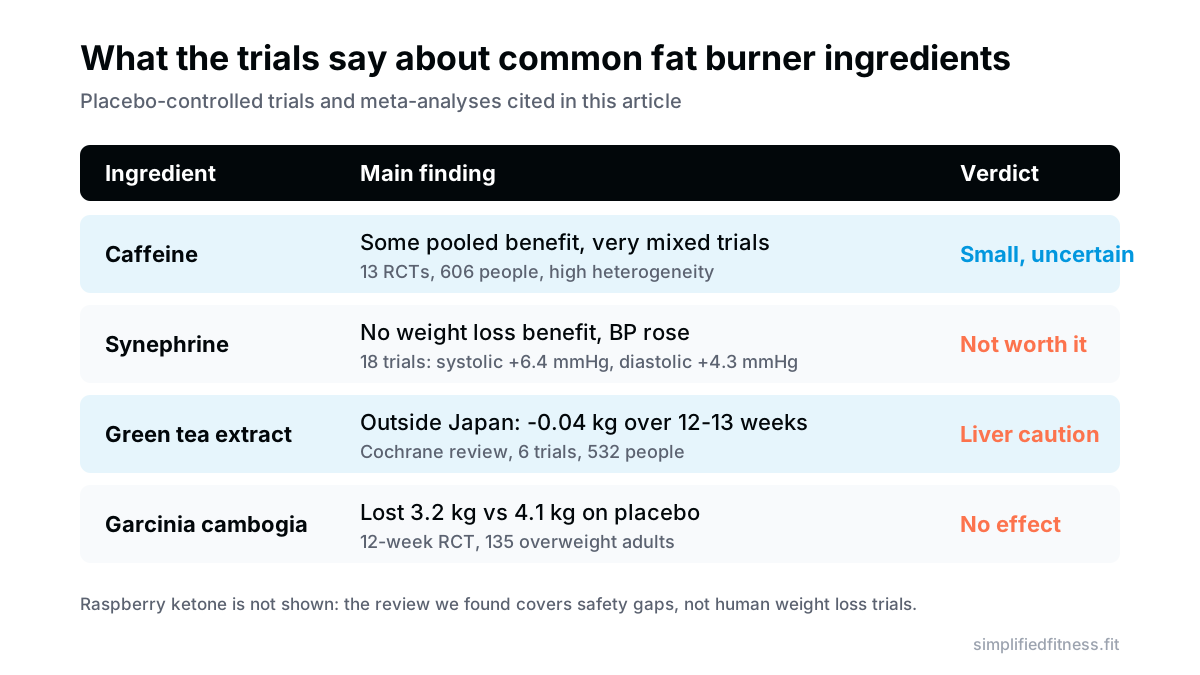
Caffeine is the honest part of most fat burners. A 2019 dose-response meta-analysis of 13 trials (606 participants) concluded that caffeine intake might promote reductions in weight, BMI and fat mass (Tabrizi et al., 2019). That sounds like a win for the pill makers.
Look closer. Heterogeneity between those trials was very high (I-squared above 90% for each outcome), so the studies disagreed heavily on size and consistency. Compare that with Clark’s pooled result for thermogenic products, which crossed zero. A cautious reading is that caffeine may help slightly, probably through appetite and energy, and that the effect is hard to pin down.
The practical takeaway: if you want caffeine, coffee or tea is the cheaper delivery system, and you control the dose. Our caffeine dosage calculator gives a sensible range for your body weight.
Synephrine (bitter orange): more blood pressure, no more weight loss
Synephrine is the “ephedra replacement” that took over after ephedra products came under scrutiny. The 2022 meta-analysis of 18 placebo-controlled human trials found that prolonged use increased systolic blood pressure by 6.37 mmHg (95% CI 1.02-11.72) and diastolic by 4.33 mmHg (95% CI 0.48-8.18). Weight loss in the synephrine group was not significant, and body composition did not change (Koncz et al., 2022). The authors say there is no evidence that synephrine facilitates weight loss and that further studies are needed on safety.
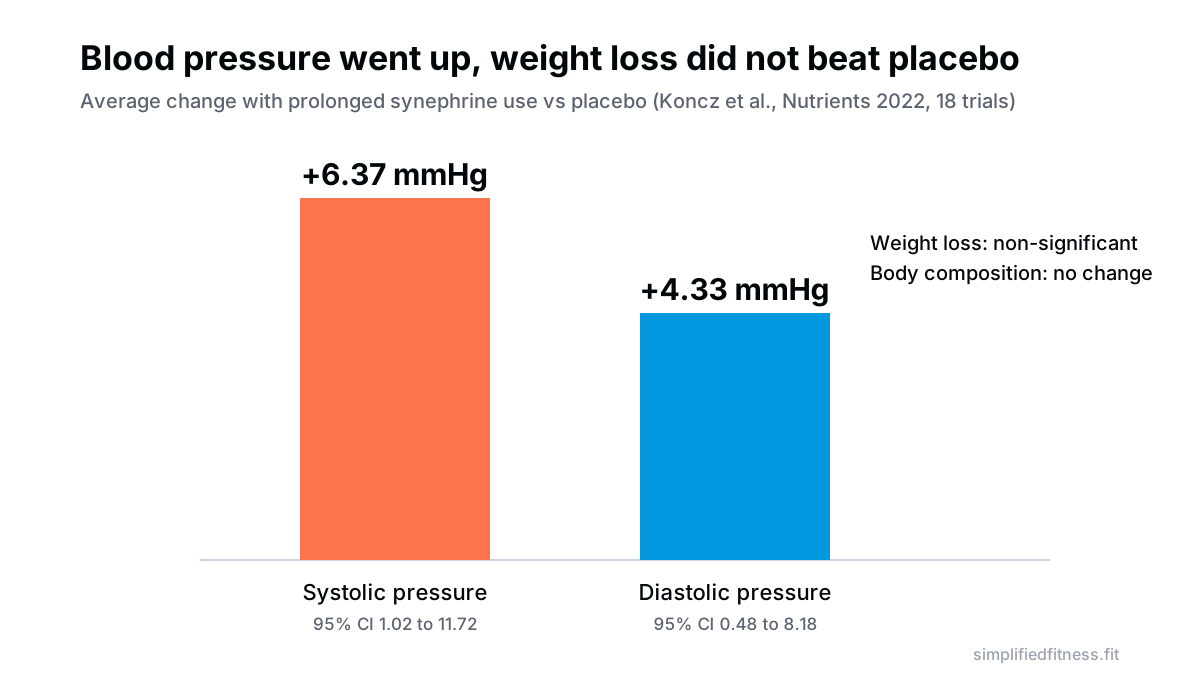
A few mmHg sounds small. On a population level a rise like that matters, and for someone already borderline hypertensive it is not what you want from a product that was supposed to help your waistline.
Green tea extract: nothing on the scale, plus a liver question
The Cochrane review of green tea for weight loss included trials of 12-13 weeks. Pooling six studies outside Japan (532 participants) gave a mean weight difference of -0.04 kg. The eight Japanese studies (1,030 participants) could not be pooled, and their results ranged from -0.2 to -3.5 kg in favour of green tea. The authors concluded that the small weight loss was not likely to be clinically important (Jurgens et al., 2012). Why might Japan look different? The abstract does not say, and differences in populations, study design or habitual diet are plausible but unproven.
The safety side matters more. A US Pharmacopeia review noted that published case reports link green tea extract to liver injury at EGCG intakes from about 140 mg to roughly 1,000 mg a day, with large differences between individuals. It also found that repeated bolus doses taken fasted raised catechin absorption, and added a label caution to take it with food and avoid it with liver problems (Oketch-Rabah et al., 2020). Cups of green tea are a different matter from concentrated extract in a capsule on an empty stomach. For a deeper look, see our green tea extract and liver risk article.
Garcinia cambogia and raspberry ketones
The best-known garcinia trial was a 12-week double-blind RCT in 135 overweight adults taking 1,500 mg of hydroxycitric acid a day alongside a high-fibre, low-energy diet. The garcinia group lost 3.2 kg and the placebo group lost 4.1 kg, a difference that was not significant, and fat loss proportions did not differ either (Heymsfield et al., 1998). Both groups lost weight because both were eating less. That is the point.
Raspberry ketone is a different problem. A 2015 safety review noted that toxicity data are limited to acute and subchronic rat studies, while recommended supplement doses of 100-1400 mg a day far exceed the amount people would ever get from eating raspberries (Bredsdorff et al., 2015). That review is about safety gaps, not proof of fat loss, and I did not find a human trial meta-analysis showing it works. Lots of marketing, little evidence.
What are the dangers of thermogenic supplements?
Three buckets worth knowing about. None of this means every user gets hurt. It means the downside is real and the upside is small.
Heart rate and blood pressure. In a meta-analysis of 21 randomized trials of caffeinated energy drinks in healthy adults, exercise heart rate rose by about 2.9 bpm and systolic pressure by about 9 mmHg versus controls (Grinberg et al., 2022). That study is on energy drinks, not fat burner capsules, so treat it as a rough guide to what stimulant-heavy products can do, especially if you already run high.
Liver. A 2017 review reported that herbal and dietary supplements account for about 20% of drug-induced liver injury cases in the US, with anabolic steroid products, green tea extract and multi-ingredient supplements among the main agents. In many multi-ingredient cases the component responsible is unknown (Navarro et al., 2017). That unknown is the real problem with proprietary blends.
Sleep, anxiety and the cut itself. This one is a coaching observation rather than a trial result: when someone is under-eating and training hard, stacking stimulants tends to make sleep and mood worse, and bad sleep makes the diet harder to hold.
See a doctor if you have chest pain, a pounding or irregular heartbeat, fainting, severe headache, or signs of liver trouble such as dark urine, yellow skin or eyes, or upper right belly pain. Stop the product first. Anyone with high blood pressure, heart disease, anxiety disorders, or who is pregnant, breastfeeding or on medication should check with a doctor before using any stimulant supplement.
Why a calorie deficit is the only real fat burner
The International Society of Sports Nutrition summarizes it plainly: diets focused on fat loss are driven by a sustained caloric deficit, and long-term success depends on compliance and on handling factors like adaptive thermogenesis (Aragon et al., 2017).
That adaptive part is why people stall. Energy restriction comes with changes in hormones, mitochondrial efficiency and energy expenditure that work to shrink the deficit (Trexler et al., 2014). A pill that nudges energy burn a little does not beat that. Adherence, protein and training do the heavy lifting.
Stubborn belly fat is not a separate problem a pill can target. Fat comes off the whole body, in the order your genetics decide, as long as the deficit holds.
What to buy instead (Indian budget version)
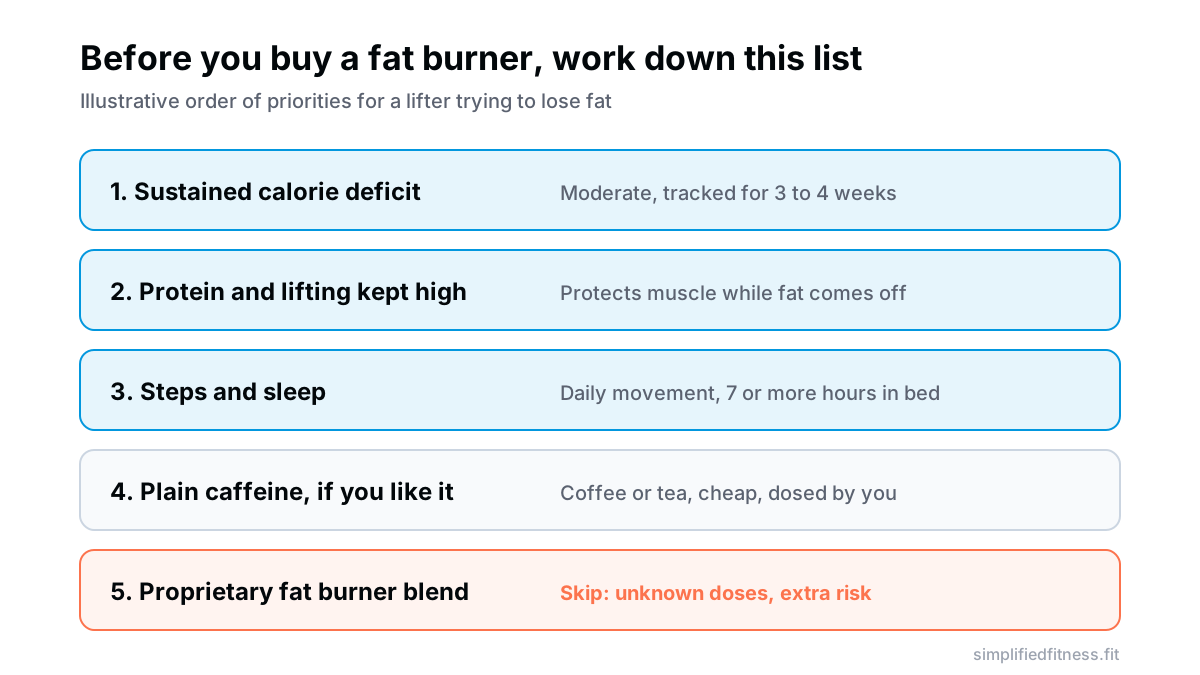
Fat burner tubs often cost more than a month of protein foods. A rough order of spending that actually helps a cut:
- Protein you will eat daily: dal, curd, paneer, eggs, soya chunks, chicken or fish if you eat them. Get your target with the protein calculator.
- A moderate deficit you can live with: smaller rice and roti portions rather than skipping meals.
- Steps: a daily walk, even in the summer heat, early morning or evening.
- Sleep: the cheapest recovery tool there is.
- Caffeine, if you like it: a cup of chai or black coffee.
If you want a supplement shortlist, our supplement tier list ranks what has real evidence. Even L-carnitine, often sold alongside fat burners, has a more nuanced story in this breakdown.
How to read a fat burner label in 60 seconds
- Is there a proprietary blend? If yes, you cannot judge the dose. Walk away.
- Add up the total caffeine from every source (guarana and green tea count too), including your coffee and chai. A large systematic review concluded that up to 400 mg a day is generally not linked to overt adverse effects in healthy adults, and up to 300 mg a day in healthy pregnant women (Wikoff et al., 2017). That is a ceiling for healthy people, not a target, and it does not apply if you have a heart condition or high blood pressure.
- Look for synephrine, yohimbine or “thermogenic complex.” Each adds stimulant load.
- Check for third-party testing. It does not prove the product works, only that it contains what it says.
- Ask whether the claim sounds like a trial or like a photo shoot.
The bottom line
The research does not support fat burner pills as a meaningful tool. The reviews show small or uncertain benefits, the individual ingredients mostly show nothing, and the stimulant and liver side of the picture is the part with real signals. A sustained, moderate deficit does the job, and everything else is optional.
Keep the money, eat enough protein, lift, walk, sleep. If you still want caffeine, buy coffee.
Frequently Asked Questions
Do fat burner pills work?
Mostly no, or only by a small and uncertain amount. A 2021 meta-analysis of 21 trials found the benefit of thermogenic supplements crossed zero and was smaller than what diet and exercise achieve on their own. Treat any pill as a tiny add-on at best, and put your effort into your calorie deficit first.
What is actually in a commercial fat burner?
Most are built around caffeine, often with synephrine (bitter orange), green tea extract and a handful of herbs. The exact amounts are frequently hidden inside a proprietary blend that only lists the total weight. If you cannot see each dose on the label, you cannot judge whether it is useful or risky.
Is synephrine (bitter orange) safe?
Evidence is limited and leans cautious. A 2022 meta-analysis of 18 placebo-controlled trials found that prolonged use raised both systolic and diastolic blood pressure, with no significant weight loss. If you have high blood pressure, a heart condition or take any medication, ask your doctor before using it.
Does green tea extract burn fat?
Not in a way you would notice. A Cochrane review found a weight difference of -0.04 kg in trials outside Japan over 12-13 weeks. High-dose extracts have also been linked to liver injury, so brewed tea is the safer habit.
Do garcinia cambogia and raspberry ketones work?
The best-known human trial of garcinia found no benefit, and raspberry ketone has little human evidence behind it. In a 12-week trial of 135 overweight adults, the garcinia group lost 3.2 kg against 4.1 kg on placebo. Save your money for protein and food.
Does caffeine help you lose fat?
Possibly a little, but the evidence is inconsistent. A meta-analysis of 13 trials suggested caffeine might reduce weight and fat mass, yet the trials differed enormously from each other. If you like it, coffee or tea gives you caffeine for a fraction of the price of a fat burner.
Can fat burners raise your blood pressure and heart rate?
Yes, stimulant-based products can. In a meta-analysis of caffeinated energy drinks, exercise heart rate rose by about 3 bpm and systolic pressure by about 9 mmHg. Stack caffeine with synephrine and other stimulants and the load can add up, so people with hypertension or heart problems should skip them.
Can fat burners damage your liver?
Some supplements can. A 2017 review reported that herbal and dietary supplements account for about 20% of drug-induced liver injury cases in the US, with green tea extract and multi-ingredient products among the main culprits. Stop and see a doctor if you notice dark urine, yellow eyes or belly pain.
What is the best natural fat burner?
A sustained calorie deficit. The ISSN states that fat loss diets are driven by a sustained caloric deficit, and that is the lever every other tool plugs into. Use a calorie calculator, eat enough protein, lift, and walk.
Why did my fat burner make me feel anxious or shaky?
Probably the stimulant load. Caffeine and similar compounds act on your nervous system, and the total dose in a multi-ingredient blend can be higher than you realise. Stop the product, drop total caffeine, and speak to a doctor if palpitations or chest tightness continue.
Are Indian-market fat burners any different?
The ingredient lists look much the same, and the same evidence applies. A product made or sold locally can still hide doses in a blend, and I have not found data showing local products perform better. Check the label for each ingredient's amount, and skip anything that will not tell you.
Should I take a fat burner during a cut?
It is not needed, and a cut is when you are most sensitive to side effects like poor sleep and jitters. Energy restriction already triggers adaptations that fight further fat loss, so adding stimulants on top of low food and bad sleep makes things harder. Fix food, steps and sleep, then reassess in a month.
Are fat burners worth the money?
For most people they are not. A 2021 systematic review found only 52 of 315 trials of weight loss supplements and alternative therapies were low risk of bias with enough data to judge efficacy. Spend the same money on protein sources like dal, paneer, eggs or soya.
Sources & References
Every claim above is checked against peer-reviewed research (PubMed, U.S. National Library of Medicine) or guidance from established health bodies. How we fact-check.
- Clark JE, et al. Comparing effectiveness of fat burners and thermogenic supplements to diet and exercise for weight loss and cardiometabolic health: Systematic review and meta-analysis. Nutr Health. 2021. PMID: 33427571
- Batsis JA, et al. A Systematic Review of Dietary Supplements and Alternative Therapies for Weight Loss. Obesity (Silver Spring). 2021. PMID: 34159755
- Koncz D, et al. The Safety and Efficacy of Citrus aurantium (Bitter Orange) Extracts and p-Synephrine: A Systematic Review and Meta-Analysis. Nutrients. 2022. PMID: 36235672
- Jurgens TM, et al. Green tea for weight loss and weight maintenance in overweight or obese adults. Cochrane Database Syst Rev. 2012. PMID: 23235664
- Heymsfield SB, et al. Garcinia cambogia (hydroxycitric acid) as a potential antiobesity agent: a randomized controlled trial. JAMA. 1998. PMID: 9820262
- Tabrizi R, et al. The effects of caffeine intake on weight loss: a systematic review and dos-response meta-analysis of randomized controlled trials. Crit Rev Food Sci Nutr. 2019. PMID: 30335479
- Grinberg N, et al. Effects of caffeinated energy drinks on cardiovascular responses during exercise in healthy adults: a systematic review and meta-analysis of randomized controlled trials. Appl Physiol Nutr Metab. 2022. PMID: 35358397
- Navarro VJ, et al. Liver injury from herbal and dietary supplements. Hepatology. 2017. PMID: 27677775
- Oketch-Rabah HA, et al. United States Pharmacopeia (USP) comprehensive review of the hepatotoxicity of green tea extracts. Toxicol Rep. 2020. PMID: 32140423
- Bredsdorff L, et al. Raspberry ketone in food supplements: High intake, few toxicity data: A cause for safety concern? Regul Toxicol Pharmacol. 2015. PMID: 26160596
- Aragon AA, et al. International society of sports nutrition position stand: diets and body composition. J Int Soc Sports Nutr. 2017. PMID: 28630601
- Trexler ET, et al. Metabolic adaptation to weight loss: implications for the athlete. J Int Soc Sports Nutr. 2014. PMID: 24571926
- Wikoff D, et al. Systematic review of the potential adverse effects of caffeine consumption in healthy adults, pregnant women, adolescents, and children. Food Chem Toxicol. 2017. PMID: 28438661

Umair Hazrami · Founder & Head Coach, Simplified Fitness
Umair Hazrami founded Simplified Fitness and the Simplified Lifter channel to cut through fitness noise. With 4+ years of consistent training and 10+ coaching clients, he writes every guide from the peer-reviewed research and links the sources so you can check them. Our editorial standards.
Educational content only, not medical advice. If you have a medical condition, are pregnant, or take medication, talk to a qualified doctor before changing your diet, supplements or training. Full disclaimer.
Keep reading
Supplements
Ashwagandha KSM-66 vs Sensoril: Which Extract, What Dose, and Do You Need to Cycle?
Ashwagandha KSM-66 vs Sensoril for lifters: what the strength trials show, realistic cortisol effects, liver safety and whether to cycle. Every study linked.
8 min read
Supplements
BCAAs vs EAAs: Why BCAAs Are a Waste of Money If Your Protein Is Covered
BCAA vs EAA for muscle growth: BCAAs are only 3 of the 9 essential amino acids. See what Wolfe 2017 and Jackman 2017 found and when EAAs or whey make sense.
8 min read
Supplements
Beetroot Juice for Running and Lifting: How Dietary Nitrate Works (and the Mouthwash Trap)
Does beetroot juice for running actually work? See what meta-analyses show, the 2-3 hour timing and dose, who benefits, and why mouthwash can cancel the effect.
9 min read

Supplements
Beta-Alanine Benefits: Carnosine Buffering, High-Rep Gains and Why It Makes You Tingle
Beta-alanine benefits explained: why pre-workout makes your skin tingle, how carnosine buffers acid, what dose works, and who should skip it. Studies linked.
8 min read