Multivitamins for Lifters: Cheap Insurance or Expensive Urine?
Do multivitamins for lifters help strength or energy? See what the research says, who may benefit from a low-dose multi, and who is wasting money.

TL;DR. The short answer
- In well-fed lifters, a standard multivitamin has not been shown to improve strength or performance. A 2021 review concluded supplementation in well-nourished athletes does not enhance performance.
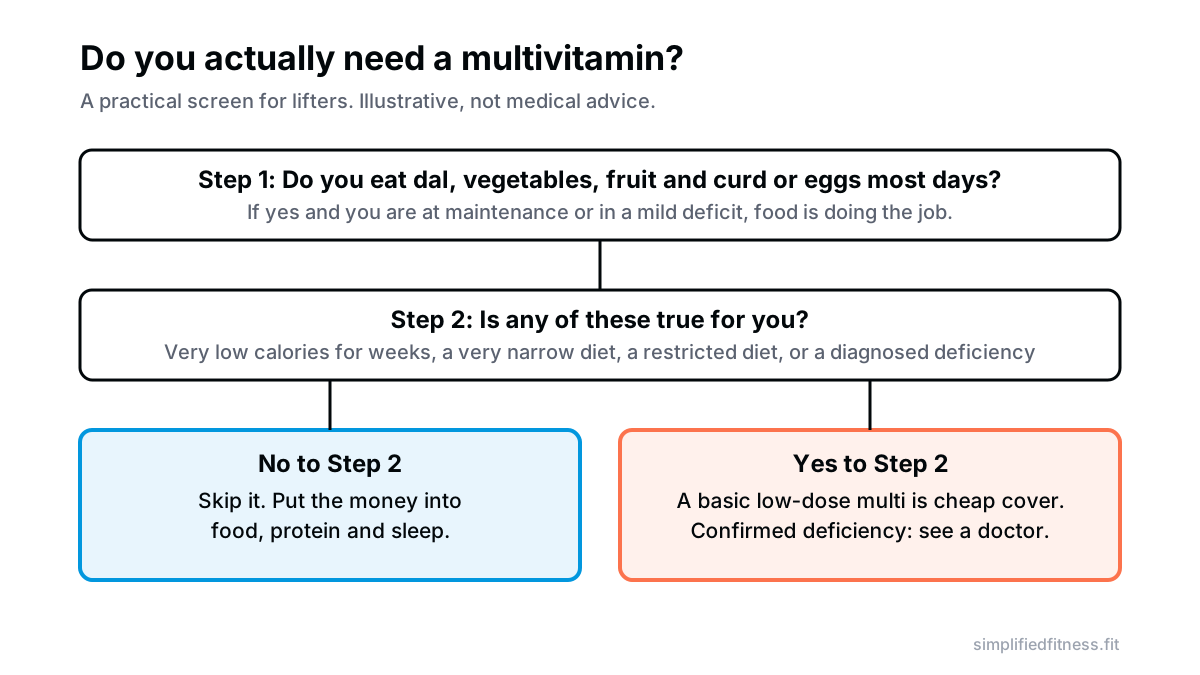
- A low-dose multivitamin can work as cheap insurance during long, deep calorie deficits, on very narrow or restricted diets, or when a doctor has confirmed a deficiency.
- Mega-dose 'athlete packs' are the weak spot. Calcium can cut iron absorption, and one trial in older men found high-dose vitamin C and E blunted muscle gains.
- Multivitamins do not replace fruit, vegetables, dal, curd or whole grains. The big prevention trials show little or no benefit for healthy adults.
- If you suspect a deficiency (constant fatigue, restless legs, heavy periods, a vegan diet), get a blood test instead of guessing with a pill.
Part of our complete guide: The Evidence-Based Fitness Supplements Guide: What Works, What's Overhyped & What's a Waste of Money
Table of contents
Do multivitamins for lifters help? In people who eat a reasonably varied diet, the research says not for strength, muscle or gym energy. A low-dose multivitamin is useful as cheap insurance in a few specific situations: long deep calorie deficits, very narrow or restricted diets, or a confirmed deficiency.
That is the honest answer to a very expensive question. In this guide, part of our evidence-based supplements guide, we will sort out who actually benefits, what the big trials found, and why the oversized “athlete pack” tubs are the part worth being suspicious about.
Do bodybuilders need a multivitamin?
Usually no. Here is the reality: vitamins and minerals are cofactors. They help enzymes run the machinery that turns food into energy and builds tissue. Once you have enough, more does not make the machine run faster.
A 2021 review of micronutrients (iron, vitamin C, vitamin E, vitamin D and calcium) and athletic performance concluded that the balance of the literature suggests supplementation in well-nourished athletes does not enhance physical performance (Beck et al., 2021). The same review notes that supplementation is warranted in some cases, such as a diagnosed deficiency, compromised energy intake, or training at altitude, and that these should be prescribed by a medical professional.
The ACSM, Academy of Nutrition and Dietetics and Dietitians of Canada joint position statement does not single out multivitamins. Its emphasis is that well-chosen nutrition strategies enhance performance and recovery, and that athletes should be referred to a registered dietitian for a personalised plan (Thomas et al., 2016).
What about the “expensive urine” myth?
There is a kernel of truth here, and a kernel of exaggeration.
Water-soluble vitamins (the B-complex and vitamin C) are not stored in large amounts, so what your body does not use is mostly excreted in urine. Riboflavin (B2) is the one that turns it neon yellow. That bright colour is simply the vitamin passing through, not a sign it worked.
But “it all just comes out” is not the whole story. The fat-soluble vitamins (A, D, E and K) are stored in body tissue, and some minerals such as iron and zinc are not casually excreted either. More is not automatically harmless. The 2022 USPSTF evidence review, for example, found limited evidence that some supplements may carry higher risk of serious harms: hip fracture with vitamin A, hemorrhagic stroke with vitamin E, and kidney stones with vitamin C and calcium (O’Connor et al., 2022). That evidence was limited, and those were isolated supplements rather than a standard multi, but it is a reminder that “mega-dose” is not a free upgrade.
Are multivitamins a waste of money?
For most healthy, well-fed people, mostly yes, though the picture has a small twist.
The big prevention trials are worth knowing. The Physicians’ Health Study II randomised 14,641 male US physicians (average age 64) to a daily multivitamin or placebo for a median of 11.2 years. The multivitamin group had a small but statistically significant lower rate of total cancer (hazard ratio 0.92, 95% CI 0.86-0.998), with no significant effect on prostate or colorectal cancer (Gaziano et al., 2012).
Then the 2022 USPSTF review pulled 84 studies (739,803 participants). Multivitamins were associated with slightly lower cancer incidence in pooled RCTs (odds ratio 0.93), but the review’s overall conclusion was that vitamin and mineral supplementation had little or no benefit for preventing cancer, cardiovascular disease and death, with the exception of that small cancer benefit for multivitamins (O’Connor et al., 2022).
Why might these studies look slightly different? PHS II was older male doctors, a population unlike a 24-year-old lifter, and the effect was borderline (the confidence interval nearly touched 1). The USPSTF review pooled mixed trials and noted important limitations. The cautious takeaway: even if there is a small benefit for disease prevention in older adults, none of it shows that a multivitamin makes a healthy young lifter stronger, bigger or more energetic.
When a multivitamin actually makes sense
Insurance is only worth buying when you can see the risk. Here is where I would take a plain, low-dose multi seriously.
- A long, deep deficit. Eat 1,400 kcal for months and your micronutrient intake usually drops with it, because you are eating less of everything. Beck and colleagues list compromised energy intake as one situation where supplementation can be warranted (Beck et al., 2021). The better first move is a more moderate cut, which we cover in setting your calorie deficit and in micronutrient support in deep deficits.
- A narrow diet. Picky eaters who live on rice, roti, eggs and whey and avoid vegetables, fruit, dal and dairy leave gaps. A multi is not the ideal fix, but it is a cheap one.
- A restricted diet. Vegans, and some vegetarians who skip dairy and eggs, can fall short on vitamin B12, iron or zinc depending on food choices. A blood test shows which gaps are real.
- A diagnosed deficiency. Here you want the specific nutrient at a dose your doctor sets, not a general multi.
- Travel or limited food access. A temporary multi for a few weeks of poor food is reasonable.
Food first: what a multivitamin cannot replace
Fruit, vegetables, dal, curd, paneer, eggs, nuts and whole grains deliver fibre, protein and a huge range of plant compounds that a tablet does not contain. A multivitamin covers the vitamins and minerals printed on the label, nothing more.
A practical Indian plate does most of the work. Dal and curd for B vitamins and calcium, a serving of green leafy vegetables (palak, methi), a seasonal fruit, a handful of peanuts or almonds, and roti or rice. Eat eggs or paneer if you can. If you want a template, the free diet plan and our calorie calculator put numbers on it.
On “synthetic vs whole food”: the vitamin molecule itself is what fixes a plain deficiency, so a tablet can work for that job. What food adds is the rest of the package. That is why food is the base and the pill is the backup.
The “athlete pack” problem: nutrient competition and mega-doses
Here is where a plain multi turns into a questionable product. Many “athlete” formulas pack in 500-1000%+ of daily values, plus extra herbs and amino acids, and a price tag to match.
Minerals compete for absorption
Some minerals share absorption routes, so a big dose of one can reduce another. Calcium and iron are the classic pair. In a series of randomised crossover studies in Indian schoolchildren, adding calcium to an iron-fortified milk drink cut iron absorption by 18-27%, with a stronger effect at the higher calcium dose, and adding vitamin C more than compensated for that loss (Walczyk et al., 2014). In adults, calcium supplements reduced absorption of dietary non-heme iron too, by about 28% in a meal with high iron availability and low calcium and 55% in a low-iron-availability, high-calcium breakfast. When taken without food, calcium citrate and calcium phosphate reduced iron absorption by 49% and 62%, but calcium carbonate did not (Cook et al., 1991).
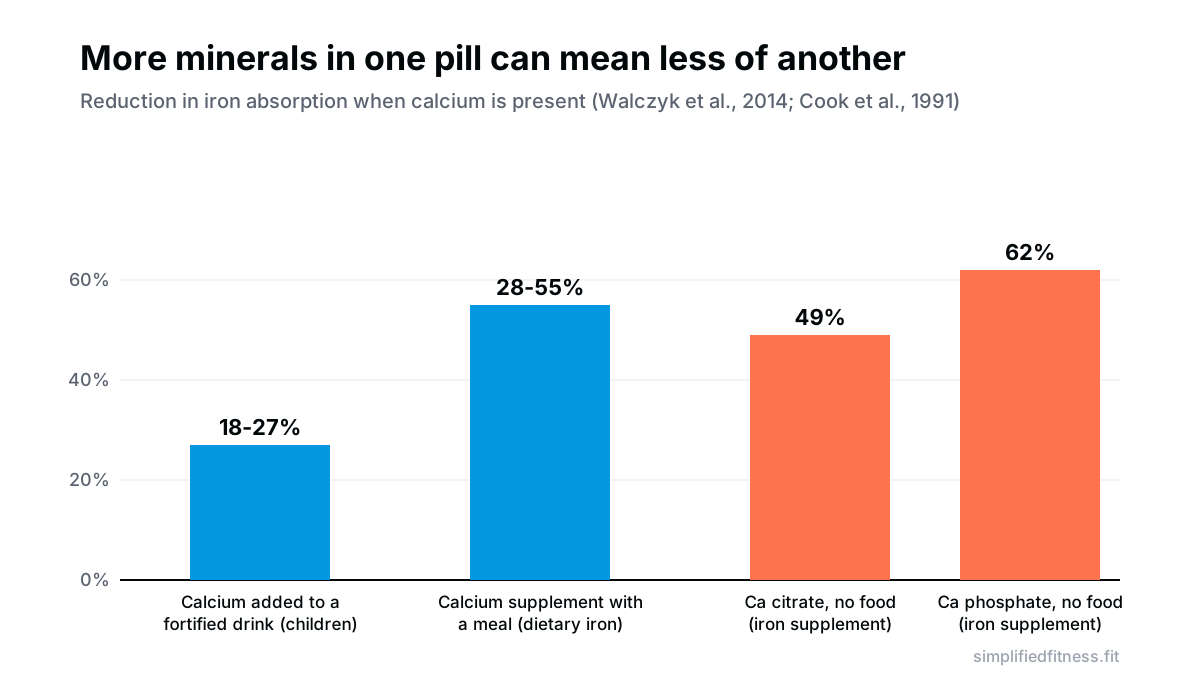
Two caveats. The children’s study used a fortified drink and the 1991 study was small and used isotopes in lab conditions, so the real-world effect on a mixed Indian meal is smaller and less certain. And a standard multi usually carries far less calcium than the 300-600 mg supplement doses tested in adults, so check your label. The practical point is about mega-dose formulas and separate high-dose calcium tablets, not a basic multi.
High-dose antioxidants can backfire
Vitamins C and E are popular because they are antioxidants, and “more antioxidants” sounds like better recovery. The data are not that kind.
Ristow and colleagues gave 1000 mg vitamin C plus 400 IU vitamin E to 39 healthy young men during four weeks of exercise. Exercise improved insulin sensitivity and induced protective gene expression only in the group that did not take the antioxidants (Ristow et al., 2009). That is a small, short, mechanistic study, but it fits a wider idea: the oxidative stress from exercise may be part of the signal that makes you adapt.
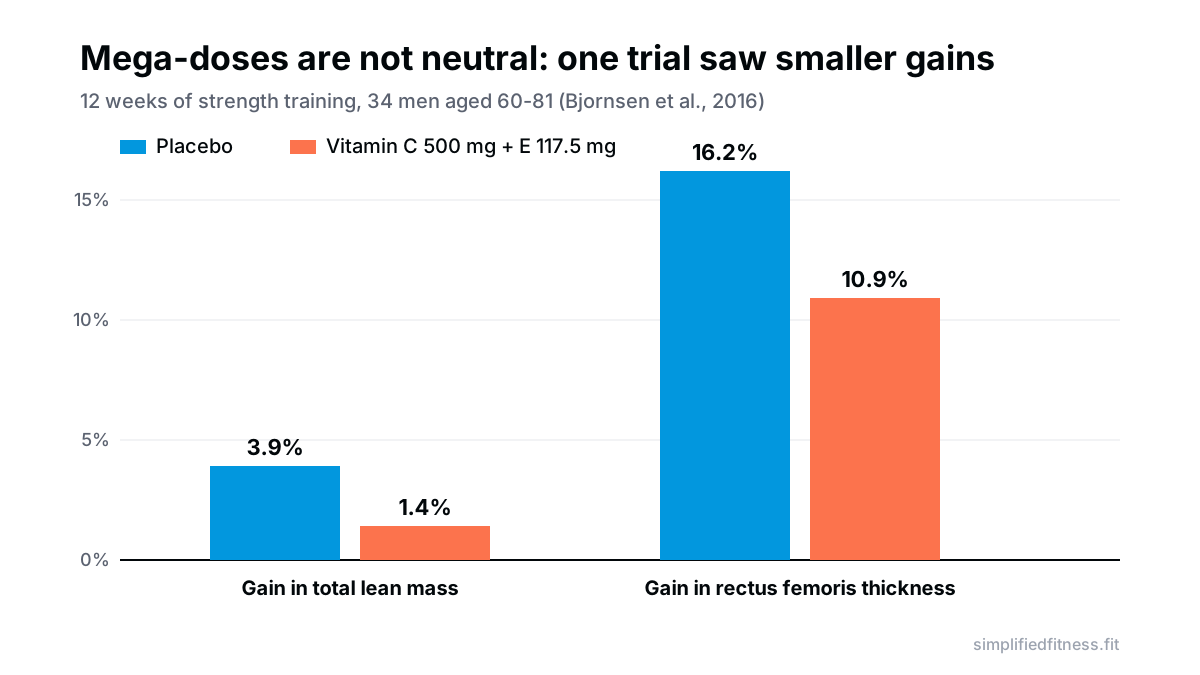
A 12-week trial in 34 men aged 60-81 randomised them to 500 mg vitamin C plus 117.5 mg vitamin E around training or placebo. Total lean mass rose 3.9% in the placebo group and 1.4% in the antioxidant group, and rectus femoris thickness rose 16.2% versus 10.9%. Strength gains (15-21%) did not differ (Bjornsen et al., 2016).
A 10-week trial in 23 trained men on a small calorie surplus also found vitamin C and E supplementation seemed to blunt upper-body strength and hypertrophy adaptations, with small effect sizes, while the placebo group gained more visceral fat (Martinez-Ferran et al., 2023).
So what do we do with that? These are small trials in older men and in a small group of trained men, using much higher doses than a multi. They do not show a standard multivitamin hurts your gains. They are a reason to avoid separate high-dose C and E “recovery” pills, and not to assume more is better.
How to pick one if you do need it
Keep it boring.
- Low dose, around 100% of daily values. Skip the 1000%+ megadoses.
- No huge extras. Proprietary blends with herbs, amino acids and “performance matrix” claims add price, not proven benefit.
- Match it to your situation. Men and post-menopausal women rarely need extra iron unless a doctor says so. Women who menstruate heavily have different needs and should ask a doctor.
- Third-party tested. See our guide to NSF and Informed Choice certifications.
- Cheap is fine. A basic store-brand multi is not worse than a premium one for covering gaps. Compare it with the other uses of your supplement money in the supplement hierarchy and the budget supplement guide.
- Take it with a meal. Fat-soluble vitamins absorb better with some fat.
If vitamin D is your specific worry, a multi is a poor way to address it. See vitamin D3 and serum targets, and for the minerals lifters most often fall short on, zinc, magnesium and iron deficiencies in lifters.
When to see a doctor instead
A multivitamin is a poor diagnostic tool. Book a blood test and a doctor visit if you notice:
- Persistent fatigue that sleep and food do not fix
- Hair shedding, brittle nails, or frequent infections
- Numbness, tingling or balance problems
- Restless legs, or unusually heavy or long periods
- A vegan diet with no B12 source
- A history of kidney stones, or any kidney, liver or thyroid condition
- Pregnancy, or planning one (needs specific advice)
Also check with a doctor before adding any supplement if you take regular medication, because some vitamins and minerals interact with drugs. This article is general information, not a diagnosis.
The bottom line
If your diet is varied and you are eating near maintenance, a multivitamin is probably not doing much for your lifts. If you are in a long hard cut, eat a narrow diet, or follow a restricted one, a basic low-dose multi is a cheap, reasonable backup, ideally after you have tried to fix the food.
Avoid the mega-dose athlete packs, separate high-dose vitamin C and E, and big calcium tablets taken with iron. Spend the money on food, protein and sleep first. If you want a place to start, work out your intake with the calorie calculator and build the plate around it.
Frequently Asked Questions
Do bodybuilders need a multivitamin?
Most do not, as long as they eat a varied diet at or near maintenance calories. A 2021 review found that micronutrient supplementation in well-nourished athletes does not enhance physical performance. If you diet very hard for months or eat a narrow diet, a basic low-dose multi is a cheap safety net.
Do multivitamins improve strength or energy in the gym?
Not in people who already get enough vitamins and minerals. Vitamins do not give you energy the way calories do, they help your body use the energy you eat. If you feel flat, check sleep, calories and iron status before buying a pill.
Is the expensive urine multivitamin myth true?
Partly. Water-soluble vitamins such as B-complex and vitamin C are not stored in large amounts, so extra is mostly passed in urine, and riboflavin (B2) turns it bright yellow. The fat-soluble ones (A, D, E, K) are stored, so more is not always harmless. Pick a standard-dose product rather than one with 1000%+ of daily values.
What is the best multivitamin for athletes?
A plain, low-dose multivitamin-mineral at roughly 100% of daily values is usually enough, with third-party testing for quality. High-dose athlete packs add cost and the nutrient competition problem without proven benefit. Check the label for iron, calcium and zinc levels that fit your diet and sex.
Are multivitamins a waste of money?
For healthy, well-fed people, mostly yes. A 2022 evidence review for the US Preventive Services Task Force found little or no benefit for preventing cardiovascular disease, cancer or death, with only a small benefit for cancer incidence from multivitamins. Spending that money on dal, eggs, paneer, fruit and protein usually buys more.
Can a multivitamin make up for a bad diet?
No. Food gives fibre, protein and a mix of compounds a tablet does not, and a pill covers only the vitamins and minerals it contains. Treat it as a backup, not a plan. Fix the plate first with a diet plan like our free [diet plan](/diet-plan).
Should I take a multivitamin when cutting?
It may help if you are eating very little for weeks, because fewer calories usually means fewer micronutrients. A low-dose multi is cheap cover, but it will not rescue a crash diet. A moderate deficit with plenty of vegetables, dal and fruit is the better fix.
Can vegetarians or vegans benefit from a multivitamin?
Sometimes. Restricted diets can fall short on nutrients such as vitamin B12, iron or zinc, depending on what you eat. A multivitamin can help cover gaps, but a blood test and a doctor or dietitian will tell you which ones actually matter for you.
Do vitamin C and E supplements hurt muscle gain?
High doses may. In a 12-week trial in men aged 60-81, 500 mg vitamin C plus 117.5 mg vitamin E blunted gains in lean mass and thigh muscle thickness compared with placebo. A small trial in trained men found a similar pattern, so avoid mega-doses of antioxidants around training.
Can calcium in a multivitamin block iron or zinc absorption?
Calcium can reduce iron absorption in some studies, especially at higher doses or when taken with meals. In Indian children, added calcium cut absorption from a fortified drink by 18-27%, and vitamin C more than offset it. Do not take large separate calcium tablets at the same meal as an iron source or supplement.
Do synthetic vitamins work as well as whole food vitamins?
For correcting a plain deficiency, the vitamin molecule itself is what counts, so a tablet can work. What food adds is everything else: fibre, protein, minerals and plant compounds that a tablet does not contain. The practical rule is food first, supplement only the gaps.
When should I take a multivitamin?
With a meal that contains some fat, since vitamins A, D, E and K absorb better that way. Timing relative to training does not matter much. Keep iron-heavy or calcium-heavy pills away from each other if you take them separately.
When should I see a doctor instead of buying a multivitamin?
See a doctor if you have ongoing fatigue, hair shedding, numbness or tingling, restless legs, heavy periods, or you follow a vegan diet. These can have causes a multivitamin will not fix. Ask for a blood test so you treat the actual gap rather than guessing.
Sources & References
Every claim above is checked against peer-reviewed research (PubMed, U.S. National Library of Medicine) or guidance from established health bodies. How we fact-check.
- Beck KL, et al. Micronutrients and athletic performance: A review. Food Chem Toxicol. 2021. PMID: 34662692
- O'Connor EA, et al. Vitamin and Mineral Supplements for the Primary Prevention of Cardiovascular Disease and Cancer: Updated Evidence Report and Systematic Review for the US Preventive Services Task Force. JAMA. 2022. PMID: 35727272
- Gaziano JM, et al. Multivitamins in the prevention of cancer in men: the Physicians' Health Study II randomized controlled trial. JAMA. 2012. PMID: 23162860
- Thomas DT, et al. American College of Sports Medicine Joint Position Statement. Nutrition and Athletic Performance. Med Sci Sports Exerc. 2016. PMID: 26891166
- Bjørnsen T, et al. Vitamin C and E supplementation blunts increases in total lean body mass in elderly men after strength training. Scand J Med Sci Sports. 2016. PMID: 26129928
- Martinez-Ferran M, et al. Antioxidant vitamin supplementation on muscle adaptations to resistance training: A double-blind, randomized controlled trial. Nutrition. 2023. PMID: 36283241
- Ristow M, et al. Antioxidants prevent health-promoting effects of physical exercise in humans. Proc Natl Acad Sci U S A. 2009. PMID: 19433800
- Walczyk T, et al. Inhibition of iron absorption by calcium is modest in an iron-fortified, casein- and whey-based drink in Indian children and is easily compensated for by addition of ascorbic acid. J Nutr. 2014. PMID: 25332469
- Cook JD, et al. Calcium supplementation: effect on iron absorption. Am J Clin Nutr. 1991. PMID: 1984334

Umair Hazrami · Founder & Head Coach, Simplified Fitness
Umair Hazrami founded Simplified Fitness and the Simplified Lifter channel to cut through fitness noise. With 4+ years of consistent training and 10+ coaching clients, he writes every guide from the peer-reviewed research and links the sources so you can check them. Our editorial standards.
Educational content only, not medical advice. If you have a medical condition, are pregnant, or take medication, talk to a qualified doctor before changing your diet, supplements or training. Full disclaimer.
Keep reading

Supplements
The Antioxidant Paradox: Can Vitamin C and E Pills Blunt Muscle Growth and Endurance?
Does vitamin C blunt muscle growth? See what trials of 1000 mg vitamin C plus E found for strength, hypertrophy and endurance, and when pills are worth taking.
8 min read
Supplements
Ashwagandha KSM-66 vs Sensoril: Which Extract, What Dose, and Do You Need to Cycle?
Ashwagandha KSM-66 vs Sensoril for lifters: what the strength trials show, realistic cortisol effects, liver safety and whether to cycle. Every study linked.
8 min read
Supplements
BCAAs vs EAAs: Why BCAAs Are a Waste of Money If Your Protein Is Covered
BCAA vs EAA for muscle growth: BCAAs are only 3 of the 9 essential amino acids. See what Wolfe 2017 and Jackman 2017 found and when EAAs or whey make sense.
8 min read
Supplements
Beetroot Juice for Running and Lifting: How Dietary Nitrate Works (and the Mouthwash Trap)
Does beetroot juice for running actually work? See what meta-analyses show, the 2-3 hour timing and dose, who benefits, and why mouthwash can cancel the effect.
9 min read