Alpha-GPC and Huperzine A Pre-Workout: Do Cholinergic Nootropics Help Lifting?
Does an alpha GPC pre workout add power or focus? See what small trials found, why Huperzine A is a poor lifting bet, and the safety flags to know first.

TL;DR. The short answer
- Alpha-GPC has small, short trials in young men showing modest gains in some force or jump measures and in focus, but results are mixed and nobody has measured a real mind-muscle connection.
- Huperzine A blocks the enzyme that clears acetylcholine. Its human evidence comes from Alzheimer's disease, not from lifters, so there is no good case for using it in the gym.
- Your body makes acetylcholine from choline, and eggs, meat, soya and dal already supply it. Plain choline supplements did not improve exercise performance in older trials.
- A large Korean cohort of adults aged 50 and over linked prescription Alpha-GPC to more strokes. It is observational and not about gym users, but it is a reason to be cautious about heavy long-term use.
- If you try Alpha-GPC at all, treat it as a cheap experiment: one tested product, the studied dose range, one or two weeks, and a doctor's okay if you have heart or stroke risk.
Part of our complete guide: Creatine, Protein Powders, Pre-Workouts and Caffeine: The Science and Safety Guide
Table of contents
Is an alpha GPC pre workout worth buying? Maybe a small, unproven edge at best. A few short trials in young men found modest gains in some force, jump or focus measures, others found nothing, and none tested whether it improves your mind-muscle connection.
Huperzine A is a weaker bet still. It has no lifting data at all. This article sits inside our guide to creatine, protein powders and caffeine, where the supplements with real evidence live. These cholinergic “nootropics” are the speculative end of the shelf.
What are cholinergic supplements supposed to do?
The pitch is neat, and it is not nonsense. Your nerves talk to your muscles using acetylcholine. When a motor neuron fires, it releases acetylcholine at the junction with the muscle fibre, and the fibre contracts. Your body builds acetylcholine from choline.
So the marketing logic runs: more choline in, more acetylcholine out, more drive to the muscle, better focus and better power. Alpha-GPC is a choline-containing supplement. Huperzine A takes a different route. It slows the enzyme (acetylcholinesterase) that clears acetylcholine away, so the signal lingers.
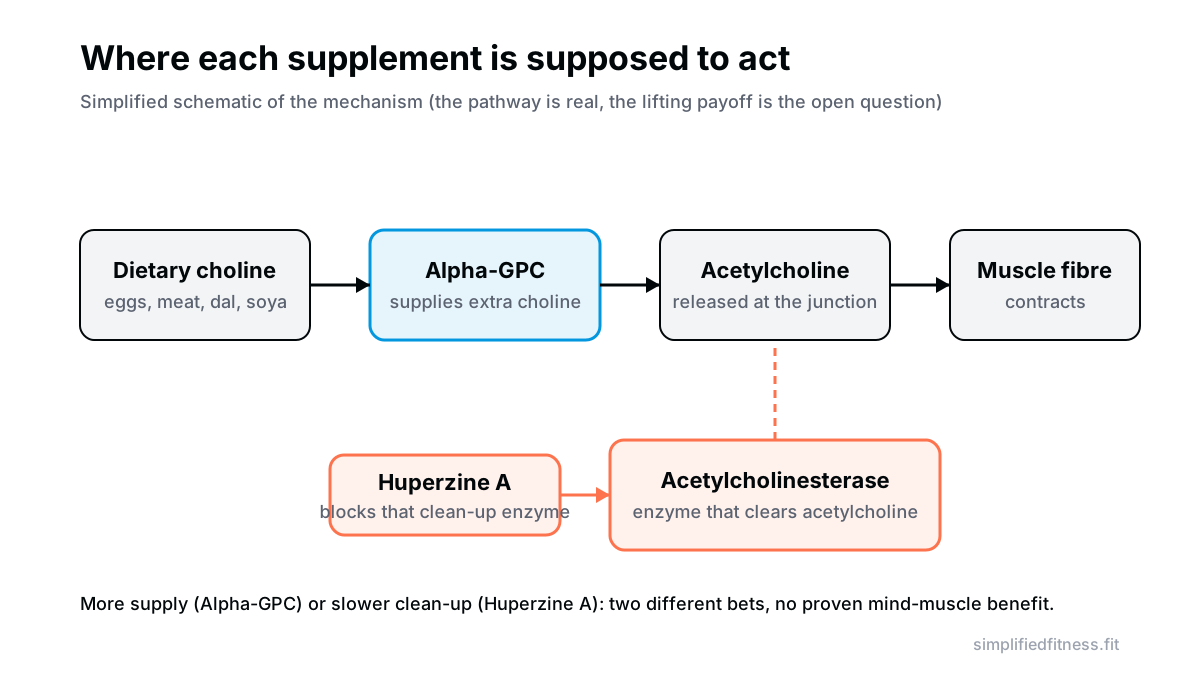
Here is the catch. A plausible mechanism is the cheapest thing in supplement marketing. What matters is whether healthy lifters, tested properly, lift more or focus better. That is what we will check.
Does alpha GPC work as a pre-workout?
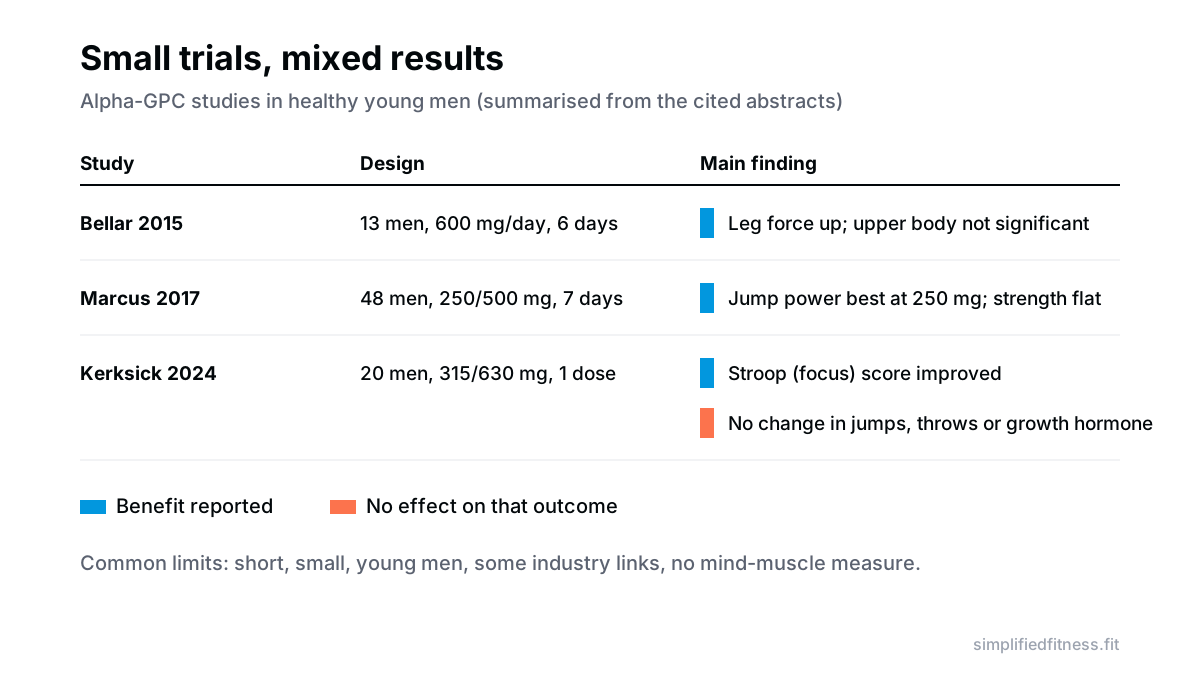
Three studies come up again and again, and they do not agree with each other.
Bellar et al. (2015). Thirteen college-aged men took 600 mg a day of Alpha-GPC or placebo for 6 days in a crossover design. Mid-thigh pull peak force rose more after Alpha-GPC than placebo (about +99 N versus -39 N). The upper-body isometric test trended in the same direction but was not statistically significant (Bellar et al., 2015).
Marcus et al. (2017). Forty-eight men were split into 500 mg Alpha-GPC, 250 mg Alpha-GPC, 200 mg caffeine or placebo for 7 days. There were no group differences in mid-thigh pull, upper-body strength or reaction-time vigilance. Countermovement jump velocity and power did differ, with the 250 mg group improving the most. Serum free choline rose in both Alpha-GPC groups, and thyroid stimulating hormone (TSH) was lower in the 500 mg group (Marcus et al., 2017).
Kerksick (2024). Twenty resistance-trained men took placebo, 315 mg or 630 mg of Alpha-GPC an hour before testing. Both doses improved Stroop test scores (a focus and inhibition task), and the higher dose was faster. There were no differences in the Flanker or N-Back tasks, no differences in physical performance, and no difference in growth hormone after a squat session (Kerksick, 2024).
Why the results do not line up
Put them together and you get this: one study sees force, one sees jump power at only the lower dose, one sees focus but no physical change. That is not a clean dose-response story.
There are ordinary explanations. These trials are small, short (days, not months) and all in men, mostly college-aged. Marcus found its jump signal at 250 mg but not 500 mg, which is odd if more were better. With many outcomes tested in small groups, a few “significant” results can appear by chance. And the 2024 trial’s author discloses paid advisory work for the sponsor, which does not invalidate it but is worth knowing.
What about choline on its own?
If the “more choline” theory were strong, plain choline should help too. Older controlled trials did not find that. In a double-blind crossover in 14 soldiers doing 4 hours of loaded treadmill walking, a large choline citrate dose raised plasma choline by 128%, yet had no significant effect on any performance measure, including time to exhaustion and squats (Warber et al., 2000). The authors also found that plasma choline did not fall under placebo, so there was no depletion to fix.
That is a different population (military, endurance) and a different compound from Alpha-GPC, so it does not settle things. But it is a reminder that raising blood choline and improving a lift are two separate claims.
Can it improve your mind-muscle connection?
Here is the reality: nobody has measured it. There is no trial of Alpha-GPC with muscle activation, EMG or a validated mind-muscle rating as the outcome.
The nearest evidence is the Stroop result above, which suggests a small acute boost on one attention task in resistance-trained men. A better score on a screen test is not the same as feeling your lats work during a pulldown. The label “mind-muscle” is a story supplement brands tell around that gap.
What actually builds the feel is boring. Lighter loads, a slower lowering phase, a pause at the stretch and a specific cue. If you want that skill, work on it directly with our guides to lat activation cues and scapular position. They cost nothing and have no side effects.
Huperzine A for bodybuilding: what is the evidence?
For lifters, we could not find any. The human trials are in Alzheimer’s disease and dementia, not gym performance.
The best human summary is a Cochrane review of six trials with 454 patients with Alzheimer’s disease. It reported benefits on some cognitive scales and mild adverse events, but noted most trials were not high quality and concluded there was inadequate evidence to recommend it (Li et al., 2008).
Think about what that means for a 25-year-old on a bulk. The data are in older patients with a disease, not healthy people. The outcome was memory and daily function, not squats or focus in the gym. And the compound is a cholinesterase inhibitor, a drug-like action, with nobody studying long-term effects in people who do not need it.
Our view: there is no good case to use Huperzine A for lifting. If a pre-workout contains it, that is a reason to look harder at the label, not a feature. See how to read proprietary blends and how third-party certifications help you avoid unknown doses.
Is there a cardiovascular catch? TMAO, choline and stroke
This is where “natural brain supplement” stops being a free lunch, and where the evidence needs careful reading.
The TMAO link. Gut bacteria convert choline from food into trimethylamine, and the liver turns that into TMAO. In a 2013 study, higher fasting TMAO was associated with more major cardiovascular events in 4,007 patients undergoing elective coronary angiography (highest versus lowest quartile hazard ratio 2.54) (Tang et al., 2013). Those were patients, many with heart disease, and the design was observational for the outcome.
A reassuring counterpoint. In a small crossover of 30 healthy young adults, about 400 mg a day of choline from three eggs or a bitartrate supplement for 4 weeks did not change plasma TMAO (Lemos et al., 2018). So moderate choline in healthy young people does not automatically push TMAO up, at least over a month.
The stroke signal. A Korean national insurance cohort followed over 12 million adults aged 50 and over for 10 years. Prescription Alpha-GPC users had a higher risk of total stroke (adjusted HR 1.43 after matching), ischemic and hemorrhagic stroke, and the risk rose with longer use (Lee et al., 2021). The authors say the mechanism is unknown and more studies are needed. The paper carries a later erratum, so read the current version.
Putting this together fairly: for a healthy 20-something taking a modest dose for a week or two, nothing here says it is dangerous. For anyone over 50, or with high blood pressure, heart disease, a past stroke, or a family history of early cardiovascular disease, the sensible move is to talk to a doctor first or skip it. And “chronic high-dose daily use” is exactly the pattern nobody has shown to be safe in lifters.
Do you already get enough choline from food?
Food is the better first move. Eggs and meat are classic choline sources, and in the Lemos trial above, plasma choline rose about 20% with eggs, while the bitartrate supplement did not move it. The authors concluded choline appeared to be more bioavailable from eggs.
For an Indian plate, the practical choline sources are eggs, chicken, fish, paneer and milk, soya chunks, rajma, chana and dal. Vegetarians can get decent amounts, but if you eat no eggs and little soya, it is worth asking whether your overall protein diet is thin. Our protein calculator is a better first step than a nootropic.
How should you test it if you are still curious?
Treat it as a cheap, short self-experiment, not a lifestyle. Here is a sensible order.
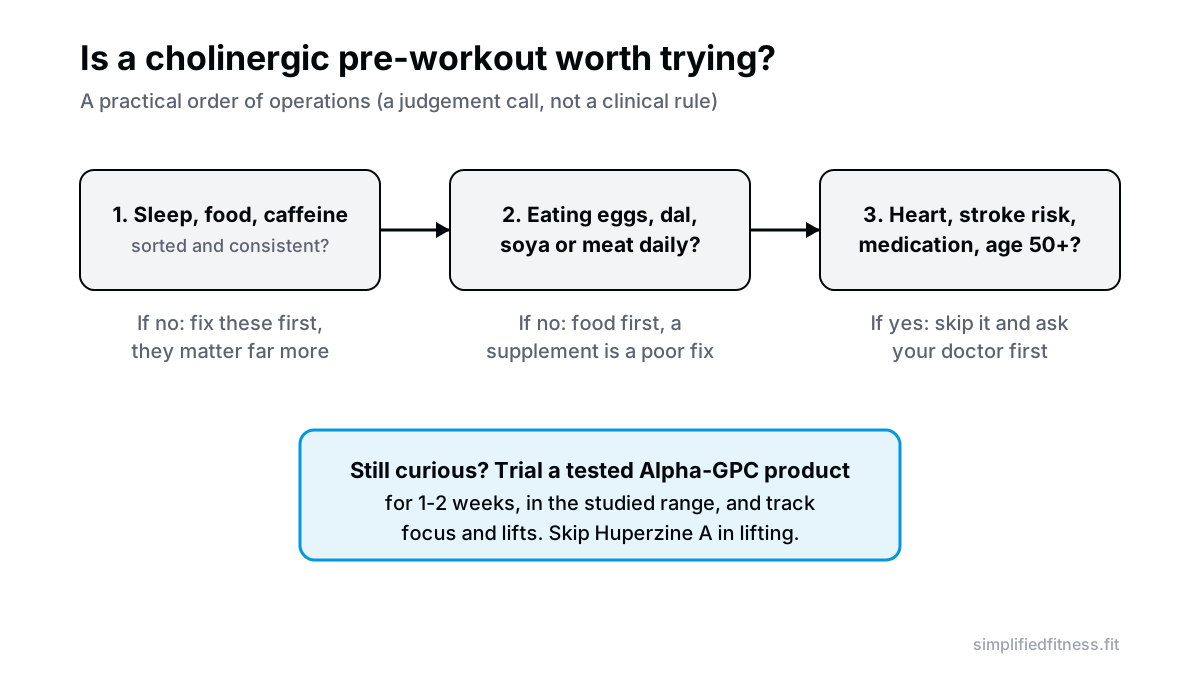
- Sort the basics. Sleep, protein, total calories and a proper warm-up beat any nootropic. Get your caffeine dose and timing right first with our guide to caffeine dosing for strength and the caffeine dosage calculator.
- Screen yourself. Heart disease, stroke history, blood pressure problems, regular medication, pregnancy or being over 50 means ask a doctor first.
- Pick one tested product. Look for single-ingredient Alpha-GPC with third-party testing, not a proprietary blend.
- Stay in the studied range. The trials used roughly 250-630 mg. There is no reason to go higher.
- Test for one to two weeks. Track something real: a repeatable jump, your top set on a main lift, or how long you stay sharp in a session.
- Change one thing. Do not start a new pre-workout, creatine and Alpha-GPC the same week, or you will never know what worked.
- Stop if it does nothing. Most people will see nothing. That is a normal result, and it saves you money.
Where do these fit in a pre-workout stack?
At the bottom. A realistic evidence ladder for pre-workouts is caffeine first, then (for some people) citrulline or beta-alanine, with the rest as extras. We cover doses in pre-workout formulation science and the full ranking in our supplement hierarchy.
If a tub lists Alpha-GPC at a dose well below the studied range, it is label decoration. If it hides the amount in a “focus matrix,” you cannot judge it at all. And if your pre-workout makes you jittery or gives palpitations, adding a second stimulant-like compound is the wrong direction. Our guide to pre-workout side effects covers what to do.
When to see a doctor
Stop and get medical advice if you get chest pain, a racing or irregular heartbeat, severe headache, sudden weakness or numbness on one side, trouble speaking, or vision changes. Those can be emergencies. Also speak to a doctor before using any of these supplements if you have heart or circulation problems, take regular medication, are pregnant or breastfeeding, or are 50 or older. This article is general information, not a diagnosis.
The bottom line
The cholinergic story is a clean mechanism wrapped around a weak and inconsistent evidence base. Alpha-GPC has a few small, short trials with modest, mixed signals for power and for one focus test. Huperzine A has no lifting evidence. The only large outcome dataset on Alpha-GPC points to a possible stroke signal in older users, and moderate choline from eggs did not raise TMAO in a small healthy sample.
If you want better lifts, you will get more from a consistent program, enough protein, sleep, and well-dosed caffeine and creatine. Start with a free push, pull and legs plan and make your training the thing you test, not your capsule.
Frequently Asked Questions
Does Alpha-GPC work as a pre-workout?
It might help a little, but the evidence is thin. A 6-day trial in 13 men found higher mid-thigh pull force, while a 7-day trial in 48 men found no strength change and a jump-power gain only at 250 mg. Treat it as an optional experiment, not a proven performance aid.
How much Alpha-GPC should I take before a workout?
The trials used roughly 250-630 mg, either daily for about a week or as a single dose about an hour before testing. There is no established dose for lifters, and the studies were small. If you try it, stay inside that range and follow the label rather than stacking extra.
What is Alpha-GPC and how does it work?
Alpha-GPC (alpha-glycerylphosphorylcholine) is a choline-containing compound sold as a supplement. Your body can use choline to make acetylcholine, the messenger that nerves release to trigger muscle contraction. Whether extra choline meaningfully raises acetylcholine signalling in a healthy lifter is still unproven, so judge it by results, not by the mechanism.
Does Alpha-GPC improve the mind-muscle connection?
No study has measured it, so the claim is untested. The one trial that looked at cognition found better scores on a focus test (Stroop) in resistance-trained men, but no change in jumps or bench throws. Better mind-muscle feel comes much more reliably from lighter loads, slower reps and deliberate cues.
Does Huperzine A help with bodybuilding?
There is no evidence that it does. Huperzine A inhibits acetylcholinesterase, and the human trials are in Alzheimer's disease, where a Cochrane review judged the evidence inadequate to recommend it. Using a drug-like compound with no lifting data is a poor trade.
Is Huperzine A safe?
In the Alzheimer's trials reviewed by Cochrane, side effects were mild, but those were supervised patients, not gym users taking pre-workout stacks. Long-term safety in healthy people is not well established. Speak to a doctor first, especially if you take any medication.
Can Alpha-GPC raise the risk of stroke?
A 2021 cohort of over 12 million Korean adults aged 50+ found prescription Alpha-GPC users had a higher 10-year stroke risk, in a dose-response pattern. This was observational, in older people given it for medical reasons, so it cannot prove cause. If you are over 50 or have stroke or heart risk factors, ask your doctor before using it.
What is TMAO and should lifters worry about choline?
TMAO is a compound your gut bacteria make from choline, and higher blood levels have been linked to cardiovascular events in people undergoing angiography. In a small trial of healthy young adults, about 400 mg/day of choline from eggs or a supplement for 4 weeks did not change TMAO. Keep doses modest and avoid long, high-dose use without medical advice.
Do I need choline supplements if I eat eggs?
Probably not for gym performance. Eggs and meats are rich choline sources, and a trial found choline was more bioavailable from eggs than from a supplement. Two eggs, some paneer, soya chunks and dal across the day is a more useful first step than a capsule.
Is Alpha-GPC better than caffeine for focus?
Caffeine has far more evidence for performance. In a 48-man trial, a 200 mg caffeine group was compared against Alpha-GPC and placebo, and the most notable jump-power result belonged to 250 mg of Alpha-GPC, but the study was small. Sort your caffeine dose and timing first, then decide if anything else is worth testing.
Can I stack Alpha-GPC with creatine or caffeine?
There is no known problem in the trials, but stacks were not studied in a way that tells us about long-term use. Creatine is the one worth taking daily, and caffeine is the one to dose carefully. Add one new thing at a time so you can tell what actually helps.
Do I need to cycle Alpha-GPC?
There is no evidence base for any cycling schedule. Trials ran about a week, and the longest safety signal comes from older adults on prescriptions. If you use it, keep it to short experimental blocks rather than year-round daily use.
Who should avoid cholinergic nootropics?
Anyone with a history of stroke, heart disease or uncontrolled blood pressure, people on regular medication, and anyone pregnant or breastfeeding should check with a doctor first. Adults over 50 should be especially careful given the stroke cohort. If a pre-workout makes your chest pound or your head ache, stop and get advice.
Sources & References
Every claim above is checked against peer-reviewed research (PubMed, U.S. National Library of Medicine) or guidance from established health bodies. How we fact-check.
- Bellar D, et al. The effect of 6 days of alpha glycerylphosphorylcholine on isometric strength. J Int Soc Sports Nutr. 2015. PMID: 26582972
- Marcus L, et al. Evaluation of the effects of two doses of alpha glycerylphosphorylcholine on physical and psychomotor performance. J Int Soc Sports Nutr. 2017. PMID: 29042830
- Kerksick CM. Acute alpha-glycerylphosphorylcholine supplementation enhances cognitive performance in healthy men. Nutrients. 2024. PMID: 39683633
- Warber JP, et al. The effects of choline supplementation on physical performance. Int J Sport Nutr Exerc Metab. 2000. PMID: 10861337
- Li J, et al. Huperzine A for Alzheimer's disease. Cochrane Database Syst Rev. 2008. PMID: 18425924
- Lee G, et al. Association of L-alpha glycerylphosphorylcholine with subsequent stroke risk after 10 years. JAMA Netw Open. 2021. PMID: 34817582
- Tang WH, et al. Intestinal microbial metabolism of phosphatidylcholine and cardiovascular risk. N Engl J Med. 2013. PMID: 23614584
- Lemos BS, et al. Effects of egg consumption and choline supplementation on plasma choline and trimethylamine-N-oxide in a young population. J Am Coll Nutr. 2018. PMID: 29764315

Umair Hazrami · Founder & Head Coach, Simplified Fitness
Umair Hazrami founded Simplified Fitness and the Simplified Lifter channel to cut through fitness noise. With 4+ years of consistent training and 10+ coaching clients, he writes every guide from the peer-reviewed research and links the sources so you can check them. Our editorial standards.
Educational content only, not medical advice. If you have a medical condition, are pregnant, or take medication, talk to a qualified doctor before changing your diet, supplements or training. Full disclaimer.
Keep reading

Supplements
The Antioxidant Paradox: Can Vitamin C and E Pills Blunt Muscle Growth and Endurance?
Does vitamin C blunt muscle growth? See what trials of 1000 mg vitamin C plus E found for strength, hypertrophy and endurance, and when pills are worth taking.
8 min read

Supplements
Caffeine Powder vs Coffee Before Lifting: Does the Source Really Matter?
Caffeine anhydrous vs coffee for lifting: what research says on absorption speed, peak levels and stomach upset, and whether pills beat your daily cup.
7 min read

Supplements
Caffeine Dosing for Strength and Power: 3-6 mg/kg and When to Take It
Caffeine dosage for strength is 3-6 mg/kg, about 210-420 mg for a 70 kg lifter, taken around 60 minutes before training. Doses, timing and when to stop.
8 min read

Supplements
Caffeine Tolerance and Cycling: Adenosine, Withdrawal and a Reset Without the Crash
Caffeine tolerance reset made practical: why 400 mg of pre-workout stops working, what withdrawal really looks like, and a 10-day taper to dodge headaches.
8 min read