Caffeine Tolerance and Cycling: Adenosine, Withdrawal and a Reset Without the Crash
Caffeine tolerance reset made practical: why 400 mg of pre-workout stops working, what withdrawal really looks like, and a 10-day taper to dodge headaches.

TL;DR. The short answer
- Daily caffeine blunts its own effect. In trials, regular intake reduced the performance boost from caffeine, though it rarely wipes it out completely.
- Withdrawal usually starts 12-24 hours after your last dose, peaks at 20-51 hours and lasts 2-9 days. Headache affects about half of people in experimental studies.
- Tapering by about 25% every 3 days (400 mg down to 0 over roughly 10 days) is a sensible way to soften withdrawal. It is a practical convention, not a protocol proven in trials.
- One trial in previously inactive men suggested a brief break could compensate for some lost benefit, but how long a reset needs is not firmly established.
- If you get severe headaches, palpitations, chest pain or anxiety, or you cannot cut down despite trying, speak to a doctor.
Part of our complete guide: Creatine, Protein Powders, Pre-Workouts and Caffeine: The Science and Safety Guide
Table of contents
If your 400 mg pre-workout now feels like a glass of water, a caffeine tolerance reset is the usual fix. The practical version is to taper your intake down over about 10 days, stay low or off for a week or two, then restart at a moderate dose. This guide is part of our complete guide to creatine, protein powders and caffeine, and it covers what is happening in your head, what withdrawal really looks like, and how to avoid the worst of it.
One honest caveat first. The human research on caffeine tolerance in gym-goers is thinner than the supplement industry makes it sound. Where the evidence is solid I will say so, and where it is a practical convention I will say that too.
Why does caffeine stop working?
Through the day your brain builds up adenosine, a chemical that makes you feel sleepy. Caffeine sits in the same receptors without activating them, so adenosine cannot deliver its “slow down” message. You feel alert.
When you do this every day, the effect fades. The classic explanation is that the brain grows extra adenosine receptors to compensate, so the same dose blocks less. That is the idea behind searches like “adenosine receptor upregulation caffeine”. The evidence for it is mostly animal work, and the two studies below do not fit the simple story well.
- Mice: a 1993 study infusing caffeine found tolerance to its stimulant effect and withdrawal effects whose time course resembled human withdrawal (Kaplan et al., 1993). The authors linked both to caffeine constantly occupying A1 adenosine receptors. Receptor binding measured in the living animal shifted and returned to control levels by days 4-6 after stopping, but binding measured in brain tissue outside the body did not change.
- Rats: after 12 weeks of caffeine in drinking water, brain PET scans showed lower A1 receptor availability about 4 hours after withdrawal, which the authors put down to leftover caffeine metabolites, and availability was back around baseline by roughly 27 hours. They concluded long-term caffeine did not cause lasting changes in these receptors (Nabbi-Schroeter et al., 2018).
These are animals, so I would not copy the numbers across to you. The fair takeaway is that tolerance and withdrawal are real, but “your receptors multiplied and need weeks to shrink back” is not what this research shows. Whatever changes happen look short-lived, which fits with how quickly human withdrawal symptoms come and go.
Does caffeine tolerance actually hurt gym performance?
A bit, and it depends on who you are.
In an 80-man trial, a 3 mg/kg dose improved 3 km run time and Wingate mean power output in every group at every stage, but habitual caffeine consumption reduced that boost. The authors concluded that short-term withdrawal could help compensate for the lost effect (Khodadadi et al., 2025). The participants were previously inactive men, so the findings may not map neatly onto experienced lifters.
A smaller, longer study gave 11 people 3 mg/kg/day for 20 days. Caffeine raised the workload at the second ventilatory threshold for around 15 days, but the size of the benefit shrank over time (Ruiz-Moreno et al., 2020). That is a cycling test, not a lifting test.
And then a reminder that caffeine can still work when you are used to it. In 12 women who already consumed about 5.7 mg/kg/day, a 6 mg/kg dose raised bench press bar velocity at 50% 1RM versus no supplement, but not versus placebo, which suggests part of the effect was expectation (Filip-Stachnik et al., 2022).
Meanwhile the broader picture is positive: a meta-analysis found caffeine modestly improved upper-body strength and power in studies overall (Grgic et al., 2018). Those effects were small (SMDs around 0.2), which is part of why chasing ever larger doses is a poor trade.
How bad is caffeine withdrawal?
A review of 57 experimental studies and 9 surveys pinned down what withdrawal actually looks like (Juliano and Griffiths, 2004):
- The best-validated symptoms were headache, fatigue, low energy, reduced alertness, drowsiness, low mood, trouble concentrating, irritability and a foggy head.
- In experimental studies, headache occurred in about 50% of people, and 13% had clinically significant distress or impairment.
- Symptoms usually began 12-24 hours after the last dose, peaked at 20-51 hours and lasted 2-9 days.
- Bigger daily doses tended to mean more frequent or stronger symptoms, but abstaining from doses as low as 100 mg/day still produced symptoms.
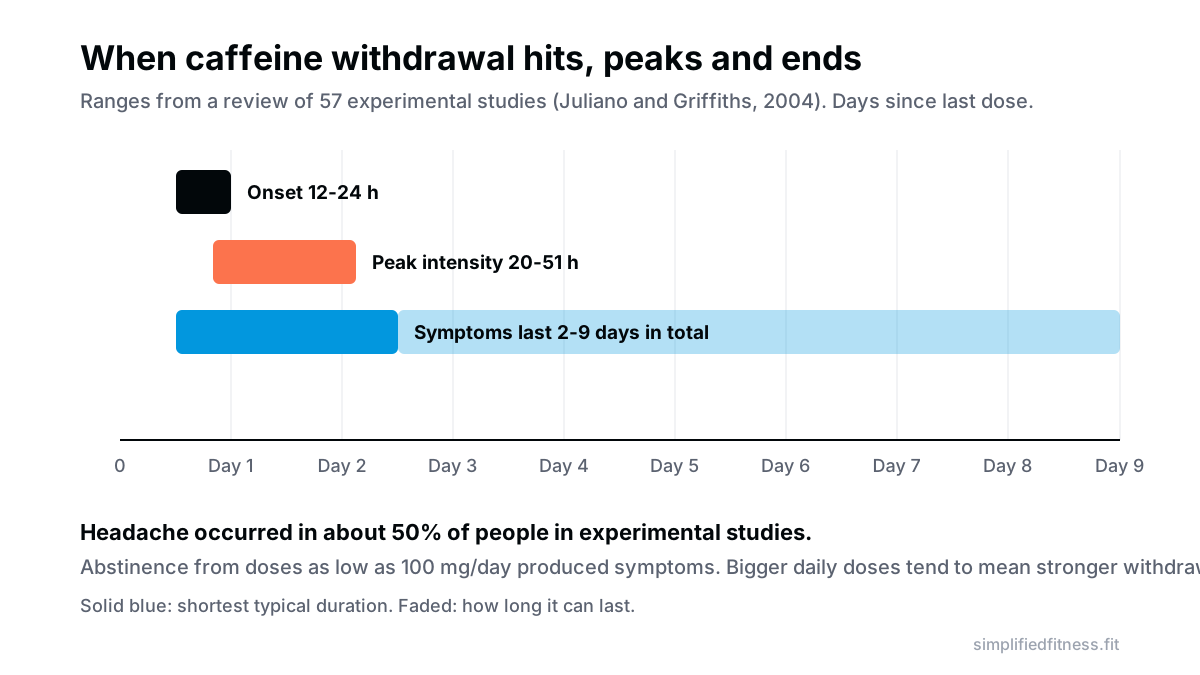
So the pain is real but short. If you stop on Friday evening, you may feel it on Saturday and Sunday, and be mostly back by midweek.
How do you cycle off caffeine without headaches?
No trial has compared a taper with quitting cold turkey for gym performance. The case for tapering comes from the symptom pattern above: if withdrawal tracks dose, smaller steps down should mean milder symptoms. The schedule below is a practical convention, not a validated protocol.
The 10-day taper (example from 400 mg/day):
- Days 1-3: drop to 75% (300 mg).
- Days 4-6: drop to 50% (200 mg).
- Days 7-9: drop to 25% (100 mg).
- Day 10 onward: 0 mg for one to two weeks.
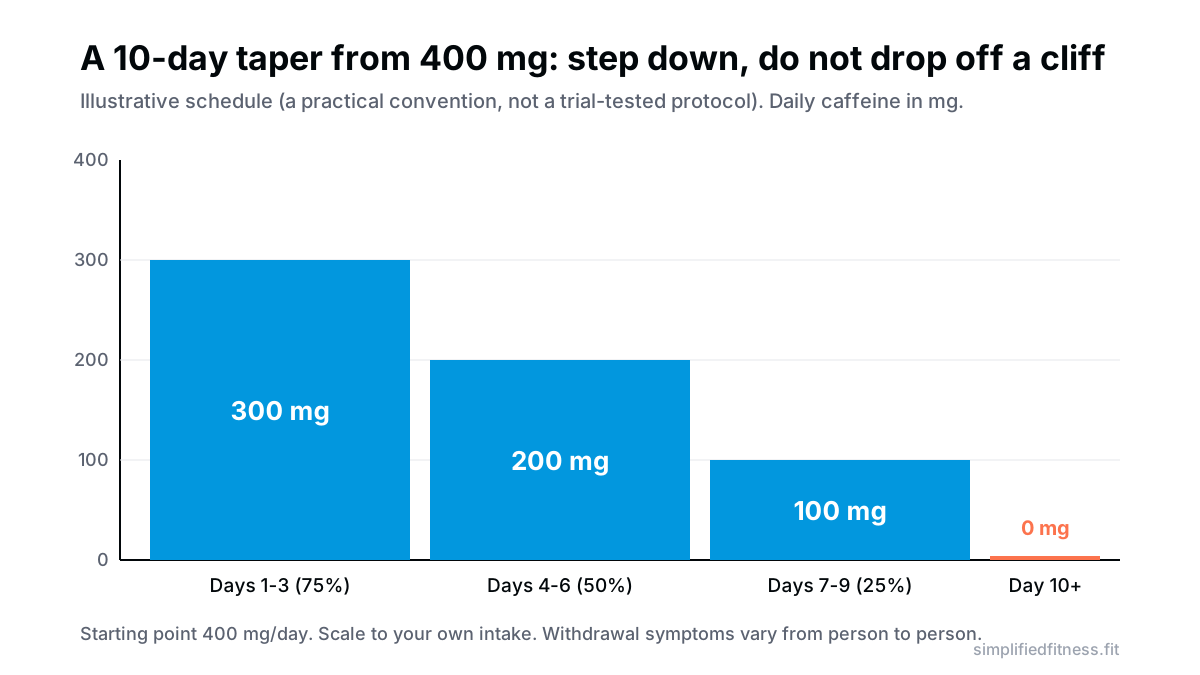
Scale it to your own intake. If you drink two coffees and a scoop of pre-workout, add everything up first, because coffee, tea, cola, energy drinks and even some pre-workouts all count. Use our caffeine dosage calculator to see where your total sits for your body weight.
A few things that make it easier:
- Cut the biggest hit first. Usually that is the pre-workout scoop, not the morning chai.
- Keep timing the same. Reduce the dose at your usual time instead of skipping a session entirely.
- Sleep and eat. Withdrawal fatigue stacks on top of sleep debt. If you are also sleeping badly, read our guide on the afternoon caffeine cutoff and deep sleep.
- Pick a quiet week. Not a test, a competition or a deadline.
Can L-tyrosine or anything else help?
The plan you may have seen online swaps in L-tyrosine to support dopamine during the taper. The reasoning is plausible, since tyrosine is a precursor to dopamine, but I have not found good evidence that it reduces caffeine withdrawal specifically, so I would not count on it. We cover what is and is not known in L-tyrosine for focus.
Boring stuff probably helps more:
- Regular meals with protein and carbs (dal, curd, paneer, eggs, roti or rice).
- Enough water, especially in hot weather when you sweat a lot.
- Eight hours of sleep opportunity.
- A short walk in daylight instead of another cup.
How long should the reset last?
This is where I have to be straight with you: no one knows the ideal break length. A review of habitual caffeine use in athletes noted that the evidence on habituation and withdrawal strategies is surprisingly small, so firm guidelines are hard to write (Pickering and Kiely, 2019). In the 80-man trial above, the authors suggested short-term withdrawal could compensate for the reduced effect, but the participants were previously inactive men and the break was short, so it tells us little about how long a lifter needs. That is the honest state of play.
A cautious takeaway: a taper plus 1-2 weeks off is a reasonable, commonly used window, and by the time withdrawal symptoms have passed (2-9 days in most people) you can judge how a small dose feels. If a break is not feasible, simply running a lower daily intake may be the more realistic option.
How do you restart without losing the benefit?
- Start lower than before. Try 100-200 mg for a few sessions and see how it feels.
- Save the big doses. Use moderate caffeine most days and a larger dose only for key sessions such as a heavy lower-body day. Our guide to caffeine dosing for strength and power covers sensible ranges.
- Check your genetics and sensitivity. People metabolize caffeine at different speeds, which is covered in caffeine sensitivity and CYP1A2.
- Watch the label. If you want to avoid stimulant overload, see pre-workout side effects and fixes.
Who should be careful?
Caffeine is not harmless for everyone. See a doctor before a taper, or before restarting, if you:
- have a heart condition, palpitations or high blood pressure
- are pregnant or breastfeeding
- take medication that interacts with caffeine
- have anxiety, panic attacks or serious sleep problems
- feel you cannot cut down even though you want to
A 2026 structured review found only four studies on problematic caffeine use, dependence and withdrawal in athletes, and concluded evidence is insufficient for firm conclusions (Liu et al., 2026). That means no one can tell you the typical athlete’s risk, so if something feels off, get individual advice. Severe or unusual headaches, chest pain or a racing heart are reasons to see a doctor, not to push through.
The bottom line
Caffeine tolerance is real, it is mild to moderate, and it is reversible. A gradual taper from your current intake over about 10 days, followed by a week or two of low or zero caffeine, is a sensible way to reset without a brutal crash. It is a practical convention rather than a proven protocol, so adjust to how you feel.
And remember what caffeine is: a small, short-lived boost on top of good training, sleep and food. If your sessions are drifting, check those first, then build your week with our free push pull legs plans.
Frequently Asked Questions
How do I reset my caffeine tolerance?
The usual approach is to taper your daily caffeine down to zero over about 10 days, then stay off for one to two weeks. Withdrawal symptoms tend to last 2-9 days, so stepping down gradually softens them compared with stopping abruptly. After the break, restart at a moderate dose rather than jumping straight back to 400 mg.
How long does it take to reset caffeine tolerance?
There is no firmly established number. Human withdrawal symptoms typically last 2-9 days, and one trial suggested a short break could help compensate for the reduced performance effect. A taper plus one to two weeks off is a reasonable, commonly used window, not a proven one.
What are the symptoms of caffeine withdrawal?
The best-validated symptoms are headache, fatigue, low energy, drowsiness, poor concentration, irritability, low mood and a foggy head. A review of 57 experimental studies found headache in about 50% of people. Expect to feel flat for a few days and plan your hardest sessions for when you feel better.
Do I need to quit caffeine completely to reset tolerance?
Not necessarily. Going fully off is the cleanest reset, but cutting well below your usual dose may already help. Research on exactly how low is limited, so treat partial reduction as a reasonable experiment and judge it by how a smaller dose feels.
Does caffeine tolerance affect my workout performance?
Yes, somewhat. In a trial of 80 men, habitual caffeine intake reduced the performance benefit of a 3 mg/kg dose in running and power tests. Caffeine still helped most groups, so tolerance dulls the benefit rather than removing it.
Do adenosine receptors really increase with caffeine?
Not clearly. The classic explanation is that the brain adds adenosine receptors to compensate for blocked ones, but the evidence is mostly from animals and does not neatly support it. A mouse study linked tolerance to caffeine constantly occupying the receptors, and a rat brain scan study found no lasting change in receptor availability after 12 weeks of caffeine, so the human story is not settled.
How do I avoid headaches when cutting caffeine?
Reduce your intake in steps rather than all at once, because withdrawal headache is more likely with larger daily doses and abrupt stops. Drink water, eat regular meals and sleep properly during the taper. If a headache is severe, unusual or will not settle, see a doctor.
Is it better to taper or quit cold turkey?
Tapering is gentler for most people, and it is the standard practical advice. No head-to-head trial compares the two for gym performance, so the case for tapering rests on the known symptom pattern. If your intake is small, going off in a few days may be perfectly fine.
Should I cycle caffeine on and off permanently?
It is optional, not required. Research on habitual caffeine use in athletes is surprisingly small, so there is no firm rule on cycling schedules. Many lifters simply keep daily intake moderate and save big doses for key sessions.
Can L-tyrosine help with caffeine withdrawal?
It might feel helpful for some people, but there is no solid evidence that it reduces caffeine withdrawal. It is a precursor to dopamine, which is why people try it for focus, though the research is limited. Do not rely on it, and put sleep, food and a gradual taper first.
How much caffeine is in a pre-workout?
It varies a lot by brand, from under 100 mg to 300 mg or more per scoop, and some labels hide it inside a blend. Check the label, remember coffee, tea and cola also count, and add it all up. Our caffeine dosage calculator can help you work out a sensible amount for your body weight.
Can I train hard during a caffeine reset?
Yes, but expect some sessions to feel flat early on. Keep your training plan but be willing to trim volume slightly on the worst withdrawal days. Schedule the reset for a week without a test, competition or major deadline.
When should I see a doctor about caffeine use?
See a doctor if you have chest pain, palpitations, severe or persistent headaches, strong anxiety, or you cannot cut down despite wanting to. Research on problematic caffeine use in athletes is very limited, so a clinician can assess your situation individually. Also check first if you are pregnant or have a heart condition.
Sources & References
Every claim above is checked against peer-reviewed research (PubMed, U.S. National Library of Medicine) or guidance from established health bodies. How we fact-check.
- Liu H, et al. Beyond ergogenic effects: limited evidence on caffeine-related problematic use, dependence, and withdrawal in athletic populations. Nutrients. 2026. PMID: 42738943
- Juliano LM, et al. A critical review of caffeine withdrawal: empirical validation of symptoms and signs, incidence, severity, and associated features. Psychopharmacology (Berl). 2004. PMID: 15448977
- Pickering C, et al. What should we do about habitual caffeine use in athletes? Sports Med. 2019. PMID: 30173351
- Khodadadi D, et al. Habitual caffeine consumption and training status affect the ergogenicity of acute caffeine intake on exercise performance. Sports Health. 2025. PMID: 39905628
- Ruiz-Moreno C, et al. Time course and magnitude of tolerance to the ergogenic effect of caffeine on the second ventilatory threshold. Life (Basel). 2020. PMID: 33321978
- Kaplan GB, et al. Caffeine treatment and withdrawal in mice: relationships between dosage, concentrations, locomotor activity and A1 adenosine receptor binding. J Pharmacol Exp Ther. 1993. PMID: 8371158
- Nabbi-Schroeter D, et al. Effects of long-term caffeine consumption on the adenosine A1 receptor in the rat brain: an in vivo PET study with [18F]CPFPX. Mol Imaging Biol. 2018. PMID: 28895043
- Filip-Stachnik A, et al. Acute effects of two caffeine doses on bar velocity during the bench press exercise among women habituated to caffeine. Eur J Nutr. 2022. PMID: 34664106
- Grgic J, et al. Effects of caffeine intake on muscle strength and power: a systematic review and meta-analysis. J Int Soc Sports Nutr. 2018. PMID: 29527137

Umair Hazrami · Founder & Head Coach, Simplified Fitness
Umair Hazrami founded Simplified Fitness and the Simplified Lifter channel to cut through fitness noise. With 4+ years of consistent training and 10+ coaching clients, he writes every guide from the peer-reviewed research and links the sources so you can check them. Our editorial standards.
Educational content only, not medical advice. If you have a medical condition, are pregnant, or take medication, talk to a qualified doctor before changing your diet, supplements or training. Full disclaimer.
Keep reading
Supplements
Alpha-GPC and Huperzine A Pre-Workout: Do Cholinergic Nootropics Help Lifting?
Does an alpha GPC pre workout add power or focus? See what small trials found, why Huperzine A is a poor lifting bet, and the safety flags to know first.
10 min read

Supplements
The Antioxidant Paradox: Can Vitamin C and E Pills Blunt Muscle Growth and Endurance?
Does vitamin C blunt muscle growth? See what trials of 1000 mg vitamin C plus E found for strength, hypertrophy and endurance, and when pills are worth taking.
8 min read

Supplements
Caffeine Powder vs Coffee Before Lifting: Does the Source Really Matter?
Caffeine anhydrous vs coffee for lifting: what research says on absorption speed, peak levels and stomach upset, and whether pills beat your daily cup.
7 min read

Supplements
Caffeine Dosing for Strength and Power: 3-6 mg/kg and When to Take It
Caffeine dosage for strength is 3-6 mg/kg, about 210-420 mg for a 70 kg lifter, taken around 60 minutes before training. Doses, timing and when to stop.
8 min read