Collagen Peptides and Vitamin C for Tendons: A Pre-Loading Protocol to Take to Your Physio
Collagen for tendon recovery: what the Shaw 2017 gelatin study showed, how to time 10-15 g with vitamin C before loading, and why collagen won't build muscle.

TL;DR. The short answer
- Collagen for tendon recovery has real but early evidence: in one small crossover study, 15 g of vitamin C-enriched gelatin an hour before skipping roughly doubled a blood marker of collagen synthesis. That is a marker, not proof of a healed tendon.
- Collagen does not build muscle. In older men, an extra 50 g/day of collagen protein did not raise muscle protein synthesis, while the same amount of whey or pea protein did.
- The practical protocol is 10-15 g of collagen or gelatin with a vitamin C source about 45-60 minutes before a loading session, alongside progressive tendon rehab. Exercise is the treatment, collagen is the add-on.
- Results are mixed. A 15-week trial in healthy young men found no extra tendon adaptation from 15 g/day, while a small Achilles tendinopathy trial found faster symptom gains with collagen plus calf exercises.
- Persistent tendon pain, swelling, or a sudden pop or loss of strength needs a doctor or physiotherapist, not a supplement.
Part of our complete guide: The Evidence-Based Fitness Supplements Guide: What Works, What's Overhyped & What's a Waste of Money
Table of contents
Collagen for tendon recovery is one of the few supplement ideas with a believable mechanism and a few decent trials behind it. Collagen for muscle growth is not. Mixing the two up is how people end up spending money on a tub that was never going to add a gram of muscle.
This article is a focused add-on to our evidence-based guide to fitness supplements. Here we separate the connective tissue claims that hold up (modestly) from the bodybuilding claims that do not, and walk through a practical protocol you can bring to your physio.
Why tendons are a different problem from muscle
Muscle has a rich blood supply. Tendon does not. A tendon is a dense, slow-turnover rope of collagen with few cells and limited blood flow, which is why a sore Achilles or patellar tendon can drag on for months while a pulled muscle settles in weeks.
Holwerda and van Loon explain in their narrative review that connective tissue proteins are constantly being remodelled, and that eating normal protein raises muscle protein synthesis but does not seem to raise muscle connective tissue protein synthesis. One proposed reason is not enough glycine and/or proline, the two amino acids collagen is full of. Dietary collagen has been proposed as a way to supply them. That is a hypothesis the review lays out, not a settled fact.
So the idea is simple: give the tendon its raw materials at the moment it is being asked to adapt. Whether that actually produces a better tendon is the open question.
What did the Shaw gelatin study actually find?
This is the study behind most “Keith Baar protocol” posts, so it is worth reading carefully. Shaw and colleagues (2017) ran a randomized, double-blind crossover trial in eight healthy men. They drank 5 g or 15 g of vitamin C-enriched gelatin, or a placebo.
Here is what they measured:
- Blood amino acids. Glycine, proline, hydroxyproline and hydroxylysine rose with the dose and peaked about an hour after drinking it.
- Engineered ligaments. Lab-grown ligaments treated for 6 days with serum from after the gelatin showed more collagen content and better mechanics.
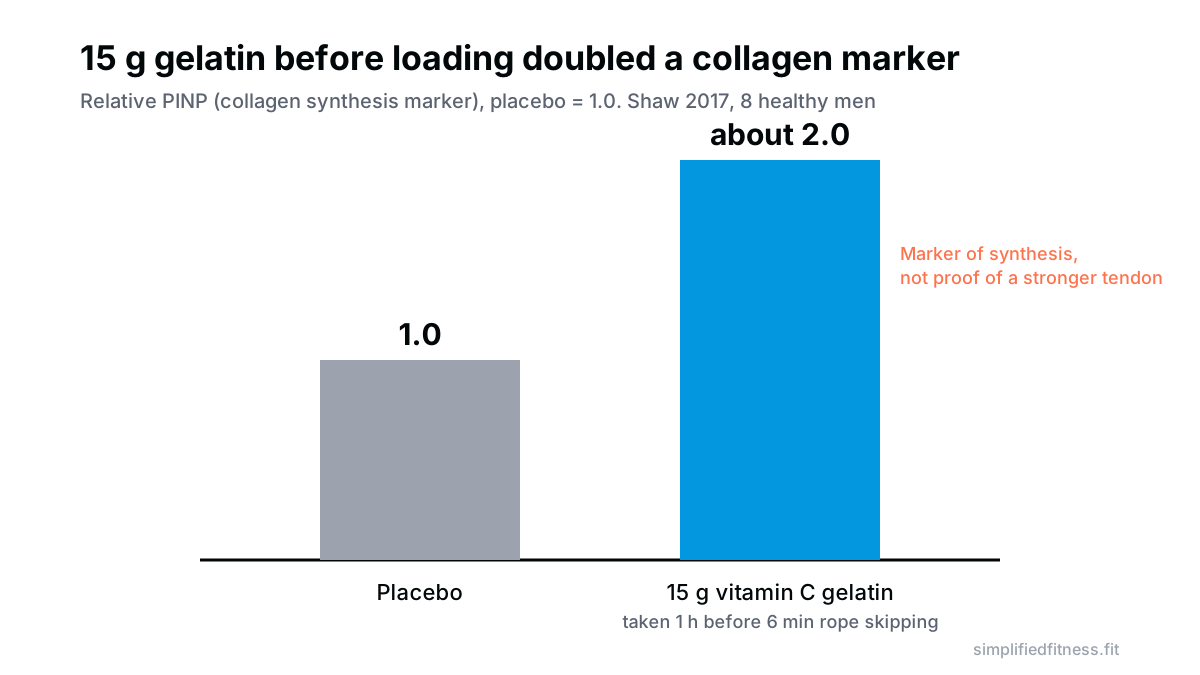
- PINP in the blood. Men who took 15 g of gelatin an hour before six minutes of rope skipping had double the amino-terminal propeptide of collagen I (PINP), a marker of collagen I synthesis.
Does collagen help with tendinopathy?
For actual tendon pain, the best-known trial is small. Praet and colleagues (2019) gave 20 people with chronic mid-portion Achilles tendinopathy either specific collagen peptides or placebo alongside a twice-daily calf-strengthening program for 6 months, in a crossover design. On the VISA-A symptom score, the group on collagen first improved by 12.6 points at 3 months versus 5.3 points for placebo first. After crossing over, both groups gained again, with the collagen phase showing larger gains. No adverse events were reported.
The authors concluded collagen may accelerate the benefit of a well-structured calf program. Note the words “may” and “pilot study.” Twenty patients is a hint, not a verdict.
Zoom out and the picture stays cautious. A 2022 systematic review of nutrition and tendinopathy found 19 studies, 14 of them on supplements, and collagen-derived peptides were the most common ingredient. Combining training with supplements seemed to give better clinical and functional outcomes. But the authors flagged the shortage of high-quality studies and said firm dietary recommendations remain out of reach.
What if you are healthy and just want stronger tendons?
Here the research disagrees, which is worth saying plainly.
- Miyamoto et al. (2025): 50 sedentary young men took 10 g of collagen peptides or placebo daily for 16 weeks, without a training program. Calf muscle and Achilles tendon stiffness and rate of torque development rose in the collagen group but not the placebo group, with no change in tendon size or maximal strength. Several authors work for Morinaga, a food company, which is worth knowing when you weigh the result. Study here.
- Balshaw et al. (2023): 39 recreationally active young men lifted three times a week for 15 weeks and took 15 g of collagen peptides or placebo daily. Patellar tendon stiffness rose about 17-21% in both groups, with no difference between them. Study here.
Why might they differ? One used sedentary men with no training at all, the other used lifters training hard enough to remodel tendon on their own. A different tendon (Achilles vs patellar), a different dose and a different supplement formulation could all matter too. The cautious reading: collagen might add something when there is little or no training stimulus, and add little when heavy lifting is already doing the job. Training is the bigger lever either way.
Does collagen build muscle?
No. This is the part the supplement labels quietly skip. We cover it in depth in collagen protein: joint support vs muscle building, so here is the short version.
Collagen is not a complete protein. It is dense in glycine and proline, but low in several essential amino acids, particularly leucine, and it has no tryptophan. Leucine is the amino acid most closely tied to switching on muscle protein synthesis (see our piece on the leucine trigger hypothesis). So a protein with little leucine is a weak candidate for building muscle.
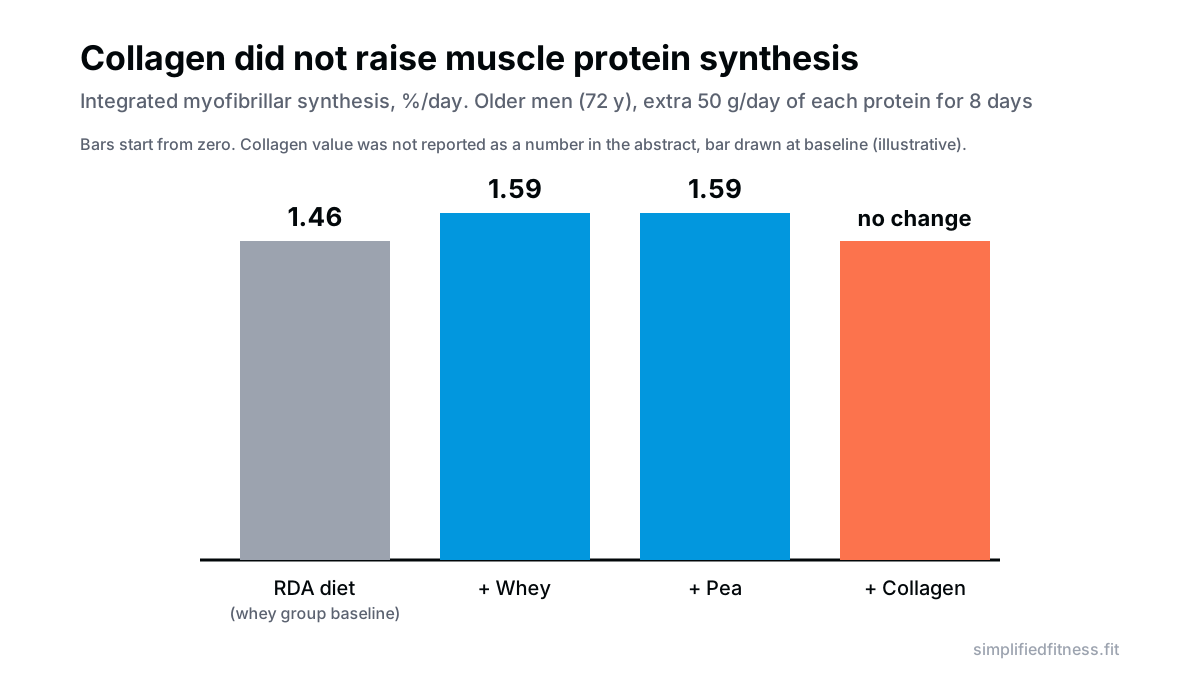
The data match the theory. In McKendry and colleagues (2024), 31 healthy older men (average age 72) ate a controlled diet at the RDA for protein, then added an extra 50 g/day of whey (n = 10), pea (n = 11) or collagen (n = 10) for about a week. Integrated muscle protein synthesis rose with whey (1.59 vs 1.46 %/day) and pea (1.59 vs 1.46 %/day), but stayed unchanged with collagen.
A systematic review of 15 randomized trials reached a similar conclusion. Collagen synthesis rates rose with 15 g/day, but collagen had no significant effect on muscle protein synthesis compared with isonitrogenous higher-quality proteins. The same review noted some improvements in body composition and strength, but it also said the mechanisms are unclear and the studies were small. So “no hypertrophy effect” is the safe call, with the caveat that most data come from older or recreationally active people, not experienced lifters in a growth phase.
If your goal is muscle, put your money into whey, curd, paneer, eggs, soya or dal plus rice combinations. Our protein calculator shows your daily target, and our guide to whey isolate vs concentrate helps with the powder decision.
The pre-loading protocol, step by step
Nobody has run a trial that proves one perfect schedule. What follows is a practical template based on the Shaw design and the dose ranges used in the studies above. Take it to your physiotherapist rather than treating it as a prescription.
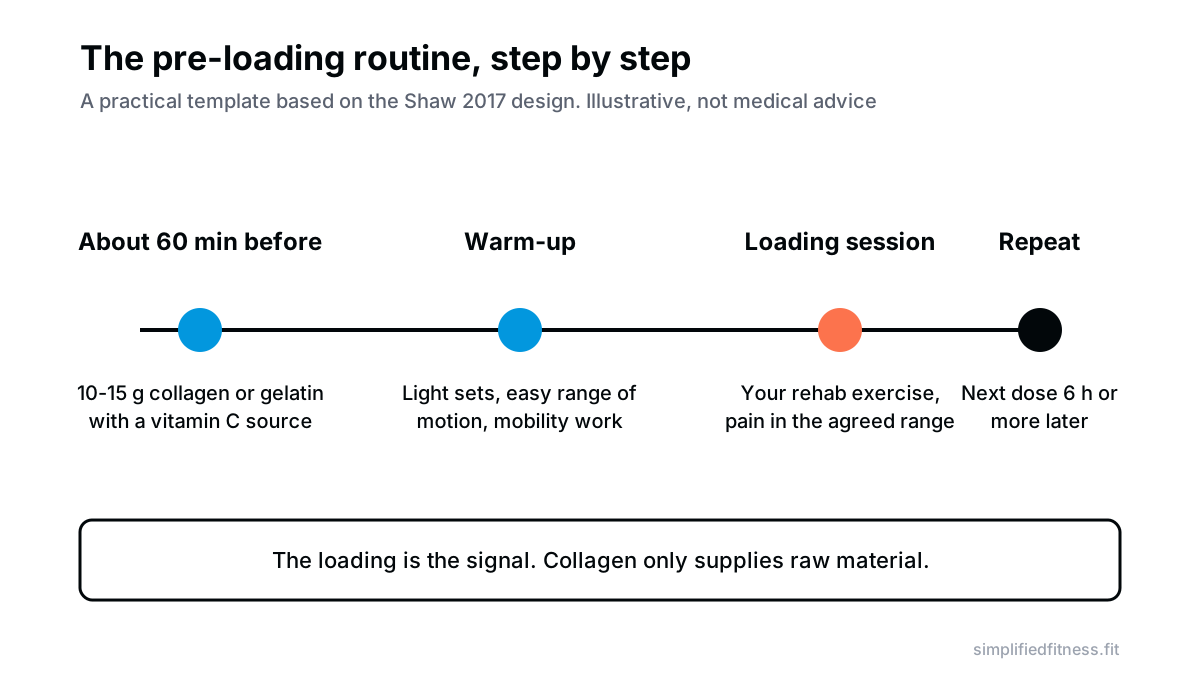
- Dose. 10-15 g of collagen peptides or gelatin. Shaw reported the doubled PINP response for the 15 g dose, so 5 g is not the dose with that evidence.
- Add vitamin C. The study gelatin was vitamin C-enriched. A glass of nimbu pani, an amla, an orange or a guava does the job, and it costs almost nothing.
- Time it. About 45-60 minutes before the session. Blood levels of glycine, proline and hydroxyproline peaked at one hour in Shaw.
- Load the tendon. This is the step people skip. In Shaw the drink came before six minutes of rope skipping, and in the Praet trial it sat alongside a structured calf program. The collagen is raw material, the loading is the signal.
- Space it out. In the Shaw protocol, doses were repeated with at least 6 hours between exercise bouts. Do not drink it all day.
Is it worth the money? Collagen peptides and gelatin run from cheap to expensive depending on the brand. Gelatin powder from a grocery shop is the budget route, though the studies used specific products, so we cannot promise they behave identically. Check the label for 10-15 g of actual collagen per serving, and see our piece on decoding proprietary blends so you are not paying for fairy dust.
Where collagen fits in your rehab (and where it does not)
The mistake we see most often is treating collagen as the treatment. It is not. Tendon rehab is built on progressive loading: heavy slow resistance, isometrics, gradually increasing demand, and fixing whatever overloaded the tendon in the first place. If your knee pain starts on squat day, our guide to knee-friendly leg workout modifications is a better first step than a tub of gelatin. Elbow pain from rows and curls? See golfer’s and tennis elbow in lifters.
Collagen’s best realistic role is a low-risk extra on top of that work. If you are weighing it against other joint products, our comparison of glucosamine, MSM and collagen for joints covers the wider picture.
When to see a doctor
Collagen is not a diagnosis tool and not a treatment for an injury you have not had checked. Book an appointment if you notice any of these:
- Tendon pain lasting more than a few weeks despite reducing load
- Visible swelling, heat or a lump along the tendon
- A sudden pop or snap followed by weakness or inability to push off
- Pain at night or at rest, or numbness and tingling
- A recent course of fluoroquinolone antibiotics or steroid injections near the painful tendon
Also check first if you are pregnant, have kidney disease, take regular medication, or have any allergy to bovine, porcine or fish products.
So is collagen worth it?
Here is the honest ledger.
| Claim | Evidence | Verdict |
|---|---|---|
| Raises a collagen synthesis marker after exercise | One small crossover trial (Shaw, n = 8) | Promising, short-term, marker only |
| Speeds symptom relief in Achilles tendinopathy | One small crossover pilot (n = 20) | Possible, needs bigger trials |
| Stiffens tendon in healthy people | One positive trial, one null trial | Mixed |
| Builds muscle | Older men: no change in muscle protein synthesis | Not supported |
| Replaces rehab exercise | No evidence | No |
Use it if you have a stubborn tendon, you are already doing proper loading work, and the cost does not bother you. Skip it if you are buying it for biceps or quads. Either way, your tendon responds first to the load you give it. If you want to see your protein number first, start with the free protein calculator.
Frequently Asked Questions
Does collagen help tendon recovery?
It may help a little when combined with exercise, but the evidence is early. A small trial in Achilles tendinopathy patients found larger improvements in symptom scores when collagen peptides were added to a calf-strengthening program, though it had only 20 people. Treat it as an optional add-on to progressive loading, never a replacement for it.
Does collagen build muscle?
No, the evidence points the other way. In a trial of older men, adding 50 g/day of collagen protein did not change muscle protein synthesis, while whey and pea protein did. If muscle is the goal, use whey, curd, paneer, soya, eggs or dal-based meals to hit your protein target instead.
What is the Shaw et al. gelatin study?
It is a 2017 randomized crossover trial led by Gregory Shaw and Keith Baar in eight healthy men. Taking 15 g of vitamin C-enriched gelatin an hour before six minutes of rope skipping doubled the blood level of PINP, a marker of collagen I synthesis. It was small and measured a marker, so it supports the idea rather than proving a faster-healing tendon.
How much collagen should I take for tendons?
Studies mostly use 10-15 g per dose, and the Shaw study used 15 g of gelatin. Both doses raised amino acids in the blood, and the doubled PINP response was reported for the 15 g dose taken before exercise. If you try it, start at 10-15 g and keep the rest of your protein intake normal.
How long before training should I take collagen?
About an hour. In the Shaw study, blood glycine, proline and hydroxyproline peaked one hour after the gelatin dose, and exercise started at that point. Many practitioners use a 45-60 minute window, so take it with a vitamin C source before your warm-up.
Do I need vitamin C with collagen?
Vitamin C is needed for the body to build stable collagen, and the Shaw study used vitamin C-enriched gelatin. The study did not test gelatin without vitamin C, so it cannot tell us whether the vitamin C is essential to the result. A glass of nimbu pani, an amla, an orange or a guava alongside the dose is a cheap, sensible pairing.
Is collagen a complete protein?
No. Collagen is rich in glycine and proline but is low in several essential amino acids, notably leucine, and lacks tryptophan, so it is a poor stand-alone muscle-building protein. That is why it should be treated as a connective tissue supplement on top of a normal protein intake, not instead of one.
Can collagen reduce joint pain from lifting?
Possibly, a little. A 2021 systematic review of 15 randomized trials concluded collagen was most beneficial for improving joint function and reducing joint pain, but the trials were small and varied. Give it a fair 3 months alongside better exercise selection and load management, and drop it if you notice nothing.
Is collagen better than whey protein?
They do different jobs. Whey raises muscle protein synthesis, which collagen did not do in older men, while collagen supplies glycine and proline that regular protein sources provide in smaller amounts. For most lifters, whey or food protein comes first and collagen is optional.
Does collagen peptide work for tennis elbow or golfer's elbow?
There is no strong evidence specific to elbow tendinopathy. The best collagen data come from the Achilles tendon and from small mixed trials, and a 2022 systematic review concluded that firm dietary recommendations for tendinopathy are still not possible. Load-based rehab is the proven part, so use collagen only as a low-risk extra.
Does collagen make tendons stronger in healthy lifters?
Results conflict. A 16-week trial in sedentary young men (with no training program) found 10 g/day increased Achilles tendon stiffness versus placebo, while a 15-week trial in recreationally active men lifting three times a week found 15 g/day added nothing beyond what training alone did. In the lifting trial, training stiffened the tendon in both groups, so keep loading as your priority.
Is collagen safe, and who should check with a doctor first?
The trials we cite did not report problems, and the Achilles pilot study reported no adverse events. Collagen supplements are usually from bovine, marine or porcine sources, so vegetarians and people with fish or other allergies need to read labels carefully. Check with your doctor if you are pregnant, have kidney disease, take medication, or have persistent tendon pain.
Is there a vegetarian way to get collagen for tendons?
Not a direct one, because collagen and gelatin come from animal tissue. Vegetarian diets can still supply the raw amino acids and vitamin C through dal, soya, paneer, curd and fruit, though no study shows this matches the gelatin protocol. If you eat fish or meat, marine collagen or gelatin is an option, otherwise focus on rehab quality and total protein.
Sources & References
Every claim above is checked against peer-reviewed research (PubMed, U.S. National Library of Medicine) or guidance from established health bodies. How we fact-check.
- Shaw G, et al. Vitamin C-enriched gelatin supplementation before intermittent activity augments collagen synthesis. Am J Clin Nutr. 2017. PMID: 27852613
- Holwerda AM, et al. The impact of collagen protein ingestion on musculoskeletal connective tissue remodeling: a narrative review. Nutr Rev. 2022. PMID: 34605901
- Praet SFE, et al. Oral Supplementation of Specific Collagen Peptides Combined with Calf-Strengthening Exercises Enhances Function and Reduces Pain in Achilles Tendinopathy Patients. Nutrients. 2019. PMID: 30609761
- Balshaw TG, et al. The Effect of Specific Bioactive Collagen Peptides on Tendon Remodeling during 15 wk of Lower Body Resistance Training. Med Sci Sports Exerc. 2023. PMID: 37436929
- Miyamoto N, et al. Collagen Peptide Supplementation Enhances Muscle-Tendon Stiffness and Explosive Strength: A 16-wk Randomized Controlled Trial. Med Sci Sports Exerc. 2025. PMID: 40623147
- McKendry J, et al. The effects of whey, pea, and collagen protein supplementation beyond the recommended dietary allowance on integrated myofibrillar protein synthetic rates in older males: a randomized controlled trial. Am J Clin Nutr. 2024. PMID: 38762187
- Khatri M, et al. The effects of collagen peptide supplementation on body composition, collagen synthesis, and recovery from joint injury and exercise: a systematic review. Amino Acids. 2021. PMID: 34491424
- Hijlkema A, et al. The impact of nutrition on tendon health and tendinopathy: a systematic review. J Int Soc Sports Nutr. 2022. PMID: 35937777

Umair Hazrami · Founder & Head Coach, Simplified Fitness
Umair Hazrami founded Simplified Fitness and the Simplified Lifter channel to cut through fitness noise. With 4+ years of consistent training and 10+ coaching clients, he writes every guide from the peer-reviewed research and links the sources so you can check them. Our editorial standards.
Educational content only, not medical advice. If you have a medical condition, are pregnant, or take medication, talk to a qualified doctor before changing your diet, supplements or training. Full disclaimer.
Keep reading

Supplements
Ashwagandha KSM-66 vs Sensoril: Which Extract, What Dose, and Do You Need to Cycle?
Ashwagandha KSM-66 vs Sensoril for lifters: what the strength trials show, realistic cortisol effects, liver safety and whether to cycle. Every study linked.
8 min read
Supplements
BCAAs vs EAAs: Why BCAAs Are a Waste of Money If Your Protein Is Covered
BCAA vs EAA for muscle growth: BCAAs are only 3 of the 9 essential amino acids. See what Wolfe 2017 and Jackman 2017 found and when EAAs or whey make sense.
8 min read
Supplements
Beetroot Juice for Running and Lifting: How Dietary Nitrate Works (and the Mouthwash Trap)
Does beetroot juice for running actually work? See what meta-analyses show, the 2-3 hour timing and dose, who benefits, and why mouthwash can cancel the effect.
9 min read

Supplements
Beta-Alanine Benefits: Carnosine Buffering, High-Rep Gains and Why It Makes You Tingle
Beta-alanine benefits explained: why pre-workout makes your skin tingle, how carnosine buffers acid, what dose works, and who should skip it. Studies linked.
8 min read