Does Glutamine Build Muscle? Why Oral Glutamine Is Mostly a Waste for Lifters
Does glutamine build muscle? Trials in healthy lifters show no extra strength or lean mass from it. See the evidence, who might benefit and what to buy instead.

TL;DR. The short answer
- Controlled trials in healthy, trained or training adults have not shown that oral glutamine adds strength or lean mass beyond what resistance training already gives.
- Your muscles make their own glutamine and your diet supplies more, so a lack of it is rarely what limits growth in a well-fed lifter.
- Glutamine has real clinical uses under medical supervision, but the best recent reviews found no clear survival benefit in severely burned or critically ill adults.
- Gut-protection results during hard exercise in the heat are mixed and come from tiny studies, so they do not justify a daily powder.
- If budget is tight, spend it on protein, creatine monohydrate and food before glutamine.
Part of our complete guide: The Evidence-Based Fitness Supplements Guide: What Works, What's Overhyped & What's a Waste of Money
Table of contents
So, does glutamine build muscle? In healthy lifters, the controlled trials say no. Adding a few grams of oral glutamine to resistance training has not been shown to give extra strength, extra lean mass or less muscle breakdown than training alone.
That does not make glutamine a useless molecule. It is one of the most abundant amino acids in your body, and doctors use it in some clinical settings. It just means the 5 g scoop after your workout is a poor use of money for most people reading this. For where it sits among all supplements, see our evidence-based supplements guide.
Why did glutamine become a bodybuilding staple?
The pitch sounds logical. Glutamine is the most plentiful free amino acid in muscle. Heavy training and illness can lower blood levels. So topping it up must protect muscle, speed recovery and keep you healthy. Supplement companies loved that chain of reasoning.
The problem is the jump from “is present and important” to “supplementing it improves results.” Plenty of important compounds in your body are already supplied at adequate levels by food and by your own metabolism. Whether extra helps is an experimental question, so let’s look at the experiments.
What do the trials in lifters show?
The cleanest test is a double-blind trial where everyone trains the same way and only the powder differs.
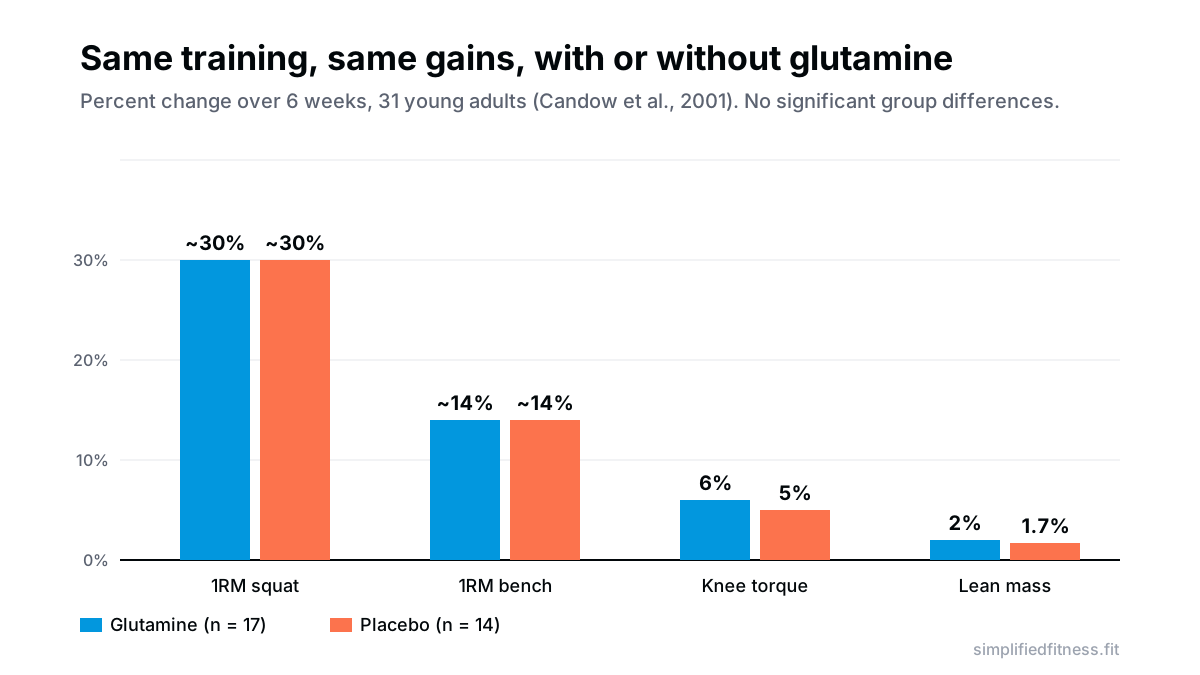
In one, 31 young adults trained the whole body for 6 weeks, four to five sets of 6-12 reps at 60-90% of 1RM. They took either glutamine (0.9 g per kg of lean tissue mass per day, a large dose) or a maltodextrin placebo (Candow et al., 2001). Both groups raised their squat by roughly 30% and bench by roughly 14%. Lean mass rose about 2% on glutamine and 1.7% on placebo. Urinary 3-methylhistidine, a marker of muscle protein breakdown, also rose in both groups with no significant difference. The authors concluded glutamine had no significant effect on performance, body composition or muscle protein degradation.
Another trial of collegiate track and field athletes (29 people, 8 weeks) compared creatine alone, creatine plus 4 g glutamine a day, and placebo. Both creatine groups gained more body mass, lean mass and initial power than placebo (Lehmkuhl et al., 2003). The abstract does not report a difference between the two creatine groups, so the gains are attributed to creatine, not to the glutamine add-on. That design cannot prove glutamine does nothing, but it gives no sign that it helped.
A broader look came from a systematic review of oral glutamine for regaining strength in adults with a strength deficit (for example after injury or orthopaedic surgery) who were on strength or endurance programmes. It found six relevant studies out of 661 articles and could not run a meta-analysis. The glutamine-only studies showed no change between groups, apart from a better perception of muscle weakness, and the authors concluded data were insufficient (Hernandez Valencia et al., 2015). Trials combining glutamine with other nutrients looked more favourable, but then you cannot tell which ingredient did the work.
Why does oral glutamine not reach muscle the way marketing implies?
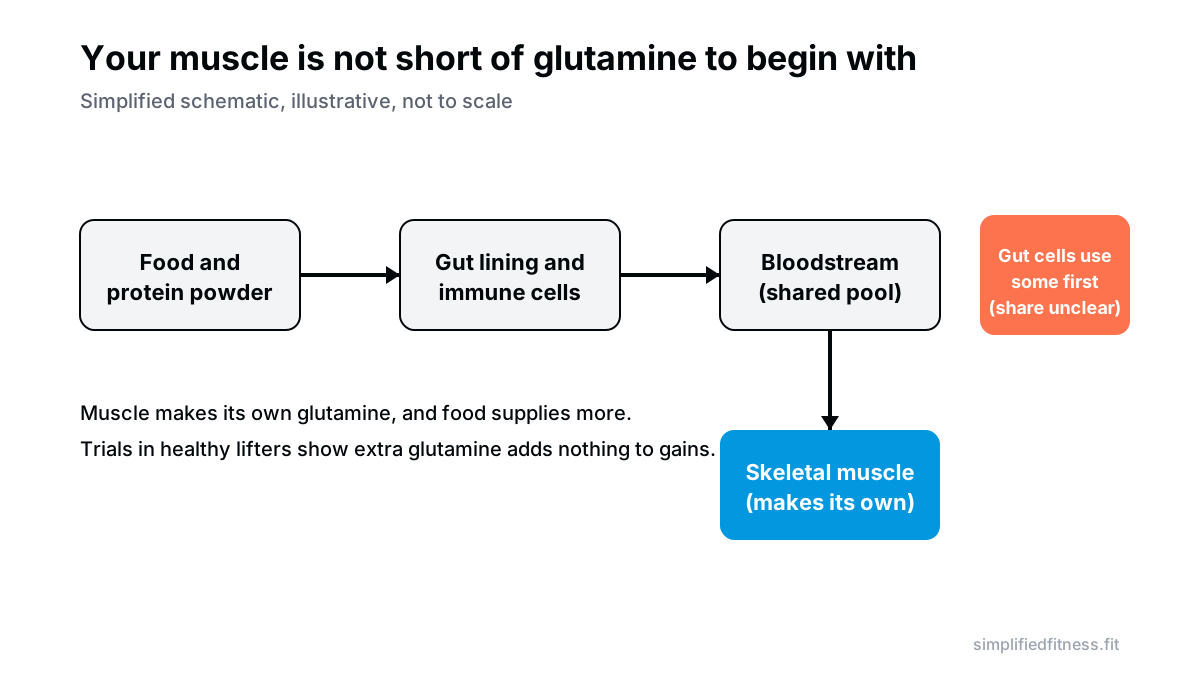
A common argument is that the gut and immune cells use much of the glutamine you swallow before it reaches the blood, so little is left for muscle. That is a reasonable physiological idea, but I will not put a percentage on it because I could not find a study in this evidence set that pins the number down.
What we can say is simpler. Muscle makes its own glutamine, food supplies more, and trials show that extra glutamine did not change muscle outcomes in healthy people. Whatever the exact fate of each gram, supplementing did not move the needle. A 2008 review also notes that the suggested reasons for taking glutamine supplements have received little support from well-controlled studies in healthy, well-nourished people (Gleeson, 2008).
Does glutamine help recovery or immunity?
The immunity idea comes from the observation that plasma glutamine can dip after prolonged hard exercise. The theory was that this dip weakens immune cells and raises infection risk.
Feeding studies tested it. Gleeson’s review reports that glutamine can keep blood levels steady during and after long strenuous exercise, yet it does not prevent the post-exercise changes in several immune measures. It also notes that, although glutamine is essential for lymphocyte proliferation, plasma levels do not fall far enough after exercise to compromise it (Gleeson, 2008).
For soreness and recovery, the evidence is thin rather than clearly negative. The honest summary is “unproven.” A food-first approach (enough protein, enough total calories, 7-9 hours of sleep) is the better recovery plan. If you are mixing up supplements for recovery, our BCAAs vs EAAs breakdown covers another popular amino acid product with a similar story.
What about glutamine for gut health?
This is where the evidence is genuinely mixed, so let’s be fair to both sides.
Hard exercise in the heat can increase gut permeability. In a small trial of 10 recreationally active men, glutamine taken 2 hours before a 60-minute run at 70% of VO2max in 30 degrees C lowered a gut permeability marker compared with placebo, at 0.25, 0.5 and 0.9 g per kg of fat-free mass, with larger doses looking more effective. GI symptoms were low and unaffected by supplementation (Pugh et al., 2017).
A later randomized cross-over trial of 10 males used 0.3 g per kg of fat-free mass before an 80-minute exertional heat stress test. Permeability was not significantly changed (p = 0.06), and the medium effect size actually favoured the placebo trial, and gut injury and bacterial translocation markers were unaffected (Ogden et al., 2022).
Why might they differ? Different doses and timing, different protocols and intensity, and very small samples. A cautious reading: glutamine might help some athletes in extreme heat, but it is unproven, and these are lab markers, not everyday gut comfort. If you are in an Indian summer and your gut acts up on long runs, hydration, pacing and food choices come first. Persistent digestive symptoms, blood in stool, unexplained weight loss or ongoing pain deserve a doctor, not a tub of powder. For gut-support products more broadly, see probiotics and digestive enzymes: what actually helps.
Where glutamine does have a clinical role (and where it doesn’t)
In hospitals, glutamine has been studied as part of nutrition support for very sick patients. The results are not the slam dunk supplement marketing suggests.
A 2023 systematic review with trial sequential meta-analysis pooled 10 RCTs (1,577 severely burned adults). It found no significant effect on overall mortality (RR 0.65, 95% CI 0.33-1.28) or infectious complications (RR 0.83, 95% CI 0.63-1.09). Single-centre trials had shown benefit, but multicentre trials did not, and the analysis suggested the single-centre results were likely false positives (Ortiz-Reyes et al., 2023).
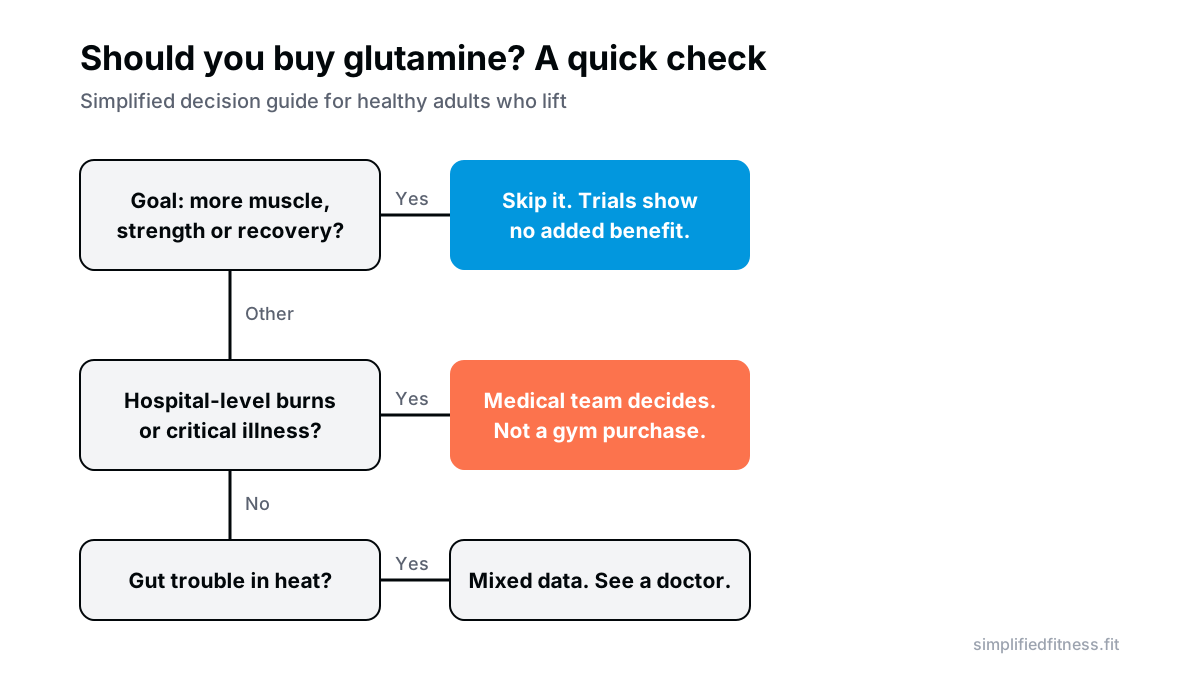
A 2015 meta-analysis of 11 trials of enteral glutamine in 1,079 critically ill adults found no reduction in hospital mortality or infections, though hospital stay was shorter, and burns showed a possible benefit based on sparse data (van Zanten et al., 2015). Two points: these are very sick patients under medical care, and the findings are conflicting between reviews and subgroups. Neither supports a healthy person taking glutamine for gym gains.
Is it safe, and who should be careful?
For healthy adults, single doses of about 20-30 g were described as seeming to be without ill effect, and one study had athletes take 28 g a day for 14 days with no harm reported (Gleeson, 2008). That is short-term data. Long-term safety in people using it for months is less well studied.
Be careful, and talk to a doctor first, if you have liver or kidney disease, are pregnant or breastfeeding, or take regular medication. Powders in India vary in quality, so favour products with third-party testing if you do buy one.
What should you spend the money on instead?
Rough priorities for a typical lifter on a budget:
- Total protein: about 1.6-2.2 g per kg of body weight from dal, curd, paneer, eggs, soya, chicken or fish. Use our protein calculator to find your number.
- Training and sleep: progressive overload, 7-9 hours of sleep.
- Creatine monohydrate: 3-5 g a day, cheap and well studied.
- A convenient protein powder if food falls short. Whey isolate vs concentrate is explained in our whey comparison.
If you want to see how supplements rank overall, read the supplement hierarchy from proven to scams. Glutamine sits in the “not needed” tier for most people.
The bottom line
Does glutamine build muscle? In healthy people doing resistance training, the best available trials say it does not add anything measurable. Gut-protection and clinical uses are real research areas, but the evidence is mixed, the studies are small or specialised, and none of it justifies a daily scoop for gym gains.
Eat enough protein, train hard, sleep well and get your meals sorted with our free diet plan. If you ever have a medical reason to consider glutamine, let your doctor or dietitian make that call.
Frequently Asked Questions
Does glutamine build muscle?
Not in healthy lifters, based on the trials we have. In a 6-week randomized trial, young adults taking glutamine gained the same strength and lean mass as those taking placebo. Put your money into enough protein and consistent training first.
Is L-glutamine worth taking for bodybuilding?
For most lifters, no. The marketing claims (faster recovery, less muscle breakdown, more growth) have little support in well-controlled studies of healthy, well-fed people. If you already eat enough protein, the extra powder is unlikely to change your results.
Does glutamine help muscle protein synthesis?
There is no good evidence that it does in healthy adults. A resistance-training trial that measured a muscle breakdown marker (urinary 3-methylhistidine) found no difference between glutamine and placebo. Muscle protein synthesis is driven mainly by training and total protein intake, so build those first.
Does glutamine speed up recovery after workouts?
The evidence is thin. A systematic review of oral glutamine for regaining strength (mostly in adults with strength loss after injury or surgery) found too little data to draw firm conclusions, and the glutamine-only studies showed no group differences in strength. Sleep, food and sensible weekly volume are better recovery bets.
Is 5 g of glutamine after a workout useful?
It is unlikely to be useful for muscle gain. A review of glutamine dosing in athletes concluded that the common reasons for taking it have received little support from well-controlled studies in healthy, well-nourished people. Skip it unless a doctor or dietitian has a specific reason for you.
Does glutamine help gut health?
It might in specific situations, but the results are mixed. One small trial found glutamine lowered a gut permeability marker during running in the heat, while a later small trial at a lower dose found no protection. If you have ongoing digestive symptoms, see a doctor rather than self-treating with powder.
Does glutamine boost immunity for athletes?
A review of the topic found that glutamine supplementation did not prevent the immune changes seen after prolonged hard exercise. Plasma glutamine does not seem to fall low enough to limit immune cell growth. Sleep, enough calories and not ramping training too quickly are the practical levers.
Is glutamine useful for burn or ICU patients?
Hospital use is a different question and a medical decision. A 2023 meta-analysis of 10 trials (1,577 severely burned adults) found no significant effect on mortality or infections. Never self-prescribe glutamine for a medical condition.
Is glutamine safe?
In healthy adults, single doses of around 20-30 g seem to be without ill effect according to one review, and one study reported no harm with 28 g a day for 14 days. Long-term safety data in supplement-using lifters are limited. If you have liver or kidney disease, check with your doctor before using it.
Is glutamine better than BCAAs or protein powder?
For muscle gain, neither stands out over simply eating enough complete protein. Whey, curd, paneer, eggs and dal-based meals supply amino acids, including glutamine, as part of normal food. Fix your daily protein before buying any single amino acid.
Can vegetarians in India benefit from glutamine?
Not specifically. Dairy, soya, dal and paneer already contain glutamine within their protein, and nothing in the trials suggests vegetarians need extra. Check your total daily protein with a calculator and fill gaps with food first.
Does glutamine break a fast or add calories?
It is an amino acid, so it provides a small amount of energy and can technically break a strict fast. For a 5 g scoop the amount is tiny. It matters only if you follow a strict fasting rule for religious or medical reasons.
Sources & References
Every claim above is checked against peer-reviewed research (PubMed, U.S. National Library of Medicine) or guidance from established health bodies. How we fact-check.
- Candow DG, et al. Effect of glutamine supplementation combined with resistance training in young adults. Eur J Appl Physiol. 2001. PMID: 11822473
- Lehmkuhl M, et al. The effects of 8 weeks of creatine monohydrate and glutamine supplementation on body composition and performance measures. J Strength Cond Res. 2003. PMID: 12930166
- Gleeson M. Dosing and efficacy of glutamine supplementation in human exercise and sport training. J Nutr. 2008. PMID: 18806122
- Hernandez Valencia SE, et al. Glutamine as an aid in the recovery of muscle strength: systematic review of literature. Nutr Hosp. 2015. PMID: 26545503
- Ortiz-Reyes L, et al. The efficacy of glutamine supplementation in severe adult burn patients: a systematic review with trial sequential meta-analysis. Crit Care Med. 2023. PMID: 37114912
- van Zanten AR, et al. Enteral glutamine supplementation in critically ill patients: a systematic review and meta-analysis. Crit Care. 2015. PMID: 26283217
- Pugh JN, et al. Glutamine supplementation reduces markers of intestinal permeability during running in the heat in a dose-dependent manner. Eur J Appl Physiol. 2017. PMID: 29058112
- Ogden HB, et al. No protective benefits of low dose acute L-glutamine supplementation on small intestinal permeability, epithelial injury and bacterial translocation biomarkers in response to subclinical exertional-heat stress: a randomized cross-over trial. Temperature. 2022. PMID: 36106146

Umair Hazrami · Founder & Head Coach, Simplified Fitness
Umair Hazrami founded Simplified Fitness and the Simplified Lifter channel to cut through fitness noise. With 4+ years of consistent training and 10+ coaching clients, he writes every guide from the peer-reviewed research and links the sources so you can check them. Our editorial standards.
Educational content only, not medical advice. If you have a medical condition, are pregnant, or take medication, talk to a qualified doctor before changing your diet, supplements or training. Full disclaimer.
Keep reading
Supplements
Ashwagandha KSM-66 vs Sensoril: Which Extract, What Dose, and Do You Need to Cycle?
Ashwagandha KSM-66 vs Sensoril for lifters: what the strength trials show, realistic cortisol effects, liver safety and whether to cycle. Every study linked.
8 min read
Supplements
BCAAs vs EAAs: Why BCAAs Are a Waste of Money If Your Protein Is Covered
BCAA vs EAA for muscle growth: BCAAs are only 3 of the 9 essential amino acids. See what Wolfe 2017 and Jackman 2017 found and when EAAs or whey make sense.
8 min read
Supplements
Beetroot Juice for Running and Lifting: How Dietary Nitrate Works (and the Mouthwash Trap)
Does beetroot juice for running actually work? See what meta-analyses show, the 2-3 hour timing and dose, who benefits, and why mouthwash can cancel the effect.
9 min read

Supplements
Beta-Alanine Benefits: Carnosine Buffering, High-Rep Gains and Why It Makes You Tingle
Beta-alanine benefits explained: why pre-workout makes your skin tingle, how carnosine buffers acid, what dose works, and who should skip it. Studies linked.
8 min read