Magnesium Glycinate vs Citrate vs Oxide: Which Form Helps Sleep and Cramps?
Magnesium glycinate vs citrate vs oxide: which form absorbs best, which may help sleep, and what trials say about night cramps, with doses and diarrhea fixes.

TL;DR. The short answer
- Magnesium citrate was absorbed better than magnesium oxide in human trials, and oxide often performed no better than placebo on blood and urine markers. Oxide is cheap but is also the form most used as a laxative.
- Glycinate (bisglycinate) has the best sleep data of the three, but that is one 4-week trial in 155 adults with poor sleep, with a small effect. No trial shows it clearly beats citrate.
- For night leg cramps, a Cochrane review of 11 trials found magnesium unlikely to help older adults with idiopathic cramps. It found no trials at all on exercise cramps, so a fix for gym cramps is unproven.
- Read the label for elemental magnesium, not the compound weight. The sleep trial used 250 mg elemental daily; start lower with food if your gut is sensitive.
- Kidney disease, heart rhythm problems or regular medicines mean you should ask a doctor before taking magnesium supplements.
Part of our complete guide: The Evidence-Based Fitness Supplements Guide: What Works, What's Overhyped & What's a Waste of Money
Table of contents
If you are choosing between magnesium glycinate vs citrate vs oxide, the short answer is this. Citrate absorbs clearly better than oxide, glycinate has the best (but still modest) sleep data, and oxide is mostly a cheap laxative. None of the three has good evidence for stopping muscle cramps.
That runs against what the shelf labels imply. This guide sits inside our evidence-based supplements guide, and it keeps the same rule: look at what trials measured, not what the tub says. For the bigger question of whether you are short on magnesium at all, see micronutrient deficiencies in lifters.
What do the different magnesium forms actually mean?
Magnesium on its own is a metal. Supplements attach it to something else: oxygen (oxide), citric acid (citrate), or the amino acid glycine (glycinate or bisglycinate). The partner changes how well it dissolves, how much reaches your blood and how your gut reacts.
One thing trips people up first. The number on the front of the tub is often the weight of the whole compound. What you care about is elemental magnesium, the magnesium itself, listed in the Supplement Facts panel. Magnesium oxide is about 60% magnesium by weight (24.3 divided by 40.3), so 1,000 mg of oxide holds about 600 mg elemental. Other forms are much lower per gram, so a capsule of glycinate or citrate can hold far less elemental magnesium than the big number suggests. Always read the elemental line.
Magnesium oxide vs citrate: which absorbs better?
Citrate, in the human studies we have. Two findings point the same way.
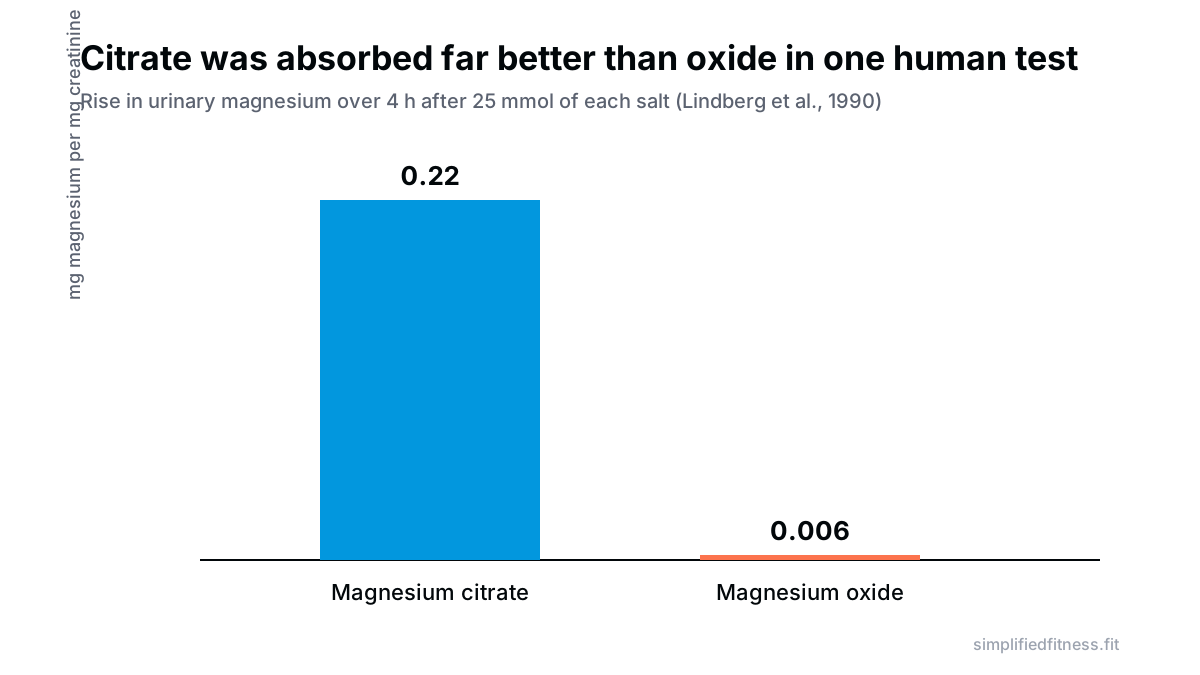
In a 1990 study, oxide was virtually insoluble in water and only 43% soluble in simulated peak stomach acid, while citrate was 55% soluble even in plain water. After a 25 mmol dose, the rise in urinary magnesium over 4 hours was 0.22 for citrate versus 0.006 mg per mg creatinine for oxide (Lindberg et al., 1990).
A 2003 randomized trial in 46 healthy people used 300 mg elemental magnesium daily for 60 days. Organic forms (citrate and an amino acid chelate) were absorbed better than oxide by 24-hour urinary excretion, citrate gave the highest serum magnesium, and oxide did not differ from placebo (Walker et al., 2003).
You will often see a single figure like “oxide is only about 4% absorbed”. I could not confirm that number from the studies above, so I am not repeating it. What the data do support is the direction: oxide is the weakest of the common forms.
Where does glycinate fit?
Here the evidence is thinner and a little messy. A 2024 trial in 40 healthy adults compared several sources after a week on a low-magnesium diet. Plasma magnesium rose significantly at all time points for a microencapsulated product, at 1 hour for oxide, at 4 hours for citrate, and not significantly for bisglycinate (Pajuelo et al., 2024). The study was funded by the maker of the microencapsulated product and followed plasma for only 6 hours.
Why might that differ from marketing claims? Short plasma curves can miss slow or tissue uptake, and bisglycinate may be absorbed differently from simple salts. The honest takeaway is that glycinate is not proven to be better absorbed than citrate. Its case rests on tolerance and the sleep trial below.
Why does magnesium oxide cause diarrhea?
Because magnesium that stays in the gut draws water in, and oxide has long been used on purpose as a laxative, especially in East Asia. A 2021 review describes it as widely used for constipation, while warning that dose, blood levels, drug interactions and side effects need attention, particularly in older people and those with kidney impairment (Mori et al., 2021).
So oxide is not a defective sleep supplement. It is a decent laxative sold in the wrong aisle. If you want it for constipation, the effect is the point. If you want sleep or recovery, the loose stools are a signal to change form or lower the dose. Citrate can also loosen stools in some people. In the 2024 comparison, only the sponsor’s microencapsulated product was reported as causing fewer gut side effects than the other forms, so claims that glycinate is gentler rest more on user experience than on trial data.
Does magnesium glycinate help sleep?
Possibly a little. This is the best direct evidence for any form in this article.
A 2025 randomized, placebo-controlled trial enrolled 155 adults aged 18-65 with self-reported poor sleep. They took magnesium bisglycinate (250 mg elemental daily) or placebo. By week 4, Insomnia Severity Index scores fell by 3.9 points on magnesium versus 2.3 on placebo (p = 0.049), with a small effect size (Cohen’s d = 0.2) (Schuster et al., 2025). Exploratory analyses hinted at larger gains in people with lower dietary magnesium, but that was not a primary result. One author runs a contract research firm funded by supplement companies.
A 2021 meta-analysis in older adults with insomnia pooled three trials (151 people). Sleep onset came 17.36 minutes sooner on magnesium, and total sleep time rose by about 16 minutes (not statistically significant). The trials were at moderate to high risk of bias and the evidence quality was low to very low (Mah et al., 2021).
Put together: a modest, uncertain benefit, strongest in people who are not eating much magnesium. That is not a sleeping pill, and it does not replace the basics in our sleep hygiene checklist for lifters. For the wider picture, including melatonin and glycine, see our sleep supplement audit.
Will magnesium stop muscle cramps?
Most likely not, and this is the claim with the weakest support.
The Cochrane review pooled 11 randomized trials with 735 participants. For idiopathic cramps, mostly in older adults with night cramps, magnesium did not differ from placebo: the difference in cramps per week at four weeks was -0.18 (95% CI -0.84 to 0.49), and the share of people with a 25% or better reduction was no different (RR 1.04) (Garrison et al., 2020). The trials in pregnancy were at high risk of bias, so no firm conclusion can be drawn there.
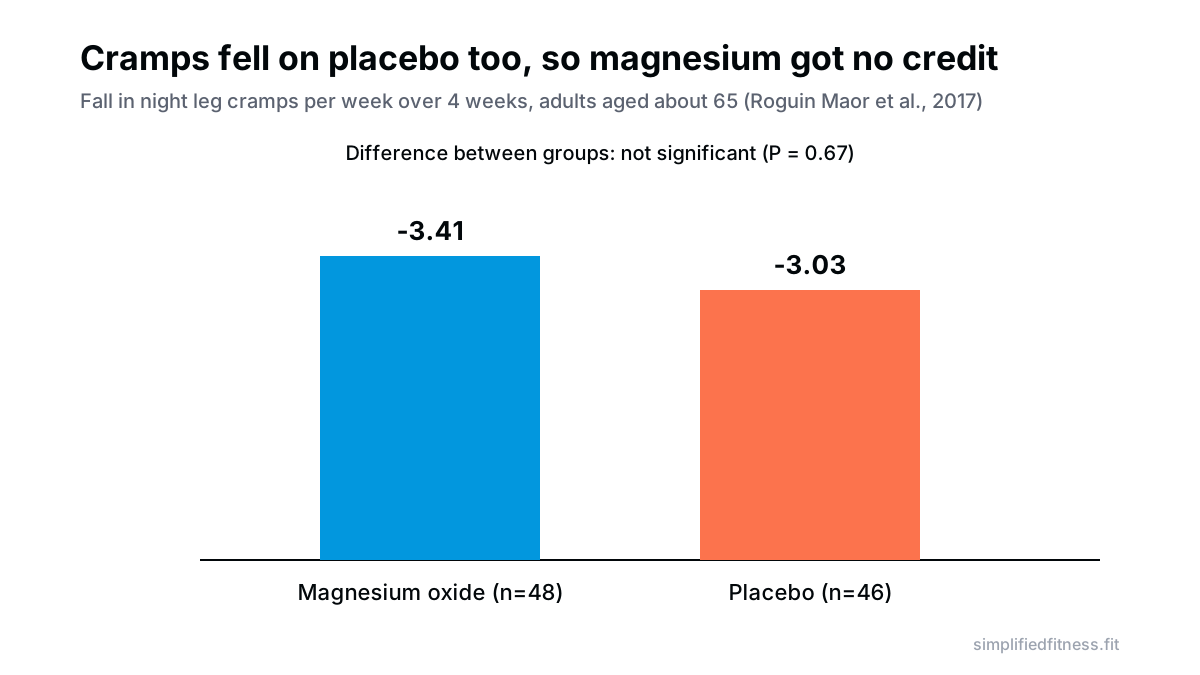
A 2017 trial of magnesium oxide, 94 adults with a mean age of 64.9, found cramps fell by 3.41 per week on magnesium and 3.03 on placebo, a difference with P = 0.67. The authors suggest the drop in both groups is likely a placebo effect, which may explain why magnesium is so widely used (Roguin Maor et al., 2017).
Two caveats. These are mostly older, non-athletic people with night cramps, and oxide was the form in the 2017 trial. The Cochrane authors found no randomized trials at all of magnesium for exercise-associated cramps, so whether any form helps younger lifters with gym cramps is simply untested. Other angles include heavy sweating (see electrolytes for gym performance) and taurine for cramps.
Magnesium glycinate vs citrate vs oxide: quick comparison
| Oxide | Citrate | Glycinate (bisglycinate) | |
|---|---|---|---|
| Absorption evidence | Weakest in human studies | Better than oxide in two trials | Mixed; one short trial showed no plasma rise |
| Gut effect | Laxative, common loose stools | Can loosen stools in some | Often marketed as gentler |
| Sleep evidence | None specific found | None specific found | One 4-week trial, small effect |
| Cramp evidence | Same as placebo in a 2017 RCT | Not shown | Not shown |
| Best use | Constipation | General topping up | Sleep trial, sensitive stomachs |
How much magnesium should I take, and when?
The doses in the studies above give a sensible frame. The 2025 sleep trial used 250 mg elemental daily; the 2003 absorption trial used 300 mg elemental. The older adult insomnia review mentions quantities under 1 g (compound) up to three times a day, which is a statement about what was studied, not a target.
A practical approach for a healthy adult:
- Check the elemental amount on the label, not the compound weight.
- Start with 100-150 mg elemental with an evening snack and see how your stomach reacts.
- If tolerated, move toward 250 mg elemental, the dose with positive sleep data.
- Judge it after four weeks. No change in sleep, or any gut upset that persists, means stop.
Timing is not proven to matter, so “45 minutes before bed” is a convention rather than a research finding. Evening with food is easy and fine.
Keep supplemental magnesium at or below 350 mg elemental a day unless a doctor advises otherwise. That is the adult tolerable upper intake level for supplements set by the US Institute of Medicine, and diarrhea is the usual first sign of going over it. Magnesium can also bind some medicines, including tetracycline and quinolone antibiotics and bisphosphonates such as alendronate, so ask your pharmacist how far apart to take them.
Food first: Indian options
Before buying anything, look at the plate. Magnesium is found in dal, rajma, chana, peanuts, almonds, pumpkin seeds, whole wheat roti, oats and leafy greens like palak. If your meals are mostly white rice and refined flour, adding a handful of nuts and a bowl of dal does more for your intake than a capsule. Our free diet plan shows how that fits with protein targets.
Who should talk to a doctor first
Your kidneys remove extra magnesium. People with kidney disease are at higher risk of buildup, and the oxide review specifically flags kidney impairment and drug interactions. Ask a doctor before supplementing if you have kidney or heart problems, are pregnant or breastfeeding, or take regular medicines. Also see one if cramps are frequent, painful, one-sided with swelling, or come with weakness, or if sleep has been poor for weeks. Those need a proper look, not another supplement.
The bottom line
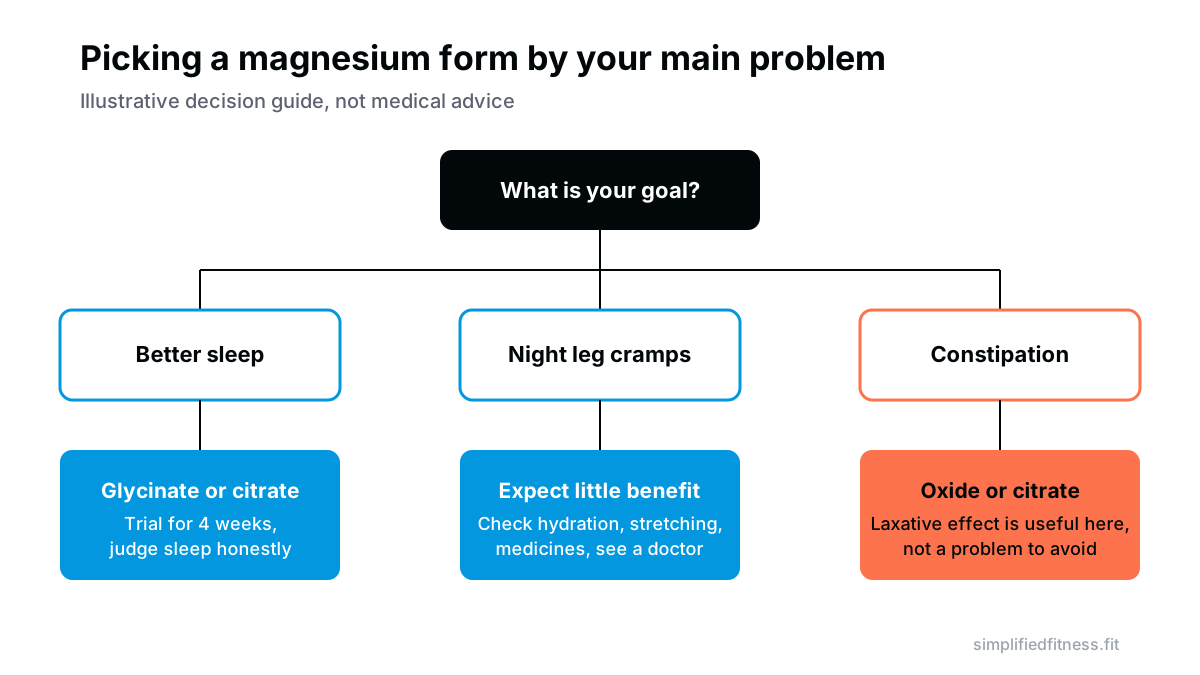
If you want magnesium for sleep, glycinate or citrate at a tolerable dose is a reasonable four-week experiment, with modest expectations. If you want it for cramps, the evidence says do not count on it. If you want a laxative, oxide does that. Improve sleep habits and food first, and treat the supplement as a small extra.
Frequently Asked Questions
Which is better, magnesium glycinate or citrate?
Neither has been shown to be clearly better in head-to-head human trials. Citrate has more absorption data and glycinate has one positive sleep trial, but a 2024 comparison found no significant plasma rise from bisglycinate over 6 hours. Choose glycinate if citrate loosens your stools, and citrate if you want a cheaper, well-studied form.
What is the best magnesium for sleep?
Magnesium bisglycinate has the most direct evidence, with a 2025 trial of 155 adults showing a modest improvement in insomnia severity at 250 mg elemental per day. The effect size was small and the trial was 4 weeks long. Try it for a month, track how you feel, and stop if nothing changes.
Does magnesium really help muscle cramps?
Probably not for most people. A Cochrane review of 11 trials found no significant benefit for idiopathic cramps in older adults, and a 2017 trial of magnesium oxide found the same result as placebo. If cramps are frequent, see a doctor rather than adding more supplements.
Why does magnesium oxide cause diarrhea?
Magnesium oxide has long been used as a laxative, and unabsorbed magnesium stays in the gut. A 2021 review notes it is used for constipation, so loose stools are the expected effect, not a fluke. Lower the dose, take it with food, or switch to a gentler form.
How much elemental magnesium should I take?
The 2025 glycinate sleep trial used 250 mg of elemental magnesium daily, and a 2003 absorption trial used 300 mg. The label gives the elemental amount in the Supplement Facts panel, which is the number that matters. Start at the lower end and increase only if you tolerate it.
Is magnesium oxide completely useless?
No, it is useful as a laxative and it does contain a lot of elemental magnesium by weight. As a way to raise magnesium levels it performed poorly in two human studies. If constipation is your issue, oxide may do what you want.
When should I take magnesium for sleep?
The trials simply used a daily dose, so there is no proven best clock time. Taking it in the evening with a snack is a practical choice that is easy on the stomach. Keep the timing consistent and judge the result after about four weeks.
Can I take magnesium every night?
For most healthy adults at moderate doses, daily use is common in trials lasting weeks to months. Your kidneys clear excess magnesium, so people with kidney problems are at higher risk of accumulation. Check with your doctor if you have kidney disease or take regular medicines.
Do lifters need extra magnesium?
Only if your diet is low in it. The sleep trial suggested bigger gains in people who ate less magnesium, but that was an exploratory finding. Dal, nuts, seeds, whole grains and green leafy vegetables are cheaper than any capsule, so fix the plate first.
Does magnesium glycinate cross the blood-brain barrier?
That claim is common in marketing but I could not confirm it from human trial data. The human evidence we have measures sleep scores, not brain magnesium. Treat it as an unproven mechanism and judge the form by sleep results and tolerance.
Can I take magnesium with creatine or protein powder?
Yes, there is no known problem with taking them on the same day, and many people do. They do different jobs, so mixing them is a convenience choice. Keep magnesium separate if it upsets your stomach, so you know what caused it.
When should I see a doctor about cramps or poor sleep?
See a doctor if cramps are frequent, severe, one-sided with swelling, or come with weakness, or if poor sleep lasts weeks. Causes such as medicines, nerve problems and sleep apnea need proper assessment. A supplement should not delay that.
Sources & References
Every claim above is checked against peer-reviewed research (PubMed, U.S. National Library of Medicine) or guidance from established health bodies. How we fact-check.
- Garrison SR, et al. Magnesium for skeletal muscle cramps. Cochrane Database Syst Rev. 2020. PMID: 32956536
- Roguin Maor N, et al. Effect of Magnesium Oxide Supplementation on Nocturnal Leg Cramps: A Randomized Clinical Trial. JAMA Intern Med. 2017. PMID: 28241153
- Schuster J, et al. Magnesium Bisglycinate Supplementation in Healthy Adults Reporting Poor Sleep: A Randomized, Placebo-Controlled Trial. Nat Sci Sleep. 2025. PMID: 40918053
- Mah J, et al. Oral magnesium supplementation for insomnia in older adults: a Systematic Review & Meta-Analysis. BMC Complement Med Ther. 2021. PMID: 33865376
- Lindberg JS, et al. Magnesium bioavailability from magnesium citrate and magnesium oxide. J Am Coll Nutr. 1990. PMID: 2407766
- Walker AF, et al. Mg citrate found more bioavailable than other Mg preparations in a randomised, double-blind study. Magnes Res. 2003. PMID: 14596323
- Pajuelo D, et al. Comparative Clinical Study on Magnesium Absorption and Side Effects After Oral Intake of Microencapsulated Magnesium (MAGSHAPE Microcapsules) Versus Other Magnesium Sources. Nutrients. 2024. PMID: 39770988
- Mori H, et al. Magnesium Oxide in Constipation. Nutrients. 2021. PMID: 33525523

Umair Hazrami · Founder & Head Coach, Simplified Fitness
Umair Hazrami founded Simplified Fitness and the Simplified Lifter channel to cut through fitness noise. With 4+ years of consistent training and 10+ coaching clients, he writes every guide from the peer-reviewed research and links the sources so you can check them. Our editorial standards.
Educational content only, not medical advice. If you have a medical condition, are pregnant, or take medication, talk to a qualified doctor before changing your diet, supplements or training. Full disclaimer.
Keep reading

Supplements
Ashwagandha KSM-66 vs Sensoril: Which Extract, What Dose, and Do You Need to Cycle?
Ashwagandha KSM-66 vs Sensoril for lifters: what the strength trials show, realistic cortisol effects, liver safety and whether to cycle. Every study linked.
8 min read

Supplements
BCAAs vs EAAs: Why BCAAs Are a Waste of Money If Your Protein Is Covered
BCAA vs EAA for muscle growth: BCAAs are only 3 of the 9 essential amino acids. See what Wolfe 2017 and Jackman 2017 found and when EAAs or whey make sense.
8 min read
Supplements
Beetroot Juice for Running and Lifting: How Dietary Nitrate Works (and the Mouthwash Trap)
Does beetroot juice for running actually work? See what meta-analyses show, the 2-3 hour timing and dose, who benefits, and why mouthwash can cancel the effect.
9 min read

Supplements
Beta-Alanine Benefits: Carnosine Buffering, High-Rep Gains and Why It Makes You Tingle
Beta-alanine benefits explained: why pre-workout makes your skin tingle, how carnosine buffers acid, what dose works, and who should skip it. Studies linked.
8 min read