Citrulline Malate vs Pure L-Citrulline: Dosing, Nitric Oxide and Muscle Pumps
Citrulline malate vs pure L-citrulline: how much of each to take (6-8 g vs 4-6 g), what the studies say about pumps and reps, and which form is worth buying.
TL;DR. The short answer
- Citrulline malate (2:1) and pure L-citrulline both raise blood arginine. Pure citrulline is simply the more concentrated powder, so 4-6 g of it roughly matches 6-8 g of citrulline malate.
- L-citrulline raises plasma arginine more effectively than L-arginine itself, because arginine is largely broken down in the gut before it reaches the blood.
- The evidence for a real performance edge is weak: pooled effects are small (about 0.13-0.20 SMD) and confidence intervals often include zero. Treat citrulline as a minor, optional extra.
- The malate half has no proven extra benefit, and in one 6-week trial in trained men, pure citrulline and citrulline malate did not differ.
- If you buy one, choose the cheaper per gram of citrulline, with a clear label and third-party testing. Spend on training, protein and sleep first.
Part of our complete guide: The Evidence-Based Fitness Supplements Guide: What Works, What's Overhyped & What's a Waste of Money
Table of contents
Citrulline malate vs pure L-citrulline is mostly a question of concentration, not magic. Both raise the same thing in your blood (arginine, the raw material for nitric oxide), and pure L-citrulline is just the stronger powder, so about 4-6 g of it lines up with 6-8 g of citrulline malate. The bigger question is whether either one does much for your pump, and the honest answer is: maybe a little, for some people, and the research is mixed.
This is a deep dive from our evidence-based fitness supplements guide. We will cover how the two forms differ, how to compare doses, what malate really adds, and what the trials show for pumps and reps.
One thing up front. Citrulline is often sold as a proven pump ingredient. The studies below do not show that. Vasodilation signalling goes up in the blood; a visible pump and extra reps are far less certain.
How does citrulline raise nitric oxide?
Nitric oxide (NO) is a gas your blood vessels use as a signal to relax and widen. The body makes it from the amino acid arginine. So the supplement logic is simple: raise arginine, raise NO, widen vessels, get more blood to the working muscle.
The catch is that eating arginine itself works poorly. In a double-blind crossover trial of 20 healthy volunteers, researchers noted that oral L-arginine is hampered by extensive removal before it enters the circulation, due to intestinal arginase activity. L-citrulline, in contrast, is readily absorbed and at least partly converted into arginine. Citrulline raised plasma arginine more effectively than arginine did, in a dose-dependent way, and at the top dose (3 g twice daily) it improved the arginine/ADMA ratio and raised urinary markers of NO signalling (Schwedhelm et al., 2008).
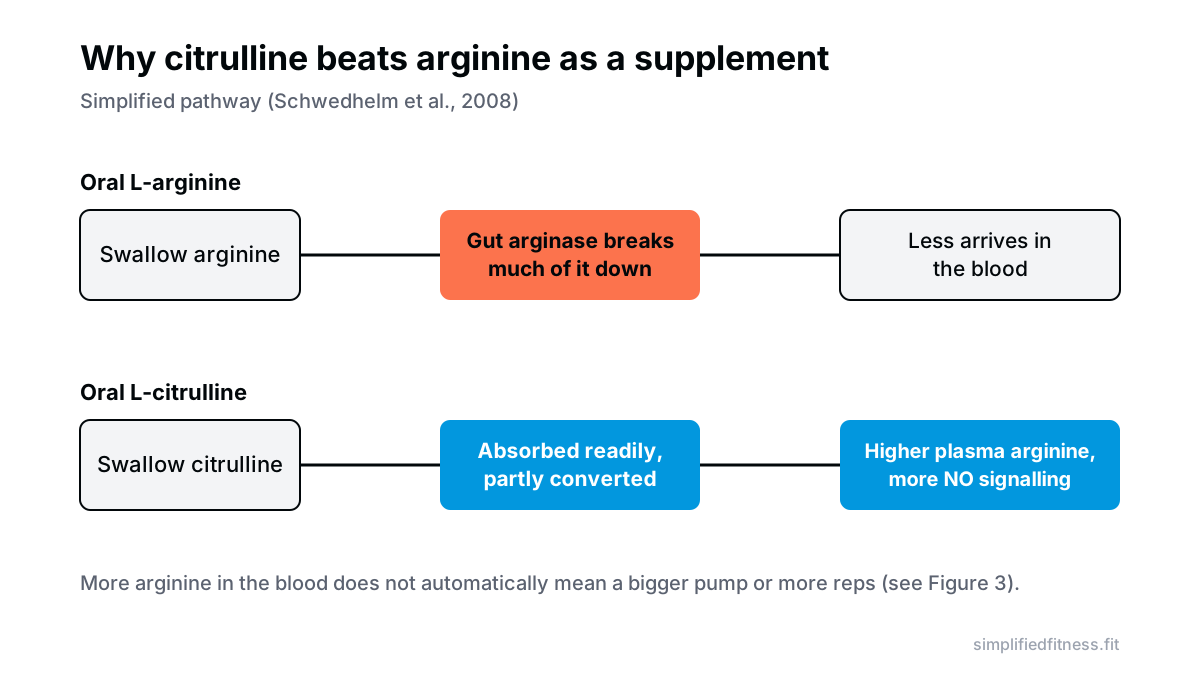
Two cautions on that study. It was 20 healthy volunteers, not trained lifters, and it measured blood chemistry, not reps or pumps. Raising a biomarker is not the same as improving a workout.
Citrulline malate vs pure L-citrulline: what is the difference?
Pure L-citrulline is one compound. Citrulline malate (CM) is citrulline bonded to malate, a Krebs cycle intermediate. The common form is “2:1”, meaning two citrulline for every one malate.
Because malate takes up weight, a scoop of CM contains less citrulline than a scoop of pure citrulline. That is the whole reason the dose recommendations differ.
| Pure L-citrulline | Citrulline malate 2:1 | |
|---|---|---|
| Common dose used | About 4-6 g | About 6-8 g |
| Active citrulline per gram | Highest | Lower (malate takes the rest) |
| Extra ingredient | None | Malate (benefit unproven) |
| Value check | Compare rupees per gram of citrulline | Same check, but you need more powder |
| Evidence base | Fewer studies | More studies (mostly single 8 g doses) |
The malate hypothesis is that it feeds the Krebs cycle for more ATP, or helps ammonia handling. A critical review described this as a possibility, and said the effectiveness of citrulline malate remains “ambiguous” until better trials arrive (Gough et al., 2021).
Citrulline malate dosage: how much do you need?
The practical rule is to compare grams of citrulline, not grams of powder. Working it out from molecular weights, a 2:1 product is roughly two thirds (if the ratio is by weight) to about 72% (if it is by molecules) citrulline, so 8 g of CM gives somewhere around 5-6 g of citrulline. Treat that as an estimate, not a lab number.
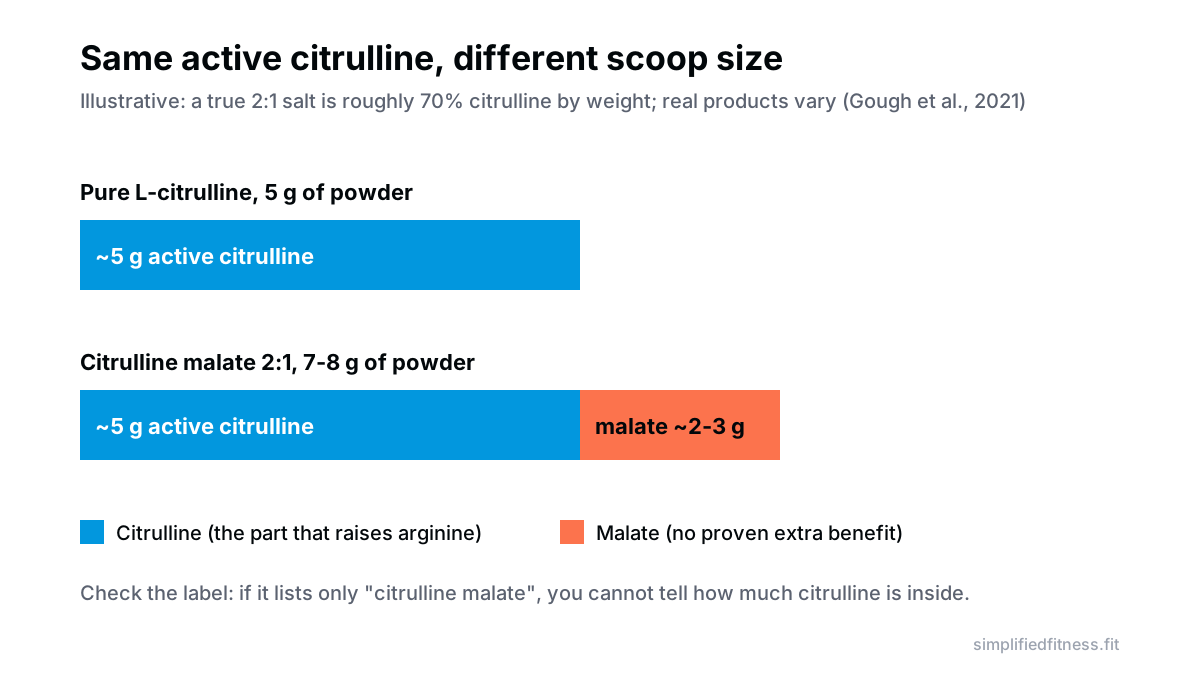
The estimate comes with a warning. The same critical review flags recent discovery of quality control issues with some manufacturers’ stated citrulline to malate ratios (Gough et al., 2021). A tub that says “8 g citrulline malate” may not deliver what you assume.
What the trials used:
- Most acute studies: a single 8 g CM dose, often 40-60 minutes before training. The Gough review notes that this single acute 8 g dose has been the most common approach, with equivocal results (Gough et al., 2021).
- A six-week trial: 8 g of L-citrulline, or 12 g of CM, daily alongside resistance training in 33 trained men (Bayat et al., 2025).
- Timing: Trexler’s meta-analysis only included studies where citrulline was given at least 30 minutes before testing and at doses of 3 g or more (Trexler et al., 2019).
Sensible starting points, given all that: 4-6 g of pure L-citrulline or 6-8 g of citrulline malate, about 45-60 minutes pre-training. Nothing in these studies shows that going higher helps.
Does citrulline malate work for pumps and reps?
Here is where the story gets less tidy.
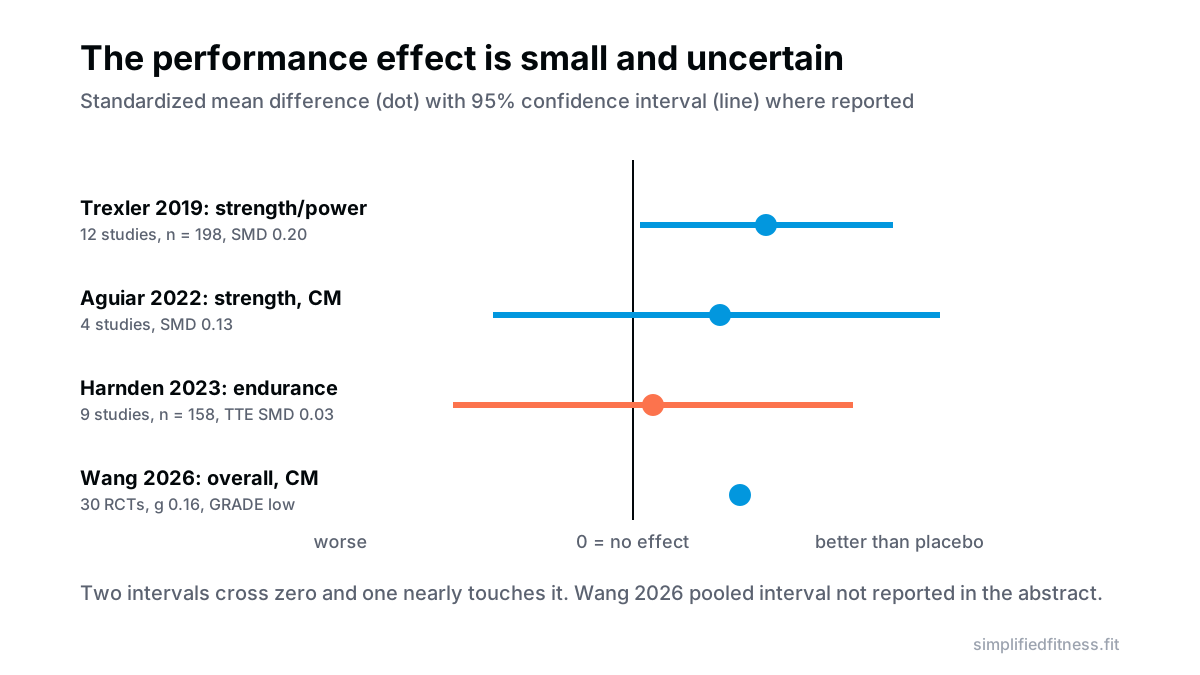
What found a benefit. A meta-analysis of 12 studies (198 participants) found a significant but small benefit of citrulline over placebo for high-intensity strength and power tasks, with a pooled SMD of 0.20 (95% CI 0.01-0.39). The authors stressed the effect was small and that each individual study’s interval crossed zero (Trexler et al., 2019). A 2026 meta-analysis of 30 trials of citrulline malate found a small improvement in overall performance (g = 0.16), but with wide prediction intervals and low to very low GRADE certainty (Wang et al., 2026).
What found nothing. A meta-analysis limited to resistance-trained adults and citrulline malate (four studies, 138 assessments) found no overall effect on muscle strength (SMD 0.13, 95% CI -0.21 to 0.46) (Aguiar et al., 2022).
Now the individual trials, since pumps are what most lifters care about:
- In 12 recreationally trained men, 8 g of CM taken 40 minutes before a 5 x 15 bench press protocol did not increase performance or augment muscle swelling. One set even showed fewer reps than placebo (Gonzalez et al., 2018).
- In 18 trained men and women, 8 g of L-citrulline did not change repetitions (placebo 36.7 vs citrulline 36.9), muscle oxygenation or most subjective measures (Gonzalez et al., 2023). Muscle pump was one of the ratings the study measured, and the authors reported no significant interactions apart from perceived fatigue.
- Over six weeks in 33 resistance-trained men, both citrulline forms improved upper body repetitions to failure versus placebo, while no differences appeared for 1RM strength (Bayat et al., 2025). The trial is small, and one author runs the gym where training took place, which the paper discloses.
Why the mismatch? Likely reasons: tiny samples, different test protocols with poor test-retest reliability, single versus repeated dosing, and uncertain product quality, all raised by the critical review (Gough et al., 2021). Chronic dosing may behave differently from one-off dosing, though the 2026 analysis could not confirm that difference.
Is citrulline malate better than pure citrulline for endurance?
The malate claim is mostly about endurance, so check it directly. A meta-analysis of nine trials (158 young healthy adults) found no significant difference between citrulline and placebo for time to exhaustion (pooled SMD 0.03, 95% CI -0.27 to 0.33) or time to completion, although the authors called the evidence base small (Harnden et al., 2023).
That trial pool covered citrulline broadly rather than malate specifically, and the Wang 2026 authors say that possible benefits for aerobic endurance in acute studies did not hold up across their sensitivity analyses (Wang et al., 2026). So there is no solid evidence that malate adds an endurance edge. And the head-to-head six-week trial found no apparent difference between the two forms (Bayat et al., 2025).
Which should you buy, and who should skip it?
My practical take, based on what is above:
- Price per gram of citrulline decides it. Pure citrulline is simpler to dose. CM is fine if the label states the ratio and amount.
- Check the label. Single ingredient, stated dose, ideally third-party tested (see certifications like NSF and Informed Choice).
- Test it fairly. Use it for 3-4 weeks at 4-6 g (pure) or 6-8 g (CM) around hard sessions, and keep a log of reps on your main lifts. If nothing changes, stop and put the money into food.
- Do not expect miracles. For where it sits among all supplements, see our supplement hierarchy.
For Indian budgets, a tub of pure L-citrulline is a luxury compared with a kilo of soya chunks, paneer or dal. If funds are tight, creatine monohydrate and protein come first.
Talk to a doctor before using it if you have kidney disease, take blood pressure drugs, nitrates or erectile dysfunction medication (all of which affect vessel tone), or are pregnant or breastfeeding. That is a cautious precaution on my part, not something the trials above tested.
Chasing a pump without citrulline
A pump is largely local blood volume, water and training style. Short rests, moderate reps (10-20) and a good carb and fluid intake do plenty. If your goal is a fuller look in the gym, see pump versus true hypertrophy, salt strategies for pumps and non-stimulant pump pre-workouts. For a nitrate route instead, see beetroot juice, and for blend design, pre-workout formulation science.
Then train the muscle you want to pump. Our free push day plan is a good place to start.
The bottom line
Pure L-citrulline and citrulline malate both raise blood arginine, and citrulline does it better than arginine itself. Pure citrulline needs about 4-6 g, CM about 6-8 g, to land in a similar place. The performance and pump benefit is small and inconsistent, the malate half has no proven extra effect, and the cheapest transparent product is a perfectly good choice. Good training beats either.
Frequently Asked Questions
Is citrulline malate or pure L-citrulline better?
Neither has been shown to be clearly better. A 2025 six-week trial in 33 resistance-trained men found no apparent difference between L-citrulline (8 g) and citrulline malate (12 g) for upper body endurance. Buy whichever gives you more actual citrulline per rupee and a transparent label.
How much citrulline malate should I take for pumps?
Most studies of citrulline malate used a single 8 g dose roughly 40-60 minutes before training. That dose has produced mixed results, and a 2021 critical review called the evidence ambiguous. If you try it, start with 6-8 g and judge it over a few weeks rather than one session.
How much pure L-citrulline equals 8 g of citrulline malate?
Roughly 5-6 g, because a 2:1 citrulline malate powder contains about two thirds or more citrulline by weight, with the rest being malate. The exact figure depends on how the product is made, and a 2021 review noted quality control problems with some labelled ratios. Use 4-6 g of pure L-citrulline as a practical starting range.
Does citrulline malate actually give a better muscle pump?
The evidence is thin. In a 2018 trial, 8 g of citrulline malate did not increase triceps muscle swelling after bench press, and a 2023 trial found no change in muscle oxygenation or reps with 8 g of L-citrulline. If you feel a stronger pump, it may be real for you, but controlled studies do not show it reliably.
L-arginine vs citrulline: which raises nitric oxide more?
L-citrulline raised blood arginine more effectively than L-arginine itself in a 20-person crossover trial. Arginine is heavily broken down by intestinal arginase before it reaches the bloodstream, while citrulline is absorbed and partly converted to arginine. For a nitric oxide support supplement, citrulline is the more sensible choice.
Does malic acid in citrulline malate help endurance?
Malate is a Krebs cycle intermediate, so the idea is that it helps energy production, but this is a theory rather than a proven effect. A 2023 meta-analysis of citrulline and endurance found no significant benefit, and the 2026 meta-analysis of citrulline malate rated its certainty as low to very low. Do not pay extra for the malate.
When should I take citrulline before a workout?
The single-dose trials cited here dosed 40-60 minutes before training, and Trexler's meta-analysis excluded doses taken less than 30 minutes before exercise. Take it with water about an hour before, and if it sits badly on an empty stomach, take it with a small snack.
Do I need to take citrulline every day?
There is no firm answer, since most trials were acute single doses. Some studies, including the 2025 six-week trial, used daily dosing alongside training. If you test it, use a consistent daily or training-day routine for several weeks so you can fairly judge whether it helps.
Is citrulline malate safe?
In the trials reviewed here, healthy adults used it without safety problems being the headline finding, but these studies were short and not designed mainly to detect rare side effects. Some people report stomach discomfort, which is one more reason not to go beyond the doses used in studies. Check with your doctor first if you have kidney disease, take blood pressure medication, nitrates or erectile dysfunction drugs, or are pregnant.
Can I get citrulline from food instead of supplements?
Watermelon is a known dietary source of citrulline, but the amount per serving is far below supplement doses of 4-8 g. Food sources have not been shown to replicate supplement effects on training performance. Eat fruit for the nutrients and treat the powder as a separate, optional decision.
Will citrulline help me build muscle?
Citrulline is not a muscle building supplement in the way creatine is. Any benefit would come indirectly, through an extra rep or two across a session, and the pooled data show that effect is small and uncertain. Progressive overload, enough protein and sleep matter far more.
Can I stack citrulline with creatine and caffeine?
Many pre-workouts combine them, and nothing in the studies cited here suggests a problem in healthy adults. Note that Trexler's meta-analysis excluded multi-ingredient products, so we know little about how citrulline behaves inside a stack. Add one thing at a time so you can tell what is actually helping.
Sources & References
Every claim above is checked against peer-reviewed research (PubMed, U.S. National Library of Medicine) or guidance from established health bodies. How we fact-check.
- Schwedhelm E, et al. Pharmacokinetic and pharmacodynamic properties of oral L-citrulline and L-arginine: impact on nitric oxide metabolism. Br J Clin Pharmacol. 2008. PMID: 17662090
- Trexler ET, et al. Acute effects of citrulline supplementation on high-intensity strength and power performance: a systematic review and meta-analysis. Sports Med. 2019. PMID: 30895562
- Gough LA, et al. A critical review of citrulline malate supplementation and exercise performance. Eur J Appl Physiol. 2021. PMID: 34417881
- Aguiar AF, et al. Effects of citrulline malate supplementation on muscle strength in resistance-trained adults: a systematic review and meta-analysis of randomized controlled trials. J Diet Suppl. 2022. PMID: 34176406
- Bayat D, et al. Changes in resistance training performance, rating of perceived exertion, and blood biomarkers after six weeks of supplementation with L-citrulline vs. L-citrulline DL-malate in resistance-trained men. J Int Soc Sports Nutr. 2025. PMID: 40470618
- Gonzalez AM, et al. Acute effect of citrulline malate supplementation on upper-body resistance exercise performance in recreationally resistance-trained men. J Strength Cond Res. 2018. PMID: 29210953
- Gonzalez AM, et al. Acute effect of L-citrulline supplementation on resistance exercise performance and muscle oxygenation in recreationally resistance trained men and women. J Funct Morphol Kinesiol. 2023. PMID: 37489301
- Harnden CS, et al. Effects of citrulline on endurance performance in young healthy adults: a systematic review and meta-analysis. J Int Soc Sports Nutr. 2023. PMID: 37155582
- Wang X, et al. Effects of citrulline malate supplementation on exercise performance: a systematic review and three-level meta-analysis. Nutrients. 2026. PMID: 42356270

Umair Hazrami · Founder & Head Coach, Simplified Fitness
Umair Hazrami founded Simplified Fitness and the Simplified Lifter channel to cut through fitness noise. With 4+ years of consistent training and 10+ coaching clients, he writes every guide from the peer-reviewed research and links the sources so you can check them. Our editorial standards.
Educational content only, not medical advice. If you have a medical condition, are pregnant, or take medication, talk to a qualified doctor before changing your diet, supplements or training. Full disclaimer.
Keep reading
Supplements
Ashwagandha KSM-66 vs Sensoril: Which Extract, What Dose, and Do You Need to Cycle?
Ashwagandha KSM-66 vs Sensoril for lifters: what the strength trials show, realistic cortisol effects, liver safety and whether to cycle. Every study linked.
8 min read
Supplements
BCAAs vs EAAs: Why BCAAs Are a Waste of Money If Your Protein Is Covered
BCAA vs EAA for muscle growth: BCAAs are only 3 of the 9 essential amino acids. See what Wolfe 2017 and Jackman 2017 found and when EAAs or whey make sense.
8 min read
Supplements
Beetroot Juice for Running and Lifting: How Dietary Nitrate Works (and the Mouthwash Trap)
Does beetroot juice for running actually work? See what meta-analyses show, the 2-3 hour timing and dose, who benefits, and why mouthwash can cancel the effect.
9 min read
Supplements
Beta-Alanine Benefits: Carnosine Buffering, High-Rep Gains and Why It Makes You Tingle
Beta-alanine benefits explained: why pre-workout makes your skin tingle, how carnosine buffers acid, what dose works, and who should skip it. Studies linked.
8 min read