Beta-Alanine Benefits: Carnosine Buffering, High-Rep Gains and Why It Makes You Tingle
Beta-alanine benefits explained: why pre-workout makes your skin tingle, how carnosine buffers acid, what dose works, and who should skip it. Studies linked.

TL;DR. The short answer
- Beta-alanine raises carnosine inside muscle, which helps buffer acid during hard efforts lasting about 1-4 minutes. Meta-analyses find a small average benefit, not a dramatic one.
- The tingling or itching is paresthesia, a harmless sensory effect and the only side effect the ISSN position stand reports. Splitting doses to about 1.6 g or using a sustained-release product reduces it.
- A typical protocol is 3.2-6.4 g per day, split into smaller doses, for at least 4 weeks. Taking it only on the day of the workout does not work, because carnosine builds up slowly.
- It does not help 1-5 rep strength and is unlikely to change muscle mass. A 2022 meta-analysis found no effect on fat-free mass or fat mass.
- It is most useful for high-rep sets, rowing, middle-distance running, and CrossFit style workouts. If your training is mostly heavy low-rep lifting, you can skip it.
Part of our complete guide: The Evidence-Based Fitness Supplements Guide: What Works, What's Overhyped & What's a Waste of Money
Table of contents
You take a scoop of pre-workout, and ten minutes later your face, neck and hands feel like they are covered in pins and needles. That is almost always beta-alanine. The beta-alanine benefits are real but narrow: it helps buffer acid in muscle during hard efforts lasting roughly 1-4 minutes, and it does very little for heavy 1-5 rep strength.
This article covers what beta-alanine does inside the muscle, why it makes you tingle, what dose the research uses, and who is wasting money on it. It sits inside our evidence-based guide to fitness supplements, where beta-alanine is a “contextual” supplement rather than a must-have.
What does beta-alanine actually do?
Your muscles make a compound called carnosine from two amino acids: beta-alanine and histidine. Carnosine acts as a buffer inside the muscle cell. During hard exercise, hydrogen ions build up and the muscle becomes more acidic, which is one of the things that contributes to that burning, can’t-go-on feeling.
Beta-alanine is the ingredient you can raise through supplementation. The ISSN position stand reports that four weeks of beta-alanine at 4-6 g daily significantly augments muscle carnosine, and describes carnosine as acting as an intracellular pH buffer (Trexler et al., 2015).
Think of it as a bigger shock absorber, not a bigger engine. It does not give you more force. It may help you keep going a little longer once acid is piling up.
Why does pre-workout make my face itch and tingle?
That sensation is called paresthesia. It is a sensory nerve effect: a prickling or itching feeling, often on the face, ears, neck and hands, that comes on not long after a dose and then fades. Bigger single doses tend to bring stronger tingling, which is why the advice is to split them.
The ISSN position stand names paraesthesia as the only reported side effect, says studies indicate it can be reduced with divided lower doses (1.6 g) or a sustained-release formula, and concludes beta-alanine appears safe in healthy people at recommended doses (Trexler et al., 2015). The leading explanation is that beta-alanine activates sensory nerve endings in the skin. It is a nerve signal, not an allergic reaction and not a sign the product is “working.”
Here is the catch. The tingle tells you nothing about whether the supplement helps you. Plenty of people feel strong tingles and see no performance change. Others feel nothing and still build carnosine.
If you ever get hives, facial swelling, trouble breathing, chest pain or feel properly unwell, stop and see a doctor. That is not paresthesia.
How strong is the evidence for beta-alanine benefits?
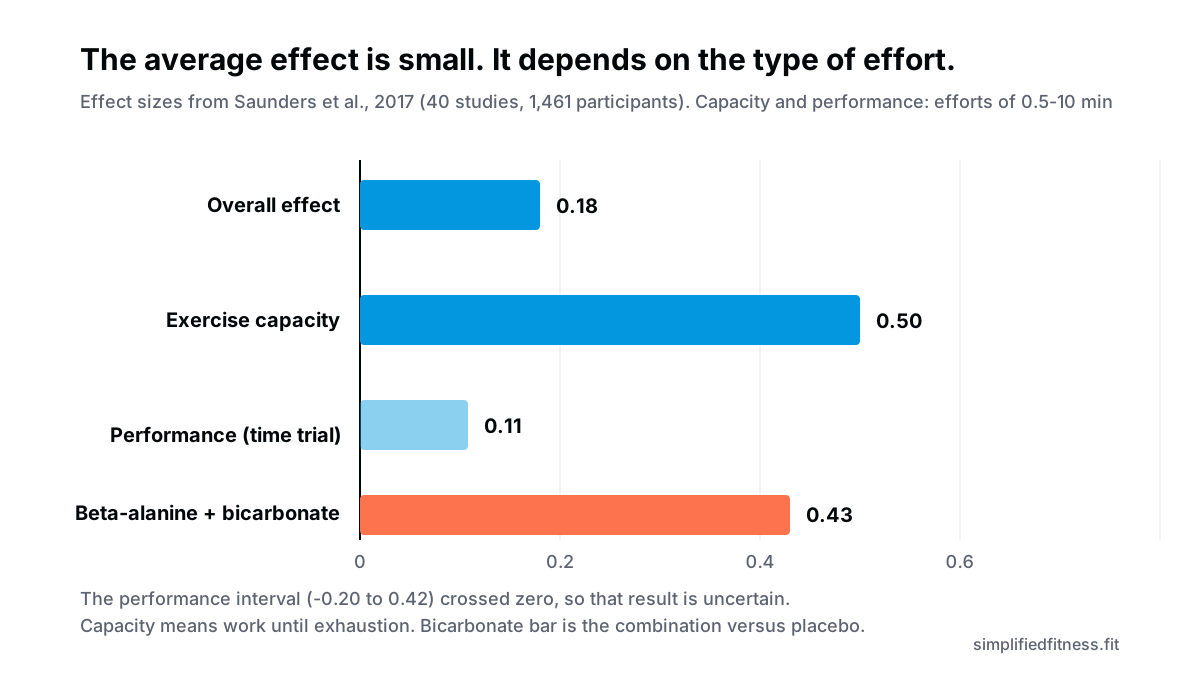
The best summary is a 2017 meta-analysis of 40 placebo-controlled studies and 1,461 participants. It found a significant overall effect size of 0.18, which is small. Exercise duration moderated the effect, and in efforts of 0.5-10 minutes the effect was larger for exercise capacity (0.50) than for performance (0.11, with a confidence interval that crossed zero) (Saunders et al., 2017).
In plain terms: beta-alanine tends to help “how long can I keep going at this intensity” more than “how fast is this one all-out effort.” Training status did not change the picture in that analysis.
A 2024 meta-analysis restricted to trained young men looked at 18 studies and 331 participants doing maximal or supramaximal efforts of 0.5-10 minutes. It found an overall effect size of 0.39 in favour of beta-alanine, with significant results at 4 weeks, in efforts of 4-10 minutes, and at 5.6-6.4 g per day (Georgiou et al., 2024).
Those two analyses are not identical, and the numbers differ. One pooled all healthy populations and many exercise types, the other only trained men in a tighter duration window, so the larger effect in the second is plausible. The safe reading is a small to moderate benefit in the right type of effort, not a guaranteed edge.
Which workouts benefit most?
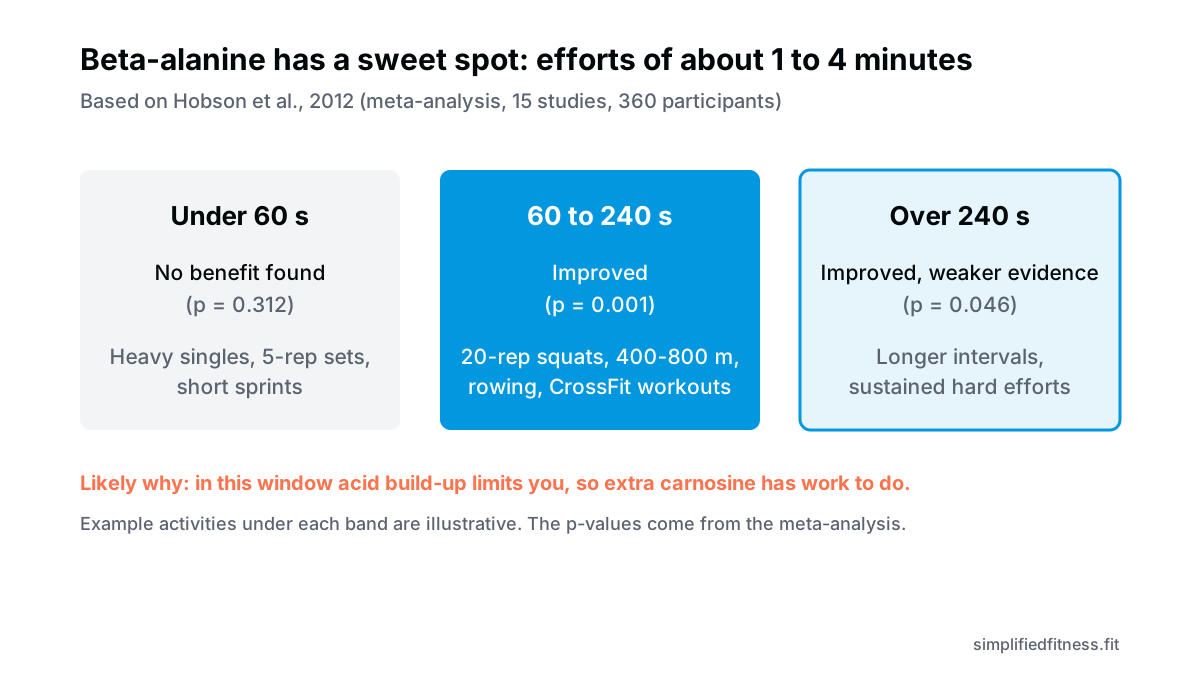
A 2012 meta-analysis of 15 studies and 360 participants found exercise lasting 60-240 seconds improved with beta-alanine (P = 0.001), exercise over 240 seconds also improved (P = 0.046), and exercise under 60 seconds showed no benefit (P = 0.312) (Hobson et al., 2012). That matches the buffering idea: acid accumulates fastest in the middle window.
What does that look like in a gym?
- A 20-rep set of squats that takes around a minute and a half.
- A 500 m rowing piece or 800 m run.
- A CrossFit style workout built around 2-4 minute rounds.
- A 3-5 minute interval repeated several times.
What does it not help much? A heavy triple, a max bench single, a 5x5 where each set lasts 20-30 seconds. Those efforts end before acid is the limiter.
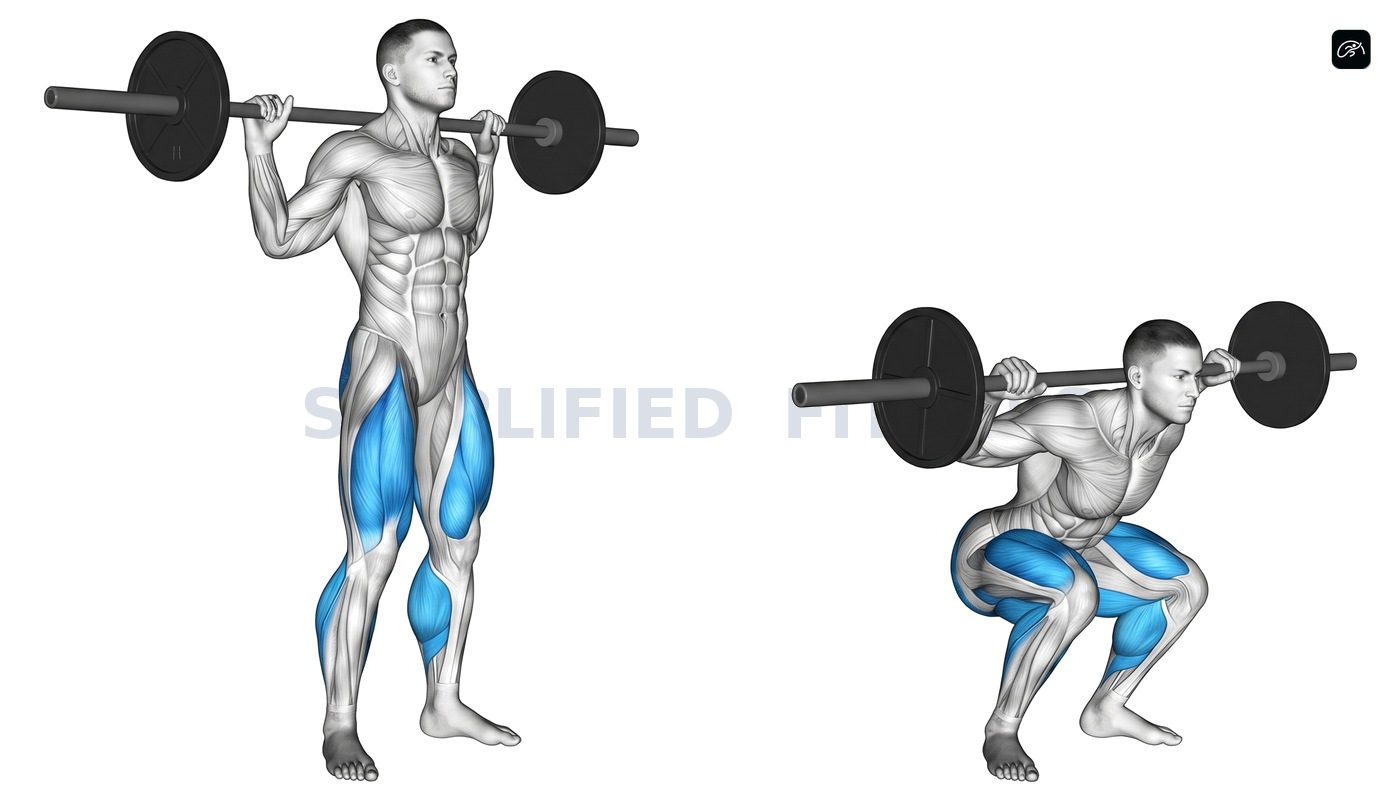
A set of 20 hard squats is one of the few places in a normal lifting program where buffering might matter. If you want to practise sets like this, our leg day plan shows how to place them, and our RIR and RPE calculator helps you judge how close to failure you are taking them.
Does beta-alanine help strength or build muscle?
The evidence says mostly no. In a 10-week resistance training study, 26 sports science students took 6.4 g per day of beta-alanine or placebo. Muscle carnosine rose by 12.81 mmol per kg of dry muscle in the beta-alanine group, with no change in the placebo group, but there was no significant effect on any exercise measure, body mass or body fat percentage (Kendrick et al., 2008). That is a small study, so treat it as one data point.
For body composition, a 2022 meta-analysis of 20 randomized trials with 492 participants found no effect on body mass, fat mass, body fat percentage or fat-free mass, with low to moderate certainty of evidence (Ashtary-Larky et al., 2022). So “does beta-alanine build muscle” gets a cautious no.
The most you can argue is an indirect route: if you can squeeze out a few more reps in long sets over months, that is slightly more training stimulus. Nobody has shown that clearly yet, and it would be a small effect.
What is the best beta-alanine dose?
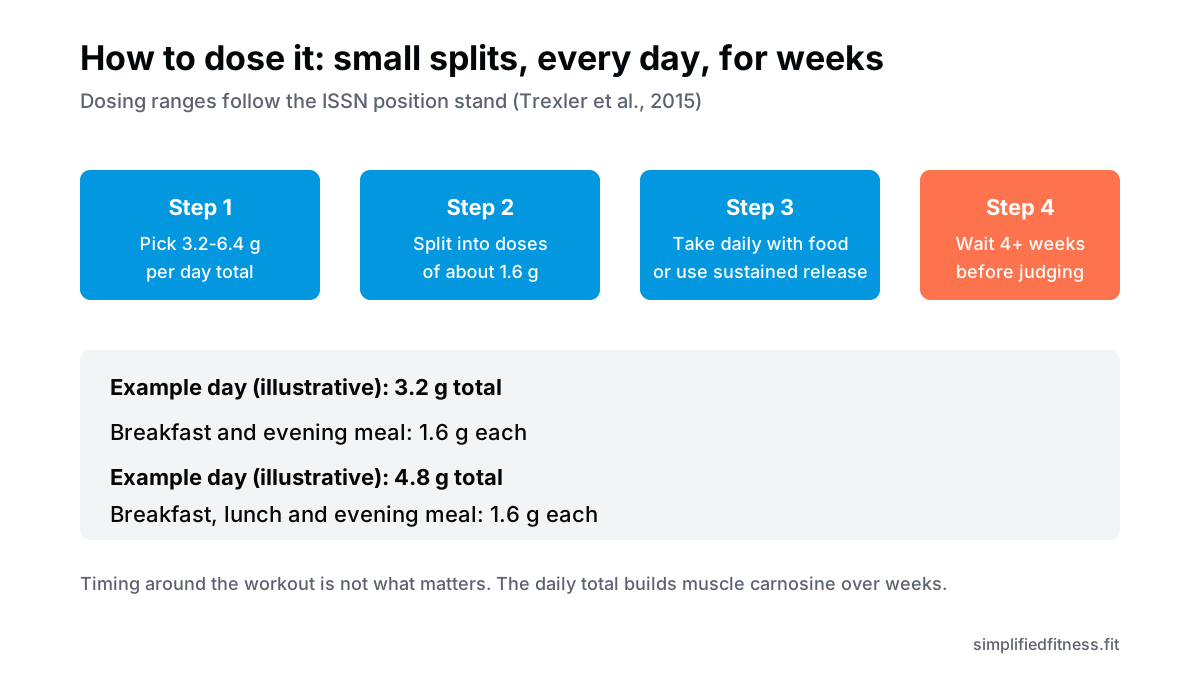
The ISSN position stand supports 4-6 g per day for at least 2-4 weeks, with divided doses of about 1.6 g or sustained release to limit tingling (Trexler et al., 2015). Many protocols sit in the 3.2-6.4 g range. Two practical points matter most.
First, it is a loading supplement. Carnosine accumulates over weeks, so you take it every day, not just before training. Second, the total matters more than the clock. You do not need to time it around your workout.
One study compared 6 g per day for 4 weeks with 12 g per day for 2 weeks, using a sustained-release product. Both raised muscle carnosine versus placebo, and the groups did not differ in paresthesia symptoms (Church et al., 2017). It was small (30 people), so you should not copy 12 g per day on that basis. It does hint that sustained-release formulas make higher daily totals more tolerable, although the trial had no immediate-release group to compare against.
Should you combine it with baking soda or creatine?
There is some evidence that stacking helps. The 2017 meta-analysis found the largest effect, 0.43, when beta-alanine was co-supplemented with sodium bicarbonate (Saunders et al., 2017). A 2024 meta-analysis of 10 studies and 243 people found no detectable benefit for either alone, but a significant benefit for the combination (SMD 0.32) (Curran-Bowen et al., 2024).
Those two reviews look like they disagree on beta-alanine alone, but the numbers are close: the 2024 review’s estimate for beta-alanine alone was 0.18, the same as the 2017 overall figure, and only its wider confidence interval (it pooled far fewer studies) stopped it reaching significance. Still, it is a reminder that the standalone effect is modest and the combination looks more promising. Baking soda causes stomach upset in some people, which we cover in our sodium bicarbonate guide.
Creatine and beta-alanine do different jobs, so there is no reason you cannot take both. Citrulline is another common pre-workout ingredient, and we compare the forms in our citrulline malate vs L-citrulline guide.
Who should take beta-alanine, and who should skip it?
Be honest about what you train for.
| Your training | Likely benefit | Verdict |
|---|---|---|
| Heavy 1-5 rep lifting | Little to none (efforts under 60 s) | Skip |
| Hypertrophy work, 8-12 reps | Unclear, small at best | Usually skip |
| 15-30 rep sets, drop sets | Possible small edge | Optional |
| Rowing, 400-1500 m running, CrossFit style work | Best supported | Reasonable to try |
| Endurance events over 25 minutes | Not established, per ISSN | Unclear, low priority |
If you are on a tight budget in India, the sums matter. Beta-alanine at 3.2-6.4 g a day is a recurring cost, and the gain is small. Protein from dal, curd, paneer, soya and eggs, plus enough sleep and food, will move your results far more than this supplement will. Our supplement hierarchy puts it where it belongs.
Talk to a doctor first if you are pregnant or breastfeeding, have a medical condition, or take regular medication. Safety data beyond healthy adults is limited. Buy products that are third-party tested where possible, so you know the label matches the tub.
Frequently asked questions
The answers to the most common beta-alanine questions are in the FAQ section below. If you have a specific health condition, ask your doctor before starting any new supplement.
Frequently Asked Questions
Why does pre-workout make my face and skin itch or tingle?
The tingling is paresthesia, and in most pre-workouts it comes from beta-alanine. It is thought to come from beta-alanine stimulating sensory nerve endings in the skin, which is why it often hits the face, neck and hands. It is harmless in healthy people, and splitting your dose or using a sustained-release product usually settles it.
Is beta-alanine tingling dangerous?
No, the ISSN position stand lists paresthesia as the only reported side effect and describes beta-alanine as safe in healthy people at recommended doses. The sensation is a nerve effect and does not indicate damage. If you get hives, swelling, breathing trouble, or feel unwell rather than just tingly, stop and see a doctor.
What does beta-alanine actually do?
Beta-alanine is the building block your muscles use, together with histidine, to make carnosine. Carnosine acts as an intracellular buffer for the hydrogen ions that build up during hard efforts and contribute to fatigue. In practice this can let you hold a hard pace or finish a few more reps in efforts lasting around 1-4 minutes.
Does beta-alanine build muscle?
There is no good evidence that it builds muscle directly. A 2022 meta-analysis of 20 randomized trials (492 participants) found no effect on fat-free mass, fat mass or body weight. If it helps at all, it is by letting you do slightly more work in high-rep sets, so keep your focus on progressive overload.
How much beta-alanine should I take per day?
Most protocols use 3.2-6.4 g per day, and the ISSN position stand highlights 4-6 g daily for at least 2-4 weeks. Muscle carnosine rises gradually, so the daily total matters more than timing. Split it into doses of about 1.6 g and take it every day, including rest days.
How long does beta-alanine take to work?
Expect to wait around 4 weeks. The ISSN position stand reports that 4 weeks of 4-6 g per day significantly raises muscle carnosine, and a 2024 meta-analysis found significant effects at the 4-week mark. Do not judge it after a week or two.
Do I need to take beta-alanine before my workout?
No, taking it right before training is not what drives the benefit. The effect comes from carnosine slowly accumulating in muscle over weeks of daily dosing. The pre-workout tingle is just the side effect of a dose, not a sign it is working.
How do I stop the beta-alanine itch?
Use smaller doses and spread them out. The ISSN position stand notes that divided lower doses of about 1.6 g or a sustained-release formula can attenuate the tingling. If one 1.6 g dose still bothers you, a sustained-release product is the next step.
Is beta-alanine good for heavy 5-rep strength training?
Probably not. A 2012 meta-analysis found no benefit for exercise lasting under 60 seconds, and the ISSN says more research is needed on strength. A single heavy set of 5 is over in well under a minute, so there is little acid buffering to be done. Save your money unless you also do high-rep or conditioning work.
Does beta-alanine work for CrossFit and high-rep sets?
It may help modestly. Efforts of 60-240 seconds improved in a 2012 meta-analysis, which is the window for many metcons, rowing intervals and 20-rep squat sets. Expect a small edge on top of good training and sleep, not a transformation.
Can I take beta-alanine with creatine and caffeine?
Yes, there is no known problem with combining them. They work differently: creatine supports short, powerful efforts, caffeine acts on the nervous system, and beta-alanine buffers acid. Take creatine daily, use caffeine when you need it, and keep the beta-alanine split across the day.
Is beta-alanine worth it for a beginner?
Usually not. Beginners gain far more from consistent training, enough protein and sleep, and the supplement effect is small on average. Consider it only after your basics are solid and you do a lot of work in the 1-4 minute range.
Who should avoid beta-alanine?
Long-term safety data are limited outside healthy adults, so pregnant or breastfeeding women, people with medical conditions, and anyone on medication should check with a doctor first. The research in these groups is thin. If tingling bothers you, a sustained-release product or simply skipping it is a fine choice.
Sources & References
Every claim above is checked against peer-reviewed research (PubMed, U.S. National Library of Medicine) or guidance from established health bodies. How we fact-check.
- Saunders B, et al. β-alanine supplementation to improve exercise capacity and performance: a systematic review and meta-analysis. Br J Sports Med. 2017. PMID: 27797728
- Trexler ET, et al. International society of sports nutrition position stand: Beta-Alanine. J Int Soc Sports Nutr. 2015. PMID: 26175657
- Hobson RM, et al. Effects of β-alanine supplementation on exercise performance: a meta-analysis. Amino Acids. 2012. PMID: 22270875
- Georgiou GD, et al. Effect of Beta-Alanine Supplementation on Maximal Intensity Exercise in Trained Young Male Individuals: A Systematic Review and Meta-Analysis. Int J Sport Nutr Exerc Metab. 2024. PMID: 39032921
- Church DD, et al. Comparison of Two β-Alanine Dosing Protocols on Muscle Carnosine Elevations. J Am Coll Nutr. 2017. PMID: 28910200
- Kendrick IP, et al. The effects of 10 weeks of resistance training combined with beta-alanine supplementation on whole body strength, force production, muscular endurance and body composition. Amino Acids. 2008. PMID: 18175046
- Ashtary-Larky D, et al. Effects of beta-alanine supplementation on body composition: a GRADE-assessed systematic review and meta-analysis. J Int Soc Sports Nutr. 2022. PMID: 35813845
- Curran-Bowen T, et al. Sodium bicarbonate and beta-alanine supplementation: Is combining both better than either alone? A systematic review and meta-analysis. Biol Sport. 2024. PMID: 38952910

Umair Hazrami · Founder & Head Coach, Simplified Fitness
Umair Hazrami founded Simplified Fitness and the Simplified Lifter channel to cut through fitness noise. With 4+ years of consistent training and 10+ coaching clients, he writes every guide from the peer-reviewed research and links the sources so you can check them. Our editorial standards.
Educational content only, not medical advice. If you have a medical condition, are pregnant, or take medication, talk to a qualified doctor before changing your diet, supplements or training. Full disclaimer.
Keep reading

Supplements
Ashwagandha KSM-66 vs Sensoril: Which Extract, What Dose, and Do You Need to Cycle?
Ashwagandha KSM-66 vs Sensoril for lifters: what the strength trials show, realistic cortisol effects, liver safety and whether to cycle. Every study linked.
8 min read
Supplements
BCAAs vs EAAs: Why BCAAs Are a Waste of Money If Your Protein Is Covered
BCAA vs EAA for muscle growth: BCAAs are only 3 of the 9 essential amino acids. See what Wolfe 2017 and Jackman 2017 found and when EAAs or whey make sense.
8 min read
Supplements
Beetroot Juice for Running and Lifting: How Dietary Nitrate Works (and the Mouthwash Trap)
Does beetroot juice for running actually work? See what meta-analyses show, the 2-3 hour timing and dose, who benefits, and why mouthwash can cancel the effect.
9 min read

Supplements
Betaine (TMG) for Strength and Power: What the Research Really Shows
Does betaine build muscle or boost power? We review the trials and meta-analyses on betaine TMG, the 2.5 g dose, betaine vs creatine, and betaine HCl.
7 min read