Third-Party Supplement Certifications: Informed-Choice, NSF Certified for Sport, and Banned Substances
Third party supplement testing explained: what Informed-Choice and NSF Certified for Sport do, how to verify a lot number, and what research shows.
TL;DR. The short answer
- Third party supplement testing means an independent lab screens batches of a product for banned substances. It lowers the risk of contamination but cannot reduce it to zero.
- Reviews of supplement analyses report prohibited substances (mainly steroids, prohormones or stimulants) in roughly 10-15% of products in some estimates and 12-58% across others, mostly in older and non-representative samples.
- Informed-Sport and NSF Certified for Sport are programs aimed at athletes. A seal on the tub is not enough: check the lot number against the official registry.
- Higher-risk categories are pre-workouts, herbal blends and weight-loss products. As a rule of thumb, plain creatine monohydrate or whey from a certified line sits at the lower-risk end.
- If you are subject to drug testing, or you develop unexplained symptoms after a supplement, talk to your anti-doping body or a doctor. A certificate does not replace that.
Part of our complete guide: The Evidence-Based Fitness Supplements Guide: What Works, What's Overhyped & What's a Waste of Money
Table of contents
Third party supplement testing is the closest thing you have to a safety check on a tub of powder. An independent lab screens batches for banned substances, and certifiers like Informed-Sport and NSF Certified for Sport publish what they have cleared. It cuts the risk of a spiked product. It does not remove it.
This guide covers what the seals mean, how to verify one properly, and where the contamination numbers come from. It sits inside our evidence-based guide to fitness supplements, and the short version is: most lifters need very few supplements, so the cheapest safety move is often buying fewer products.
Why can supplements be contaminated at all?
Supplements are not approved by regulators before they reach the shelf. Rules and enforcement differ by country, and a recent global review describes variable frameworks and limited safety oversight as a driver of inadvertent doping risk (Wardenaar et al., 2026).
Contamination happens two ways. One is accident: a factory that also makes a steroid-containing product, shared equipment, poor quality control. The other is deliberate. A Cologne anti-doping group review describes undeclared anabolic steroids and stimulants arriving through cross-contamination from substandard manufacturing, or through intentional admixture to make products work better (Walpurgis et al., 2020).
Both routes matter to you. The first makes an honest brand risky. The second makes a fast “results” brand risky.
How common is the problem?
Honest answer: the numbers are old, uneven and not a market-wide rate.
The best-known figure comes from an international analysis in 2001 and 2002 of 634 supplements bought in 13 countries. About 15% of the non-hormonal products contained anabolic-androgenic steroids, mainly prohormones (Geyer et al., 2008). A review of the empirical data put the share of supplements that may contain prohibited substances at 10-15% (Outram and Stewart, 2015). A broader review of 23 studies reported contamination rates between 12% and 58% (Martinez-Sanz et al., 2017).
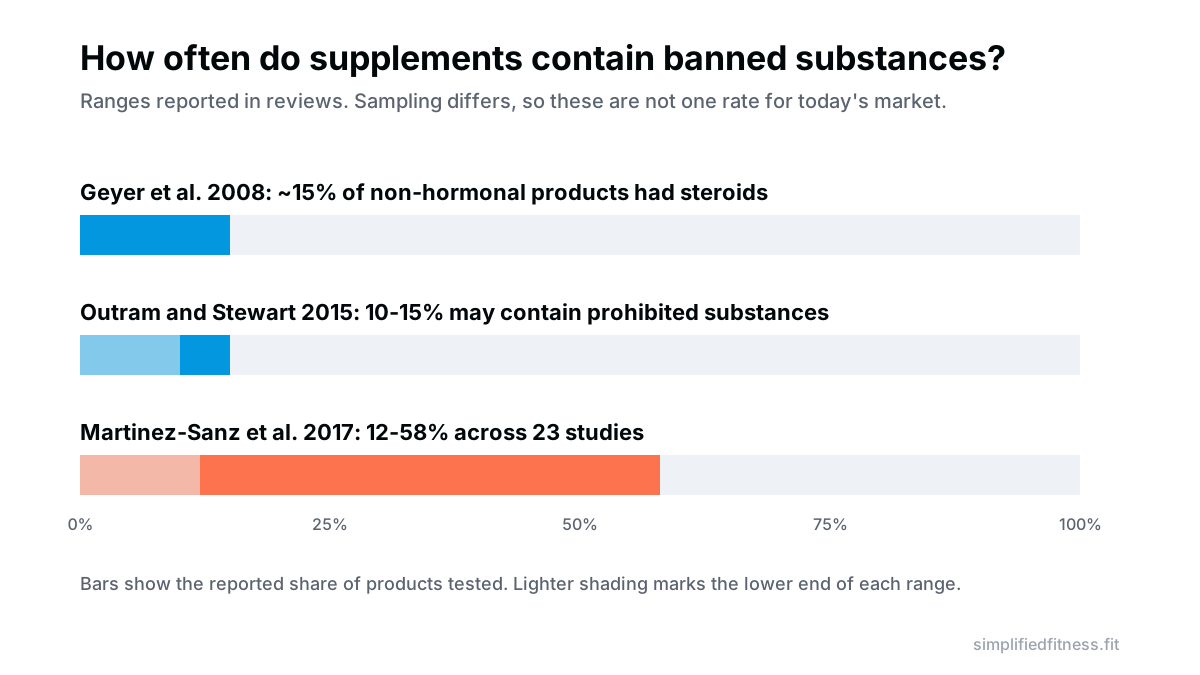
Why such a wide range? Studies often test products already suspected of being risky. Some looked only at prohormones, others at stimulants too. Some were done before newer manufacturing rules. The 58% figure should not be read as “58% of what you can buy today.”
Can a spiked supplement actually harm you?
Beyond failing a drug test, yes, in documented cases. From 2012 to 2013, about 16 New York residents reported fatigue, scalp hair loss and muscle aches, and one was hospitalised with liver damage. Investigators traced a common factor to B-50 vitamin and multimineral supplements from one supplier. Lab analysis found methasterone and related androgenic steroids in implicated lots (Tran et al., 2023). That is a case series, so it shows a link, not how often this happens.
Heavy metals are a different story. A risk assessment based on reported arsenic, cadmium, mercury and lead levels in protein powders found typical intake did not pose an increased health risk, with the highest values in mass-gainer products and the lowest in whey (Bandara et al., 2020). It was a modelling study that relied on previously reported concentrations, not new lab testing. So: metals are worth knowing about, steroids and stimulants are the sharper concern.
What do the main certification programs actually do?
Program rules change, so treat this as an overview and check the certifier’s own site for current details.
NSF Certified for Sport. NSF’s site describes an independent third-party certification recognised by USADA, MLB, the NHL and the CFL. Products can be searched by name, keyword or lot number.
Informed-Sport and Informed-Choice. These are run by the same testing company. Informed-Sport targets athletes. The exact testing scope, batch frequency and banned list change over time, so read the program’s current rules on its own website.
Cologne List. A German database of supplements that have been lab-tested for doping substances. It is built for tested athletes, and its inclusion rules differ from retail registries.
USP and BSCG. USP and BSCG also run quality or sport-related verification. Their scope differs from the athlete programs above, so check each one directly before relying on it.
Labdoor. Not an anti-doping certification. It ranks products using its own testing, which is useful context but a different thing entirely.
| Question | Informed-Sport | NSF Certified for Sport | Labdoor |
|---|---|---|---|
| Anti-doping focus | Yes, athlete program | Yes, recognised by US bodies | No, ranking site |
| Lot lookup | Check official registry | Name, keyword or lot number | Product pages |
| Peer-reviewed validation | Not found | Not found | Not found |
How do I verify a supplement properly?
A logo is easy to print on a tub. A batch listed on the certifier’s registry is much harder to fake.
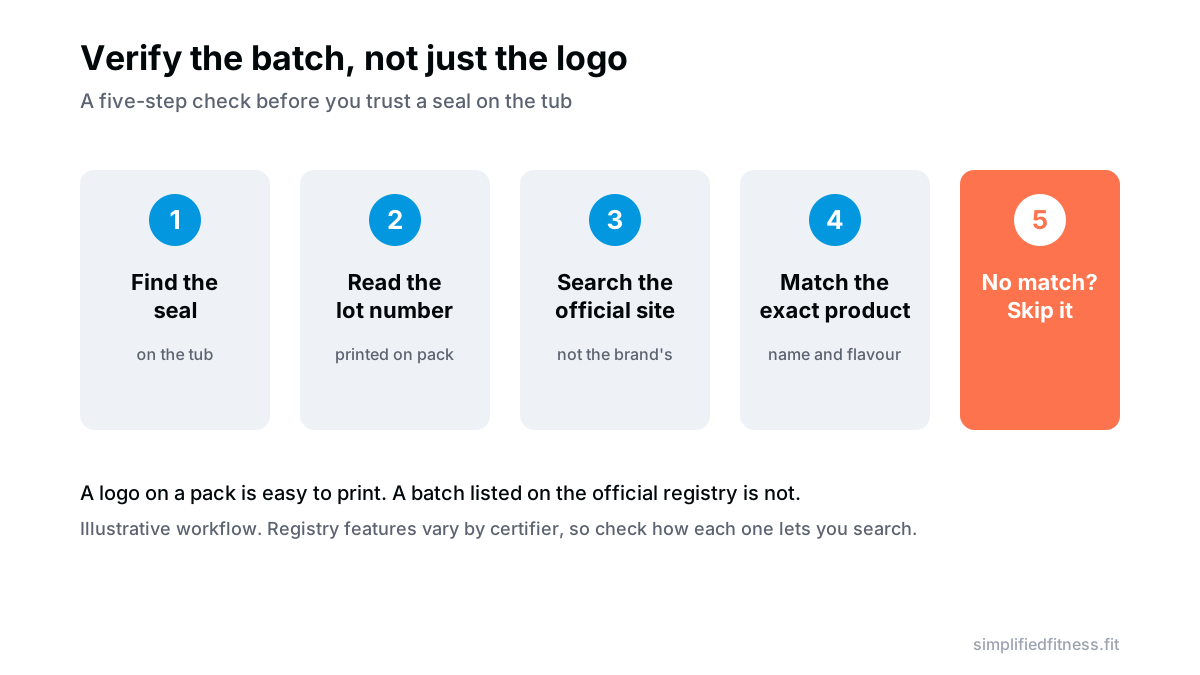
- Find the seal on the tub.
- Read the lot or batch number printed on the pack.
- Go to the certifier’s website yourself. Do not click links printed on the brand’s page.
- Match the exact product name, flavour and lot.
- If it does not match, treat it as untested.
Which supplement categories carry the most risk?
A 2026 global review of supplement safety reported high-risk products across all regions, including certain herbal blends, pre-workouts and weight-management supplements (Wardenaar et al., 2026). Many ingredients means many places for an undeclared compound to enter. Our guide to proprietary blends and under-dosing shows why those labels are hard to trust anyway, and commercial fat burners are a common case.
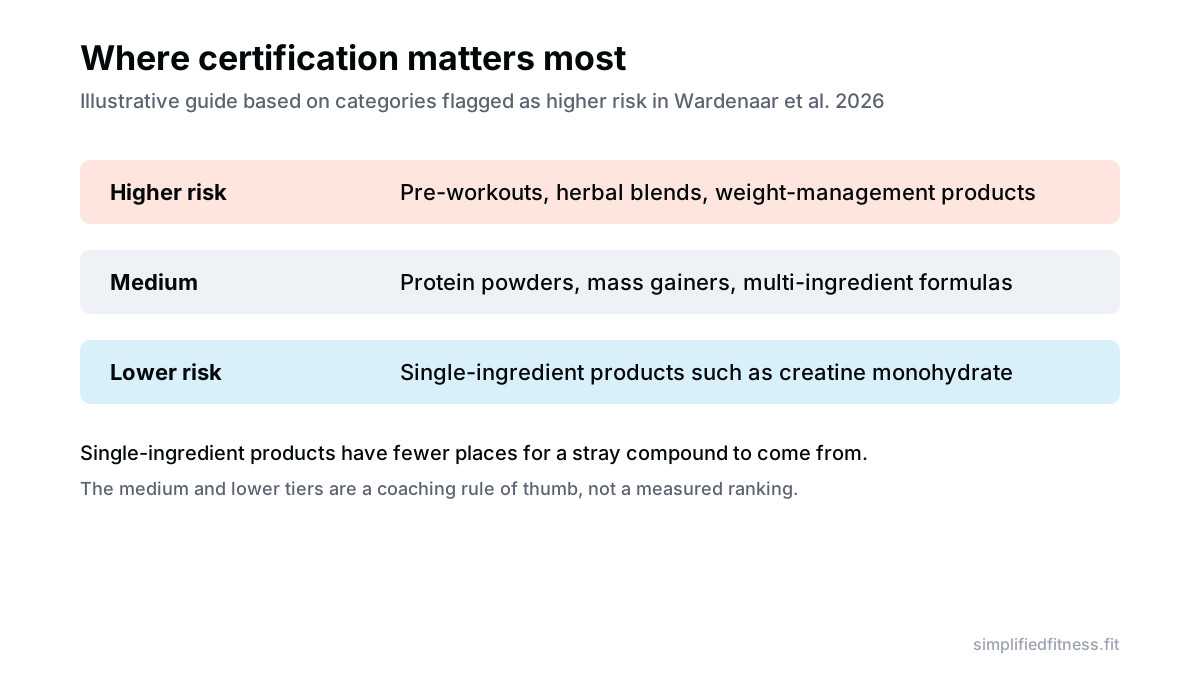
That tiering is a coaching rule of thumb, not a measured ranking. It follows one logic: the simpler the product, the fewer ways it can go wrong. Creatine monohydrate is a good example.
Indian context: does any of this apply to me?
It does, and perhaps more. The 2026 review notes that third-party testing programs remain concentrated in Europe, North America and Australia/New Zealand, and that cost and availability limit use elsewhere (Wardenaar et al., 2026). So an Indian buyer may find fewer certified options and more counterfeits. Our guide to FSSAI rules and spotting fake protein in India covers the local rules and counterfeit checks. In practice: buy from authorised sellers, check the lot against the official registry where one exists, and be extra sceptical of imported pre-workouts sold at big discounts.
And food comes first. Dal, paneer, curd, eggs and soya cover protein for most people, and the supplement hierarchy explains why few products earn a place. You can see how much protein you need with the protein calculator before buying anything.
What certification cannot tell you
A seal answers one question: was this batch screened for prohibited substances? It says nothing about whether the product works. A certified pre-workout can still be under-dosed, and a certified protein powder can still taste like chalk.
It also does not make a bad idea good. If a supplement has weak evidence, a certificate only means the weak-evidence product is probably free of steroids. That is why we rank products first by evidence, and only then by testing status. If you are unsure where a product sits, our guide to reading a pre-workout label helps you strip the marketing out.
Testing also has limits of method. Labs screen for known compounds. Walpurgis and colleagues note that even minute trace amounts of a contaminant can still produce a positive doping test, which is why anti-doping groups talk about lowering risk rather than eliminating it (Walpurgis et al., 2020).
Is the extra cost worth it?
For most recreational lifters, a tested whey or creatine costs a little more than an unknown brand and removes one worry. For a multi-ingredient pre-workout, the better move is usually to skip it and use coffee or tea, which is cheaper and has no hidden blend. For a tested athlete, the cost question mostly disappears: the consequence of a positive test is far larger than the price gap, and the usual advice is to use only products verified by your sport’s recommended program.
The practical rules
- Skip high-risk categories unless you have a real reason.
- Prefer single-ingredient products.
- Verify lot numbers on the certifier’s site.
- Buy from authorised sellers.
- Keep the pack and lot number for a few weeks after finishing the tub.
- Tested athletes: follow your anti-doping body’s guidance. The IOC consensus statement notes that inadvertent intake of prohibited substances is a known risk of taking some supplements (Maughan et al., 2018).
When to see a doctor
Stop a product and see a doctor if you notice unexplained fatigue, yellowing of skin or eyes, sudden hair loss, voice changes, acne flares or menstrual changes after starting it. Take the pack with you. This article cannot diagnose a cause, and these symptoms have many possible explanations.
Frequently Asked Questions
What is third party supplement testing?
It means an independent organisation, not the brand, tests a supplement for prohibited substances and sometimes contaminants. Brands pay for this, so the programs usually test batches or audit factories to keep the seal meaningful. As a buyer, look for the program name on the tub and then confirm the exact batch on the certifier's own website.
Is Informed-Choice the same as Informed-Sport?
They are related programs, and Informed-Sport is the one aimed at athletes. The exact differences in scope are best read on the certifier's own site. Check the exact logo and the certifier's registry before assuming a product has the athlete-level screening.
Informed-Choice vs NSF Certified for Sport: which is better?
Neither is clearly better in published research, because I could not find head-to-head comparisons of the two. Both are independent third-party programs used by athletes, and NSF Certified for Sport is recognised by several US leagues and USADA according to its own site. Pick whichever certifies the product you actually want and verify the lot number.
How do I check a supplement lot number?
Find the lot or batch code printed on the pack, then enter it on the certifier's official search page. NSF's site lets you search certified products by name, keyword or lot number. If the exact lot does not appear, treat the product as untested.
Are untested supplements really contaminated with steroids?
Some are, though not most. An international analysis of 634 supplements bought in 2001 and 2002 found about 15% of non-hormonal products contained anabolic-androgenic steroids, mainly prohormones. That study is old, so use it as a warning about the risk, not as today's exact rate.
Do certified supplements guarantee a clean drug test?
No. Certification lowers risk but testing samples a batch and cannot prove every scoop is clean. Anti-doping authorities generally still hold the athlete responsible for what is in their body. Tested athletes should also check with their national anti-doping body.
What is the Cologne List?
It is a German database of supplements that have been lab-tested for doping substances. It is aimed at tested athletes, so rules and eligibility can differ from a normal consumer registry. Check the official site to see whether the product and lot are listed.
Is Labdoor a certification?
No. Labdoor publishes its own rankings and test results, but that is a different thing from an anti-doping certification program. I did not find peer-reviewed validation of its scores, so use it as one extra data point and not as proof of banned-substance safety.
Can protein powder contain heavy metals like lead or arsenic?
Trace amounts can be present. A risk assessment of protein powders using reported arsenic, cadmium, mercury and lead levels concluded typical intake would not cause adverse health effects, though mass-gainer products had the highest hazard index values. If you use large servings daily, choosing a tested whey over a mass gainer is a sensible low-cost step.
Which supplements are riskiest for contamination?
A 2026 global review flagged certain herbal blends, pre-workouts and weight-management supplements as high-risk for anti-doping violations in all regions. These products contain many ingredients, which gives more routes for undeclared compounds. Single-ingredient products like creatine monohydrate are likely the safer end of the shelf, though that is reasoning rather than a measured ranking.
I am not a competitive athlete. Do I need certified supplements?
Not strictly, but it is cheap insurance if you use multi-ingredient products. Most recreational lifters can skip the risky categories entirely and spend on food, whey and creatine. The extra cost of a tested product is usually small compared with what a surprise steroid or stimulant could cost your health.
What should I do if I think a supplement made me ill?
Stop taking it and see a doctor, and take the pack with the lot number with you. A New York case series linked symptoms such as fatigue, scalp hair loss and muscle aches, and one hospitalisation for liver damage, to a supplement later found to contain androgenic steroids. Doctors can test for the cause far better than guesses can.
Sources & References
Every claim above is checked against peer-reviewed research (PubMed, U.S. National Library of Medicine) or guidance from established health bodies. How we fact-check.
- Geyer H, et al. Nutritional supplements cross-contaminated and faked with doping substances. J Mass Spectrom. 2008. PMID: 18563865
- Outram S, et al. Doping through supplement use: a review of the available empirical data. Int J Sport Nutr Exerc Metab. 2015. PMID: 25722470
- Martinez-Sanz JM, et al. Intended or unintended doping? A review of the presence of doping substances in dietary supplements used in sports. Nutrients. 2017. PMID: 28976928
- Walpurgis K, et al. Dietary supplement and food contaminations and their implications for doping controls. Foods. 2020. PMID: 32727139
- Tran BN, et al. Androgenic steroids in over-the-counter dietary supplements: analysis for association with adverse health effects. Steroids. 2023. PMID: 36796473
- Wardenaar FC, et al. Navigating the risks beyond the label: unpacking global nutritional supplement safety. Int J Sport Nutr Exerc Metab. 2026. PMID: 41468235
- Bandara SB, et al. A human health risk assessment of heavy metal ingestion among consumers of protein powder supplements. Toxicol Rep. 2020. PMID: 33005567
- Maughan RJ, et al. IOC consensus statement: dietary supplements and the high-performance athlete. Br J Sports Med. 2018. PMID: 29540367

Umair Hazrami · Founder & Head Coach, Simplified Fitness
Umair Hazrami founded Simplified Fitness and the Simplified Lifter channel to cut through fitness noise. With 4+ years of consistent training and 10+ coaching clients, he writes every guide from the peer-reviewed research and links the sources so you can check them. Our editorial standards.
Educational content only, not medical advice. If you have a medical condition, are pregnant, or take medication, talk to a qualified doctor before changing your diet, supplements or training. Full disclaimer.
Keep reading
Supplements
Ashwagandha KSM-66 vs Sensoril: Which Extract, What Dose, and Do You Need to Cycle?
Ashwagandha KSM-66 vs Sensoril for lifters: what the strength trials show, realistic cortisol effects, liver safety and whether to cycle. Every study linked.
8 min read
Supplements
BCAAs vs EAAs: Why BCAAs Are a Waste of Money If Your Protein Is Covered
BCAA vs EAA for muscle growth: BCAAs are only 3 of the 9 essential amino acids. See what Wolfe 2017 and Jackman 2017 found and when EAAs or whey make sense.
8 min read
Supplements
Beetroot Juice for Running and Lifting: How Dietary Nitrate Works (and the Mouthwash Trap)
Does beetroot juice for running actually work? See what meta-analyses show, the 2-3 hour timing and dose, who benefits, and why mouthwash can cancel the effect.
9 min read

Supplements
Beta-Alanine Benefits: Carnosine Buffering, High-Rep Gains and Why It Makes You Tingle
Beta-alanine benefits explained: why pre-workout makes your skin tingle, how carnosine buffers acid, what dose works, and who should skip it. Studies linked.
8 min read