The Supplement Hierarchy: Tier 1 (Proven), Tier 2 (Contextual), Tier 3 (Skip)
Which supplements actually work? A supplement hierarchy sorting creatine, caffeine and protein from BCAAs, test boosters and fat burners, ranked by evidence.
TL;DR. The short answer
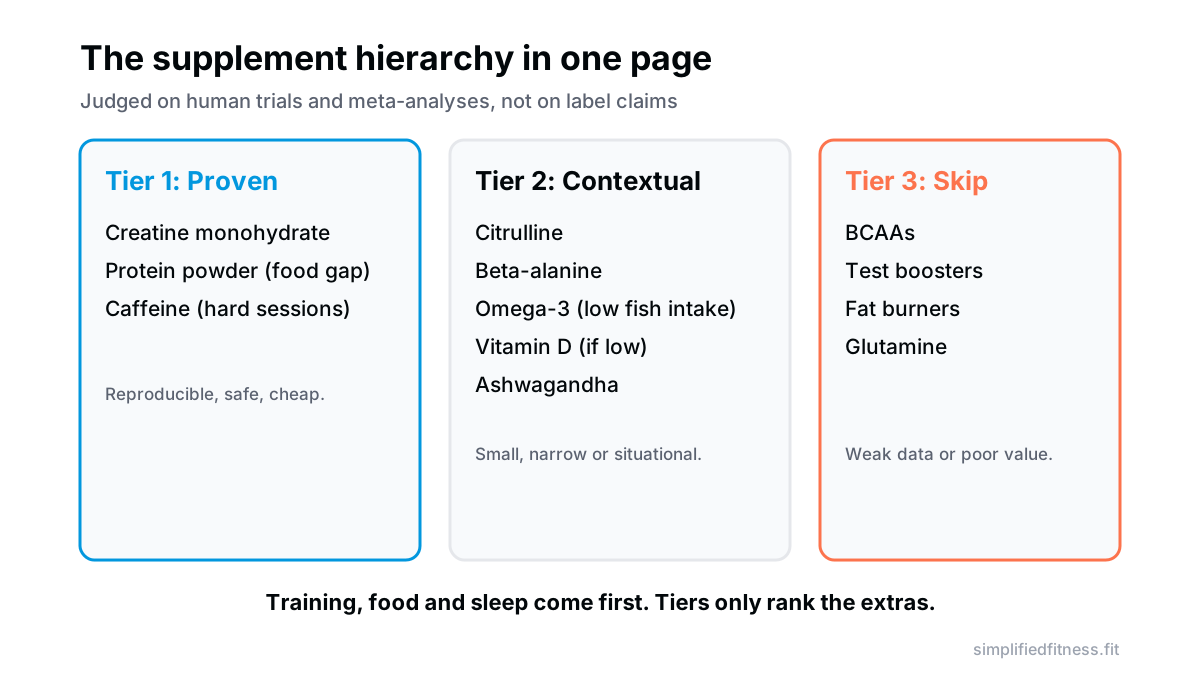
- Only three supplements sit in Tier 1: creatine monohydrate (3-5 g/day), protein powder when food falls short, and caffeine before hard sessions.
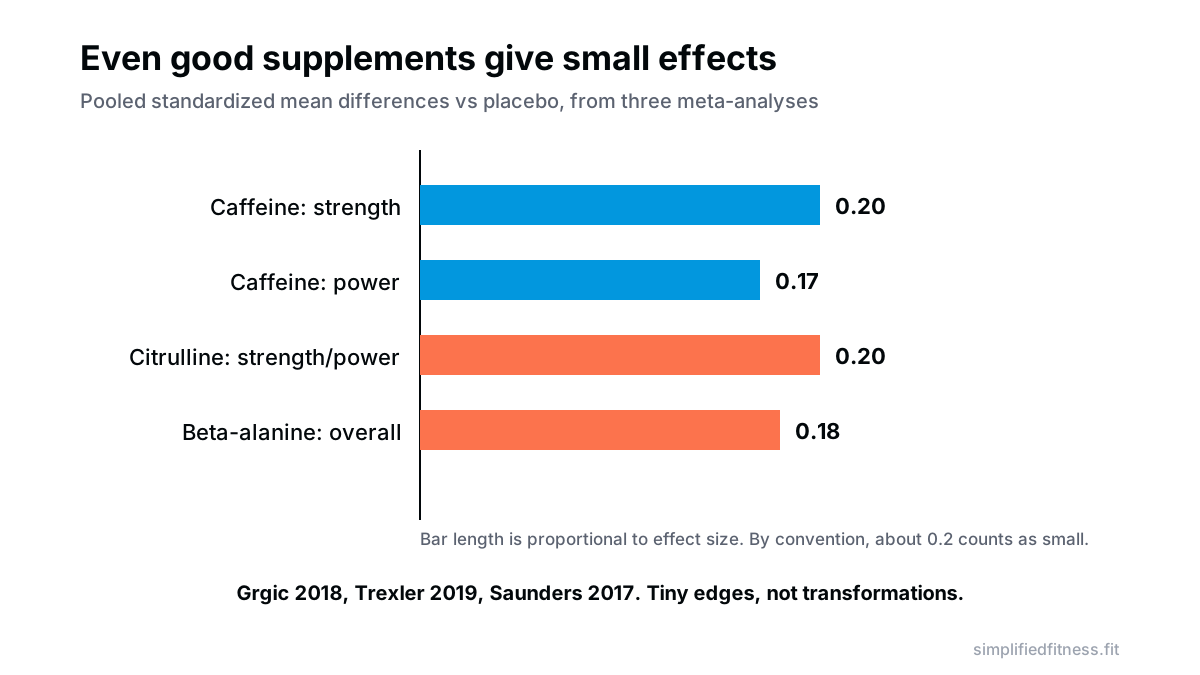
- Tier 2 (citrulline, beta-alanine, omega-3, vitamin D, ashwagandha) helps in specific situations, and pooled effects are small, around 0.2 standard deviations for citrulline, beta-alanine and caffeine.
- Tier 3 (BCAAs, test boosters, fat burners, glutamine) has weak or no human evidence for building muscle or burning fat in healthy lifters.
- Protein supplements add little once total daily protein passes roughly 1.6 g/kg, so powder is a convenience, not a requirement.
- Run any product through four questions: human trials, real outcome, label dose, and a real gap. Most Tier 3 products fail at least one.
Part of our complete guide: The Evidence-Based Fitness Supplements Guide: What Works, What's Overhyped & What's a Waste of Money
Table of contents
Most supplements do very little. A handful do something small but real, and three are worth buying first: creatine monohydrate, protein powder (when your diet falls short) and caffeine. That is the supplement hierarchy in one sentence.
The rest of this article is the why. It sits under our evidence-based fitness supplements guide, and it is the quick index you can use to audit your shelf. Every tier is based on human trials and meta-analyses, with the studies linked so you can check me.
How the supplement hierarchy is built
I sort products by four things. Are there human trials in healthy, trained or training adults? Did the trials measure something you care about (strength, muscle, performance) rather than a lab marker? Was the dose realistic? And are the results repeated across independent groups, ideally in a meta-analysis?
A product that fails the first question never gets a tier above 3. Rat studies and test-tube results do not count, and neither does a single small trial funded by the brand.
One more caveat. “Proven” here does not mean dramatic. It means the effect shows up repeatedly and the safety record is good. The gains are measured in a kilo of lean mass, a rep or two, a few percent of performance.
Tier 1: which supplements are proven?
Creatine monohydrate
Creatine has the deepest evidence base of any sports supplement. The International Society of Sports Nutrition (ISSN) position stand (Kreider et al., 2017) concludes that it increases muscle creatine, which may explain improved high-intensity performance and greater training adaptations. It also reports that short and long-term use (up to 30 g/day for 5 years in the studies reviewed) is safe and well tolerated in healthy people.
The dose most lifters use is 3-5 g a day, any time. You can work out your own number with the creatine dosage calculator. If hair loss or kidney worries are what stopped you, read our creatine myths breakdown first. If you have kidney disease or any medical condition, talk to your doctor before starting.
Protein powder (to fill a gap)
Protein itself is not a supplement, it is food. Powder is just a convenient way to hit your daily number. A meta-analysis of 49 randomised trials and 1,863 participants (Morton et al., 2018) found protein supplementation modestly increased strength and fat-free mass during resistance training. The average fat-free mass gain was 0.30 kg, and the benefit was larger in resistance-trained people and smaller with older age.
Here is the part brands skip. Beyond total protein intakes of about 1.62 g/kg/day, supplementation gave no further fat-free mass gains.
So the question is not “whey or no whey.” It is “am I already near 1.6 g/kg from food?” For a 70 kg lifter that is roughly 112 g a day. If dal, eggs, curd, paneer, soya chunks and chicken get you there, a tub adds convenience and not much else. Check your target with the protein calculator.
Caffeine
Caffeine is the other well-supported option. A meta-analysis of ten strength studies and ten power studies (Grgic et al., 2018) found a small benefit for maximal strength (SMD 0.20) and muscle power (SMD 0.17). In subgroup analysis the benefit was significant for upper-body strength but not for lower-body strength. The authors flagged that blinding was often poorly controlled and that evidence in women was scarce.
So caffeine is a mild performance nudge, not a muscle builder. Coffee or chai before a hard session works as well as a tub of pre-workout, usually at a fraction of the cost. Dose by body weight with the caffeine dosage calculator, and read our guide to caffeine dosing for strength if you want the detail. In a hot climate, keep an eye on fluids, and avoid it within several hours of bedtime. People with heart rhythm problems, high blood pressure, anxiety or who are pregnant should ask a doctor first.
Tier 2: which supplements are contextual?
These are not scams. They are “maybe, if you have a reason.” Expect small effects.
Citrulline
A meta-analysis of 12 studies (13 samples, 198 participants) (Trexler et al., 2019) found citrulline improved strength and power outcomes with a small pooled SMD of 0.20. The confidence interval of every individual study crossed the line of no effect, so no single trial was convincing on its own. The authors note it could matter to high-level athletes, where small margins decide results. Every included trial used at least 3 g, taken at least 30 minutes before exercise, because that was an inclusion criterion. See our citrulline malate vs pure citrulline guide for dosing.
Beta-alanine
A meta-analysis of 40 studies and 1,461 participants (Saunders et al., 2017) found an overall effect size of 0.18. Exercise duration moderated the effect, and in the 0.5-10 minute window the benefit was larger for exercise capacity than for performance. Co-supplementation with sodium bicarbonate gave the largest effect (0.43). Because effects depended on exercise duration and type, it is usually discussed for hard, sustained efforts like high-rep sets or intervals rather than heavy low-rep lifting. Many people feel harmless tingling on the skin, which is a known side effect, but check with a doctor if you have a medical condition.
Omega-3, vitamin D and ashwagandha
These three are the “check your situation first” supplements.
Omega-3 (fish oil). Its case is mostly general health, especially if you rarely eat oily fish. For muscle itself, I am not aware of strong evidence in healthy young lifters, so I would not buy it for gains. Our fish oil dosing guide covers EPA and DHA.
Vitamin D. If your blood level is low, correcting it makes sense, and low vitamin D is widely reported in India despite the sunshine. But I am not aware of strong evidence that extra vitamin D builds muscle in people who are already sufficient. Test first, then dose with medical advice, and see our vitamin D3 and K2 guide.
Ashwagandha. Small trials suggest benefit for strength and recovery, but they are small, short and often industry-linked. Among the testosterone-booster studies in the 2024 systematic review (Morgado et al., 2024), Withania somnifera was rated possibly effective in healthy men. “Possibly” is the honest word. Read our ashwagandha guide for the details, and skip it if you are pregnant, have a thyroid condition or take medication without asking a doctor.
Other things that sometimes come up in Tier 2 lists, such as tart cherry juice and low-dose melatonin for sleep, I would also file under “situational.” The goal there is better recovery or sleep, not muscle, and good sleep habits come first.
Tier 3: which supplements are a waste of money?
BCAAs
BCAAs are the poster child. Wolfe’s review (Wolfe, 2017) points out that a whole industry grew around the idea that BCAAs alone stimulate muscle protein synthesis. His argument is that the other essential amino acids needed to build new protein can only come from muscle breakdown when BCAAs are taken alone. He found no human study that measured the response of muscle protein synthesis to oral BCAAs alone. He concluded the claim is unwarranted.
If you eat enough protein, you already get BCAAs. Details are in our BCAAs vs EAAs article. To be fair, this is one researcher’s review, and he has industry ties he discloses, but the argument follows the biochemistry.
Testosterone boosters
A systematic review of 52 studies covering 27 proposed boosters (Morgado et al., 2024) found that most failed to increase total testosterone compared with placebo. The exceptions were limited. HMB and betaine could be considered effective for male athletes, and a few other ingredients were possibly effective in particular groups such as men with late-onset hypogonadism.
Two notes. A testosterone number on a blood test is not the same as muscle, and the review measured testosterone only. And if you suspect low testosterone, see a doctor rather than buying a tub. Our test booster audit goes ingredient by ingredient.
Fat burners
I cannot cite a trial here that justifies the price. What the products usually deliver is caffeine plus a few other stimulants, which means jitters, a racing heart and a lighter wallet. Fat loss comes from a calorie deficit. Sort that with the calorie calculator and our fat burner breakdown. If a product makes your heart pound, stop and talk to a doctor.
Glutamine
A meta-analysis of 25 trials in athletes (Ramezani Ahmadi et al., 2019) found glutamine had no effect on immune function, aerobic performance or body composition, apart from a greater drop in body weight. That is not a muscle-building result. See why in our glutamine explainer.
HMB and carnitine
HMB showed up as effective for testosterone in athletes in the review above. I would still park it, because higher testosterone on paper is not proven extra muscle in trained lifters, and I have not seen evidence here that justifies the cost. Carnitine for fat loss falls in the same bucket: the case is weak enough that I would not spend money on it.
| Supplement | Tier | Best-supported use | Realistic expectation |
|---|---|---|---|
| Creatine monohydrate | 1 | 3-5 g/day, daily | Extra reps, small lean mass gain |
| Protein powder | 1 | Fill the gap to ~1.6 g/kg | Small gain over food alone |
| Caffeine | 1 | 3-6 mg/kg before hard sessions | Small strength and power edge |
| Citrulline | 2 | 3 g or more before training | Small effect, SMD about 0.2 |
| Beta-alanine | 2 | Longer, harder efforts | Small effect, SMD about 0.18 |
| Omega-3, vitamin D, ashwagandha | 2 | Only with a clear reason | Little muscle effect shown |
| BCAAs, test boosters, fat burners, glutamine | 3 | None well supported | Likely nothing |
What is the best supplement stack for a natural lifter?
For most people the answer is shorter than the marketing suggests. A minimal stack is creatine monohydrate every day, protein powder only if your food falls short, and caffeine on hard days if you enjoy it. Add a Tier 2 item only when you have a specific reason, such as a documented low vitamin D level.
In practice, in a vegetarian Indian diet, the biggest gap is often protein, not micronutrient pills. Dal, curd, paneer, soya chunks and milk can cover much of it, with whey as a gap filler. Our free diet plan shows how to build that from normal kitchen food.
How to audit your own supplement shelf
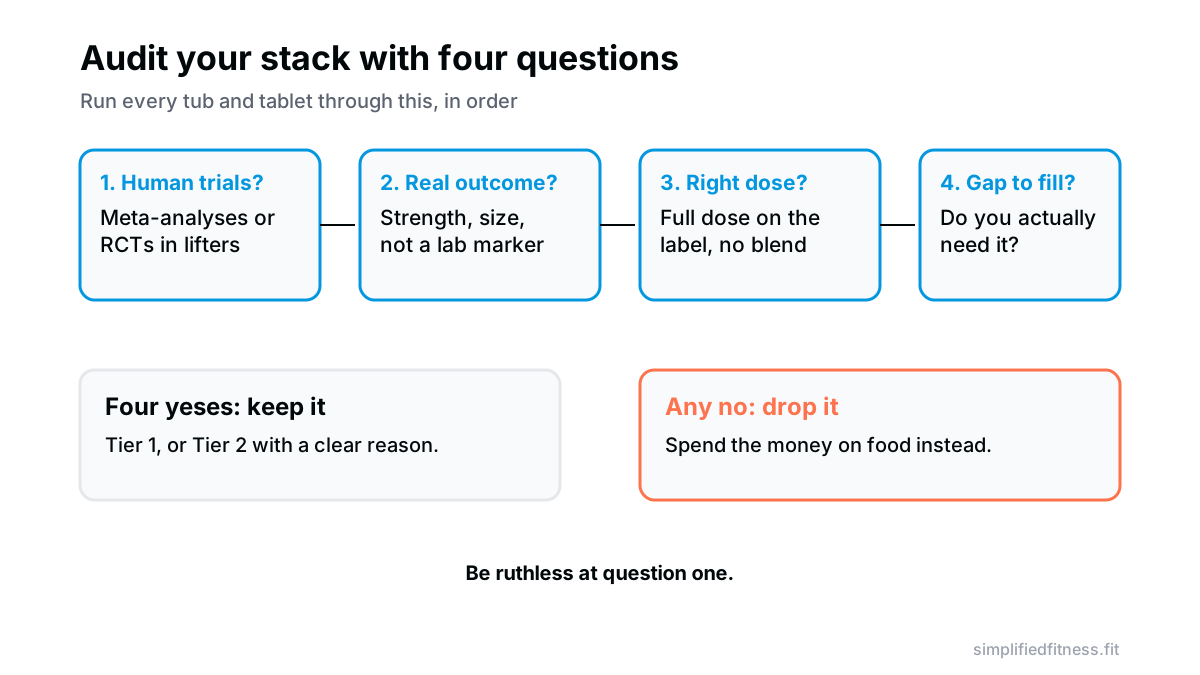
Take everything off the shelf and run each item through four questions.
- Are there human trials in healthy adults? If you cannot find a meta-analysis or position stand, treat it as unproven.
- Did they measure strength, size or performance, not a lab marker?
- Does the label dose match the studied dose, or is it hidden in a “proprietary blend”? Our guide to proprietary blends and underdosing shows the tricks.
- Do you have a real gap? A low blood test, a protein shortfall, a sleep problem.
Then check quality. Supplements are lightly regulated in many places, so look for independent testing, as explained in our guide to third-party certifications. If you are watching the budget, our budget supplement guide shows where to cut first.
For the full picture on creatine, protein and caffeine together, see our creatine, protein and caffeine pillar.
When to see a doctor
Talk to a doctor before supplementing if you are pregnant or breastfeeding, have kidney, liver, heart or thyroid conditions, take prescription medication, or are under 18. The same goes for symptoms you are trying to fix with pills, like constant fatigue, low mood, or a drop in libido. Those deserve a proper workup, and a supplement tub is not a diagnosis.
The honest bottom line
Supplements are the last 5% of a plan. If your training is consistent, your protein is near 1.6 g/kg and you sleep properly, creatine is the one worth adding without much debate. Everything else is optional, and a lot of it is marketing. Cut the shelf down, keep what passes the four questions, and put the difference into food.
Frequently Asked Questions
What is the supplement hierarchy?
It is a ranking of supplements by the strength of human evidence, from proven to useless. Tier 1 products have repeated trials and position stands behind them, Tier 2 help in specific situations, and Tier 3 have weak data or poor value. Use it to decide what to buy first and what to cut.
Which supplements are actually worth taking?
Creatine monohydrate, protein powder (only when food falls short) and caffeine have the strongest case for lifters. The International Society of Sports Nutrition position stand on creatine and meta-analyses on protein and caffeine all show measurable but modest benefits. Start with creatine, and add the others only if you have a reason.
What is the best supplement stack for a natural lifter?
A minimal stack is creatine monohydrate plus protein powder if your diet is short, with caffeine as an optional extra. Everything beyond that adds small gains at best, according to the meta-analyses on citrulline and beta-alanine. Spend the saved money on dal, paneer, eggs and curd.
Are BCAAs a waste of money?
For most lifters eating enough protein, yes. Wolfe's 2017 review argues that BCAAs alone cannot produce a muscle-building response because the other essential amino acids are missing, and no human study of oral BCAAs alone measured protein synthesis. If you eat enough protein or use whey, skip them.
Do testosterone boosters work?
Mostly no. A 2024 systematic review of 52 studies on 27 proposed boosters found that most failed to raise total testosterone versus placebo. A few ingredients showed possible effects in specific groups, but that is not the same as more muscle, so do not buy one expecting gains.
Do fat burners work?
The stimulants in them can nudge things slightly, but no pill replaces a calorie deficit. Most of the effect people feel is caffeine, which you can get from coffee far more cheaply. Fix your calories and steps first, and see the fat burner guide linked above.
Is glutamine worth taking for muscle growth?
No. A 2019 meta-analysis of 25 trials in athletes found no effect on aerobic performance, immune function or body composition, apart from a small drop in body weight. Your body makes glutamine and food protein supplies plenty. Skip it unless a doctor advises it for a medical reason.
Is protein powder necessary to build muscle?
No, it is a convenience. A 2018 meta-analysis of 49 trials found protein supplements helped, but gains in fat-free mass stopped growing once total intake passed about 1.6 g/kg per day. If dal, eggs, paneer, curd and soya already get you there, powder adds little.
How much creatine should I take?
Most lifters use 3-5 g of creatine monohydrate daily. The ISSN position stand reports that creatine is safe and well tolerated in healthy people, and that it raises muscle creatine to support high-intensity work. Take it at any time of day, consistently.
Should I take caffeine before every workout?
No, save it for your hardest sessions. A meta-analysis found small gains in upper-body strength and power, nothing dramatic. A common range is 3-6 mg/kg about an hour before training and keep it away from late evening so sleep does not suffer.
Do I need vitamin D or omega-3 as a lifter?
Only if you have a reason such as a low blood level or very little oily fish. Correcting a deficiency makes sense, but evidence that extra vitamin D improves performance in people who are already sufficient is limited. Get your level tested and talk to a doctor before choosing a dose.
How do I know a supplement is not a scam?
Look for human trials in healthy lifters, a clinically studied dose on the label (not a proprietary blend), and third-party testing. Marketing claims about 'boosting' or 'igniting' something are not evidence. If you cannot find a meta-analysis or position stand, treat it as unproven.
Sources & References
Every claim above is checked against peer-reviewed research (PubMed, U.S. National Library of Medicine) or guidance from established health bodies. How we fact-check.
- Kreider RB, et al. International Society of Sports Nutrition position stand: safety and efficacy of creatine supplementation in exercise, sport, and medicine. J Int Soc Sports Nutr. 2017. PMID: 28615996
- Grgic J, et al. Effects of caffeine intake on muscle strength and power: a systematic review and meta-analysis. J Int Soc Sports Nutr. 2018. PMID: 29527137
- Morton RW, et al. A systematic review, meta-analysis and meta-regression of the effect of protein supplementation on resistance training-induced gains in muscle mass and strength in healthy adults. Br J Sports Med. 2018. PMID: 28698222
- Trexler ET, et al. Acute effects of citrulline supplementation on high-intensity strength and power performance: a systematic review and meta-analysis. Sports Med. 2019. PMID: 30895562
- Saunders B, et al. Beta-alanine supplementation to improve exercise capacity and performance: a systematic review and meta-analysis. Br J Sports Med. 2017. PMID: 27797728
- Wolfe RR. Branched-chain amino acids and muscle protein synthesis in humans: myth or reality? J Int Soc Sports Nutr. 2017. PMID: 28852372
- Morgado A, et al. Do testosterone boosters really increase serum total testosterone? A systematic review. Int J Impot Res. 2024. PMID: 37697053
- Ramezani Ahmadi A, et al. The effect of glutamine supplementation on athletic performance, body composition, and immune function: a systematic review and a meta-analysis of clinical trials. Clin Nutr. 2019. PMID: 29784526

Umair Hazrami · Founder & Head Coach, Simplified Fitness
Umair Hazrami founded Simplified Fitness and the Simplified Lifter channel to cut through fitness noise. With 4+ years of consistent training and 10+ coaching clients, he writes every guide from the peer-reviewed research and links the sources so you can check them. Our editorial standards.
Educational content only, not medical advice. If you have a medical condition, are pregnant, or take medication, talk to a qualified doctor before changing your diet, supplements or training. Full disclaimer.
Keep reading
Supplements
Ashwagandha KSM-66 vs Sensoril: Which Extract, What Dose, and Do You Need to Cycle?
Ashwagandha KSM-66 vs Sensoril for lifters: what the strength trials show, realistic cortisol effects, liver safety and whether to cycle. Every study linked.
8 min read
Supplements
BCAAs vs EAAs: Why BCAAs Are a Waste of Money If Your Protein Is Covered
BCAA vs EAA for muscle growth: BCAAs are only 3 of the 9 essential amino acids. See what Wolfe 2017 and Jackman 2017 found and when EAAs or whey make sense.
8 min read
Supplements
Beetroot Juice for Running and Lifting: How Dietary Nitrate Works (and the Mouthwash Trap)
Does beetroot juice for running actually work? See what meta-analyses show, the 2-3 hour timing and dose, who benefits, and why mouthwash can cancel the effect.
9 min read

Supplements
Beta-Alanine Benefits: Carnosine Buffering, High-Rep Gains and Why It Makes You Tingle
Beta-alanine benefits explained: why pre-workout makes your skin tingle, how carnosine buffers acid, what dose works, and who should skip it. Studies linked.
8 min read