Casein Protein Before Bed: Does Micellar Casein Really Work?
Casein protein before bed raises overnight muscle protein synthesis, but do you need it? See the studies, the dose and cheap paneer and curd swaps that work.

TL;DR. The short answer
- Casein protein before bed (about 30-40 g) is digested during sleep and keeps amino acids elevated for the night. In a 16-man trial it improved overnight net protein balance from -11 to +61 micromol/kg versus placebo.
- Casein is a slow protein. In one single-meal study it gave a smaller but longer amino acid plateau than whey and cut protein breakdown by 34%, which whey did not.
- Longer trials suggest pre-sleep protein may add a little to muscle and strength in young men, but a 2021 systematic review urged caution. It is not a must-have if your daily protein is already adequate.
- Whole foods such as cottage cheese, paneer, thick curd and Greek yogurt are reasonable swaps. Direct muscle-growth comparisons with powder are lacking.
- A casein shake is a convenience tool, not a requirement. Hit your daily total first, then use a pre-sleep serving only if you are short or find it easy.
Part of our complete guide: The Evidence-Based Fitness Supplements Guide: What Works, What's Overhyped & What's a Waste of Money
Table of contents
Casein protein before bed is one of the few supplement timing tricks with real mechanistic data behind it. Taking about 30-40 g before sleep raises muscle protein synthesis overnight, and it may add a small edge to muscle and strength gains in young men who train hard. It is a nice extra, not a requirement. (It sits inside our evidence-based supplements guide.)
The marketing says you “starve” overnight and shrink without it. That is not what the studies show. In this guide we will cover what micellar casein is, what the key trials found, how it differs from calcium caseinate, whether you need it, and which paneer, curd and cottage cheese swaps do a similar job.
What is micellar casein, and why is it “slow”?
Milk protein comes in two families, whey and casein. Whey stays dissolved and moves through the stomach quickly. Casein, in its natural micellar form, tends to form clots in the stomach, so it leaves slowly and drips amino acids into your blood over hours.
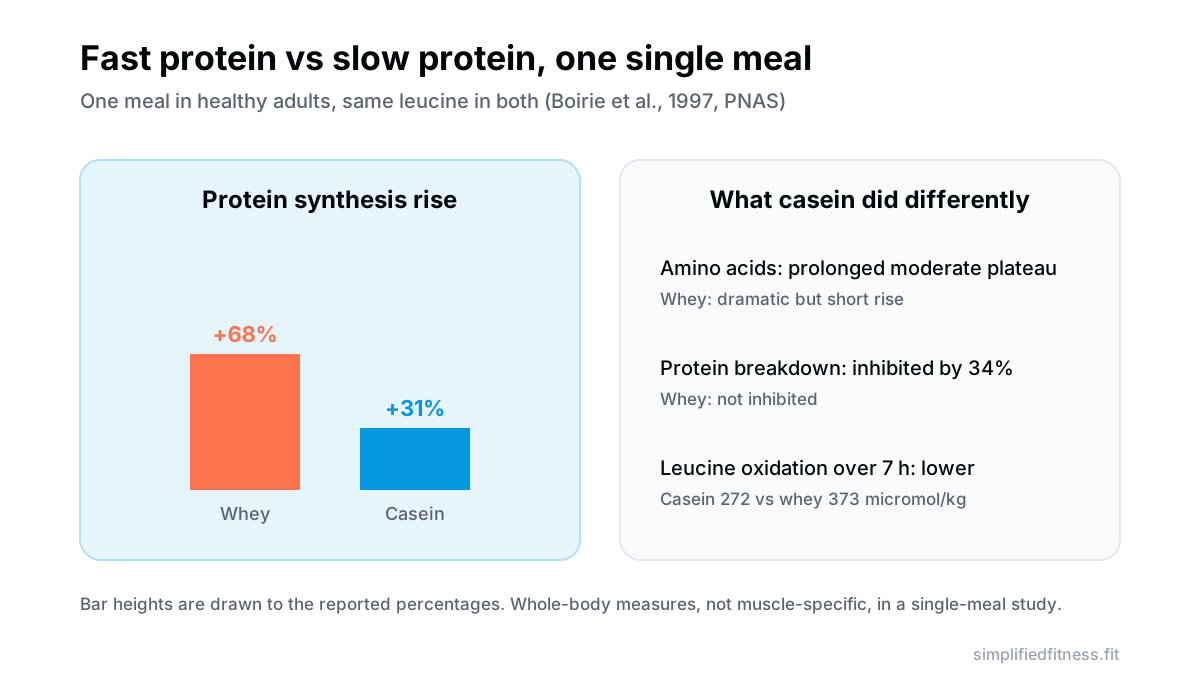
Here is what a human study measured. Boirie and colleagues fed healthy adults a single meal of either whey or casein with the same leucine content. Whey caused a dramatic but short rise in blood amino acids. Casein produced a prolonged plateau of moderate levels, probably due to slow gastric emptying (Boirie et al., 1997).
The metabolic result was different too:
- Whole-body protein synthesis rose 68% after whey and 31% after casein.
- Protein breakdown fell by 34% after casein, but not after whey.
- Leucine oxidation over 7 hours was lower with casein (272 vs 373 micromol/kg), so net leucine balance was more positive.
Does casein protein before bed work? What the studies show
The classic trial is Res et al. (2012). Sixteen healthy young men did an evening resistance workout, had a standard recovery drink, then drank either 40 g of casein or a placebo 30 minutes before sleep. Researchers measured protein handling across 7.5 hours of sleep (Res et al., 2012).
The casein was digested and absorbed during sleep, and blood amino acids stayed raised through the night. Net protein balance went from -11 micromol/kg with placebo to +61 with casein, and whole-body protein synthesis was higher (311 vs 246). Muscle protein synthesis was about 22% higher, though that result only reached borderline significance (P = 0.05).
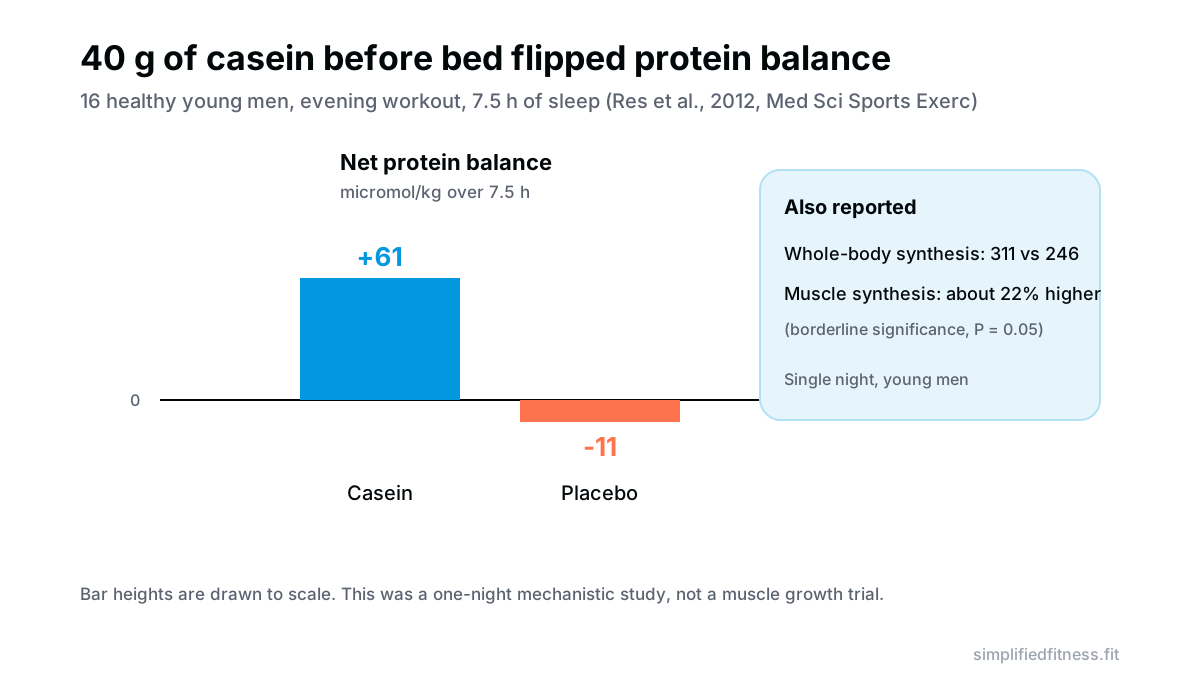
That 22% figure gets quoted like gospel. It is a single night in 16 young men, and the statistics were borderline. Useful, yes. Proof of a big growth effect, no.
What happens over weeks of training?
Reviews pull the longer picture together. Trommelen and van Loon concluded that pre-sleep protein can further augment gains in muscle mass and strength during prolonged resistance training, and that at least 40 g appears needed for a clear overnight increase in muscle protein synthesis (Trommelen & van Loon, 2016). Snijders et al. reached a similar conclusion, adding that pre-sleep protein does not appear to reduce next-morning appetite or change resting energy expenditure (Snijders et al., 2019).
The ISSN position stand lists pre-sleep casein (30-40 g) as increasing overnight muscle protein synthesis and metabolic rate without influencing lipolysis (Jager et al., 2017).
The cautious reading
A 2021 systematic review of nine studies found 20-40 g of casein about 30 minutes before sleep stimulated whole-body protein synthesis in young and elderly men, and could augment muscle adaptations over 10-12 weeks of resistance exercise in young men but not in elderly men. The authors warned that conclusions need caution because protein intakes were uneven between groups in some trials (Reis et al., 2021).
That caveat matters. If the casein group simply ate more total protein, you cannot tell whether timing or total drove the result. And in older men, a 12-week trial of 30 untrained participants found 40 g of protein either post-workout or pre-sleep added nothing over training alone, when baseline protein intake was already at least 1.0 g/kg/day (Klemp et al., 2025). It was a small trial, so the question is not closed, but it does not support the idea that older adults need a bedtime shake.
Do I need casein if I already hit 1.8 g/kg a day?
Probably not. This is the question that actually decides whether you spend money.
The ISSN says 1.4-2.0 g/kg of body weight per day is sufficient for most exercising people to build and maintain muscle (Jager et al., 2017). Someone at 70 kg eating 1.8 g/kg already has about 126 g across the day. If that is spread across three or four meals, you have given your muscles plenty of signals before bed.
Where a pre-sleep serving earns its place:
- Your last real meal is 4-5 hours before bed and you train in the evening.
- You are a few grams short of your daily target and a bedtime serving is the easiest way to close the gap.
- You are cutting and want a filling, low-effort protein hit at night.
Where it does not:
- You already eat 1.6 g/kg or more with a protein-rich dinner.
- You train in the morning and eat well afterwards.
- The shake means skipping something cheaper and more filling.
Work out your own number with the protein calculator, and see our guides on optimal daily protein for hypertrophy and how to spread protein across meals before buying a tub.
Micellar casein vs calcium caseinate
Labels can be confusing here. Micellar casein is the native form, with the micelle structure that clots in the stomach. Calcium caseinate is a more processed form made by treating casein with an alkali. In general, caseinate is described as dissolving more readily and not forming the same gel, so it likely digests faster.
We are not aware of a direct trial comparing them for overnight muscle outcomes, so treat that as a likely difference, not a proven one. If slow release is your goal, look for “micellar casein” or “casein isolate” on the label rather than just “casein protein”. Some products are blends, and the label may not tell you the ratio. Our guide to decoding proprietary blends covers how to spot a tub that hides its numbers.
Casein is also thicker and chalkier than whey. Many people mix it into a pudding-style texture with curd or milk.
How long does micellar casein take to digest?
There is no single answer. In the Boirie study, casein kept amino acids moderately elevated for hours, with leucine balance tracked over 7 hours. In the Res trial, blood amino acid levels rose quickly after the bedtime drink and were sustained through the rest of the night. Dose, whether you have eaten, and your own gut all change the curve.
Practical rule: have it 30-60 minutes before you sleep, as the trials did, and do not expect an exact clock.
Casein vs cottage cheese, paneer and curd
Whole foods are the old-school answer, and they are fine. Milk protein is mostly casein, so paneer, cottage cheese, hung curd and Greek yogurt deliver largely the same slow-digesting protein family, plus fat, calcium and often more fullness.
The evidence is thinner, though. In a small crossover study of 10 active women, pre-sleep cottage cheese (30 g protein) was compared with an equivalent casein drink and placebo. Next-morning resting energy expenditure and appetite did not differ between the three (Leyh et al., 2018). That tells us the whole food behaves similarly on those outcomes. It does not tell us whether muscle growth is identical, because that was not measured.
Indian and Western pre-sleep options
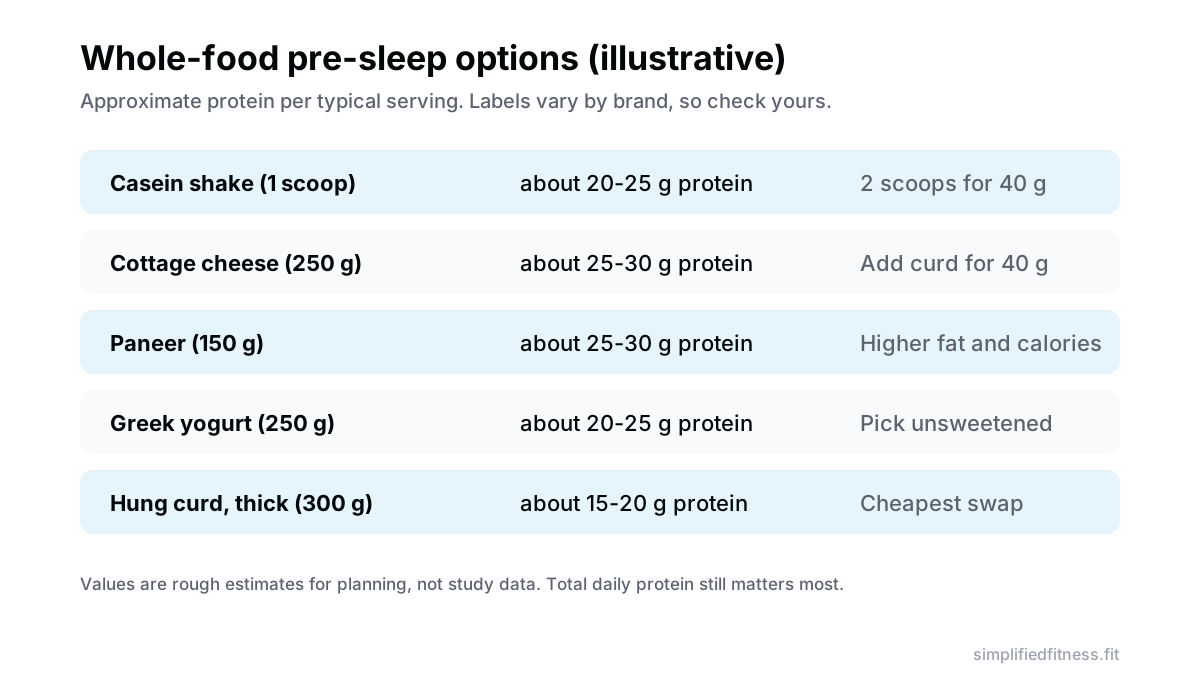
- Paneer cubes (100-150 g), lightly pan-seared with black pepper. Higher in fat, so mind total calories. See our take on low-fat paneer and chenna.
- Thick hung curd (200-300 g) with cinnamon or a little fruit. Cheapest option, and good in summer.
- Cottage cheese or Greek yogurt (200-250 g) if you can find them. Unsweetened versions keep sugar down.
- Warm milk plus curd bowl, if you tolerate dairy. Two glasses of milk alone gets you only part of the way.
- Casein shake mixed thick, for nights when you are tired and want the simplest option.
Plain curd is lower in protein per 100 g than paneer, so you need a larger bowl to reach 30 g. And remember the first rule: whole foods are not a bonus on top, they are the swap.
Who should skip it or ask a doctor first
Casein is a milk protein. If you have a milk allergy, avoid it. If dairy gives you cramps or bloating, a lactose-free option or a non-dairy protein may suit you better. If you have kidney disease or reduced kidney function, ask your doctor before raising protein intake with any product.
Late heavy meals can aggravate acid reflux in some people. If you wake often with heartburn, smaller or earlier servings can help, but persistent symptoms are a reason to see a doctor.
Simple protocol
- Hit your daily protein target first (about 1.6-2.0 g/kg for most lifters, within the ISSN range).
- If you still want a pre-sleep serving, use 30-40 g of protein, 30-60 minutes before bed.
- Pick micellar casein if convenience matters, or paneer, hung curd or cottage cheese if cost and fullness matter more.
- Count it in your daily calories.
- Judge it after 8-12 weeks by your training log and body weight trend, not by how it feels overnight.
If bedtime nutrition in general is your question, including carbs and sleep quality, read pre-bed eating, sleep quality and protein digestion. For the daytime side of the equation, see our guide to whey protein types and the MPS timeline after training.
The bottom line
Casein protein before bed works in the narrow sense that matters most to the physiology: it is digested overnight and raises muscle protein synthesis and net protein balance. Whether that becomes noticeably more muscle depends on everything else you do. If your daily protein is solid and your training is consistent, the bedtime serving is a small optimisation, and a bowl of curd or paneer can do most of the same job.
Get the training and the daily total right first. If you want a structure for that, start with our free push, pull and legs plans and then decide whether a bedtime protein serving fits your budget.
Frequently Asked Questions
Does casein protein before bed actually build muscle?
It can help a little, mainly in young men who train hard, though the evidence is not as strong as the hype. Studies show that 30-40 g of casein before sleep raises overnight muscle protein synthesis, and a 2021 systematic review found possible gains in muscle mass and strength over 10-12 weeks of training. Treat it as a small add-on after your daily protein total is covered.
How much casein should I take before bed?
Research most often uses 20-40 g, taken about 30 minutes before sleep. The Trommelen and van Loon review suggests at least 40 g is needed to show a clear overnight increase in muscle protein synthesis, while the ISSN position stand lists 30-40 g. If you are smaller or already eat plenty of protein, 30 g is a sensible starting point.
What is micellar casein?
Micellar casein is the form of casein as it naturally occurs in milk, packed into clusters called micelles. In the stomach these clusters tend to clot, which slows emptying and spreads amino acids out over hours. It is usually sold as a powder, so check the label for 'micellar casein' rather than just 'casein'.
What is the difference between micellar casein and calcium caseinate?
Micellar casein keeps the natural micelle structure, while caseinate is a more processed form made by treating casein with an alkali. Caseinate generally mixes more easily and is usually described as less able to clot, so it may digest faster, although we are not aware of a head-to-head muscle study that confirms the practical difference. For a true slow-release goal, micellar casein is the safer pick.
How long does micellar casein take to digest?
It digests slowly, over several hours. Boirie and colleagues found casein produced a prolonged plateau of moderate amino acid levels, probably from slow gastric emptying, and net leucine balance stayed more positive over 7 hours than with whey. Exact timing varies with the dose, the meal around it and the person.
Is casein better than whey before bed?
On paper, casein suits bedtime better because it releases amino acids slowly. Whey causes a big short spike, while casein gives a smaller, longer one that cut protein breakdown by 34% in one single-meal study. No long trial has proven casein beats whey for muscle size, so what you can afford and tolerate matters more.
Is cottage cheese as good as casein powder before bed?
It is a reasonable swap, but direct muscle-growth trials comparing the two are missing. In 10 active women, 30 g of protein from cottage cheese did not change next-morning energy expenditure or appetite compared with a casein drink. Choose whichever you will actually eat, and aim for about 30 g of protein.
Can paneer or curd replace a casein shake at night?
Probably yes for most people, because their protein is mostly casein. Direct overnight studies on paneer and curd are lacking, so we would not claim an identical effect. A 150 g portion of paneer or a big bowl of thick curd gets you into a similar protein range.
Do I need casein if I already eat 1.8 g/kg protein a day?
Probably not. The ISSN says 1.4-2.0 g/kg per day is enough for most exercising people, and a 2025 trial in older men with adequate protein found no extra benefit from 40 g pre-sleep. If you already hit your total across the day, a bedtime serving is optional at best.
Will pre-sleep protein make me fat or stop me losing weight?
Not by itself. Reviews report that protein before sleep did not reduce next-morning appetite or change resting energy expenditure. Calories still count, so fit the serving into your daily total, especially on a cut.
Does casein before bed work for older adults?
Evidence is weaker. Acute studies suggest it raises overnight muscle protein synthesis, but a 2025 12-week trial in 30 older men found no added muscle or strength gain from 40 g pre-sleep protein beyond training alone. Older adults should prioritise regular resistance training and enough protein through the day.
Should I eat protein right before sleep if I get acid reflux or an upset stomach?
Be cautious, because a large late serving can feel heavy and may worsen reflux in some people. Try a smaller portion earlier in the evening, such as 60-90 minutes before bed. If symptoms persist or you wake with heartburn often, speak to a doctor.
Is casein safe if I am lactose intolerant or allergic to milk?
Casein is a milk protein, so people with a milk allergy should avoid it entirely. Micellar casein powder is usually low in lactose, but tolerance varies. If you have a diagnosed allergy or symptoms after dairy, check with a doctor or dietitian first.
Sources & References
Every claim above is checked against peer-reviewed research (PubMed, U.S. National Library of Medicine) or guidance from established health bodies. How we fact-check.
- Res PT, et al. Protein ingestion before sleep improves postexercise overnight recovery. Med Sci Sports Exerc. 2012. PMID: 22330017
- Trommelen J, et al. Pre-sleep protein ingestion to improve the skeletal muscle adaptive response to exercise training. Nutrients. 2016. PMID: 27916799
- Snijders T, et al. The impact of pre-sleep protein ingestion on the skeletal muscle adaptive response to exercise in humans: an update. Front Nutr. 2019. PMID: 30895177
- Reis CEG, et al. Effects of pre-sleep protein consumption on muscle-related outcomes: a systematic review. J Sci Med Sport. 2021. PMID: 32811763
- Jager R, et al. International Society of Sports Nutrition position stand: protein and exercise. J Int Soc Sports Nutr. 2017. PMID: 28642676
- Boirie Y, et al. Slow and fast dietary proteins differently modulate postprandial protein accretion. Proc Natl Acad Sci U S A. 1997. PMID: 9405716
- Leyh SM, et al. Pre-sleep protein in casein supplement or whole-food form has no impact on resting energy expenditure or hunger in women. Br J Nutr. 2018. PMID: 30249314
- Klemp AO, et al. Neither pre-sleep nor post-exercise protein consumption influences resistance exercise training adaptations in older adults. J Int Soc Sports Nutr. 2025. PMID: 40539259

Umair Hazrami · Founder & Head Coach, Simplified Fitness
Umair Hazrami founded Simplified Fitness and the Simplified Lifter channel to cut through fitness noise. With 4+ years of consistent training and 10+ coaching clients, he writes every guide from the peer-reviewed research and links the sources so you can check them. Our editorial standards.
Educational content only, not medical advice. If you have a medical condition, are pregnant, or take medication, talk to a qualified doctor before changing your diet, supplements or training. Full disclaimer.
Keep reading

Supplements
Ashwagandha KSM-66 vs Sensoril: Which Extract, What Dose, and Do You Need to Cycle?
Ashwagandha KSM-66 vs Sensoril for lifters: what the strength trials show, realistic cortisol effects, liver safety and whether to cycle. Every study linked.
8 min read
Supplements
BCAAs vs EAAs: Why BCAAs Are a Waste of Money If Your Protein Is Covered
BCAA vs EAA for muscle growth: BCAAs are only 3 of the 9 essential amino acids. See what Wolfe 2017 and Jackman 2017 found and when EAAs or whey make sense.
8 min read
Supplements
Beetroot Juice for Running and Lifting: How Dietary Nitrate Works (and the Mouthwash Trap)
Does beetroot juice for running actually work? See what meta-analyses show, the 2-3 hour timing and dose, who benefits, and why mouthwash can cancel the effect.
9 min read

Supplements
Beta-Alanine Benefits: Carnosine Buffering, High-Rep Gains and Why It Makes You Tingle
Beta-alanine benefits explained: why pre-workout makes your skin tingle, how carnosine buffers acid, what dose works, and who should skip it. Studies linked.
8 min read