Glycerol Hyperhydration for Bodybuilding Pumps: What the Science Says
Does glycerol hyperhydration for bodybuilding give bigger pumps? See what research shows on fluid retention, heat, dosing and the stomach side effects.
TL;DR. The short answer
- Glycerol taken with a lot of fluid reliably makes your body hold more water than fluid alone. A meta-analysis found about 7.7 mL/kg more retained fluid, which is roughly half a litre for a 70 kg person.
- No controlled trial in lifters shows glycerol improves muscle pumps, size or strength. The pump claim is a reasonable guess from the water-retention data, not a tested result.
- For endurance and heat, results are mixed. A small benefit appears across hyperhydration studies, but a 2023 trial of a 5 km heat run found no improvement.
- The published protocol is about 1.2 g/kg glycerol in 26 mL/kg of fluid over an hour. That is around 84 g of glycerol and 1.8 L of fluid for a 70 kg person, and stomach upset is a real risk.
- If you have kidney, heart or blood pressure problems, or are on diuretics, speak to your doctor before trying it.
Part of our complete guide: The Evidence-Based Fitness Supplements Guide: What Works, What's Overhyped & What's a Waste of Money
Table of contents
Glycerol hyperhydration does make your body hold more water, and that part is well supported. Whether it gives lifters a bigger, harder pump is a different question, and I could not find a controlled trial that tests it.
So glycerol hyperhydration for bodybuilding sits on borrowed evidence: endurance research, mostly in men, mostly in cyclists and runners. This guide walks through what that research shows, what it cannot tell us, and why the stomach side effects matter more than most pump-formula labels admit. It is a niche add-on, not part of the basics in our evidence-based supplements guide.
What is glycerol hyperhydration?
Glycerol (also called glycerin or vegetable glycerin) is a small, sweet, syrupy compound. Your body already handles it as part of normal fat metabolism. Drink plain water in large amounts and your kidneys clear most of it as urine within a couple of hours. Add glycerol and that changes.
A 2010 review describes glycerol drinks as creating an osmotic gradient in the circulation that favours fluid retention, which makes it easier to hyperhydrate and protects against dehydration (van Rosendal et al., 2010). Plain version: glycerol keeps more water in the body instead of letting it flow out as urine. Many studies, according to the same review, achieved increases in body water of 1 L or more.
An older six-person study described glycerol as rapidly absorbed and spread evenly through the body’s fluid compartments, and found less urine before exercise after glycerol than after water alone (Lyons et al., 1990). That is the basis for the claim you see on labels that glycerol pulls water “into the muscle”. Treat it as a plausible mechanism, not a measured pump.
Does glycerol actually improve pumps?
Honest answer: nobody has shown it. I searched for controlled trials of glycerol on muscle pump, muscle thickness or lifting performance and did not find one. Every study I found measured fluid retention, plasma volume, heart rate, core temperature or endurance.
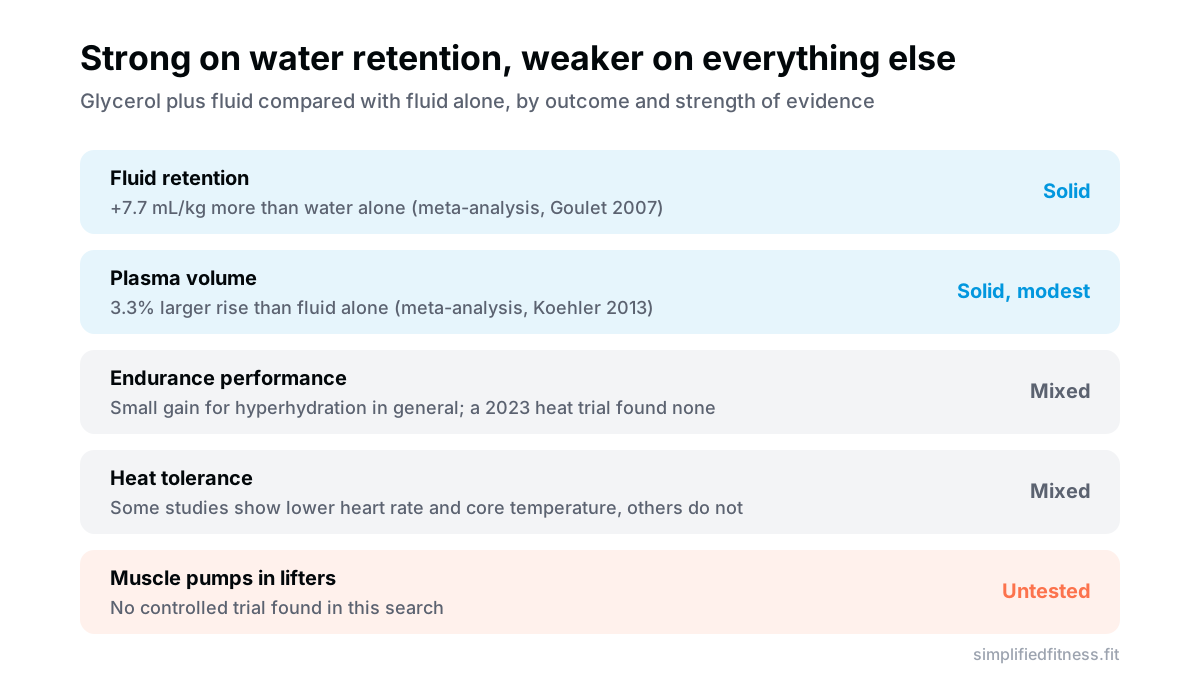
Here is what the water-retention data does show. A meta-analysis of 14 comparisons found that glycerol-induced hyperhydration increased fluid retention by 7.7 mL/kg body weight compared with water-induced hyperhydration (Goulet et al., 2007). For a 70 kg person that is about 540 mL (our arithmetic). Another meta-analysis found plasma volume rose 3.3% more with glycerol than with fluid alone (Koehler et al., 2013).
Those are modest numbers. Plasma volume is the liquid part of your blood, not the water inside muscle cells, and these studies did not measure muscle fullness.
A real pump comes mostly from blood flow, training volume, carbohydrate in the muscle and short rest periods. If you want to optimise that, a lot is available before you touch glycerol. See our guides on sodium and salt before training and citrulline malate versus pure citrulline first.
Does glycerol improve endurance?
Possibly slightly, and not consistently.
The 2007 meta-analysis pooled four studies and found glycerol hyperhydration was associated with a 2.62% improvement in endurance performance, but the authors said data were scarce and conclusions premature (Goulet et al., 2007).
A 2024 meta-analytical review looked at pre-exercise hyperhydration in general, not glycerol only. It found a small-to-moderate improvement in time to exhaustion (Hedges’ g = 0.31) and in time trials (g = 0.25), but not in total work tasks (McCubbin and Irwin, 2024). The authors noted the studies lacked elite and female athletes and running-type exercise.
Then there is the 2023 trial that tried to test the exact hype. Ten recreationally active people did a 5 km run time trial at 30 °C. Glycerol hyperhydration gave 846 mL more fluid retention and a 10.1% larger plasma volume change, yet race times did not differ between glycerol and the control condition (Jolicoeur Desroches et al., 2023). Ten people is a small trial, so it does not prove glycerol never helps, but it shows that more water in the body does not automatically mean a faster run.
Does glycerol help in heat?
This is the most common selling point, and the evidence is split.
On the positive side, a 2023 systematic review of 38 studies (403 participants, almost all male) reported that nine studies saw lower heart rate and eight saw lower core temperature after hyperhydration (with glycerol, sodium or other aids, not glycerol alone), and ten saw higher plasma volume. It concluded hyperhydration may improve capacity during constant-effort exercise, and that combining glycerol and sodium may enhance retention (Jardine et al., 2023). The six-person 1990 study also reported lower rectal temperature and a higher sweat rate during moderate exercise in the heat (Lyons et al., 1990).
On the sceptical side, a 2000 review argued that many earlier heat studies had design flaws, such as cold fluids that cooled the body or controls that were actually dehydrated. In better-controlled work, hyperhydration with water or glycerol did not change core temperature, sweating or heart rate, and if you stay hydrated during exercise, hyperhydration has no meaningful advantage (Latzka and Sawka, 2000). The 2024 meta-analysis also found no significant overall effect on body temperature, and in a sodium versus glycerol comparison, body temperature after the performance task was lower with sodium (McCubbin and Irwin, 2024).
Why might they differ? Different control conditions, different fluid temperatures, small samples and different exercise types. Practical takeaway: the benefit, if any, seems to be greatest when you cannot drink during the session. Lifting in a gym, you usually can.
Glycerol hyperhydration dose: what the protocol looks like
The most cited guideline comes from the 2010 review. For endurance athletes intending to hyperhydrate, it suggests glycerol 1.2 g/kg body weight in 26 mL/kg of fluid, taken over 60 minutes, finishing 30 minutes before exercise (van Rosendal et al., 2010). The same paper suggests a much smaller amount during exercise (0.125 g/kg in 5 mL/kg of fluid) to delay dehydration.
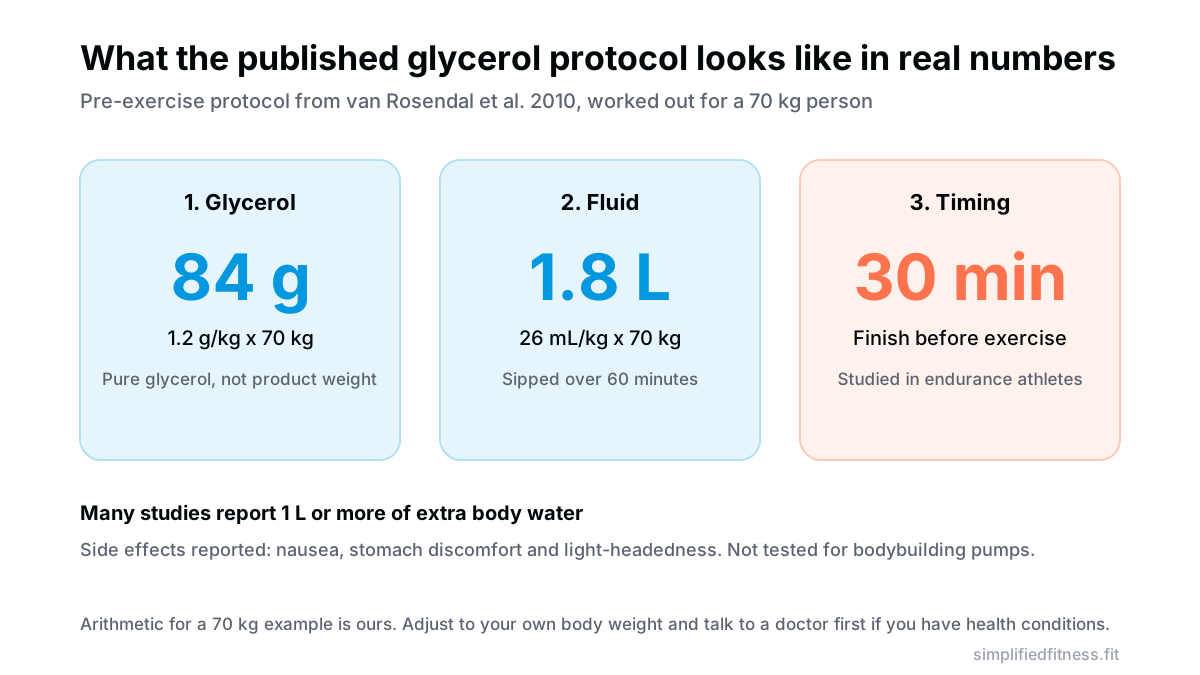
Check how your product compares. If a serving gives you only a few grams of glycerol, the dose on the tub and the dose in the research differ by a factor of ten or more, and nothing in these studies tells us such a small amount changes your hydration status. I cannot verify a particular brand’s glycerol content from here, so read the label and compare grams of actual glycerol to your body weight.
The 2023 running trial used an even higher amount, 1.4 g/kg of fat-free mass, with 30 mL/kg of fat-free mass of cold water over the first 60 minutes (Jolicoeur Desroches et al., 2023). Protocols vary, and no single dose is established for lifters.
Liquid glycerin vs glycerol powder (and HydroMax)
All of these are glycerol, so the molecule is the same. What differs is the carrier and the convenience.
| Form | Practical notes |
|---|---|
| Liquid vegetable glycerin | Thick, very sweet, easy to dose by weight on a kitchen scale |
| Glycerol powder | Easier to mix, but may be blended with carriers, so product weight is not glycerol weight |
| Branded pump powders (such as HydroMax) | Convenient, but you must check the label for grams of actual glycerol per serving |
The only number that matters for comparing products is grams of glycerol per serving. Compare that to your body weight and the 1.2 g/kg figure. If a label hides it inside a proprietary blend, you cannot compare it, which is the same trap we cover in how to spot proprietary blends in a pre-workout.
Side effects and the stomach problem
Nausea, gastrointestinal discomfort and light-headedness are the side effects named in the 2010 review, which calls them rare (van Rosendal et al., 2010). The 2023 systematic review found gastrointestinal symptoms were reported in 26 studies, with severity possibly linked to treatment, dose and ingestion rate, and called for better ways of measuring them (Jardine et al., 2023).
My reading of that, as a coach: drinking close to two litres of fluid plus a concentrated sweet syrup in an hour is hard on an empty stomach, and a bloated gut under a heavy squat is not a pump. I did not find a study that quantifies diarrhea risk, so I will not put a number on it.
If you try this at all:
- Do a trial day, not a competition or a PR day.
- Start with a fraction of the dose and sip over the full hour.
- Skip it if you feel nausea or a pounding headache.
- Stay close to a toilet.
Who should skip it
Drinking a large fluid volume quickly is not suitable for everyone. Talk to a doctor first if you have kidney disease, heart disease, high blood pressure or diabetes, if you have ever had low blood sodium, or if you take diuretics or blood pressure medication. Pregnant and breastfeeding women should also avoid experiments like this.
Tested athletes should also know that a 2013 paper reports glycerol was prohibited by the World Anti-Doping Agency from 2010, because of a concern it could mask blood doping, although the paper’s own analysis found only a limited effect on blood values (Koehler et al., 2013). Check the current WADA list before using it in any tested event.
What to do instead for hot-weather training
If you train in a hot gym, as many of us in India do through summer, the better first steps are cheaper:
- Drink steadily through the day. Our water intake calculator gives a starting number.
- Eat a salty meal or add a pinch of salt and nimbu to your pre-workout water. See electrolyte powders versus salt water.
- Take carbs before training, such as poha, banana or oats, so muscles are full.
- Sip during the session instead of banking water beforehand.
These steps cost almost nothing, carry far less stomach risk, and do not ask you to drink nearly two litres in an hour.
Bottom line
Glycerol with a lot of fluid reliably increases fluid retention and plasma volume. The endurance and heat benefits are small and inconsistent. The bodybuilding pump claim has not been tested in a controlled trial that I could find.
If you are curious, treat it as an experiment: a small test dose on a light day, a clear stomach plan, and honest notes on whether anything improved. If it does not help you in two or three tries, drop it and spend the money on food.
Frequently Asked Questions
What is glycerol hyperhydration?
It means drinking glycerol together with a large volume of water so your body holds on to more fluid than it would with water alone. Glycerol is osmotically active, so it keeps fluid in the circulation instead of letting the kidneys clear it quickly. Studies mostly use it before endurance exercise, so treat any use for lifting as an experiment.
Does glycerol give you a better pump?
There is no controlled trial showing that it does. Glycerol with fluid does increase total body water and plasma volume in research, which is the logic behind the claim. If you try it, judge by how training feels and performs, not by how the mirror looks.
How much glycerol should I take?
The most cited guideline for endurance athletes is 1.2 g/kg body weight of glycerol in 26 mL/kg of fluid over 60 minutes, finishing 30 minutes before exercise. That works out to about 84 g glycerol and 1.8 L fluid at 70 kg. Most pre-workout glycerol powders contain far less per scoop, so check the label for grams of actual glycerol.
Does glycerol improve endurance performance?
Possibly a little, but the evidence is mixed. A 2007 meta-analysis found a 2.62% improvement from four studies, while a 2023 trial in recreational runners found no change in 5 km time in the heat. If endurance is your goal, test it in training before you ever use it on race day.
Is glycerol safe?
At the doses studied, side effects are described as rare, but they include nausea, stomach discomfort and light-headedness. Large fluid loads can also be hard on people with heart, kidney or blood pressure issues. Check with a doctor before trying it if any of those apply to you.
Can glycerol cause diarrhea or stomach upset?
Yes, nausea and gastrointestinal discomfort are the documented side effects, and a systematic review noted that severity seemed to depend on the dose, ingestion rate and treatment used. Drinking nearly two litres quickly, plus a concentrated sugar-alcohol-like syrup, is a lot for an empty gut. Start with a far smaller test dose and spread the drinking out.
Is glycerol the same as HydroMax?
HydroMax is a commercial glycerol powder. Glycerol is the active ingredient, but powders may contain carriers, so grams of product and grams of glycerol are not the same thing. I could not verify any specific product's glycerol content here, so read the label and compare the glycerol per serving with the 1.2 g/kg figure.
Liquid vegetable glycerin or glycerol powder?
Both are glycerol, so the active compound is the same. Liquid is thick and very sweet, powder is easier to mix, and powders may be diluted with carriers. Use the pure-glycerol gram amount on the label to compare, not the scoop size.
Does glycerol help in hot weather?
Evidence is split. Some studies showed lower heart rate or core temperature after hyperhydration, while a review of well-controlled studies found no meaningful advantage if you stay hydrated during exercise. For hot Indian summers, drinking to a plan and adding salt is the better first step.
Is glycerol banned in sport?
A 2013 paper reports that the World Anti-Doping Agency prohibited glycerol from 2010 because it might mask blood doping, but the same paper found that its effect on blood values is quite limited. Rules change, so check the current WADA list before using it in tested competition.
Glycerol vs citrulline or sodium for pumps?
They work differently. Glycerol acts on fluid retention, citrulline is a nitric oxide precursor for blood flow, and sodium holds water through simple osmosis. None of the three has strong direct evidence for visible pumps, so start with cheaper basics like carbs, water and salt.
Who should avoid glycerol hyperhydration?
Anyone with kidney disease, heart disease, high blood pressure, diabetes, a history of low blood sodium, or who takes diuretics should talk to a doctor first. Pregnant and breastfeeding women should also skip experiments. Drinking close to two litres in an hour is not trivial for anyone with a medical condition.
Sources & References
Every claim above is checked against peer-reviewed research (PubMed, U.S. National Library of Medicine) or guidance from established health bodies. How we fact-check.
- van Rosendal SP, et al. Guidelines for glycerol use in hyperhydration and rehydration associated with exercise. Sports Med. 2010. PMID: 20092365
- Goulet ED, et al. A meta-analysis of the effects of glycerol-induced hyperhydration on fluid retention and endurance performance. Int J Sport Nutr Exerc Metab. 2007. PMID: 17962713
- Koehler K, et al. Meta-analysis: Effects of glycerol administration on plasma volume, haemoglobin, and haematocrit. Drug Test Anal. 2013. PMID: 24353192
- McCubbin AJ, et al. The effect of pre-exercise oral hyperhydration on endurance exercise performance, heart rate, and thermoregulation: a meta-analytical review. Appl Physiol Nutr Metab. 2024. PMID: 38198662
- Jolicoeur Desroches A, et al. Effect of Glycerol-Induced Hyperhydration on a 5-kilometer Running Time-Trial Performance in the Heat in Recreationally Active Individuals. Nutrients. 2023. PMID: 36771308
- Jardine WT, et al. The Effect of Pre-Exercise Hyperhydration on Exercise Performance, Physiological Outcomes and Gastrointestinal Symptoms: A Systematic Review. Sports Med. 2023. PMID: 37490269
- Latzka WA, et al. Hyperhydration and glycerol: thermoregulatory effects during exercise in hot climates. Can J Appl Physiol. 2000. PMID: 11098160
- Lyons TP, et al. Effects of glycerol-induced hyperhydration prior to exercise in the heat on sweating and core temperature. Med Sci Sports Exerc. 1990. PMID: 2402207

Umair Hazrami · Founder & Head Coach, Simplified Fitness
Umair Hazrami founded Simplified Fitness and the Simplified Lifter channel to cut through fitness noise. With 4+ years of consistent training and 10+ coaching clients, he writes every guide from the peer-reviewed research and links the sources so you can check them. Our editorial standards.
Educational content only, not medical advice. If you have a medical condition, are pregnant, or take medication, talk to a qualified doctor before changing your diet, supplements or training. Full disclaimer.
Keep reading

Supplements
Ashwagandha KSM-66 vs Sensoril: Which Extract, What Dose, and Do You Need to Cycle?
Ashwagandha KSM-66 vs Sensoril for lifters: what the strength trials show, realistic cortisol effects, liver safety and whether to cycle. Every study linked.
8 min read
Supplements
BCAAs vs EAAs: Why BCAAs Are a Waste of Money If Your Protein Is Covered
BCAA vs EAA for muscle growth: BCAAs are only 3 of the 9 essential amino acids. See what Wolfe 2017 and Jackman 2017 found and when EAAs or whey make sense.
8 min read
Supplements
Beetroot Juice for Running and Lifting: How Dietary Nitrate Works (and the Mouthwash Trap)
Does beetroot juice for running actually work? See what meta-analyses show, the 2-3 hour timing and dose, who benefits, and why mouthwash can cancel the effect.
9 min read

Supplements
Beta-Alanine Benefits: Carnosine Buffering, High-Rep Gains and Why It Makes You Tingle
Beta-alanine benefits explained: why pre-workout makes your skin tingle, how carnosine buffers acid, what dose works, and who should skip it. Studies linked.
8 min read