The No-BS Guide to Energy Balance, Fat Loss, Bulking & Body Recomposition
Calories in calories out science explained: how to find your TDEE, size a deficit or surplus, handle metabolic slowdown and recomp, with every study linked.

TL;DR. The short answer
- Calories in calories out science holds: body weight follows the gap between intake and expenditure over time. The messy part is that both sides move when you change the other, so your targets are estimates you adjust using the scale trend.
- For fat loss, a moderate deficit of roughly 0.5-1% of body weight per week with high protein and lifting helps you keep muscle. Leaner people should sit at the gentle end.
- For muscle gain, a small surplus (about 10-20% above maintenance, or roughly 0.25-0.5% of body weight per week for newer lifters) is a sensible range. Bigger surpluses tend to add more fat without faster muscle gain.
- Metabolic adaptation is real but usually modest. Extreme dieting plus heavy exercise (The Biggest Loser) shows the upper end, not what a normal cut looks like.
- Body recomposition is most likely for beginners, people returning after a break, and those with more body fat. The more trained and leaner you are, the more a deliberate cut or bulk beats trying to do both.
Table of contents
Calories in calories out science is simple at the core and slippery at the edges. Eat less energy than you burn for long enough and you lose body mass. Eat more and you gain it. What gets messy is that your body quietly changes the “out” side when you change the “in” side, so any calorie number is an estimate you refine, not a verdict.
Most fitness arguments about keto, fasting windows and “clean” food are really arguments about how to hit that gap and stay consistent. This guide strips the noise out: how to estimate your needs, how big to make a deficit or surplus, what metabolic slowdown actually looks like, and when recomposition is realistic. (Protein targets get their own deep dive in our complete protein guide for hypertrophy.)
Does calories in calories out actually work?
Yes, as physics. Body weight responds to the balance between energy intake and energy expenditure, and nothing about low-carb, intermittent fasting or any named diet repeals that. The deeper treatment lives in our piece on the science of energy balance and CICO, but here is the practical version.
The catch is time and feedback. A mathematical model of adult metabolism by Hall and colleagues found that bodyweight responds slowly to a change in intake, with a half-time of about a year, and that people with more body fat lose more for the same change in intake (Hall et al., 2011). It is a modelling paper, not a diet trial, but it explains something every dieter feels: results arrive slower than the spreadsheet promised, and the rate of loss tapers as you get smaller.
Two ideas to hold onto:
- The equation is not wrong. Your inputs are. Food labels, restaurant portions and calculator outputs all carry error.
- Your body is not a bank account. Hunger, daily movement and metabolic rate shift when intake shifts.
What makes up your TDEE: BMR, NEAT, TEF and exercise?
Your total daily energy expenditure has four parts. We unpack each in our TDEE breakdown; the short version is below.
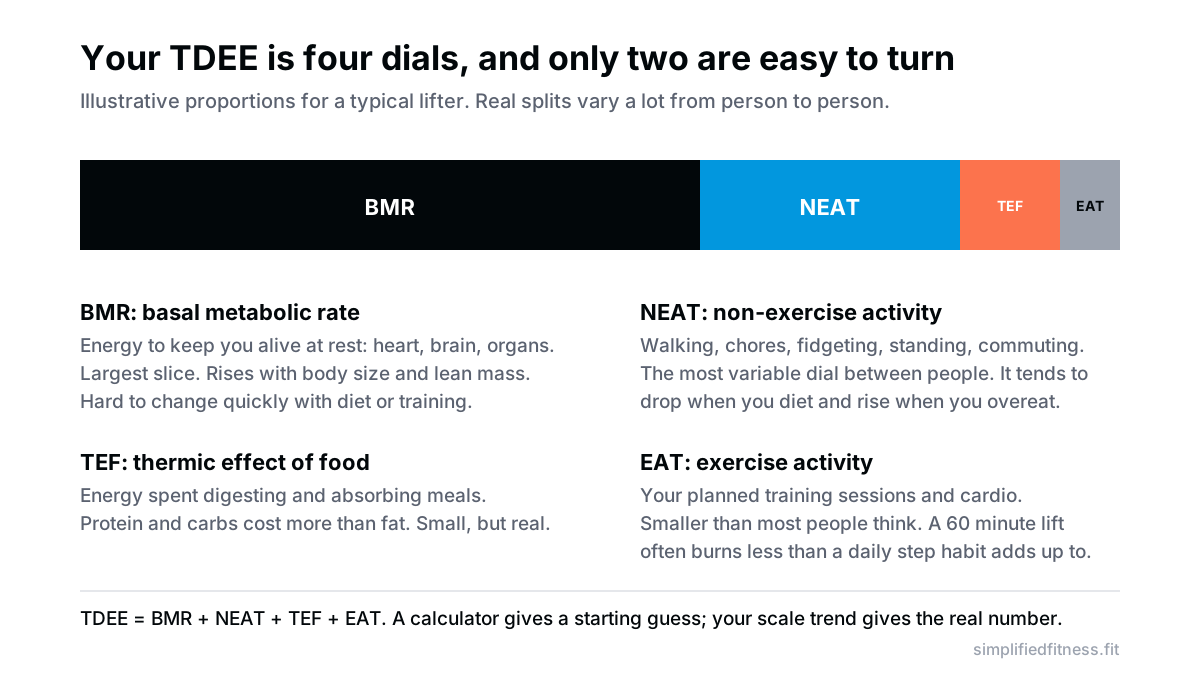
BMR is what you burn at rest. It scales with body size and lean mass, and it is usually the largest slice.
NEAT is everything that is not sleeping, eating or deliberate exercise: walking, chores, typing, fidgeting. Levine’s review describes NEAT as explaining a vast majority of non-resting energy needs, and notes it tends to rise with overfeeding and fall with underfeeding (Levine, 2002). That second point matters on a diet. You can be “in a deficit” on paper while quietly sitting more.
TEF is the energy used to digest and absorb food. A review in the Journal of the American College of Nutrition reports TEF is higher with carbohydrate and protein than with fat, and increases with larger meals as opposed to frequent small ones (Calcagno et al., 2019). It is a modest slice. Do not build a diet around it.
EAT is your planned training. It is real, but a 60-minute session often burns less than people hope.
How do I estimate my TDEE?
Use a calculator for a starting guess. Our calorie calculator and BMR calculator will give you a number in a minute.
Just do not treat that number as sacred. A 2023 systematic review and meta-analysis of 29 studies in athletes found that prediction equations vary widely in accuracy: some, including Mifflin-St Jeor, significantly over- or underestimated measured resting metabolic rate on average, and the authors advise caution about relying on a single equation (O’Neill et al., 2023). Lifters carry more muscle than the average person the equations were built on, so your real number could land above or below the printout.
The fix is boring and reliable:
- Eat at your estimated maintenance for two weeks.
- Weigh yourself daily and take the weekly average.
- If the average is flat, you found maintenance. If it drifts, adjust by 100-200 kcal and repeat.
What is the right calorie deficit for fat loss?
Short answer: a moderate one. Deeper detail is in our guide to setting an optimal deficit, but the logic fits here.
The old “3500 kcal per pound of fat” rule comes from fat’s energy density. Hall’s 2008 analysis showed it only roughly holds for people with a lot of body fat, and that it overestimates the cumulative deficit needed per unit of weight lost in leaner people (Hall, 2008). So the arithmetic works better as a planning guide than as a promise.
For lifters trying to keep muscle, rate matters more than the exact calorie figure. The International Society of Sports Nutrition position stand says diets for fat loss are driven by a sustained deficit, that the higher your body fat the more aggressive the deficit can be, and that slower rates preserve lean mass better in leaner people (Aragon et al., 2017). Helms and colleagues recommend a calorie intake that produces body weight loss of roughly 0.5-1% per week for natural bodybuilders (Helms et al., 2014).
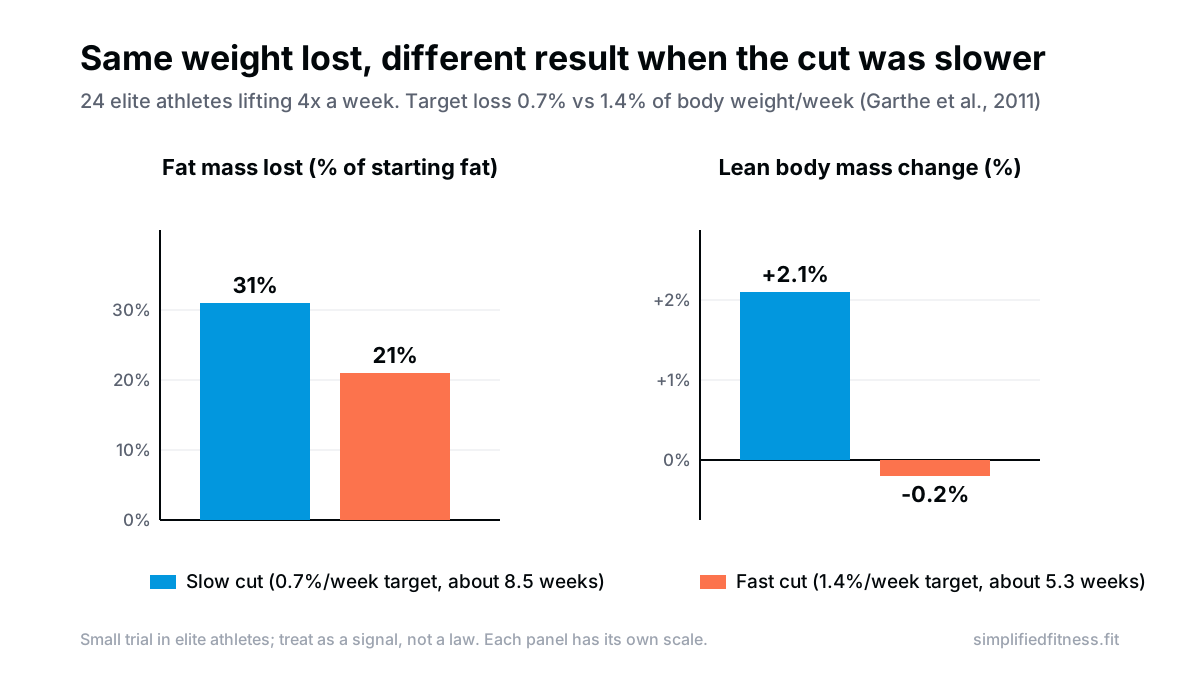
Then there is the trial that makes the point vivid. Garthe and colleagues randomised 24 elite athletes to lose weight at 0.7% or 1.4% of body weight per week, with four resistance sessions weekly. Both groups lost similar weight overall, but lean body mass rose 2.1% in the slow group and was unchanged in the fast group, and the slow group lost a larger share of its fat (31% versus 21%) (Garthe et al., 2011).
A practical deficit sizing table
| Your situation | Sensible weekly loss | Why |
|---|---|---|
| Higher body fat, newer lifter | Toward 1% of body weight | More fat to draw on, less risk to muscle |
| Moderate body fat, trained | About 0.5-0.75% | Balance of speed and muscle retention |
| Already lean, trained | About 0.5% or less | Muscle is more at risk when fat is low |
| Short diet before an event or photo shoot | Pick the gentle end, keep it short | Hunger and fatigue build quickly |
Treat these as ranges, not prescriptions. If you feel flat in training, sleeping badly or obsessing about food, ease off.
How much protein protects muscle on a cut?
A lot more than the minimum. In a 4-week randomised trial, young men on a roughly 40% energy deficit with six days a week of training ate either 1.2 or 2.4 g/kg of protein. The higher-protein group gained 1.2 kg of lean mass and lost 4.8 kg of fat, while the lower-protein group gained 0.1 kg of lean mass and lost 3.5 kg of fat (Longland et al., 2016).
An earlier athlete study found similar direction over two weeks: roughly 2.3 g/kg protein led to smaller lean mass loss than roughly 1.0 g/kg (Mettler et al., 2010).
Both were short and in young, active people, and the Longland protocol was unusually intense, so do not expect identical numbers in a normal gym routine. As a practical base, 1.6-2.2 g/kg a day works for most people, with the upper end or more when you are lean and cutting. Details and Indian vegetarian options are in our high-protein nutrition guide. Use the macro calculator to turn the numbers into grams.
Does metabolic adaptation make fat loss impossible?
No. But it is not a myth either.
When you diet, hormones, mitochondrial efficiency and energy expenditure change in ways that tend to blunt the deficit, a pattern reviewed for athletes by Trexler and colleagues (Trexler et al., 2014). Part of the drop in expenditure is simply that a smaller body burns less. The “adaptation” is the extra drop beyond that. We go deeper in our piece on metabolic adaptation and adaptive thermogenesis.
What does the research say about the size of it?
Here the evidence is mixed, so let me be fair to both sides.
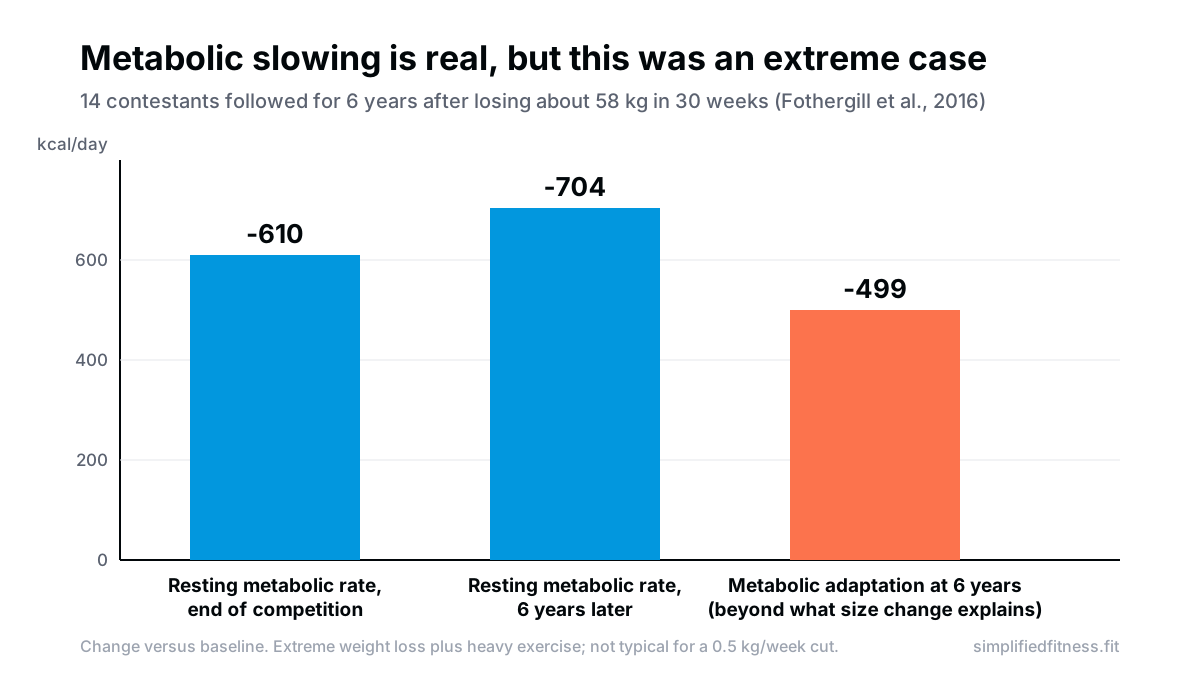
Study A, “The Biggest Loser”: contestants lost an average of 58.3 kg in 30 weeks. Six years later, 14 of the original 16 were followed up. They had regained about 41 kg, their resting metabolic rate was 704 kcal/day below baseline, and metabolic adaptation was about -499 kcal/day (Fothergill et al., 2016). Hall later reinterpreted the data, suggesting the biggest slowing occurred in contestants with the largest increases in sustained physical activity, and that studies with lower activity levels have not measured such large adaptation (Hall, 2022).
Study B, a 2022 systematic review of 33 studies and 2,528 adults: adaptive thermogenesis showed up in 27 studies, mostly in resting energy expenditure, but well-designed studies reported lower or non-significant values, and it seemed attenuated or absent once weight stabilised (Nunes et al., 2022).
Why the gap? Measurement methods differ a lot, the Biggest Loser was an extreme intervention in people with severe obesity, and whether adaptation is measured during dieting or after weight stabilises changes the answer.
Related work by Pontzer and colleagues in 332 adults found that total energy expenditure rose with physical activity at low activity levels but plateaued at higher levels, which supports a constrained model of energy expenditure rather than a simple additive one (Pontzer et al., 2016). That fits with why adding huge amounts of cardio does not always produce the deficit you calculate.
Are diet breaks and refeeds worth it?
Possibly, but the proof is thin. In the MATADOR trial, 51 men with obesity were randomised to 16 weeks of continuous restriction or alternating 2-week blocks of restriction and energy balance (30 weeks total). Among those who completed, the intermittent group lost more weight (14.1 versus 9.1 kg) and more fat, with a smaller drop in resting energy expenditure after adjusting for body composition (Byrne et al., 2018). The catch is that it took much longer, it was men with obesity rather than lifters, and the ISSN position stand concluded that intermittent restriction showed no significant advantage over daily restriction for body composition (Aragon et al., 2017).
So conflicting results, different populations. A cautious path: use scheduled maintenance weeks if you find continuous dieting miserable, not because a magic effect is guaranteed. The full discussion is in diet breaks versus refeeds.
Is “starvation mode” real?
Not in the way the internet means it. Adaptation is a slowing, not a shutdown. If your scale has stalled, check hidden calories, NEAT and fluid first. Our starvation mode myth article covers this in detail.
How big a calorie surplus do you need to build muscle?
Smaller than most people think. A bulk is not a licence to eat everything, as we explain in the clean versus dirty bulk guide.
Iraki and colleagues’ narrative review for natural bodybuilders suggests a hypercaloric diet of roughly 10-20% above maintenance, aiming for about 0.25-0.5% of body weight per week in novice and intermediate lifters, with advanced lifters being more conservative. Their suggested protein is 1.6-2.2 g/kg (Iraki et al., 2019). The ISSN position stand agrees that muscle gain is driven by a sustained surplus, and that the size of the surplus and the lifter’s training status shape what you gain (Aragon et al., 2017).
For a 70 kg beginner, 0.25-0.5% per week works out to about 175-350 g a week. That is slow. It is meant to be.
One honest caution: a critical review found that the commonly cited advice of +300-500 kcal/day for about 0.45 kg weekly gain, mostly lean mass, has thin evidence behind it, and that gaining that fast as mostly lean mass may be hard for some athletes (Larson-Meyer et al., 2022). A small trial of elite athletes did find that a structured plan with about a 500 kcal/day surplus produced more lean mass gain than eating freely, but that was in young athletes on a supervised plan (Garthe et al., 2011).
Bulking surplus quick reference
| Lifting experience | Weekly weight gain to aim for | Surplus idea |
|---|---|---|
| Beginner | About 0.25-0.5% of body weight | Toward the upper end of 10-20% |
| Intermediate | About 0.25% | Around 10% above maintenance |
| Advanced | Slower still | Small, conservative surplus |
Rates are from the narrative review above, with the intermediate and advanced rows being my practical reading of “be more conservative”. Your own trend decides. Our guide to monthly weight-gain targets for natural lifters goes further.
Where does the extra energy go?
Some becomes muscle, some becomes fat, and the split depends on training, genetics and how big the surplus is. Our article on P-ratio and energy partitioning explains the idea.
Can you recomp: lose fat and build muscle at the same time?
Sometimes. Here is who and when. Our full body recomposition guide goes deep; this section covers the decision.
Recomposition is most plausible when you are:
- A true beginner whose muscles respond quickly to any new training
- Returning after a long break (the “muscle memory” effect, covered in our body composition and adherence guide)
- Carrying more body fat, which gives you stored energy to fund muscle building
In a 2026 randomised trial, 30 young resistance-trained participants did resistance training four days a week for 10 weeks. Groups ate a high-protein diet (about 2.5 g/kg) either at maintenance or in a moderate deficit, versus a control group with no diet supervision. Fat-free mass increased in both diet groups, by roughly a kilogram, while controls showed no meaningful change. The deficit group lost more fat in absolute terms (about 2.9 vs 1.4 kg), though that group difference was not statistically significant (Vargas-Molina et al., 2026). It is small and short, and the authors’ own phrasing that it “challenges the traditional model” should be read with caution: DXA can misread changes in water and glycogen, and the study was far shorter than most real cuts.
Longland’s trial earlier in this guide points the same way: young men on a large deficit with high protein and heavy training gained lean mass and lost fat in four weeks (Longland et al., 2016).
The ISSN position stand notes that training status influences what you gain in a surplus and that slower loss better protects lean mass in leaner people (Aragon et al., 2017). The more experienced and lean you are, the less room there is for both goals at once.
Skinny-fat: cut, bulk or recomp?
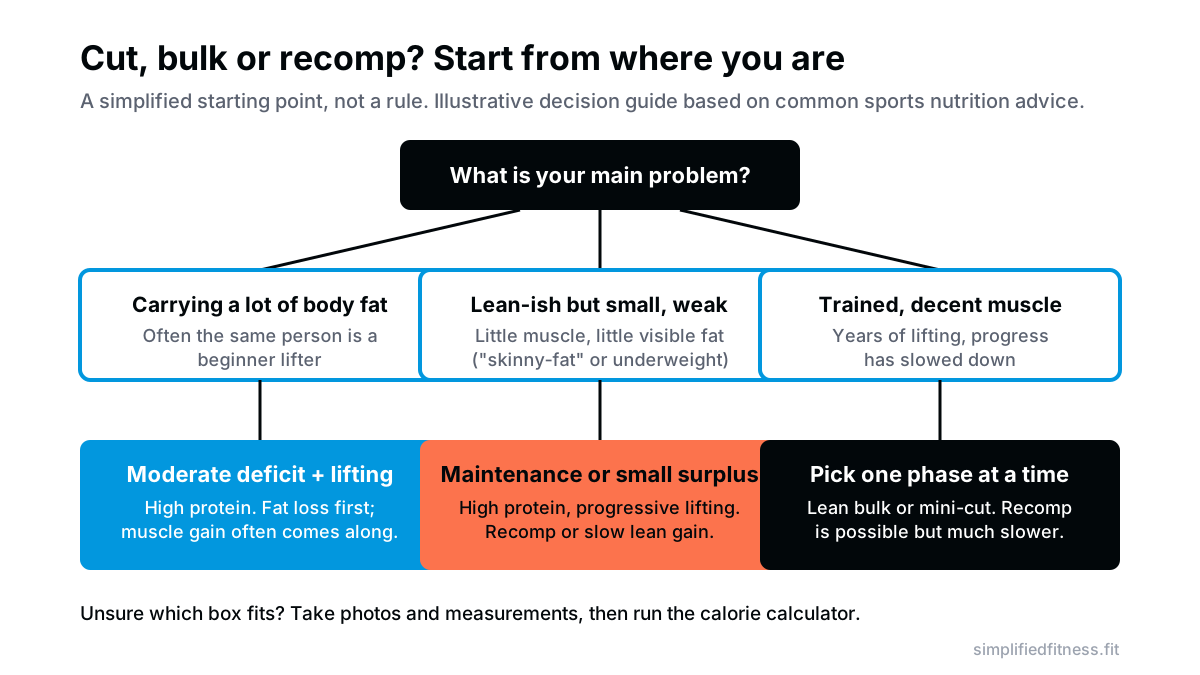
It depends on where you really are, which is why the answer is not the same for everyone. Our skinny-fat decision guide walks through it. A common starting point is maintenance or a small deficit with 1.6-2.2 g/kg protein and progressive lifting for 8-12 weeks, then re-evaluate.
The mini-cut
If you have been bulking and gained more fat than planned, a short deficit of a few weeks can reset you without a full diet. Keep protein high, keep the weights heavy, and set an end date in advance. See the full mini-cut strategy.
Why does my weight go up and down?
Because the scale measures everything: water, food still in your gut, glycogen, and only then fat. Salt, a heavy carbohydrate meal, poor sleep or stress can shift weight by a kilogram overnight without fat changing at all. See our explainers on daily scale fluctuations and the whoosh effect.
Use weekly averages, a waist measurement every two weeks, and progress photos monthly. Strength going up is a quiet sign you are keeping muscle.
How accurate does food tracking need to be?
Accurate enough to be useful. Under-reported oil, tasting bites and “eyeballed” rice are the usual leaks. A digital scale beats measuring cups for dense foods, as we discuss in food logging precision.
For Indian food, these are the spots where calories hide:
- Oil and ghee. A tablespoon is roughly 110-120 kcal, and “just a little” in a sabzi can be several tablespoons.
- Rice and roti portions. A heaped bowl is not a cup. Weigh cooked rice and count rotis for a week.
- Paneer, nuts and peanut butter. Great foods, dense calories.
- Chai and drinks. Sweetened chai several times a day adds up quietly, and so do juices and lassi.
- Weekend meals. Biryani and mithai can erase a weekday deficit.
In hot weather, appetite and NEAT can both drop, so check your trend rather than assuming your usual numbers hold. If you want a ready structure, our free diet plan is a starting point.
How do you stay on track long term?
Adherence beats cleverness. The ISSN position stand notes that the long-term success of a diet depends upon compliance (Aragon et al., 2017). The best plan is the one you can repeat for months. Our guide to flexible dieting and IIFYM shows how to build room for real life.
When the cut ends, do not snap straight back to old habits. Compare reverse dieting with an immediate return to maintenance, and check where you want to sit long term using our note on optimal body fat ranges. Use the weight loss calculator to sanity-check timelines.
Eating well on a budget with vegetarian options is covered in the high-protein foods and meal prep cost guide, and fats and carbs for training are in the carbohydrates, fats and hydration guide.
A simple step-by-step plan
- Estimate maintenance with the calorie calculator, then verify with two weeks of weights.
- Pick a phase: deficit, maintenance with lifting, or small surplus, using Figure 4.
- Set protein at 1.6-2.2 g/kg, higher if lean and cutting.
- Choose a rate: roughly 0.5-1% of body weight per week down, or 0.25-0.5% up.
- Lift progressively and track strength.
- Hold a step target so NEAT does not drift.
- Review every two to three weeks, change one thing at a time.
- Schedule maintenance between phases.
When to see a doctor
See a doctor before changing your diet if you have diabetes, kidney or heart disease, are pregnant or breastfeeding, take medication affected by weight or diet, or have a history of disordered eating. Seek advice if you notice missed periods, constant fatigue, dizziness, fainting, hair loss or weight changes you cannot explain. Obsessing over food or feeling out of control around it deserves a conversation with a professional too. This guide is educational and not medical advice.
If you take one thing away: estimate, measure, adjust, and be patient.
Go deeper: every guide in this topic
- Body Recomposition: Who Can Lose Fat and Build Muscle at the Same Time?
- Breaking Fat Loss Plateaus: Check Fluid, Hidden Calories and NEAT
- How to Calculate Macros: Step-by-Step Grams per Kilogram Formula for Protein, Fat and Carbs
- Daily Scale Weight Fluctuations: Sodium, Bowels, Glycogen and Water
- Diet Breaks vs Refeeds: Do Hormones, Glycogen and Sanity Really Matter?
- Food Logging Precision: Digital Scales vs Measuring Cups and Hidden Calorie Errors
- Lean Bulking Calorie Surplus: Why a Small Surplus Beats a Dirty Bulk
- Flexible Dieting (IIFYM) vs Rigid Restriction: Why Adherence Wins Long-Term
- Metabolic Adaptation to Weight Loss: Why Fat Loss Stalls and What Actually Helps
- The Mini-Cut Strategy: 3-6 Week Rapid Deficits to Clear Fat and Resensitize Appetite
- Optimal Body Fat Percentage for Natural Lifters: Men 10-15%, Women 18-23%
- P-Ratio Energy Partitioning: Do Surplus Calories Become Muscle or Fat?
- Reverse Dieting vs Immediate Maintenance: How to Transition Out of a Deficit Without Rapid Fat Gain
- CICO Science: Does Calories In vs Calories Out Really Work for Fat Loss?
- Setting the Optimal Caloric Deficit: Moderate (15-20%) vs Aggressive (25%+) Compared
- The Starvation Mode Myth: What Really Happens to Metabolism in a Long Calorie Deficit
- Target Rates of Weight Gain for Natural Lifters: Monthly Scale Goals by Training Age
- TDEE Deconstructed: What BMR, TEF, EAT and NEAT Really Burn
- Water Retention and the Whoosh Effect: Why the Scale Suddenly Drops
Frequently Asked Questions
Is calories in calories out actually true?
Yes, as a physical rule: if you eat less energy than you burn, stored energy (mostly fat) is used to cover the gap. The difficulty is that your expenditure and appetite shift in response, so the maths is a tool for estimating, not a guarantee. Treat any calorie target as a starting guess and adjust it using two to three weeks of scale data.
How do I calculate my TDEE?
TDEE is your total daily energy expenditure: BMR plus NEAT, the thermic effect of food and exercise. Formulas and calculators estimate it from age, sex, height, weight and activity level, but a 2023 meta-analysis in athletes found that common equations can over- or underestimate measured resting metabolic rate. Start with our calorie calculator, then track weight for two weeks and correct the number.
What is the difference between BMR and TDEE?
BMR is the energy your body spends at complete rest to keep organs running, while TDEE adds everything you do on top of that: daily movement, digesting food and exercise. BMR is usually the biggest slice, but it is TDEE that decides whether you gain or lose weight. Eat relative to your TDEE, not your BMR.
What is NEAT and why does it matter for fat loss?
NEAT is non-exercise activity thermogenesis, the energy spent on walking, chores, standing and fidgeting. Research suggests NEAT tends to fall with underfeeding and rise with overfeeding, so it quietly changes your real deficit. Keep a daily step target so your NEAT does not slide while you diet.
How big should my calorie deficit be?
For most lifters a moderate deficit that drops body weight by about 0.5-1% per week is a good range, with the lower end for leaner people. In a trial of elite athletes, a 0.7% weekly loss was linked to lean mass gain while 1.4% was not. Pick the gentler rate if you are already lean or training hard.
Is the 3500 calories per pound of fat rule accurate?
Only roughly. Hall's 2008 analysis showed the rule fits people with a lot of body fat but overestimates the deficit needed for leaner people, and it ignores that your expenditure falls as you lose weight. Use it as a rough planning guide, not a promise.
Can you really lose fat and build muscle at the same time?
Yes, under the right conditions. Recomposition is most likely in beginners, people returning to training and people with higher body fat, especially with progressive lifting and high protein. In a 2026 trial of resistance-trained participants, both a moderate deficit and a maintenance-calorie high-protein diet increased fat-free mass over 10 weeks. Expect it to be slower the more trained and lean you are.
How much protein do I need on a cut?
Trials and reviews support intakes well above the basic RDA during a deficit. A 4-week trial in young men found 2.4 g/kg preserved and added more lean mass than 1.2 g/kg, and a natural bodybuilding review suggests 2.3-3.1 g/kg of lean mass for lean dieters. Aim for the 1.6-2.2 g/kg range as a practical base and go higher if you are lean and in a hard deficit.
What is a lean bulk and how many calories should the surplus be?
A lean bulk is a small, controlled surplus designed to build muscle with minimal fat gain. A narrative review for natural lifters suggests roughly 10-20% above maintenance, aiming for about 0.25-0.5% of body weight per week as a novice or intermediate. More advanced lifters should be more conservative because they gain muscle more slowly.
Is a dirty bulk ever worth it?
Usually not. A bigger surplus does not make muscle grow faster once the surplus covers growth; more of the extra tends to end up as fat, which you then have to cut away. Keep the surplus modest and watch the scale trend.
What is metabolic adaptation?
It is the extra drop in energy expenditure that exceeds what your smaller body size explains, driven by hormonal and efficiency changes during energy restriction. A systematic review found it appears in many studies but is often small or non-significant in higher-quality designs. Reduce its impact by avoiding crash diets, keeping protein high and lifting.
Does starvation mode stop fat loss?
No. Your metabolism slows somewhat as you eat less and weigh less, but it does not stop fat loss. If the scale has stalled, hidden calories, lower daily movement or inaccurate tracking are far more likely explanations than a metabolism that switched off.
Do diet breaks and refeeds work?
Evidence is promising but limited. In the MATADOR trial, men with obesity who alternated 2-week blocks of dieting with 2-week blocks at maintenance lost more fat and showed less metabolic slowing, though the study was small and the intermittent group took longer overall. The ISSN position stand found no consistent body composition advantage over daily restriction, so choose whichever you can stick to.
How long should a cut last?
There is no universal number, because it depends on how much fat you need to lose and how well you can stay consistent. Moderate cuts of 8-16 weeks are common in practice, but the research does not set a fixed limit. Finish when you reach your target or when fatigue, hunger and performance tell you it is time for maintenance.
What should I do when fat loss stalls?
First check the basics for two weeks: tracking accuracy, weekend intake, cooking oil and drinks, and daily steps. Adaptation is real but not usually big enough to explain a total stall on its own. Make a small change, such as 5-10% fewer calories or 2,000 more steps a day, rather than slashing food.
How fast can a natural lifter gain muscle?
It depends heavily on training experience. Beginners can gain muscle relatively quickly, while experienced lifters gain very slowly, which is why advanced lifters are advised to use smaller surpluses. Check progress monthly using strength, measurements and the scale, not daily swings.
Why does my weight jump up and down day to day?
Day-to-day weight reflects water, food in your gut and carbohydrate stored as glycogen, not just fat. A salty or high-carb meal can add a kilo overnight without any fat gain. Use a weekly average of daily weigh-ins to judge the trend.
Should a skinny-fat person cut or bulk?
Often neither at full intensity. Many skinny-fat beginners do well on maintenance or a small deficit with high protein and progressive lifting, because new lifters are the group most likely to recomp. If after a few months you are lean but still small, move to a lean bulk.
What is a mini-cut?
A mini-cut is a short, focused deficit of a few weeks used to trim fat gained during a bulk before returning to a surplus. It keeps the bulk lean without a long diet. Keep protein high, keep lifting heavy, and set an end date before you start.
Do I need to count calories forever?
No. Tracking is a skill you can use for a few weeks to calibrate portions, then loosen up and check in occasionally. Long-term success depends on adherence, so use the lightest method that keeps your weight trend where you want it.
How does Indian food fit into calorie targets?
Easily, but cooking oil, ghee, rice portions and sweets are where calories hide. A dal-roti-sabzi plate can be great for fat loss or bulking depending on portion size and how much oil goes in. Weigh rice, roti and oil for a week to see where your calories really come from.
Can I eat at maintenance and still gain muscle?
For some people, yes. A small 2026 trial in resistance-trained young adults found fat-free mass rose by about a kilogram over 10 weeks on a high-protein maintenance diet, and beginners and people with more body fat are generally the most likely to recomp. Very lean, experienced lifters usually need a small surplus to see meaningful gains.
When should I see a doctor about my weight or diet?
See a doctor before starting a diet if you have diabetes, kidney disease, a heart condition, are pregnant or breastfeeding, or have a history of disordered eating. Also seek advice for unexplained weight change, loss of periods, constant fatigue or dizziness. This article is educational and is not a diagnosis.
Sources & References
Every claim above is checked against peer-reviewed research (PubMed, U.S. National Library of Medicine) or guidance from established health bodies. How we fact-check.
- Hall KD, et al. Quantification of the effect of energy imbalance on bodyweight. Lancet. 2011. PMID: 21872751
- Hall KD. What is the required energy deficit per unit weight loss? Int J Obes (Lond). 2008. PMID: 17848938
- Trexler ET, et al. Metabolic adaptation to weight loss: implications for the athlete. J Int Soc Sports Nutr. 2014. PMID: 24571926
- Garthe I, et al. Effect of two different weight-loss rates on body composition and strength and power-related performance in elite athletes. Int J Sport Nutr Exerc Metab. 2011. PMID: 21558571
- Longland TM, et al. Higher compared with lower dietary protein during an energy deficit combined with intense exercise promotes greater lean mass gain and fat mass loss: a randomized trial. Am J Clin Nutr. 2016. PMID: 26817506
- Mettler S, et al. Increased protein intake reduces lean body mass loss during weight loss in athletes. Med Sci Sports Exerc. 2010. PMID: 19927027
- O'Neill JER, et al. Accuracy of resting metabolic rate prediction equations in athletes: a systematic review with meta-analysis. Sports Med. 2023. PMID: 37632665
- Fothergill E, et al. Persistent metabolic adaptation 6 years after The Biggest Loser competition. Obesity (Silver Spring). 2016. PMID: 27136388
- Hall KD. Energy compensation and metabolic adaptation: The Biggest Loser study reinterpreted. Obesity (Silver Spring). 2022. PMID: 34816627
- Nunes CL, et al. Does adaptive thermogenesis occur after weight loss in adults? A systematic review. Br J Nutr. 2022. PMID: 33762040
- Pontzer H, et al. Constrained total energy expenditure and metabolic adaptation to physical activity in adult humans. Curr Biol. 2016. PMID: 26832439
- Levine JA. Non-exercise activity thermogenesis (NEAT). Best Pract Res Clin Endocrinol Metab. 2002. PMID: 12468415
- Calcagno M, et al. The thermic effect of food: a review. J Am Coll Nutr. 2019. PMID: 31021710
- Aragon AA, et al. International society of sports nutrition position stand: diets and body composition. J Int Soc Sports Nutr. 2017. PMID: 28630601
- Helms ER, et al. Evidence-based recommendations for natural bodybuilding contest preparation: nutrition and supplementation. J Int Soc Sports Nutr. 2014. PMID: 24864135
- Iraki J, et al. Nutrition recommendations for bodybuilders in the off-season: a narrative review. Sports (Basel). 2019. PMID: 31247944
- Larson-Meyer DE, et al. Weight gain recommendations for athletes and military personnel: a critical review of the evidence. Curr Nutr Rep. 2022. PMID: 35233712
- Byrne NM, et al. Intermittent energy restriction improves weight loss efficiency in obese men: the MATADOR study. Int J Obes (Lond). 2018. PMID: 28925405
- Vargas-Molina S, et al. Comparison of two nutritional protocols in body re-composition of resistance-trained participants. Eur J Appl Physiol. 2026. PMID: 41940947
- Garthe I, et al. Long-term effect of nutritional counselling on desired gain in body mass and lean body mass in elite athletes. Appl Physiol Nutr Metab. 2011. PMID: 21851204

Umair Hazrami · Founder & Head Coach, Simplified Fitness
Umair Hazrami founded Simplified Fitness and the Simplified Lifter channel to cut through fitness noise. With 4+ years of consistent training and 10+ coaching clients, he writes every guide from the peer-reviewed research and links the sources so you can check them. Our editorial standards.
Educational content only, not medical advice. If you have a medical condition, are pregnant, or take medication, talk to a qualified doctor before changing your diet, supplements or training. Full disclaimer.
Keep reading

Nutrition
Alcohol and Muscle Growth: What a Heavy Night Does to MPS, Sleep and Recovery
Alcohol and muscle growth: does a heavy Saturday night wipe out your week? See what research says on MPS, REM sleep and recovery, and how to limit the damage.
7 min read

Nutrition
The Anabolic Window Myth: Do You Really Need a Shake Within 30 Minutes?
The anabolic window myth, debunked: what meta-analyses show about the 30-minute post-workout shake, how wide your real window is, and when timing still matters.
8 min read

Nutrition
Ashwagandha and Cortisol: Does It Lower Stress and Boost Strength in the Gym?
Ashwagandha for lifting: what the trials show on cortisol, stress and strength gains, realistic dose (300-600 mg), who should skip it and how to buy it safely.
7 min read
Nutrition
Body Recomposition: Who Can Lose Fat and Build Muscle at the Same Time?
How to do body recomposition: who can lose fat and build muscle at once, what the trials show, and a protein, training and calorie protocol you can start today.
8 min read