Electrolyte Supplements: Do Gym Trainees Need Electrolyte Powders or Simple Salt and Water?
Do you need electrolyte supplements for the gym? See what sweat actually contains, when powders like LMNT or Liquid IV help, and a cheap DIY drink recipe.
TL;DR. The short answer
- For a typical indoor lifting session of about an hour, most people do not need electrolyte supplements. Normal meals, water and salt to taste cover what sweat takes.
- Sodium is the main electrolyte in sweat (roughly 1 g per litre on average in marathoners, with big person-to-person differences). Potassium losses are about a quarter of that, and other minerals such as calcium and magnesium are minor sweat components.
- A homemade drink of water, a small pinch to quarter teaspoon of salt and some lemon does the same job as a packet for a rupee or two. Powders mainly sell convenience, flavour and a pre-measured dose.
- Commercial powders can make sense for long, hot, heavy-sweating sessions (2+ hours) or if you hate plain water. In long events, drinking far more than thirst asks for is a bigger risk than too little salt.
- Have kidney disease, high blood pressure, a heart condition or take BP medicines? Check with your doctor before using electrolyte products or potassium-based lite salt.
Part of our complete guide: The Evidence-Based Fitness Supplements Guide: What Works, What's Overhyped & What's a Waste of Money
Table of contents
Most lifters do not need electrolyte supplements. If you train for about an hour, eat normal meals and drink water when you are thirsty, food plus a little ordinary salt replaces what sweat takes. The packets are a convenience product, not a performance requirement.
That does not make them useless. There are real situations where extra sodium helps, and this guide sorts them from the marketing. It sits inside our wider evidence-based guide to fitness supplements, where electrolytes land in the “nice for some, unnecessary for most” bucket.
Short version first, then the numbers.
What is actually in your sweat?
Mostly water and salt, meaning sodium and chloride. A review of sweat physiology lists sodium, chloride and potassium as the major sweat electrolytes, with calcium, magnesium and other minerals as minor constituents (Baker and Wolfe, 2020).
In a study of 157 marathoners, sweat sodium averaged 42.9 mmol/L, which works out to roughly 1 g of sodium per litre. Sweat potassium averaged 6.0 mmol/L, about a quarter of that in mg terms (Lara et al., 2016). These were experienced runners in a warm race, so gym numbers will differ, but the ratio is the point. Sodium dominates.
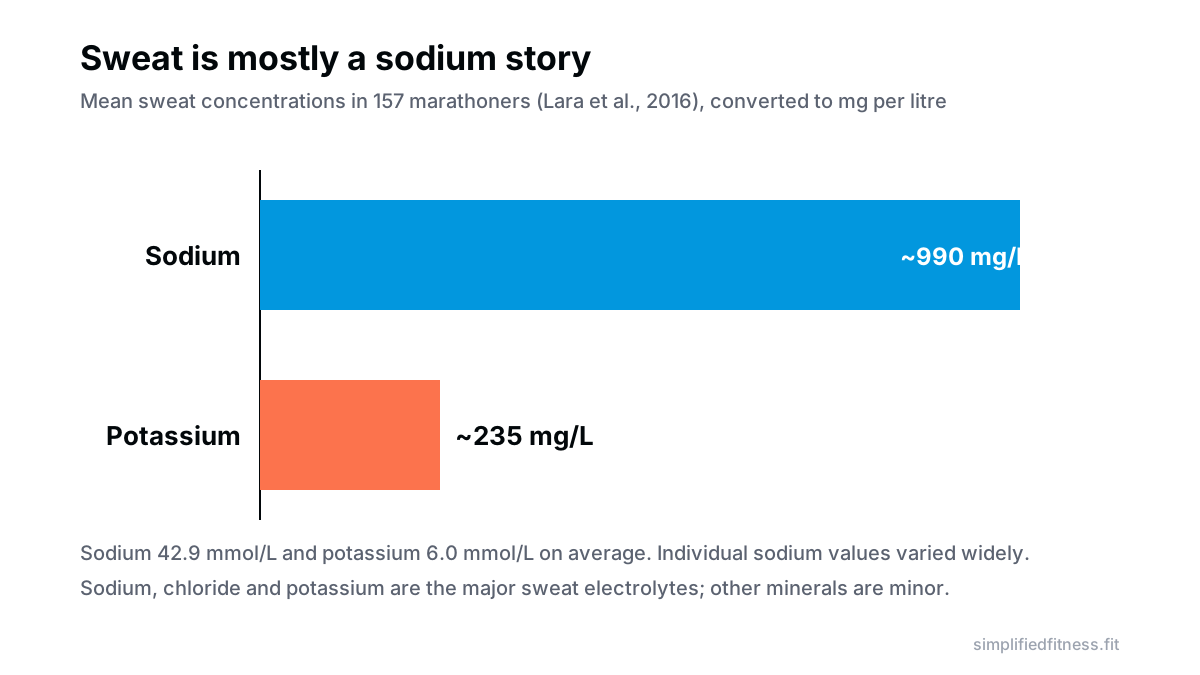
The spread between people is the catch. In that same group sweat sodium varied widely, and about 20% of runners lost enough salt that the authors suggested they might need special sodium advice. Sweat concentration did not track with sweat rate, age, body size or experience (Lara et al., 2016).
A much larger analysis of 1,944 sweat tests found that the factors we usually blame (age, ethnicity, humidity, how much sodium you ate) did not explain much. Energy expenditure and season, a proxy for heat acclimatization, were the most important predictors, and the models still explained only 17-23% of the variation (Baker et al., 2022). (The authors work for PepsiCo, which sells sports drinks, so keep that in mind, though this finding does not flatter any product.) Translation: nobody can guess your sweat saltiness from looks alone. Warmer months were linked to lower sweat sodium, which fits the idea that your body adapts to heat.
Do lifters need electrolyte supplements?
For a standard gym session, probably not.
A review of fluid and electrolyte needs in heat concluded that for people eating a normal diet, electrolyte supplementation is not warranted, except perhaps during the first few days of heat exposure (Sawka and Montain, 2000). That review focused on heat stress and endurance-type work, but lifting sessions usually involve less continuous sweating than that.
A modelling study makes the same point with numbers. Replacing sodium during exercise was unnecessary in all realistic scenarios modelled for a soccer match and an elite marathon. Targeted sodium only looked necessary in a 160 km ultramarathon, when sweat sodium was 40 mmol/L or higher and people replaced more than 80% of fluid losses (McCubbin, 2023). This is a model, not a trial, so treat it as a framework rather than proof. Still, if a soccer match does not need it, a 60-75 minute lift very likely does not.
Think about what your session looks like. Eight to ten hard sets across a few exercises, rest periods between them, and a gym fan blowing. Compared with a marathon, that is a gentle sweat. Your lunch and dinner, with dal, roti, curd and a pinch of salt, do the replacing afterwards.
LMNT, Liquid IV and similar powders: what do you actually pay for?
You pay for a measured dose of sodium (usually with some potassium, sometimes magnesium or sugar), flavouring and convenience. That is a legitimate product. It is not a different kind of electrolyte.
I could not find a controlled trial showing that branded packets beat a salt-and-water drink with a matching sodium dose in gym trainees. Absence of a trial is not proof of equivalence, but chemistry is chemistry: sodium chloride in a packet and sodium chloride from your kitchen behave the same in the gut. Label sodium amounts differ a lot between brands, so read the label rather than trusting the marketing.
One small trial is worth knowing about. In 19 healthy young adults at rest, adding electrolytes alone, at sports drink levels, did not consistently improve how well a beverage hydrated compared with water. Electrolytes combined with carbohydrate or a dipeptide did beat water on fluid retention, but the three enhanced drinks did not differ significantly from each other, and the authors concluded electrolyte content made the largest contribution (Millard-Stafford et al., 2021). So the salt is doing most of the work, and a little sugar may add a bit on top. This was a small study in resting adults, not lifters sweating in a gym.
| Homemade drink | Commercial packet | |
|---|---|---|
| Sodium | Easy to dose with table salt | Pre-measured, varies by brand |
| Potassium | Lemon, lite salt (use with care) | Usually included |
| Cost | A few paise to a rupee or two per serving (illustrative) | Many times more per serving |
| Convenience | Mix it yourself | Tear, pour, shake |
| Taste | Salty-lemony, adjustable | Flavoured |
| Best for | Daily gym and hot-day use | Travel, events, long sessions |
If you like a packet, that is fine. Just know you are buying convenience.
Homemade electrolyte drink recipe
Here is the cheap version. Measures are practical starting points, not a prescription.
- 500 ml water
- A pinch to 1/4 teaspoon of table salt (1/4 tsp is about 1.5 g salt, roughly 600 mg sodium)
- Juice of half a lemon or nimbu
- 1 teaspoon sugar or honey (optional, helps taste and longer sessions)
Start with a pinch. If it tastes like seawater, you overshot. Indian options also work: salted nimbu pani, chaas with a pinch of salt, or coconut water with a pinch of salt. A banana or a bowl of dal gives you potassium without any powder.
What about lite salt and potassium?
Lite salt blends sodium chloride with potassium chloride, so it is a cheap source of both. It is also a product with a clear caution. A Cochrane review notes that low-sodium salt substitutes carry a concern about hyperkalaemia (high blood potassium) in people at risk, such as those with chronic kidney disease or on medications that impair potassium excretion (Brand et al., 2022).
So if you have kidney disease, a heart condition, or take BP medicines such as ACE inhibitors or potassium-sparing diuretics, do not experiment with lite salt or potassium powders. Talk to your doctor. If you are healthy, a pinch in a drink is unlikely to matter much either way, and food does the heavy lifting for potassium.
Will electrolytes stop muscle cramps?
Not reliably. This is where marketing runs ahead of the science.
A review of exercise cramps found the causes and cures remain uncertain. Some cases seem tied to water and salt balance, others to abnormal spinal reflex activity from muscle fatigue, and none of the folk remedies were consistently effective (Maughan and Shirreffs, 2019). Different cramps probably have different mechanisms, so a single supplement fix is unlikely to work for everyone.
If you get calf cramps late in a hard session, look at the boring stuff first: sudden jumps in volume, poor sleep, low food intake and big heat exposure. Magnesium and taurine come up often for cramps. We look at those separately in our guides on magnesium forms for sleep and cramps and taurine and muscle cramps.
The bigger risk: drinking too much
Here is the part packet ads skip. Exercise-associated hyponatremia is low blood sodium during or after prolonged exertion. A review of the topic concluded that its primary cause is fluid intake beyond what the body needs, usually worsened by the body’s reduced ability to excrete the extra water. Women, people with low body weight and those taking NSAID painkillers were at higher risk, and the key prevention was drinking by perceived need rather than a rigid rule (Rogers and Hew-Butler, 2009).
That is mostly an endurance-event problem. But the lesson carries to the gym: forcing four litres a day because an app told you to, then adding a packet “to balance it”, solves nothing. Drink to thirst. Use our water intake calculator for a ballpark and adjust for heat.
So when do powders genuinely make sense?
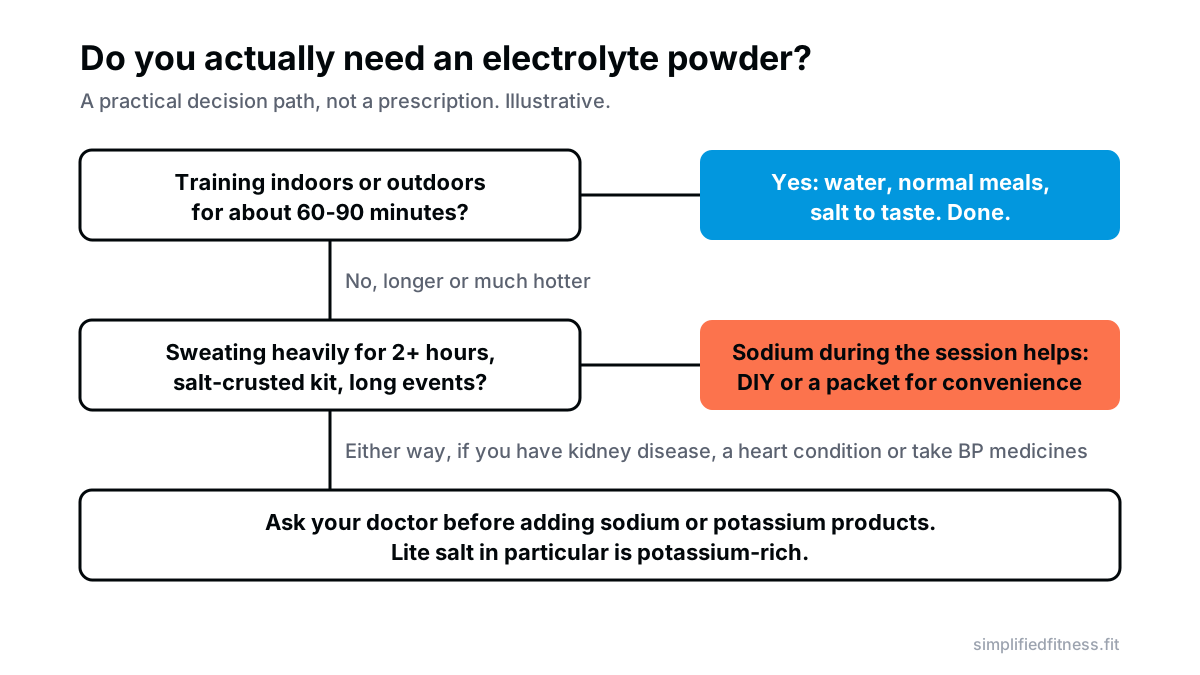
Reasonable cases for a packet or a DIY sodium drink:
- Sessions longer than about two hours, especially outdoors in heat
- Heavy sweaters whose kit ends up salt-crusted
- Back-to-back training days in a hot climate with limited meals
- Travel or events where mixing a recipe is a hassle
- People who simply drink more when the water tastes good
For everyone else, the boring version wins. Eat enough, salt your food to taste, sip water, and let meals do the replacing. If you want to see how your meals stack up, our free diet plan is a starting point. Our guide on electrolytes for gym performance goes deeper on daily sodium, potassium and magnesium intake. The idea of loading up on salt before training for a pump is covered in pre-workout sodium strategy and salt before workouts.
When to see a doctor
Electrolyte problems can be serious. See a doctor if you have repeated severe cramps, dizziness, confusion, vomiting, a racing heartbeat or swelling during or after exercise. Also check first if you have kidney disease, high blood pressure, heart problems, or take diuretics or BP medicines before adding salt or potassium. This article is general information and not a diagnosis.
The bottom line
Sweat is mostly sodium and water, and a normal lifting session does not take enough to need a supplement. Meals, water and salt to taste do the job. A homemade drink covers the longer, hotter days for almost nothing, and a packet is a fair purchase only if you want the convenience.
Get the basics right first: enough protein, enough food and consistent training. Work out your protein with the protein calculator before spending on anything in a sachet.
Frequently Asked Questions
Do lifters need electrolyte supplements?
For most lifters training about an hour indoors, no. Sawka and Montain concluded that for people eating a normal diet, electrolyte supplementation is not warranted except perhaps in the first days of heat exposure. Eat regular meals, drink to thirst and salt your food to taste.
Is LMNT or Liquid IV better than salt and water?
There is no good trial showing that branded packets outperform a plain salt-and-water drink with similar sodium. Sweat is mostly sodium and water, so the sodium dose matters more than the brand. You are paying for convenience, flavour and portion control, so check the label and decide whether that is worth it to you.
What is a good homemade electrolyte drink recipe?
Mix 500 ml water with a pinch to 1/4 teaspoon of table salt, the juice of half a lemon, and optionally a teaspoon of sugar or honey. The salt supplies sodium, the lemon adds taste and a little potassium, and the sugar helps if the session is long. Start with the smaller pinch and adjust to taste.
How much sodium do you lose when you sweat?
It varies a lot between people. In a study of 157 marathoners, average sweat sodium was about 43 mmol/L (roughly 1 g per litre), and about 20% were high enough to need special sodium advice. Your own number depends on your genetics, heat and how hard you work, so treat averages as a starting point.
Do I need potassium and magnesium after training?
Sweat carries far less potassium and magnesium than sodium, and food usually replaces them. In marathoners, sweat potassium averaged about 6 mmol/L, a fraction of sodium. Dal, curd, banana, potatoes and leafy vegetables cover most needs, so you rarely need a powder for these.
Do electrolytes prevent muscle cramps?
Not reliably. Reviews describe the cause of exercise cramps as uncertain, with some cases linked to water and salt balance and others to fatigued muscle and spinal reflexes. Individual risk factors matter more than a single fix, so train progressively, eat enough and see a doctor if cramps are frequent or severe.
Are electrolyte powders worth the money?
Usually not for gym sessions under 90 minutes. A homemade drink costs a tiny fraction of a packet and provides sodium just as well. Powders are worth it when convenience matters, such as travel, long hot sessions or sports events.
Can you drink too much water or electrolytes?
Yes. Exercise-associated hyponatremia is mainly caused by drinking more fluid than the body needs, which dilutes blood sodium. Drinking by thirst rather than a rigid rule is the key preventive step, and electrolyte powders do not protect you if you overdrink.
Does lite salt work as an electrolyte source?
Lite salt replaces part of the sodium with potassium, so it supplies both. It is cheap, but potassium can build up dangerously in people with chronic kidney disease or on certain medicines. If you have either, ask your doctor first and do not use it in a DIY drink.
Do I need electrolytes in hot Indian weather?
Heat raises sweat loss, and you adapt over days, with sweat sodium tending to be lower in warm months. A salted nimbu pani, buttermilk (chaas) or coconut water with a pinch of salt handles most gym sessions. Consider extra sodium only for long outdoor sessions of two hours or more.
Should I take electrolytes before a workout for a pump?
Some lifters add sodium pre-workout hoping for a better pump, but strong evidence for that is limited. A salty meal an hour or two before training is a simple way to try it. We cover the idea in our guide on salt before training.
When should I see a doctor about electrolytes?
See a doctor if you have repeated severe cramps, dizziness, confusion, a very fast heartbeat or vomiting during or after exercise. These can signal a real fluid or electrolyte problem, not a supplement gap. Do not self-treat with large amounts of salt or potassium.
Sources & References
Every claim above is checked against peer-reviewed research (PubMed, U.S. National Library of Medicine) or guidance from established health bodies. How we fact-check.
- Lara B, et al. Interindividual variability in sweat electrolyte concentration in marathoners. J Int Soc Sports Nutr. 2016. PMID: 27478425
- Baker LB, et al. Explaining variation in sweat sodium concentration: effect of individual characteristics and exercise, environmental, and dietary factors. J Appl Physiol. 2022. PMID: 36227164
- McCubbin AJ. Modelling sodium requirements of athletes across a variety of exercise scenarios. Eur J Sport Sci. 2023. PMID: 35616504
- Sawka MN, Montain SJ. Fluid and electrolyte supplementation for exercise heat stress. Am J Clin Nutr. 2000. PMID: 10919961
- Maughan RJ, Shirreffs SM. Muscle cramping during exercise: causes, solutions, and questions remaining. Sports Med. 2019. PMID: 31696455
- Millard-Stafford M, et al. The beverage hydration index: influence of electrolytes, carbohydrate and protein. Nutrients. 2021. PMID: 34578811
- Rogers IR, Hew-Butler T. Exercise-associated hyponatremia: overzealous fluid consumption. Wilderness Environ Med. 2009. PMID: 19594207
- Baker LB, Wolfe AS. Physiological mechanisms determining eccrine sweat composition. Eur J Appl Physiol. 2020. PMID: 32124007
- Brand A, et al. Replacing salt with low-sodium salt substitutes for cardiovascular health in adults, children and pregnant women. Cochrane Database Syst Rev. 2022. PMID: 35944931

Umair Hazrami · Founder & Head Coach, Simplified Fitness
Umair Hazrami founded Simplified Fitness and the Simplified Lifter channel to cut through fitness noise. With 4+ years of consistent training and 10+ coaching clients, he writes every guide from the peer-reviewed research and links the sources so you can check them. Our editorial standards.
Educational content only, not medical advice. If you have a medical condition, are pregnant, or take medication, talk to a qualified doctor before changing your diet, supplements or training. Full disclaimer.
Keep reading
Supplements
Ashwagandha KSM-66 vs Sensoril: Which Extract, What Dose, and Do You Need to Cycle?
Ashwagandha KSM-66 vs Sensoril for lifters: what the strength trials show, realistic cortisol effects, liver safety and whether to cycle. Every study linked.
8 min read
Supplements
BCAAs vs EAAs: Why BCAAs Are a Waste of Money If Your Protein Is Covered
BCAA vs EAA for muscle growth: BCAAs are only 3 of the 9 essential amino acids. See what Wolfe 2017 and Jackman 2017 found and when EAAs or whey make sense.
8 min read
Supplements
Beetroot Juice for Running and Lifting: How Dietary Nitrate Works (and the Mouthwash Trap)
Does beetroot juice for running actually work? See what meta-analyses show, the 2-3 hour timing and dose, who benefits, and why mouthwash can cancel the effect.
9 min read

Supplements
Beta-Alanine Benefits: Carnosine Buffering, High-Rep Gains and Why It Makes You Tingle
Beta-alanine benefits explained: why pre-workout makes your skin tingle, how carnosine buffers acid, what dose works, and who should skip it. Studies linked.
8 min read