Fish Oil and Omega-3 for Lifters: How Much EPA and DHA You Actually Need
Fish oil dosage for lifters explained: how to read the EPA + DHA line, what the evidence says about muscle, soreness and joints, and who should skip it.

TL;DR. The short answer
- Ignore the big '1,000 mg fish oil' number on the front. Only the combined EPA + DHA line on the back counts, and it is often 300 mg or less per capsule.
- Common supplement doses run from about 1 to 3 g of combined EPA + DHA a day. A 2023 meta-analysis found dose (under 2 g vs 2 g or more) did not change muscle outcomes, so about 1 g is a sensible start.
- Omega-3 does not reliably build muscle in healthy adults. Reviews show no effect on muscle mass and a very small effect on strength.
- Joint and soreness benefits are modest and inconsistent: some reviews show small improvements, and a 5-year trial in older adults with knee pain found none.
- Algal oil raised DHA and EPA levels about as well as fish oil in one trial, so vegetarians have a real option. See a doctor first if you take blood thinners, have heart rhythm problems or have a fish allergy.
Part of our complete guide: The Evidence-Based Fitness Supplements Guide: What Works, What's Overhyped & What's a Waste of Money
Table of contents
Most lifters buy fish oil by the front of the bottle and get the dose wrong. The number that matters is the combined EPA + DHA on the back, and common supplement doses run from about 1 to 3 g of that a day. The evidence for omega-3 helping muscle, soreness or joints in healthy lifters is modest, so treat it as an optional extra, not a growth tool.
This guide is the practical buying and dosing side of fish oil dosage for lifters. It sits inside our evidence-based supplements guide, and we keep the muscle-biology deep dive in a separate piece on omega-3 EPA and DHA dosing and muscle benefits.
What is the right fish oil dosage for lifters?
Here is the honest answer: nobody has proven a lifter-specific dose.
Studies use a wide spread. One tightly controlled study of 9 healthy 25-45 year olds used 4 g a day of a prescription omega-3 product (Lovaza) for 8 weeks (Smith et al., 2011). Many supplement labels aim lower. A 2023 meta-analysis of 14 studies sorted trials into under 2 g a day and 2 g or more, and found that dose did not change the (very small) muscle results (Santo André et al., 2023).
So how do you pick a number?
- Baseline: about 1 g of combined EPA + DHA a day, with a meal.
- Higher end: 2-3 g is a common gym recommendation. The evidence does not show that more is better for muscle, and heart rhythm risk rose above 1 g a day in older cardiac-risk patients.
- Above that: there is a trade-off, covered in the safety section below.
A caution on the evidence: the 2023 review pooled healthy young and older adults, and its authors rated the certainty of evidence as only moderate. Treat any dose as a reasonable range, not a prescription.
Why “1,000 mg fish oil” on the label is misleading
A capsule of “1,000 mg fish oil” is mostly fat that is not EPA or DHA. Some budget products carry around 300 mg of actual EPA + DHA per capsule. A concentrated product might carry over 600 mg. Same front label, very different dose.
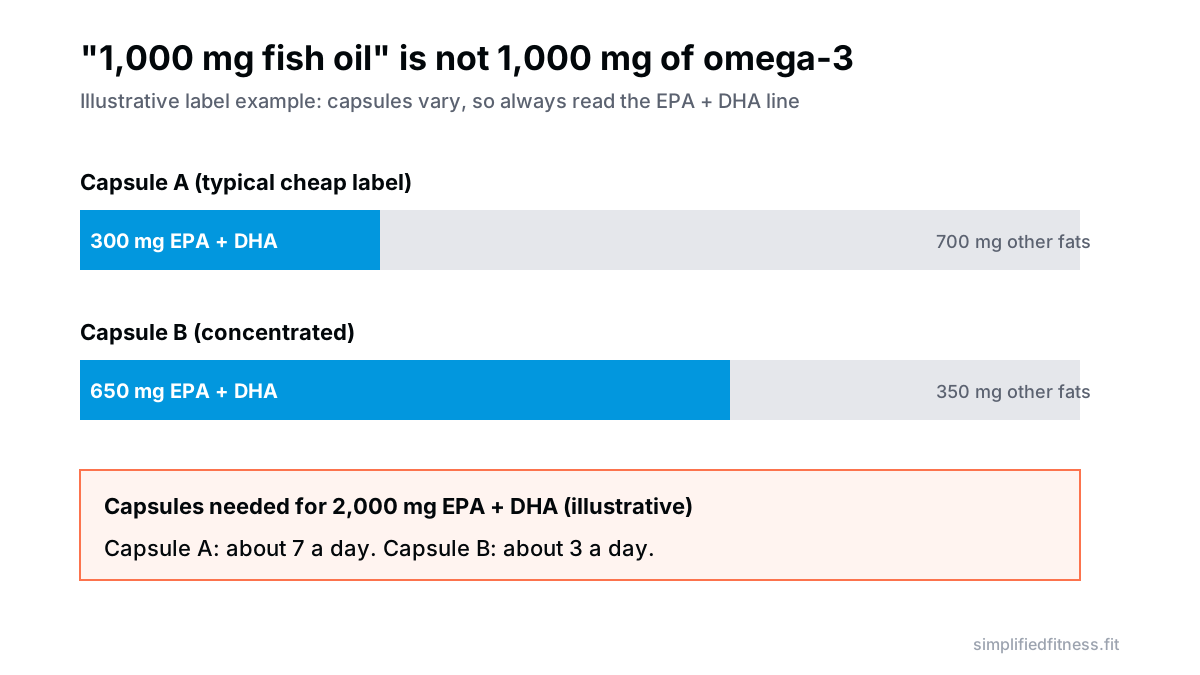
The three-step label check:
- Find the “Supplement Facts” panel and locate EPA and DHA (usually listed separately).
- Add them. That is your real dose per serving.
- Check the serving size. Many labels list “per 2 capsules” or “per 3 softgels”, and the front claim often refers to a single capsule.
The most common mistake here is comparing price per bottle. Compare the price per gram of EPA + DHA instead. A cheap bottle that needs 7 capsules a day can cost more than a pricier concentrated one that needs 3.
Triglyceride vs ethyl ester: does the form matter?
It might. Fish oil capsules come in two common chemical forms: natural or re-esterified triglycerides, and ethyl esters (a processed form common in cheap concentrates).
A 6-month randomized, double-blind trial randomised 150 adults to triglyceride fish oil, ethyl ester fish oil or a corn oil placebo. The two fish oil groups got identical doses of EPA + DHA (1.01 g EPA and 0.67 g DHA daily) as either triglycerides or ethyl esters. The omega-3 index (the share of EPA + DHA in red blood cell membranes) rose to 197% of baseline with triglycerides versus 171% with ethyl esters at six months (Neubronner et al., 2011).
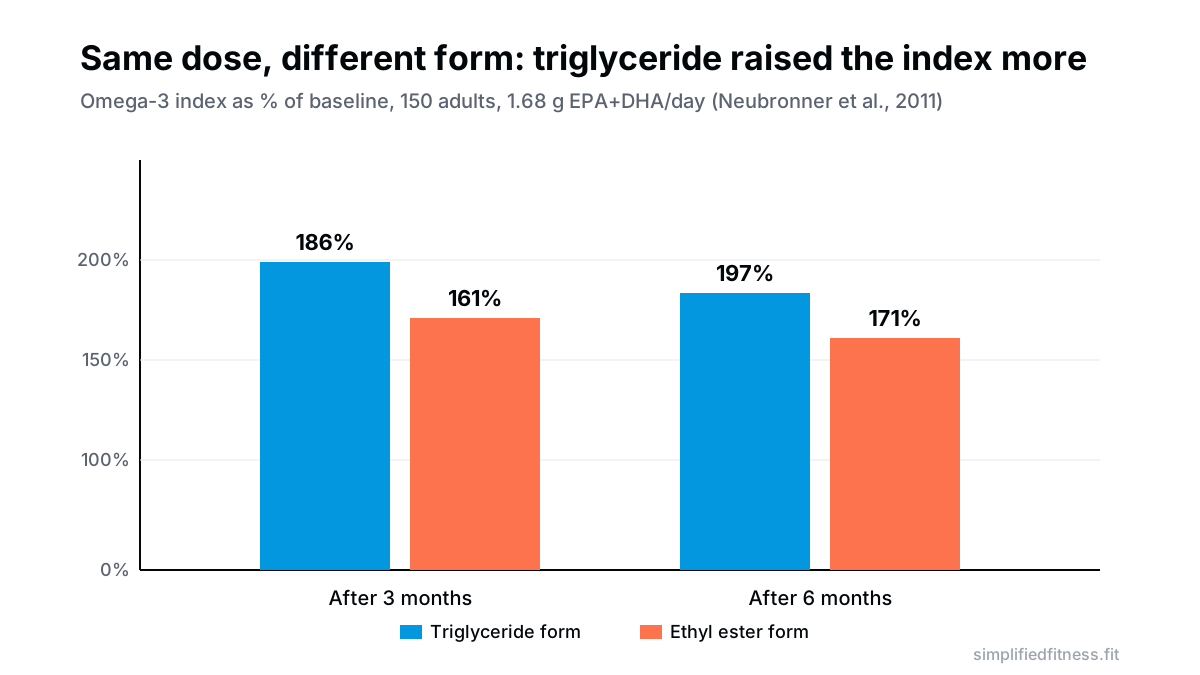
One trial is not the last word, and it measured a blood marker, not gym performance. The practical takeaway: if the price per gram of EPA + DHA is similar, the triglyceride form is a sensible choice. If it costs far more, a good ethyl ester product taken with food is still a reasonable option.
How do you avoid rancid or oxidized fish oil?
Fish oil is a delicate fat. In a 2020 lab analysis, fish oils exposed to oxygen and light, or warmed in contact with air, became heavily oxidized and changed chemically (Phung et al., 2020). That was a deliberate lab stress test, not a survey of shop shelves, but the lesson for storage is the same. Here is a plain checklist:
- Smell and taste one capsule. Sharp, rotten or harsh means bin it.
- Store it cool and dark. In a hot Indian summer, a kitchen shelf near the stove is a poor spot. A cupboard away from heat is better.
- Buy a size you will finish. A huge tub opened for months is not a bargain.
- Look for third-party testing. Our guide to NSF and Informed Choice certifications explains what those marks do and do not cover.
Does omega-3 help muscle growth?
This is the claim that sells most fish oil in gyms, and the evidence is thinner than the marketing.
The famous lab result: in the 2011 study above, 8 weeks of 4 g a day of omega-3 did not change basal muscle protein synthesis in nine healthy adults, but it increased the response to an insulin and amino acid infusion (from 0.062 to 0.083 %/h), with about 50% higher mTOR and p70S6K signalling (Smith et al., 2011). That is a mechanism study with a tiny sample, not a muscle-growth trial.
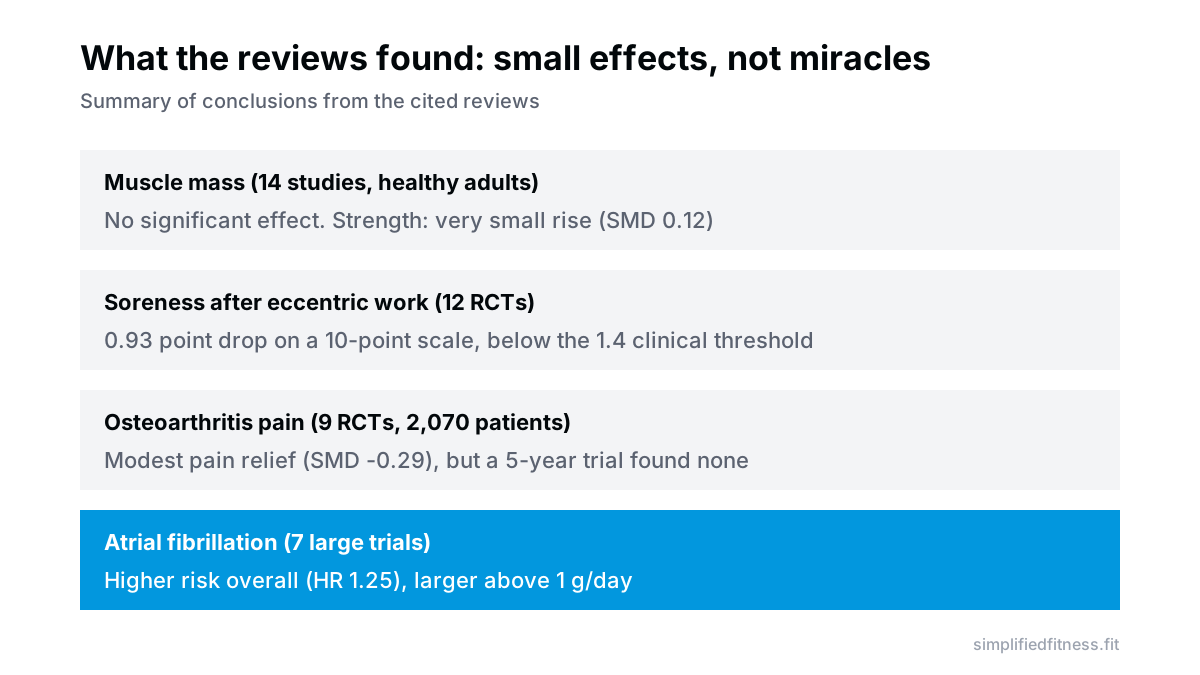
The real-world results are less exciting. The 2023 meta-analysis of 14 studies and 1,443 participants found no significant effect on muscle mass, no effect on muscle function, and a very small positive effect on muscle strength (SMD 0.12) (Santo André et al., 2023). Age, dose and whether people also did resistance training did not change these results.
Why the gap between mechanism and outcome? Short lab measures do not always translate into months of training. Older adults are often named as the group where the anabolic story is most plausible (see our piece on anabolic resistance in older adults), but in this review age did not change the result, so the data are not a green light for anyone.
Can fish oil reduce muscle soreness after training?
A little, maybe. A 2020 meta-analysis pooled 12 randomized trials (145 supplemented participants and 156 controls) and found DOMS two days after eccentric exercise was lower with omega-3 (mean difference -0.93 on a 10-point scale). That is statistically significant, but below the 1.4-point minimum clinically important difference, and the authors graded the evidence as low quality (Lv et al., 2020). Strength and range of motion did not improve.
So fish oil will not erase soreness. Our soreness and nutrition guide compares it with other options, and the biggest lever is still gradual progression of volume.
Does fish oil help joint pain from lifting?
The evidence conflicts, so here is both sides.
What supports it: a 2023 meta-analysis of 9 randomized trials with 2,070 osteoarthritis patients found that omega-3 relieved pain (SMD -0.29) and improved joint function (SMD -0.21) versus placebo, with similar side effects between groups (Deng et al., 2023).
What does not: in VITAL, a double-blind trial of 25,871 US adults, a subgroup of 1,398 people with chronic knee pain (mean age 67.7) showed no difference in WOMAC pain, function or stiffness between omega-3 and placebo over about 5.3 years (MacFarlane et al., 2020).
Why might they differ? The first pooled trials in people with diagnosed osteoarthritis, and the pain results varied a fair amount between studies. The second was a large, long-term trial in older adults with chronic knee pain. Neither studied healthy young lifters with training-related aches.
A cautious takeaway: if your joints ache from lifting, fish oil is a low-priority experiment, not a fix. Check exercise choice, range of motion, load progression and sleep first. For other options, see our guide to joint health supplements. Persistent, swollen or worsening joint pain needs a doctor, not another capsule.
Algal oil vs fish oil: a vegetarian option
Fish get their omega-3 from algae. Algal oil skips the middleman, which suits vegetarians, vegans and people who dislike fish.
A randomized, double-blind trial of 74 adults compared microalgal and fish oil supplements and found plasma phospholipid DHA and EPA at 6 and 14 weeks were statistically non-inferior with the algal oil (Bailey et al., 2025). Note the limits: the study was run by employees of a company that makes microalgal oil, and it measured blood levels, not muscle or joint outcomes.
For vegetarians in India, who often get almost no EPA or DHA from diet, algal oil is a reasonable way to fill the gap. Flax and walnuts supply a different omega-3 (ALA) and are not the same thing, so do not count them toward an EPA + DHA target. Check the label for actual DHA and EPA content, as with fish oil. I would not make claims about heavy metal levels beyond saying that third-party testing is worth looking for.
Who should be careful with omega-3?
Higher doses are not free of risk. A 2021 meta-analysis of 7 randomized cardiovascular trials (81,210 patients, mean age 65) found marine omega-3 supplements were associated with a higher risk of atrial fibrillation (HR 1.25), and the hazard ratio was larger in trials testing more than 1 g a day (1.49) than in trials at 1 g or less (1.12) (Gencer et al., 2021). These were older patients with cardiovascular risk, so the finding may not apply to a healthy 25-year-old. But it is a reason not to treat 3 g as automatically better.
Talk to a doctor before supplementing if you:
- take blood thinners or have a bleeding disorder
- have a heart rhythm problem, such as atrial fibrillation
- are pregnant or breastfeeding
- have a fish or shellfish allergy (algal oil may be an alternative, but check with your doctor)
- are scheduled for surgery
Unusual palpitations, an irregular heartbeat or unexplained bruising while taking omega-3 are reasons to stop and see a doctor.
The simple fish oil plan for lifters
- Decide if you need it. If you eat oily fish two or three times a week, a capsule adds little. If you eat almost none, a supplement is a reasonable top-up.
- Pick a form. Fish oil (triglyceride form if the price per gram of EPA + DHA is close) or algal oil if you are vegetarian.
- Read the back. Add EPA and DHA. Buy on price per gram of EPA + DHA.
- Dose. Start around 1 g of combined EPA + DHA with a meal. More is not proven to be better for muscle.
- Store it. Cool, dark, sealed. Smell a capsule now and then.
- Keep expectations low. If it does nothing visible, that is the expected result.
Then spend your real effort where the gains are: training, calories and protein. Work out your daily target with our protein calculator, and for the tier it belongs in, see the supplement guide. Another vitamin often paired with omega-3 is covered in vitamin D3 and K2 dosing.
Frequently Asked Questions
How much fish oil should I take for lifting?
There is no single proven dose for lifters, but most studies and products land between about 1 and 3 g of combined EPA + DHA a day. A 2023 meta-analysis found that muscle outcomes did not differ between doses under 2 g and 2 g or more. Starting around 1 g of EPA + DHA with a meal is a sensible default, and check the label, since total fish oil weight is not the number that matters.
How many fish oil capsules is 2,000 mg of EPA and DHA?
It depends entirely on the capsule. A cheap capsule with 300 mg of EPA + DHA needs about 7 a day, while a concentrated one with 650 mg needs about 3. Read the 'EPA' and 'DHA' lines on the supplement facts panel, add them together, and divide your target by that number.
Does fish oil build muscle?
Not in a way you would notice in the gym. A 2023 meta-analysis of 14 studies found no significant effect on muscle mass in healthy adults and only a very small gain in strength. Omega-3 might support recovery or health, but protein, calories and progressive training are what build muscle.
Is fish oil good for joint pain from lifting?
It might help a little, but the evidence is mixed. A 2023 meta-analysis of 9 trials in osteoarthritis found modest pain relief, while a 5-year trial in older adults with chronic knee pain found no benefit. Fix exercise selection, load and recovery first, and treat fish oil as an optional extra, not a cure.
Does omega-3 reduce muscle soreness (DOMS)?
Slightly at best. A 2020 meta-analysis of 12 trials found a statistically significant drop in soreness but smaller than the threshold considered clinically important. Soreness is mostly a sign of unfamiliar training, so ramp volume gradually and do not expect a capsule to erase it.
What is the difference between EPA and DHA?
They are the two long-chain omega-3 fats found in fish and algae. Both are measured on the label, and most studies dose them together. Choose a product that lists both rather than hunting for one specific ratio.
Is triglyceride fish oil better than ethyl ester?
It may absorb better. In a 6-month trial of 150 adults (split between triglyceride, ethyl ester and placebo groups), the omega-3 index rose more with the triglyceride form than the ethyl ester form at the same dose. Take either form with a meal containing some fat, and consider the triglyceride form if your budget allows.
How do I know if my fish oil is rancid?
A strong, sharp fishy smell or a harsh aftertaste is the usual warning sign. Oxidized oil is chemically changed, and strong off smells are the simplest consumer check. Store capsules in a cool, dark place, avoid leaving them in a hot car or on a sunny kitchen shelf, and bin them if they smell or taste foul.
Is algal oil as good as fish oil?
In one 14-week trial of 74 adults, algal oil raised plasma DHA and EPA levels about as well as fish oil (statistically non-inferior). The trial was run by employees of a company that makes microalgal oil, so independent replication would be welcome. Vegetarians can reasonably use algal oil, and should check the label for the actual EPA + DHA amount.
Can I just eat fish instead of taking capsules?
Yes, and that is a fine approach if you eat oily fish regularly. Fish gives you EPA and DHA plus protein and other nutrients, while capsules just give you the oils. If you do not like fish or rarely buy it, a supplement fills the gap.
Should I take fish oil with food?
Yes, taking it with a meal that contains fat is the sensible default. Omega-3 is a fat, and many people report fewer fishy burps and less stomach upset with food. Pair it with lunch or dinner and keep it consistent.
Is high-dose fish oil safe?
Not for everyone. A 2021 meta-analysis of 7 large trials found that marine omega-3 supplements were associated with a higher risk of atrial fibrillation, and the risk was greater in trials using more than 1 g a day. If you have a heart rhythm condition, take blood thinners or are older, talk to your doctor before taking more than a basic dose.
Do I need fish oil if I already eat a healthy diet?
Probably not. Omega-3 is not in the same tier as creatine or protein for gym results. If you eat fish two or three times a week, a supplement adds little, but if your diet has almost none, it can be a reasonable top-up.
Sources & References
Every claim above is checked against peer-reviewed research (PubMed, U.S. National Library of Medicine) or guidance from established health bodies. How we fact-check.
- Smith GI, et al. Omega-3 polyunsaturated fatty acids augment the muscle protein anabolic response to hyperinsulinaemia-hyperaminoacidaemia in healthy young and middle-aged men and women. Clin Sci (Lond). 2011. PMID: 21501117
- Santo André HC, et al. The Influence of n-3PUFA Supplementation on Muscle Strength, Mass, and Function: A Systematic Review and Meta-Analysis. Adv Nutr. 2023. PMID: 36811583
- Lv ZT, et al. Omega-3 Polyunsaturated Fatty Acid Supplementation for Reducing Muscle Soreness after Eccentric Exercise: A Systematic Review and Meta-Analysis of Randomized Controlled Trials. Biomed Res Int. 2020. PMID: 32382573
- Neubronner J, et al. Enhanced increase of omega-3 index in response to long-term n-3 fatty acid supplementation from triacylglycerides versus ethyl esters. Eur J Clin Nutr. 2011. PMID: 21063431
- Deng W, et al. Effect of omega-3 polyunsaturated fatty acids supplementation for patients with osteoarthritis: a meta-analysis. J Orthop Surg Res. 2023. PMID: 37226250
- MacFarlane LA, et al. The Effects of Vitamin D and Marine Omega-3 Fatty Acid Supplementation on Chronic Knee Pain in Older US Adults: Results From a Randomized Trial. Arthritis Rheumatol. 2020. PMID: 32583982
- Bailey E, et al. Comparative Bioavailability of DHA and EPA from Microalgal and Fish Oil in Adults. Int J Mol Sci. 2025. PMID: 41096614
- Gencer B, et al. Effect of Long-Term Marine Omega-3 Fatty Acids Supplementation on the Risk of Atrial Fibrillation in Randomized Controlled Trials of Cardiovascular Outcomes: A Systematic Review and Meta-Analysis. Circulation. 2021. PMID: 34612056
- Phung AS, et al. Chemical Compositional Changes in Over-Oxidized Fish Oils. Foods. 2020. PMID: 33092165

Umair Hazrami · Founder & Head Coach, Simplified Fitness
Umair Hazrami founded Simplified Fitness and the Simplified Lifter channel to cut through fitness noise. With 4+ years of consistent training and 10+ coaching clients, he writes every guide from the peer-reviewed research and links the sources so you can check them. Our editorial standards.
Educational content only, not medical advice. If you have a medical condition, are pregnant, or take medication, talk to a qualified doctor before changing your diet, supplements or training. Full disclaimer.
Keep reading

Supplements
Ashwagandha KSM-66 vs Sensoril: Which Extract, What Dose, and Do You Need to Cycle?
Ashwagandha KSM-66 vs Sensoril for lifters: what the strength trials show, realistic cortisol effects, liver safety and whether to cycle. Every study linked.
8 min read

Supplements
BCAAs vs EAAs: Why BCAAs Are a Waste of Money If Your Protein Is Covered
BCAA vs EAA for muscle growth: BCAAs are only 3 of the 9 essential amino acids. See what Wolfe 2017 and Jackman 2017 found and when EAAs or whey make sense.
8 min read
Supplements
Beetroot Juice for Running and Lifting: How Dietary Nitrate Works (and the Mouthwash Trap)
Does beetroot juice for running actually work? See what meta-analyses show, the 2-3 hour timing and dose, who benefits, and why mouthwash can cancel the effect.
9 min read

Supplements
Beta-Alanine Benefits: Carnosine Buffering, High-Rep Gains and Why It Makes You Tingle
Beta-alanine benefits explained: why pre-workout makes your skin tingle, how carnosine buffers acid, what dose works, and who should skip it. Studies linked.
8 min read