Baking Soda for Athletic Performance: Dose, Timing and Stomach Protection
Does baking soda for athletic performance work? See the 0.2-0.3 g/kg dose, timing, who benefits, and how to avoid the stomach trouble, with every study linked.
TL;DR. The short answer
- Baking soda (sodium bicarbonate) at 0.2-0.3 g/kg body weight can help hard efforts lasting roughly 30 seconds to 12 minutes, according to the ISSN position stand. Benefits outside that window are much less certain.
- It works by raising bicarbonate in your blood, which helps clear hydrogen ions out of working muscle. It is extracellular buffering, a different job from beta-alanine and carnosine inside the muscle cell.
- Stomach trouble is the main problem. In a 2025 meta-analysis of running trials, GI symptoms hit 29.5% of people on bicarbonate versus 2.6% on placebo.
- Ways to reduce symptoms include taking it about 180 minutes before, with a high-carbohydrate meal, in enteric-coated capsules or as mini-tablets in a hydrogel. No study has ranked these strategies against each other yet.
- Baking soda carries a lot of sodium (about 5.8 g at 0.3 g/kg for a 70 kg person). Anyone with high blood pressure, kidney disease or a sodium-restricted diet should speak to a doctor first.
Part of our complete guide: The Evidence-Based Fitness Supplements Guide: What Works, What's Overhyped & What's a Waste of Money
Table of contents
Baking soda for athletic performance is one of the few kitchen-cupboard tricks with real research behind it. At 0.2-0.3 g/kg of body weight, sodium bicarbonate can help you hold a hard effort that lasts about 30 seconds to 12 minutes. It also has a very real downside: a lot of people end up in the toilet instead of on the start line.
This is a cluster guide inside our evidence-based fitness supplements guide. Here we cover what it does, what it does not do, how to dose it, and how to keep your stomach intact.
How does baking soda improve athletic performance?
Hard exercise produces hydrogen ions (H+), and their build-up makes the muscle and blood more acidic. That acid is one of the things that makes a 400 m or a hard set of intervals feel like your legs are filled with concrete.
Sodium bicarbonate is an alkalinising agent. Taken by mouth, it raises bicarbonate concentration in your blood. The idea is that this promotes the efflux of hydrogen ions out of working cells and tissues (Peart et al., 2012). More bicarbonate in the blood, easier acid exit from the muscle. That is the whole mechanism.
Note the word extracellular. This works outside the muscle cell, in the blood. The muscle has its own buffer inside the cell, called carnosine, and that is what beta-alanine raises. Different location, different job. Our guide to beta-alanine, carnosine and the tingles covers the inside story.
What does the research say about sodium bicarbonate?
The most useful single source is the International Society of Sports Nutrition (ISSN) position stand. It concludes that doses of 0.2 to 0.5 g/kg improve muscular endurance, various combat sports (boxing, judo, karate, taekwondo, wrestling), and high-intensity cycling, running, swimming and rowing. The effects are mostly established for tasks of high intensity lasting between 30 seconds and 12 minutes. The panel also says it works in both men and women, and that a portion of the effect seems to be placebo-driven (Grgic et al., 2021).
That is the optimistic reading. Here is where it gets messier.
- A meta-analysis found the overall effect on performance was moderate, but significantly lower in specifically trained participants than in recreationally trained ones (Peart et al., 2012). So if you are already well trained, expect a smaller gain.
- A 2025 meta-analysis of 11 randomised, placebo-controlled running studies (126 participants, mostly male, median test length about 4 minutes) found a negligible benefit overall once GI-related dropouts and publication bias were accounted for (SMD 0.18, 95% CI -0.01 to 0.36). In the 8 male-only studies the effect was small and significant (SMD 0.40) (Miller et al., 2025).
Why the gap? Study designs differ, trained athletes have less room to improve, and stomach symptoms can wipe out the benefit for the people who get them. The ISSN panel is reviewing the wider literature, while the running meta-analysis adjusts for people who dropped out. Neither is wrong. The honest takeaway: probably helpful for some people, in some events, and not a guaranteed edge.
Which sports and workouts benefit most?
Think of events where you are working near your limit for somewhere between half a minute and a dozen minutes.
- 400 m to 1500 m running, and track cycling or hard sprint cycling
- Rowing 2 km efforts and swimming 100-400 m
- Boxing, judo, wrestling, MMA-style rounds (the ISSN lists several combat sports)
- Repeated hard intervals or sprint repeats, where the acid keeps stacking up
- Muscular endurance sets that last 30 seconds or more
What about a sodium bicarbonate sprint workout of single 10-second sprints? The research base is thinnest there, since the effect is mostly established from 30 seconds upwards. And for steady running, remember the 2025 meta-analysis above: negligible overall. If your key event is a 10 km or a marathon, this is not where I would spend your tolerance for stomach pain.
How much baking soda should you take (and how do you load it)?
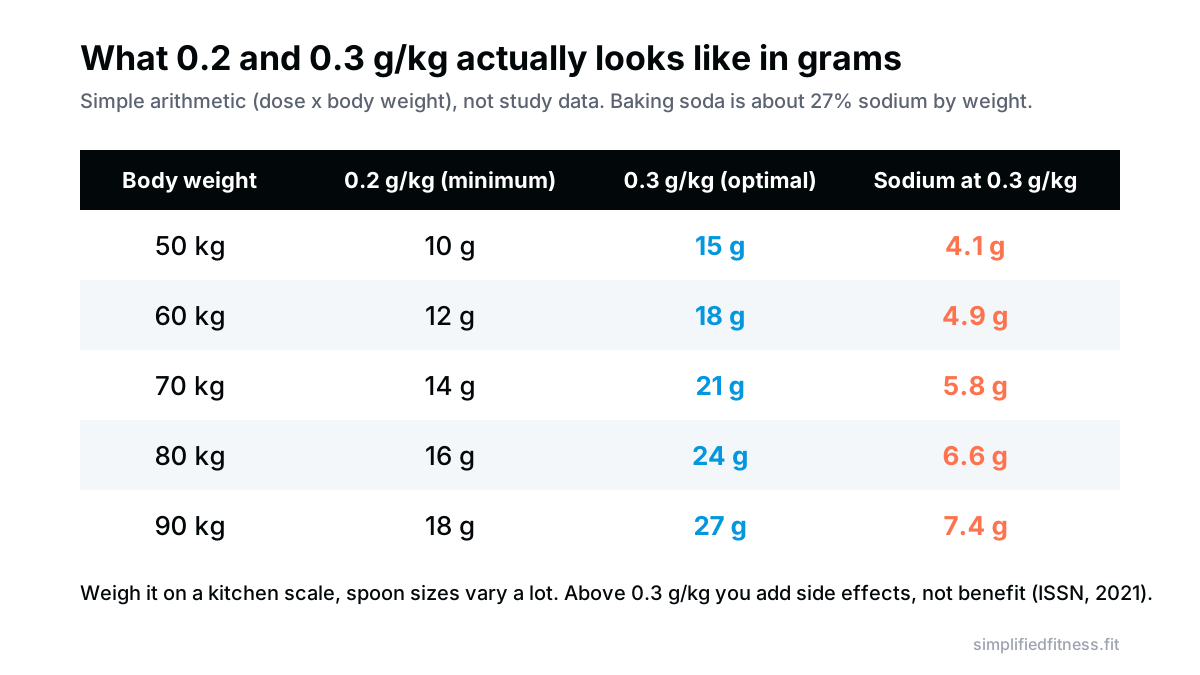
The ISSN says 0.2 g/kg seems to be the minimum single dose for improvement, and 0.3 g/kg seems optimal. Larger doses of 0.4 or 0.5 g/kg gave no extra benefit in single-dose protocols but came with more and worse side effects (Grgic et al., 2021).
There are two ways to run it.
- Single dose: 0.2-0.3 g/kg, taken 60-180 minutes before the effort.
- Multi-day protocol: 0.4-0.5 g/kg in total per day for 3-7 days, divided into smaller doses (for example 0.1-0.2 g/kg at breakfast, lunch and dinner). The ISSN notes this can help reduce side-effect risk on competition day.
Do not copy a number from a friend. Check your own weight, multiply, and weigh it on a kitchen scale (spoon sizes are not consistent).
When should I take it? Timing varies by person
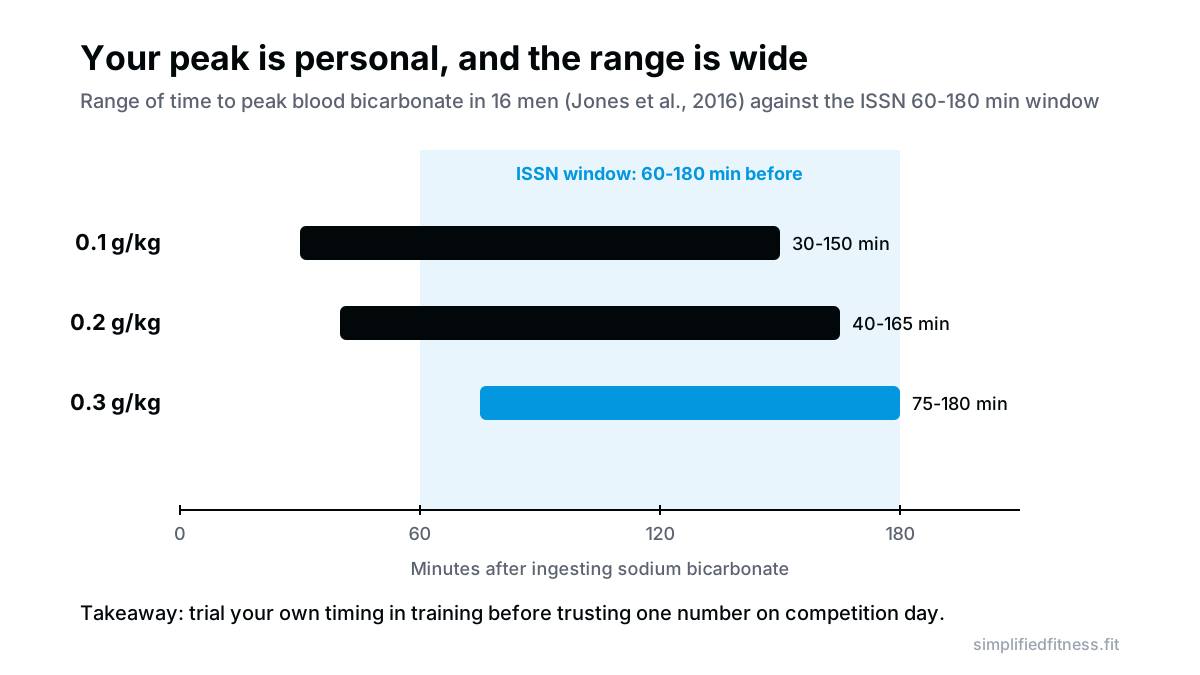
The ISSN recommends 60 to 180 minutes before exercise. But individuals differ wildly. In a study of 16 healthy males, time to peak blood bicarbonate ranged from 75 to 180 minutes at 0.3 g/kg, and from 30 to 150 minutes at 0.1 g/kg. The authors said athletes should individualise the protocol and trial different doses before competition (Jones et al., 2016).
How do you avoid stomach problems?
Common GI symptoms are bloating, nausea, vomiting and abdominal pain, and diarrhoea is regularly reported too. A 2026 systematic review of 101 investigations concluded that common acute doses (0.2-0.4 g/kg) produce mild-to-severe symptoms that likely rise with dose when taken in one go (Winter et al., 2026). In the running meta-analysis, GI symptoms were reported in 29.5% of cases with bicarbonate versus 2.6% with placebo, and GI-related dropout was 8.7% versus 1.6% (Miller et al., 2025).
The ISSN lists four strategies to cut the risk (Grgic et al., 2021):
- Use smaller doses (0.2 or 0.3 g/kg)
- Take it around 180 minutes before exercise, or adjust timing to your own response
- Take it with a high-carbohydrate meal
- Use enteric-coated capsules
A practical Indian version of the carbohydrate meal: a plate of rice with dal, or poha or upma with curd, a couple of hours before. Keep it familiar and low in fibre and fat. Your usual pre-training food, not an experiment. Our guide to intra-workout carbs covers fuelling the session itself.
The 2026 review adds the other options: spreading intake over hours, enteric-coated tablets, and mini-tablets inside a carbohydrate hydrogel. It also points out that direct comparisons of these strategies are missing, so ranking them is not possible (Winter et al., 2026).
If you are training in a hot Indian summer, remember that a salty, gassy stomach on top of mild dehydration is an unpleasant combination. Keep up your usual fluids, and see our electrolyte guide for the salt-and-water basics.
Maurten bicarb review: is hydrogel worth the money?
The Maurten Bicarb System packages sodium bicarbonate mini-tablets in a carbohydrate hydrogel. The early evidence looks interesting but is thin.
- At rest: In 12 well-trained male cyclists given 0.3 g/kg, the hydrogel version produced peak bicarbonate 0.95 mmol/L higher than capsules, reached it 38 minutes earlier (117 versus 156 minutes), and reduced aggregate GI discomfort. The authors concluded that GI discomfort was almost eliminated. They noted that performance effects were still to be determined (Gough and Sparks, 2024).
- Performance: In 14 trained male cyclists, a 40 km time trial was a mean 54.14 seconds faster with the hydrogel bicarbonate than with placebo, with no significant difference in GI symptoms (Shannon et al., 2024).
The caveats matter. Both were small crossover studies in trained men. In the performance paper, Maurten provided the product free of charge and one author is now employed by Maurten, although the company had no input into design, analysis or interpretation. And, as the 2026 review says, nobody has compared hydrogel against enteric capsules head to head.
My take: if you have a proven stomach problem with plain baking soda, it is a reasonable thing to test. If plain bicarbonate in capsules works fine for you, I would not pay a premium on faith.
Baking soda from the kitchen or a sports product?
Plain food-grade sodium bicarbonate (khane ka soda) is the same compound the research used, and it is very cheap. The trouble is taste, texture and the stomach. Capsule versions solve some of that. For anything beyond plain baking soda, check that a product contains what the label says and has third-party testing (see our guide to third-party supplement certifications). Do not swap in baking powder, which is a different product, or a blended antacid.
What about the sodium load?
This is the part most social posts skip. Sodium bicarbonate is about 27% sodium by weight, so a 0.3 g/kg dose for a 70 kg person (21 g) contains roughly 5.8 g of sodium. That is a big amount to take in one sitting compared with ordinary daily intake. The studies we cite focus on performance and stomach symptoms rather than long-term sodium effects, so it is a reason for caution if your blood pressure or kidneys are not in good shape.
Can you stack it with beta-alanine, creatine or caffeine?
The ISSN says combining sodium bicarbonate with creatine or beta-alanine may produce additive effects, while it is unclear whether stacking it with caffeine or nitrates adds anything (Grgic et al., 2021).
One trial of 20 men, split into a placebo group and a beta-alanine group (6.4 g/day for 4 weeks), tested each with and without bicarbonate in a cycling test at 110% of power max. Time to exhaustion rose by 6.5% with bicarbonate alone, 12.1% with beta-alanine alone and 16.2% with both. The extra 4.1% from adding bicarbonate to beta-alanine was not statistically significant, though the authors estimated a roughly 70% chance of a meaningful benefit (Sale et al., 2011). That was a small trial, so treat it as suggestive.
Practical rule: add one thing at a time. If you change three supplements before the same race, you will not know which one helped or which one wrecked your stomach. If you want a caffeine number as well, our caffeine dosage calculator gives a starting point by body weight, and the beetroot juice guide covers nitrates.
Should you use baking soda? A simple decision path
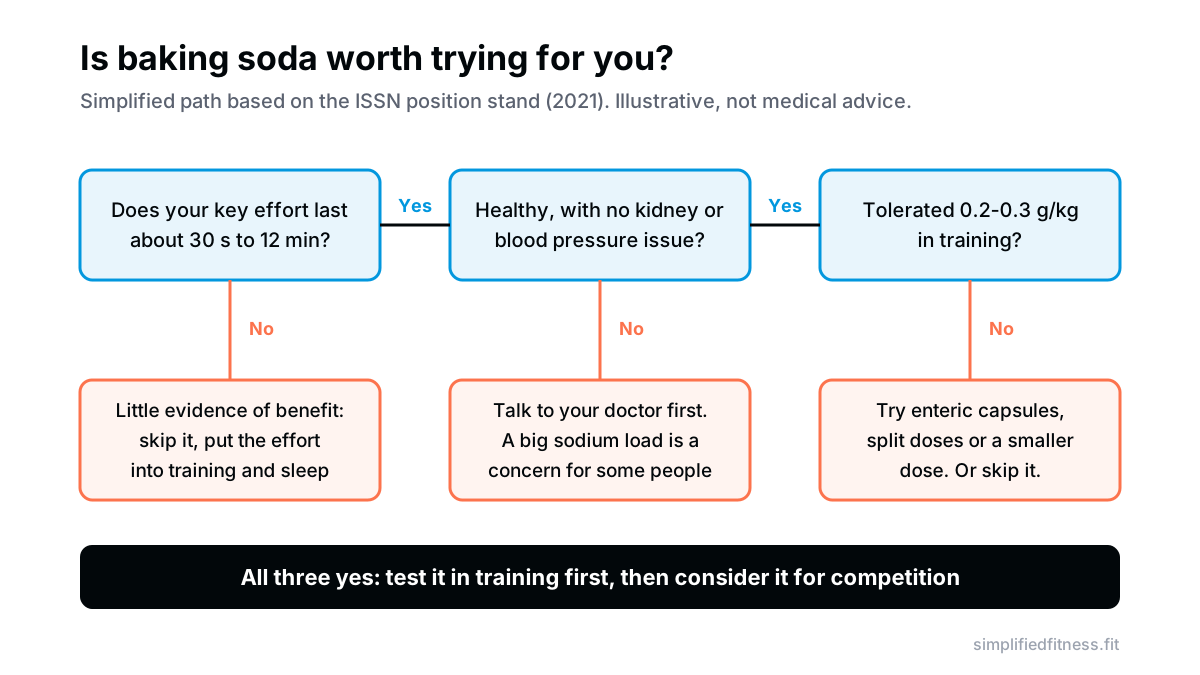
If you came here because your 5 km time is stuck, start with training, sleep and food. Bicarbonate is a small, optional top-up for people who have the basics covered, and it is not a shortcut. For a deeper look at salt and fluid for gym performance, see sodium loading for pump and hydration.
The bottom line
- Evidence is best for hard efforts of 30 seconds to 12 minutes, at 0.2-0.3 g/kg, 60-180 minutes before.
- The benefit is smaller in well-trained athletes and negligible for continuous running overall, and part of it may be placebo.
- GI symptoms are common. Use the smallest effective dose, a carbohydrate meal and enteric capsules, and test everything in training.
- Hydrogel products look promising for stomach tolerance but need more independent research.
- Mind the sodium load, and see a doctor first if you have blood pressure, kidney or heart concerns.
Frequently Asked Questions
Does baking soda really improve athletic performance?
It can, mainly in hard efforts lasting about 30 seconds to 12 minutes. The ISSN position stand reports benefits in high-intensity cycling, running, swimming, rowing and combat sports, though a meta-analysis found the effect was smaller in well-trained athletes than in recreational ones. Test it in training before using it in competition, because individual responses differ.
How much baking soda should I take for performance?
Research supports 0.2 g/kg as the minimum useful single dose and 0.3 g/kg as the best-supported dose. Higher doses of 0.4-0.5 g/kg did not add benefit in single-dose protocols but increased side effects. For a 70 kg person, 0.3 g/kg is 21 g, so weigh it on a kitchen scale rather than guessing with spoons.
When should I take sodium bicarbonate before exercise?
The ISSN suggests 60-180 minutes before exercise. Blood bicarbonate peaks at very different times in different people (75-180 minutes at 0.3 g/kg in one study of 16 men). Try a few timings in training and note when you feel fine and perform well.
How do I take sodium bicarbonate without diarrhea?
Use the smallest effective dose, take it earlier, and pair it with a high-carbohydrate meal. Enteric-coated capsules, spreading the dose over hours, or mini-tablets in a carbohydrate hydrogel are the strategies the evidence points to. If you still get cramps or loose stools in training, it is not a good fit for you.
Is baking soda the same as baking powder?
No. Baking soda is pure sodium bicarbonate, while baking powder is a mix that also contains acid and starch, so it is not a suitable substitute. Use food-grade sodium bicarbonate (khane ka soda), and avoid antacid or fruit salt sachets, which are blended products. Check the label and the amount per gram, not the brand name.
Is the Maurten Bicarb System better than plain baking soda?
It may reduce stomach upset, but the evidence is still small. In 12 trained cyclists at rest, the hydrogel product raised blood bicarbonate earlier and produced much less GI discomfort than capsules, and in a separate study of 14 cyclists a 40 km time trial was about 54 seconds faster than with placebo. No study has compared it directly with plain baking soda in a performance test. These were short crossover studies in men, so cost against benefit is a personal call.
Does sodium bicarbonate help long-distance running?
Probably very little. A 2025 meta-analysis of 11 running studies found a negligible overall benefit after adjusting for dropouts, with a small benefit in male-only studies. The tests in those studies were short, with a median of about 4 minutes, so this says little about marathons.
Can I combine baking soda with creatine or beta-alanine?
The ISSN says combining sodium bicarbonate with creatine or beta-alanine may add benefits, because they work at different sites. A trial combining beta-alanine with bicarbonate found a further 4.1% gain in time to exhaustion that was not statistically significant. Introduce one change at a time so you can tell what helps and what upsets your stomach.
Who should not use baking soda as a supplement?
People with high blood pressure, kidney disease, heart conditions or a doctor-advised low-sodium diet should not self-experiment. A 0.3 g/kg dose contains a large amount of sodium, far more than most health guidance would suggest in a single sitting. Ask your doctor first, and do not use it if you are pregnant without medical advice.
Is sodium bicarbonate a banned substance?
Check the current WADA Prohibited List and your own federation's rules before using it in competition, because rules change and can differ between events. The bigger practical risk in tested sport is a contaminated supplement, so if you use a capsule or branded product, choose one with third-party testing.
Is the benefit partly placebo?
Yes, the ISSN position stand states that a portion of the effect seems to be placebo-driven. That does not make it fake, since physiological effects on blood buffering are also measurable. It is a reason to run a blinded self-test when you can and to be skeptical of dramatic claims.
Does baking soda help with gym workouts and sprint intervals?
It may help with repeated hard intervals and high-rep sets that last 30 seconds or more. The ISSN position stand says it improves muscular endurance activities and both single and multiple bouts. For short sets of heavy lifting, the benefit is far less established, so do not expect extra strength.
Sources & References
Every claim above is checked against peer-reviewed research (PubMed, U.S. National Library of Medicine) or guidance from established health bodies. How we fact-check.
- Grgic J, et al. International Society of Sports Nutrition position stand: sodium bicarbonate and exercise performance. J Int Soc Sports Nutr. 2021. PMID: 34503527
- Peart DJ, et al. Practical recommendations for coaches and athletes: a meta-analysis of sodium bicarbonate use for athletic performance. J Strength Cond Res. 2012. PMID: 22505127
- Miller LE, et al. Negligible benefit of oral single-dose sodium bicarbonate on continuous running performance: systematic review with meta-analysis of randomized, double-blind, placebo-controlled trials. J Int Soc Sports Nutr. 2025. PMID: 41416636
- Winter IP, et al. Gastrointestinal Symptoms Associated With Sodium Bicarbonate Supplementation Protocols: A Systematic Review. Eur J Sport Sci. 2026. PMID: 42499192
- Gough LA, et al. The Effects of a Carbohydrate Hydrogel System for the Delivery of Bicarbonate Mini-Tablets on Acid-Base Buffering and Gastrointestinal Symptoms in Resting Well-trained Male Cyclists. Sports Med Open. 2024. PMID: 38356036
- Shannon ES, et al. The effect of sodium bicarbonate mini-tablets ingested in a carbohydrate hydrogel system on 40 km cycling time trial performance and metabolism in trained male cyclists. Eur J Appl Physiol. 2024. PMID: 39068627
- Jones RL, et al. Dose-Response of Sodium Bicarbonate Ingestion Highlights Individuality in Time Course of Blood Analyte Responses. Int J Sport Nutr Exerc Metab. 2016. PMID: 27098290
- Sale C, et al. Effect of beta-alanine plus sodium bicarbonate on high-intensity cycling capacity. Med Sci Sports Exerc. 2011. PMID: 21407127

Umair Hazrami · Founder & Head Coach, Simplified Fitness
Umair Hazrami founded Simplified Fitness and the Simplified Lifter channel to cut through fitness noise. With 4+ years of consistent training and 10+ coaching clients, he writes every guide from the peer-reviewed research and links the sources so you can check them. Our editorial standards.
Educational content only, not medical advice. If you have a medical condition, are pregnant, or take medication, talk to a qualified doctor before changing your diet, supplements or training. Full disclaimer.
Keep reading

Supplements
Ashwagandha KSM-66 vs Sensoril: Which Extract, What Dose, and Do You Need to Cycle?
Ashwagandha KSM-66 vs Sensoril for lifters: what the strength trials show, realistic cortisol effects, liver safety and whether to cycle. Every study linked.
8 min read
Supplements
BCAAs vs EAAs: Why BCAAs Are a Waste of Money If Your Protein Is Covered
BCAA vs EAA for muscle growth: BCAAs are only 3 of the 9 essential amino acids. See what Wolfe 2017 and Jackman 2017 found and when EAAs or whey make sense.
8 min read
Supplements
Beetroot Juice for Running and Lifting: How Dietary Nitrate Works (and the Mouthwash Trap)
Does beetroot juice for running actually work? See what meta-analyses show, the 2-3 hour timing and dose, who benefits, and why mouthwash can cancel the effect.
9 min read

Supplements
Beta-Alanine Benefits: Carnosine Buffering, High-Rep Gains and Why It Makes You Tingle
Beta-alanine benefits explained: why pre-workout makes your skin tingle, how carnosine buffers acid, what dose works, and who should skip it. Studies linked.
8 min read