Beetroot Juice for Running and Lifting: How Dietary Nitrate Works (and the Mouthwash Trap)
Does beetroot juice for running actually work? See what meta-analyses show, the 2-3 hour timing and dose, who benefits, and why mouthwash can cancel the effect.
TL;DR. The short answer
- Beetroot juice for running can help a little: meta-analyses show small to moderate gains in time to exhaustion (SMD about 0.33), but weaker or no gains in time trials and in well-trained endurance athletes.
- The active ingredient is inorganic nitrate. Bacteria on your tongue convert it to nitrite, which can become nitric oxide in working muscle and lower the oxygen cost of steady exercise.
- In the main dose-response trial, about 8 mmol of nitrate (roughly 500 mg, 140 mL of concentrated juice) taken 2.5 hours before exercise worked, and double that added nothing. A small 70 mL shot with about 4 mmol did not change exercise responses.
- Antibacterial mouthwash (especially chlorhexidine) blunts nitrite production, so rinsing with it around beetroot doses can cut the benefit.
- Effects on lifting are small and inconsistent. Not for you if you take nitrate medication or have kidney stones, unless your doctor says it is fine.
Part of our complete guide: The Evidence-Based Fitness Supplements Guide: What Works, What's Overhyped & What's a Waste of Money
Table of contents
Does beetroot juice for running actually work? A little, yes (see our evidence-based supplements guide for where it sits among the rest). Meta-analyses show small to moderate gains in how long you can hold a hard steady effort, but the effect is weaker in time trials, in very fit endurance athletes, and for most lifting outcomes.
It is one of the few supplements with a believable mechanism and a genuine research base. It also has a trap that is easy to miss: an antibacterial mouthwash can blunt the first step of the process.
How does beetroot juice work? The nitrate-nitrite-NO pathway
The active ingredient is inorganic nitrate, not the pink colour. Nitrate is abundant in vegetables, mainly green leafy ones, and beetroot is a rich source (Jones et al., 2021).
Here is the chain:
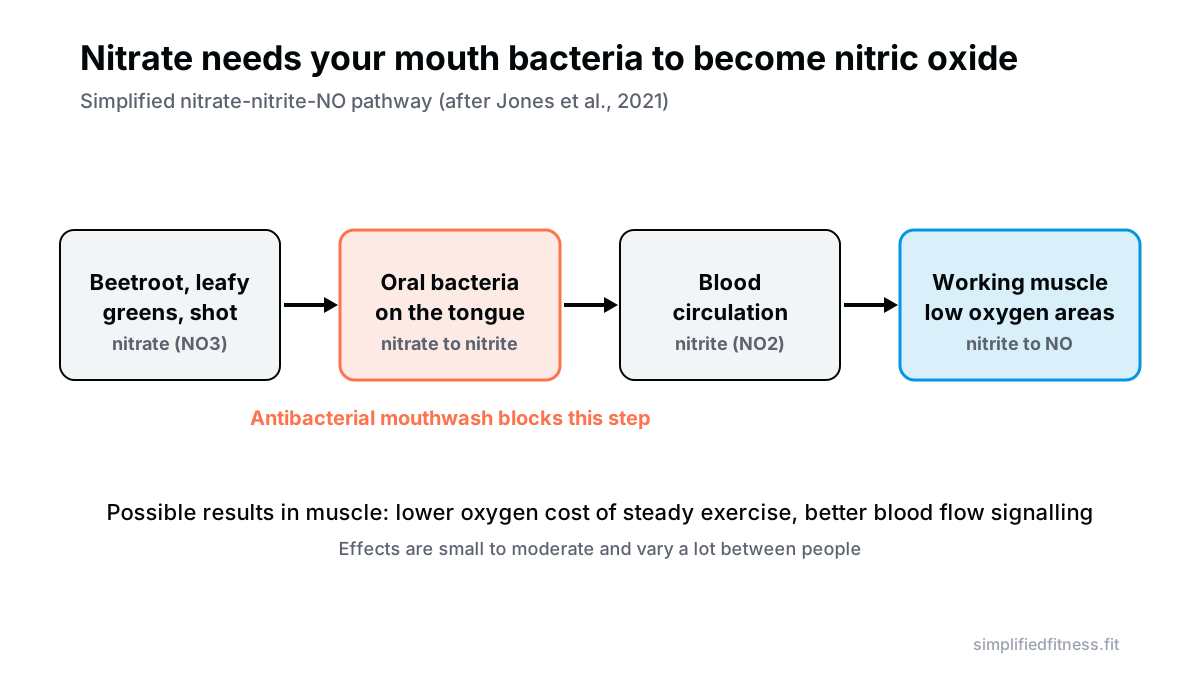
- You swallow nitrate (beetroot, spinach, a concentrated shot).
- Bacteria living in your mouth reduce nitrate to nitrite.
- Nitrite circulates in your blood.
- In low-oxygen areas, such as hard-working muscle, nitrite is reduced further to nitric oxide (NO).
That oral bacteria step is not a footnote. Jones and colleagues describe NO availability as “greatly enhanced” by mouth bacteria, and they argue the oral microbiome, circulation and skeletal muscle work as one integrated system (Jones et al., 2021).
This is a different route from the one used by L-citrulline, which feeds your body’s own NO synthase enzyme. If you want that comparison, see our piece on citrulline malate vs pure L-citrulline.
Why does it lower the oxygen cost of exercise?
This is the strangest finding in the area. In a small crossover study, eight men drank 500 mL a day of beetroot juice (a concentration of about 11.2 mM nitrate, so roughly 5.6 mmol a day) or a low-nitrate blackcurrant cordial placebo for six days (Bailey et al., 2009). On beetroot juice:
- Systolic blood pressure was lower (124 vs 132 mmHg).
- The rise in oxygen uptake at the start of moderate exercise (per watt of work) was 19% smaller.
- Time to exhaustion at a severe intensity was longer (675 vs 583 seconds).
Same work, less oxygen. How? A separate randomized crossover trial looked at muscle mitochondria after nitrate supplementation and found an improvement in oxidative phosphorylation efficiency, the P/O ratio, which correlated with the drop in oxygen cost during exercise (Larsen et al., 2011). In plain terms, mitochondria may produce a bit more ATP per unit of oxygen. The authors tied this to lower expression of a protein involved in proton leak.
Both studies are small and used healthy, young participants, so treat them as mechanism evidence, not a promise that you will feel faster.
Does beetroot juice for running improve performance? What meta-analyses say
Individual trials disagree, so look at the pooled data.
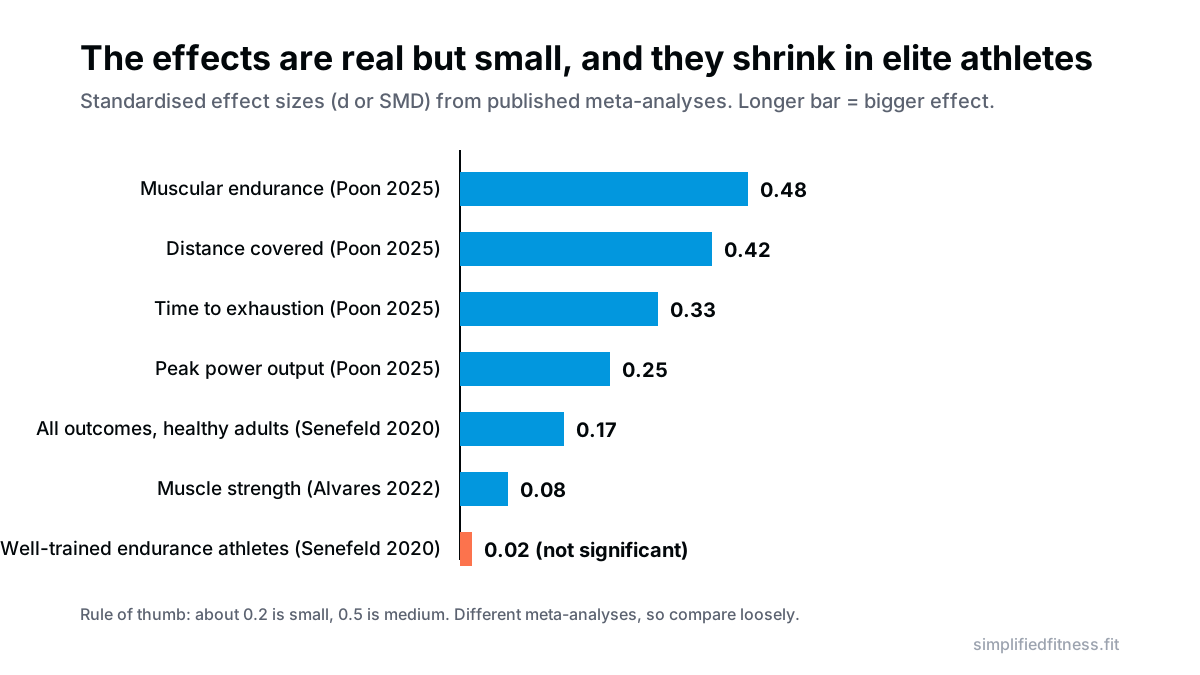
Endurance. A 2017 meta-analysis of 47 studies (76 trials) found a small to moderate benefit for time to exhaustion (effect size 0.33) but only a trivial, non-significant effect when all trials were pooled (McMahon et al., 2017). The authors concluded nitrate is more likely to help in capacity tests than in time-trial performance.
Fitness level matters. A 2020 meta-analysis of 80 studies found an overall ergogenic effect, but it was small (d = 0.174). It was not observed in well-trained endurance athletes (VO2max 65 mL/kg/min or higher) or in studies of only women (six studies) (Senefeld et al., 2020). The authors concluded that nitrate has more limited use in people with excellent aerobic fitness.
The big picture. A 2025 umbrella review of 20 meta-analyses (180 primary studies, 2,672 participants) reported benefits for time to exhaustion, total distance, muscular endurance, peak power output and time to peak power, with no significant effect on other outcomes. It also warned that most of the included reviews had low to critically low methodological quality (Poon et al., 2025).
For a recreational runner with a hard session or a 5-10 km race coming up, a small edge is plausible. If you are already running 60 km a week at a high VO2max, expect less. Our guides on concurrent training for 5K and 10K running and VO2 max training for lifters cover where the bigger gains are.
How much and when? Beetroot shot dose and timing
Most shots are sold in millilitres, but nitrate is what counts. Roughly 62 mg of nitrate equals 1 mmol.
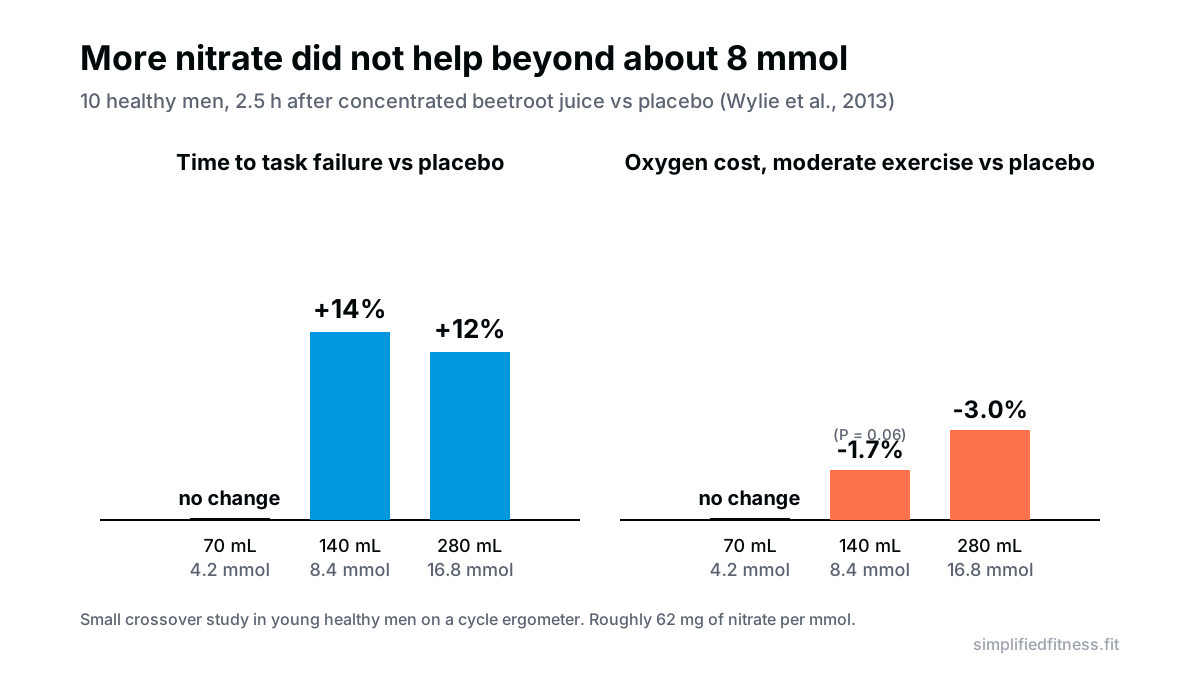
The best dose-response data come from 10 healthy men given 70, 140 or 280 mL of concentrated beetroot juice (4.2, 8.4 and 16.8 mmol nitrate) 2.5 hours before cycling (Wylie et al., 2013):
- Plasma nitrite rose in a dose-dependent way, peaking around 2-3 hours.
- 70 mL did not alter exercise responses.
- 140 mL and 280 mL extended time to task failure (14% and 12%). Oxygen cost fell by 1.7% and 3.0%, though only the 3.0% drop was statistically significant.
- There was no extra benefit from 16.8 mmol compared with 8.4 mmol.
The umbrella review points the same way, with larger time-to-exhaustion effects when the dose was at least 6 mmol per day (372 mg) and when supplementation lasted more than 3 days (Poon et al., 2025).
A practical, hedged protocol:
| Question | Evidence-based starting point |
|---|---|
| Dose | About 6-8 mmol nitrate (roughly 370-500 mg) |
| Acute timing | 2-3 hours before the session |
| Multi-day option | Daily for 3+ days before an event |
| Test it | On a hard training day, never first on race day |
| What to buy | A product that states the nitrate content in mg or mmol |
That last point is where most people go wrong. A “70 mL shot” tells you nothing unless the label gives the nitrate dose. The 70 mL shot in the dose-response trial contained only 4.2 mmol and did not change the exercise responses. Some other brands contain more. Read the label, and be wary of powders that do not state it.
Does beetroot juice help lifting? Power vs endurance
Here the picture is weaker. A 2022 meta-analysis of 34 studies found a trivial effect on muscular strength (SMD 0.08) and a small effect on muscular endurance (SMD 0.31), and described the effects as trivial to small (Alvares et al., 2022).
A 2023 meta-analysis limited to resistance-trained men and the back squat and bench press (six studies) found improved reps to failure (SMD 0.43), mean power (0.40) and mean velocity (0.57), but no effect on peak power or peak velocity. Squats looked more likely to benefit than bench press, and the authors noted the evidence base was limited and variable (Tan et al., 2023).
The newest trial points the other way for women. Eighteen resistance-trained women took about 6.7 mmol of nitrate 2.5 hours before explosive squat and bench sets. There was no improvement, and bench press mean power and velocity at 60% of 1RM were slightly lower with nitrate (Brennan et al., 2026). That is one small study, so do not read too much into it either way.
For lifters, the honest summary is: possibly a rep or two on higher-rep sets, little for heavy singles, and not a substitute for decent programming. If you have limited budget, creatine and plenty of protein come first (see the supplement hierarchy).
The mouthwash interaction: why your rinse can cancel the benefit
This is the part with an actual mechanism you can act on.
In a crossover trial of 12 healthy volunteers, people drank 70 mL of beetroot juice (6.2 mmol nitrate) twice a day for six days while rinsing three times daily with a strong chlorhexidine mouthwash, a weaker mouthwash, or water. Chlorhexidine reduced the rise in plasma nitrite compared with both other conditions, and even the weaker rinse reduced it compared with water (McDonagh et al., 2015). During treadmill walking, the blood pressure rise was higher in the chlorhexidine condition than in the water condition.
A second trial looked at the same bacteria without beetroot. In 23 healthy adults, an antibacterial mouthwash after exercise attenuated the post-exercise blood pressure drop by 61% at one hour and fully by two hours, and blocked the usual rise in circulating nitrite and the muscle oxygenation response (Clarke et al., 2019).
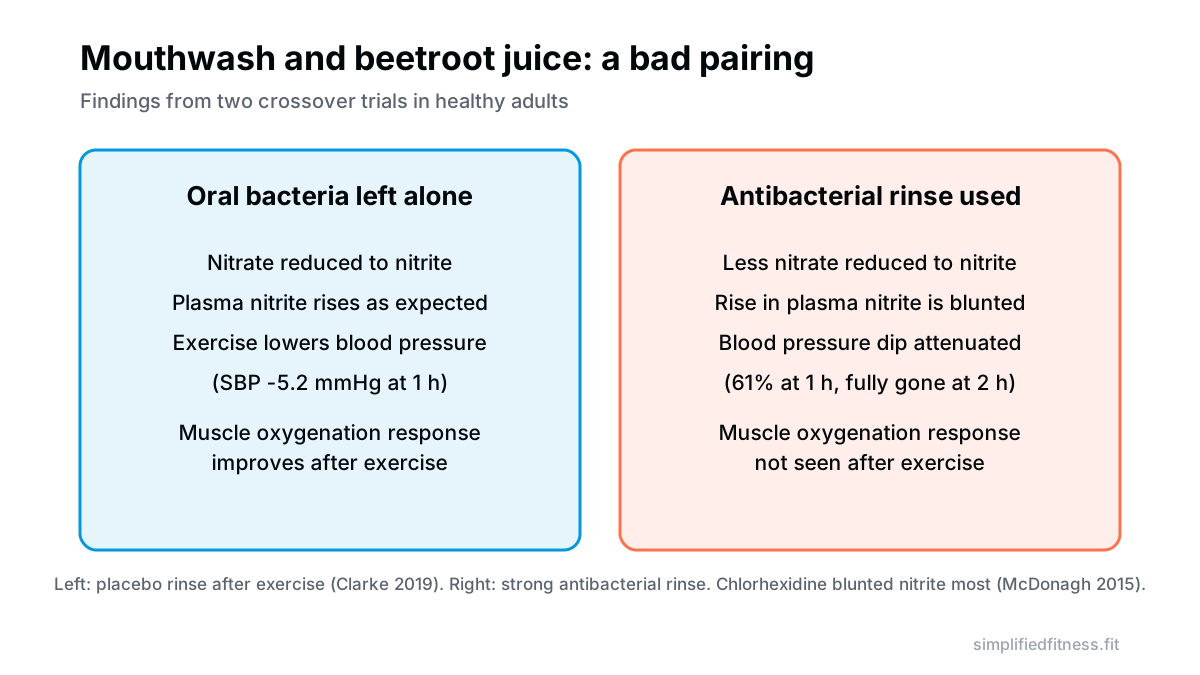
Neither trial tested race performance directly, so the link to your 10 km time is inferred from the mechanism. Still, the practical takeaway is simple:
- Skip chlorhexidine and other antibacterial rinses around beetroot doses.
- Do not rinse straight after your shot.
- If you need a medicated mouthwash for gum disease, do not stop it on a blog’s say-so. Ask your dentist how to time it.
I could not find a study that tests exactly how many hours apart is safe, so I will not invent a number.
Whole beets, shots or powders?
Format is mostly about how well you can control the dose.
- Concentrated shots: convenient and easy to dose if the nitrate content is on the label. More expensive per dose.
- Whole beets or home juice: cheap and good food, but the nitrate content varies widely and is not known to you.
- Powders: can work, but the nitrate content is often not stated. Without a number, you are guessing.
- Other vegetables: spinach, methi and other leafy greens add nitrate to your diet at almost no cost, though they are rarely tested as a performance dose.
Who should skip it or talk to a doctor first
Beetroot juice is food, and it is generally well tolerated, but a few cautions are sensible. Nitrate lowers blood pressure in some studies (Bailey et al. saw a drop of 8 mmHg in healthy men), so check with your doctor if you take blood pressure drugs, nitrate medicines (for example for angina), erectile dysfunction drugs such as sildenafil, or have low blood pressure. Beetroot is also high in oxalate, so ask a doctor if you have had kidney stones. Pink urine (beeturia) is common and harmless, but if you see unexplained blood or have pain, get checked and do not assume it is the beets.
None of this replaces medical advice, and the research here is mostly in healthy young adults, not in older people or people with conditions.
So should you use it?
Use a simple decision rule:
- Recreational runner, cyclist or rower with a key session coming up: worth a trial. Take about 6-8 mmol nitrate, 2-3 hours before, no antibacterial mouthwash.
- Highly trained endurance athlete: expect little. Test it in training and keep what you can measure.
- Lifter: low priority. Possible small help for higher-rep sets, little for max strength.
- On a tight budget: spend on protein, food and sleep first. Our free protein calculator and diet plan cover the basics.
Nitrate is a small, cheap-ish edge, not a transformation. If you like it and it fits your budget, use it well. If not, you lose very little.
Frequently Asked Questions
Does beetroot juice help with running?
It can help modestly, mainly by extending how long you can hold a hard steady effort. A 2017 meta-analysis found a small to moderate benefit for time to exhaustion, while the overall pooled effect was trivial and the authors judged time trials less likely to benefit. Try it on a hard training session first, not on race day.
How much beetroot juice should I drink before a workout?
Aim for roughly 6-8 mmol of nitrate (about 370-500 mg), not a fixed number of millilitres. In a dose-response trial, 140 mL of concentrated juice (8.4 mmol) improved time to task failure while 70 mL (4.2 mmol) did not. Check the nitrate content on the label, because brands vary widely.
When should I take a beetroot shot before a workout?
Take it about 2-3 hours before you train. Plasma nitrite peaked about 2-3 hours after drinking in the Exeter dose-response study, which is when the exercise effects were tested. Plan your breakfast or pre-training meal around that gap.
Does nitric oxide from beetroot give a muscle pump?
Not in the way gym marketing suggests. The nitrate route to nitric oxide changes oxygen use and blood flow signalling, but studies on lifting show only small, mixed effects, mostly on reps to failure rather than a visible pump. If a pump is your goal, a hard set close to failure with enough volume matters far more.
Can I use mouthwash while taking beetroot juice?
Antibacterial mouthwash can interfere. Chlorhexidine rinses disturbed oral bacteria and lowered the rise in plasma nitrite after beetroot juice in a 2015 crossover trial. Skip antibacterial rinses on days you use beetroot, or at least keep them well away from the dose, since no study I found tests exact spacing.
Why does mouthwash stop nitrate from working?
Your body cannot turn nitrate into nitrite on its own, so it relies on bacteria on the back of the tongue. Antibacterial rinses reduce that bacterial activity, so less nitrite enters the blood. Less nitrite means less nitric oxide available in muscle.
Is beetroot juice better than a beetroot powder or whole beets?
The nitrate dose matters more than the format. Concentrated shots are easiest to dose because the nitrate is printed on the label, while powders and whole beets vary a lot in content. Whole beets are cheap and fine for general health, but they are hard to dose precisely.
Does beetroot juice work for weightlifting?
Evidence is mixed and the effects are small. A 2023 meta-analysis of resistance-trained men found improved reps to failure and mean power in squat and bench press, but no change in peak power or peak velocity. A 2026 trial in resistance-trained women found no improvement from a single dose.
Do elite endurance athletes benefit from beetroot juice?
Probably less than recreational athletes. A large meta-analysis found no significant effect in well-trained endurance athletes (VO2max of 65 mL/kg/min or more). Highly fit people may already get most of the available benefit from training.
Does beetroot juice work for women?
Data in women are scarce and less convincing so far. The 2020 Senefeld meta-analysis found no significant effect in studies using only women, although only six such studies were included. Test it yourself with a trial run rather than assuming it will work.
Are there side effects of beetroot juice?
The most common harmless one is pink or red urine or stools, called beeturia. Beetroot is also high in oxalate and can lower blood pressure, so people with kidney stones, low blood pressure or nitrate medicines should ask a doctor first. Start with a small amount to see how your stomach handles it.
Do I need to take beetroot juice every day?
A single dose can work, but longer supplementation has looked more consistent. An umbrella review of 20 meta-analyses reported more pronounced time-to-exhaustion gains with at least 6 mmol per day (372 mg) and protocols longer than 3 days. For an event, many athletes dose for several days leading up to it.
Are green vegetables a nitrate source too?
Yes. Green leafy vegetables are the main dietary nitrate source, and palak (spinach), methi and lettuce all contribute. Beetroot juice is simply a convenient concentrated source for supplementation research. Regular vegetables support your baseline nitrate intake at almost no cost.
Sources & References
Every claim above is checked against peer-reviewed research (PubMed, U.S. National Library of Medicine) or guidance from established health bodies. How we fact-check.
- Jones AM, et al. Dietary nitrate and nitric oxide metabolism: mouth, circulation, skeletal muscle, and exercise performance. Med Sci Sports Exerc. 2021. PMID: 32735111
- Bailey SJ, et al. Dietary nitrate supplementation reduces the O2 cost of low-intensity exercise and enhances tolerance to high-intensity exercise in humans. J Appl Physiol. 2009. PMID: 19661447
- Larsen FJ, et al. Dietary inorganic nitrate improves mitochondrial efficiency in humans. Cell Metab. 2011. PMID: 21284982
- Wylie LJ, et al. Beetroot juice and exercise: pharmacodynamic and dose-response relationships. J Appl Physiol. 2013. PMID: 23640589
- McMahon NF, et al. The effect of dietary nitrate supplementation on endurance exercise performance in healthy adults: a systematic review and meta-analysis. Sports Med. 2017. PMID: 27600147
- Senefeld JW, et al. Ergogenic effect of nitrate supplementation: a systematic review and meta-analysis. Med Sci Sports Exerc. 2020. PMID: 32936597
- Poon ET, et al. Dietary nitrate supplementation and exercise performance: an umbrella review of 20 published systematic reviews with meta-analyses. Sports Med. 2025. PMID: 40085422
- McDonagh ST, et al. The effects of chronic nitrate supplementation and the use of strong and weak antibacterial agents on plasma nitrite concentration and exercise blood pressure. Int J Sports Med. 2015. PMID: 26332900
- Clarke C, et al. Post-exercise hypotension and skeletal muscle oxygenation is regulated by nitrate-reducing activity of oral bacteria. Free Radic Biol Med. 2019. PMID: 31369841
- Alvares TS, et al. Effect of dietary nitrate ingestion on muscular performance: a systematic review and meta-analysis of randomized controlled trials. Crit Rev Food Sci Nutr. 2022. PMID: 33554654
- Tan R, et al. Effects of dietary nitrate supplementation on back squat and bench press performance: a systematic review and meta-analysis. Nutrients. 2023. PMID: 37299456
- Brennan SN, et al. Dietary nitrate supplementation does not improve resistance exercise performance in resistance-trained women. Eur J Appl Physiol. 2026. PMID: 41931137

Umair Hazrami · Founder & Head Coach, Simplified Fitness
Umair Hazrami founded Simplified Fitness and the Simplified Lifter channel to cut through fitness noise. With 4+ years of consistent training and 10+ coaching clients, he writes every guide from the peer-reviewed research and links the sources so you can check them. Our editorial standards.
Educational content only, not medical advice. If you have a medical condition, are pregnant, or take medication, talk to a qualified doctor before changing your diet, supplements or training. Full disclaimer.
Keep reading

Supplements
Ashwagandha KSM-66 vs Sensoril: Which Extract, What Dose, and Do You Need to Cycle?
Ashwagandha KSM-66 vs Sensoril for lifters: what the strength trials show, realistic cortisol effects, liver safety and whether to cycle. Every study linked.
8 min read
Supplements
BCAAs vs EAAs: Why BCAAs Are a Waste of Money If Your Protein Is Covered
BCAA vs EAA for muscle growth: BCAAs are only 3 of the 9 essential amino acids. See what Wolfe 2017 and Jackman 2017 found and when EAAs or whey make sense.
8 min read

Supplements
Beta-Alanine Benefits: Carnosine Buffering, High-Rep Gains and Why It Makes You Tingle
Beta-alanine benefits explained: why pre-workout makes your skin tingle, how carnosine buffers acid, what dose works, and who should skip it. Studies linked.
8 min read

Supplements
Betaine (TMG) for Strength and Power: What the Research Really Shows
Does betaine build muscle or boost power? We review the trials and meta-analyses on betaine TMG, the 2.5 g dose, betaine vs creatine, and betaine HCl.
7 min read