Probiotics and Digestive Enzymes for Protein Absorption: Do Healthy Lifters Need Them?
Do enzymes or probiotics improve protein absorption in healthy lifters? What four human trials measured, where lactase helps, and the cheaper food fixes.
TL;DR. The short answer
- Healthy lifters do not need digestive enzyme pills for protein. The pancreas already makes protease, amylase and lipase, and the trials that exist measured blood amino acids after one meal, not muscle growth.
- Enzyme and probiotic studies show small, inconsistent shifts in blood amino acids, and several were run by or with companies that sell the product. Nobody has shown that those shifts turn into extra muscle.
- The one case where an enzyme clearly helps is lactose intolerance: lactase tablets, or switching to curd, kefir or whey isolate, can fix gas and bloating from milk and whey concentrate.
- Probiotics have modest, strain-specific evidence for IBS symptoms (mostly low certainty) and a possible small effect on fatigue in athletes. They are optional, not a protein booster.
- Persistent pain, blood in stool, unexplained weight loss or changed bowel habits need a doctor, not a supplement.
Part of our complete guide: The Evidence-Based Fitness Supplements Guide: What Works, What's Overhyped & What's a Waste of Money
Table of contents
Do enzyme pills or probiotics improve protein absorption? For healthy lifters, mostly no: they are a solution to a problem you do not have. Your pancreas already pours out protease, amylase and lipase, and the small trials on enzyme and probiotic pills show, at best, modest shifts in blood amino acids after a single meal. Nobody has shown those shifts become extra muscle.
That does not make every gut supplement useless. Lactase for lactose intolerance genuinely works, and some probiotics have a case for IBS symptoms. This article sorts the real uses from the marketing, as part of our evidence-based supplements guide.
Do healthy lifters need digestive enzymes for protein?
No, and the logic is simple. Protein digestion is not a bottleneck you can widen with a pill. Stomach acid and pepsin start the job, the pancreas releases proteases into the small intestine, and the gut lining finishes it off. Healthy young people carry plenty of spare capacity.
Think of a supplement as a spare key for a door that is already open.
The exceptions are real medical conditions, such as pancreatic insufficiency (seen in some people with chronic pancreatitis or cystic fibrosis) or lactase deficiency. Those are diagnosed, not guessed at in the supplement aisle. If that is you, a doctor decides the treatment, not a label that says “mega digest.” Our sister article on digestive enzymes during a bulk covers bloating on big calorie intakes; this one sticks to the protein absorption claim.
What do digestive enzymes and protein absorption studies actually show?
There are a few human trials, and they are worth reading carefully because the headlines overstate them.
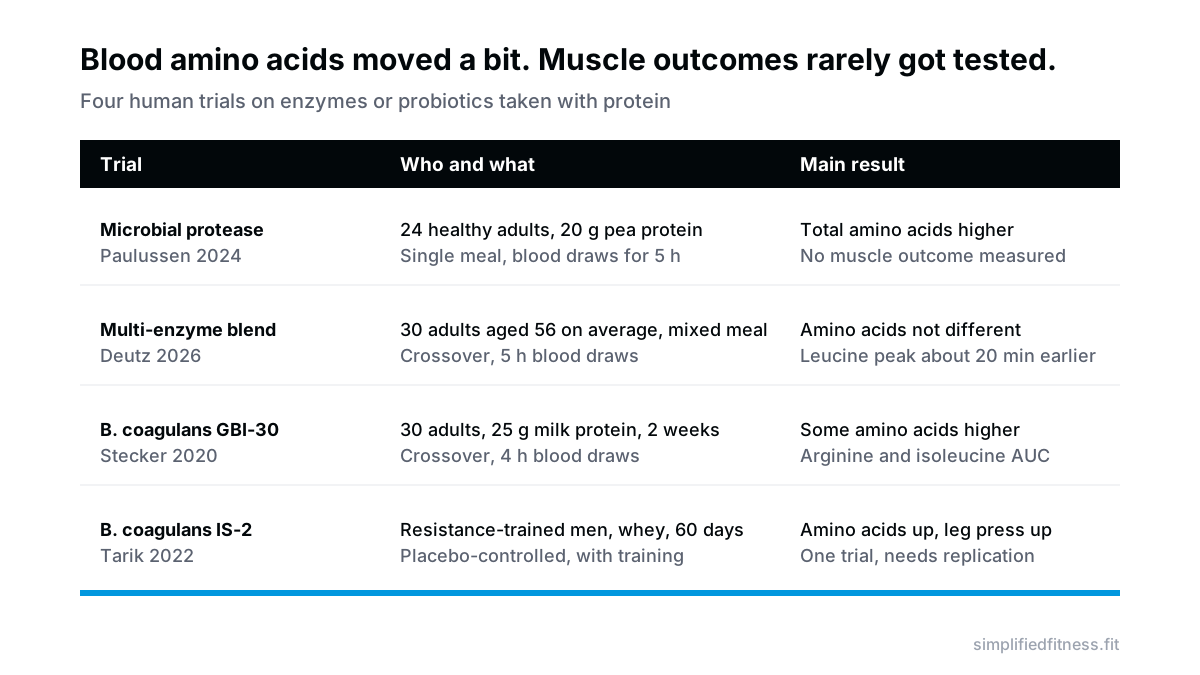
In a 2024 randomized, double-blind crossover trial, 24 healthy adults ate 25 g of pea protein isolate (20 g protein) with either a microbial protease mix or a maltodextrin placebo. Total amino acids in the blood were higher with the protease over five hours, and the early rise (0-2 h) was larger, but essential amino acids only showed a trend and leucine and BCAA did not differ (Paulussen et al., 2024). Authors from the company that makes the enzyme blend were involved.
Now the other side. A 2026 crossover trial gave 30 middle-aged and older adults (average 56) a chicken, peas, potato and butter meal with a six-enzyme blend or placebo. Plasma amino acids were not statistically different overall. Leucine peaked about 20 minutes sooner with the enzymes (121 versus 141 min), and glucose and fatty acids were higher (Deutz et al., 2026). This study was funded by the enzyme manufacturer too. The authors report the timing shift was strongest in people with lower BMI and more lean mass, an exploratory finding that has not been tested in lifters.
Why the mixed picture? Different enzymes, different proteins (pea is less digestible than animal protein, so there is more room to improve it), different people and different meals. A cautious reading: plant protein might gain slightly from added protease, and mixed meals in healthy adults show little change.
Do probiotics improve protein absorption?
A 2020 trial in 30 young adults tested Bacillus coagulans GBI-30 added to a 25 g milk protein dose for two weeks, with a washout and crossover design. Arginine and isoleucine showed a greater area under the curve with the probiotic, and several other amino acids hit higher peaks or peaked sooner (Stecker et al., 2020). The authors declared no competing interests, but blood measures are all it tested.
A second trial, in resistance-trained men, is the one supplement brands love to cite. Participants took whey protein with Bacillus coagulans Unique IS-2 (2 billion CFU) or whey with lactose placebo once daily for 60 days alongside controlled resistance training. Total plasma free amino acids were 16.1% higher in the probiotic group, BCAA 33.1% higher, and the probiotic group improved one-rep-max leg press by 16.61% and vertical jump power by 7.86% (Tarik et al., 2022).
That sounds impressive. Here is the catch: it is one trial, in one strain, and findings like this need replication by independent groups before you build a purchase around them.
When do digestive supplements legitimately help?
Lactose intolerance is the clearest case. Many adults produce less lactase, the enzyme that splits milk sugar. Undigested lactose reaches the colon, gets fermented and causes gas, bloating and loose stools. A systematic review notes the severity depends on dose, residual lactase, other foods eaten, transit time and the gut microbiome, and that many people tolerate yogurt and cheese better than milk (Leis et al., 2020).
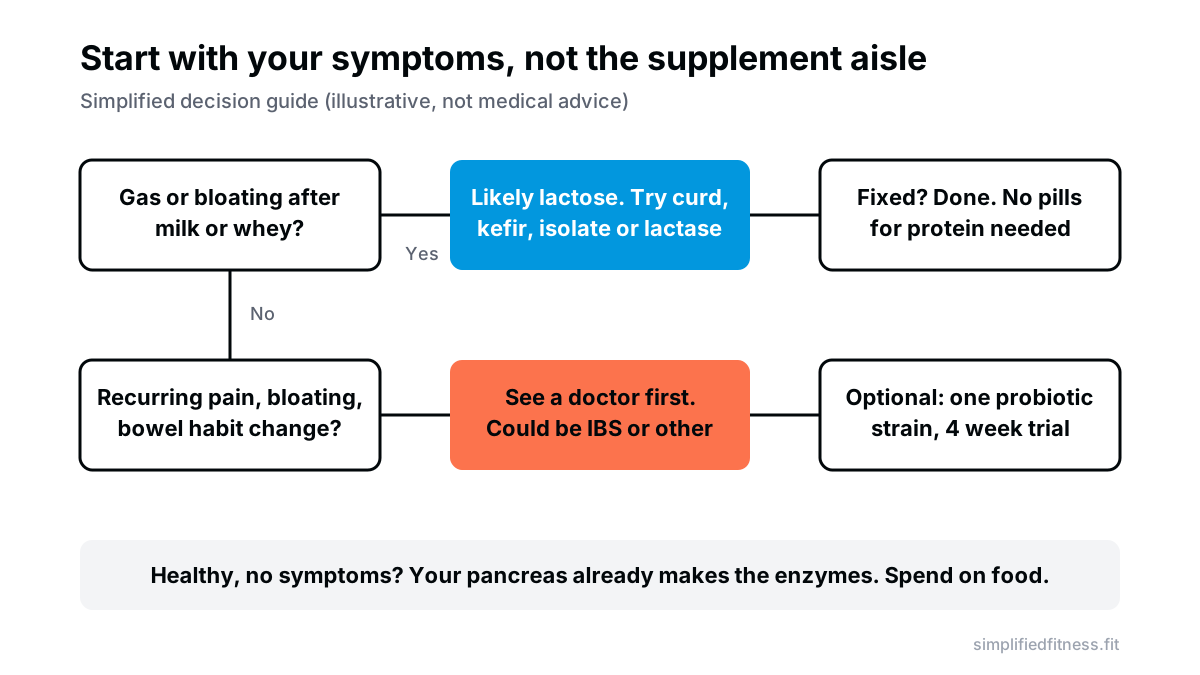
This matters for lifters because whey concentrate and milk-based mass gainers carry lactose. If your 2 pm shake leaves you gassy, you probably do not need a “digestive blend.” You need a different protein, or lactase.
Three practical fixes, cheapest first:
- Switch to curd, hung curd or paneer, which are often easier than milk.
- Try whey isolate, which has much less lactose than concentrate (see our guide on isolate versus concentrate and lactose).
- Take a lactase tablet with the first sip of the shake. In a New Delhi crossover trial of 47 adults with breath-test-confirmed lactose intolerance, lactase tablets improved symptoms and cut breath hydrogen by 55% compared with placebo (Baijal and Tandon, 2021).
If symptoms keep happening, ask a doctor about a breath test rather than self-diagnosing.
Are curd and kefir enough instead of probiotic pills?
For lactose symptoms, food is competitive. In a randomized study where each of 15 adults with lactose maldigestion tried every option, people ate 20 g lactose portions as milk, kefir or yogurt. Breath hydrogen (a marker of fermentation) was 224 ppm x h for milk, 76 for plain yogurt and 87 for plain kefir. Flatulence severity was 54% to 71% lower than with milk (Hertzler et al., 2003).
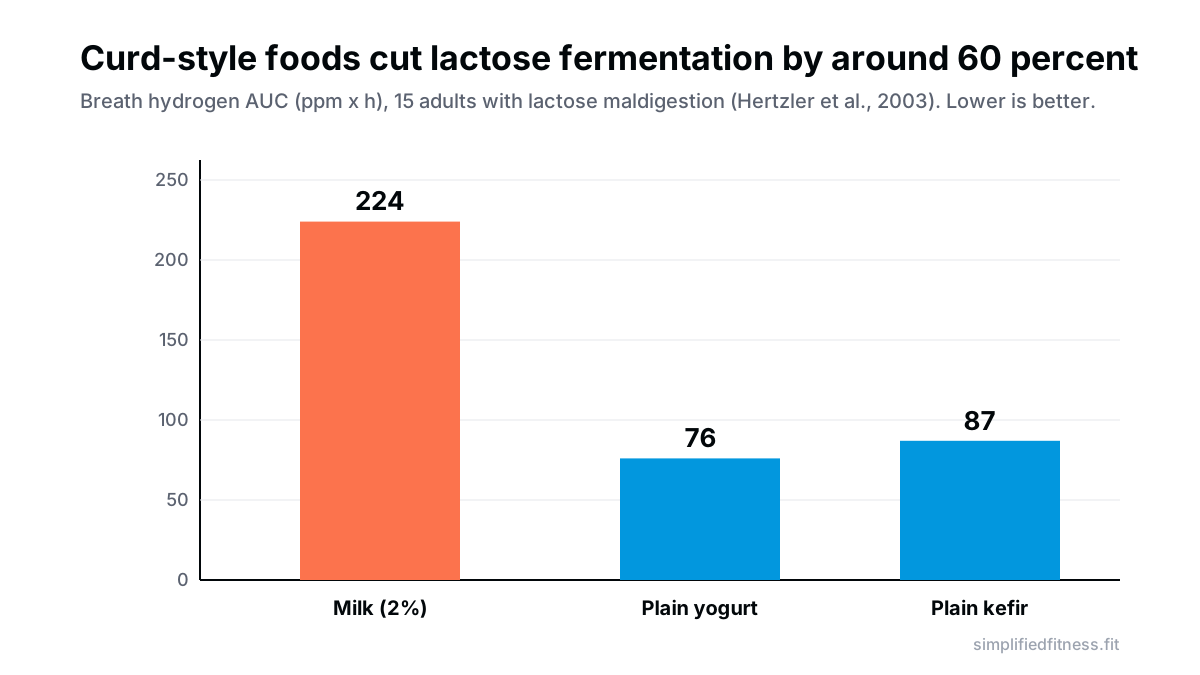
In India, plain dahi, chaas and hung curd fit this neatly. They also bring protein, calcium and calories, which a capsule cannot. One caveat: the study was small and short, and cultures differ from home-set dahi to branded products, so effects will vary.
Do lifters need probiotics?
Not for protein. For gut comfort, maybe, but it depends on the problem.
IBS symptoms. A 2023 systematic review and meta-analysis pooled 82 randomized trials with 10,332 patients with IBS. Some strains and mixtures looked helpful, but certainty was low or very low across almost all analyses; Escherichia strains had moderate certainty for global symptoms. Adverse events were not significantly higher with probiotics (Goodoory et al., 2023). Translation: a trial of a single strain is reasonable, but it is not a proven fix.
Athletic fatigue and GI upset. A 2024 systematic review of 13 randomized trials (513 participants) found that probiotics may reduce perceived fatigue at a minimum of 15 billion CFU daily for at least 28 days (Kearns et al., 2024). Studies varied in strain, dose and exercise protocol, so this is a “might help” at best.
If you want to try one:
- Pick a single product with a named strain and a CFU count on the label.
- Use it daily for four weeks.
- Track one thing, such as bloating or stool regularity, in a notes app.
- Stop if nothing changes. Do not stack three gut products at once.
Check labels for third-party testing too; our guide to certifications like NSF and Informed Choice explains what the logos mean, and our post on proprietary blends shows why a vague label is a red flag.
What should a lifter on a high-protein diet fix first?
When people say “my gut feels off on high protein,” the cause is rarely missing enzymes. Look here first:
- Lactose: shakes made from concentrate, milk-heavy gainers, big bowls of paneer.
- Fibre: a very high protein, low fibre plate (lots of chicken, eggs, whey, little dal, sabzi or fruit) slows things down. See our fibre and gut health guide.
- Sweeteners and sugar alcohols: common in protein bars and flavoured powders.
- Portion size: 60 g of protein in one sitting feels different from 30 g, and our post on protein absorption ceilings covers what actually limits uptake.
- Hydration and heat: a hot Indian summer plus low fluid intake can change stool consistency.
- Eating speed: gulping a shake right after a hard session is not kind to the stomach.
For the full gut-side picture, our gut microbiome and bloating article goes deeper, and our look at probiotics for athletes covers immunity and training-block uses. To check you are actually eating enough protein before blaming digestion, use our protein calculator.
When to see a doctor
Supplements should not be the first response to ongoing symptoms. See a doctor if you notice:
- blood in stool or black stools
- unexplained weight loss
- diarrhoea or pain lasting more than a couple of weeks
- symptoms that wake you at night
- a sudden, lasting change in bowel habit
- fatty, floating, foul stools (which can point to fat malabsorption)
These need testing. Coeliac disease, pancreatic problems and other conditions are not solved by a capsule, and a supplement can hide the signal.
The bottom line
For a healthy lifter, the best “digestive supplement” is a sensible plate: enough fibre, protein spread across meals, plain curd or kefir if milk bothers you, and a protein powder your gut tolerates. Use lactase if lactose is the confirmed trigger. Try one probiotic strain for a month if you are curious, then judge it by symptoms. Keep the budget for protein, sleep and training. For where all of this sits among the supplements worth buying, see our supplement hierarchy, and build your meals around a free diet plan.
Frequently Asked Questions
Do digestive enzymes help with protein absorption?
In healthy people the evidence is thin. A 2024 trial in 24 healthy adults found a microbial protease raised total blood amino acids after pea protein, but a 2026 trial in 30 middle-aged and older adults found no difference in plasma amino acids with a six-enzyme blend. If your digestion is fine, spend the money on food and protein you already enjoy.
Do lifters need digestive enzymes?
Generally no, because the healthy pancreas, stomach and gut brush border already produce what is needed to break down protein, starch and fat. Supplements are designed for people with a real deficiency, such as pancreatic insufficiency or lactase deficiency. Fix your protein source, portion size and meal timing before buying pills.
Do probiotics help build muscle?
There is no solid evidence that probiotics build muscle in healthy lifters. One 60-day trial in resistance-trained men taking whey with Bacillus coagulans reported higher blood amino acids and better leg press and vertical jump, but it is a single trial and needs replication. Treat probiotics as a gut comfort experiment, not a muscle supplement.
Can probiotics make you absorb more protein?
Possibly a little, in blood measures only. A 2020 crossover trial of Bacillus coagulans GBI-30 with 25 g milk protein found higher area under the curve for arginine and isoleucine, not for most other amino acids. Higher blood levels do not prove more muscle protein synthesis, so do not rely on it.
Why does whey protein make me bloated?
The most common reason is lactose, the milk sugar left in whey concentrate, which people with low lactase ferment in the colon and turn into gas. Whey isolate, curd or kefir, or a lactase tablet with the shake often settles it. If bloating persists with lactose-free protein, speak to a doctor.
Do lactase enzymes work for lactose intolerance?
Yes, this is the clearest use for an enzyme supplement. Lactase replaces the missing enzyme, and a crossover trial in 47 Indian adults with breath-test-confirmed lactose intolerance found lactase tablets improved symptoms and cut breath hydrogen by 55% versus placebo. Take it with the first sip of milk or the shake, and confirm the diagnosis with a doctor if symptoms are frequent.
Are curd and kefir better than probiotic pills?
For lactose symptoms, they work well. In 15 adults with lactose maldigestion, plain yogurt and plain kefir cut breath hydrogen to roughly a third of milk's level. They also give you protein, calcium and calories, which pills do not, so food first is a sensible default.
Which probiotic is best for IBS?
No single product wins. A 2023 meta-analysis of 82 trials (10,332 patients) found that certainty was low to very low for almost every strain or mixture, with moderate certainty only for Escherichia strains on global symptoms. If you try one, pick one strain, use it for about four weeks, and stop if nothing changes.
Are probiotics safe to take every day?
For most healthy adults, yes. The IBS meta-analysis found no significantly higher risk of adverse events with probiotics across 55 trials. People who are immunocompromised, critically ill or have central lines should only use them under medical advice.
Do high-protein diets damage gut health?
The evidence is not clear enough to say that, and effects depend on the protein source and the rest of the diet. Lifters who feel gassy on very high protein often improve by adding fibre from dal, vegetables and fruit, spreading protein across meals and checking for lactose. Persistent symptoms deserve a doctor visit.
Can I take digestive enzymes and probiotics together?
You can, but it makes any result impossible to interpret. If symptoms change you will not know which product did it, and neither has strong evidence for healthy lifters. Change one thing at a time for about four weeks, and keep notes on bloating and stool regularity.
When should I see a doctor about digestion problems?
See a doctor for blood in stool, black stools, unexplained weight loss, ongoing diarrhoea, night-time symptoms, severe pain or a sudden change in bowel habits. Supplements can mask a problem that needs testing, such as coeliac disease or pancreatic disease. Get checked before layering pills on top of symptoms.
Is a probiotic worth it during a heavy training block?
It might help a little with fatigue and gut upset, but the evidence is modest. A 2024 systematic review of 13 trials suggested at least 15 billion CFU daily for 28 days or more may reduce perceived fatigue. Try it only if you are prone to stomach trouble, and judge it after a month.
Sources & References
Every claim above is checked against peer-reviewed research (PubMed, U.S. National Library of Medicine) or guidance from established health bodies. How we fact-check.
- Paulussen KJM, et al. Acute Microbial Protease Supplementation Increases Net Postprandial Plasma Amino Acid Concentrations After Pea Protein Ingestion in Healthy Adults: A Randomized, Double-Blind, Placebo-Controlled Trial. J Nutr. 2024. PMID: 38467279
- Deutz MT, et al. Oral Multienzyme Supplementation Alters Postprandial Plasma Nutrient Concentrations after a Mixed Meal in Healthy Middle-Aged and Older Adults: A Randomized, Double-Blind, Placebo-Controlled, Crossover Trial. J Nutr. 2026. PMID: 41662956
- Stecker RA, et al. Bacillus coagulans GBI-30, 6086 improves amino acid absorption from milk protein. Nutr Metab (Lond). 2020. PMID: 33110439
- Tarik M, et al. The effect of Bacillus coagulans Unique IS-2 supplementation on plasma amino acid levels and muscle strength in resistance trained males consuming whey protein: a double-blind, placebo-controlled study. Eur J Nutr. 2022. PMID: 35249118
- Goodoory VC, et al. Efficacy of Probiotics in Irritable Bowel Syndrome: Systematic Review and Meta-analysis. Gastroenterology. 2023. PMID: 37541528
- Hertzler SR, et al. Kefir improves lactose digestion and tolerance in adults with lactose maldigestion. J Am Diet Assoc. 2003. PMID: 12728216
- Leis R, et al. Effects of Prebiotic and Probiotic Supplementation on Lactase Deficiency and Lactose Intolerance: A Systematic Review of Controlled Trials. Nutrients. 2020. PMID: 32443748
- Baijal R, Tandon RK. Effect of lactase on symptoms and hydrogen breath levels in lactose intolerance: A crossover placebo-controlled study. JGH Open. 2021. PMID: 33490624
- Kearns RP, et al. Do probiotics mitigate GI-induced inflammation and perceived fatigue in athletes? A systematic review. J Int Soc Sports Nutr. 2024. PMID: 39193818

Umair Hazrami · Founder & Head Coach, Simplified Fitness
Umair Hazrami founded Simplified Fitness and the Simplified Lifter channel to cut through fitness noise. With 4+ years of consistent training and 10+ coaching clients, he writes every guide from the peer-reviewed research and links the sources so you can check them. Our editorial standards.
Educational content only, not medical advice. If you have a medical condition, are pregnant, or take medication, talk to a qualified doctor before changing your diet, supplements or training. Full disclaimer.
Keep reading

Supplements
Ashwagandha KSM-66 vs Sensoril: Which Extract, What Dose, and Do You Need to Cycle?
Ashwagandha KSM-66 vs Sensoril for lifters: what the strength trials show, realistic cortisol effects, liver safety and whether to cycle. Every study linked.
8 min read
Supplements
BCAAs vs EAAs: Why BCAAs Are a Waste of Money If Your Protein Is Covered
BCAA vs EAA for muscle growth: BCAAs are only 3 of the 9 essential amino acids. See what Wolfe 2017 and Jackman 2017 found and when EAAs or whey make sense.
8 min read
Supplements
Beetroot Juice for Running and Lifting: How Dietary Nitrate Works (and the Mouthwash Trap)
Does beetroot juice for running actually work? See what meta-analyses show, the 2-3 hour timing and dose, who benefits, and why mouthwash can cancel the effect.
9 min read

Supplements
Beta-Alanine Benefits: Carnosine Buffering, High-Rep Gains and Why It Makes You Tingle
Beta-alanine benefits explained: why pre-workout makes your skin tingle, how carnosine buffers acid, what dose works, and who should skip it. Studies linked.
8 min read