Do Natural Testosterone Boosters Work? Tribulus, Tongkat Ali, Fadogia and D-AA Audited
Do natural testosterone boosters work? We audit tribulus, D-aspartic acid, tongkat ali and fadogia against human trials, plus what really moves testosterone.
TL;DR. The short answer
- Most over-the-counter test boosters fail to raise testosterone. A 2024 systematic review of 52 studies found that most of the 27 proposed boosters did not increase total testosterone versus placebo.
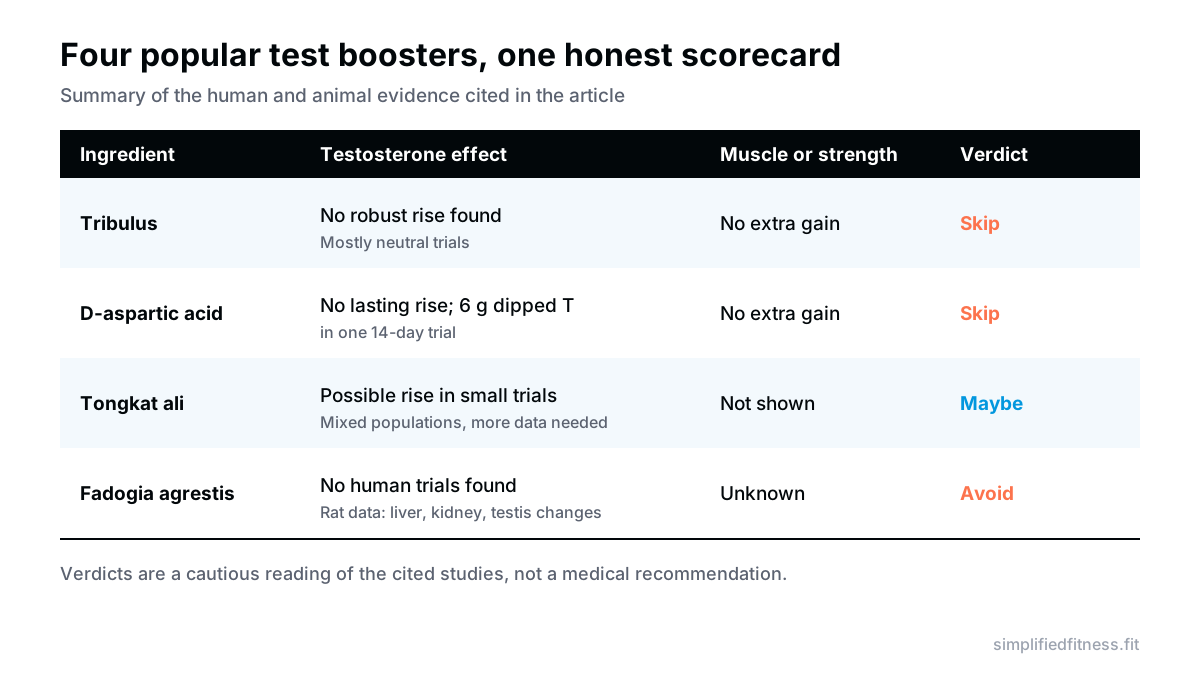
- Tribulus has no clear testosterone effect in humans, and D-aspartic acid did not help trained lifters; 6 g a day actually lowered testosterone in one 14-day trial.
- Of the four, tongkat ali is the only one with a plausible signal, from a handful of small trials in healthy men and men with low testosterone. It is not shown to build extra muscle.
- Fadogia agrestis has rat data showing liver, kidney and testicular changes and no human safety trials that I could find. Avoid it.
- If you suspect low testosterone, get a blood test and see a doctor. Sleep, a sensible body fat level and hard training matter far more than any capsule.
Part of our complete guide: The Evidence-Based Fitness Supplements Guide: What Works, What's Overhyped & What's a Waste of Money
Table of contents
So, do natural testosterone boosters work? For healthy men, mostly no. This audit sits inside our evidence-based supplement guide. A 2024 systematic review covering 52 studies and 27 proposed boosters concluded that most of them fail to increase total testosterone versus placebo (Morgado et al., 2024). Below, we go ingredient by ingredient: tribulus, D-aspartic acid, tongkat ali and fadogia.
The hope behind these pills is simple. If testosterone drives muscle growth, a capsule that lifts it should get you “mildly steroid-level” gains. The problem sits in both halves of that sentence, and we will take them in turn.
What these pills promise, and what the research asks of them
A booster needs to clear two hurdles. First, it has to raise testosterone in men whose levels are already normal. Second, that rise has to translate into more strength or muscle than lifting alone gives you.
Most products never get tested as a finished product. The label lists a blend of ingredients, while any proof (when it exists) is for single ingredients at specific doses, so a trial on one herb does not vouch for the pill you hold.
Does tribulus terrestris raise testosterone?
Tribulus is probably the most heavily marketed of the lot, and it has the weakest case.
A 2014 systematic review looked for randomized trials in healthy people. A few animal studies showed higher testosterone, but in humans an effect only appeared when tribulus was part of a combined supplement, and the authors concluded that it appears ineffective for raising testosterone, so marketing claims are unsubstantiated (Qureshi et al., 2014).
A 2025 systematic review reached a similar place. Of 10 eligible studies (483 participants in total), 8 reported no significant change in androgens, and the two that saw a rise in total testosterone involved men with hypogonadism and a small increase of 60-70 ng/dL. Half the studies were of low methodological quality (Vilar Neto et al., 2025).
There is one wrinkle worth being fair about. In that same review, tribulus at 400-750 mg a day for 1-3 months improved erectile dysfunction in 3 of the 5 studies that measured it, though the authors call the evidence level low. So the “aphrodisiac” reputation has a thread of support. But better erections or libido are not the same thing as higher testosterone, and neither one builds muscle.
D-aspartic acid: a spike that does not survive contact with lifters
D-aspartic acid (D-AA) got its reputation from an early finding of higher testosterone in sedentary, untrained men. The lifter trials are where that story falls apart.
In a 2015 trial, 24 men with at least two years of lifting experience took 3 g, 6 g or placebo for 14 days. The 3 g dose did nothing. The 6 g dose actually reduced total testosterone and free testosterone (Melville et al., 2015). The authors note that what this drop means for strength and size was unknown.
Then came the longer test. In 2017, 22 resistance-trained men took 6 g a day or placebo through 12 weeks of supervised training. Basal total and free testosterone did not change, and both groups gained similar strength and muscle size. The D-AA group did show a 16% fall in estradiol, which is of unclear meaning (Melville et al., 2017).
Put together: any benefit seen in untrained men does not appear in trained ones, and in the best test we have, the training did all the work. A caution on scope. These are small trials (22 to 24 men), so I would not claim D-AA is harmful. I would just not pay for it.
Tongkat ali: the only one with a real signal
Tongkat ali (Eurycoma longifolia) deserves a more careful answer, because the picture is mixed rather than empty.
On the positive side, a 2022 meta-analysis of five randomized trials reported a significant increase in total testosterone in men taking tongkat ali (SMD = 1.352, 95% CI 0.565 to 2.138), also seen in the subgroup with hypogonadism. The authors say it may be promising, particularly in hypogonadal men, but that more research is required before clinical use (Leisegang et al., 2022). The 2024 booster review also graded it as possibly effective for men with late-onset hypogonadism and for healthy men (Morgado et al., 2024).
Now the caveats. Only five trials were pooled, and the effect size is large enough that I would treat it cautiously: small studies often overstate. The pooled trials mixed healthy volunteers and men with hypogonadism, and the effect was confirmed in the hypogonadal subgroup, so it does not tell you that a healthy 24-year-old lifter with normal levels will see the same rise. And a higher blood number is not the same as more muscle.
Nothing I found shows an extra muscle benefit in lifters, and the meta-analysis above measured testosterone, not muscle or strength.
For completeness, the 2024 review also rated ashwagandha (Withania somnifera) as possibly effective in healthy men, though it was built on only three studies (Morgado et al., 2024). We cover it in our ashwagandha evidence review.
The honest summary: tongkat ali is the one ingredient where a curious, healthy adult might reasonably say “the signal is not nothing”. It is not a muscle builder, and it is not a substitute for testing if you actually think your levels are low.
Fadogia agrestis: the one I would avoid
Fadogia became popular through social media, usually stacked with tongkat ali. The problem is what is missing.
I could not find any human trial establishing its safety. The data that exist are from rats. In a 28-day study in male rats at 18, 50 and 100 mg/kg, a fadogia stem extract lowered several enzyme activities in the liver and kidney while raising them in the blood, and the authors suggested it disrupted the plasma membranes of liver and kidney cells (Yakubu et al., 2009). The same group’s separate 28-day rat study at the same doses reported changes in testicular function markers that they interpreted as adverse, with recovery after stopping seen mainly at the lowest dose (Yakubu et al., 2008).
Two honest limits apply. Rats are not men, and doses in mg/kg do not map neatly onto a capsule. But that cuts both ways: with no human safety data, nobody can tell you what a safe dose is. When a supplement has toxicity signals in animals and no human safety trial, “avoid” is the reasonable default, particularly if you have any kidney or liver concern.
The label problem nobody mentions
Even when an ingredient has some evidence, the bottle may not match the trial. Proprietary blends hide doses. If you want to read labels properly, our guide on decoding proprietary blends and under-dosing tricks shows what to look for. If you do buy any supplement, prefer products with independent testing; we cover that in third-party supplement certifications.
What actually supports healthy testosterone
Here is the part that is boring and works. These do not push a healthy man above his natural ceiling, but they stop you from sitting below it.
- A healthy body fat level. A meta-analysis of 24 studies found that weight loss through a low-calorie diet or bariatric surgery was associated with higher total testosterone, with larger rises in those who lost more weight, and in younger, non-diabetic men with greater obesity (Corona et al., 2013). That evidence is in men with obesity, so it does not mean that getting leaner than average will push you further up.
- Not crash dieting. Very low calories and very lean physiques for long periods can leave you tired and flat. Our piece on optimal body fat ranges covers the sensible zone.
- Regular, adequate sleep. Research linking sleep to testosterone is not unanimous, so I would not oversell it. Sleep still matters for training and recovery regardless; see our sleep and recovery guide.
- Enough zinc from food if you are low. Zinc deficiency is linked with lower testosterone, and the benefit of extra zinc seems to depend on where you start. If you eat dal, chickpeas, curd, eggs and the occasional meat, you may already be covered. We go deeper in zinc and testosterone.
- Lifting hard, but not for the hormone spike. Progressive overload builds muscle. In 56 young men training for 12 weeks, the post-workout rise in free testosterone did not correlate with gains in lean mass or leg press strength (West and Phillips, 2012). More in our piece on post-workout hormone spikes.
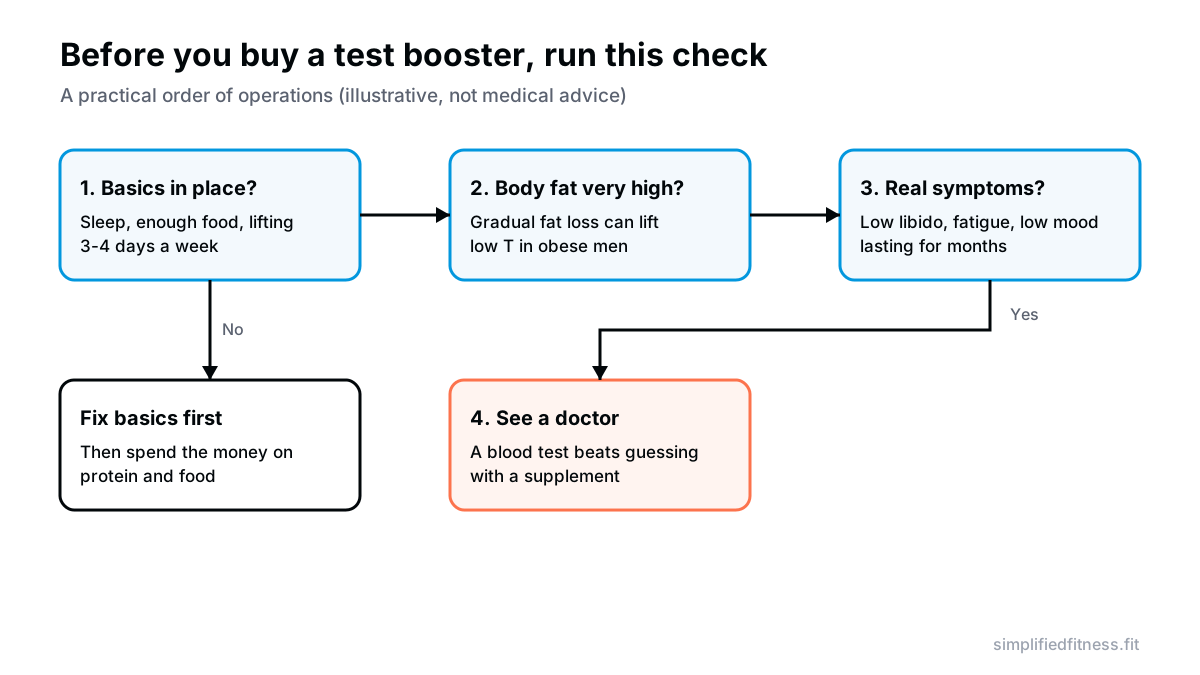
If you want the practical side, start with a sensible free training plan and work out your protein with the protein calculator. Most men asking about boosters are one or two of these basics away from feeling better.
When to see a doctor
Low testosterone is a medical diagnosis. Persistent low libido, fatigue that does not improve, low mood, loss of morning erections, or difficulty with fertility are reasons to book an appointment, not to try a capsule. Symptoms overlap with poor sleep, stress, thyroid problems and depression, so a morning blood test and a proper history matter. Also speak to your doctor before using any herbal product if you take medication or have kidney, liver or hormonal conditions.
Anyone under 18 should not be taking these products at all.
The bottom line
Natural test boosters mostly do not do what the label implies in healthy lifters. Tribulus and D-aspartic acid have the weakest records in the trials covered here. Tongkat ali is the single ingredient with a plausible, still-uncertain signal, and fadogia has no human safety data to stand on. A supplement can legitimately help only when it has trial evidence in people like you, at a dose you can verify, from a product you can trust.
For muscle, the real levers are boring: lift with progression, eat enough protein, sleep, and keep body fat in a healthy range. If you are curious about the supplements that do hold up, see where each one lands in our supplement hierarchy.
Frequently Asked Questions
Do natural testosterone boosters work?
Mostly no, at least not in healthy men. A 2024 systematic review of 52 studies on 27 proposed boosters found that most failed to raise total testosterone versus placebo. If your testosterone is normal, put the money into protein, food and sleep instead.
Does tribulus terrestris increase testosterone?
Not in any way that has been convincingly shown in humans. A 2014 systematic review concluded that tribulus appears ineffective for raising testosterone, and a 2025 review found 8 of 10 trials reported no significant androgen change. Some men report better libido, but that does not mean more testosterone or more muscle.
Does D-aspartic acid raise testosterone in lifters?
Not in trained men. A 12-week trial of 6 g a day found no change in testosterone and no extra strength or muscle, and a 14-day trial found 6 g a day reduced total and free testosterone. Skip it unless a doctor has told you otherwise.
Does tongkat ali work for bodybuilding?
It has a possible testosterone signal but no proven muscle benefit. A 2022 meta-analysis of five randomized trials reported higher total testosterone with tongkat ali, yet those trials measured testosterone, not muscle or strength. Treat it as an experiment with uncertain returns, not a growth tool.
Is fadogia agrestis safe?
Human safety has not been established. The available data come from rats, where 28-day studies of a stem extract found changes in testicular function markers and signs the authors read as damage to liver and kidney cell membranes. Because I could not find a human safety trial, the cautious answer is to avoid it.
Why do test booster ads show before and after photos?
Photos are not evidence. Lighting, pumps, tans, weight changes and months of training explain most visible changes, and ingredient evidence does not automatically carry over to a finished product. Judge a product by controlled trials, not by marketing images.
What actually increases testosterone naturally?
Fixing the basics. A meta-analysis found weight loss raised testosterone in men with obesity, and regular sleep, adequate food and treating medical problems support normal levels. These steps restore your baseline; none will push a healthy man far above it.
Does lifting heavy raise testosterone permanently?
Training can bump hormones briefly after a session, but in a study of 56 young men over 12 weeks, the size of the post-workout free testosterone rise did not correlate with gains in lean mass or strength. Do not chase the spike. Focus on progressive overload, enough protein and recovery.
How do I know if I have low testosterone?
Symptoms like low libido, persistent fatigue, low mood or loss of morning erections can be hints, but they overlap with sleep problems, stress and other conditions. Only a morning blood test ordered by a doctor can confirm it. Do not self-diagnose from a supplement ad.
Can test boosters cause side effects?
Yes, mainly through unknown dosing, contamination or ingredients with weak safety data. Doses on a label may not match the studies, and herbal ingredients like fadogia have no human safety data. If you take medication or have kidney, liver or hormone-related conditions, speak to your doctor first.
Are testosterone boosters the same as steroids?
No. Herbal boosters are marketed to nudge your own hormone production, while anabolic steroids are synthetic hormones that act directly on androgen receptors. The catch is that boosters mostly do not deliver even a small nudge in healthy men, so expecting steroid-like results is unrealistic.
Is a test booster worth the money for a natural lifter in India?
For most people, no. A booster capsule often costs more per month than the extra paneer, eggs or soya chunks that would help you reach your protein target. Spend on food first, and use our protein calculator to see whether you are actually hitting your number.
Sources & References
Every claim above is checked against peer-reviewed research (PubMed, U.S. National Library of Medicine) or guidance from established health bodies. How we fact-check.
- Morgado A, et al. Do testosterone boosters really increase serum total testosterone? A systematic review. Int J Impot Res. 2024. PMID: 37697053
- Qureshi A, et al. A systematic review on the herbal extract Tribulus terrestris and the roots of its putative aphrodisiac and performance enhancing effect. J Diet Suppl. 2014. PMID: 24559105
- Vilar Neto JO, et al. Effects of Tribulus (Tribulus terrestris L.) supplementation on erectile dysfunction and testosterone levels in men: a systematic review of clinical trials. Nutrients. 2025. PMID: 40219032
- Melville GW, et al. Three and six grams supplementation of d-aspartic acid in resistance trained men. J Int Soc Sports Nutr. 2015. PMID: 25844073
- Melville GW, et al. The effects of d-aspartic acid supplementation in resistance-trained men over a three month training period: a randomised controlled trial. PLoS One. 2017. PMID: 28841667
- Leisegang K, et al. Eurycoma longifolia (Jack) improves serum total testosterone in men: a systematic review and meta-analysis of clinical trials. Medicina. 2022. PMID: 36013514
- Yakubu MT, et al. Mode of cellular toxicity of aqueous extract of Fadogia agrestis stem in male rat liver and kidney. Hum Exp Toxicol. 2009. PMID: 19755438
- Yakubu MT, et al. Effects of oral administration of aqueous extract of Fadogia agrestis stem on some testicular function indices of male rats. J Ethnopharmacol. 2008. PMID: 18023305
- West DW, Phillips SM. Associations of exercise-induced hormone profiles and gains in strength and hypertrophy in a large cohort after weight training. Eur J Appl Physiol. 2012. PMID: 22105707
- Corona G, et al. Body weight loss reverts obesity-associated hypogonadotropic hypogonadism: a systematic review and meta-analysis. Eur J Endocrinol. 2013. PMID: 23482592

Umair Hazrami · Founder & Head Coach, Simplified Fitness
Umair Hazrami founded Simplified Fitness and the Simplified Lifter channel to cut through fitness noise. With 4+ years of consistent training and 10+ coaching clients, he writes every guide from the peer-reviewed research and links the sources so you can check them. Our editorial standards.
Educational content only, not medical advice. If you have a medical condition, are pregnant, or take medication, talk to a qualified doctor before changing your diet, supplements or training. Full disclaimer.
Keep reading
Supplements
Ashwagandha KSM-66 vs Sensoril: Which Extract, What Dose, and Do You Need to Cycle?
Ashwagandha KSM-66 vs Sensoril for lifters: what the strength trials show, realistic cortisol effects, liver safety and whether to cycle. Every study linked.
8 min read
Supplements
BCAAs vs EAAs: Why BCAAs Are a Waste of Money If Your Protein Is Covered
BCAA vs EAA for muscle growth: BCAAs are only 3 of the 9 essential amino acids. See what Wolfe 2017 and Jackman 2017 found and when EAAs or whey make sense.
8 min read
Supplements
Beetroot Juice for Running and Lifting: How Dietary Nitrate Works (and the Mouthwash Trap)
Does beetroot juice for running actually work? See what meta-analyses show, the 2-3 hour timing and dose, who benefits, and why mouthwash can cancel the effect.
9 min read

Supplements
Beta-Alanine Benefits: Carnosine Buffering, High-Rep Gains and Why It Makes You Tingle
Beta-alanine benefits explained: why pre-workout makes your skin tingle, how carnosine buffers acid, what dose works, and who should skip it. Studies linked.
8 min read