Ashwagandha KSM-66 vs Sensoril: Which Extract, What Dose, and Do You Need to Cycle?
Ashwagandha KSM-66 vs Sensoril for lifters: what the strength trials show, realistic cortisol effects, liver safety and whether to cycle. Every study linked.
TL;DR. The short answer
- KSM-66 (root-only) and Sensoril (root and leaf) are different extracts, and no head-to-head trial shows one is better. The best-known strength trials are one per extract, both small and in men: 600 mg/day of a root extract for 8 weeks, and 500 mg/day of Sensoril for 12 weeks.
- A 2025 meta-analysis found ashwagandha lowered cortisol on average (about 1.16 ug/dL) but did not significantly change perceived stress. A lower lab number does not guarantee you feel calmer.
- The strength evidence is promising but fragile: a 2026 meta-analysis of three trials (161 people) rated certainty low to very low. Expect a possible small edge, not a transformation.
- No trial has tested cycling schedules such as 8 weeks on, 2 weeks off. Most trials ran 8-12 weeks, so a break after about 8-12 weeks is a cautious habit, not a proven rule.
- Rare liver injury has been reported, including deaths in people with existing liver disease. Stop and see a doctor if you get jaundice, dark urine, itching or persistent nausea.
Part of our complete guide: The Evidence-Based Fitness Supplements Guide: What Works, What's Overhyped & What's a Waste of Money
Table of contents
Ashwagandha KSM-66 vs Sensoril is the question most lifters hit at the shop counter, and the honest answer is that nobody has tested one against the other. KSM-66 is a root-only extract and Sensoril uses root and leaf. Each has small trials in training men showing a possible strength edge over placebo, plus a lower cortisol reading, and neither has proof of a cycling schedule. This sits inside our evidence-based supplements guide, where ashwagandha is a “maybe, if the basics are done” product.
Below: what the two extracts really are, what the trials found, how to take it, what the “feeling numb” reports amount to, and what the liver safety data says.
Ashwagandha KSM-66 vs Sensoril: what is actually different?
Both come from Withania somnifera, the Ayurvedic herb. The difference is the plant part and the processing.
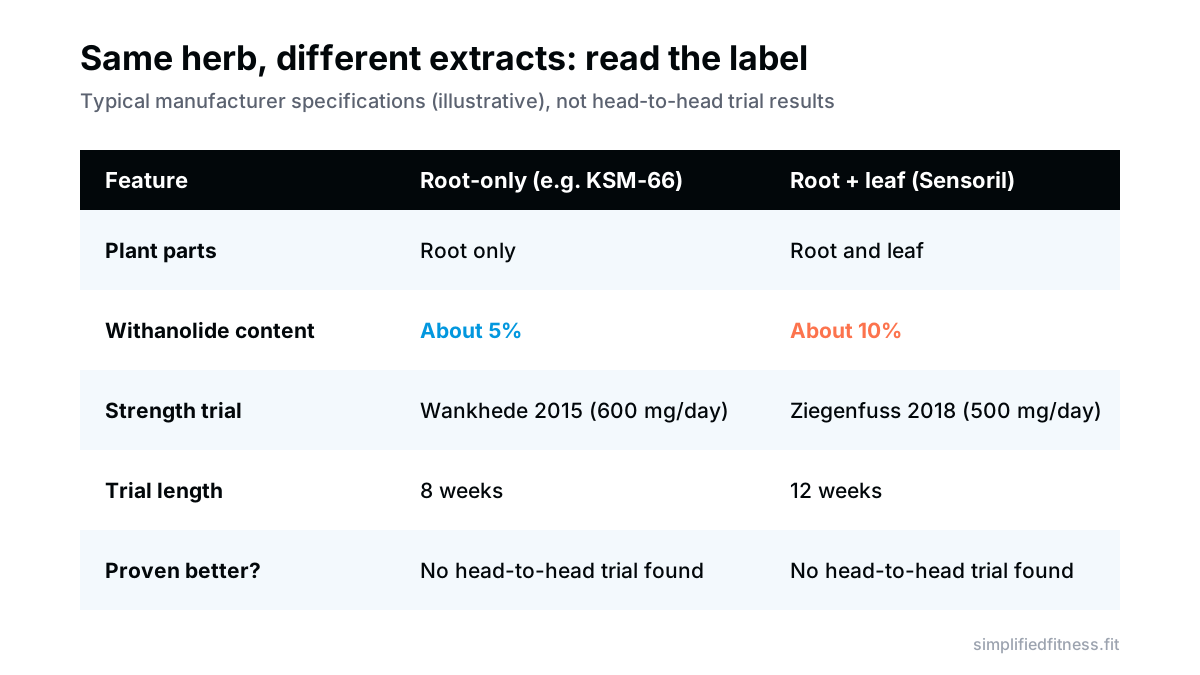
- KSM-66 is a root-only extract. Manufacturers typically describe it at around 5% withanolides.
- Sensoril is an aqueous extract of root and leaf. The STAR trial describes it as exactly that (Ziegenfuss et al., 2018), and it is usually marketed at around 10% withanolides.
Those percentages are label specifications from the brands, not outcomes from head-to-head testing. The popular line that KSM-66 is “for strength” and Sensoril is “for sleep and anxiety” is marketing shorthand. I found no trial that compared the two directly, so treat any confident ranking with suspicion.
Does ashwagandha lower cortisol?
Yes, on average, with a catch.
A 2025 meta-analysis pooled seven randomized trials on cortisol and found a significant drop of about 1.16 ug/dL. The same review pooled six trials on perceived stress and found no significant change (Albalawi, 2025). Heterogeneity was moderate, and the authors flagged short durations and limited long-term data.
A larger 2026 meta-analysis of 23 trials (1,706 participants) also reported lower cortisol (Fornalik et al., 2026). Its subgroup analyses hinted that withanolide content might matter, which is relevant to the KSM-66 vs Sensoril question, but the authors flag heterogeneity and no extract was tested against another.
You may see big percentage drops in cortisol quoted online. Much of the trial data comes from adults recruited because they were stressed, not from lifters in general. In a dose trial of 60 stressed adults, 250 mg/day and 600 mg/day both lowered serum cortisol versus placebo over 8 weeks (Salve et al., 2019). Stressed people have more room to drop. If you already sleep well and are not under strain, the effect may be smaller.
KSM-66 vs Sensoril for strength: what each trial shows
For the extract question, what matters is that each extract has roughly one well-known trial behind it, and the trials are not alike.
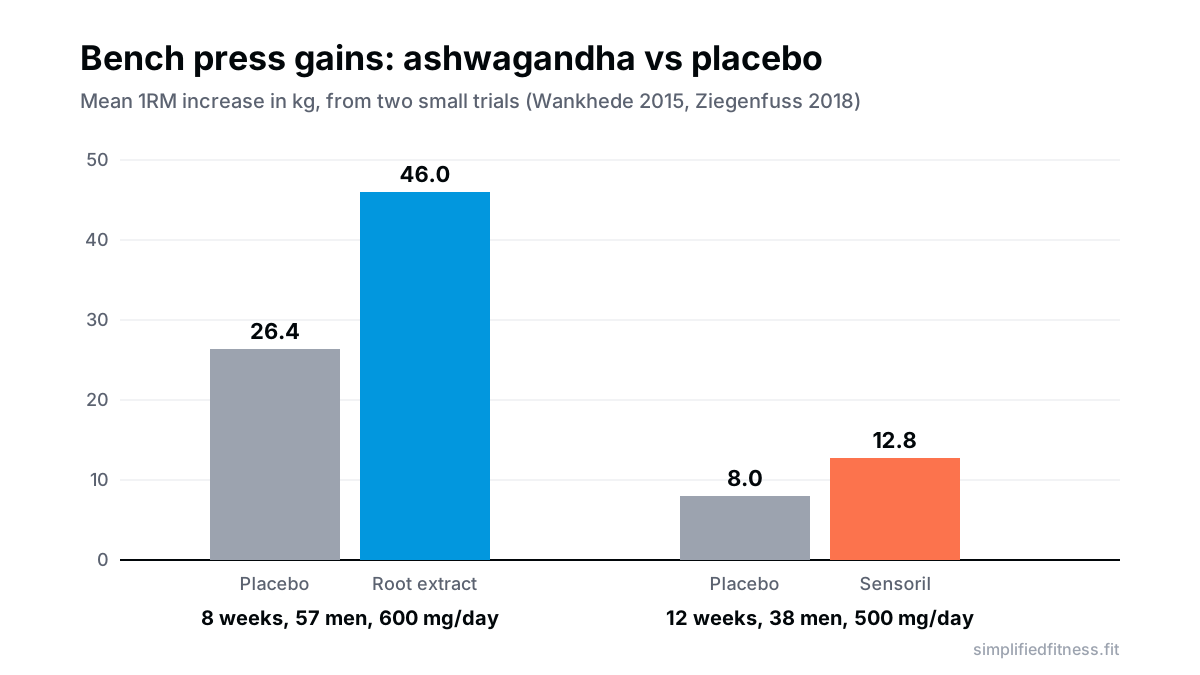
Root extract (8 weeks). 57 men aged 18-50 with little resistance-training experience took 300 mg of root extract twice daily or a starch placebo while training. Bench press 1RM rose 46.0 kg versus 26.4 kg with placebo (Wankhede et al., 2015).
Sensoril (12 weeks). 38 recreationally active men took 500 mg/day of Sensoril or placebo on a 4-day upper/lower program. Squat 1RM rose 19.1 kg versus 10.0 kg and bench press 12.8 kg versus 8.0 kg (Ziegenfuss et al., 2018).
The full breakdown of both trials, including size, testosterone and recovery outcomes, is in our ashwagandha cortisol and strength evidence guide. Here the point is narrower: different lengths, doses and training backgrounds mean you cannot rank the two extracts from these numbers.
Now the cautious read. The 2026 meta-analysis of trials combining standardized extract with structured resistance training found only four eligible RCTs, three poolable (161 people). It reported greater 1RM bench press (SMD 0.60) and lower-body 1RM (SMD 0.52), but both strength estimates lost statistical significance under a stricter analysis, each leaned on one influential trial, and certainty was rated low for strength and very low for chest circumference (Lee et al., 2026). The authors concluded the evidence does not establish that ashwagandha meaningfully enhances training adaptations.
Also notice the populations. Trial A recruited men with little training experience, who gain quickly on almost any decent program. Trial B used recreationally active men. Neither tells us much about experienced lifters, and women were not studied in these two.
How to take ashwagandha for the gym
If you decide to try it, keep it boring.
- Product: a single-ingredient standardized extract, ideally with third-party testing (see how to read NSF and Informed Choice certifications). Avoid multi-herb blends so you know what you are reacting to.
- Dose: the strength trials used 500-600 mg/day of extract. Salve et al. saw effects at 250 mg/day and 600 mg/day in stressed adults. Starting at 300 mg with food and moving up is sensible.
- Split or single: Wankhede used 300 mg twice daily. A single evening dose is a common alternative, but timing was not compared in the trials.
- Duration to judge: 8 weeks, with weekly notes on sleep, mood and bar speed.
An 8-week trial of a root extract in 80 people with and without insomnia reported better sleep onset, total sleep time and sleep quality than placebo (Langade et al., 2021). That supports an evening dose for people whose problem is sleep. If sleep is the whole issue, compare it with magnesium forms for sleep or low-dose melatonin, which are better studied for that job in some cases.
In Indian budgets, ashwagandha capsules are cheap compared with most imported products, but a low price tag with no testing certificate is exactly where underdosing and adulteration hide. A middle-priced, lab-tested brand beats the cheapest tub.
Ashwagandha cycling protocol: is 8 weeks on, 2 off real?
Honest answer: it is a convention, not a finding.
I found no randomized trial that compared cycling schedules with continuous use. What exists is trial length. The strength trials ran 8 and 12 weeks, and a 2026 safety review of 23 randomized trials of standardized root-only extracts (2,317 healthy adults, doses 125-600 mg/day, durations from a single dose up to 180 days) reported no clinically meaningful changes in liver, kidney, blood, endocrine or cardiovascular markers, but noted limited data beyond 180 days (Coope et al., 2026). Two caveats: root-and-leaf extracts like Sensoril were outside that review, and some of its authors have supplement-industry ties, which the paper discloses.
So a cautious plan could be:
- Run it 8-12 weeks, the span that has actual trial data.
- Take 2-4 weeks off.
- Compare how you sleep, feel and train. If nothing changed, you did not need it.
- Restart only if the break made things clearly worse.
That is a personal experiment, not a protocol with proven benefit. If you are on prescription medication, ask your doctor before restarting at all.
Does ashwagandha cause emotional blunting?
You will see forum posts describing feeling flat or numb on ashwagandha, often used to justify cycling. I could not find controlled trials that measured emotional blunting, so this is anecdotal. What trials do report is mild: the 2026 safety review lists gastrointestinal discomfort, headache and transient drowsiness, seen in both intervention and comparator groups (Coope et al., 2026).
That does not make personal reports false. A sedating herb that lowers stress reactivity could plausibly feel like “less everything” to some people. If you notice it, here is the practical order:
- Lower the dose or move it to the evening.
- Stop for 2-3 weeks and see whether the feeling lifts.
- If low mood, loss of interest or numbness persists or is severe, see your doctor. Do not self-diagnose from a supplement.
Ashwagandha liver safety: the part most brands skip
Liver injury is rare but documented. A case series of five patients (Iceland and the US DILI Network) described jaundice and symptoms such as nausea, lethargy and itching after 2-12 weeks. The injury was cholestatic or mixed, liver tests normalized within 1-5 months in four patients, and none developed liver failure (Bjornsson et al., 2020). An Indian series of 8 single-ingredient cases found cholestatic hepatitis as the commonest picture. Five had underlying chronic liver disease, three developed acute-on-chronic liver failure and all three died, while the rest recovered (Philips et al., 2023).
Case series cannot give a risk rate, and the 2026 trial review found normal liver markers in healthy trial participants. These two things can both be true: rare idiosyncratic reactions plus good tolerance in most people. Weigh it this way:
- Existing liver disease, heavy alcohol use or other hepatotoxic medicines: do not use it without medical advice.
- Stop immediately and get liver tests if you develop yellow eyes or skin, dark urine, pale stools, persistent itching or nausea.
- Thyroid: the 2026 hormone meta-analysis found a modest T4 rise, so ask your doctor first if you have thyroid disease or take thyroid medicine.
Does ashwagandha raise testosterone?
Slightly, in men, according to pooled data: the 2026 meta-analysis reported a mean increase of 57 ng/dL in men but no effect in women (Fornalik et al., 2026). Reviews of root extract safety describe the rises as staying within physiological ranges (Coope et al., 2026). A rise inside the normal range is not a steroid-like effect, so do not expect visible muscle changes from it alone.
Should you take it at all?
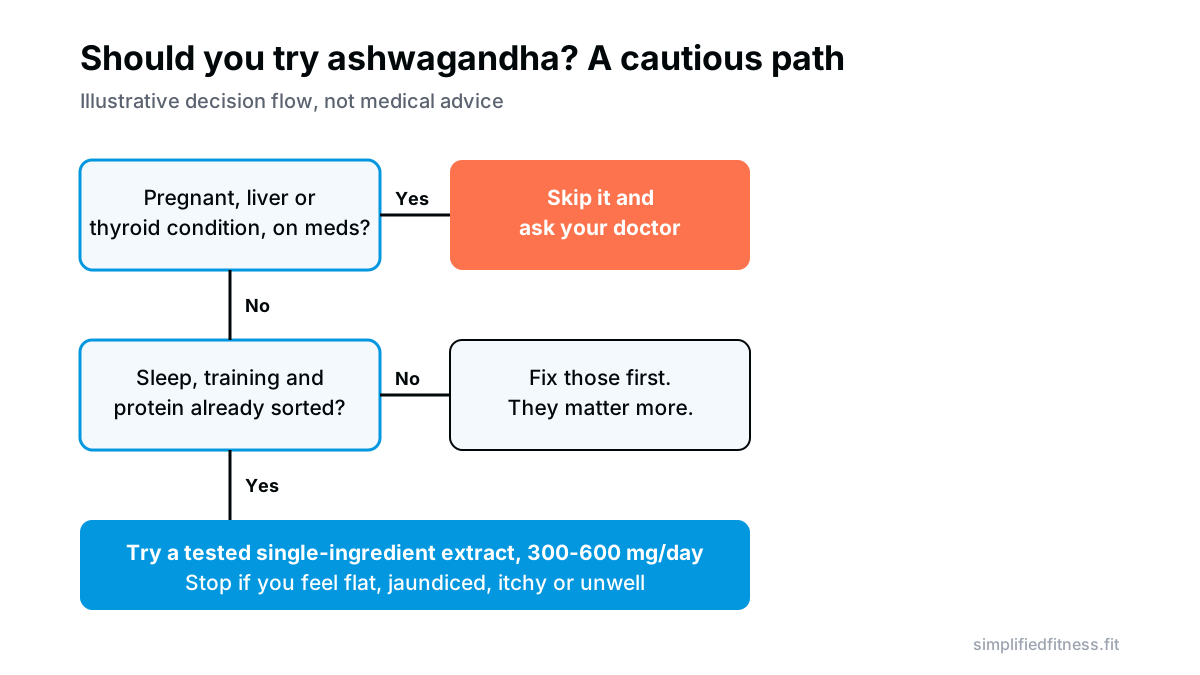
The supplement hierarchy is clear. Eating enough protein (use our protein calculator), training with progressive overload (our free push, pull and legs plans are a starting point) and sleeping 7-9 hours beat ashwagandha by a distance. If those are in place and you carry real stress, an 8-12 week trial of a tested extract is reasonable. Where it sits against other products is covered in the supplement hierarchy.
Pick KSM-66 or Sensoril on price, availability and how you tolerate it. The trials do not give you a winner, and your own notes will tell you more than a label claim.
Frequently Asked Questions
What is the difference between KSM-66 and Sensoril?
KSM-66 is a root-only extract, while Sensoril is made from root and leaf and is marketed at a higher withanolide percentage. Manufacturers describe KSM-66 at roughly 5% and Sensoril at roughly 10%, but those are label specifications, not proof of different effects. Check the label for the extract name and the milligrams of extract per capsule, not just 'ashwagandha 600 mg'.
Which is better for strength, KSM-66 or Sensoril?
There is no head-to-head trial, so nobody can say. One 8-week trial of a root extract and one 12-week trial of Sensoril each reported bigger strength gains than placebo in young men, but they used different designs and populations. Pick either, run it for 8-12 weeks, and judge it by your own logbook.
Does ashwagandha lower cortisol?
On average, yes. A 2025 meta-analysis of seven trials (488 participants across the review) found a cortisol drop of about 1.16 ug/dL, though perceived stress did not change significantly. Treat cortisol as a lab marker, and judge success by sleep, mood and training quality.
How much ashwagandha should I take for the gym?
The strength trials used 500-600 mg/day of standardized extract. A dose-comparison trial in stressed adults found benefits at 250 mg/day and 600 mg/day. Start at the lower end of that range with food and do not exceed what the label says.
When should I take ashwagandha, morning or night?
The trials did not test timing against each other, so there is no proven best time. Some people feel drowsy, so many take it in the evening, while those who feel fine can take it with breakfast. Split doses (for example 300 mg twice daily, as in one strength trial) are a reasonable pattern.
Do I need to cycle ashwagandha?
There is no trial evidence that cycling is required, and none showing a specific schedule works better. Most studies lasted 8-12 weeks, and long-term data beyond 180 days is limited. A planned break every 8-12 weeks is a cautious way to check whether you still need it.
Can ashwagandha make you feel numb or emotionally flat?
Some users report feeling flat, but I could not find controlled trials measuring emotional blunting, so this is anecdotal. Reviews of healthy adults report mostly mild effects such as stomach upset, headache and drowsiness. If you feel flat, stop for a couple of weeks and see if it lifts, and speak to a doctor if mood stays low.
Is ashwagandha safe for your liver?
For most healthy adults in trials it looked well tolerated, but rare liver injury is documented in case series. Reported cases were mostly cholestatic (jaundice, itching) and usually resolved in months, yet three Indian patients with existing liver disease died. Skip it if you have liver disease, and stop and get tested if you develop yellow eyes or skin, dark urine or itching.
Does ashwagandha boost testosterone?
Probably a little in men, but the gym effect is unclear. A 2026 meta-analysis of 23 trials reported higher testosterone in men (mean difference about 57 ng/dL) but not in women. Do not buy it as a testosterone booster, and see a doctor if you suspect low testosterone.
Who should avoid ashwagandha?
People who are pregnant, have liver disease or thyroid disease, or take thyroid, sedative or immune-suppressing medication should ask a doctor first. The 2026 hormone meta-analysis found a modest rise in T4, which matters if your thyroid is already being treated. Bring the bottle to your appointment.
How long does ashwagandha take to work?
Trials ran 8 weeks or more, so judge it after about 8 weeks rather than a few days. Cortisol and sleep changes in studies were measured at the end of those periods. Track sleep, training performance and mood weekly so you can tell if anything actually changed.
Is ashwagandha worth it for lifters?
It is optional, not essential. Protein, enough calories, progressive training and 7-9 hours of sleep outrank it by a wide margin, and the strength evidence is low certainty. If those are already in order and you are under real stress, a tested product for 8-12 weeks is a reasonable experiment.
Sources & References
Every claim above is checked against peer-reviewed research (PubMed, U.S. National Library of Medicine) or guidance from established health bodies. How we fact-check.
- Wankhede S, et al. Examining the effect of Withania somnifera supplementation on muscle strength and recovery: a randomized controlled trial. J Int Soc Sports Nutr. 2015. PMID: 26609282
- Ziegenfuss TN, et al. Effects of an Aqueous Extract of Withania somnifera on Strength Training Adaptations and Recovery: The STAR Trial. Nutrients. 2018. PMID: 30463324
- Lee JC, et al. Adjunctive Ashwagandha (Withania somnifera) Supplementation and Resistance-Training Adaptations in Healthy Adults: A Systematic Review and Random-Effects Meta-Analysis of Muscular Strength, Chest Circumference, and Body Composition. Nutrients. 2026. PMID: 42738987
- Albalawi AA. Dual impact of Ashwagandha: Significant cortisol reduction but no effects on perceived stress, a systematic review and meta-analysis. Nutr Health. 2025. PMID: 40746175
- Fornalik M, et al. Hormonal Modulation with Withania somnifera: Systematic Review and Meta-Analysis of Randomized-controlled Trials. Planta Med. 2026. PMID: 41740946
- Langade D, et al. Clinical evaluation of the pharmacological impact of ashwagandha root extract on sleep in healthy volunteers and insomnia patients: a double-blind, randomized, parallel-group, placebo-controlled study. J Ethnopharmacol. 2021. PMID: 32818573
- Bjornsson HK, et al. Ashwagandha-induced liver injury: A case series from Iceland and the US Drug-Induced Liver Injury Network. Liver Int. 2020. PMID: 31991029
- Philips CA, et al. Ashwagandha-induced liver injury, a case series from India and literature review. Hepatol Commun. 2023. PMID: 37756041
- Coope OC, et al. Back to the Roots: Safety and Tolerability of Standardised Ashwagandha (Withania somnifera) Root Extract in Healthy Adults, a Systematic Review of Biomarkers and Adverse Events. Pharmaceuticals (Basel). 2026. PMID: 42198398
- Salve J, et al. Adaptogenic and Anxiolytic Effects of Ashwagandha Root Extract in Healthy Adults: A Double-blind, Randomized, Placebo-controlled Clinical Study. Cureus. 2019. PMID: 32021735

Umair Hazrami · Founder & Head Coach, Simplified Fitness
Umair Hazrami founded Simplified Fitness and the Simplified Lifter channel to cut through fitness noise. With 4+ years of consistent training and 10+ coaching clients, he writes every guide from the peer-reviewed research and links the sources so you can check them. Our editorial standards.
Educational content only, not medical advice. If you have a medical condition, are pregnant, or take medication, talk to a qualified doctor before changing your diet, supplements or training. Full disclaimer.
Keep reading
Supplements
BCAAs vs EAAs: Why BCAAs Are a Waste of Money If Your Protein Is Covered
BCAA vs EAA for muscle growth: BCAAs are only 3 of the 9 essential amino acids. See what Wolfe 2017 and Jackman 2017 found and when EAAs or whey make sense.
8 min read
Supplements
Beetroot Juice for Running and Lifting: How Dietary Nitrate Works (and the Mouthwash Trap)
Does beetroot juice for running actually work? See what meta-analyses show, the 2-3 hour timing and dose, who benefits, and why mouthwash can cancel the effect.
9 min read

Supplements
Beta-Alanine Benefits: Carnosine Buffering, High-Rep Gains and Why It Makes You Tingle
Beta-alanine benefits explained: why pre-workout makes your skin tingle, how carnosine buffers acid, what dose works, and who should skip it. Studies linked.
8 min read
Supplements
Betaine (TMG) for Strength and Power: What the Research Really Shows
Does betaine build muscle or boost power? We review the trials and meta-analyses on betaine TMG, the 2.5 g dose, betaine vs creatine, and betaine HCl.
7 min read