Leucine Trigger Hypothesis: How Much Leucine Per Meal Do You Need?
The leucine trigger hypothesis explained: how Sestrin2 and mTORC1 sense leucine, what the human trials show, and when extra leucine helps a low-protein meal.
TL;DR. The short answer
- The leucine trigger hypothesis says leucine acts as a signal that switches on muscle protein synthesis through mTORC1, so each meal needs enough of it. The cell biology is solid, but the strict per-meal threshold is less certain in humans.
- The ISSN suggests about 0.7-3 g of leucine per protein dose, and 2.5-3 g is a common practical target for young lifters, which 25 g of whey protein provides. Older adults may need a bit more, though a 2023 systematic review found no clear threshold in them.
- Topping up a small, low-protein serving to about 5 g of total leucine helped in an acute trial in young men, and 3-5 g per meal raised muscle protein synthesis in older adults. A smaller top-up to 3 g did not match a full protein dose. It does not replace eating enough total protein.
- In young men, leucine-enriched soy did not beat plain soy for muscle protein synthesis over six hours, so a decent protein dose may already clear the bar.
- Total daily protein and hard training come first. Leucine tuning is a refinement for low-protein meals, vegetarian diets and older lifters.
Part of our complete guide: The Evidence-Based Fitness Supplements Guide: What Works, What's Overhyped & What's a Waste of Money
Table of contents
The leucine trigger hypothesis says leucine is more than a building block: it acts as a signal that tells muscle cells to start making protein, so each meal needs enough of it. The cell biology behind that is well supported. The strict “hit 3 g every meal or waste the meal” version is not, and the human data are more nuanced.
This article sits inside our evidence-based supplements guide and goes deep on the one question that matters if you eat a lot of vegetarian meals: when does adding leucine actually help? Total daily protein still comes first, and you can set yours with our protein intake calculator.
What is the leucine trigger hypothesis?
Muscle protein synthesis (MPS) is the process of stitching amino acids into new muscle protein. After a meal, MPS rises, peaks, then falls back even if amino acids are still circulating. The trigger hypothesis proposes that leucine is the amino acid that flips the switch, and that the size of the rise in blood leucine decides how strongly the switch turns on.
A closely related idea is the “leucine threshold”: a minimum amount per meal below which MPS barely moves. A 2023 systematic review describes both ideas and tested them against the published human data, which we will get to below (Wilkinson et al., 2023).
How does Sestrin2 and mTORC1 sense leucine?
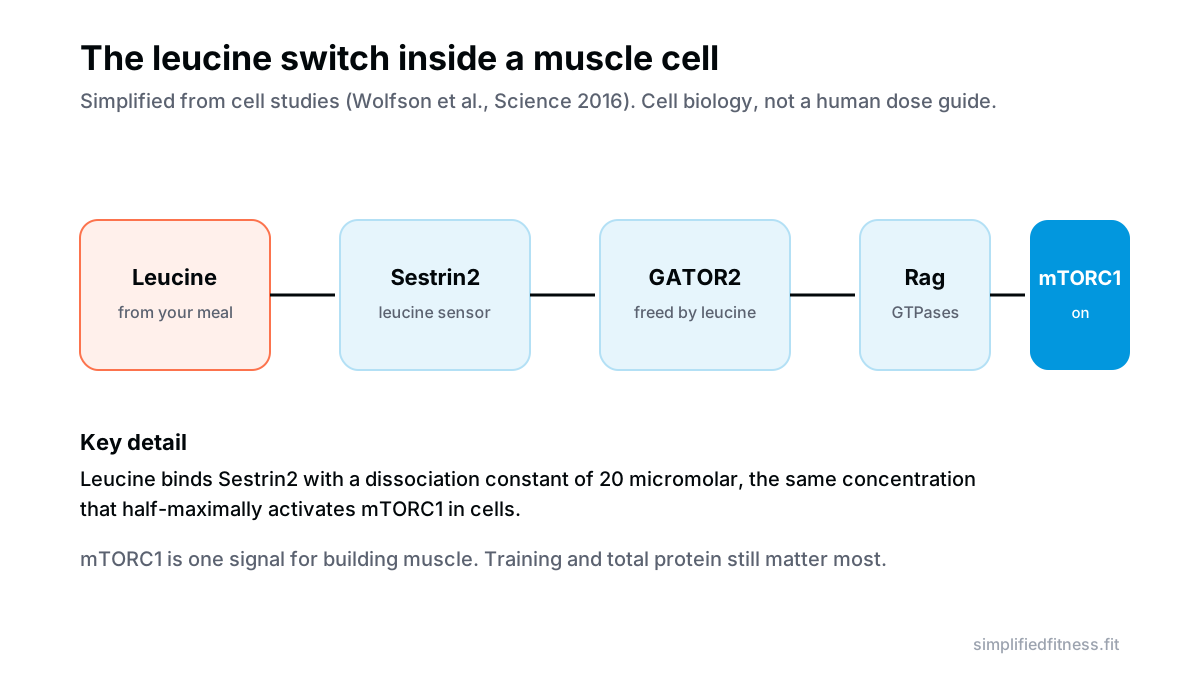
Inside cells, a growth-controlling complex called mTORC1 decides whether the cell builds or holds back. Amino acids signal to it through proteins called Rag GTPases. One of the regulators is Sestrin2, which binds another protein, GATOR2, and keeps mTORC1 signalling suppressed.
In 2016, researchers in Cambridge, Massachusetts showed that leucine, but not arginine, binds Sestrin2 and breaks up the Sestrin2-GATOR2 link. The dissociation constant was 20 micromolar, which matches the leucine concentration that half-maximally activates mTORC1 in cells (Wolfson et al., 2016). So the sensor is real and its sensitivity fits the signal.
How much leucine do you need per meal to build muscle?
The ISSN position stand suggests each protein dose should contain about 700-3,000 mg of leucine (Jager et al., 2017), and 2.5-3 g is a commonly used practical target for young lifters. That is roughly what 25 g of whey protein gives you. In the 2014 trial below, 25 g of whey supplied 3.0 g of leucine.
Here is the catch. The 2023 systematic review pooled studies in healthy adults who did resistance exercise and then ate protein. Leucine dose was associated with the MPS response in older adults, but not in younger adults, and the authors reported no clear threshold in older adults and no single blood leucine measure that predicted the response (Wilkinson et al., 2023). In other words, the target numbers are useful rules of thumb, but a hard cliff at 2.7 g is not what the data show.
| Group | Rough per-meal leucine target | How firm is it? |
|---|---|---|
| Young lifters | about 2.5-3 g | Working estimate, a decent protein dose usually reaches it |
| Older adults | about 3-4 g | Dose linked to response, but no clear threshold found |
| Above 5 g | No good evidence of added benefit | Few trials went higher |
For context, a per-meal protein target of about 0.4 g/kg across at least four meals has been proposed to maximise muscle building (Schoenfeld et al., 2018). For a 70 kg person that is about 28 g per meal, which fits the leucine range above without any supplement.
Can a little leucine rescue a low-protein meal?
This is the most interesting trial for anyone eating light vegetarian meals. In 2014, 40 young men did a one-legged resistance session and then drank one of five drinks: 25 g whey (3.0 g leucine), 6.25 g whey (0.75 g leucine), 6.25 g whey topped up to 3.0 g or 5.0 g total leucine, or 6.25 g whey with leucine, isoleucine and valine to 5.0 g leucine. MPS over 1.5-4.5 hours was greatest after the 25 g whey (about 267%) and the 6.25 g whey with 5.0 g leucine (about 220%). The authors concluded that a low-protein drink with high leucine can be as effective as the high-protein dose (Churchward-Venne et al., 2014).
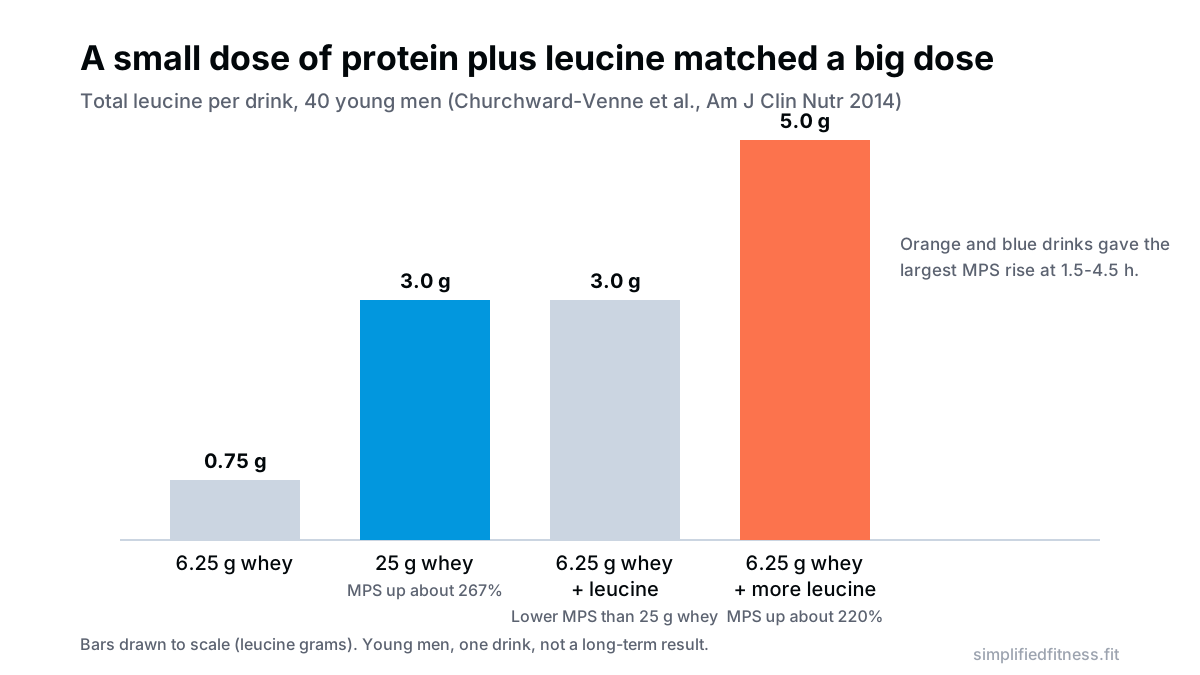
Two honest caveats. The 3.0 g top-up group did not match the 25 g whey, and this was a single drink in young men. It shows leucine can compensate for a small protein dose in the short term. It does not show you can eat very little protein and build muscle on leucine.
Do older adults need more leucine?
Older muscle tends to respond less to a modest amount of protein, a pattern called anabolic resistance. Some of the best evidence comes from a crossover trial at McMaster University in 20 healthy older men aged 65-85. They ate lower-protein (0.8 g/kg/day) or higher-protein (1.2 g/kg/day) diets and took 5 g of leucine with each of their three main meals. Leucine raised the 3-day integrated MPS rate versus placebo at rest and after resistance exercise, and it worked equally on both diets (Murphy et al., 2016).
In a separate bed-rest study, 20 healthy older adults (average age about 68) added 0.06 g/kg of leucine (about 3-4 g) to each meal during seven days of bed rest. Leg lean mass fell by 423 g with leucine versus 1,035 g with an alanine control, but strength and endurance outcomes were largely unchanged (Arentson-Lantz et al., 2020).
Both studies were small and short. They suggest leucine may help older adults, but they do not prove it builds muscle over months. If you are older or have kidney disease, check with your doctor before using amino acid supplements.
How much leucine is in the foods you eat?
Here are rough figures per typical serving. These are approximate values from typical food composition data and vary by brand and cooking, so treat them as a guide.
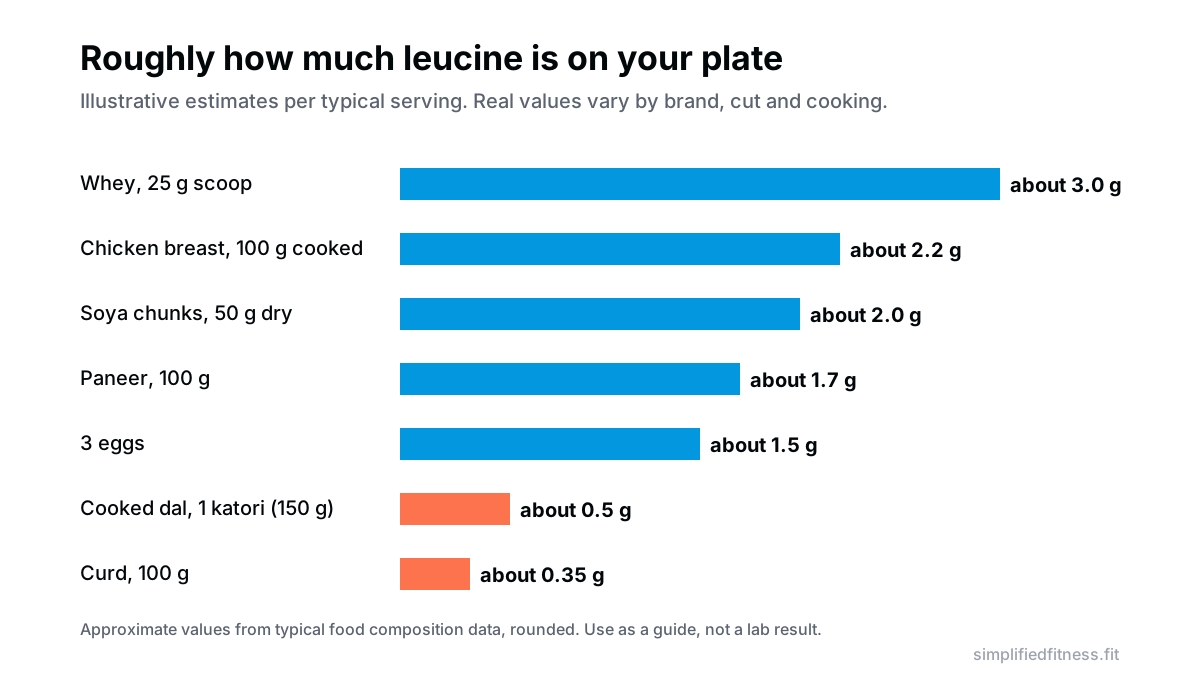
The pattern is simple. A normal serving of dal or curd is a low-leucine meal on its own. Paneer, soya chunks, eggs and chicken do much better per serving. If you want a deeper look at how legumes and grains combine, see our plant protein blends guide.
Adding leucine to plant protein: does it work?
Plant proteins usually carry less leucine per gram than whey, which is why people reach for a leucine top-up. The evidence is mixed. In 36 young men, 20 g of soy raised peak plasma leucine less than 20 g of whey, and soy plus free leucine matched whey’s peak. Yet MPS over six hours after combined resistance and endurance exercise was the same for whey, soy and leucine-enriched soy (Churchward-Venne et al., 2019).
Longer studies point the same way. A meta-analysis of nine training studies (266 participants, at least six weeks long) found soy protein gave similar gains in strength and lean mass to whey and other animal proteins (Messina et al., 2018).
Why might the studies differ from the 2014 low-protein result? The 2019 meals had 20 g of protein, a decent dose, while the 2014 meal had only 6.25 g of whey. The most reasonable reading is that leucine matters most when the protein dose is small. Once you are at 20-30 g, plant protein looks fine on its own.
A practical per-meal plan for Indian lifters
- Set your daily protein first. Aim for the range in our protein calculator, then split it over 3-4 meals.
- Build each meal around 0.3-0.4 g/kg of protein. For a 70 kg lifter that is 20-28 g.
- Use leucine-rich anchors at weak meals: paneer, eggs, soya chunks, whey, chicken or fish.
- If a meal must stay small, a leucine top-up to about 3-5 g total for that meal is an option, not an obligation. Check you are not paying for what a couple of boiled eggs or a paneer portion would do.
- Skip megadoses. Trials used about 3-5 g per meal and we have no good evidence for more.
- Pick tested products. Our supplement certification guide explains what to look for.
Who should be careful
Leucine amounts of 2-5 g per meal were used in short trials in healthy people. Talk to your doctor before using it if you have kidney or liver disease, are pregnant, or take medication for diabetes. This article is education, not medical advice.
The bottom line
The Sestrin2 sensor is real, and leucine does matter. But in practice, enough total protein spread across your day gets you most of the way, and a leucine top-up is mainly useful for small, low-protein meals. Do the big things first, then fine-tune.
Frequently Asked Questions
What is the leucine trigger hypothesis?
It is the idea that leucine works as a signal, not just a building block, and that a meal must raise blood leucine enough to switch on muscle protein synthesis. Leucine binds Sestrin2 inside cells, which helps activate mTORC1. The human data are mixed on a hard threshold, so aim for a solid protein serving at each meal rather than counting every gram.
How much leucine do I need per meal to build muscle?
A practical target for young lifters is roughly 2.5-3 g of leucine per meal, about what 25 g of whey protein provides. Older adults may do better nearer 3-4 g, but a 2023 systematic review found leucine dose predicted the response in older adults without showing a clear cut-off. Build each meal around 0.3-0.4 g/kg of protein, mostly from dairy, eggs, soya or meat, and you will often land near that range.
What is the leucine threshold per meal?
Papers often quote about 2.7-3 g for young adults, but the number is a working estimate, not a law. The 2023 systematic review found leucine dose was linked to the muscle protein synthesis response in older adults but not in younger ones, and found no threshold in older adults. Treat it as a rough target.
How does Sestrin2 sense leucine?
Sestrin2 is a protein that sits bound to GATOR2 and holds mTORC1 signalling back. In cell experiments, leucine binds Sestrin2 and releases GATOR2, which allows mTORC1 to switch on. This was shown in cells, so practically it only tells you why leucine matters, not how much to eat.
Is leucine the same as BCAAs?
No. Leucine is one of the three branched-chain amino acids, along with isoleucine and valine. The 2014 trial tested a BCAA top-up as well, but its clearest finding was for a small whey dose topped up with leucine to 5 g. For the full comparison with EAAs, read our BCAA vs EAA guide.
Can I add leucine to plant protein?
You can, and it is a reasonable fix for a small plant-based meal such as a bowl of dal and rice. The evidence is mixed in young men: leucine-enriched soy matched plain soy and whey for muscle protein synthesis after exercise. If your meal already has 20-30 g of protein, the extra leucine may add little.
Do vegetarians need leucine supplements?
Not automatically. Vegetarians who eat paneer, curd, eggs, soya and dal across the day can usually reach good per-meal leucine by eating larger protein servings. A leucine supplement is a cheap option for light meals, such as a breakfast of poha or idli, but eat more protein first.
Is more than 5 g of leucine per meal better?
There is no good evidence that going far above 5 g adds anything for muscle. The trials we have used about 3-5 g per meal, and 5 g was already effective in both young men and older men. Staying around 3-5 g avoids pointless spend.
Do older adults need more leucine per meal?
Older adults tend to respond less to a modest amount of protein, which is called anabolic resistance, so a bit more per meal is a sensible starting point. A trial in healthy older men gave 5 g of leucine with each of three daily meals and found higher muscle protein synthesis than placebo. Pair it with resistance training and talk to your doctor if you have kidney disease.
Is leucine safe?
The trials here used about 3-5 g per meal in healthy people for days to weeks, and their abstracts did not report safety problems, but short studies in small groups tell us little about long-term use. People with kidney or liver disease should speak to a doctor before adding any amino acid supplement. Food first is the simplest approach.
Is leucine better than whey protein?
No. Whey already carries roughly 3 g of leucine in 25 g of protein, plus the other essential amino acids your muscles need. Free leucine alone does not supply the full set of building blocks, so it works best as a top-up to a meal that already has some protein.
What is the best time to take leucine?
Take it with a meal that is low in protein, since the strongest case for leucine is lifting a weak meal. The trials gave it alongside food or in a drink after exercise. Taking it between meals with nothing else is less well supported.
Does leucine alone build muscle?
No. Leucine switches on a signal, but muscle needs all the essential amino acids to build new protein, plus training and enough total calories. A bed-rest study in older adults showed leucine reduced leg lean mass loss, not that it built muscle. Eat enough protein and train hard first.
Sources & References
Every claim above is checked against peer-reviewed research (PubMed, U.S. National Library of Medicine) or guidance from established health bodies. How we fact-check.
- Wolfson RL, et al. Sestrin2 is a leucine sensor for the mTORC1 pathway. Science. 2016. PMID: 26449471
- Churchward-Venne TA, et al. Leucine supplementation of a low-protein mixed macronutrient beverage enhances myofibrillar protein synthesis in young men: a double-blind, randomized trial. Am J Clin Nutr. 2014. PMID: 24284442
- Wilkinson K, et al. Association of postprandial postexercise muscle protein synthesis rates with dietary leucine: A systematic review. Physiol Rep. 2023. PMID: 37537134
- Murphy CH, et al. Leucine supplementation enhances integrative myofibrillar protein synthesis in free-living older men consuming lower- and higher-protein diets: a parallel-group crossover study. Am J Clin Nutr. 2016. PMID: 27935521
- Arentson-Lantz EJ, et al. Countering disuse atrophy in older adults with low-volume leucine supplementation. J Appl Physiol. 2020. PMID: 32191600
- Churchward-Venne TA, et al. Myofibrillar and Mitochondrial Protein Synthesis Rates Do Not Differ in Young Men Following the Ingestion of Carbohydrate with Whey, Soy, or Leucine-Enriched Soy Protein after Concurrent Resistance- and Endurance-Type Exercise. J Nutr. 2019. PMID: 30698812
- Messina M, et al. No Difference Between the Effects of Supplementing With Soy Protein Versus Animal Protein on Gains in Muscle Mass and Strength in Response to Resistance Exercise. Int J Sport Nutr Exerc Metab. 2018. PMID: 29722584
- Jager R, et al. International Society of Sports Nutrition position stand: protein and exercise. J Int Soc Sports Nutr. 2017. PMID: 28642676
- Schoenfeld BJ, et al. How much protein can the body use in a single meal for muscle-building? Implications for daily protein distribution. J Int Soc Sports Nutr. 2018. PMID: 29497353

Umair Hazrami · Founder & Head Coach, Simplified Fitness
Umair Hazrami founded Simplified Fitness and the Simplified Lifter channel to cut through fitness noise. With 4+ years of consistent training and 10+ coaching clients, he writes every guide from the peer-reviewed research and links the sources so you can check them. Our editorial standards.
Educational content only, not medical advice. If you have a medical condition, are pregnant, or take medication, talk to a qualified doctor before changing your diet, supplements or training. Full disclaimer.
Keep reading

Supplements
Ashwagandha KSM-66 vs Sensoril: Which Extract, What Dose, and Do You Need to Cycle?
Ashwagandha KSM-66 vs Sensoril for lifters: what the strength trials show, realistic cortisol effects, liver safety and whether to cycle. Every study linked.
8 min read

Supplements
BCAAs vs EAAs: Why BCAAs Are a Waste of Money If Your Protein Is Covered
BCAA vs EAA for muscle growth: BCAAs are only 3 of the 9 essential amino acids. See what Wolfe 2017 and Jackman 2017 found and when EAAs or whey make sense.
8 min read
Supplements
Beetroot Juice for Running and Lifting: How Dietary Nitrate Works (and the Mouthwash Trap)
Does beetroot juice for running actually work? See what meta-analyses show, the 2-3 hour timing and dose, who benefits, and why mouthwash can cancel the effect.
9 min read

Supplements
Beta-Alanine Benefits: Carnosine Buffering, High-Rep Gains and Why It Makes You Tingle
Beta-alanine benefits explained: why pre-workout makes your skin tingle, how carnosine buffers acid, what dose works, and who should skip it. Studies linked.
8 min read