DIY Pre-Workout Guide: Check the Label for Fairy-Dusting, Then Mix Your Own
A DIY pre workout guide: learn how proprietary blends hide underdosing, check labels against research doses, and mix a transparent pre-workout yourself.
TL;DR. The short answer
- A proprietary blend lists the total weight and the ingredient names but not the amount of each one, so you cannot tell whether citrulline is 8 g or 500 mg.
- Fairy-dusting means adding a token amount of a researched ingredient so it appears on the label. A tub with 18 ingredients is not necessarily better than one with four.
- Research-backed doses: caffeine 3-6 mg/kg, citrulline malate 6-8 g, and beta-alanine 4-6 g daily for several weeks. Betaine and sodium are optional extras.
- In an analysis of the top 100 pre-workouts, the average beta-alanine dose was below the effective dose and caffeine sat near the low end of the effective range.
- A DIY mix lets you see every dose and adjust caffeine to your tolerance. It does not make you stronger by itself, and caffeine still needs care if you are sensitive, pregnant or have a heart condition.
Part of our complete guide: The Evidence-Based Fitness Supplements Guide: What Works, What's Overhyped & What's a Waste of Money
Table of contents
A pre-workout is worth buying only if you can see how much of each ingredient is inside. This diy pre workout guide shows you how to spot a proprietary blend that hides small doses, check each ingredient against the research, and mix a fully transparent version yourself. It sits inside our wider evidence-based supplements guide, where pre-workouts rank well below the basics like protein, creatine and sleep.
Short version: if the label will not tell you the dose, assume the dose is small.
What is a proprietary blend on a pre-workout label?
A proprietary blend is a group of ingredients listed together under a fancy name, such as “Explosive Pump Matrix”, with one total weight for the whole group. The label tells you the names and the combined weight. It does not tell you how much of each ingredient you are getting.
In the United States this is legal under the Dietary Supplement Health and Education Act of 1994, which lets companies list nonnutrient ingredients as a blend to protect their formulas. The blend weight and ingredient names must be declared, but not the individual amounts, which means the dose cannot be used to estimate your intake or compare with clinical trials (Saldanha et al., 2023).
That is the whole trick. The company is not necessarily lying. It is simply not telling you. For the wider picture across all supplement types, see our guide to proprietary blends in supplements. Here we stick to pre-workouts and what to do instead.
How common is it? A 2019 analysis of the 100 top-selling pre-workouts found an average of 18.4 ingredients per product, with about 8.1 of them inside a proprietary blend at undisclosed amounts. Nearly half (44.3%) of all ingredients across the products were in blends (Jagim et al., 2019). Reviewers also note that these blends make it hard or impossible to compare one product with another, or with a single ingredient (Harty et al., 2018).
What is fairy-dusting, and how do you spot underdosed pre-workout?
Fairy-dusting means sprinkling a tiny amount of a well-known ingredient into a formula so its name can appear on the tub. The marketing says “contains citrulline, beta-alanine, betaine”. The dose may say otherwise.
You can spot underdosing with simple arithmetic. Say a label shows a 6 g “Pump Matrix” containing citrulline, arginine, glycerol, taurine and four herbal extracts. Even if every gram were citrulline, you would barely reach the low end of the research dose. With nine ingredients sharing 6 g, the citrulline portion has to be much smaller. The blend weight caps what any single ingredient can be.
Three patterns suggest fairy-dusting:
- A very long ingredient list with exotic herbs, many of which have little or no performance research.
- A blend weight smaller than the dose of one key ingredient in the research. If citrulline malate needs 6-8 g and the whole blend is 4 g, the maths does not work.
- Clear doses only for the cheap, stimulating ingredient. Caffeine is easy to feel, so a clearly listed high caffeine dose can make a product seem strong while the other ingredients stay hidden.
That last point is worth sitting with. You can feel caffeine fairly soon after a dose. You cannot feel citrulline or beta-alanine. So a brand could load up on cheap caffeine, hide everything else, and you would walk out thinking it worked. I cannot tell you any specific brand does this deliberately, but the incentive is obvious.
What are the clinical doses for pre-workout ingredients?
Here is what the research supports for the ingredients that actually have evidence. These are the numbers to hold a label against.
| Ingredient | Research dose | What the evidence shows |
|---|---|---|
| Caffeine | 3-6 mg/kg, about 60 min before | Consistent performance benefit across many exercise types |
| Citrulline malate | 6-8 g, 40-60 min before | Small gain in reps to failure, mixed on strength |
| Beta-alanine | 4-6 g daily for 2-4+ weeks | Helps efforts of roughly 1-4 minutes |
| Betaine | Daily for 7+ days | Possible strength gain, mostly lower body |
| Sodium | Optional, to taste | Not shown to boost lifting in the studies reviewed here |
Caffeine: the dose that is rarely hidden
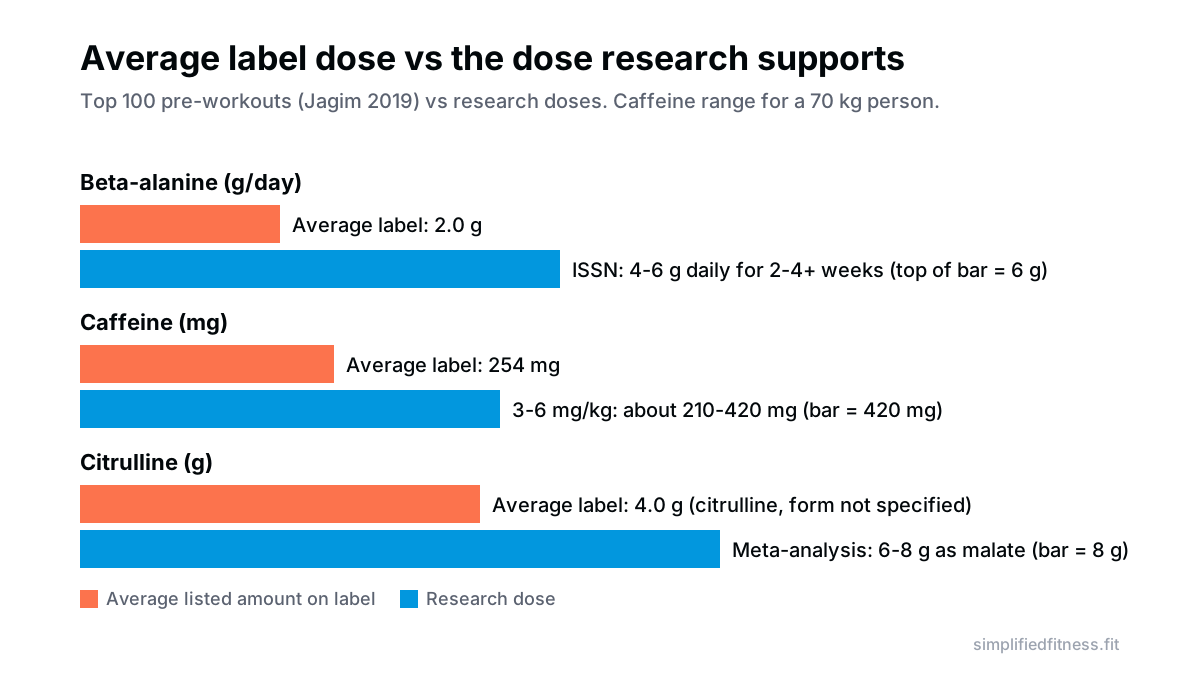
The ISSN position stand reports that caffeine consistently improves performance at 3-6 mg/kg body mass, with minimal effective doses that may be as low as 2 mg/kg. Very high doses of around 9 mg/kg bring a high rate of side effects and do not seem necessary (Guest et al., 2021). The usual timing is about 60 minutes before exercise.
For a 70 kg person, 3-6 mg/kg means roughly 210-420 mg. Keep your whole day in view too: the US FDA says about 400 mg a day is not generally linked to dangerous effects in healthy adults, so a high-dose scoop plus several cups of chai or coffee can push you past that. The 2019 analysis found an average of 254 mg of caffeine in the top products, near the low end of the effective range for a 70 kg person (Jagim et al., 2019). So the common claim that every pre-workout is overloaded with caffeine is not what that analysis found on average. Some products may still carry much more, so read the number. Our caffeine dosage calculator gives you a range for your body weight.
If you are caffeine sensitive, have a heart rhythm problem, high blood pressure, or are pregnant, speak to your doctor before using any caffeinated pre-workout. If you drink chai or coffee all day, your response may be smaller, and our guide on resetting caffeine tolerance explains what helps.
Citrulline malate: where underdosing is common
A 2021 meta-analysis pooled eight double-blind studies (137 participants, mostly strength-trained men) and found that 6-8 g of citrulline malate taken 40-60 minutes before training increased repetitions by about 3 (6.4%) compared with placebo, a small effect (SMD 0.196). The lower body result was borderline and the upper body result was not significant (Varvik et al., 2021).
A separate meta-analysis of four randomized trials in resistance-trained adults found no overall effect on muscle strength (Aguiar et al., 2022). Those two results do not contradict each other as much as they seem to. One measured reps to failure, the other measured strength, and both used small sets of studies. A fair reading is that citrulline might help you squeeze out a few more reps, and it is unlikely to change your one-rep max.
Now the underdosing angle. The top-product analysis found citrulline in 71% of products at an average of 4.0 g, and the abstract did not say which form it was (Jagim et al., 2019). Citrulline malate and pure citrulline are not interchangeable gram for gram, and we compare them in citrulline malate vs pure L-citrulline. The useful rule here: if the label does not say how many grams of which form, you cannot compare it with the research dose.
Beta-alanine: not really a pre-workout ingredient
This one surprises people. According to the ISSN, four weeks of 4-6 g of beta-alanine daily significantly raises muscle carnosine, which acts as an intracellular pH buffer, and 2-4 weeks at that dose has been shown to improve performance. The effects are most pronounced in tasks lasting 1-4 minutes. The only reported side effect is paraesthesia (tingling), which can be reduced with divided lower doses of 1.6 g or a sustained-release form (Trexler et al., 2015).
Two things follow. First, it builds up over weeks, so one scoop 30 minutes before training does not do much for that session. Second, the top-100 analysis found beta-alanine in 87% of products at an average of 2.0 g per serving, below the recommended effective dose (Jagim et al., 2019). If you took one serving daily at 2 g, you would be under the ISSN range. For a deeper look, see our beta-alanine and tingles guide.
For heavy sets of 5-10 reps, which is most gym training, beta-alanine has a limited role. The ISSN notes that more research is needed on strength.
Betaine and salt: optional extras
A 2024 meta-analysis of 17 studies (317 participants, 21% female) found that chronic betaine for at least 7 days significantly improved maximal strength (effect size 0.47), mostly in the lower body. It found no significant effect on upper body strength, cycling sprint power or muscular endurance (Zawieja et al., 2024). The confidence interval was wide (0.04 to 0.89), so treat it as promising, not settled. Details are in our betaine review.
Sodium is a different story. I did not find a trial in this review showing that salt in a pre-workout improves lifting performance, so I would not describe it as a clinical dose. It is a reasonable practical add-on for people who sweat heavily in Indian summers, and salt in pre-workouts is covered separately. If you have high blood pressure or kidney disease, skip the extra sodium and ask your doctor.
How to read a pre-workout label in four steps
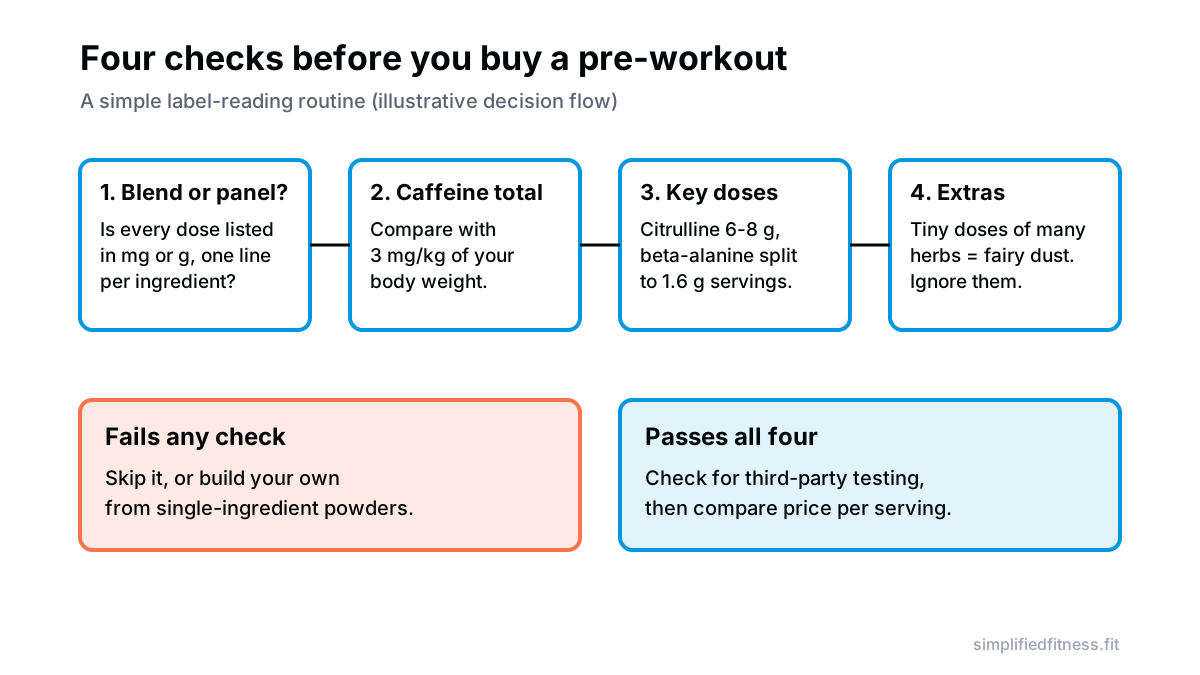
- Is there a blend? Look at the supplement facts panel. If key ingredients are inside a blend with only a total weight, you cannot verify dosing.
- What is the caffeine total? Divide it by your body weight. Compare with 3 mg/kg as a starting point, and remember coffee or tea elsewhere in the day.
- Are the main doses in range? Citrulline malate 6-8 g. Beta-alanine in servings that add up to the daily range. If a dose is missing, assume it is low.
- What is the filler list? A long tail of herbs and “neuro-matrices” at unknown doses is the fairy dust. It has no research behind it at those quantities.
Also check for third-party testing. Reviewers warn that some pre-workout formulations may intentionally contain banned substances or contain them as contaminants, so athletes in tested sports should check ingredients carefully (Harty et al., 2018). Our guide to third-party certifications explains which seals mean something.
On Indian products, I would not rely on the front of the tub alone. Look for a licence number and a batch code you can ask the seller about, and be cautious of unusually cheap imports. We cover this in more depth in our FSSAI guide to fake supplements.
How do you make a DIY pre-workout?
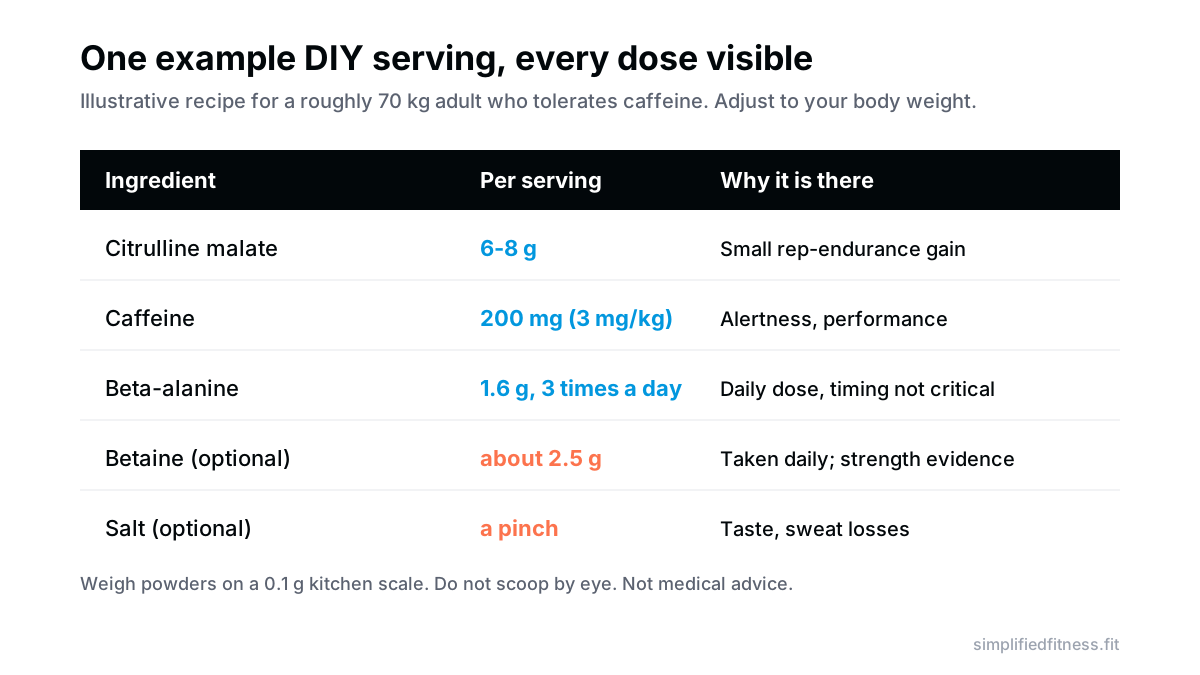
A DIY pre-workout is just single-ingredient powders you weigh yourself, so every dose is visible. The example below suits a roughly 70 kg adult who tolerates caffeine. Change the caffeine to match your body weight and sensitivity.
What you need
- Citrulline malate powder
- A caffeine source: coffee, or caffeine tablets or capsules you can count
- Beta-alanine powder (optional, and taken daily)
- Betaine and table salt (optional)
- A 0.1 g precision kitchen scale, a shaker, and water
Steps
- Weigh 6-8 g of citrulline malate into the shaker. Start at 6 g.
- Add caffeine. About 3 mg/kg (around 200 mg for a 70 kg person) is a reasonable start. Coffee is fine, though strength varies a lot between cups, so counted tablets are more precise.
- If you use beta-alanine, take it as separate 1.6 g doses across the day (three doses gives about 4.8 g, inside the ISSN range) rather than one big scoop, to limit tingles.
- Add betaine (about 2.5 g is a commonly used amount) and a pinch of salt only if you want them. These two are my practical suggestions, not doses proven by the studies cited here.
- Mix with 400-500 ml of water. Drink about 45-60 minutes before training.
A safety warning
Do not scoop pure caffeine powder by eye. A small spoon can hold a dangerous amount. Use tablets, capsules or coffee unless you have a scale accurate to a milligram. If you are not comfortable measuring, choose a transparent ready-made product instead.
How much money can you save?
I will not give you a percentage, because prices change by brand and city. Instead use this check. Divide the price of each bulk powder by the number of servings in the tub. Add the per-serving costs together. Compare that with the per-serving price of the ready-made tub you were considering. Our budget supplement guide walks through the same maths for the rest of your stack.
Many people find the DIY route cheaper per serving when buying citrulline and beta-alanine in bulk, and the difference grows if your caffeine comes from coffee. The trade-off is time and the bother of weighing.
Do you even need a pre-workout?
Probably not. The evidence here is for small effects: about 3 extra reps, averaged over roughly five sets of an exercise at about 70% of one-rep max, from citrulline, and a modest caffeine boost. Training quality, protein intake and sleep matter more.
If you are tired before training, check your sleep and total food first. A banana, a cup of coffee and some dal-rice a couple of hours before lifting is a perfectly good pre-workout. If you want a structured session to spend that energy on, try our push day plan and keep the supplement as a small extra.
When to talk to a doctor
See a doctor before using caffeinated or stimulant-containing pre-workouts if you have a heart condition, high blood pressure, anxiety, seizures, are pregnant or breastfeeding, or take medicines that interact with caffeine. Stop and seek medical help if you get chest pain, a racing or irregular heartbeat, fainting, or severe headaches. Most safety studies on pre-workouts are shorter than eight weeks, so long-term safety is less certain (Harty et al., 2018).
The bottom line
A proprietary blend hides doses, fairy-dusting hides underdosing, and a long ingredient list is not proof of quality. Check caffeine against your body weight, citrulline malate against 6-8 g, and beta-alanine against a daily dose rather than a single scoop. If the label cannot pass, mix your own with powders you can weigh, and keep the expectations modest: these ingredients give small edges on top of good training, food and sleep.
Frequently Asked Questions
What is a proprietary blend on a supplement label?
It is a group of ingredients listed under one name with a single total weight, without the dose of each ingredient. In the United States the law allows this so companies can protect their formulas, as long as the blend weight and ingredient names are declared. Treat a blend as a red flag and look for products that list each dose on its own line.
Is a proprietary blend a scam?
Not automatically, but it removes the one thing you need to judge the product: the dose of each ingredient. Blends are legal, yet a 2019 analysis found that nearly half of all ingredients in top-selling pre-workouts sat inside blends with undisclosed amounts. If a brand will not tell you the dose, assume you are paying for the name rather than the dose.
What is fairy-dusting in supplements?
Fairy-dusting is adding a very small amount of a proven ingredient so it can be printed on the front of the tub. The dose is usually far below what studies used, so it is unlikely to do anything. Check each ingredient against its research dose before you believe the label.
How do I know if my pre-workout is underdosed?
Compare each listed dose with the amount used in research: citrulline malate 6-8 g, beta-alanine 4-6 g daily, and caffeine 3-6 mg/kg. If the dose is hidden in a blend or clearly smaller, the product is likely underdosed. Add up the blend weight too, because a 5 g blend holding ten ingredients cannot contain 6 g of citrulline.
How much caffeine should a pre-workout have?
The ISSN position stand reports consistent benefits at 3-6 mg/kg body mass, with possibly useful effects from about 2 mg/kg. For a 70 kg person that is roughly 210-420 mg, and starting near the low end is sensible. Very high doses of about 9 mg/kg bring many side effects without added benefit, so more is not better.
How much citrulline is in an effective pre-workout?
A 2021 meta-analysis of acute studies used 6-8 g of citrulline malate taken 40-60 minutes before training. It found a small rise in repetitions to failure, about 6%, though a separate meta-analysis found no strength benefit. Use 6-8 g if you want to try it and judge it by your rep counts.
Does beta-alanine work as a pre-workout?
It works as a daily supplement, not as a pre-workout hit. The ISSN says four weeks of 4-6 g daily raises muscle carnosine, 2-4 weeks at that dose has improved performance, and benefits are clearest for efforts lasting 1-4 minutes. Take it every day at divided doses of about 1.6 g to reduce tingling, regardless of workout timing.
Can I make my own pre-workout at home?
Yes. Buy single-ingredient powders such as citrulline malate and beta-alanine, use coffee or counted caffeine tablets for caffeine, and weigh each dose on a 0.1 g scale. Pure caffeine powder is dangerous to scoop by eye, so avoid it unless you have a milligram scale. If measuring feels risky, a clearly dosed ready-made product is a fine choice.
Is DIY pre-workout cheaper than store-bought?
Often, but the saving depends on the brand and the powders you buy. Work it out by dividing each bulk powder's price by the number of servings it gives, adding them up, and comparing with the per-serving price of the tub. Do the maths with your own prices before you assume a number.
Is betaine worth adding to a pre-workout?
It is optional. A 2024 meta-analysis of 17 studies found betaine taken for at least 7 days improved maximal strength, especially in the lower body, but not upper body strength or muscular endurance. Treat it as an extra you take daily, not something you need before each session.
Is it safe to take a pre-workout every day?
Short-term studies have not flagged major problems for most healthy adults, but most are under eight weeks long, so long-term data are limited. The main practical issues are caffeine-related, such as poor sleep, jitters and a racing heart. Skip late-evening doses and see a doctor if you have heart disease, high blood pressure, or are pregnant.
Do pre-workouts contain banned or hidden ingredients?
Some can, either deliberately or through contamination, according to a review of multi-ingredient pre-workouts. That is another reason a short, fully disclosed label is easier to trust. Competitive athletes should choose products with third-party testing.
Why do I get tingles from pre-workout?
The tingling is paraesthesia from beta-alanine, and the ISSN calls it the only reported side effect. It is harmless for most people and can be reduced by smaller divided doses of about 1.6 g or a sustained-release form. If it bothers you, split your daily dose across the day.
Sources & References
Every claim above is checked against peer-reviewed research (PubMed, U.S. National Library of Medicine) or guidance from established health bodies. How we fact-check.
- Jagim AR, et al. Common Ingredient Profiles of Multi-Ingredient Pre-Workout Supplements. Nutrients. 2019. PMID: 30678328
- Saldanha LG, et al. Perspectives on the Use of Proprietary Blends in Dietary Supplements. J Nutr. 2023. PMID: 37004873
- Guest NS, et al. International society of sports nutrition position stand: caffeine and exercise performance. J Int Soc Sports Nutr. 2021. PMID: 33388079
- Trexler ET, et al. International society of sports nutrition position stand: Beta-Alanine. J Int Soc Sports Nutr. 2015. PMID: 26175657
- Varvik FT, et al. Acute Effect of Citrulline Malate on Repetition Performance During Strength Training: A Systematic Review and Meta-Analysis. Int J Sport Nutr Exerc Metab. 2021. PMID: 34010809
- Aguiar AF, et al. Effects of Citrulline Malate Supplementation on Muscle Strength in Resistance-Trained Adults: A Systematic Review and Meta-Analysis of Randomized Controlled Trials. J Diet Suppl. 2022. PMID: 34176406
- Zawieja E, et al. Effects of chronic betaine supplementation on exercise performance: Systematic review and meta-analysis. J Sports Sci. 2024. PMID: 39514262
- Harty PS, et al. Multi-ingredient pre-workout supplements, safety implications, and performance outcomes: a brief review. J Int Soc Sports Nutr. 2018. PMID: 30089501

Umair Hazrami · Founder & Head Coach, Simplified Fitness
Umair Hazrami founded Simplified Fitness and the Simplified Lifter channel to cut through fitness noise. With 4+ years of consistent training and 10+ coaching clients, he writes every guide from the peer-reviewed research and links the sources so you can check them. Our editorial standards.
Educational content only, not medical advice. If you have a medical condition, are pregnant, or take medication, talk to a qualified doctor before changing your diet, supplements or training. Full disclaimer.
Keep reading

Supplements
Ashwagandha KSM-66 vs Sensoril: Which Extract, What Dose, and Do You Need to Cycle?
Ashwagandha KSM-66 vs Sensoril for lifters: what the strength trials show, realistic cortisol effects, liver safety and whether to cycle. Every study linked.
8 min read
Supplements
BCAAs vs EAAs: Why BCAAs Are a Waste of Money If Your Protein Is Covered
BCAA vs EAA for muscle growth: BCAAs are only 3 of the 9 essential amino acids. See what Wolfe 2017 and Jackman 2017 found and when EAAs or whey make sense.
8 min read
Supplements
Beetroot Juice for Running and Lifting: How Dietary Nitrate Works (and the Mouthwash Trap)
Does beetroot juice for running actually work? See what meta-analyses show, the 2-3 hour timing and dose, who benefits, and why mouthwash can cancel the effect.
9 min read

Supplements
Beta-Alanine Benefits: Carnosine Buffering, High-Rep Gains and Why It Makes You Tingle
Beta-alanine benefits explained: why pre-workout makes your skin tingle, how carnosine buffers acid, what dose works, and who should skip it. Studies linked.
8 min read