L-Glutamine for Gut Health: The Real Story Behind the Gym Myth
L-glutamine for gut health: what trials show on leaky gut, IBS-D and running in the heat, why it fails as a muscle builder, and who might reasonably try it.
TL;DR. The short answer
- Glutamine does not add strength or muscle in healthy lifters. In a double-blind 6-week trial of 31 young adults, glutamine and placebo gave the same gains in strength and lean mass.
- The gut story is different and more interesting: glutamine fuels intestinal cells, and one 8-week trial in post-infectious IBS-D with a leaky gut reported large symptom improvements.
- For hard exercise in the heat, results are mixed. One small trial found lower gut permeability markers, a later one found no benefit and even slightly worse permeability.
- Most reasons gym marketing gives for glutamine (recovery, immunity, less muscle breakdown) have little support in healthy, well-fed people.
- Ongoing gut symptoms need a doctor first, not a tub of powder. For muscle, spend on protein, food and creatine instead.
Part of our complete guide: The Evidence-Based Fitness Supplements Guide: What Works, What's Overhyped & What's a Waste of Money
Table of contents
L-glutamine for gut health is where this amino acid has its only serious case. As a muscle builder, in healthy people who train and eat enough protein, the trials say no. Glutamine is not useless, though. It has a genuine gut-health story, and that story is exactly what the “recovery powder” marketing quietly borrows.
That is the paradox this article untangles: a real nutrient with real uses, sold to the wrong audience for the wrong reason. It is one part of our wider evidence-based supplements guide. If you came here asking whether glutamine builds muscle, our companion piece on why oral glutamine does not build muscle covers it. Here the focus is the gut side, and what that means for your wallet.
What glutamine actually does in the body
Glutamine is the most abundant free amino acid in the blood. It is called “conditionally essential”: a healthy body makes enough for ordinary life, but demand can outrun supply during serious illness or injury (Coqueiro et al., 2019).
Two things make it popular with supplement companies. First, it fuels fast-dividing cells, including immune cells and the cells lining your gut. Second, your muscle is a large glutamine store and producer. Marketers jump from “muscle contains lots of glutamine” to “so you should eat more of it.” That jump is the weak link.
Here is the simple logic. A well-fed lifter already gets glutamine from food (milk, curd, paneer, eggs, dal, soya, chicken, all of it is part of their protein) and makes more in muscle. Drinking an extra 5 g does not obviously fix a shortage that was not there. You may have seen the claim that most oral glutamine is “scavenged” by the gut before it reaches muscle. I could not confirm a specific percentage from the studies I reviewed, so I will not quote one. What matters is simpler and better tested: when researchers actually gave glutamine to lifters, nothing extra happened.
What happened when lifters were tested
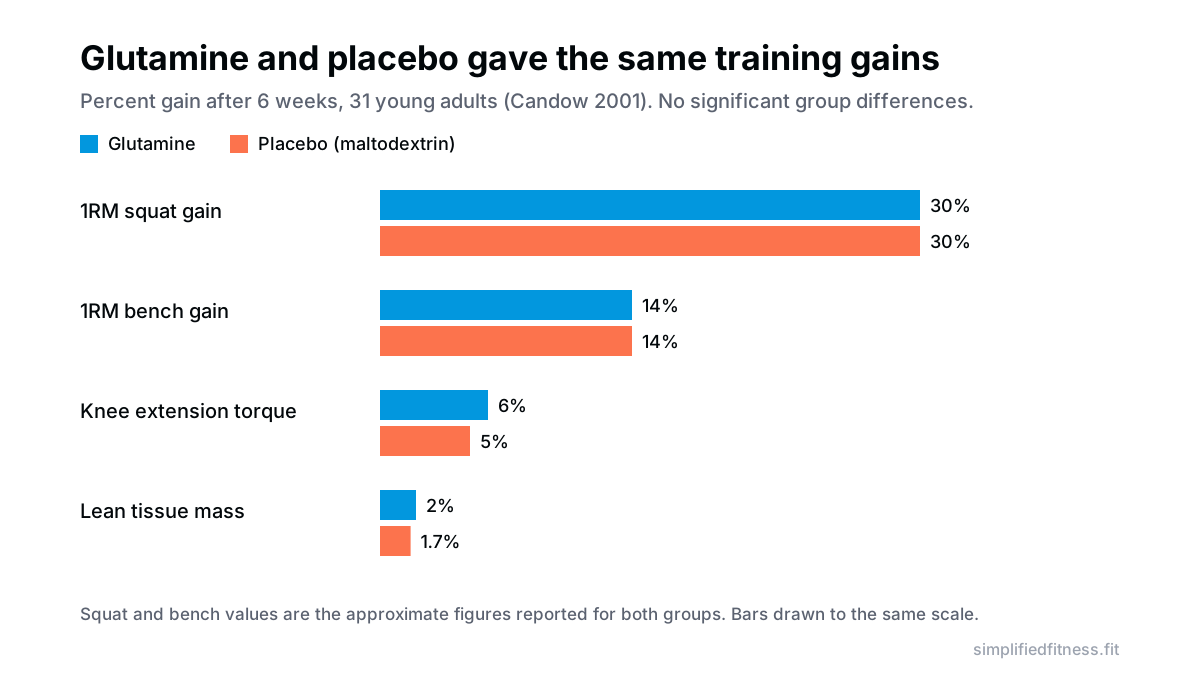
The cleanest test is a double-blind trial in young adults. Thirty-one people aged 18-24 did total-body resistance training for 6 weeks. One group took glutamine (0.9 g per kg of lean tissue mass per day, a large dose), the other a maltodextrin placebo (Candow et al., 2001).
Result: strength, torque and lean mass all rose with training, with no significant difference between groups. Both groups improved their squat by roughly 30% and bench press by roughly 14%. Lean mass rose about 2% on glutamine and 1.7% on placebo. Even urinary 3-methylhistidine, a marker of muscle protein breakdown, rose in both groups with no significant difference between them.
A broader look backs this up. A review of glutamine dosing in athletes concluded that the suggested reasons for taking it (immune support, more glycogen, less muscle breakdown) have received little support from well-controlled studies in healthy, well-nourished humans (Gleeson, 2008). Another review of 55 studies on glutamine and fatigue found that some fatigue markers improved, such as ammonia and glycogen synthesis, but physical performance did not (Coqueiro et al., 2019).
Where glutamine does have a real case: the gut
Now the other half of the paradox. Gut cells burn glutamine as fuel, and “gut barrier” research (often shortened to “leaky gut”) is where supplements get studied seriously. Intestinal permeability simply means how easily things pass through the gut lining. Researchers measure it with sugar tests (lactulose and rhamnose or mannitol) or blood markers such as I-FABP.
Be careful with the phrase “leaky gut.” It is a research concept with real measurements, but it is also a marketing label stuck onto almost any bloating complaint. Bloating alone does not prove increased permeability.
L-glutamine for leaky gut and IBS
The strongest human result is in a narrow group. In an 8-week randomized, double-blind trial, adults with post-infectious diarrhoea-predominant IBS (IBS-D) and raised gut permeability took 5 g of glutamine three times a day or placebo. The primary endpoint (a 50-point drop on the IBS severity score) was reached by 43 of 54 on glutamine (79.6%) versus 3 of 52 on placebo (5.8%). Permeability normalised in the glutamine group, and side effects were low and similar to placebo (Zhou et al., 2019).
That is a striking result, and the authors themselves say larger trials are needed. It does not show that glutamine fixes every IBS type, or bloating after dal and rajma, or “leaky gut” you diagnosed from a website.
What the pooled data say
When researchers pooled the trials, the story got more modest. A 2024 meta-analysis of 10 randomized trials (352 participants, mean age about 47, with many different health conditions) found that glutamine did not significantly change intestinal permeability overall. A subgroup analysis suggested a reduction at higher doses for durations under 2 weeks. The abstract gives the threshold as both 30 g and 30 mg a day, which tells you how carefully to read it, and the included trials ran from 1998 to 2014 (Abbasi et al., 2024). Subgroup results are hypothesis-generating, and the studies were varied and mostly not in athletes.
So the honest summary is: promising in particular clinical groups, unproven as a general gut tonic.
Glutamine, heat and long endurance sessions
Hard exercise in hot weather can temporarily loosen the gut barrier, which is relevant for anyone training outdoors in an Indian summer or running a long event. This is the one area where lifters-adjacent athletes sometimes get a legitimate pitch.
The evidence, though, disagrees with itself.
- A positive study: ten recreationally active men ran for 60 minutes at 70% VO2max in a 30 degrees C chamber after placebo or glutamine (0.25, 0.5 or 0.9 g per kg of fat-free mass). Gut permeability was lower after all glutamine doses than placebo, with larger doses likely working better. Symptoms were low in all trials and did not differ (Pugh et al., 2017).
- A negative study: ten men ran to exhaustion (about 22 minutes) at 40 degrees C after a low dose (0.3 g per kg of fat-free mass) or placebo. Permeability was actually higher after glutamine, and gut injury and bacterial translocation markers did not differ (Ogden et al., 2022).
Why might they differ? The exercise was different (steady 60 minutes versus a short, exhausting effort), the temperature was different, the dose and timing differed, and both studies were tiny. A systematic review of supplements for exercise-related gut damage found that most glutamine studies showed reduced permeability markers, but with large heterogeneity, and that it is unclear whether this improves how athletes actually feel or perform (Chantler et al., 2022).
The cautious takeaway: if you do long hot endurance sessions and have repeated gut trouble, glutamine is something to trial in training, ideally after speaking to a sports dietitian. It is not proven, and the highest heat-trial dose (0.9 g per kg of fat-free mass) works out well above the 20-30 g single intake that one review described as without ill effect in healthy adults. For electrolytes and hydration in hot weather, see our guide on electrolyte powders versus salt water.
What about immunity and recovery?
The standard pitch says hard training drops blood glutamine, which weakens immunity, so you must top it up. The review evidence is not convinced. Feeding studies show that blood glutamine can be held steady during and after prolonged exercise without preventing the post-exercise immune changes, and levels do not seem to fall low enough to limit lymphocyte growth (Gleeson, 2008).
That is why recovery claims are the weakest part of the glutamine pitch. Sleep, calories, protein and not ramping volume too fast do far more. If you are chasing broader recovery gains, our guide to BCAAs versus EAAs is another good place to check where your money goes.
The verdict: who should consider it
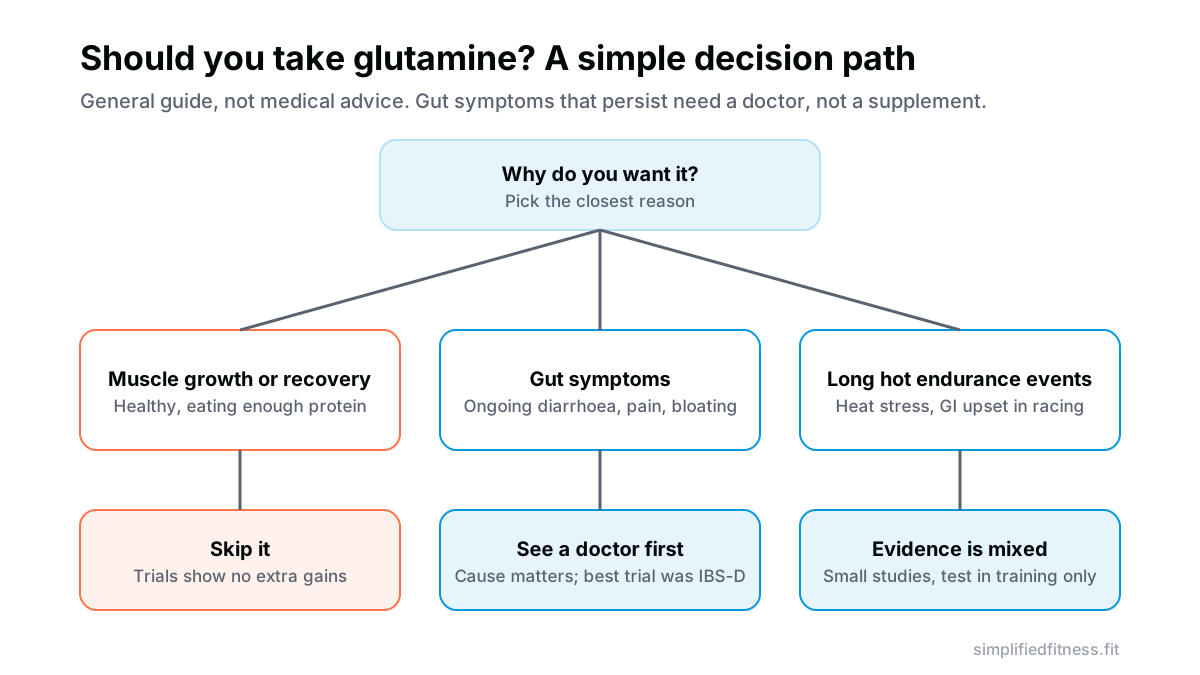
| Goal | Evidence | Practical call |
|---|---|---|
| Muscle growth, strength | Consistent null results in healthy lifters | Skip |
| Faster recovery, less soreness | Weak, little support in healthy people | Skip |
| Immune support for athletes | Reviews do not support it | Skip |
| Post-infectious IBS-D with leaky gut | One positive RCT, needs replication | Ask a doctor |
| Gut barrier in hot endurance exercise | Mixed, tiny studies | Optional experiment |
What to spend the money on instead
If your goal is muscle, the biggest wins are cheap. Check your total daily protein with our protein intake calculator, then close the gap with curd, paneer, eggs, dal, soya chunks or a decent whey. Add creatine monohydrate if you want a proven supplement. Our supplement hierarchy lays out what deserves your rupees and what does not. If your gut is the problem, our guides on probiotics and digestive enzymes and on bloating and the gut microbiome are a more useful next stop.
The bottom line
Glutamine is a real nutrient with real clinical interest, and a poor muscle supplement. The lifter trials show no extra growth, strength or recovery. The gut evidence is intriguing but narrow: one promising IBS-D trial, mixed heat-stress studies and a pooled analysis that is not convincing overall.
If you are healthy and training for muscle, skip it. If you have recurring gut symptoms, see a doctor first and let the diagnosis, not a supplement label, decide what comes next.
Frequently Asked Questions
Does glutamine build muscle?
No, not in healthy people who train and eat enough protein. In a double-blind trial, 31 young adults trained for 6 weeks and glutamine did not change strength, lean mass or muscle breakdown compared with placebo. Get your total daily protein right before thinking about any single amino acid.
Is glutamine a waste of money for gym-goers?
For muscle growth, mostly yes. A review of glutamine dosing in athletes concluded that the usual reasons for taking it have received little support from well-controlled studies in healthy, well-nourished people. Put that money into milk, curd, paneer, eggs, dal or whey first.
Why does glutamine work in hospitals but not in the gym?
Severe illness and gut disease change how much glutamine the body needs, while a healthy, well-fed lifter is in a very different situation. Muscle also makes glutamine on its own, and food supplies more. Never self-prescribe glutamine for a medical problem.
Is L-glutamine good for leaky gut?
It may help in specific cases, but the evidence is narrow. A randomized trial in people with post-infectious IBS-D and raised gut permeability reported that glutamine improved symptoms and normalised permeability, yet the authors called for larger trials to confirm it. See a doctor to find out what is actually causing your symptoms.
Can glutamine help IBS?
Possibly in one subtype. The 8-week trial used 5 g three times a day in people with post-infectious IBS-D and reported clear improvements versus placebo. That was one trial in one group, so it does not show that glutamine helps every type of IBS.
Does glutamine protect the gut during hot, hard workouts?
The results disagree. A 2017 trial in 10 men found lower permeability markers after glutamine during a 60-minute run in 30 degrees C, but a 2022 trial in 10 men found no protection and slightly higher permeability during exhaustive running at 40 degrees C. If you try it, test it in training, never on race day.
What does the research say about gut permeability and glutamine overall?
A 2024 meta-analysis of 10 randomized trials (352 participants, mostly with health conditions) found no significant overall effect. A subgroup analysis suggested a benefit at doses above 30 g a day for under 2 weeks, but subgroup findings are less reliable. This is why glutamine is a maybe, not a proven fix.
How much glutamine do people take?
Doses in the studies vary a lot, from about 15 g a day in the IBS-D trial to roughly 0.25-0.9 g per kg of fat-free mass in single-dose heat trials. The top of that range is far more than the 20-30 g single intake one review described as without ill effect in healthy adults, so do not self-dose that high without medical advice.
Does glutamine boost immunity for athletes?
The evidence does not support it for healthy athletes. A review found that supplementation keeps blood glutamine steady after prolonged hard exercise but does not prevent the post-exercise immune changes. Sleep, enough food and sensible training load matter more.
Is glutamine safe?
In healthy adults, acute intakes of 20-30 g seemed to be without ill effect in one review, and the IBS-D trial found low, similar rates of side effects to placebo. Long-term safety data in lifters are limited. Check with your doctor first if you have liver or kidney disease.
Is glutamine better than BCAAs or EAAs?
Neither is a clear winner for muscle growth if your protein intake is already adequate. Whole protein foods already deliver glutamine and the essential amino acids together. Fix your daily protein with a calculator before buying any single-amino-acid powder.
Do vegetarians in India need extra glutamine?
There is no evidence that they do. Dal, soya, paneer, curd and milk all supply glutamine inside their protein. The more useful question is whether your total daily protein is high enough.
Should I take glutamine?
For muscle gain, no. For ongoing gut symptoms, talk to a doctor about the cause first, because that is where glutamine has its best (though still limited) evidence. If your doctor suggests it, treat it as a medical supplement, not a gym supplement.
Sources & References
Every claim above is checked against peer-reviewed research (PubMed, U.S. National Library of Medicine) or guidance from established health bodies. How we fact-check.
- Candow DG, et al. Effect of glutamine supplementation combined with resistance training in young adults. Eur J Appl Physiol. 2001. PMID: 11822473
- Gleeson M. Dosing and efficacy of glutamine supplementation in human exercise and sport training. J Nutr. 2008. PMID: 18806122
- Coqueiro AY, et al. Glutamine as an anti-fatigue amino acid in sports nutrition. Nutrients. 2019. PMID: 30999561
- Pugh JN, et al. Glutamine supplementation reduces markers of intestinal permeability during running in the heat in a dose-dependent manner. Eur J Appl Physiol. 2017. PMID: 29058112
- Ogden HB, et al. Acute (L)-glutamine supplementation does not improve gastrointestinal permeability, injury or microbial translocation in response to exhaustive high intensity exertional-heat stress. Eur J Sport Sci. 2022. PMID: 34726114
- Abbasi F, et al. A systematic review and meta-analysis of clinical trials on the effects of glutamine supplementation on gut permeability in adults. Amino Acids. 2024. PMID: 39397201
- Zhou Q, et al. Randomised placebo-controlled trial of dietary glutamine supplements for postinfectious irritable bowel syndrome. Gut. 2019. PMID: 30108163
- Chantler S, et al. A systematic review: role of dietary supplements on markers of exercise-associated gut damage and permeability. PLoS One. 2022. PMID: 35417467

Umair Hazrami · Founder & Head Coach, Simplified Fitness
Umair Hazrami founded Simplified Fitness and the Simplified Lifter channel to cut through fitness noise. With 4+ years of consistent training and 10+ coaching clients, he writes every guide from the peer-reviewed research and links the sources so you can check them. Our editorial standards.
Educational content only, not medical advice. If you have a medical condition, are pregnant, or take medication, talk to a qualified doctor before changing your diet, supplements or training. Full disclaimer.
Keep reading
Supplements
Ashwagandha KSM-66 vs Sensoril: Which Extract, What Dose, and Do You Need to Cycle?
Ashwagandha KSM-66 vs Sensoril for lifters: what the strength trials show, realistic cortisol effects, liver safety and whether to cycle. Every study linked.
8 min read
Supplements
BCAAs vs EAAs: Why BCAAs Are a Waste of Money If Your Protein Is Covered
BCAA vs EAA for muscle growth: BCAAs are only 3 of the 9 essential amino acids. See what Wolfe 2017 and Jackman 2017 found and when EAAs or whey make sense.
8 min read
Supplements
Beetroot Juice for Running and Lifting: How Dietary Nitrate Works (and the Mouthwash Trap)
Does beetroot juice for running actually work? See what meta-analyses show, the 2-3 hour timing and dose, who benefits, and why mouthwash can cancel the effect.
9 min read

Supplements
Beta-Alanine Benefits: Carnosine Buffering, High-Rep Gains and Why It Makes You Tingle
Beta-alanine benefits explained: why pre-workout makes your skin tingle, how carnosine buffers acid, what dose works, and who should skip it. Studies linked.
8 min read