Vitamin D3 and K2 Synergy: Dosage, Blood Targets and Bone Health for Lifters
Vitamin D3 K2 dosage for lifters: how the pair is meant to work, which doses trials used, what blood level to aim for, and where the evidence is still thin.

TL;DR. The short answer
- A sensible vitamin D3 K2 dosage for lifters, based on what trials used, is about 1,000-5,000 IU D3 a day with a fat-containing meal, plus 90-100 mcg of MK-7 if you choose to add K2. Test your 25(OH)D first, because many people need far less, and doses above 4,000 IU a day belong under a doctor's supervision.
- D3 helps you absorb calcium. K2 (MK-7) activates osteocalcin and matrix Gla protein, proteins that handle calcium in bone and vessels. That is the proposed synergy, and it is well supported at the biomarker level.
- No trial shows D3 plus K2 beats D3 alone for strength, injuries or bone in healthy lifters. Treat K2 as an optional, low-risk add-on, not a requirement.
- In athletes, supplementing D3 reliably raises blood 25(OH)D, but two meta-analyses found no clear performance gain overall.
- Warfarin users, people with kidney disease, high calcium or kidney stones, and pregnant lifters should speak to a doctor before starting either vitamin.
Part of our complete guide: The Evidence-Based Fitness Supplements Guide: What Works, What's Overhyped & What's a Waste of Money
Table of contents
If you want a number for vitamin D3 K2 dosage for lifters, here is the honest version. Trials in athletes used roughly 3,000-5,000 IU of D3 a day to correct low levels, and K2 trials used about 90-100 mcg of MK-7. But the extra performance or bone benefit from pairing them is not proven in healthy lifters.
That does not make the pair useless. It means you should test first, dose to your result, and treat K2 as optional. This article sits inside our evidence-based supplements guide, and it focuses on the D3 plus K2 pairing specifically. For the wider vitamin D picture, see vitamin D3 optimization and serum targets.
Why take K2 with D3? The proposed synergy
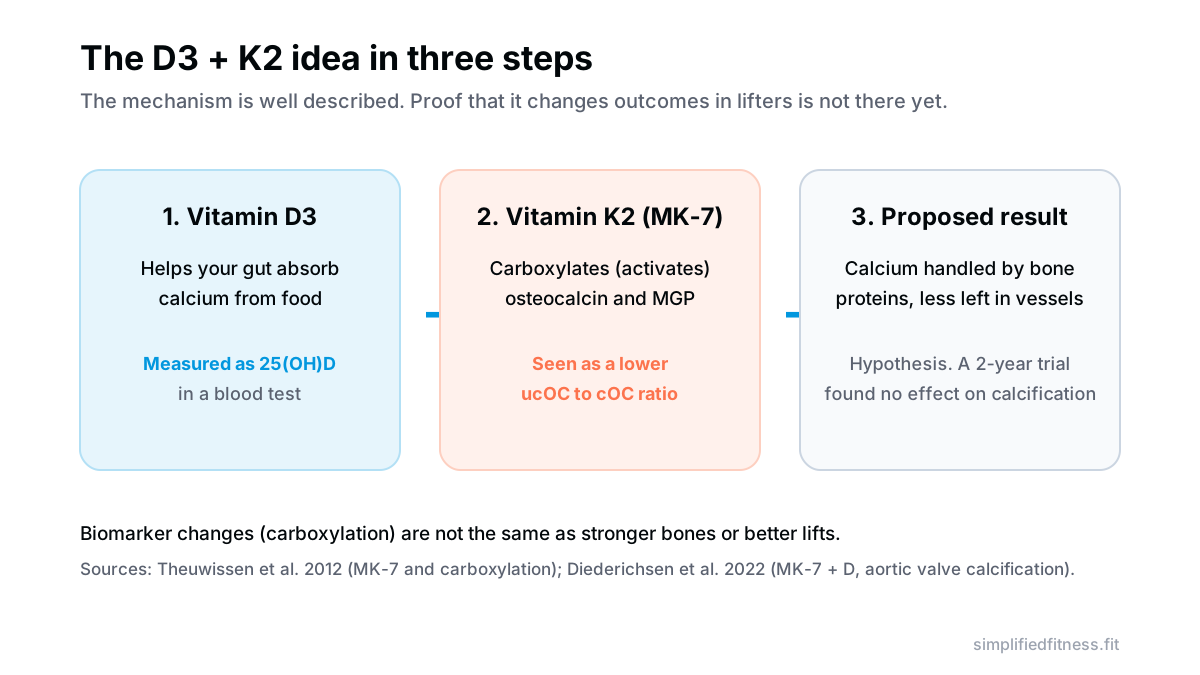
The logic comes in three steps.
Vitamin D3 helps your gut absorb calcium. Vitamin K2, in the form menaquinone-7 (MK-7), is a cofactor that “carboxylates”, or switches on, two proteins: osteocalcin in bone and matrix Gla protein (MGP) in the artery wall. Under normal conditions a sizeable share of both stays undercarboxylated. In a randomized trial of 42 healthy adults aged 18-45, MK-7 at doses around the recommended intake increased carboxylation of circulating osteocalcin and MGP, with no adverse effect on thrombin generation (Theuwissen et al., 2012).
So the theory: more D3 brings more calcium in, and K2 helps the right proteins handle it. Tidy. But a biomarker moving is not the same as a stronger skeleton or a bigger squat.
Do you actually need K2 if you take D3?
Probably not. Here is what the combination trials show.
In a one-year RCT of 311 men and postmenopausal women aged 50-75, 90 mcg a day of K2 reduced femoral neck bone loss in postmenopausal women but not in men. Adding calcium and vitamin D3 on top of K2 brought no additional effect (Zhang et al., 2020). In a small 3-month trial of 40 adults with type 2 diabetes, D3 alone, K2 alone, and D3 plus K2 each lowered glucose, and both D3 alone and the combination reduced the undercarboxylated-to-carboxylated osteocalcin ratio (Aguayo-Ruiz et al., 2020). With 12-16 people per group, that trial can only be called suggestive.
Notice what is missing: healthy, trained people, and outcomes like injuries, strength or bone density. If a supplement label claims the pair “builds stronger bones for athletes”, that is extrapolation.
Vitamin D3 dosage for lifters: what did trials use?
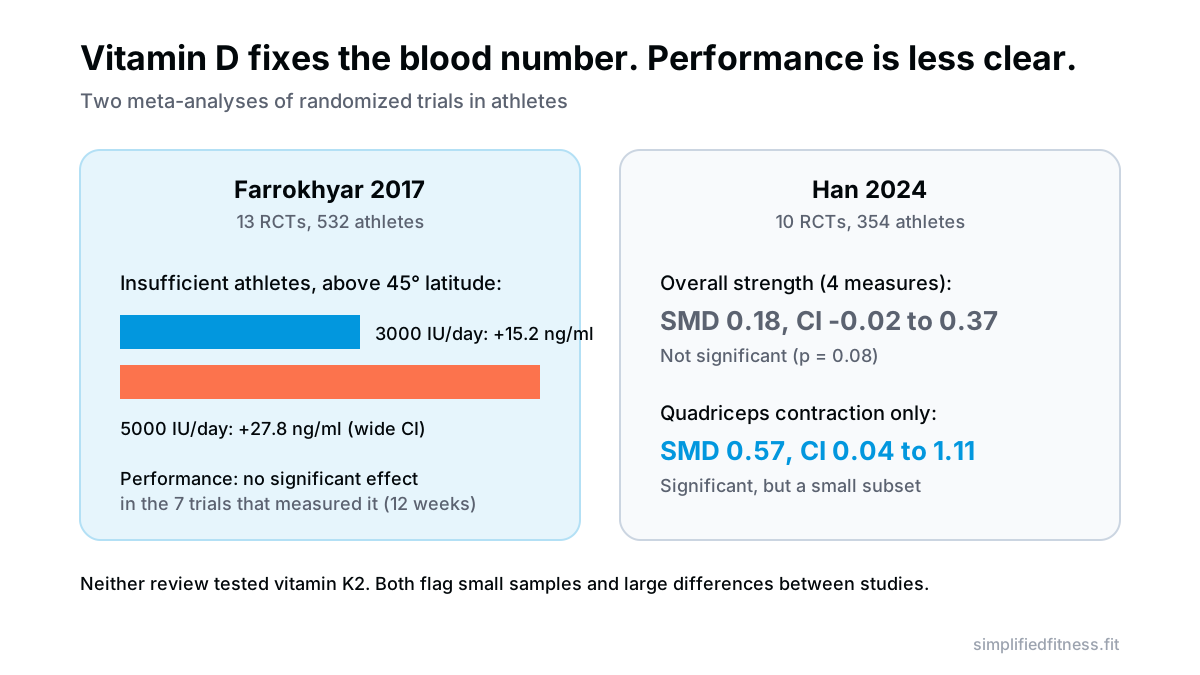
A 2017 meta-analysis pooled 13 randomized trials (532 athletes). Among athletes who started insufficient and lived above 45° latitude, 3,000 IU a day raised 25(OH)D by about 15.2 ng/ml and 5,000 IU a day by about 27.8 ng/ml (the 5,000 IU estimate was much less consistent between studies). Both reached sufficiency in winter (Farrokhyar et al., 2017). Athletes who started sufficient generally stayed sufficient on a range of doses.
That tells you what dose corrected deficiency in cold-climate athletes. It does not tell you that everyone needs 3,000-5,000 IU. For a general adult, 1,000-2,000 IU is a common maintenance range. In the VITAL trial of 25,871 midlife and older adults, 2,000 IU a day did not lower fracture risk compared with placebo over a median of 5.3 years, in people not selected for deficiency (LeBoff et al., 2022).
Practical rule: the more deficient you are, the more a higher dose makes sense, and the more you should do it under a doctor’s guidance. Note that 5,000 IU a day sits above the 4,000 IU daily tolerable upper intake level that the US Institute of Medicine set for adults, which is another reason not to self-prescribe the top of the trial range for months.
What is the optimal vitamin D blood level for the gym?
The test is serum 25-hydroxyvitamin D, or 25(OH)D. The athlete reviews cited here used 30 ng/ml (75 nmol/L) as the line for sufficiency (Farrokhyar et al., 2017) (Han et al., 2024). That is a reasonable working target, not a performance sweet spot. I found no evidence that chasing 50 or 60 ng/ml makes you stronger, and higher doses have their own risks (see below).
Lab ranges and cutoffs differ between countries and societies, so ask your doctor to read your result in context.
Does D3 improve athletic performance?
Mostly it fixes a number, and the performance payoff is less certain.
| Evidence | Population | Finding |
|---|---|---|
| 2017 meta-analysis, 13 RCTs | 532 athletes | Blood level rose with 3,000+ IU. No significant performance effect in the 7 trials that measured it (12 weeks) |
| 2024 meta-analysis, 10 RCTs | 354 athletes | Overall strength not significantly improved (SMD 0.18, p = 0.08). Quadriceps contraction improved (SMD 0.57) |
| 2015 meta-analysis, 7 trials | 310 healthy adults aged 18-40 | Upper and lower limb strength improved (SMD 0.32 each) |
The Tomlinson meta-analysis is the optimistic one (Tomlinson et al., 2015), but it pooled six RCTs and one non-randomized trial with doses from 4,000 IU a day to 60,000 IU a week. The athlete-only analyses are more conservative. The 2024 authors say the evidence cannot support a significant overall strength gain once athletes reach adequate levels, and they point to the small number of studies (Han et al., 2024).
Why might they disagree? Different baselines, doses, trial lengths and outcome measures. Benefits are most plausible in people who start low. A lifter at 35 ng/ml probably has little to gain.
Who is most likely to be low?
A 2015 meta-analysis of 23 studies (2,313 athletes) found that 56% had vitamin D inadequacy (below 32 ng/ml). Risk was higher in winter and spring and in indoor sports (Farrokhyar et al., 2015).
India adds its own twist. A review reported that deficiency prevails at 70-100% in the general Indian population, with little food fortification and lifestyle factors cutting sun exposure despite plentiful sunshine (Rajagopal and Gupta, 2014). That review is general-population, so it does not tell you about your own level. If you train in an air-conditioned gym at 6 am or 8 pm, work indoors, wear covering clothes or have darker skin, a blood test is far better than guessing. Dietary sources (eggs, fatty fish) are modest, and most Indian staples such as dal, roti and rice supply almost none.
A practical D3 and K2 plan
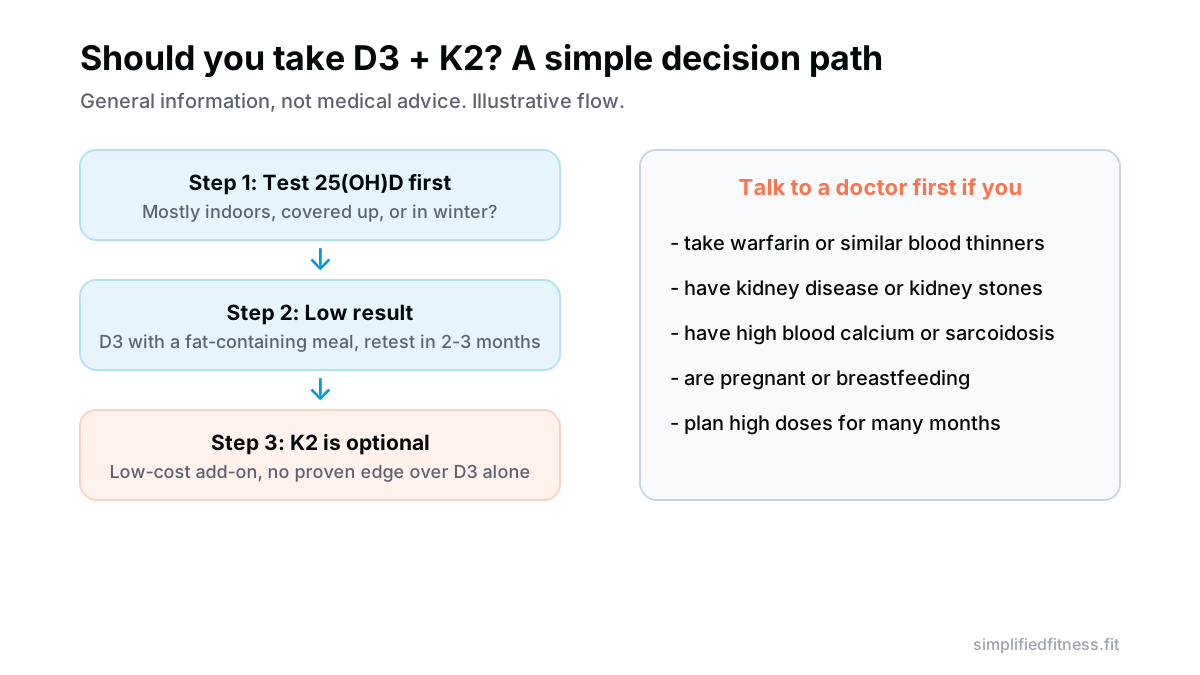
- Test first. Ask for 25(OH)D at your next blood work.
- If you are low, discuss a dose with your doctor. Athlete trials used 3,000-5,000 IU a day, but the right figure depends on how low you are.
- If you are borderline or sufficient, 1,000-2,000 IU a day, mainly in winter or if you are mostly indoors, is a common approach.
- Take it with a meal that has some fat.
- Retest after about 2-3 months and adjust. Do not keep raising the dose on a hunch.
- K2 (optional): MK-7 at about 90-100 mcg a day matches doses used in trials. Skip it if you are on warfarin.
The most common mistake here is buying a “mega-dose” D3 plus K2 bottle, taking it for a year, and never testing. You do not know whether you needed it, and you do not know whether you overshot.
Safety: when to see a doctor
Vitamin D is not harmless at any dose. A meta-analysis of 48 long-term trials (19,833 participants) found that vitamin D supplementation raised the risk of hypercalcemia (RR 1.54) and hypercalciuria (RR 1.64), and these increases were not clearly dose related. Kidney stones were not significantly increased (Malihi et al., 2016).
For K2, the biggest flag is blood thinners. Vitamin K affects clotting. In a controlled trial in warfarin patients, a multivitamin with just 25 mcg of K1 lowered INR in patients with low vitamin K status (Kurnik et al., 2004). That trial used K1 rather than K2, but it shows how sensitive warfarin therapy can be to small changes in vitamin K intake.
Speak to a doctor before starting if you:
- take warfarin or another anticoagulant
- have kidney disease, kidney stones, high calcium or sarcoidosis
- are pregnant or breastfeeding
- plan to take high doses for many months
- have symptoms such as persistent fatigue, bone pain or muscle weakness (a blood test, not a supplement guess, is the right first step)
What matters more than the supplement
If bone health is the goal, lifting heavy things already does a lot of the work. Pair it with enough protein, calcium from curd, milk or paneer, and enough calories. Our calcium, vitamin D and bone density article covers that side. For the broader choice of what is worth your money, see the supplement hierarchy, and compare with multivitamins for lifters and magnesium. If your food is the weak link, start with the free diet plan.
The bottom line
D3 is worth testing for and correcting if low, especially in winter or if you train and work indoors. K2 has a sound mechanism and little proof of extra benefit in lifters. Test, dose modestly, take it with fat, retest, and keep your doctor in the loop if you take blood thinners or have kidney or calcium problems.
Frequently Asked Questions
What is the right vitamin D3 K2 dosage for lifters?
Trials in athletes used about 3,000-5,000 IU of D3 a day to correct low levels, and a general adult maintenance dose is often lower, so 1,000-2,000 IU is a common starting point. K2 trials used roughly 90-100 mcg a day. Get a blood test first, then pick the lowest dose that brings you into range.
Why take K2 with D3?
Vitamin D3 increases calcium absorption, while vitamin K2 activates proteins such as osteocalcin and matrix Gla protein that handle that calcium. The idea is that the two work as a pair. The proof that this changes bone or lifting outcomes is limited, so K2 is optional rather than essential.
Do I need K2 if I take vitamin D3?
Probably not, if you are healthy and your diet is reasonable. A 2020 trial found that adding calcium and D3 to K2 gave no extra bone benefit beyond K2 alone, and no trial has shown D3 plus K2 beats D3 alone in lifters. If you want it, it is a cheap add-on, but check with a doctor first if you take blood thinners.
What is the optimal vitamin D blood level for the gym?
Several athlete trials used 30 ng/ml (75 nmol/L) of 25(OH)D as the cutoff for sufficiency, and that is a reasonable working target. Higher is not proven to be better for performance. Ask your doctor to interpret your result against the lab's own reference range.
Does vitamin D3 improve athletic performance?
Not clearly. A 2017 meta-analysis of 13 trials found no significant performance effect, and a 2024 update found no significant overall strength gain, though quadriceps strength improved. Benefits, if any, are most likely when you start out deficient, so fix a low level and do not expect extra performance beyond that.
Should I take vitamin D3 and K2 in the morning or at night?
There is no good evidence that time of day matters. What does matter is taking D3 with a meal containing fat, since one trial found about 32% higher peak D3 levels with a fat-containing meal than a fat-free one. Pair it with a meal you never skip, such as lunch with ghee, paneer, eggs or nuts.
Is MK-7 better than MK-4 or K1?
MK-7 is the form used in most of the supplement trials discussed here, so it has the most supporting data for carboxylation. I could not confirm head-to-head superiority over other forms from the studies I reviewed. If you buy K2, pick MK-7 with a clear dose per capsule.
Can I get enough vitamin D from sunlight in India?
Often not. A review of Indian data reported vitamin D deficiency in 70-100% of the general population, with limited fortification and cultural and lifestyle factors reducing sun exposure despite plentiful sunshine. If you train indoors early or late in the day and cover up, a test is worth doing.
Can you take too much vitamin D?
Yes. A meta-analysis of long-term trials found vitamin D supplementation raised the risk of high blood calcium and urine calcium, though not kidney stones. Stay with moderate doses unless a doctor has told you otherwise, and retest rather than guessing.
Is vitamin K2 safe with blood thinners like warfarin?
Do not add it without medical advice. Vitamin K takes part in blood clotting, and a trial in warfarin patients found that even 25 mcg a day of K1 in a multivitamin lowered INR in people with low vitamin K status. Your doctor may need to adjust your dose and monitor you.
How long does vitamin D3 take to raise blood levels?
Trials in athletes measured results over about 12 weeks, so 2-3 months is a sensible interval before retesting. Larger doses raise levels faster but carry more risk of overshooting. Retest after about three months and adjust instead of increasing the dose on a hunch.
Does vitamin D3 plus K2 make bones stronger in lifters?
Lifting loads bone, and we lack trials testing D3 plus K2 on bone in lifters. In a one-year trial in adults aged 50-75, 90 mcg of K2 reduced femoral neck bone loss in postmenopausal women but not men. Extrapolating that to healthy young lifters is speculative, so prioritise training, calcium and protein.
Sources & References
Every claim above is checked against peer-reviewed research (PubMed, U.S. National Library of Medicine) or guidance from established health bodies. How we fact-check.
- Farrokhyar F, et al. Effects of Vitamin D Supplementation on Serum 25-Hydroxyvitamin D Concentrations and Physical Performance in Athletes: A Systematic Review and Meta-analysis of Randomized Controlled Trials. Sports Med. 2017. PMID: 28577257
- Han Q, et al. Effects of vitamin D3 supplementation on strength of lower and upper extremities in athletes: an updated systematic review and meta-analysis of randomized controlled trials. Front Nutr. 2024. PMID: 38860160
- Farrokhyar F, et al. Prevalence of vitamin D inadequacy in athletes: a systematic-review and meta-analysis. Sports Med. 2015. PMID: 25277808
- Theuwissen E, et al. Low-dose menaquinone-7 supplementation improved extra-hepatic vitamin K status, but had no effect on thrombin generation in healthy subjects. Br J Nutr. 2012. PMID: 22289649
- Diederichsen ACP, et al. Vitamin K2 and D in Patients With Aortic Valve Calcification: A Randomized Double-Blinded Clinical Trial. Circulation. 2022. PMID: 35465686
- Zhang Y, et al. Effect of Low-Dose Vitamin K2 Supplementation on Bone Mineral Density in Middle-Aged and Elderly Chinese: A Randomized Controlled Study. Calcif Tissue Int. 2020. PMID: 32060566
- Aguayo-Ruiz JI, et al. Effect of supplementation with vitamins D3 and K2 on undercarboxylated osteocalcin and insulin serum levels in patients with type 2 diabetes mellitus: a randomized, double-blind, clinical trial. Diabetol Metab Syndr. 2020. PMID: 32831908
- Dawson-Hughes B, et al. Dietary fat increases vitamin D-3 absorption. J Acad Nutr Diet. 2015. PMID: 25441954
- Malihi Z, et al. Hypercalcemia, hypercalciuria, and kidney stones in long-term studies of vitamin D supplementation: a systematic review and meta-analysis. Am J Clin Nutr. 2016. PMID: 27604776
- LeBoff MS, et al. Supplemental Vitamin D and Incident Fractures in Midlife and Older Adults. N Engl J Med. 2022. PMID: 35939577
- Tomlinson PB, et al. Effects of vitamin D supplementation on upper and lower body muscle strength levels in healthy individuals. A systematic review with meta-analysis. J Sci Med Sport. 2015. PMID: 25156880
- Kurnik D, et al. Over-the-counter vitamin K1-containing multivitamin supplements disrupt warfarin anticoagulation in vitamin K1-depleted patients. A prospective, controlled trial. Thromb Haemost. 2004. PMID: 15543329
- Rajagopal G, Gupta A. Vitamin D deficiency in India: prevalence, causalities and interventions. Nutrients. 2014. PMID: 24566435

Umair Hazrami · Founder & Head Coach, Simplified Fitness
Umair Hazrami founded Simplified Fitness and the Simplified Lifter channel to cut through fitness noise. With 4+ years of consistent training and 10+ coaching clients, he writes every guide from the peer-reviewed research and links the sources so you can check them. Our editorial standards.
Educational content only, not medical advice. If you have a medical condition, are pregnant, or take medication, talk to a qualified doctor before changing your diet, supplements or training. Full disclaimer.
Keep reading

Supplements
Ashwagandha KSM-66 vs Sensoril: Which Extract, What Dose, and Do You Need to Cycle?
Ashwagandha KSM-66 vs Sensoril for lifters: what the strength trials show, realistic cortisol effects, liver safety and whether to cycle. Every study linked.
8 min read

Supplements
BCAAs vs EAAs: Why BCAAs Are a Waste of Money If Your Protein Is Covered
BCAA vs EAA for muscle growth: BCAAs are only 3 of the 9 essential amino acids. See what Wolfe 2017 and Jackman 2017 found and when EAAs or whey make sense.
8 min read
Supplements
Beetroot Juice for Running and Lifting: How Dietary Nitrate Works (and the Mouthwash Trap)
Does beetroot juice for running actually work? See what meta-analyses show, the 2-3 hour timing and dose, who benefits, and why mouthwash can cancel the effect.
9 min read

Supplements
Beta-Alanine Benefits: Carnosine Buffering, High-Rep Gains and Why It Makes You Tingle
Beta-alanine benefits explained: why pre-workout makes your skin tingle, how carnosine buffers acid, what dose works, and who should skip it. Studies linked.
8 min read