Intra-Workout Carbs for Bodybuilding: Who Needs Sugar in the Gym and Who Is Wasting Calories
Intra workout carbs bodybuilding: do you need them for a 60-minute session? See what the research says on glycogen, cyclic dextrin, osmolality and electrolytes.

TL;DR. The short answer
- For a typical 45-60 minute lifting session eaten and hydrated normally, intra-workout carbs are usually optional. A 2022 systematic review found carbohydrate intake is unlikely to change performance in the fed state in workouts of up to 10 sets per muscle group.
- Carbs during training help most when sessions are long, very high volume, or done after a long fast. A 2022 meta-analysis found the clearest benefit in sessions over 45 minutes and after fasts of 8 hours or more.
- For multi-hour endurance work, a 2013 review advises about 60 g of carbohydrate per hour, and up to 90 g per hour only with mixed sugar types in well-trained athletes.
- Cyclic dextrin has some early evidence behind it, but the one resistance-training trial we have was small, industry-linked, and showed a speed benefit in men but not women. It is not a proven upgrade over cheaper options.
- Heavy, salty sweating in a hot climate is a stronger reason to drink something with sodium than a reason to buy a 40 g sugar drink. If you are cutting, liquid calories are the first thing to question.
Part of our complete guide: The Evidence-Based Fitness Supplements Guide: What Works, What's Overhyped & What's a Waste of Money
Table of contents
Walk into any gym and you will see a shaker of bright, sugary liquid being sipped between sets. The marketing says intra workout carbs bodybuilding style will “fuel your pump” and “protect your gains.” For a normal 45-60 minute lifting session, the research says you probably do not need them, and the 150-200 kcal might be better spent at a meal.
There are real exceptions, and they are worth knowing. This article sits inside our evidence-based supplements guide and covers who benefits from sugar in the gym, what cyclic dextrin does and does not prove, and how drink concentration affects your stomach. For a shorter take on the same debate, see who actually needs intra-workout carbohydrates.
Do I need carbs during my workout?
Start with what the biggest reviews found.
A 2022 systematic review pulled together 49 studies on carbohydrate intake and strength training performance. In acute studies, higher carbohydrate intake did not improve performance in 13 studies and did in six, mostly where the control group was fasted and workouts were over 10 sets per muscle group. The authors concluded carbohydrate intake is unlikely to affect strength training in a fed state for workouts of up to 10 sets per muscle group (Henselmans et al., 2022).
That is a pretty direct answer to a very common question. Ate a normal meal, doing a standard split? The sugar drink probably adds calories, not reps.
A separate 2022 meta-analysis of 21 crossover studies (226 participants) found a benefit on total session volume (standardised mean difference 0.61). The effect was larger in sessions longer than 45 minutes (1.02) and after a fast of 8 hours or more (0.39). It also depended on how many maximal-effort sets were done, not on the carbohydrate dose or load (King et al., 2022).
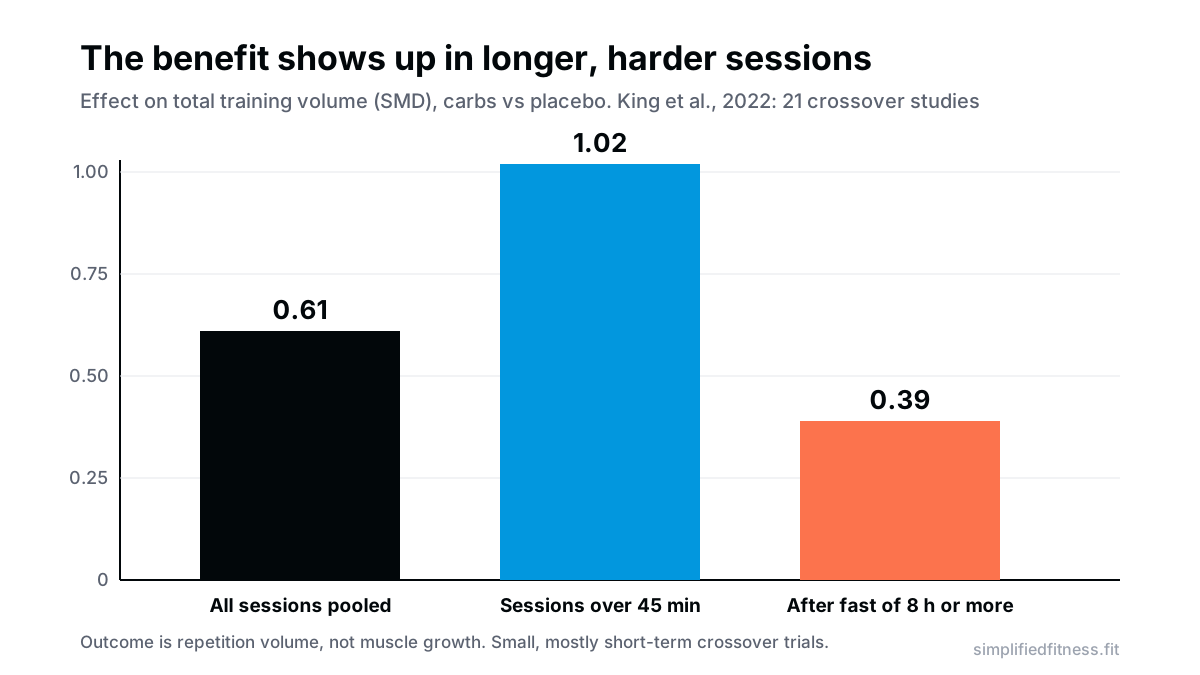
Do those two reviews contradict each other? Not really. They define the question differently. The meta-analysis asks “does carbohydrate raise volume across all kinds of crossover trials?” while the systematic review asks “does it matter if you are fed and the workout is modest?” Fasted subjects and high-volume sessions drive the positive findings in both. One honest wrinkle: a 60-minute session technically falls in the meta-analysis’s “over 45 minutes” group, so the evidence for a normal hour-long session is genuinely mixed. Being fed and keeping volume moderate are the factors that most consistently make carbs unnecessary. The cautious takeaway: carbs help most when fuel is genuinely short or the session is genuinely long.
How much glycogen does a gym workout actually use?
Intra-workout marketing leans on one idea: your muscles run dry mid-session. So how dry do they get?
A 2025 meta-analysis of 20 studies (168 men and 12 women) found a single resistance training session significantly lowers glycogen in the vastus lateralis (a quad muscle). The drop was larger with more sets and longer sessions, and smaller at higher intensity. Depletion was slightly larger in untrained than trained participants, and the prediction interval was wide, meaning results across studies varied a lot (Hamidvand et al., 2025).
Notice what that does not say. It does not say your muscles were empty. It says glycogen falls, more so with high volume. For a standard session, that is a reason carbs matter across the day, not proof that you need them in your hand during the set.
You may have seen a figure quoted of roughly 20-30% depletion in a typical session. The meta-analysis reports an average drop in absolute units (about 104 mmol per kg of dry muscle), not a percentage, so treat any percentage you see online as a ballpark at best. Also remember all of this is measured in one muscle, mostly in men.
When do intra-workout carbs actually make sense?
The honest list is short.
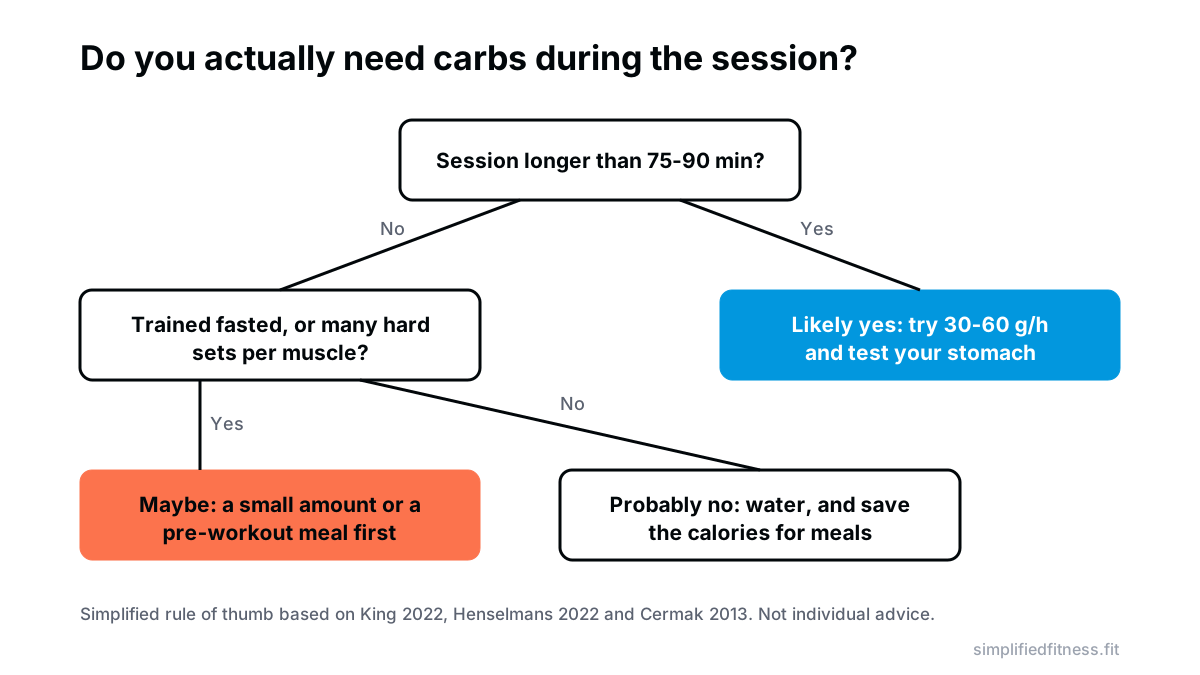
- Long sessions. The meta-analysis found the clearest benefit in sessions over 45 minutes. Our practical rule of thumb is to consider carbs once sessions run well past an hour (75-90 minutes or more), such as long bodybuilding sessions, two-a-day training or heavy leg days with many sets.
- Training fasted and still wanting volume. The positive findings clustered here.
- High-volume sessions. The meta-analysis found the effect scaled with the number of maximal-effort sets.
- Endurance or long mixed sessions. A 2013 review reported that carbohydrate during prolonged (over 2 hours) moderate-to-high intensity exercise can significantly improve endurance performance, with 60 g per hour advised for 2-3 hours and up to 90 g per hour in well-trained athletes competing beyond 2.5 hours, using multiple transportable carbohydrates (Cermak and van Loon, 2013).
That same review also noted that small amounts of carbohydrate may help shorter, intense bouts (45-60 minutes) even when stores are not limiting, and suggests the mechanism may be in the central nervous system. That is a possible edge for a very hard session, but the evidence is about endurance-type efforts, so do not over-extend it to a bench day.
Cyclic dextrin vs maltodextrin: is the premium worth it?
Cluster dextrin (highly branched cyclic dextrin, HBCD) sells at several times the price of maltodextrin or dextrose. The pitch is faster stomach emptying, steady energy and no bloating. What backs that up?
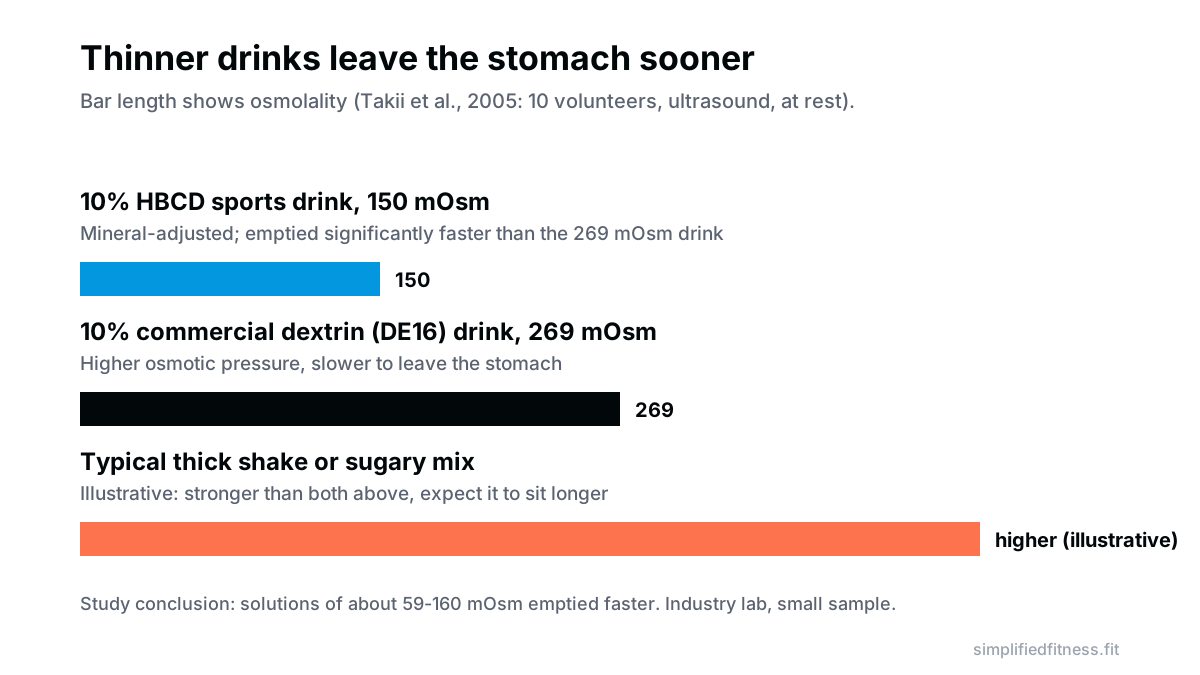
On gastric emptying: a 2005 study used ultrasound in 10 healthy volunteers and compared water, saline and different carbohydrate solutions. For most carbohydrates, lower osmotic pressure meant faster transfer out of the stomach. HBCD behaved differently, with emptying time increasing as concentration rose. A 10% HBCD sports drink adjusted to 150 mOsm emptied faster than a plain 10% HBCD solution and faster than a 10% commercial dextrin (DE16) drink at 269 mOsm. The authors concluded solutions of about 59-160 mOsm emptied faster (Takii et al., 2005). Note the first author works for Ezaki Glico, a company that makes HBCD, the sample was small, and this was measured at rest.
On resistance training: a 2025 randomized, double-blind crossover trial gave 30 active people (15 men, 15 women) either 45 g of HBCD in 750 mL (sipped as 50 mL before each set) or a near calorie-free placebo during five sets of eight reps at their 12RM on bench press, bench pull and squat. The drink was well tolerated with no stomach complaints. Rep velocity improved in men but not in women, lactate was comparable or higher, and perceived fatigue did not change significantly (Morenas-Aguilar et al., 2025). Several authors are affiliated with the Life Pro Nutrition Research Center, part of a supplement company.
So where does that leave us? Two small studies, both with industry ties, one at rest and one in a single session. The most honest summary is: HBCD may be easy on the stomach and may help bar speed in some people, but there is no clean head-to-head evidence in these abstracts that it beats maltodextrin or dextrose at the same dose and osmolality. If you have the budget and like how it feels, fine. If you are paying a premium for a proven edge, the data does not yet show one.
| Option | What the evidence shows | Practical note |
|---|---|---|
| Water only | Fine for fed, normal-length sessions | Cheapest; no extra kcal |
| Dextrose or glucose | Studied in many carbohydrate trials | Cheap, sweet; keep it dilute |
| Maltodextrin | Common carb in trials and powders | Cheap; concentration matters for the stomach |
| Cyclic dextrin (HBCD) | Small studies, industry-linked | Costs more; unproven edge over cheaper carbs |
| Banana or dates and water | Food-based, tolerable for many | Budget-friendly in India; carry easily |
Osmolality and gastric emptying: why a thick drink sits in your stomach
Osmolality is simply how concentrated a drink is in terms of dissolved particles. The more sugar and salt you pack in, the higher it goes. A body-fluid-like (isotonic) drink sits around the same level as your blood, a more dilute one is hypotonic, and a stronger one is hypertonic.
Why should you care? Because the stomach controls how fast liquid moves into the intestine, where absorption happens. In the Takii study above, stronger carbohydrate solutions generally left the stomach more slowly, and the best emptying was seen at roughly 59-160 mOsm. Stomach fullness and cramping mid-set are exactly what ruin a leg session.
The gym-floor translation:
- Mix the powder with more water than the scoop instructions suggest if you get sloshy.
- Sip in small amounts between sets, not big gulps.
- Trial any new drink on a normal training day, never on the day you want a PR.
This is a mechanistic and small-sample finding, so use it as a reason to experiment cautiously, not as a precise rule.
Electrolytes during heavy sweating: do you need sodium in the drink?
Here is something the “intra” marketing often buries: for many Indian lifters, the bigger issue in May is not glycogen, it is sweat.
The American College of Sports Medicine states the goal of drinking during exercise is to prevent excessive dehydration (more than 2% body weight lost from a water deficit) and excessive changes in electrolyte balance. It notes there is considerable variability in sweating rates and sweat electrolyte content between individuals, recommends customized plans, and says individual sweat rates can be estimated by weighing yourself before and after exercise. It also says drinks with electrolytes and carbohydrates can provide benefits over water alone under certain circumstances (Sawka et al., 2007).
A 2017 review agrees that sweating rate and sweat sodium concentration vary considerably within and among athletes, and that body mass change is the simplest and most accurate way to estimate whole-body sweating rate (Baker, 2017). That author works at an industry sports science institute, so read the practical recommendations with that in mind, but the weighing method itself is simple and sensible.
A simple test: weigh yourself in minimal clothing before and after a normal session, noting what you drank. If you lose well under 1-2% of body weight and feel fine, you probably do not need a special drink. If you finish dizzy, cramping, with white salt marks on your clothes, a sodium-containing drink may help more than a sugar bomb. Our water intake calculator is a good starting point for daily fluids, and the dedicated guide on electrolyte powders vs salt water covers the choices in more detail. For the performance side of dehydration, see hydration and strength.
Who is wasting calories on intra-workout drinks?
A few typical cases come to mind.
The 50-minute lifter on a cut. Ate rice and dal two hours earlier. A 45 g carb drink adds around 180 kcal for a benefit the review suggests is unlikely in this setup.
The person doing heavy arms and chest in a 60-minute session who feels fine. No sign of fading. The drink is a habit, not a need.
The beginner copying a pro’s routine. Pros train twice a day, for long sessions, with huge volume, and often have sponsors. Context matters.
On the other side, someone doing a long leg day at 6 am, no breakfast, with 20+ hard sets, a long commute and no pre-workout meal is exactly the profile the studies pointed to. For that person, 20-40 g of carbs (a banana or a diluted dextrose drink) is a reasonable test. Not proof of anything, just a trial.
If your real goal is simply fuelling hard training without gaining fat, the larger lever is your daily carbohydrate intake and pre-workout meal. We cover the daily side in dietary carbohydrates, hypertrophy and glycogen, and the fasted question in fasted vs fed cardio. Our free calorie calculator will show how much a drink really costs you.
A practical protocol that respects the evidence
- Eat first. A carb-and-protein meal 2-3 hours before (rice and dal, roti and paneer, poha with curd) or a lighter snack 45-60 minutes before.
- Start with water. If you fade at the 60-minute mark, note it for two or three sessions.
- If you genuinely fade in long or high-volume sessions, try 20-40 g of carbs, well diluted, sipped between sets. The review found no dose-response effect in acute studies, so more is not clearly better.
- For multi-hour endurance work, build towards 30-60 g per hour in training, using mixed sugars if you go higher, as the 2013 review describes.
- Reassess on a cut. If calories are tight, drop the drink first and keep the pre-workout meal.
- Hot climate? Weigh before and after, and sip a sodium-containing drink if you are a heavy, salty sweater.
Not sure how this fits into the rest of your stack? Our supplement hierarchy puts intra-workout drinks well below basics like creatine and protein.
When to see a doctor: persistent dizziness, fainting, severe cramps, very dark urine, or repeated stomach problems during exercise are not things to fix with a powder. Diabetes also changes the picture, since carbohydrate timing interacts with medication. Speak to your doctor before experimenting.
What the evidence cannot tell us yet
Most carb-and-resistance-training studies measure repetitions or bar velocity in one session, not months of muscle growth. Sample sizes are small, many used crossover designs in young, active participants, and there are few women in the glycogen data. The one cyclic dextrin resistance trial found a sex difference that no one has explained, and industry funding ties run through parts of this literature. Take it as a reason to be curious and cheap, not certain.
Frequently Asked Questions
Do I need carbs during a workout?
For most gym sessions lasting 45-60 minutes, no. A systematic review of 49 studies found carbohydrate intake is unlikely to improve strength training in the fed state for workouts of up to 10 sets per muscle group. If your session runs well past an hour, involves a lot of hard sets, or you train fasted, a small carb drink becomes more reasonable.
Are intra-workout carbs worth it for bodybuilding?
Usually not for standard hypertrophy sessions, because the evidence shows no consistent benefit when you have eaten beforehand. A 2022 meta-analysis did find more total repetition volume with carbs, mainly in longer sessions and after fasting. Eat a proper meal 2-3 hours before and see whether you actually fade before paying for a powder.
How much of my muscle glycogen does a lifting session use?
A 2025 meta-analysis of 20 studies found a single resistance session significantly lowers glycogen in the thigh muscle, with more depletion as sets and session length go up. It does not report a single number that fits everyone, and individual studies varied a lot. The average drop does not suggest muscles are emptied by a normal session, so do not assume you are running on fumes mid-workout.
What is cyclic dextrin and is it better than maltodextrin?
Cyclic dextrin (highly branched cyclic dextrin, or HBCD) is a branched carbohydrate made from starch. A small 2005 ultrasound study found a mineral-adjusted 150 mOsm HBCD drink left the stomach faster than a 269 mOsm drink based on ordinary dextrin, but because the HBCD drink was also adjusted for osmolality, the study cannot isolate HBCD itself as the reason. Treat the claim of superiority as unproven and compare price per gram first.
Does cyclic dextrin improve resistance training performance?
One 2025 crossover trial in 30 active people used 45 g in 750 mL spread across rest periods and found faster rep velocity in men but not in women. It also reported no stomach complaints. The trial was small, short-term, and several authors are affiliated with a supplement company research centre, so more independent data is needed.
What is the difference between hypotonic and isotonic drinks?
A hypotonic drink has fewer dissolved particles than body fluids, an isotonic drink is about the same, and a hypertonic drink has more. Lower osmolality drinks generally leave the stomach more easily, which matters when you are mid-session and trying not to feel sloshy. Mix your drink weaker rather than stronger if you notice nausea during heavy sets.
Should I drink carbs while cutting?
Probably not unless your session is long. A 45 g carb drink is roughly 180 kcal, which is a real chunk of a cutting deficit for a benefit that may be small in a 60-minute session. Put those calories into a pre-workout meal and use our [calorie calculator](/tools/calorie-calculator) to see how much room you actually have.
Do I need electrolytes during a normal gym workout?
Usually not if you drink to thirst and eat normal meals. The ACSM position stand notes that drinks containing electrolytes and carbohydrate can offer benefits over water alone under certain circumstances, such as long or very sweaty sessions. Check your sweat loss by weighing yourself before and after training before buying anything.
How much sodium do you lose in sweat?
It varies a lot between people and conditions. A 2017 review explains that sweating rate and sweat sodium concentration differ considerably within and between athletes, and that body mass change is the simplest way to estimate sweat loss. A salty-sweater in an Indian summer gym may need more than someone in an air-conditioned one, so test your own pattern.
How many grams of carbs per hour should I take during long training?
For exercise lasting 2-3 hours, a 2013 review advised about 60 g per hour. Well-trained endurance athletes competing beyond 2.5 hours can handle up to 90 g per hour if they use multiple transportable carbohydrates, such as glucose plus fructose. Build up gradually in training so your gut adapts.
Can carbs during a workout hurt my stomach?
They can, mainly if the drink is concentrated, large in volume or new to your gut. Gastric emptying slows as a solution gets stronger, which is why thick sugary mixes can sit heavily. Sip small amounts between sets and trial any drink on a normal training day first.
What is the cheapest intra-workout carb option in India?
For a long session, plain glucose or dextrose powder, a banana, or dates with water are far cheaper than branded blends. The research compares carbohydrate amounts and types, not brands, so the cheapest source that your stomach tolerates is a sensible start. Keep the dose in the 30-60 g per hour range only when the session is genuinely long.
Is a pre-workout meal better than an intra-workout drink?
For standard sessions, a meal 2-3 hours before gives you carbohydrate availability without liquid calories during the workout. The 2022 review found benefits mainly in studies with fasted control groups, which suggests being fed matters more than sipping during the session. Fix the pre-workout meal first, then add an intra drink only if you still fade.
Sources & References
Every claim above is checked against peer-reviewed research (PubMed, U.S. National Library of Medicine) or guidance from established health bodies. How we fact-check.
- King A, et al. The Ergogenic Effects of Acute Carbohydrate Feeding on Resistance Exercise Performance: A Systematic Review and Meta-analysis. Sports Med. 2022. PMID: 35809162
- Henselmans M, et al. The Effect of Carbohydrate Intake on Strength and Resistance Training Performance: A Systematic Review. Nutrients. 2022. PMID: 35215506
- Hamidvand A, et al. Acute effects of resistance exercise on skeletal muscle glycogen depletion: A systematic review and meta-analysis. Physiol Rep. 2025. PMID: 41420384
- Cermak NM, et al. The use of carbohydrates during exercise as an ergogenic aid. Sports Med. 2013. PMID: 23846824
- Morenas-Aguilar MD, et al. Highly branched cyclic dextrin supplementation and resistance training: A randomized double-blinded crossover trial examining mechanical, metabolic, and perceptual responses. Clin Nutr ESPEN. 2025. PMID: 39644922
- Takii H, et al. Fluids containing a highly branched cyclic dextrin influence the gastric emptying rate. Int J Sports Med. 2005. PMID: 15900642
- Sawka MN, et al. American College of Sports Medicine position stand. Exercise and fluid replacement. Med Sci Sports Exerc. 2007. PMID: 17277604
- Baker LB. Sweating Rate and Sweat Sodium Concentration in Athletes: A Review of Methodology and Intra/Interindividual Variability. Sports Med. 2017. PMID: 28332116

Umair Hazrami · Founder & Head Coach, Simplified Fitness
Umair Hazrami founded Simplified Fitness and the Simplified Lifter channel to cut through fitness noise. With 4+ years of consistent training and 10+ coaching clients, he writes every guide from the peer-reviewed research and links the sources so you can check them. Our editorial standards.
Educational content only, not medical advice. If you have a medical condition, are pregnant, or take medication, talk to a qualified doctor before changing your diet, supplements or training. Full disclaimer.
Keep reading

Supplements
Ashwagandha KSM-66 vs Sensoril: Which Extract, What Dose, and Do You Need to Cycle?
Ashwagandha KSM-66 vs Sensoril for lifters: what the strength trials show, realistic cortisol effects, liver safety and whether to cycle. Every study linked.
8 min read
Supplements
BCAAs vs EAAs: Why BCAAs Are a Waste of Money If Your Protein Is Covered
BCAA vs EAA for muscle growth: BCAAs are only 3 of the 9 essential amino acids. See what Wolfe 2017 and Jackman 2017 found and when EAAs or whey make sense.
8 min read
Supplements
Beetroot Juice for Running and Lifting: How Dietary Nitrate Works (and the Mouthwash Trap)
Does beetroot juice for running actually work? See what meta-analyses show, the 2-3 hour timing and dose, who benefits, and why mouthwash can cancel the effect.
9 min read

Supplements
Beta-Alanine Benefits: Carnosine Buffering, High-Rep Gains and Why It Makes You Tingle
Beta-alanine benefits explained: why pre-workout makes your skin tingle, how carnosine buffers acid, what dose works, and who should skip it. Studies linked.
8 min read