Melatonin for Lifters: Why a Low Dose (0.3-1 mg) Beats the 10 mg Gummy
Melatonin dosage for sleep: why 0.3-1 mg is the evidence-backed start, why 10 mg gummies may leave you groggy, plus timing and jet lag, with every study linked.

TL;DR. The short answer
- Melatonin is a timing signal for your body clock, not a knockout sedative. In a lab trial in healthy volunteers, evening doses of 0.3 mg and 1 mg shortened the time to fall asleep.
- More is not clearly better. A Cochrane review of jet lag found doses above 5 mg were no more effective, and one 2024 meta-analysis put the peak sleep benefit at about 4 mg a day.
- A 10 mg gummy is far above a physiological dose. No trial I found directly tests it for morning grogginess, but the mechanism and lab data make it a reasonable suspect, and the fix is simple: drop the dose.
- Take it earlier than most people do, roughly 1-3 hours before bed, then dim the lights. Sleep hours matter more for lifting than any pill.
- Skip it or ask a doctor first if you are pregnant, have epilepsy, take warfarin or other regular medication, or sleep badly for weeks on end.
Part of our complete guide: The Evidence-Based Fitness Supplements Guide: What Works, What's Overhyped & What's a Waste of Money
Table of contents
If you are searching for the right melatonin dosage for sleep, the evidence points to a small number: roughly 0.3-1 mg, taken in the evening, not the 5-10 mg gummies that dominate the shelf. Melatonin is a darkness signal for your body clock, not a sedative, so a bigger dose does not clearly buy you a deeper sleep. It may buy you a foggy morning.
This guide is part of our evidence-based supplements guide. It covers what melatonin actually does, what the trials say about dose and timing, where the research disagrees, and how to use it around travel or a night shift. For the room, light and routine side of sleep, see our sleep hygiene checklist for lifters.
What does melatonin actually do?
Your brain releases melatonin when it gets dark. The signal tells your body that biological night has started: core temperature drifts down, alertness falls, and your clock shifts toward sleep. Light switches it off again in the morning.
That makes it a timing hormone. A sedative forces drowsiness at any hour. Melatonin only works well when it arrives at the right point in your 24-hour cycle.
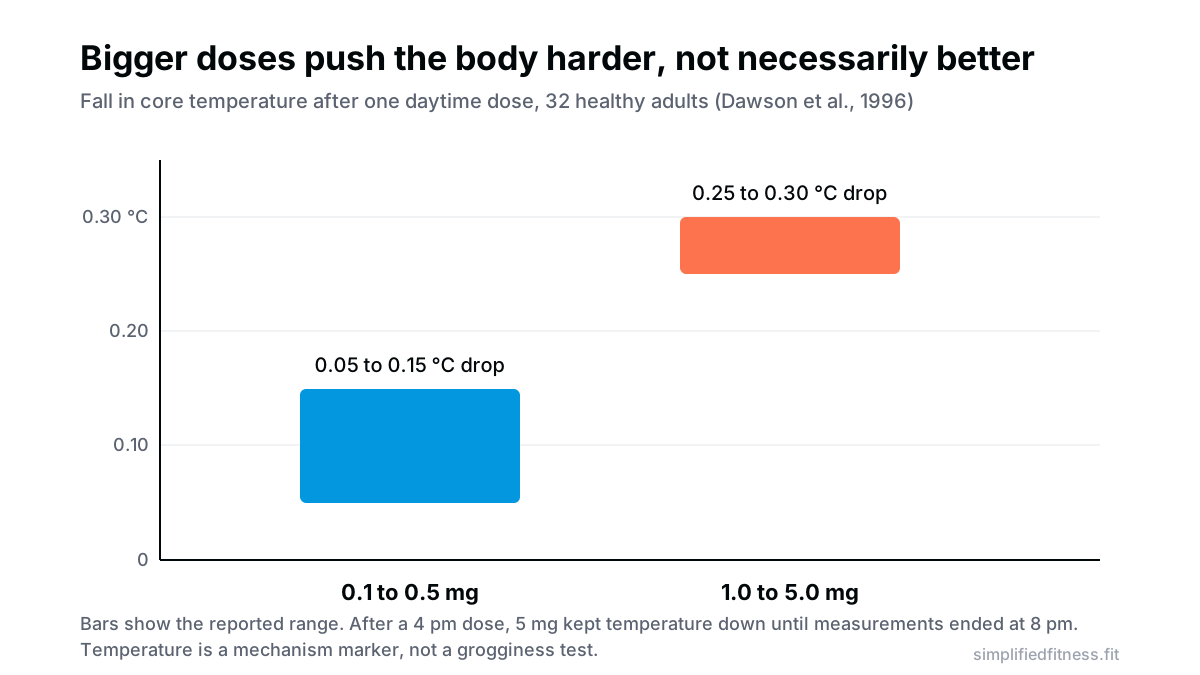
You can see the “night signal” idea in the lab. In a study of 32 healthy adults, melatonin capsules from 0.1 to 5.0 mg lowered core body temperature, and the drop was larger and longer at higher doses, although the authors cautioned it was not a simple dose-response curve (Dawson et al., 1996). After a 4 pm dose, the 5 mg group’s temperature stayed suppressed until measurements ended at 8 pm. Blood levels rose from physiological to pharmacological as the dose went up.
Is 0.3-1 mg really enough to fall asleep faster?
In lab conditions, yes. Volunteers in one controlled study took 0.3 mg, 1.0 mg or placebo at 6, 8 or 9 pm. Either dose, at any of those times, shortened the time to fall asleep and the time to stage 2 sleep, and it did not suppress REM sleep (Zhdanova et al., 1995).
Those doses were chosen to mimic what the body makes naturally, which is why “micro-dosing” is a fair label. Two cautions apply. The study was small and old, and the volunteers were not lifters with stressful jobs and a phone in bed. A lab result at 0.3 mg is a reason to try a low dose first, not a promise that it will work for you.
Why is 10 mg melatonin too much?
Here is what I can and cannot say.
What the evidence supports: a 10 mg gummy is many times a physiological dose, and there is no sign that bigger doses work better. The Cochrane jet lag review found daily doses between 0.5 and 5 mg similarly effective (people did fall asleep a little faster on 5 mg than 0.5 mg), with doses above 5 mg appearing no more effective (Herxheimer and Petrie, 2002). Paying for 10 mg buys no extra benefit that I can find.
What is plausible but not proven: next-morning grogginess. The temperature study above shows a big dose holds the body in a night-like state for hours. In the same study, melatonin was cleared quickly (half-lives of roughly 33-47 minutes), so the popular claim that megadoses “saturate receptors all night” is an oversimplification (Dawson et al., 1996). I found no trial that directly tests 10 mg gummies for morning fog, and the claim that high doses cause receptor “desensitization” in humans is a hypothesis, not an established finding.
What does look reassuring about low doses: in the 1995 trial, neither 0.3 nor 1.0 mg caused a “hangover” on mood and performance tests the next morning (Zhdanova et al., 1995).
So the honest summary is this: higher doses give you more of the effect and a longer tail, with no proven added benefit. If you are groggy on a big gummy, lowering the dose is a cheap experiment.
Does more melatonin work better? What the studies disagree on
This is where the story gets less tidy, and it is worth saying so.
A 2024 systematic review and dose-response meta-analysis pooled 26 randomized trials (1,689 observations) in people with insomnia and healthy volunteers. It found melatonin gradually shortened sleep onset and lengthened total sleep time, peaking at about 4 mg a day. It also suggested that taking it about 3 hours before the desired bedtime, and at 4 mg, might work better than the common 2 mg half an hour before bed (Cruz-Sanabria et al., 2024). Insomnia status also predicted a bigger effect.
That does not contradict the 0.3-1 mg data so much as widen it. The low-dose trials show a small dose can shorten sleep onset in healthy sleepers. The meta-analysis suggests the useful range extends up to about 4 mg, and that timing matters. Neither result supports 10 mg.
There is a further wrinkle on the low end. In the temperature study, the lowest doses (0.1 and 0.5 mg) produced very variable blood levels, and the authors concluded that 1.0-5.0 mg were the lowest doses that gave a consistent temperature drop across all participants (Dawson et al., 1996). So a 0.3 mg capsule may do a lot for one person and little for another.
| Question | What the evidence shows | Source |
|---|---|---|
| Does 0.3-1 mg shorten sleep onset? | Yes, in a lab study of healthy volunteers | Zhdanova 1995 |
| Where does the sleep benefit peak? | About 4 mg/day in a dose-response meta-analysis | Cruz-Sanabria 2024 |
| Is more than 5 mg better? | Appeared no more effective for jet lag | Herxheimer 2002 |
| Do the lowest doses work for everyone? | Variable blood levels at 0.1-0.5 mg | Dawson 1996 |
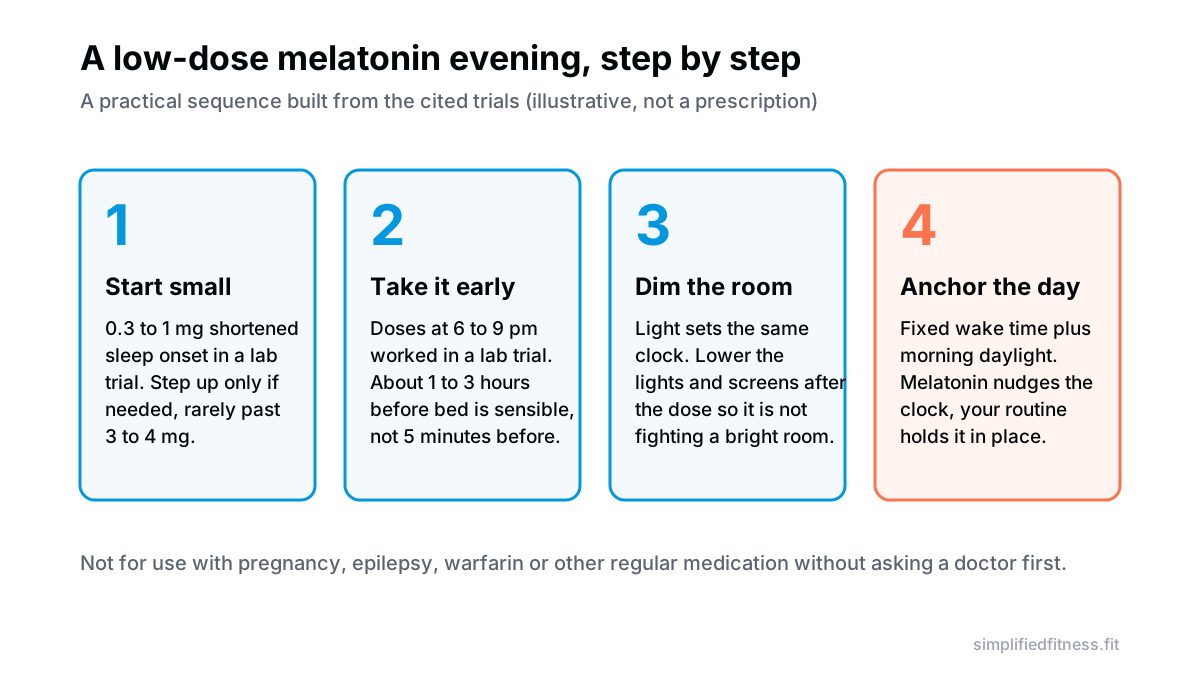
A cautious takeaway: start around 0.5-1 mg, give it a week, and if it clearly does nothing, step up gradually toward 3 mg. Stay well under 10 mg.
When should you take it?
Most people take melatonin as they climb into bed. The research suggests that is too late for the signal to land.
In the 1995 trial, doses taken at 6, 8 and 9 pm all shortened sleep onset (Zhdanova et al., 1995), and the 2024 meta-analysis found that a longer gap between the dose and the sleep episode predicted better sleep onset (Cruz-Sanabria et al., 2024). Taken together, a window of roughly 1-3 hours before bed is a reasonable starting point. If you usually sleep at 11:30 pm, try the dose around 9-10:30 pm and dim the room afterwards.
Light is the other half. In a controlled study of 36 healthy adults, early-evening melatonin (5 mg, taken nearly 6 hours before habitual bedtime) and morning bright light each shifted the body clock earlier by a similar amount, and the two together shifted it more than either alone (Burke et al., 2013). The dose there was higher than the micro-dose range and the study measured clock phase, not training outcomes, so treat it as proof of the principle: melatonin and light talk to the same clock.
Does melatonin help with jet lag, travel and shift work?
Here the evidence is genuinely mixed, and the two main reviews are worth putting side by side.
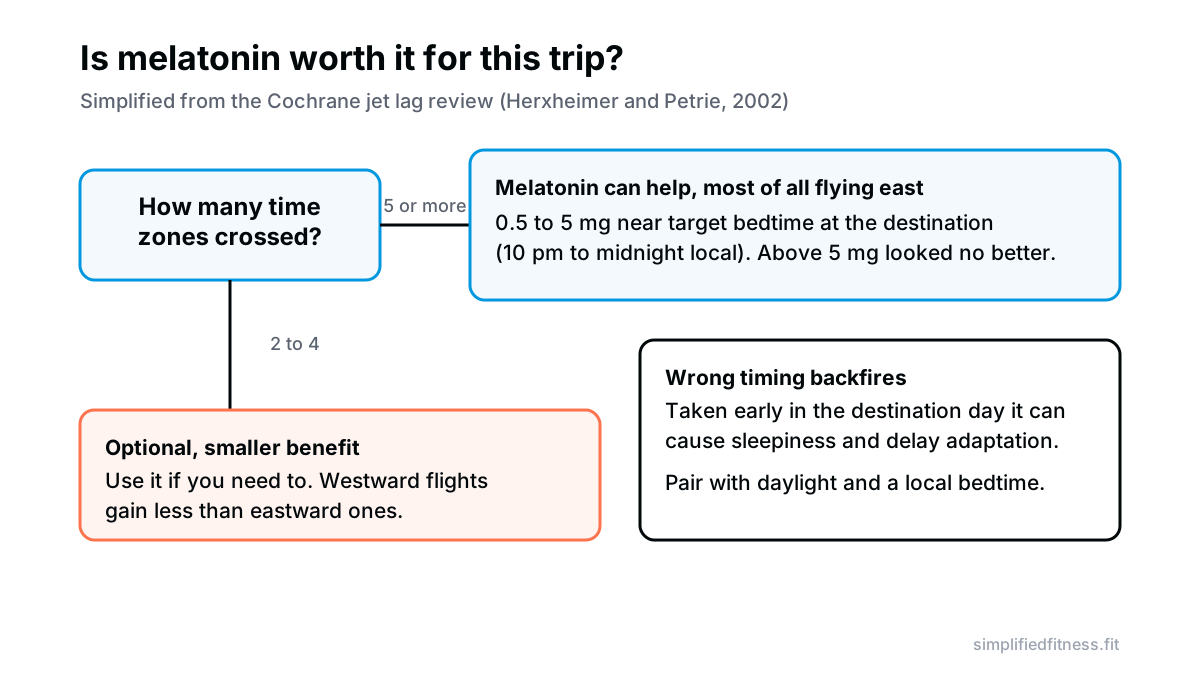
The Cochrane review of jet lag found nine of ten trials showed less jet lag when melatonin was taken close to target bedtime at the destination (10 pm to midnight) after crossing five or more time zones. The benefit was likely larger the more zones crossed, and smaller for westward flights. Taken at the wrong time, early in the destination day, it could cause sleepiness and delay adaptation (Herxheimer and Petrie, 2002).
A BMJ meta-analysis went the other way for a different question. It pooled trials in secondary sleep disorders and in sleep problems linked to sleep restriction, including jet lag and shift work, and found no evidence that melatonin shortened sleep onset (a difference of about 1 minute in nine trials with 427 participants for sleep restriction). It did find no evidence of adverse effects with short-term use, defined as three months or less (Buscemi et al., 2006).
Why might they differ? The Cochrane review looked at jet-lag symptoms and recovery after crossing time zones, while the BMJ analysis looked at time to fall asleep in a mixed group of conditions. Timing, dose and population differed too, and many of these trials are old and small. My reading: melatonin may help long, eastward trips when timed to the destination clock, and there is not much evidence that it fixes everyday sleep loss or a night shift.
For the full travel playbook, use our jet lag and travel sleep protocol. If you work nights, our shift worker lifting guide covers the training side.
Why sleep matters more than any pill for lifters
It is worth being honest about priorities. There is no proof that melatonin improves your lifting. The reason to care about sleep is that losing it costs you.
A systematic review of 17 studies (rated moderate or weak quality) found that consecutive nights of sleep restriction could reduce force output in multi-joint lifts but not single-joint ones, while a total sleepless night had little effect on strength (Knowles et al., 2018). In a crossover trial of ten resistance-trained women, nine nights at 5 hours in bed slowed lower-body bar speed by up to 15% and raised perceived effort, although total volume load barely changed (Knowles et al., 2022). That is a small sample and a short run, so take it as a pattern, not a verdict.
The practical read: if melatonin gets your bedtime back by 30-45 minutes without morning fog, it may be worth it. If it does not, fix the schedule, the light and the caffeine cutoff first. Our guide to magnesium for sleep and the sleep supplements audit compare the other options, and the sleep circadian timing guide is the bigger picture.
How to choose a product (India notes)
- Check the dose per unit. Many gummies and tablets are 5-10 mg. Look for 0.5-1 mg, or a tablet you can split. Do not guess from the front label alone.
- Buy from a pharmacy or a brand you trust. The Cochrane reviewers called for routine pharmaceutical quality control of melatonin products (Herxheimer and Petrie, 2002). I could not verify the exact accuracy of Indian products, so do not assume the number on the label is the number in the capsule.
- For jet lag, prefer immediate-release. The Cochrane review noted that 2 mg slow-release melatonin was relatively ineffective for jet lag, suggesting a short, higher peak works better there. Slow-release products are a different case, so ask a pharmacist or doctor if one has been prescribed for you.
- Ignore the hype. Melatonin is not a testosterone or growth hormone booster, and nothing here shows it builds muscle.
Who should not use melatonin without a doctor
Skip it, or ask a doctor first, if you:
- are pregnant or breastfeeding
- have epilepsy or a seizure disorder
- take warfarin, or take any regular prescription medication
- are under 18
- have had weeks of poor sleep despite a good routine
The Cochrane review flagged case reports suggesting harm in people with epilepsy and in those on warfarin (Herxheimer and Petrie, 2002). Long trouble sleeping can have medical causes such as sleep apnea, depression or thyroid problems, and a supplement will not fix those. If you snore loudly or wake gasping, our note on sleep apnea in muscular lifters is a good next read, and a doctor is the right next step.
The bottom line
Melatonin is a clock signal. A small dose of roughly 0.3-1 mg, taken 1-3 hours before bed in a dim room, is the best-supported place to start. Doses up to about 4 mg have some support in a pooled analysis, and 10 mg has no evidence of extra benefit. If you wake up groggy, the dose is the first thing to change.
Build the rest first: a fixed wake time, morning daylight, a caffeine cutoff and a dark room. When training is dialed in too, our free training plans give you a simple structure to recover from.
Frequently Asked Questions
What is the best melatonin dosage for sleep?
There is no single best dose, but the lowest dose that works is a sensible start, and a lab trial in healthy volunteers found 0.3 mg and 1 mg both shortened sleep onset. A 2024 dose-response meta-analysis found the benefit peaked around 4 mg a day, so the useful range is roughly 0.3-4 mg rather than 10. Start at 0.5-1 mg, give it a week, and only step up if it clearly does nothing.
Why is 10 mg melatonin too much?
It is many times the amount your body releases at night, and there is no evidence that it works better than a smaller dose. The Cochrane jet lag review found doses above 5 mg no more effective, and temperature studies show larger doses keep the body in a 'night' state longer. If you wake up groggy on a 10 mg gummy, cut it to 1 mg and see whether mornings improve.
Does melatonin make you groggy in the morning?
It can in some people, mostly when the dose is high or taken too late. A lab trial of 0.3 mg and 1 mg found no morning hangover on mood and performance tests, which suggests low doses are less likely to cause it. If you feel foggy, lower the dose and take it earlier in the evening.
Is melatonin a sleeping pill?
Not in the usual sense. It signals biological night to your brain and shifts the timing of your clock, while sedative sleeping pills act directly on brain chemistry to knock you out. That is why timing matters so much with melatonin. Think of it as a cue to pair with a dark room and a regular bedtime.
How long before bed should I take melatonin?
Earlier than most people think. Lab trials used evening doses from 6 pm, and a 2024 meta-analysis suggested that taking it about 3 hours before the desired bedtime may work better than 30 minutes before. A practical window is roughly 1-3 hours before bed, and you can adjust from there.
Can I take melatonin every night?
Short-term use looks safe in the trials, but long-term data are thinner. A BMJ meta-analysis of 17 trials found no evidence of adverse effects within three months. Treat it as a short-term tool while you fix your routine, and see a doctor if you need it for months.
Does melatonin lower your own melatonin production?
I could not find good human evidence either way for ordinary low-dose use, so the confident claims online should be treated with caution. The studies I reviewed measured sleep, timing and short-term safety, not long-term changes in your own output. If you are worried, the safest approach is the lowest effective dose for the shortest time.
Does melatonin help with jet lag?
Yes, for longer flights. A Cochrane review found nine of ten trials showed less jet lag when melatonin was taken near the target bedtime at the destination after crossing five or more time zones. Doses of 0.5-5 mg at local bedtime were used, and taking it early in the destination day can backfire.
Does melatonin build muscle or boost growth hormone?
No trial I found shows that melatonin builds muscle or works as a hormone booster for lifters. The reliable route to better recovery is simply sleeping enough, and the studies on sleep loss and strength are covered below.
Can I take melatonin with magnesium?
Many people do, and the combination is common in sleep stacks, but I did not find trials proving the pair works better than either alone. Each has its own dose and timing rules. Our [sleep supplements audit](/blog/sleep-supplements-melatonin-glycine-magnesium-audit) compares them side by side.
Is melatonin safe for lifters in India?
Safety depends on the dose, your health and the product quality, not on where you live. Quality control is a real issue because the Cochrane reviewers called for routine pharmaceutical quality control of melatonin products. Buy from a reputable pharmacy brand with the dose clearly printed, and ask a doctor if you take other medicines.
Who should not take melatonin?
Anyone pregnant or breastfeeding, anyone with epilepsy, and people on warfarin or other regular medication should speak to a doctor first. The Cochrane review flagged case reports of possible harm in epilepsy and with warfarin. If you sleep badly for weeks, see a doctor, because poor sleep can have causes that a supplement will not fix.
Sources & References
Every claim above is checked against peer-reviewed research (PubMed, U.S. National Library of Medicine) or guidance from established health bodies. How we fact-check.
- Cruz-Sanabria F, et al. Optimizing the Time and Dose of Melatonin as a Sleep-Promoting Drug: A Systematic Review of Randomized Controlled Trials and Dose-Response Meta-Analysis. J Pineal Res. 2024. PMID: 38888087
- Zhdanova IV, et al. Sleep-inducing effects of low doses of melatonin ingested in the evening. Clin Pharmacol Ther. 1995. PMID: 7768078
- Dawson D, et al. The hypothermic effect of melatonin on core body temperature: is more better? J Pineal Res. 1996. PMID: 8836952
- Herxheimer A, et al. Melatonin for the prevention and treatment of jet lag. Cochrane Database Syst Rev. 2002. PMID: 12076414
- Buscemi N, et al. Efficacy and safety of exogenous melatonin for secondary sleep disorders and sleep disorders accompanying sleep restriction: meta-analysis. BMJ. 2006. PMID: 16473858
- Burke TM, et al. Combination of light and melatonin time cues for phase advancing the human circadian clock. Sleep. 2013. PMID: 24179293
- Knowles OE, et al. Inadequate sleep and muscle strength: Implications for resistance training. J Sci Med Sport. 2018. PMID: 29422383
- Knowles OE, et al. Sustained Sleep Restriction Reduces Resistance Exercise Quality and Quantity in Females. Med Sci Sports Exerc. 2022. PMID: 36136596

Umair Hazrami · Founder & Head Coach, Simplified Fitness
Umair Hazrami founded Simplified Fitness and the Simplified Lifter channel to cut through fitness noise. With 4+ years of consistent training and 10+ coaching clients, he writes every guide from the peer-reviewed research and links the sources so you can check them. Our editorial standards.
Educational content only, not medical advice. If you have a medical condition, are pregnant, or take medication, talk to a qualified doctor before changing your diet, supplements or training. Full disclaimer.
Keep reading

Supplements
Ashwagandha KSM-66 vs Sensoril: Which Extract, What Dose, and Do You Need to Cycle?
Ashwagandha KSM-66 vs Sensoril for lifters: what the strength trials show, realistic cortisol effects, liver safety and whether to cycle. Every study linked.
8 min read
Supplements
BCAAs vs EAAs: Why BCAAs Are a Waste of Money If Your Protein Is Covered
BCAA vs EAA for muscle growth: BCAAs are only 3 of the 9 essential amino acids. See what Wolfe 2017 and Jackman 2017 found and when EAAs or whey make sense.
8 min read
Supplements
Beetroot Juice for Running and Lifting: How Dietary Nitrate Works (and the Mouthwash Trap)
Does beetroot juice for running actually work? See what meta-analyses show, the 2-3 hour timing and dose, who benefits, and why mouthwash can cancel the effect.
9 min read

Supplements
Beta-Alanine Benefits: Carnosine Buffering, High-Rep Gains and Why It Makes You Tingle
Beta-alanine benefits explained: why pre-workout makes your skin tingle, how carnosine buffers acid, what dose works, and who should skip it. Studies linked.
8 min read