Decoding Supplement Proprietary Blends: Under-Dosing Tricks and Deceptive Labels
Proprietary blends in supplements hide how much of each ingredient you get. Why they are legal, a 60-second dose-math check, and how accurate labels really are.

TL;DR. The short answer
- A proprietary blend lists the total weight of a mix and the ingredient names, but not how much of each ingredient is inside, so you cannot compare it with the doses used in studies.
- Blends are legal in the US under the 1994 DSHEA law, which lets companies protect formulas. Legal does not mean useful: without individual amounts, you cannot judge whether a dose is effective.
- Quick test: add up the studied doses of the headline ingredients. If they exceed the blend's total weight (for example a 5,000 mg blend claiming citrulline, beta-alanine and caffeine), at least one is under-dosed.
- Choose products that list every ingredient with its own milligram amount. If the label hides doses, buy the single ingredients separately instead.
- Third-party testing and an honest label are different things. A tested product can still be under-dosed, and a transparent one can still be untested.
Part of our complete guide: The Evidence-Based Fitness Supplements Guide: What Works, What's Overhyped & What's a Waste of Money
Table of contents
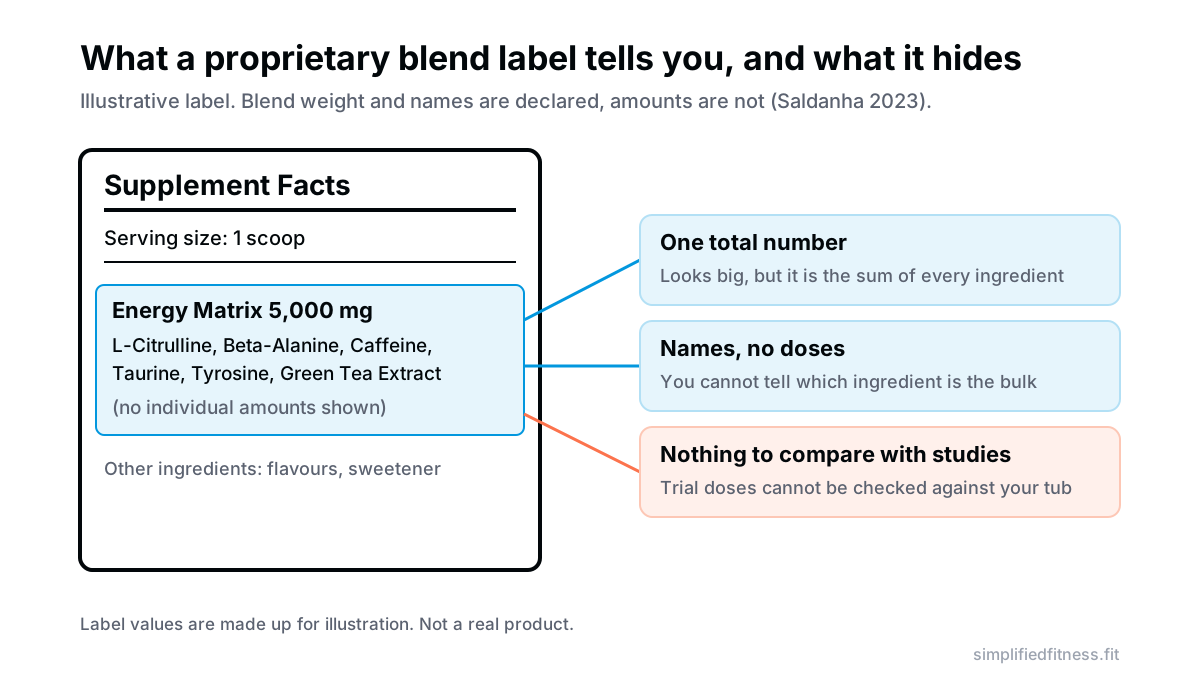
A proprietary blend is a group of ingredients listed under one name with one combined weight, so you can see what is in the tub but not how much of each ingredient you are getting. That is why proprietary blends in supplements are the easiest place to hide an under-dosed formula. A “5,000 mg Energy Matrix” sounds serious, but without individual amounts you cannot tell whether it is mostly useful ingredients or mostly cheap filler.
This guide gives you a simple forensic toolkit: how the label rules work, a dose-math check you can do in 60 seconds, and a buying rule that saves money. It sits inside our wider guide to evidence-based fitness supplements, which covers what is actually worth buying.
What is a proprietary blend, and is it legal?
Yes, it is legal. A 2023 paper by authors from the NIH Office of Dietary Supplements, the FDA and an industry association explains that the Dietary Supplement Health and Education Act of 1994 lets companies list non-nutrient dietary ingredients as a proprietary blend to protect their unique formula. The total weight of the blend and the names of the ingredients inside must be declared, but not the amounts of each one (Saldanha et al., 2023).
The same paper makes a point that matters to lifters: because of this, a label alone cannot tell you the dose of an ingredient in a blend, which also makes it hard to work out intakes or compare with clinical trial doses.
Think about what that means in the gym. Studies test ingredients at specific doses. If your tub hides its doses, you cannot check whether it matches anything that was tested.
Why do companies use proprietary blends?
Two reasons, one fair and one less so.
The fair one: protecting a formula from copycats. Some blends contain botanical extracts where the exact ratio really is a trade secret.
The less fair one: it makes the label impossible to audit. A 2013 pharmacy journal review of pre-workout ingredients notes that pre-workouts typically contain proprietary blends of multiple ingredients, that labels often do not disclose all ingredients or their precise amounts, and that evidence for the combination products is scant, inconclusive or conflicting (Eudy et al., 2013).
This is not limited to pre-workout powders. An analysis of the label panels of 75 top-selling energy drinks and shots in the US found 15 products with proprietary blends containing undisclosed ingredient amounts (Jagim et al., 2022). So roughly one in five of that sample used the format.
I cannot tell you a given brand is cheating. What I can say is that a hidden dose is a dose you cannot defend.
How do under-dosing tricks work?
There are three patterns I would watch for. None proves bad intent, but all of them make dose checking impossible.
1. Fairy dusting. A real but tiny amount of an expensive ingredient is added so the name can sit on the front of the tub. The ingredient is there, the effect is not.
2. Stimulant padding. Caffeine is cheap and you can feel it, so a formula can seem “strong” because of caffeine while the other ingredients do very little. In that case the effect you feel may come almost entirely from the caffeine, which you could buy on its own for much less.
3. Name stacking. A long ingredient list creates the impression of a complete formula. But the total weight of a scoop is fixed. Every extra ingredient fights for the same few grams.
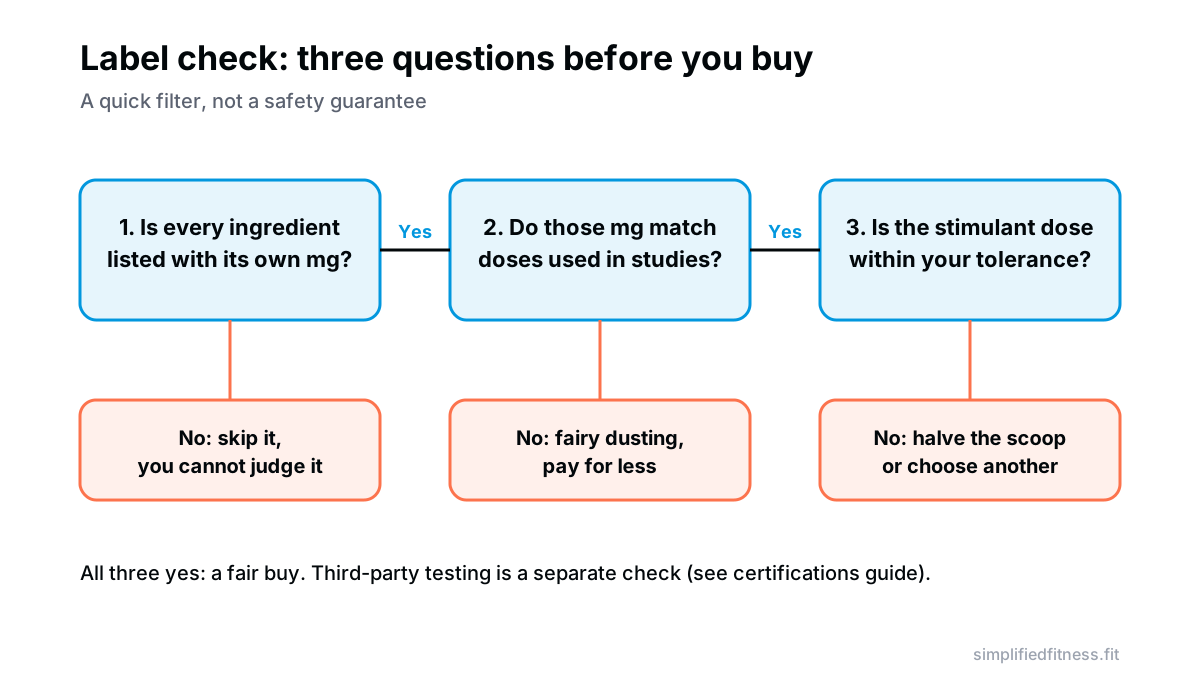
A five-step label check
- Check the serving size. Make sure the numbers are per scoop, and that the scoop is the one you will really use. Some labels list a half serving.
- Look for a milligram amount beside every active ingredient. If a name sits inside a blend with no number, count it as unverified.
- Compare amounts with studied doses. The next section shows how.
- Add up stimulants. Caffeine, plus anything else with a stimulant effect, plus your usual coffee or chai.
- Check price per serving. Compare it with buying caffeine and the main ingredients on their own.
The 60-second dose math
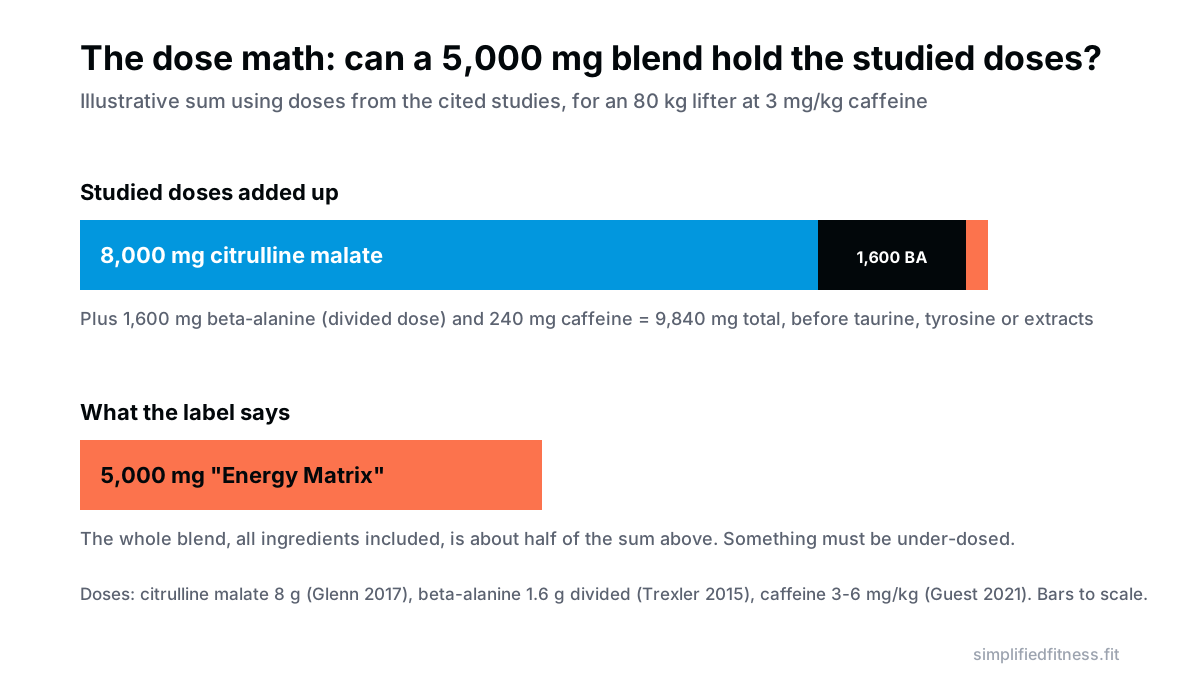
Here is the check that exposes a lot of blends. Take the ingredients named on the front of the label and add up the doses used in research. If the sum exceeds the blend’s total weight, the blend cannot contain all of them at those doses. It is simple arithmetic.
Use doses from the evidence:
- Citrulline malate: one trial in 15 resistance-trained women used 8 g of citrulline malate taken one hour before training, and found more reps over six sets than placebo (Glenn et al., 2017). That is a small acute study, so treat it as a reference point and not a guarantee.
- Beta-alanine: the ISSN reports that 4-6 g daily for at least 2-4 weeks improves performance, and that divided doses of about 1.6 g can reduce tingling (Trexler et al., 2015).
- Caffeine: the ISSN says 3-6 mg/kg body mass consistently improves performance, and the minimum effective dose may be as low as 2 mg/kg (Guest et al., 2021).
Now run an illustrative example for an 80 kg lifter. Caffeine at 3 mg/kg is 240 mg. Add 1.6 g of beta-alanine and 8 g of citrulline malate:
8,000 + 1,600 + 240 = 9,840 mg.
A “5,000 mg Energy Matrix” cannot hold that, and it also lists taurine, tyrosine and green tea extract. At least one ingredient is under-dosed relative to the studies. That does not mean the product is dangerous or useless (a stimulant dose may still make you feel switched on). It means you are not buying what the ingredient list implies.
For the ingredient-level evidence, see our dedicated guides on citrulline malate vs pure L-citrulline and beta-alanine and the tingles.
Can I trust the numbers on a clear label?
Mostly, but not blindly. Even a transparent label is only as honest as the manufacturing behind it.
A small study bought three samples each of nine popular sports supplements over nine months and tested them. Many products did not contain the same number and amount of stimulants every time. In five of the six caffeinated products, caffeine varied from -7% to +266% against the first measurement, and some products contained other stimulants such as synephrine or ephedrine in variable amounts (Attipoe et al., 2016). The authors say the sample was too small for statistical analysis, so this is a warning sign, not a market-wide verdict.
What to do with that:
- Start a new tub at a half scoop and see how you feel.
- Avoid stacking multiple stimulant products.
- Prefer brands that publish test results, and read our guide on third-party supplement certifications to know what a seal does and does not cover.
Proprietary blend vs transparent label: a quick comparison
| What you want to know | Proprietary blend | Fully transparent label |
|---|---|---|
| Dose of each ingredient | Hidden | Listed in mg |
| Compare with studies | Not possible | Possible |
| Spot fairy dusting | Very hard | Easy |
| Risk of unknown stimulant load | Higher, since caffeine may not be itemised | Lower |
| Best for | Nobody, unless the brand shows its full doses elsewhere | Anyone who wants to control dose |
Some companies publish their full formulas on a website even when the tub shows a blend. If you can find every amount in writing, you are back in the transparent column.
What should I buy instead? A simple rule
The golden rule is easy: if a product hides doses, treat it as unproven and move on. Plenty of brands label every ingredient, and many lifters need less than they think.
For most people, the useful part of a pre-workout is caffeine. For a 70-80 kg lifter, 3 mg/kg is roughly 210-240 mg, which is about two cups of strong filter coffee or a tablet, at a fraction of the cost. Work out your number with the caffeine dosage calculator. Individual response varies, and genetics may play a part in sleep and anxiety effects, which we cover in how CYP1A2 genetics change caffeine response.
If you want to build a pre-workout yourself from separate ingredients, we go through that in how to spot proprietary blends and build a DIY pre-workout. If you are shopping in India, our guide to FSSAI rules and spotting fake protein covers labeling and counterfeits.
Who should be careful with pre-workouts?
Pre-workout products are stimulant-heavy, and the review of pre-workout ingredients lists adverse effects reported with them, including gastrointestinal symptoms, cardiac arrhythmia, higher blood pressure and possible effects on lipids and glucose, with risk rising if users take more than recommended or combine products (Eudy et al., 2013).
See a doctor before using stimulant products if you have a heart condition, high blood pressure, anxiety or sleep problems, are pregnant or breastfeeding, or take regular medication. Stop and get medical help if you get chest pain, a racing or irregular heartbeat, or fainting. Hidden doses make it harder for you and your doctor to know what you actually took.
The bottom line
A proprietary blend is legal, but it hides the one number that lets you judge a product. Add up the studied doses, compare them with the blend weight, and buy only labels that show every dose. Most of what a pre-workout does for you can come from a measured amount of caffeine, and your training, protein and sleep matter far more than any scoop. Start with a free plan from our workout plans, then decide whether you need a supplement at all.
Frequently Asked Questions
What is a proprietary blend in supplements?
It is a mix of ingredients listed under one name with one combined weight, such as a 5,000 mg energy matrix. The names and total weight appear on the label, but not the amount of each ingredient. This lets a company keep its formula private, so check whether the doses you care about can possibly fit inside the total.
Are proprietary blends legal?
Yes. In the US, the Dietary Supplement Health and Education Act of 1994 allows non-nutrient ingredients to be listed as a blend, with the blend weight and ingredient names declared but not individual amounts. Legal only means the label is allowed, not that the dose is effective, so judge the product on transparency.
Are proprietary blends a scam?
Not automatically, since some blends are honest and just protect a formula. The problem is that you cannot verify the dose, which makes under-dosing easy to hide. If a company will not tell you how much citrulline or beta-alanine you get, assume you are paying for the name and consider buying them separately.
What is fairy dusting in supplements?
Fairy dusting means adding a tiny amount of an expensive ingredient so it can appear on the label and marketing, even though the dose is far below what studies used. The ingredient is real but unlikely to do anything at that amount. Check the doses against research, for example 4-6 g daily for beta-alanine in the ISSN position stand.
How do I read a pre-workout label?
Start with the serving size, then look for a separate milligram amount beside every active ingredient. Compare each amount with studied doses and check the total stimulant load. If an ingredient sits inside a blend with no amount, you cannot judge it, so treat it as unproven.
How can I tell if my pre-workout is underdosed?
Add the studied doses of the main ingredients and compare the sum with the blend's total weight. If the studied doses add up to more than the total, the blend cannot contain them all. Then check the tub size and price per serving, since a cheap, huge-sounding blend often hides a lot of cheap filler or stimulant.
How much citrulline malate should a pre-workout contain?
One trial in 15 resistance-trained women used 8 g of citrulline malate an hour before training and found more reps than placebo, but wider evidence is small and uncertain. A 2026 meta-analysis found only a small overall benefit with low-certainty evidence. So look for a label that states the citrulline amount clearly instead of hiding it in a blend.
How much beta-alanine is in a good pre-workout?
The ISSN position stand reports that 4-6 g daily for at least 2-4 weeks improves performance, with tasks lasting 1-4 minutes showing the clearest effect. Divided doses of about 1.6 g can reduce the tingling side effect. Since beta-alanine works through daily loading, a small dusting in one scoop is unlikely to match those studies.
Why is caffeine the main ingredient in most pre-workouts?
Caffeine has the strongest evidence and is cheap, so it is often the one ingredient you can feel. The ISSN says 3-6 mg/kg body mass improves performance consistently, and that very high doses cause more side effects. Check your total with our caffeine dosage calculator so you do not stack coffee on top of a strong scoop.
Is the caffeine amount on the label always accurate?
Not always. In one small study of nine sports supplements tested over nine months, caffeine content in five of six caffeinated products varied from -7% to +266% compared with the first measurement. The sample was too small for firm conclusions, so be cautious with hidden stimulant blends and start with a half scoop.
Should I buy a pre-workout or the ingredients separately?
For most lifters, separate ingredients are cheaper and let you control every dose. Caffeine from coffee or tablets covers most of the proven effect, and beta-alanine or citrulline can be added if you want to experiment. A fully transparent multi-ingredient product is a fine alternative if the doses match research.
Does a third-party tested label mean the doses are correct?
No. Testing programs mainly check for banned substances and contamination, not whether the doses are useful. A product can be clean and still under-dosed. Read our guide to third-party certifications for what each seal does cover.
Sources & References
Every claim above is checked against peer-reviewed research (PubMed, U.S. National Library of Medicine) or guidance from established health bodies. How we fact-check.
- Saldanha LG, et al. Perspectives on the Use of Proprietary Blends in Dietary Supplements. J Nutr. 2023. PMID: 37004873
- Eudy AE, et al. Efficacy and safety of ingredients found in preworkout supplements. Am J Health Syst Pharm. 2013. PMID: 23515510
- Jagim AR, et al. Prevalence and Amounts of Common Ingredients Found in Energy Drinks and Shots. Nutrients. 2022. PMID: 35057494
- Attipoe S, et al. Variability of Stimulant Levels in Nine Sports Supplements Over a 9-Month Period. Int J Sport Nutr Exerc Metab. 2016. PMID: 26841433
- Trexler ET, et al. International society of sports nutrition position stand: Beta-Alanine. J Int Soc Sports Nutr. 2015. PMID: 26175657
- Guest NS, et al. International society of sports nutrition position stand: caffeine and exercise performance. J Int Soc Sports Nutr. 2021. PMID: 33388079
- Glenn JM, et al. Acute citrulline malate supplementation improves upper- and lower-body submaximal weightlifting exercise performance in resistance-trained females. Eur J Nutr. 2017. PMID: 26658899
- Wang X, et al. Effects of Citrulline Malate Supplementation on Exercise Performance: A Systematic Review and Three-Level Meta-Analysis. Nutrients. 2026. PMID: 42356270

Umair Hazrami · Founder & Head Coach, Simplified Fitness
Umair Hazrami founded Simplified Fitness and the Simplified Lifter channel to cut through fitness noise. With 4+ years of consistent training and 10+ coaching clients, he writes every guide from the peer-reviewed research and links the sources so you can check them. Our editorial standards.
Educational content only, not medical advice. If you have a medical condition, are pregnant, or take medication, talk to a qualified doctor before changing your diet, supplements or training. Full disclaimer.
Keep reading
Supplements
Ashwagandha KSM-66 vs Sensoril: Which Extract, What Dose, and Do You Need to Cycle?
Ashwagandha KSM-66 vs Sensoril for lifters: what the strength trials show, realistic cortisol effects, liver safety and whether to cycle. Every study linked.
8 min read
Supplements
BCAAs vs EAAs: Why BCAAs Are a Waste of Money If Your Protein Is Covered
BCAA vs EAA for muscle growth: BCAAs are only 3 of the 9 essential amino acids. See what Wolfe 2017 and Jackman 2017 found and when EAAs or whey make sense.
8 min read
Supplements
Beetroot Juice for Running and Lifting: How Dietary Nitrate Works (and the Mouthwash Trap)
Does beetroot juice for running actually work? See what meta-analyses show, the 2-3 hour timing and dose, who benefits, and why mouthwash can cancel the effect.
9 min read

Supplements
Beta-Alanine Benefits: Carnosine Buffering, High-Rep Gains and Why It Makes You Tingle
Beta-alanine benefits explained: why pre-workout makes your skin tingle, how carnosine buffers acid, what dose works, and who should skip it. Studies linked.
8 min read