Sleep, Circadian Timing & Systemic Recovery: How Lifters Maximize Anabolic Rest & CNS Recovery
Sleep and muscle growth explained: how short sleep hurts lifting quality and lean mass, when strength peaks, caffeine cutoffs and CNS fatigue, with studies.
TL;DR. The short answer
- Sleep supports muscle growth indirectly: short sleep makes lifts feel harder and slower, and in one small dieting trial it shifted weight loss away from fat and toward lean mass. Direct proof that sleeping more builds more muscle in trained lifters is still thin.
- Most adults do well on roughly 7-9 hours, but needs differ. Habitually sleeping under 7 hours is common in athletes, and expert consensus favours an individual approach rather than one number for everyone.
- Strength and power tend to be higher from early afternoon to early evening, but long-term muscle and strength gains were similar whether people trained in the morning or the evening. Train when you can be consistent.
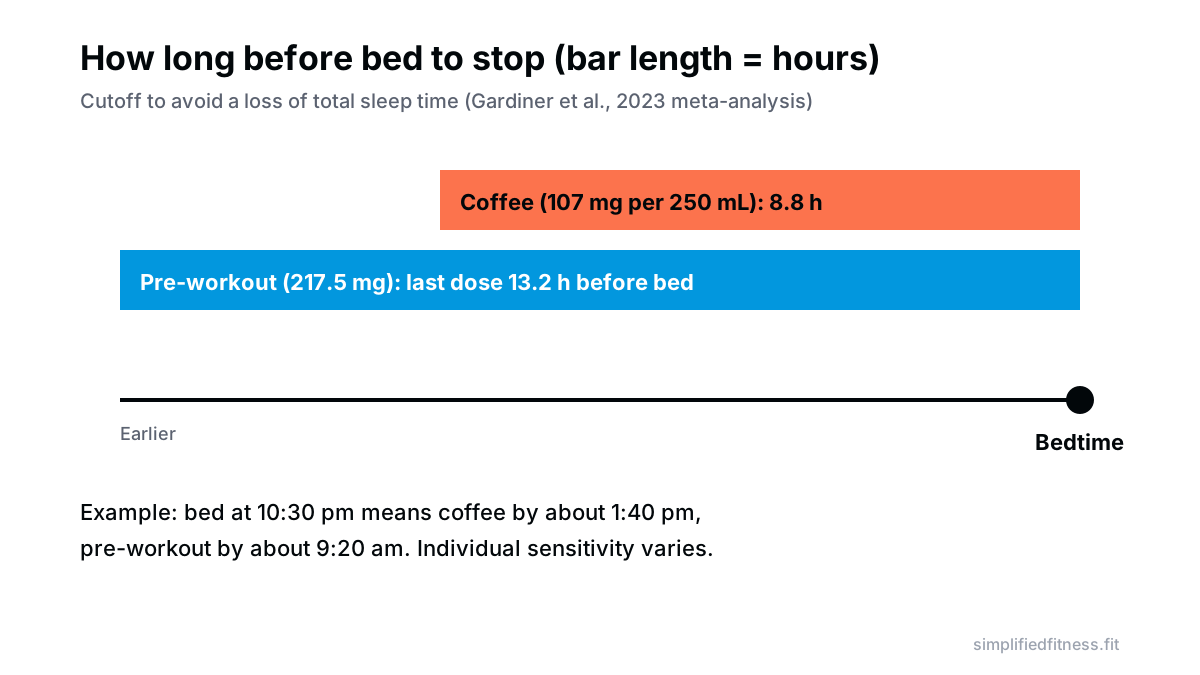
- Caffeine can cost you sleep even 6 hours before bed. A 2023 meta-analysis suggested stopping coffee about 8.8 hours and a standard pre-workout about 13.2 hours before bedtime.
- What lifters call a fried CNS is usually a mix of poor sleep, stress, under-eating and accumulated fatigue, not a single measurable nerve shutdown. Persistent exhaustion, low mood or illness deserves a doctor, not another supplement.
Table of contents
Sleep and muscle growth are connected, but not in the way most supplement ads claim. Sleep does not build muscle by itself. What it does is shape how hard you can train, how much of your weight loss comes from fat, and how well your body copes with the stress you put on it.
The honest summary: the evidence that short sleep makes lifting feel and perform worse is decent. The evidence that short sleep directly shrinks muscle in trained lifters is thin and comes mostly from small studies. This guide separates what we know from what gym lore assumes, and it sits alongside our guides to muscle hypertrophy for natural lifters and recovery modalities and soreness.
Think of sleep as the foundation under training and food. Not the building itself.
How does sleep affect muscle growth?
There are three routes, and they are not equally well supported.
Route 1: Training quality. In sleep restriction studies, bar speed drops and the same weight feels harder. This is the best-supported route, and we cover it below.
Route 2: Body composition while dieting. One carefully controlled crossover trial found that cutting sleep changed what the body lost during a calorie deficit. Small, but striking.
Route 3: Hormones and molecular signals. Growth hormone peaks in sleep, and muscle protein synthesis rates drop in some sleep restriction studies. Mechanistically interesting, but proof of a practical muscle-size effect in healthy lifters is limited.
What happens during a night of sleep (and why lifters care)
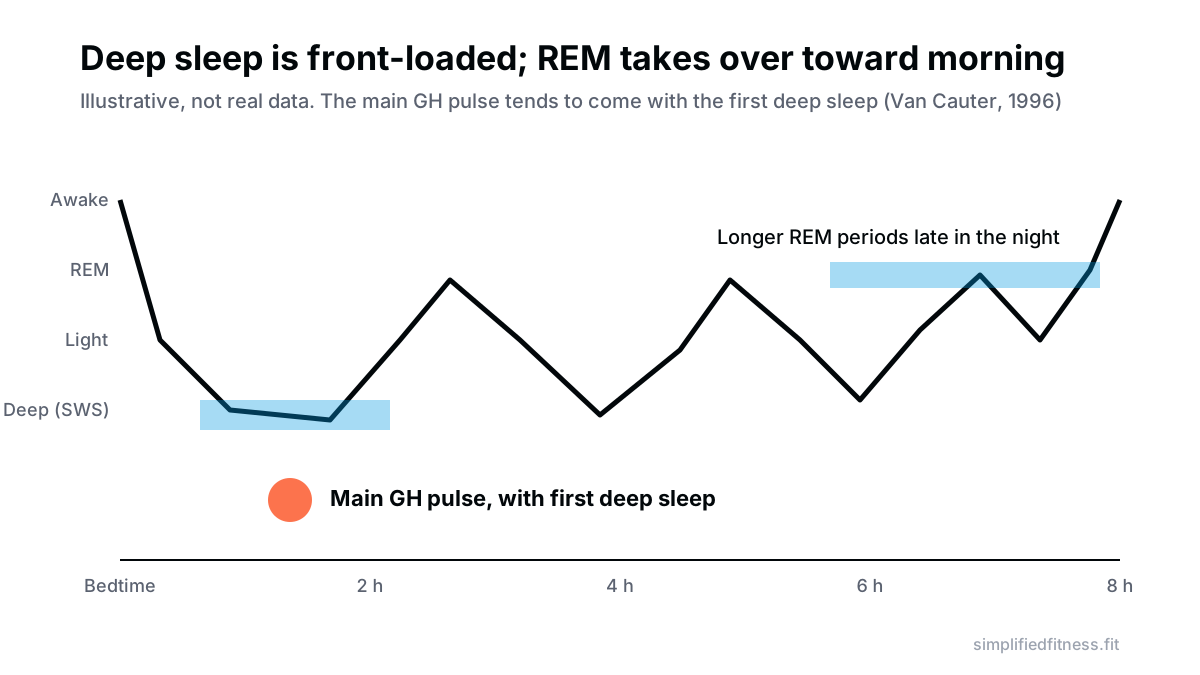
A night of sleep is not one flat state. You cycle through lighter non-REM sleep, deep non-REM sleep (called slow-wave sleep, or SWS) and REM sleep. Deep sleep is concentrated in the first half of the night, and REM periods get longer toward morning.
Here is the part lifters care about. In adults, the most reproducible growth hormone (GH) pulse of the day usually comes shortly after sleep onset, with the first phase of slow-wave sleep. A classic review reported that in men about 70% of GH pulses during sleep coincide with SWS, and the amount of GH released correlates with the amount of SWS (Van Cauter and Plat, 1996). The same review notes both GH output and SWS fall sharply between the ages of 30 and 40.
A few honest caveats. GH is not the same thing as muscle growth in a healthy adult lifter. Training, protein and total energy intake do most of the work. So the practical lesson is simpler than “boost GH”: protect the first few hours of your night, because that is where deep sleep lives. We go deeper in sleep architecture, slow-wave sleep and growth hormone for athletes.
Does sleep deprivation cause muscle loss?
This is where the strongest human data on lean mass sits, and it is also a small study. So let’s be careful.
In a randomized two-period crossover trial, 10 overweight adults (mean age 41) followed 14 days of moderate calorie restriction with either 8.5 or 5.5 hours of sleep opportunity per night. With the shorter sleep, the proportion of weight lost as fat fell by 55% (1.4 kg vs 0.6 kg), and loss of fat-free mass increased by 60% (1.5 kg vs 2.4 kg). Hunger rose and the body shifted toward burning less fat (Nedeltcheva et al., 2010). The authors listed the short duration and small sample as limitations.
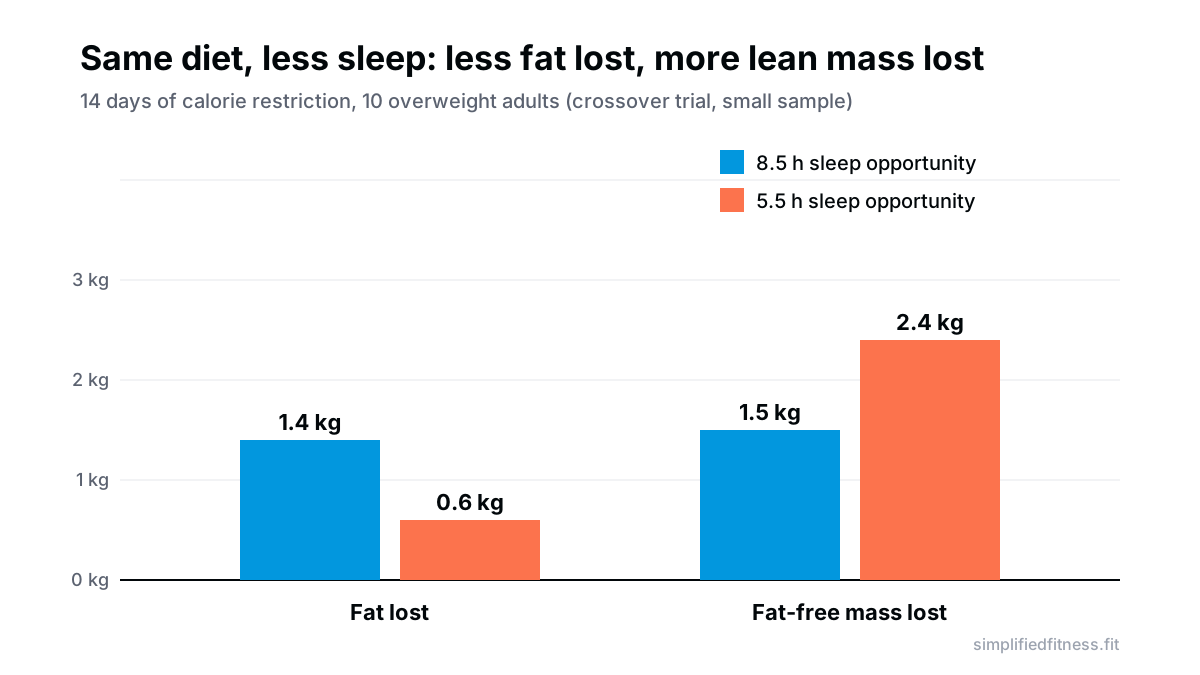
What does this mean for you? Not that one short week of sleep melts muscle. It means that if you are cutting and also sleeping 5 hours, you may be making the cut less efficient. The most common mistake here is cutting calories harder when a stalled fat loss is really a sleep problem. We unpack this study in sleep restriction, muscle catabolism and fat loss, and the diet side in our energy balance and body recomposition guide.
What about muscle protein synthesis?
A 2021 trial in 24 healthy young males used five nights of 4-hour time in bed. The sleep-restricted group showed a lower rate of sarcoplasmic protein synthesis, lower mitochondrial function and reduced glucose tolerance. A group that also did three high-intensity interval sessions during the restriction did not show those declines (Saner et al., 2021). Treat this carefully: it is young men, five nights, and it measured sarcoplasmic protein, not the contractile proteins that most people mean by “muscle”. It suggests a mechanism, and it hints that keeping up with exercise during bad sleep may help.
How much sleep do lifters need?
Most adults function well on about 7-9 hours, which is the range commonly quoted. But the 2021 expert consensus on athlete sleep cautions that a one-size-fits-all number such as 7-9 hours is unlikely to be ideal, and recommends an individualised approach based on the athlete’s perceived sleep needs. The same paper notes athletes often sleep under 7 hours habitually, and that research has under-represented females and often relied on questionable sleep measurement tools (Walsh et al., 2020).
A practical way to find your number:
- Spend 7.5-8.5 hours in bed for two weeks, with a fixed wake time.
- Note how you feel at 3 pm and how your warm-up sets move.
- If you need an alarm and an extra coffee just to function, you probably need more time in bed.
Time in bed is not time asleep. If you are in bed 8 hours but asleep for 6.5, you have a quality problem and not just a quantity one.
What does short sleep do to your lifting?
The evidence here is more nuanced than the headlines suggest, and the conflicting findings are worth laying out.
What one body of evidence says. A systematic review of 17 studies (quality rated moderate or weak) found that a full night of sleep deprivation had little effect on muscle strength. In contrast, consecutive nights of sleep restriction could reduce force output in multi-joint movements but not single-joint ones. Hormone responses were conflicting (Knowles et al., 2018).
What a controlled trial in trained lifters says. Ten resistance-trained females did nine nights of 5-hour sleep restriction against 7 hours or more in a crossover design. Volume load barely changed (under 1%), but lower-body mean concentric velocity was up to 15% slower, intraset velocity loss in back squats was up to 7% greater, session perceived exertion was 11% higher, and salivary cortisol was 42% higher (Knowles et al., 2022).
Why they may differ. Sleep-deprived people can often push a single heavy effort when motivated. The cost shows up in speed, in how hard the same weight feels, and in repeated high-intensity work. A 2024 meta-analysis of acute sleep deprivation in athletes found an overall effect size of -0.56 on performance, with high-intensity intermittent exercise hit hardest, and a larger impact from losing sleep at the end of the night than at the start (Gong et al., 2024).
The cautious takeaway. After bad sleep, your max may survive but your session quality may not. Judge the day by bar speed and effort, not just the weight on the bar. A sensible response is to keep the main lifts, trim the accessory volume, and stop sets earlier than usual.
Can sleeping more improve performance?
Extension studies are encouraging but small. In 11 collegiate basketball players, 5-7 weeks of sleep extension (aiming for 10 hours in bed) improved a timed sprint from 16.2 to 15.5 seconds and raised free throw and 3-point percentages by about 9% each. Players were compared with their own baseline, so expectation effects can’t be ruled out (Mah et al., 2011). A systematic review of 25 sleep intervention studies found that extending night sleep or napping looked the most effective strategies, while acknowledging a limited amount of high-quality evidence (Cunha et al., 2023).
Those are sport skills, not hypertrophy. The best reading is that when you are chronically short on sleep, more of it is likely to help your training. We do not know how far this goes if you are already well rested.
Circadian rhythm and strength: when is the afternoon peak?
Your body clock does not just control sleepiness. It also nudges temperature, hormones and neuromuscular output across the day.
A 2022 systematic review and meta-analysis of diurnal variation in physical performance (63 articles, 29 in the meta-analysis) found effect sizes favouring the evening for Wingate maximum power (0.73), jump height (0.79), handgrip strength (0.39) and endurance tests (0.23). The authors concluded there is strong evidence that anaerobic power and jump height are maximal between 1300 and 2000 h, some evidence that handgrip strength peaks between 1400 and 2100 h, and little evidence of a clear peak for maximum endurance. They also noted a moderately high overall risk of bias in the included studies (Knaier et al., 2022).
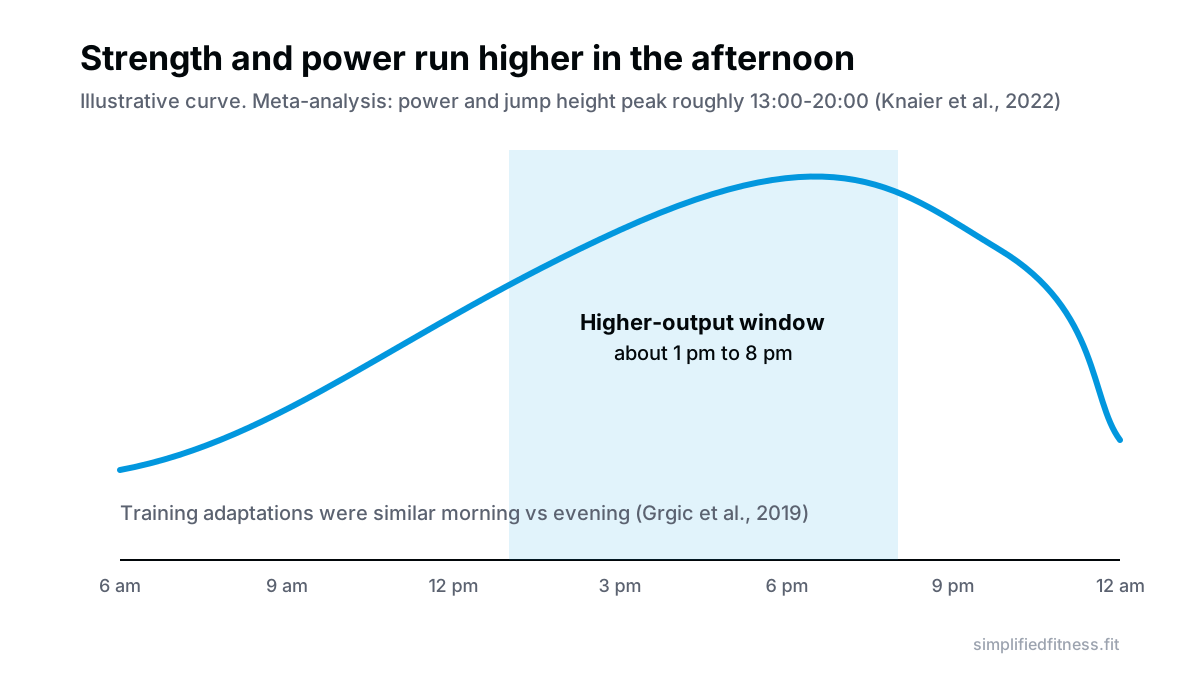
So if you are chasing a PR attempt, an afternoon slot is a reasonable bet. See why afternoon peaks happen and how big they are.
Should you train in the morning or evening?
This is where the peak stops mattering as much as people think. A 2019 meta-analysis of 11 studies comparing time-of-day-specific resistance training (with volume and frequency matched) concluded that strength gains were similar in the morning and evening training groups, and that increases in muscle size were similar irrespective of when people trained (Grgic et al., 2019). Training in the morning also seemed to raise strength tested in the morning toward evening levels, which suggests you adapt to the time you practise.
That gives you a clean decision rule:
- Pick the slot you can keep for months.
- Keep it consistent so your body adapts to it.
- If you have flexibility, use afternoon for heavy testing days.
- Do not trade sleep for a “better” training time.
We compare the two in detail in morning vs evening training, adaptations and consistency. For how the session itself should be built, see our workout split guide or start with the free push pull legs plan.
How does caffeine interact with sleep?
Caffeine is the lifter’s most-used performance aid and the most common sleep saboteur. The effect is dose and timing dependent.
An early lab-and-home trial gave 400 mg of caffeine at bedtime, 3 hours before bed or 6 hours before bed. All three significantly disturbed sleep compared with placebo, and the authors suggested avoiding substantial caffeine for at least 6 hours before bed (Drake et al., 2013). That was a single high dose, which is more than a typical coffee.
A 2023 meta-analysis of 24 studies pooled the data. Caffeine reduced total sleep time by 45 minutes and sleep efficiency by 7%, increased time to fall asleep by 9 minutes, and cut deep sleep (N3 and N4) by about 11 minutes. The authors estimated that, to avoid reducing total sleep time, coffee (107 mg per 250 mL) should be consumed at least 8.8 hours before bedtime, and a standard pre-workout serve (217.5 mg) at least 13.2 hours before bedtime (Gardiner et al., 2023).
What does this mean for an evening lifter? If you train at 7 pm with a pre-workout, you may be paying for it in deep sleep. Options are a smaller dose, a caffeine-free pre-workout, or simply training without stimulants on late sessions. Your own sensitivity matters, and some people metabolise caffeine faster. Use our caffeine dosage calculator to size your dose and read the caffeine half-life and sleep guide. For the wider supplement picture see our creatine, protein powder and caffeine guide.
A sleep hygiene routine that fits a lifter’s life
Expert consensus on athlete sleep leans on small studies, so think of the following as a toolbox rather than a prescription.
- Fix your wake-up time first. It is the easiest anchor to control, even when bedtime drifts.
- Set a caffeine cutoff using the numbers above.
- Keep the room cool, dark and quiet. In India’s summer, a fan or AC and blackout curtains are worth more than any supplement. Details in the sleep hygiene checklist for lifters.
- Dim screens and bright lights late in the evening. Our piece on blue light and melatonin explains the actual size of the effect.
- Have a small, sensible last meal. A heavy late dinner can make sleep worse for some; others sleep better with a light snack such as curd or a glass of milk. Test it. See eating before bed.
- Use a short early-afternoon nap if you slept badly. Naps were among the more effective sleep interventions in the review above. See 20 vs 90 minute naps.
Not everything popular works. The same athlete review of sleep interventions reported that sleep hygiene and removing electronic devices at night showed no effects on sleep or performance, but based on only a few studies (Cunha et al., 2023). That is a reason to be pragmatic, not a reason to stay up scrolling. Keep the habits that visibly help you.
Shift workers, travel and a messy body clock
If your schedule rotates, the idea of one perfect training time is a luxury. Priorities shift.
- Protect one long, dark sleep block after your shift.
- Train at a consistent point relative to waking, not relative to the clock.
- Lean on caffeine early in your waking day and cut it well before your planned sleep.
- On disrupted days, reduce volume rather than skip entirely.
We work through meals and training for rotating schedules in lifting for shift workers, and cross-time-zone travel in resetting sleep rhythms after jet lag. If you have been on night shifts for years and have lasting insomnia or heavy sleepiness, speak to a doctor.
CNS fatigue in lifting: what is real and what is gym lore
“My CNS is fried” is one of the most overused phrases in lifting. It points at something real, but it is not a diagnosis.
Fatigue during resistance exercise has peripheral mechanisms (in the muscle itself) and central mechanisms (in how fully the nervous system drives the muscle). A critical review notes that peripheral fatigue has been studied and explained in more detail than the central side, and that fatigue occurs regardless of the volume and intensity used (Zajac et al., 2015). So we know both exist. We do not have a clean gym test that separates them.
Here is how it tends to show up in practice, in plain language:
- Bar speed on warm-ups is slower than normal.
- The same weight feels heavier across several sessions.
- Motivation is flat and sleep is bad.
- Resting heart rate or mood feels “off” for days, not hours.
Those are signals that total stress is outrunning recovery. The cause might be sleep debt, a deep calorie deficit, work stress, illness or just an overloaded programme. The fix is usually boring: sleep more, eat enough, and trim volume for a week. We cover this in CNS fatigue vs plain lethargy, and the programming side in our progressive overload and deload guide.
Where cortisol and stress fit
Cortisol gets blamed for everything, but a single rise after hard training is normal. In the female trial above, 9 nights of restricted sleep raised salivary cortisol by 42%, alongside higher perceived exertion (Knowles et al., 2022). That is a sign of added load, not proof that cortisol is eating your muscle. See cortisol and resistance training and psychological stress and recovery.
Rest days and active recovery
Rest days are where the training stimulus gets absorbed. Easy walking and mobility on off days are fine if you feel better for them. Details in why rest days matter and active recovery.
Do wearables help? Oura, Whoop and Apple Watch
A tracker can tell you when you went to bed and how consistent you are, and that is useful. The stage breakdown is where I would be careful. A review in Medicine and Science in Sports and Exercise points out that proprietary algorithms, device malfunction and firmware updates all complicate use, and that guidelines for standardised assessment of device performance are needed (de Zambotti et al., 2019).
So use the trend in duration and consistency, plus how you feel. Do not panic over one night of “low deep sleep”. More in wearable recovery trackers compared.
When to see a doctor
Sleep and fatigue are health topics, not just training topics. See a doctor if you notice:
- loud snoring with gasping or pauses in breathing, morning headaches, or sleepiness while driving
- insomnia most nights for weeks
- exhaustion with mood changes, unexplained weight change or frequent infections
- a strong urge to nap despite long sleep
Muscular, heavier lifters with thick necks can have sleep apnea too. See sleep apnea in lifters. We cannot diagnose anything here, and neither can a ring.
The bottom line
Sleep earns its place in a lifting plan for three reasons: lifts feel and perform better, weight loss in a deficit may be kinder to your lean mass, and your whole system copes better with stress. It is not a hormone hack, and the evidence is stronger for performance than for direct muscle growth.
If you change just three things this week: set a fixed wake time, move your last caffeine earlier, and train at a time you can repeat. Then check your sleep before you cut more calories or add more volume. If you want a structured plan to sit on top, see our free push pull legs plan.
Go deeper: every guide in this topic
- Active Recovery on Rest Days: Walking, Light Cycling and Mobility
- Afternoon Caffeine Cutoff: Half-Life, Deep Sleep and Pre-Workout
- Blue Light, Melatonin and Screen Time: Do Blue-Blockers Actually Help You Sleep?
- Is Your CNS Fried? CNS Fatigue vs Plain Lethargy in the Gym
- Circadian Rhythm and Strength: Why You Peak in the Late Afternoon
- Cortisol and Resistance Training: Acute Workout Spikes vs Chronically High Cortisol
- Why Rest Days Matter for Muscle Growth: What Your Body Does When You Skip the Gym
- Morning vs Evening Workouts: Which Is Better for Muscle, Consistency and Sleep?
- Power Napping for Athletes: 20-Minute Power Naps vs 90-Minute Full Sleep Cycle Naps
- Pre-Bed Eating and Sleep Quality: Do Late-Night Carbs or Protein Disrupt Sleep?
- Psychological Stress and Recovery: How Life Stress Slows Muscle Repair and Strength Gains
- Resetting Sleep Rhythms After Travel and Jet Lag: Light, Meals, and Melatonin
- Shift Workers Lifting Guide: Sleep, Meals and Workouts on Rotating Schedules
- Sleep Apnea in Muscular Lifters: Neck Size, Oxygen Dips and CPAP
- Sleep Architecture for Athletes: Deep Sleep, REM and Growth Hormone
- Sleep Hygiene for Lifters: Bedroom Temperature, Darkness, Noise and a Wind-Down Routine
- Sleep Restriction and Muscle Loss on a Cut: What 5.5 vs 8.5 Hours Did in the Nedeltcheva Study
- Wearable Recovery Trackers (Oura, Whoop, Apple Watch): What Sleep Metrics Actually Matter?
Frequently Asked Questions
Does sleep affect muscle growth?
Yes, mostly indirectly. Short sleep lowers lifting quality and, during a calorie deficit, can shift weight loss toward lean mass. Direct long-term trials in trained lifters are limited, so treat sleep as a strong supporting factor rather than a magic switch.
How much sleep do I need for bodybuilding?
Most adults function well on about 7-9 hours, but expert consensus warns against one number for everyone. Habitually sleeping under 7 hours is common in athletes, and in the wider population it is linked with more respiratory infections. Track how you perform and feel over two weeks at 7-9 hours in bed, then adjust.
Does sleep deprivation cause muscle loss?
In humans, the best evidence is from a 2-week dieting trial where 5.5 hours of sleep opportunity increased fat-free mass loss compared with 8.5 hours. It was a small study of 10 overweight adults, so it shows a plausible risk rather than a guaranteed outcome. Protect sleep especially while cutting.
Does growth hormone released during sleep build muscle?
The biggest daily growth hormone pulse in adults usually arrives with the first deep sleep phase. Whether those pulses translate into extra muscle in healthy lifters is not well proven, because muscle growth is driven mainly by training, protein and total recovery. Aim for consistent sleep, but do not rely on a GH hack.
What is slow-wave sleep and why do lifters care?
Slow-wave sleep is the deepest non-REM stage, concentrated in the first half of the night. It coincides with a large share of growth hormone pulses and feels physically restorative. Protect the start of your night by keeping a regular bedtime and avoiding late caffeine.
What happens to my lifts after one bad night of sleep?
A systematic review found a night without sleep had little effect on maximal strength, while a meta-analysis found acute sleep deprivation clearly impaired high-intensity repeated efforts. That is why a heavy single can feel fine while a long session drags. After a bad night, keep your session but lower the volume if the first sets feel heavy.
Is it better to train in the morning or evening?
Strength and power are usually higher in the afternoon and evening, but meta-analysis found similar strength and size gains from morning and evening training. The best time is the one you can repeat. Pick a slot that does not steal your sleep.
When is the best time of day to lift for strength?
A 2022 meta-analysis found power output and jump height peak roughly between 1 pm and 8 pm. Grip strength probably peaks between 2 pm and 9 pm, though evidence there is weaker. If you are testing a max, schedule it in the afternoon and keep the time consistent.
Can I train in the morning and still perform well?
Yes. Morning strength is lower on average, but studies show people who train in the morning adapt so that morning strength rises toward evening levels. A longer warm-up helps. Do not skip morning sessions if that is the only slot you can keep.
How late is too late for caffeine?
A 400 mg dose still disturbed sleep when taken 6 hours before bed. A 2023 meta-analysis suggested stopping coffee about 8.8 hours and pre-workout about 13.2 hours before bed to protect total sleep time. Our caffeine calculator can help you work out your dose, and you can shift the cutoff earlier if you are sensitive.
Does caffeine reduce deep sleep?
The 2023 meta-analysis reported that caffeine cut total sleep time by 45 minutes on average and reduced deep sleep (N3 and N4) by about 11 minutes. It also increased time to fall asleep and nighttime waking. Move your last cup earlier before blaming anything else.
What is CNS fatigue in lifting?
CNS fatigue describes a drop in how fully your nervous system can drive your muscles, alongside fatigue in the muscle itself. Reviews on resistance exercise describe both central and peripheral mechanisms, but the central side is studied less. In practice, bar speed dropping, sets feeling heavy and low motivation are the signs worth acting on.
How do I know if my CNS is fried?
There is no home test for a fried CNS. Practical signs are lifts that are slower than usual, a heavier feeling at the same weight, poor sleep and low motivation across several sessions. Take an easier week, fix sleep and food, and see a doctor if exhaustion persists.
Do I need a deload if I am sleeping badly?
A deload is a sensible response when sleep has been short for several days and your training quality is slipping. Cutting volume for a week lowers the load on a tired system without losing your gains. Return to normal volume once sleep is back to normal.
Do wearables like Oura, Whoop or Apple Watch measure sleep stages accurately?
They can be useful for tracking when and how consistently you sleep, but treat stage estimates with caution. A review in Medicine and Science in Sports and Exercise flags proprietary algorithms, device malfunction and firmware updates as problems, and calls for standardised testing of device performance. Use the trend in duration and how you feel, not the exact deep sleep number.
Should I take a nap after training?
A nap can help if you slept badly. A systematic review of sleep interventions in athletes found naps and sleep extension were among the most effective strategies, though the evidence base is limited. Keep it short and early in the afternoon so it does not push your bedtime back.
How should night-shift workers schedule training?
Train at a consistent time relative to your wake-up, and protect one main sleep block in a dark, cool room. Shift workers face more circadian disruption, so the same plan as a day worker will not fit. See a doctor if you have long-term insomnia or heavy daytime sleepiness.
Does snoring or sleep apnea matter for lifters?
It can, because loud snoring with gasping, morning headaches and heavy daytime sleepiness can signal obstructive sleep apnea, and larger, muscular people are not immune. This is a medical issue, not a gym one. See a doctor if these signs sound familiar.
Is eating before bed bad for sleep or muscle?
A small meal is not harmful for most people, but a heavy late meal can make you uncomfortable and sleep worse. If you are hungry before bed, a modest protein-rich snack like curd or milk is a practical option. Test it for a week and keep whichever feels better.
How can I get better sleep as a lifter?
Keep a consistent sleep and wake time, a cool dark room, caffeine early and screens lowered late in the evening. Expert consensus on sleep hygiene is mostly based on small studies, so treat it as a toolbox and keep what works for you. Start with your wake-up time and caffeine cutoff because those are the easiest levers.
Does sleep affect fat loss while cutting?
In a 14-day trial of overweight adults, shorter sleep reduced the share of weight lost as fat by 55% and increased hunger. The sample was small, so treat it as a warning, not a rule. If your cut stalls, check your sleep before you cut calories further.
Do I need magnesium or melatonin to sleep better?
Most lifters should fix timing, caffeine and room temperature before buying supplements. We have not reviewed supplement trials in this guide, so treat them as unproven for lifters here. Talk to your doctor if you have chronic insomnia or take other medicines.
When should I see a doctor about my sleep or fatigue?
See a doctor if you have loud snoring with pauses in breathing, ongoing insomnia, daytime sleepiness that affects driving or work, or fatigue with mood changes, weight changes or frequent illness. These can have medical causes that no training tweak will fix. Bring a short log of your sleep and training.
Sources & References
Every claim above is checked against peer-reviewed research (PubMed, U.S. National Library of Medicine) or guidance from established health bodies. How we fact-check.
- Knowles OE, et al. Inadequate sleep and muscle strength: Implications for resistance training. J Sci Med Sport. 2018. PMID: 29422383
- Knowles OE, et al. Sustained Sleep Restriction Reduces Resistance Exercise Quality and Quantity in Females. Med Sci Sports Exerc. 2022. PMID: 36136596
- Nedeltcheva AV, et al. Insufficient sleep undermines dietary efforts to reduce adiposity. Ann Intern Med. 2010. PMID: 20921542
- Van Cauter E, Plat L. Physiology of growth hormone secretion during sleep. J Pediatr. 1996. PMID: 8627466
- Saner NJ, et al. Exercise mitigates sleep-loss-induced changes in glucose tolerance, mitochondrial function, sarcoplasmic protein synthesis, and diurnal rhythms. Mol Metab. 2021. PMID: 33137489
- Knaier R, et al. Diurnal Variation in Maximum Endurance and Maximum Strength Performance: A Systematic Review and Meta-analysis. Med Sci Sports Exerc. 2022. PMID: 34431827
- Grgic J, et al. The effects of time of day-specific resistance training on adaptations in skeletal muscle hypertrophy and muscle strength: A systematic review and meta-analysis. Chronobiol Int. 2019. PMID: 30704301
- Drake C, et al. Caffeine effects on sleep taken 0, 3, or 6 hours before going to bed. J Clin Sleep Med. 2013. PMID: 24235903
- Gardiner C, et al. The effect of caffeine on subsequent sleep: A systematic review and meta-analysis. Sleep Med Rev. 2023. PMID: 36870101
- Gong M, et al. Effects of Acute Sleep Deprivation on Sporting Performance in Athletes: A Comprehensive Systematic Review and Meta-Analysis. Nat Sci Sleep. 2024. PMID: 39006249
- Walsh NP, et al. Sleep and the athlete: narrative review and 2021 expert consensus recommendations. Br J Sports Med. 2020. PMID: 33144349
- Mah CD, et al. The effects of sleep extension on the athletic performance of collegiate basketball players. Sleep. 2011. PMID: 21731144
- Cunha LA, et al. The Impact of Sleep Interventions on Athletic Performance: A Systematic Review. Sports Med Open. 2023. PMID: 37462808
- Zajac A, et al. Central and Peripheral Fatigue During Resistance Exercise - A Critical Review. J Hum Kinet. 2015. PMID: 26839616
- de Zambotti M, et al. Wearable Sleep Technology in Clinical and Research Settings. Med Sci Sports Exerc. 2019. PMID: 30789439

Umair Hazrami · Founder & Head Coach, Simplified Fitness
Umair Hazrami founded Simplified Fitness and the Simplified Lifter channel to cut through fitness noise. With 4+ years of consistent training and 10+ coaching clients, he writes every guide from the peer-reviewed research and links the sources so you can check them. Our editorial standards.
Educational content only, not medical advice. If you have a medical condition, are pregnant, or take medication, talk to a qualified doctor before changing your diet, supplements or training. Full disclaimer.
Keep reading

Recovery
Active Recovery on Rest Days: Walking, Light Cycling and Mobility
Active recovery vs passive rest for lifters: what the research says about walking, light cycling and mobility, plus a 20-minute rest day routine you can copy.
7 min read
Recovery
Afternoon Caffeine Cutoff: Half-Life, Deep Sleep and Pre-Workout
Afternoon caffeine cutoff for lifters: how caffeine's half-life cuts sleep time and deep sleep even if you fall asleep fine, plus a practical cutoff by bedtime.
9 min read
Recovery
Blue Light, Melatonin and Screen Time: Do Blue-Blockers Actually Help You Sleep?
Blue light screen time melatonin suppression is real, but do blue-blocking glasses fix it? See what the trials found and the free fixes that matter more.
7 min read

Recovery
Is Your CNS Fried? CNS Fatigue vs Plain Lethargy in the Gym
Is my CNS fried from lifting? See what central fatigue really is, how fast it recovers and how to tell it from low motivation or poor sleep. Studies linked.
9 min read