BCAAs vs EAAs: Why BCAAs Are a Waste of Money If Your Protein Is Covered
BCAA vs EAA for muscle growth: BCAAs are only 3 of the 9 essential amino acids. See what Wolfe 2017 and Jackman 2017 found and when EAAs or whey make sense.
TL;DR. The short answer
- BCAAs (leucine, isoleucine, valine) are 3 of the 9 essential amino acids. Building new muscle protein needs all nine, so BCAAs alone cannot supply the full set.
- Wolfe's 2017 review found no human study of oral BCAAs alone that measured muscle protein synthesis, and the two IV infusion studies showed lower synthesis and lower breakdown, not growth.
- A small 2017 study in 10 trained men did find a 22% rise in muscle protein synthesis after 5.6 g of BCAAs, but it was a 4-hour snapshot, not a muscle-growth trial.
- If your daily protein is covered, BCAAs add little. Whey, dal, paneer, eggs and curd already contain every EAA, along with the rest of the protein you need.
- BCAAs may reduce soreness after damaging exercise in some trials, but that is a recovery comfort claim, not proof of more muscle.
Part of our complete guide: The Evidence-Based Fitness Supplements Guide: What Works, What's Overhyped & What's a Waste of Money
Table of contents
If your daily protein is already covered, BCAAs add very little. They are three of the nine essential amino acids your muscle needs to build new protein, and the other six are sitting in your dal, paneer, eggs and whey scoop.
That is the short answer to bcaa vs eaa for muscle growth. The long answer matters because the pink-water-in-the-gym habit is built on a half-truth, and we will separate the true half from the sales half below. (For where BCAAs sit among every other supplement, see our evidence-based supplement guide and the supplement hierarchy.)
What are BCAAs, and what are EAAs?
BCAAs are leucine, isoleucine and valine. They are called “branched-chain” because of their molecular shape, and they are a large share of the essential amino acids in muscle protein.
EAAs are the essential amino acids: the nine your body cannot make, so they must come from food. BCAAs are three of those nine. The other six are lysine, methionine, threonine, phenylalanine, tryptophan and histidine.
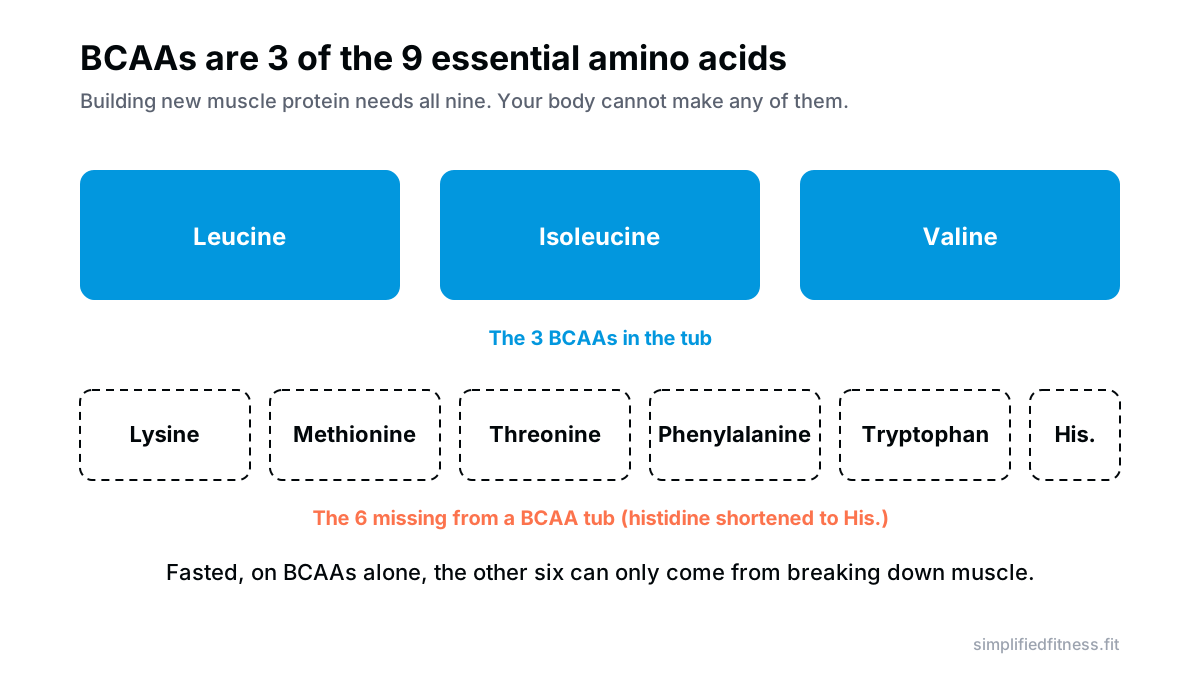
Think of building muscle like building a wall. Leucine is a bricklayer shouting “start building”. But if there are no bricks on site, the shouting does not make a wall.
Why BCAAs alone do not build muscle (the Wolfe argument)
Here is the real mechanism. Leucine acts as a signal that switches on mTORC1, the pathway that tells your muscle to start making protein. That part is true, and it is the origin of the BCAA marketing.
But a signal is not material. To actually assemble new muscle protein, the cell needs every essential amino acid. Robert Wolfe, a long-time researcher in amino acid metabolism, laid out the logic in a 2017 review (Wolfe, 2017):
- In a fasted state, BCAAs alone can only boost muscle protein synthesis by roughly the gap between breakdown and synthesis (about 30% above synthesis), because the other EAAs can only come from breaking down existing muscle protein.
- Realistically, he argues, 30% is an over-estimate, since some of those amino acids are always oxidized.
- He found no human study that measured the muscle protein synthesis response to oral BCAAs alone. Only two IV infusion studies existed, and both found BCAAs decreased muscle protein synthesis as well as breakdown, and the catabolic state persisted.
His conclusion: the claim that dietary BCAAs stimulate muscle protein synthesis or produce an anabolic response in humans is unwarranted.
One more fair point: Wolfe has disclosed grants or honoraria from the US beef checkoff programme, Abbott, Danone and PepsiCo, shares in Essential Blends and consulting for Axcella, as listed in the paper. That does not make his biochemistry wrong, but it is why we also lean on the independent evidence below.
But didn’t a study show BCAAs raise muscle protein synthesis?
Yes, and you should know about it. This is the conflicting evidence, so here is both sides.
Study A (Jackman et al., 2017). Ten young, resistance-trained men drank either 5.6 g of BCAAs or a placebo right after training. Muscle protein synthesis over the next 4 hours was 22% higher with BCAAs, and mTORC1 signalling was higher at 1 hour (Jackman et al., 2017). The authors concluded BCAAs alone increase post-exercise protein synthesis.
Study B (Jackman et al., 2023). The same group gave 10 trained men carbs plus 5.6 g BCAAs or carbs alone. Protein synthesis was about 15% greater with BCAAs added (p = 0.039), though the lower end of the confidence interval dipped just below zero (-0.002 to 0.028) (Jackman et al., 2023).
Why this does not overturn Wolfe. Look at what was measured: a 4-hour snapshot of synthesis in ten men. The abstracts do not report net muscle protein balance, and neither study tracked actual muscle growth over weeks. A 22% rise also sits inside Wolfe’s theoretical ceiling of roughly 30%, the most BCAAs could add if the other EAAs have to come from the muscle’s own breakdown. So Jackman’s data do challenge Wolfe’s claim that oral BCAAs have never been shown to raise synthesis, but they do not show that a BCAA drink builds new tissue.
Practical takeaway: BCAAs are not inert. They are just not the efficient route, because a protein source gives you the signal and the bricks together.
Do BCAAs help recovery or soreness?
Maybe a little. This is the one area where BCAAs have a modest case, and it is a comfort claim, not a growth claim.
A 2024 meta-analysis of 18 randomized trials found BCAA supplementation reduced muscle soreness at 24, 48, 72 and 96 hours after muscle-damaging exercise, and lowered creatine kinase at some time points but not others (Salem et al., 2024). A 2021 meta-analysis of nine trials pointed the same way but said high variability in dose, training status and timing prevented firm conclusions for untrained people (Weber et al., 2021).
So: some trials show you may feel less sore. Less soreness does not mean more muscle, and your protein intake probably moves that needle too. Do not buy a tub on this alone.
Does total daily protein make BCAAs obsolete?
For most people, yes. Here is the order of importance.
- Total daily protein. A 2018 meta-analysis of 49 trials (1,863 people) found protein supplementation increased strength and lean mass, and extra protein gave no further fat-free mass gains beyond about 1.62 g/kg/day total intake (Morton et al., 2018). For a 70 kg lifter, that is roughly 110 g a day.
- Protein quality and spread. A complete protein with all nine EAAs, spread across 3-4 meals.
- Everything else. Including amino acid powders.
Once step 1 and 2 are done, a BCAA scoop is topping up something already full. Use our protein calculator to find your own target.
BCAA vs protein powder: what does whey actually do?
Whey protein is a complete protein, so it delivers BCAAs and the six other EAAs at the same time. In one trial, 48 resistance-trained young men drank 0, 10, 20 or 40 g of whey after leg training. Muscle protein synthesis rose 49% with 20 g and 56% with 40 g, and the 10 g dose gave no additional stimulation above 0 g in that analysis (Witard et al., 2014). The authors concluded 20 g was enough for maximal stimulation in about 80 kg trained young men.
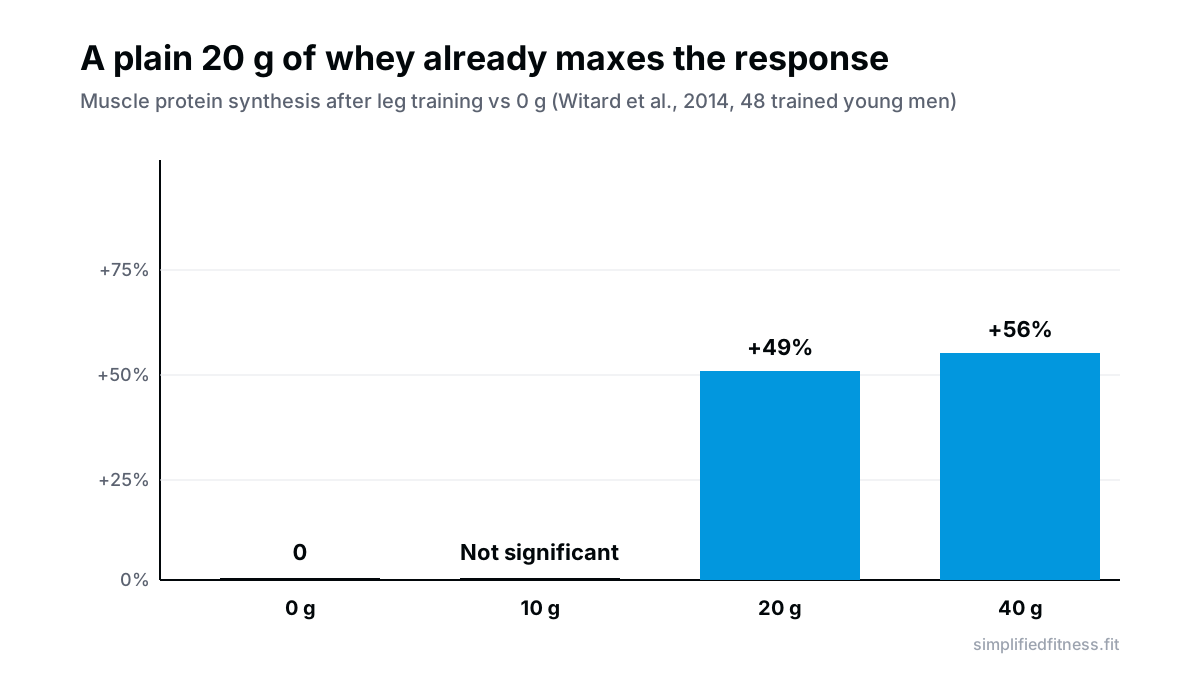
Notice the catch from the same paper: at 40 g, more of the protein was oxidized and turned into urea. More is not always better, and that also applies to adding amino acid powders on top of whey. We cover choosing a whey in isolate vs concentrate.
What does the 2023 ISSN position stand say about EAAs?
This is the fairer, more current view. The International Society of Sports Nutrition position stand on EAA supplementation says (Ferrando et al., 2023):
- free-form EAAs quickly raise blood amino acids and stimulate muscle protein synthesis
- at rest, stimulation begins at small doses (1.5-3.0 g) and seems to plateau around 15-18 g
- muscle protein synthesis from EAAs does not require non-essential amino acids
- free-form EAAs stimulated synthesis more than the same amount of intact protein in the studies reviewed
- EAA needs rise during a caloric deficit, and ageing requires a higher proportion of leucine
Two cautions. First, several authors of that paper disclose ties to amino acid products, including patents on EAA-based compositions. Second, “stimulates synthesis” is not “builds more muscle than eating enough protein”, and the position stand compares acute responses, not long-term growth in lifters who already hit their targets.
So where do EAAs fit? As a convenient, fast option, for example during a cut when appetite is low, around a fasted session, or when you cannot eat a protein meal. It is not essential. Several of those groups studied are older or clinical populations, and evidence for healthy young lifters eating enough protein is thinner.
Who might still use BCAAs or EAAs?
- You genuinely cannot hit protein with food. Whey or soya comes first. EAAs are a second-line option.
- You train fasted and feel awful. A scoop of whey or a banana plus curd works too. Evidence on fasted training is limited, so treat this as comfort.
- You are older, or cutting hard. The ISSN says needs for EAAs or leucine can rise. Talk to your doctor or a dietitian if you have kidney or liver disease before adding amino acid supplements.
- You like the taste and it keeps you hydrated. Fine, as long as you know it is not doing the muscle-building.
How to decide in 60 seconds
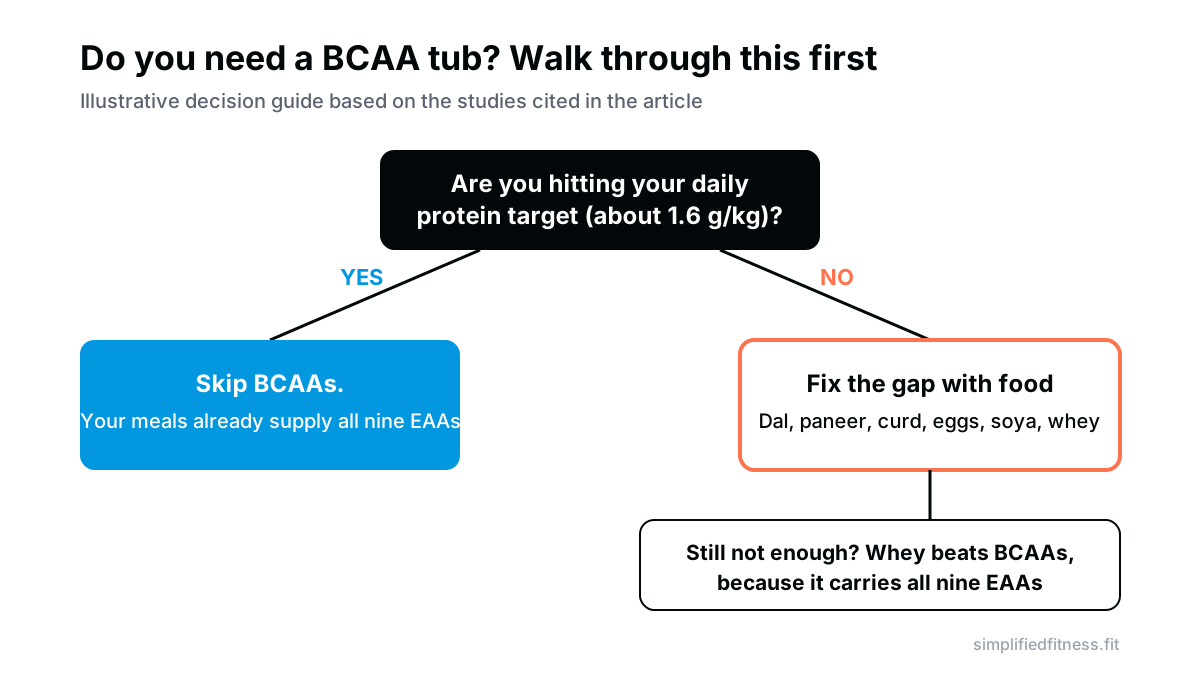
The simple routine looks like this:
- aim for roughly 1.6 g/kg/day total protein (the point beyond which Morton found no further lean mass gain)
- spread it over 3-4 meals, each with a solid protein source
- use whey as a convenient top-up, not as a replacement for meals
- if you still want an amino powder, choose EAAs over BCAAs, and check for proprietary blend underdosing
- do not expect it to replace training, sleep or total calories
The bottom line
BCAAs are a real signal with a missing supply chain. They contain the three amino acids associated with turning on muscle protein synthesis, but not the other six needed to build the protein, and none of the studies above show better muscle growth than simply eating enough protein.
Spend the money on protein you eat. If you want to test whether you are hitting the number, start with the protein calculator and follow a structured push pull legs plan. If you have kidney disease, liver disease or take medication, check with your doctor before adding amino acid products.
Frequently Asked Questions
Are BCAAs a waste of money?
For most lifters who eat enough protein, yes, they add very little. BCAAs supply only 3 of the 9 essential amino acids, and a normal protein-rich diet already delivers all of them, including plenty of leucine. If your budget is tight, put the money into whey, eggs, paneer or soya chunks instead.
Do BCAAs build muscle?
Not on their own, based on current evidence. A 2017 study in 10 trained men saw muscle protein synthesis rise after BCAAs, but protein synthesis in a 4-hour window is not the same as measured muscle growth. Wolfe's 2017 review argues the other six EAAs are needed to build new protein, so food or whey is the safer route.
What is the difference between BCAAs and EAAs?
BCAAs are leucine, isoleucine and valine. EAAs are all nine essential amino acids, which are those your body cannot make itself, and BCAAs are three of them. If you want an amino acid supplement at all, the full EAA set is the more logical choice than the BCAA subset.
Are EAAs better than BCAAs?
On the biochemistry, yes, because EAAs include the six that BCAAs leave out. The 2023 ISSN position stand says free-form EAAs stimulate muscle protein synthesis and that non-essential amino acids are not required for this. Even so, EAAs are usually a convenience product, and a protein meal does the same job.
Do BCAAs cause muscle breakdown?
That claim is overstated. Wolfe's review notes that two IV infusion studies found BCAAs alone lowered both muscle protein synthesis and breakdown, and the net catabolic state continued. So BCAAs alone do not fix breakdown, but they have not been shown to cause extra breakdown either.
Is whey protein better than BCAAs?
For building muscle, whey is the better choice. It contains all nine EAAs, and 20 g was enough to maximally stimulate muscle protein synthesis in trained young men in one dose-response trial. Whey is also widely available in India, and every scoop brings the full amino acid set rather than three of them.
Do I need BCAAs when I train fasted?
Probably not. The better fix is a small protein-containing meal or a scoop of whey around the session, since that delivers all nine EAAs. Evidence on fasted training specifically is limited, so treat any amino acid product as optional convenience, not a requirement.
Do BCAAs help with muscle soreness?
They might, a little. A 2024 meta-analysis of 18 randomized trials found lower soreness at 24 to 96 hours after muscle-damaging exercise, though results varied with dose and study design. Less soreness is not the same as more muscle, so do not count it as a growth benefit.
Should vegetarians take BCAAs?
Usually no. A vegetarian diet with dal, rice, curd, paneer, soya and milk can reach the protein target without a BCAA tub. If you struggle to hit your number, a whey or well-formulated plant protein is a more complete fix, and you can work out your target with our protein calculator.
How much protein do I need so I can skip BCAAs?
A 2018 meta-analysis of 49 trials in healthy adults found protein supplementation gave no further lean mass gains beyond total intakes of about 1.6 g/kg/day. For a 70 kg lifter that is roughly 110 g a day. Spread it over 3 to 4 meals and use the protein calculator to check your own number.
Are EAA supplements ever worth it?
Sometimes, as a convenience tool. The ISSN position stand suggests EAA needs rise during a caloric deficit and that older adults may need more leucine, but a lot of that research is in older or clinical groups. For a healthy lifter eating enough protein, EAA powder is a nice-to-have, not a need-to-have.
Can I take BCAAs with whey?
You can, but it is redundant. Whey already contains leucine, isoleucine and valine alongside the other six EAAs. Skip the add-on and use the money to cover your daily protein.
Sources & References
Every claim above is checked against peer-reviewed research (PubMed, U.S. National Library of Medicine) or guidance from established health bodies. How we fact-check.
- Wolfe RR. Branched-chain amino acids and muscle protein synthesis in humans: myth or reality? J Int Soc Sports Nutr. 2017. PMID: 28852372
- Jackman SR, et al. Branched-chain amino acid ingestion stimulates muscle myofibrillar protein synthesis following resistance exercise in humans. Front Physiol. 2017. PMID: 28638350
- Jackman SR, et al. Co-ingestion of branched-chain amino acids and carbohydrate stimulates myofibrillar protein synthesis following resistance exercise in trained young men. Int J Sport Nutr Exerc Metab. 2023. PMID: 37225168
- Ferrando AA, et al. International Society of Sports Nutrition position stand: effects of essential amino acid supplementation on exercise and performance. J Int Soc Sports Nutr. 2023. PMID: 37800468
- Morton RW, et al. A systematic review, meta-analysis and meta-regression of the effect of protein supplementation on resistance training-induced gains in muscle mass and strength in healthy adults. Br J Sports Med. 2018. PMID: 28698222
- Witard OC, et al. Myofibrillar muscle protein synthesis rates subsequent to a meal in response to increasing doses of whey protein at rest and after resistance exercise. Am J Clin Nutr. 2014. PMID: 24257722
- Salem A, et al. Attenuating muscle damage biomarkers and muscle soreness after an exercise-induced muscle damage with branched-chain amino acid (BCAA) supplementation: a systematic review and meta-analysis with meta-regression. Sports Med Open. 2024. PMID: 38625669
- Weber MG, et al. The use of BCAA to decrease delayed-onset muscle soreness after a single bout of exercise: a systematic review and meta-analysis. Amino Acids. 2021. PMID: 34669012

Umair Hazrami · Founder & Head Coach, Simplified Fitness
Umair Hazrami founded Simplified Fitness and the Simplified Lifter channel to cut through fitness noise. With 4+ years of consistent training and 10+ coaching clients, he writes every guide from the peer-reviewed research and links the sources so you can check them. Our editorial standards.
Educational content only, not medical advice. If you have a medical condition, are pregnant, or take medication, talk to a qualified doctor before changing your diet, supplements or training. Full disclaimer.
Keep reading

Supplements
Ashwagandha KSM-66 vs Sensoril: Which Extract, What Dose, and Do You Need to Cycle?
Ashwagandha KSM-66 vs Sensoril for lifters: what the strength trials show, realistic cortisol effects, liver safety and whether to cycle. Every study linked.
8 min read
Supplements
Beetroot Juice for Running and Lifting: How Dietary Nitrate Works (and the Mouthwash Trap)
Does beetroot juice for running actually work? See what meta-analyses show, the 2-3 hour timing and dose, who benefits, and why mouthwash can cancel the effect.
9 min read

Supplements
Beta-Alanine Benefits: Carnosine Buffering, High-Rep Gains and Why It Makes You Tingle
Beta-alanine benefits explained: why pre-workout makes your skin tingle, how carnosine buffers acid, what dose works, and who should skip it. Studies linked.
8 min read

Supplements
Betaine (TMG) for Strength and Power: What the Research Really Shows
Does betaine build muscle or boost power? We review the trials and meta-analyses on betaine TMG, the 2.5 g dose, betaine vs creatine, and betaine HCl.
7 min read