Iron Deficiency and Ferritin in Athletes: Why You Feel Flat Despite Normal Hemoglobin
Ferritin levels in athletes explained: why low iron stores cause gym fatigue even with normal hemoglobin, how to absorb plant iron, and when to test first.
TL;DR. The short answer
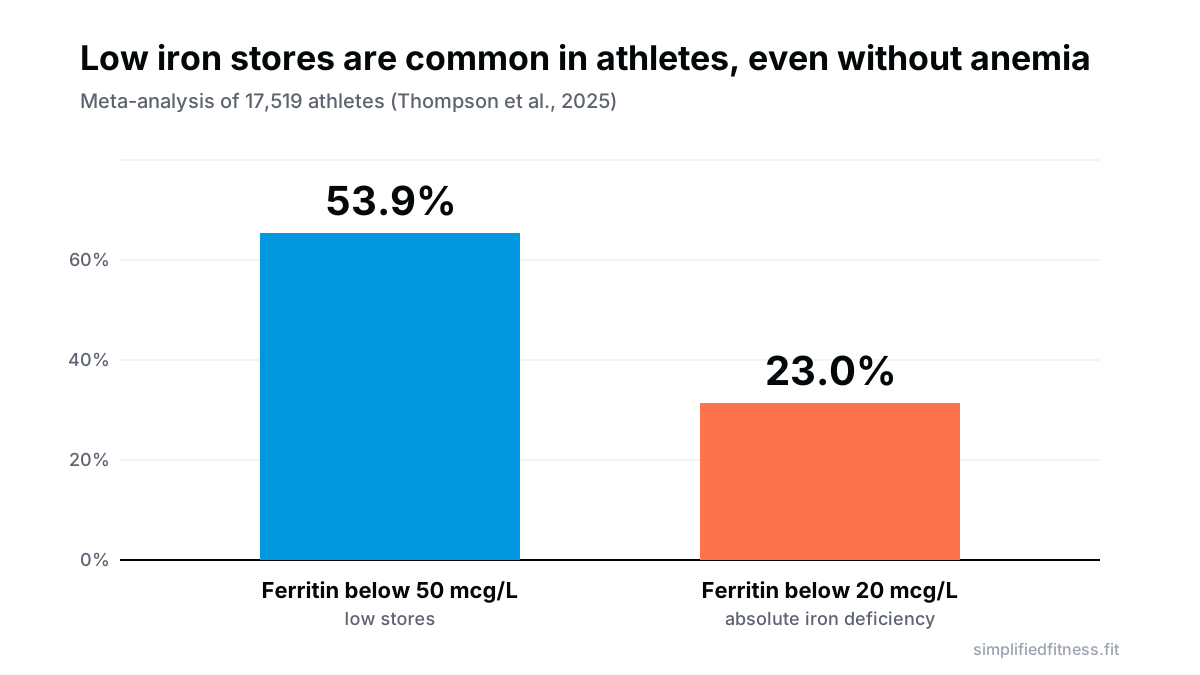
- Ferritin is your iron storage marker. A large 2025 meta-analysis of 17,519 collegiate athletes found 53.9% had ferritin below 50 mcg/L and 23.0% below 20 mcg/L, so low stores are common even when hemoglobin looks normal.
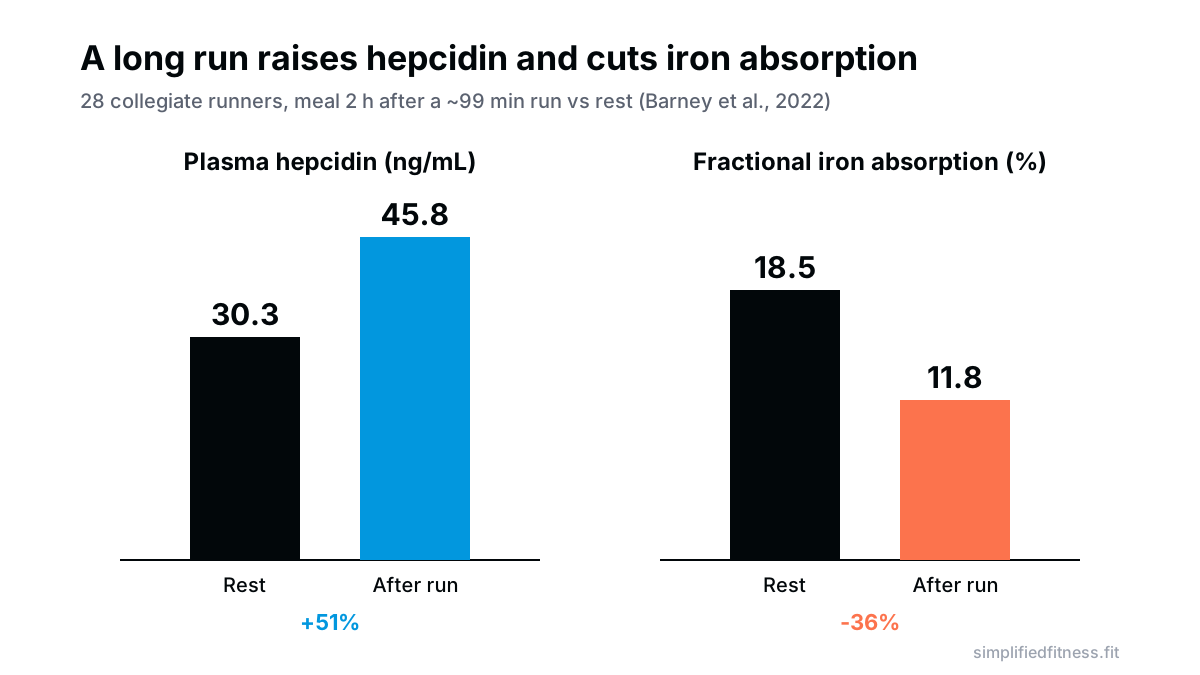
- Hard training can lower iron through several routes at once: a rise in the hormone hepcidin that blocks absorption, heavy periods or low intake, and in runners some red cell breakage from foot strike. In one study, a long run cut iron absorption by 36%.
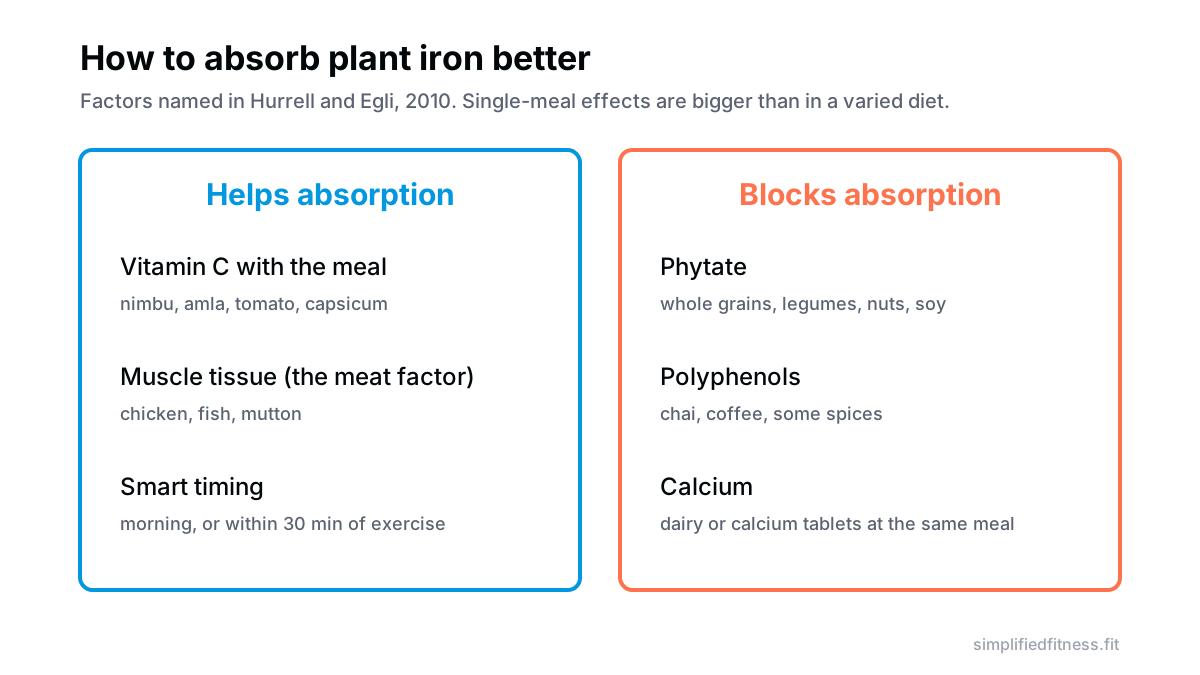
- Plant (non-heme) iron absorbs poorly, around 5-12% in vegetarian diets versus 14-18% in mixed diets for people with no iron stores. Vitamin C helps, while phytate, tea, coffee and calcium at the same meal reduce it.
- Oral iron raised ferritin mainly in people who started low (12 mcg/L or under). Do not take it blind: test ferritin first, because the body has no way to excrete extra iron.
- Ongoing fatigue, breathlessness, heavy periods, black stools or pallor deserve a doctor visit, not self-treatment.
Part of our complete guide: Creatine, Protein Powders, Pre-Workouts and Caffeine: The Science and Safety Guide
Table of contents
If your training has gone flat, your legs feel heavy and you get breathless on warm-ups that used to be easy, your hemoglobin may be fine and your iron stores may still be low. Ferritin levels in athletes are often lower than people expect, and a 2025 meta-analysis found that more than half of collegiate athletes had ferritin below 50 mcg/L. Iron is the supplement you should test before you buy, not after.
This is part of our guide to creatine, protein powders and caffeine, and it is the one supplement topic where the advice is test first, buy second. Quick version first, then the details.
What does ferritin actually measure?
Think of your iron as a warehouse and a delivery fleet. Ferritin is the warehouse stock. Serum iron is whatever is on the trucks right now. Total iron binding capacity (TIBC) is how many empty trucks your body has available, and hemoglobin is the oxygen-carrying cargo in your red cells.
Hemoglobin only drops late, once the warehouse is empty and red cell production suffers. Ferritin drops first. That is why a routine blood count can look normal while you are already running on empty stores.
Two cautions. Ferritin is also an inflammation marker, so a hard session or an infection can push it up and hide a real shortage. And athletes have no sport-specific reference ranges, so reviews recommend looking at hemoglobin, ferritin, training load and menstrual pattern together over time rather than one number (Pedlar et al., 2018).
Which blood tests should you ask for?
A useful panel for an athlete with unexplained fatigue is simple. Ask for a full blood count (including hemoglobin), serum ferritin, and, if your doctor wants a fuller picture, serum iron with transferrin saturation or TIBC. Ferritin does the heavy lifting for storage, while the others help your doctor tell true deficiency from inflammation or other causes.
Practical tips: get tested when you are well and not straight after a hard session or illness, and repeat the same test at the same lab so results are comparable. Do not start iron the day before the test, because it will blur the result. In India, a basic panel like this is usually inexpensive at a standard diagnostic lab, but ask your doctor which tests they want rather than ordering a random package.
How common is iron deficiency without anemia in the gym?
Common enough that it is worth checking. A systematic review and meta-analysis of 17,519 athletes across 62 sports found about 53.9% of student-athletes had ferritin below 50 mcg/L, and 23.0% met the stricter threshold of below 20 mcg/L (Thompson et al., 2025). The authors argued for routine screening in adolescent and collegiate athletes.
Why does hard training lower your iron?
Several mechanisms stack up. None is the whole story.
Hepcidin. This hormone shuts the gate on iron absorption in your gut. Hepcidin concentrations rise in the 3-6 hours after exercise, and absorption from meals eaten about 2 hours post-exercise falls (Peeling & McKay, 2023). In a study of 28 trained collegiate runners, hepcidin rose 51% and fractional iron absorption fell 36% after a roughly 99-minute run compared with rest (Barney et al., 2022). These runners already had low stores (mean ferritin about 22 ng/mL), and the hepcidin rise looked driven by the men rather than the women, so do not over-generalise.
Foot-strike hemolysis. Repeated impact can break red cells in the foot. A 2024 scoping review of nine marathon-distance studies (267 runners, 88% male) found a 16% rise in reticulocytes and a 21% fall in haptoglobin, which suggest transient hemolysis, but hemoglobin and hematocrit stayed within normal limits (Gartner et al., 2024). The authors say it is unclear how much this matters across different runners. Lifters who do not run long distances have little reason to worry about this one.
Other routes. Heavy menstrual bleeding is a major risk factor in female athletes (Pedlar et al., 2018), and low dietary intake or poor absorption add to it.
Can low ferritin really cause fatigue in lifters?
Plausibly yes, but be honest about what we know. Iron is needed to build hemoglobin, so truly depleted stores can reduce oxygen delivery. In athletes, though, ferritin and hemoglobin alone have limited value because plasma volume shifts and inflammation muddy the picture (Pedlar et al., 2018). And when researchers pooled trials of oral iron in healthy adult athletes, VO2max showed only a small positive trend that was not statistically significant (Smid et al., 2024). I would not call low ferritin the cause of your fatigue. I would call it a fixable suspect.
Should you take an iron supplement?
Only after a blood test and, ideally, a doctor’s input. A meta-analysis of 13 randomized trials (449 athletes) found oral iron raised serum ferritin, but hemoglobin, transferrin receptor and transferrin saturation did not change significantly. The ferritin rise was evident in people who started at 12 mcg/L or below, with minimal effect at higher starting levels. Effective doses ranged from 16 to 100 mg of elemental iron daily over 6-8 weeks, and shorter protocols were ineffective (Smid et al., 2024). The evidence quality was moderate to low.
Why not just take it as insurance? Because iron balance is controlled only by absorption, with no physiological way to excrete excess (Hurrell & Egli, 2010). People with conditions such as hemochromatosis can accumulate iron, so blind supplementing is a bad bet. If you do have iron tablets at home, store them out of reach of children, because an iron overdose is a medical emergency for a child. If you are weighing a general multivitamin instead, read our take on multivitamins for lifters and the broader micronutrient deficiencies in lifters.
If your doctor does prescribe iron, timing may help. One crossover study of 16 endurance runners found iron was absorbed better at breakfast after a morning run than at dinner (McCormick et al., 2019), and a 2023 review notes a window of enhanced absorption around 30 minutes either side of exercise (Peeling & McKay, 2023). The evidence behind these timing ideas is still small, so use them as a tie-breaker, not a rule.
How to absorb plant iron better
Food comes first, and this matters for vegetarians. Iron bioavailability has been estimated at 14-18% for mixed diets and 5-12% for vegetarian diets in people with no iron stores (Hurrell & Egli, 2010). The same paper lists phytate, polyphenols, calcium, ascorbic acid and muscle tissue as factors that change absorption, with larger effects in single-meal studies than in varied diets.
Practical Indian examples:
- Squeeze nimbu over dal, rajma or chana, or add tomato, capsicum or amla.
- Keep chai and coffee away from your iron-rich meal. An hour or two apart is a sensible habit.
- Do not take calcium tablets or a big glass of milk with your main iron source.
- Soaking, sprouting and fermenting pulses and grains may reduce phytate, though I would not expect a dramatic change.
- Rotate iron-rich plant foods (lentils, chickpeas, soya, leafy greens) and include non-veg sources if you eat them.
When to test and when to see a doctor
Reasonable triggers for a ferritin test (with hemoglobin) include unexplained fatigue, performance dropping despite good sleep and food, heavy periods, a vegetarian or vegan diet with high training volume, or a high-mileage running block. Ask for the result to be read with your symptoms.
See a doctor promptly for shortness of breath at rest, chest pain, fainting, a racing heart, black or bloody stools, very heavy periods, or unexplained weight loss. Low iron in an adult can signal blood loss that needs its own work-up. Female readers should also see how women differ in training response and discuss cycle patterns with their clinician.
What about lifters who do not run?
Most of the hard data above comes from endurance runners and mixed collegiate athletes. Lifters do not take thousands of foot strikes, so foot-strike hemolysis is unlikely to be your issue. But hepcidin responds to exercise-linked inflammation in general, and a lifter who is vegetarian, cutting calories hard, or losing blood through heavy periods can still end up with low stores. Resistance exercise specifically has been studied far less in humans for iron outcomes, so I would not assume lifting is either protective or harmful. The sensible position is to test when symptoms or risk factors appear.
Your simple protocol
- Get ferritin and hemoglobin tested if you have symptoms or risk factors, and bring your training history.
- If results are low, let your doctor choose the dose and recheck, because ferritin took 6-8 weeks to move in trials.
- Meanwhile, fix meal pairing: vitamin C with iron-rich meals, chai and calcium away from them.
- Do not stack iron with a generic supplement habit. If you are building a stack, see vitamin D and strength or our free protein calculator and diet plan for the basics first.
Iron is one of the few supplements where the right move is a blood test before the purchase. If it comes back normal, spend the money on food, sleep and a program like our free training plans.
Frequently Asked Questions
What is a normal ferritin level for athletes?
There is no single agreed number, and cut-offs vary between labs and guidelines. A large athlete meta-analysis used below 20 mcg/L for absolute iron deficiency and below 50 mcg/L for low stores. Ask your doctor to interpret your result with your symptoms, training load and menstrual pattern.
Can you have iron deficiency without anemia?
Yes. Iron stores can run low while hemoglobin stays in the normal range, which is why athletes are often missed. Reviews describe athletes as being at high risk of iron deficiency even without anemia. If you are tired despite normal hemoglobin, ask for a ferritin test.
Can low ferritin cause fatigue in lifters?
It may. Iron is needed to make hemoglobin and for oxygen use in muscle, so depleted stores can plausibly affect training quality, although evidence on performance in non-anemic athletes is mixed. Check ferritin before assuming overtraining or a lack of motivation.
What is foot-strike hemolysis?
It is the breakage of red blood cells caused by the repeated impact of the foot on the ground, mostly discussed in long-distance runners. A 2024 scoping review of nine marathon-distance studies found small signs of hemolysis (reticulocytes up 16%, haptoglobin down 21%) while hemoglobin stayed in the normal range. It is probably one contributor, not the main cause, so do not blame it alone.
Why does exercise lower iron absorption?
Exercise raises inflammatory signals such as IL-6, which raise hepcidin, the hormone that blocks iron uptake in the gut. In a 2022 study of 28 trained runners, hepcidin rose 51% and iron absorption fell 36% after a long run. Hepcidin peaks about 3-6 hours after exercise, so that window is a poor time for an iron-rich meal or tablet.
Should I take an iron supplement as a runner or lifter?
Only if a blood test shows you need it. A 2024 meta-analysis found oral iron raised ferritin mostly in people with starting levels of 12 mcg/L or lower, with little effect in those higher up. Get tested, then let your doctor choose the dose and recheck after a few weeks.
How long does it take to raise ferritin?
Expect weeks, not days. The same meta-analysis found effective protocols lasted 6-8 weeks and that shorter ones were ineffective. Book a repeat test with your doctor rather than stopping when you feel better.
How can I absorb plant iron better?
Pair iron-rich plant foods with vitamin C and keep tea, coffee and calcium away from that meal. Reviews of absorption studies show vitamin C improves non-heme absorption while phytate, polyphenols and calcium reduce it. For example, have your dal with a squeeze of nimbu and drink chai an hour or two later.
Are vegetarians more likely to be iron deficient?
Not necessarily, but they start from lower absorption. In a study of recreational runners, fewer than 30% of omnivores, vegetarians and vegans had depleted iron stores and none had iron deficiency anemia. Plan your meals around vitamin C pairing and test ferritin once a year if you train hard.
Is it dangerous to take iron without testing?
Yes, it can be. The body regulates iron almost entirely through absorption because it has no physiological way to excrete it, and some people carry conditions such as hemochromatosis. Never take high-dose iron without a result and a doctor's guidance, and keep iron tablets well out of reach of children, for whom an overdose can be life-threatening.
Do female athletes need to worry more about iron?
Menstruating women, particularly with heavy periods, are at elevated risk of iron deficiency. A review for female athletes notes that blood loss, diet, hepcidin and training all interact. If your periods are heavy or you feel flat, ask for a ferritin test and discuss the pattern with your doctor.
Does iron supplementation improve performance?
The evidence is modest. A meta-analysis of 13 trials (449 athletes) found a small positive trend for VO2max that did not reach statistical significance. Treat iron as a way to correct a proven deficiency, not as a performance booster.
Sources & References
Every claim above is checked against peer-reviewed research (PubMed, U.S. National Library of Medicine) or guidance from established health bodies. How we fact-check.
- Thompson C, et al. The Global Prevalence of Iron Deficiency in Collegiate Athletes: A Systematic Review and Meta-Analysis. Pediatr Blood Cancer. 2025. PMID: 39530537
- Barney DE, et al. A Prolonged Bout of Running Increases Hepcidin and Decreases Dietary Iron Absorption in Trained Female and Male Runners. J Nutr. 2022. PMID: 35661896
- Peeling P, et al. Iron regulation and absorption in athletes: contemporary thinking and recommendations. Curr Opin Clin Nutr Metab Care. 2023. PMID: 37421382
- McCormick R, et al. The Impact of Morning versus Afternoon Exercise on Iron Absorption in Athletes. Med Sci Sports Exerc. 2019. PMID: 31058762
- Gartner A, et al. Foot-strike Hemolysis: A Scoping Review of Long-Distance Runners. Kans J Med. 2024. PMID: 39758544
- Hurrell R, et al. Iron bioavailability and dietary reference values. Am J Clin Nutr. 2010. PMID: 20200263
- Smid AN, et al. Effects of Oral Iron Supplementation on Blood Iron Status in Athletes: A Systematic Review, Meta-Analysis and Meta-Regression of Randomized Controlled Trials. Sports Med. 2024. PMID: 38407751
- Pedlar CR, et al. Iron balance and iron supplementation for the female athlete: A practical approach. Eur J Sport Sci. 2018. PMID: 29280410
- Nebl J, et al. Micronutrient Status of Recreational Runners with Vegetarian or Non-Vegetarian Dietary Patterns. Nutrients. 2019. PMID: 31121930

Umair Hazrami · Founder & Head Coach, Simplified Fitness
Umair Hazrami founded Simplified Fitness and the Simplified Lifter channel to cut through fitness noise. With 4+ years of consistent training and 10+ coaching clients, he writes every guide from the peer-reviewed research and links the sources so you can check them. Our editorial standards.
Educational content only, not medical advice. If you have a medical condition, are pregnant, or take medication, talk to a qualified doctor before changing your diet, supplements or training. Full disclaimer.
Keep reading
Supplements
Alpha-GPC and Huperzine A Pre-Workout: Do Cholinergic Nootropics Help Lifting?
Does an alpha GPC pre workout add power or focus? See what small trials found, why Huperzine A is a poor lifting bet, and the safety flags to know first.
10 min read

Supplements
The Antioxidant Paradox: Can Vitamin C and E Pills Blunt Muscle Growth and Endurance?
Does vitamin C blunt muscle growth? See what trials of 1000 mg vitamin C plus E found for strength, hypertrophy and endurance, and when pills are worth taking.
8 min read
Supplements
Caffeine Powder vs Coffee Before Lifting: Does the Source Really Matter?
Caffeine anhydrous vs coffee for lifting: what research says on absorption speed, peak levels and stomach upset, and whether pills beat your daily cup.
7 min read
Supplements
Caffeine Dosing for Strength and Power: 3-6 mg/kg and When to Take It
Caffeine dosage for strength is 3-6 mg/kg, about 210-420 mg for a 70 kg lifter, taken around 60 minutes before training. Doses, timing and when to stop.
8 min read