Digestive Enzymes for Bodybuilding: Do Lifters Need Them to Bulk Without Bloat?
Digestive enzymes for bodybuilding: lactase has real evidence, protease blends mostly don't. See who benefits on a bulk and who is wasting money.
TL;DR. The short answer
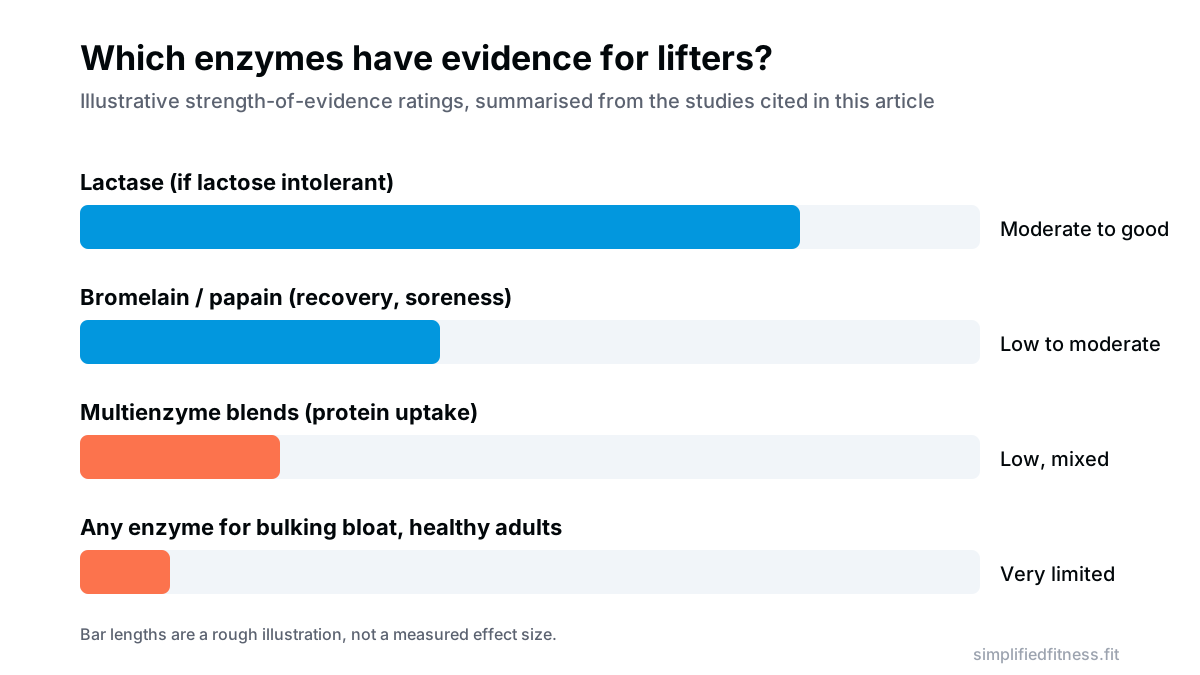
- Lactase is the one digestive enzyme with solid evidence for lifters: in adults with confirmed lactose intolerance, an Indian crossover trial of 47 adults found it cut symptoms and breath hydrogen (a marker of gut fermentation) versus placebo.
- Healthy adults with working pancreases have little proven need for protease or multienzyme blends. A 2026 trial in middle-aged and older adults found no difference in total plasma amino acids with a blend.
- Bromelain and papain have some recovery data, but those studies tested muscle soreness and strength, not digestion or bloating.
- Most bulking bloat comes from meal size, fibre jumps, speed of eating and fat load. Fix those before spending money on enzymes.
- Constant bloating, weight loss, blood in stool or greasy stools are not a supplement problem. See a doctor.
Part of our complete guide: Creatine, Protein Powders, Pre-Workouts and Caffeine: The Science and Safety Guide
Table of contents
Digestive enzymes for bodybuilding are mostly marketing, with one honest exception. Lactase helps lifters who are lactose intolerant. Protease and multienzyme blends have very little proof of helping healthy people absorb more protein or bloat less on a big bulk.
If you are eating 3,000-4,000 kcal and your stomach feels like a drum by evening, the pitch is tempting: add enzymes, digest more, grow more. This article sorts what the research supports from what it does not. It sits inside our complete guide to creatine, protein powders and caffeine, where supplements are ranked by evidence.
What do digestive enzymes actually do?
Your pancreas and small intestine release enzymes that cut food into absorbable pieces. Proteases split protein into peptides and amino acids, amylase handles starch, lipase handles fat, and lactase splits milk sugar (lactose).
Supplements copy these. Reviews describe enzyme supplementation as a core treatment for exocrine pancreatic insufficiency, where the pancreas truly cannot make enough, and as helpful in lactose intolerance (Roxas, 2008). A 2016 narrative review of the field covers the same ground: pancreatic enzymes, lactase and bile acids, mostly in people with gut disease (Ianiro et al., 2016).
Notice the pattern. The strong use cases involve a diagnosed deficiency. Neither review is a trial of healthy gym-goers.
Do healthy lifters need extra enzymes on a bulk?
Probably not. A healthy pancreas is built with a large margin, and a heavier plate mainly changes how long food sits in your stomach and how much reaches the colon. The most common mistake here is blaming “poor digestion” when the real issue is cramming 1,200 kcal into one sitting.
The best direct test I found is a 2026 randomized, double-blind crossover trial in 30 middle-aged and older adults (56 ± 11 years). They ate a mixed meal of chicken, peas, potatoes and butter (435 kcal, 34 g protein) with either a six-enzyme blend or placebo. Total plasma amino acids were not statistically different between treatments. Leucine peaked about 20 minutes earlier with the enzymes (121 versus 141 minutes), and glucose and fatty acids were higher. The authors concluded digestion of the meal improved, most clearly in adults with lower BMI and more lean mass (Deutz et al., 2026).
Read that carefully. It is one trial, in adults who are older than most lifters, funded by the company that supplied the blend. A faster leucine peak has not been shown to build more muscle. For a 25-year-old on 3,500 kcal, it tells us nothing about bloating.
Do protease enzymes improve protein absorption?
The marketing claim is that extra protease means more of your shake reaches muscle. The honest answer is “not demonstrated in healthy people.”
Healthy adults already absorb most dietary protein. The 2026 trial above is the closest test, and it found no difference in overall amino acid levels. If you want a faster-digesting protein, a different product choice (for example hydrolyzed whey, covered in our hydrolyzed whey guide) is a more studied route than swallowing capsules. For the wider protein-absorption question, including probiotics, see our breakdown of whether enzymes or probiotics boost protein absorption.
Does lactase help with whey protein and dairy bloat?
This is where enzymes earn their place. Many adults produce less lactase as they age, so milk, paneer, curd and whey concentrate can cause gas, cramps and bloating. A review notes that a low-lactose diet allowing up to 12-15 g of lactose per day was well tolerated by most people with lactose intolerance, and that the hydrogen breath test is the most widely used diagnostic (Borralho and Marcos, 2025).
For supplements, there is a trial from India. In a randomized, double-blind crossover study, 47 adults with lactose intolerance confirmed by breath test took lactase chewable tablets or placebo. Symptom scores and breath hydrogen both improved with lactase, with a 55% lower cumulative hydrogen level over 180 minutes (Baijal and Tandon, 2021).
Caveats: that is one trial of modest size, in people with confirmed intolerance. It does not show that lactase helps lifters who tolerate dairy fine. Products also differ in dose.
A practical dairy test for Indian lifters
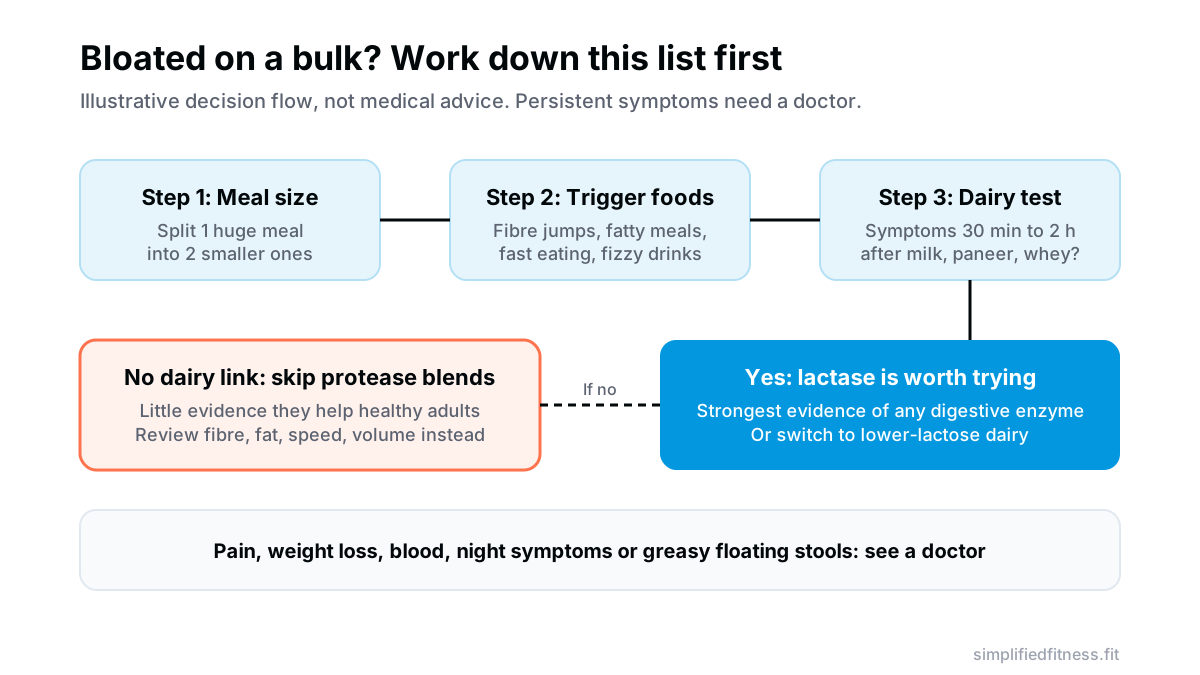
If your bloat appears after chai, a milk-heavy shake or lassi, run a simple check. For one week, swap those for lactose-free milk or a whey isolate and see whether symptoms ease. If they do, reintroduce dairy in small portions and try a lactase tablet taken with the first bite. Some people find curd easier than milk, but that varies, so test it rather than assume. Our comparison of whey isolate versus concentrate explains where the lactose actually sits in powders.
Bromelain and papain: digestion aid or recovery supplement?
Bromelain comes from pineapple, papain from papaya. Both are proteases and show up in many “digestive” and “recovery” blends.
Here is what the studies actually tested, and it was not digestion. In a 2009 trial of 29 young adults, 21 days of a protease blend (fungal proteases, bromelain and papain, 5.83 g per day) was followed by a 45-minute downhill treadmill run. The protease group showed better peak torque recovery and lower inflammatory markers (Buford et al., 2009). In a 2016 trial of 15 trained cyclists, 1,000 mg per day of bromelain over a six-day race did not prevent rises in muscle damage markers, though fatigue ratings were lower on day four and there was a trend toward preserved testosterone (Shing et al., 2016).
Why the difference? Different doses, different products (a blend versus bromelain alone), different exercise, and very small groups. Neither trial studied bloating.
A 2023 meta-analysis of bromelain gave a similar picture: a small but statistically significant pain benefit, moderate-quality evidence, and adverse events including flatulence, nausea and headache (Leelakanok et al., 2023). Note that flatulence is on that list, which is awkward if you are taking it to reduce gas.
What really causes bloating when you eat 3,000-4,000 kcal?
Enzymes are rarely the missing piece. These usually are:
- Meal size. Three giant meals instead of five or six moderate ones.
- Fibre jumps. Going from 20 g to 45 g fibre in a week with dal, rajma, oats and raw salad. Build up gradually.
- Speed. Wolfing down a shake and a full plate in ten minutes means swallowing a lot of air with it.
- Fat load. A heavy ghee-and-fried plate slows stomach emptying.
- Sugar alcohols and fizzy drinks. Protein bars and diet sodas are common culprits.
- Dairy volume. Two or three large milk shakes can push lactose past what you tolerate.
If your gut flora seems to be the issue, our article on probiotics for athletes covers what that research does and does not show.
Who might benefit, and who is wasting money?
| Situation | Enzyme worth trying? | Why |
|---|---|---|
| Confirmed or likely lactose intolerance | Lactase, yes | Controlled evidence for fewer symptoms |
| Bloating only after milk, paneer or whey concentrate | Lactase, reasonable trial | Targets the likely cause |
| Bloating after any big meal, no dairy link | Not first | Meal size and fibre usually explain it |
| Wanting “better protein absorption” | Protease blend, probably no | No clear benefit in healthy adults |
| Sore after eccentric-heavy training | Bromelain or blend, optional | Small, mixed recovery data |
| Greasy stools, weight loss, ongoing pain | See a doctor | Possible pancreatic or other condition |
When should you see a doctor?
Do not self-treat symptoms that suggest something real. Persistent diarrhoea, unplanned weight loss, blood in the stool, severe or night-time pain, vomiting, or greasy, floating, foul-smelling stools need medical assessment. Those can signal conditions such as pancreatic insufficiency or coeliac disease, where proper diagnosis matters more than any supplement. Prescription pancreatic enzymes exist for diagnosed cases, and a doctor decides that, not a label.
Also check first if you take blood thinners, are pregnant, or are allergic to pineapple or papaya before using bromelain or papain products.
A sensible plan
- Log meals and symptoms for a week.
- Split your largest meal and slow your eating pace.
- Raise fibre by about 5 g every few days, not all at once.
- Run the dairy test above. If dairy is the trigger, try lactase with the dairy meal.
- Skip protease blends unless you have a medical reason, and judge any trial by symptoms after two to three weeks.
- Set your calorie and protein targets with our protein calculator and keep the surplus modest.
If you want help turning this into a weekly eating structure that fits your budget and schedule, a coach can map it out, but the steps above will solve most cases without buying anything.
Frequently Asked Questions
Do digestive enzymes help with bodybuilding?
Mostly no, with one exception. Healthy adults make plenty of their own enzymes, and trials of added protease blends have not shown clear muscle or digestion benefits, while lactase clearly helps people who are lactose intolerant. If dairy is your trigger, try lactase; otherwise put the money into food and training.
Do protease enzymes improve protein absorption?
Not convincingly in healthy people. A 2026 randomized crossover trial of a six-enzyme blend found total plasma amino acids were not statistically different from placebo, though leucine peaked about 20 minutes sooner. Faster peak is not the same as more muscle, so do not expect a visible change.
Does lactase help with whey protein?
It can, if your symptoms come from lactose. Whey concentrate contains some lactose, and lactase breaks it down before it ferments in the gut. If you are unsure, try an isolate or a lactose-free product first, and read our guide to whey isolate versus concentrate.
Why do I feel bloated when bulking?
Usually because of more food volume, more fibre, faster eating and bigger fatty meals rather than missing enzymes. A large meal stays in the stomach longer and produces more gas in the colon. Split big meals, eat slower and raise fibre gradually.
Is bromelain good for digestion?
Bromelain is a protein-digesting enzyme from pineapple, but evidence that it improves digestion in healthy people is thin. A 2023 meta-analysis found oral bromelain gave a small pain reduction and listed flatulence and nausea among the adverse events. Eating fresh pineapple is cheaper and carries no such promise.
Does bromelain help muscle soreness?
Evidence is small and mixed. A 2009 trial of a protease blend (fungal proteases, bromelain and papain) saw better strength recovery after downhill running, while a 2016 cycling trial of 1,000 mg/day bromelain saw no clear change in muscle damage markers but lower fatigue ratings. Treat it as an optional extra, not a recovery strategy.
Do I need digestive enzymes if I eat 3,500 kcal a day?
Probably not. Your pancreas adjusts enzyme output to what you eat, and a bigger intake mainly changes meal size and gut transit rather than enzyme supply. Spread calories across 4-6 eating occasions and see whether symptoms settle.
How do I know if I am lactose intolerant?
The usual signs are bloating, cramps, gas or loose stools within a few hours of milk, paneer or whey. A hydrogen breath test is the standard diagnostic, and a doctor can arrange it. A simple home check is two weeks of low-lactose dairy to see if symptoms ease.
How much lactose can most intolerant people handle?
A 2025 review states that a low-lactose diet allowing up to 12-15 g of lactose a day was well tolerated by most people with lactose intolerance. A glass of milk has roughly 10-12 g, so spreading dairy across the day often works. Test your own limit rather than cutting dairy completely.
Are digestive enzymes safe to take daily?
Short-term use appears well tolerated in the studies above, but long-term data in healthy lifters are scarce. Side effects reported for bromelain include flatulence, nausea and headache, and anyone on blood thinners or with allergies to pineapple or papaya should ask a doctor first. Use the lowest dose that helps and stop if symptoms worsen.
Are digestive enzyme supplements regulated like medicines?
Prescription pancreatic enzymes are medicines used for conditions such as pancreatic insufficiency, while over-the-counter blends are sold as supplements with far looser proof of benefit. Label doses and activity units vary between brands. Pick products with third-party testing and clear enzyme activity listed.
What actually fixes gas and bloating on a bulk?
Smaller, more frequent meals, slower eating, gradual fibre increases and avoiding fizzy drinks with meals fix most cases. These reduce stomach load and the amount of undigested food reaching the colon. Change one thing at a time for a week so you can tell what worked.
Sources & References
Every claim above is checked against peer-reviewed research (PubMed, U.S. National Library of Medicine) or guidance from established health bodies. How we fact-check.
- Roxas M. The role of enzyme supplementation in digestive disorders. Altern Med Rev. 2008. PMID: 19152478
- Ianiro G, et al. Digestive Enzyme Supplementation in Gastrointestinal Diseases. Curr Drug Metab. 2016. PMID: 26806042
- Deutz MT, et al. Oral Multienzyme Supplementation Alters Postprandial Plasma Nutrient Concentrations after a Mixed Meal in Healthy Middle-Aged and Older Adults: A Randomized, Double-Blind, Placebo-Controlled, Crossover Trial. J Nutr. 2026. PMID: 41662956
- Buford TW, et al. Protease supplementation improves muscle function after eccentric exercise. Med Sci Sports Exerc. 2009. PMID: 19727022
- Shing CM, et al. Acute protease supplementation effects on muscle damage and recovery across consecutive days of cycle racing. Eur J Sport Sci. 2016. PMID: 25604346
- Leelakanok N, et al. Efficacy and safety of bromelain: A systematic review and meta-analysis. Nutr Health. 2023. PMID: 37157782
- Baijal R, et al. Effect of lactase on symptoms and hydrogen breath levels in lactose intolerance: A crossover placebo-controlled study. JGH Open. 2021. PMID: 33490624
- Borralho AI, et al. Lactose Intolerance and Malabsorption Revisited: Exploring the Impact and Solutions. GE Port J Gastroenterol. 2025. PMID: 40432984

Umair Hazrami · Founder & Head Coach, Simplified Fitness
Umair Hazrami founded Simplified Fitness and the Simplified Lifter channel to cut through fitness noise. With 4+ years of consistent training and 10+ coaching clients, he writes every guide from the peer-reviewed research and links the sources so you can check them. Our editorial standards.
Educational content only, not medical advice. If you have a medical condition, are pregnant, or take medication, talk to a qualified doctor before changing your diet, supplements or training. Full disclaimer.
Keep reading
Supplements
Alpha-GPC and Huperzine A Pre-Workout: Do Cholinergic Nootropics Help Lifting?
Does an alpha GPC pre workout add power or focus? See what small trials found, why Huperzine A is a poor lifting bet, and the safety flags to know first.
10 min read

Supplements
The Antioxidant Paradox: Can Vitamin C and E Pills Blunt Muscle Growth and Endurance?
Does vitamin C blunt muscle growth? See what trials of 1000 mg vitamin C plus E found for strength, hypertrophy and endurance, and when pills are worth taking.
8 min read

Supplements
Caffeine Powder vs Coffee Before Lifting: Does the Source Really Matter?
Caffeine anhydrous vs coffee for lifting: what research says on absorption speed, peak levels and stomach upset, and whether pills beat your daily cup.
7 min read

Supplements
Caffeine Dosing for Strength and Power: 3-6 mg/kg and When to Take It
Caffeine dosage for strength is 3-6 mg/kg, about 210-420 mg for a 70 kg lifter, taken around 60 minutes before training. Doses, timing and when to stop.
8 min read