Green Tea Extract Fat Loss Myth: What the Reviews and Liver Data Say
Green tea extract fat loss claims fall apart in the trials: about 1.3 kg at best, plus a liver risk at high doses. See the numbers before you buy a pill.
TL;DR. The short answer
- Green tea extract does not meaningfully burn fat. A Cochrane review found a mean difference of 0.04 kg outside Japan over 12-13 weeks, and the best-case meta-analysis found about 1.3 kg.
- The mechanism is real but small: catechins may inhibit COMT and raise norepinephrine, and one small trial measured a 4% rise in 24-hour energy expenditure on an extract, which is a modest number of calories.
- Concentrated extracts have been linked to liver injury. A USP review reports case reports at EGCG intakes from 140 mg to about 1000 mg a day, and a one-year trial at 843 mg EGCG saw ALT elevations in 6.7% of users versus 0.7% on placebo.
- Brewed green tea is a very different exposure from a capsule, and no one has shown it burns meaningful fat either. A calorie deficit, protein, lifting and steps do the real work.
- Never take extract on an empty stomach, skip it with any liver problem, and stop and see a doctor for abdominal pain, dark urine or yellow skin or eyes.
Part of our complete guide: Creatine, Protein Powders, Pre-Workouts and Caffeine: The Science and Safety Guide
Table of contents
The green tea extract fat loss myth is simple to state: a capsule of tea catechins will melt fat while you carry on as usual. The trials say otherwise. Across the pooled trials the extra weight lost on green tea is somewhere between nothing and about 1.3 kg, and concentrated extracts have been tied to liver injury in a minority of users.
If you are comparing supplements, this sits in the “secondary” tier of our complete guide to creatine, protein powders and caffeine. Here is what the research shows on effect size, mechanism and safety, and what to do instead.
Does green tea extract actually work for fat loss?
Mostly no. Two big reviews give you the range.
The Cochrane review pooled randomized trials of at least 12 weeks in overweight or obese adults. Six studies outside Japan (532 people) showed a mean difference in weight loss of 0.04 kg (95% CI -0.5 to 0.4). Eight Japanese studies (1,030 people) were too different to pool, with results ranging from 0.2 kg to 3.5 kg in favour of green tea. The authors concluded the weight loss is small, not statistically significant, and not likely to be clinically important (Jurgens et al., 2012).
A 2009 meta-analysis of 11 articles was more generous. It found catechins decreased body weight by a mean of 1.31 kg and helped maintain weight after a loss phase, and it called the effect small (Hursel et al., 2009). A 2014 systematic review of five parallel trials of at least 12 weeks found a non-significant 0.78 kg difference, and a small fat-percentage drop it judged not clinically relevant (Baladia et al., 2014).
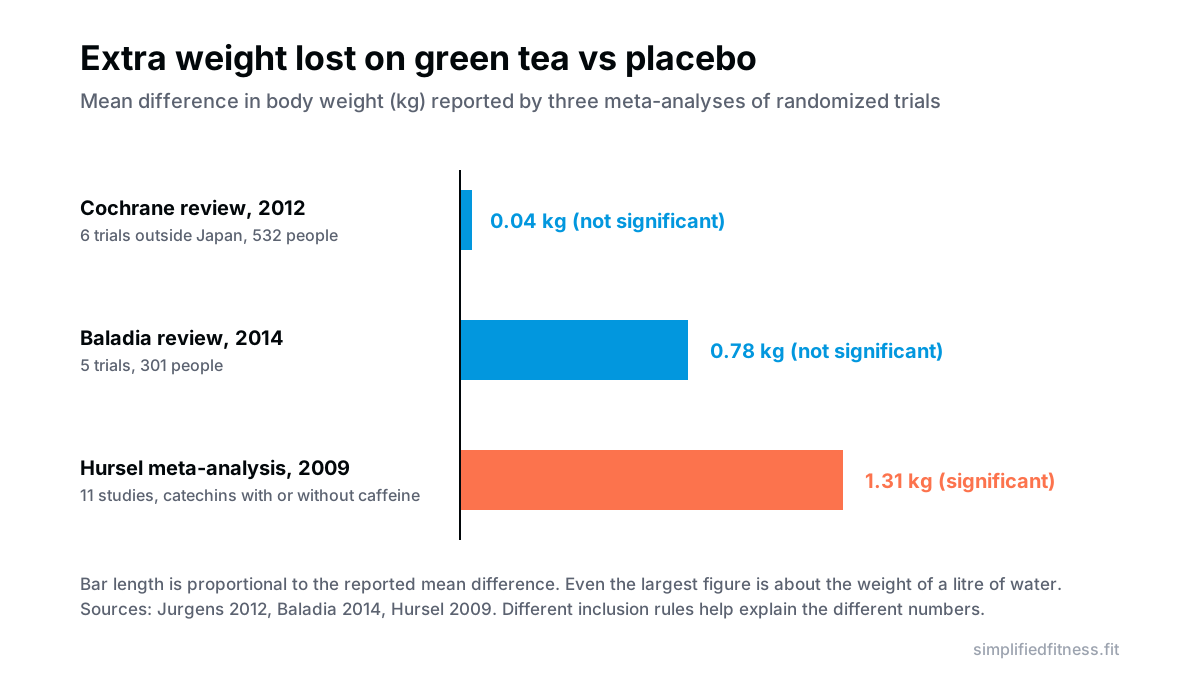
Why do the reviews disagree? Inclusion rules differ, and so do the populations. The 2009 analysis suggested that habitual caffeine intake and ethnicity might moderate the effect, with a smaller result in people who already consume more than 300 mg of caffeine a day, though that gap did not reach significance. The Cochrane authors also split Japanese from non-Japanese studies because of heterogeneity.
How green tea is supposed to burn fat: COMT and norepinephrine
The mechanism is not made up, which is partly why the myth survives.
Catechol-O-methyltransferase (COMT) is an enzyme that breaks down catecholamines, including norepinephrine. The idea is that tea catechins inhibit COMT, so norepinephrine signalling lasts longer, which nudges energy expenditure and fat oxidation up (Hursel et al., 2014).
The best-known human test is a small respiratory chamber study from 1999. Ten healthy men took a green tea extract (90 mg EGCG and 50 mg caffeine), caffeine alone (50 mg) or placebo at three meals. The extract raised 24-hour energy expenditure by 4% versus placebo, lowered the respiratory quotient from 0.88 to 0.85, and raised 24-hour urinary norepinephrine by 40%. The same caffeine alone had no effect (Dulloo et al., 1999).
So what does 4% mean in calories? That is simple arithmetic, not a finding from the paper. If your total daily burn is 2,000-2,500 kcal, 4% is roughly 80-100 kcal, about one banana. In a trial of ten men on one product, under controlled conditions. In real life, with a gym session and a sandwich, it disappears into the noise.
There is a second catch. In a crossover study of 14 young adults, energy expenditure and fat oxidation rose on green tea only in carriers of the high-activity COMT genotype, not in the low-activity group (Hursel et al., 2014). The authors also noted the gap came mostly from how the two groups responded to placebo. It was a pilot with seven people per group, so treat it as a hint for why results are inconsistent, not as a test you should run on yourself.
Can green tea extract damage your liver?
This is the part that turns a harmless waste of money into a consumer safety issue.
The United States Pharmacopeia (USP) convened an expert panel and published a systematic review of green tea extract hepatotoxicity. Its key points, straight from the abstract (Oketch-Rabah et al., 2020):
- Animal and human data indicate that repeated bolus doses of extract during fasting significantly increase catechin (especially EGCG) bioavailability, possibly by saturating first-pass elimination.
- Toxicology shows a hepatocellular pattern of injury.
- Case reports link liver injury to EGCG intakes from 140 mg to about 1000 mg a day, with large differences between individuals, possibly genetic.
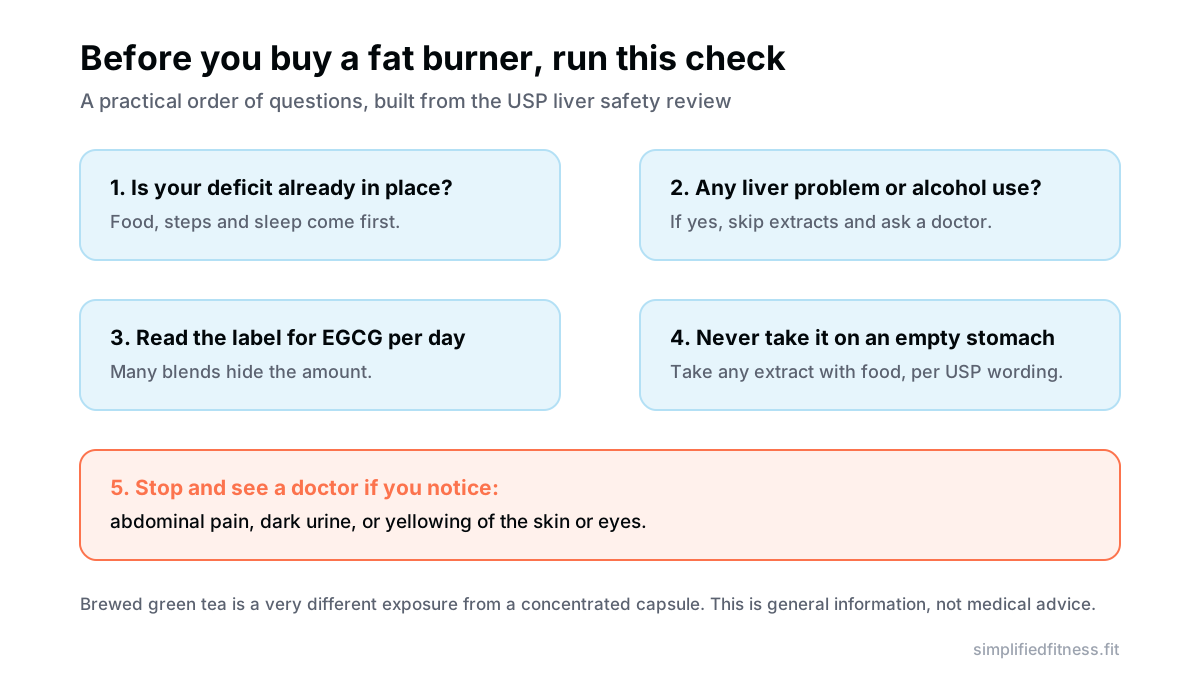
- On that basis, USP requires cautionary labelling on its decaffeinated green tea extract monograph: do not take on an empty stomach, take with food, do not use if you have a liver problem, and stop and consult a healthcare practitioner if you develop abdominal pain, dark urine or jaundice.
The review found no evidence that solvent residues, pesticides or other contaminants explained the injuries. It also notes that catechin profiles vary a lot with how the extract is made, which is one reason two “green tea” capsules are not interchangeable.
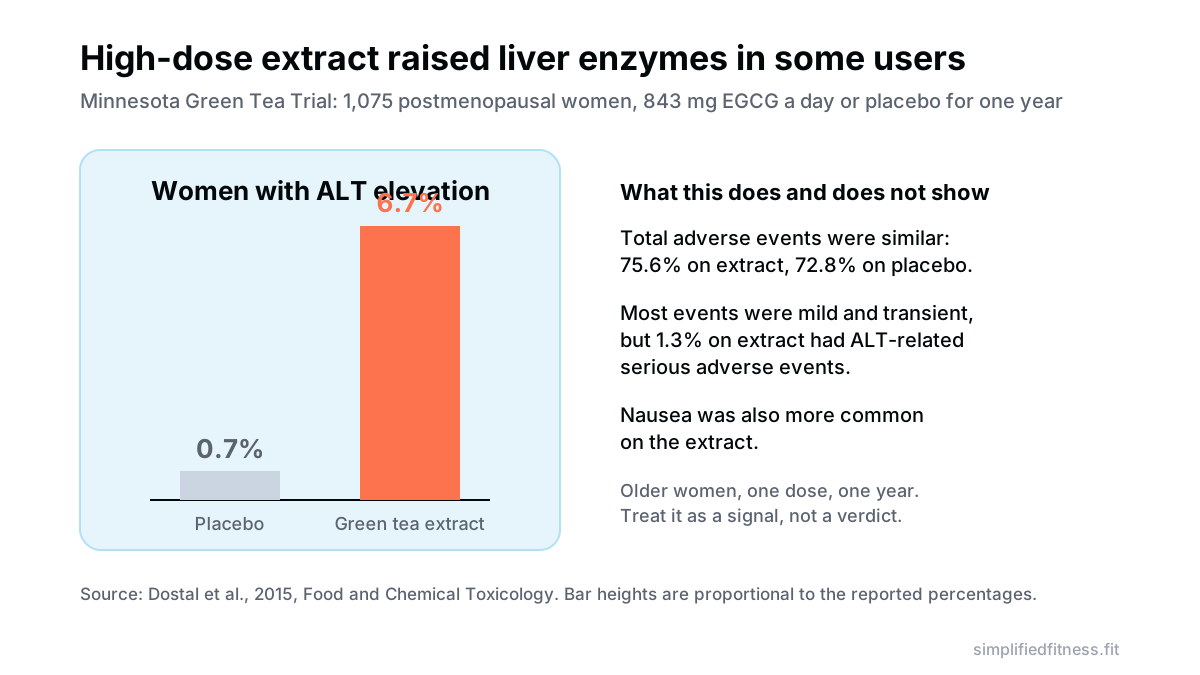
A one-year trial puts numbers on it. In the Minnesota Green Tea Trial, 1,075 postmenopausal women took extract with 843 mg EGCG daily or placebo. Overall adverse events were similar (75.6% versus 72.8%), and most were mild and transient. But 6.7% of the extract group had ALT elevations versus 0.7% on placebo, and 1.3% on the extract had ALT-related serious adverse events. Nausea was also more common (Dostal et al., 2015).
But the risk is not universal
To be fair, the evidence is mixed. A systematic review of 34 randomized trials of green tea extracts found liver-related adverse events in four trials: seven people in the extract groups and one in the control groups, with a summary odds ratio of 2.1 (95% CI 0.5-9.8). Most were mild enzyme elevations, none were serious, and the authors suggested liver events are expected to be rare, though not conclusively (Isomura et al., 2016).
How do these fit together? The confidence interval in the pooled review is wide, so it cannot rule out a real increase. The Minnesota trial used a high dose for a full year in a large group, which gives rare events a chance to show up. And case reports, by nature, capture the rare severe responders. The cautious reading: most people tolerate extracts, a minority do not, and nobody can tell in advance which group they are in.
If you want the wider picture on stacked stimulant products, our breakdown of commercial fat burners and what is really in them goes through the usual ingredients.
Brewed green tea vs concentrated extract
These are not the same exposure, and the difference is the main reason brewed tea is generally considered the low-risk option.
| Brewed green tea | Concentrated extract capsule | |
|---|---|---|
| EGCG per serving | Varies with leaf, brew time and cup size | Often high, sometimes not stated on the label |
| How it is taken | Slowly, usually with meals or snacks | Bolus dose, often fasted |
| Liver signal in research | The USP labelling advice is written for extracts, not brewed tea | Case reports and ALT elevations at high daily EGCG |
| Fat loss evidence | Not shown to burn meaningful fat | Small at best, see Figure 1 |
| Cost in India | A few rupees a cup | Typically a bottle purchase, often with a proprietary blend |
I would not call brewed tea a fat burner either. It is a pleasant, low-calorie drink that gives you a little caffeine and fits a cut. Having two or three cups with meals is a reasonable habit. If you have liver disease or take regular medication, ask your doctor first rather than assuming tea is automatically fine.
What actually works instead
Fat loss comes from a moderate calorie deficit you can hold for weeks, enough protein, lifting to keep muscle, and daily movement. A supplement adds a rounding error to that.
- Set the deficit properly. Use the calorie calculator and read how to set an optimal caloric deficit before you spend on pills.
- Know where your calories go. The TDEE breakdown explains why a daily 80-100 kcal tweak from any supplement is small next to NEAT and food choices.
- Walk more. NEAT and daily steps are cheaper and safer than any capsule.
- If you want caffeine, use coffee or chai in a sensible amount, and check how your own body handles it in our guide to caffeine sensitivity and genetics.
- If you want a supplement schedule, the daily supplement protocol shows where the few worthwhile ones fit.
Who should avoid green tea extract, and when to see a doctor
Skip concentrated extracts if you have any liver problem, drink alcohol heavily, are pregnant or breastfeeding, or take regular medication, unless your doctor says otherwise. The USP wording is explicit that people with a liver problem should not use it.
See a doctor promptly if you develop abdominal pain, dark urine, or yellowing of the skin or eyes while taking any supplement, and stop the product. This article is general information, not a diagnosis, and it cannot tell you whether a specific symptom is related to a supplement.
The bottom line
Green tea extract has a real mechanism and a small measurable effect on energy expenditure, but the trial data on weight range from nothing to about 1.3 kg. At high daily EGCG doses, especially fasted, there is a documented liver risk in a minority of people. For a lifter, that trade is poor. Put the money into protein, put the effort into a deficit and steps, and if you like green tea, drink it brewed with food. For a structured plan, start with the free training plans.
Frequently Asked Questions
Does green tea extract help you lose fat?
Only by a trivially small amount, if at all. A Cochrane review of 12-13 week trials found a mean difference of 0.04 kg outside Japan and called the effect unlikely to be clinically important. The practical move is to spend that money on protein and food you can sustain.
How much weight can you lose with green tea extract?
The most generous pooled estimate is about 1.3 kg more than placebo, from a 2009 meta-analysis of catechin trials. Other reviews found smaller and non-significant differences, such as 0.78 kg in a 2014 review of five trials. Treat anything around 1 kg as a ceiling, not a promise.
Is EGCG good for weight loss?
EGCG is the main catechin in green tea, and it may modestly raise energy expenditure, but trials do not show it produces much fat loss. Pooled trials show at most about 1.3 kg more weight lost than placebo. Even if you are tempted, the liver risk at high doses outweighs that small upside.
Can green tea extract damage your liver?
Yes, in a small number of people. A USP expert review links hepatotoxicity case reports to EGCG intakes from 140 mg to about 1000 mg a day, with large differences in individual susceptibility. If you take any extract, take it with food and see a doctor if you notice abdominal pain, dark urine or jaundice.
How much EGCG is too much?
No single safe line has been proven for everyone. The USP review cites case reports from 140 mg to about 1000 mg a day, and the Minnesota trial used 843 mg a day with more ALT elevations than placebo. Many commercial blends do not state EGCG per serving, which is a good reason to avoid them.
Is green tea extract safe on an empty stomach?
No, that is the situation the USP specifically warns about. Animal and human data suggest repeated bolus doses during fasting raise catechin bioavailability, possibly by saturating first-pass elimination. If you take it at all, take it with a meal.
Is drinking brewed green tea safe for the liver?
For most healthy people, brewed tea delivers far less concentrated EGCG than a capsule, so the exposure is very different. A systematic review of 34 trials of green tea extracts found liver-related adverse events were rare and mostly mild elevations. If you have liver disease, ask your doctor how much tea is reasonable for you.
What is COMT inhibition and why does it matter for fat burners?
COMT is an enzyme that helps break down catecholamines such as norepinephrine. Catechins may inhibit it, which could prolong norepinephrine signalling and nudge energy expenditure up. The effect appears to differ by COMT genotype, so it is inconsistent from person to person.
Do fat burner pills work?
Most deliver little beyond their caffeine, and the research on their other ingredients shows small effects at best. A pill cannot replace a calorie deficit, and some products carry real organ risks. Read the label, avoid proprietary blends, and put your effort into food, steps and lifting.
Is green tea extract better than caffeine for burning fat?
In one small respiratory chamber trial, an extract with 90 mg EGCG and 50 mg caffeine per meal raised 24-hour energy expenditure by 4%, while the same caffeine alone did not. That was 10 healthy men and one study, so it is not proof of fat loss. A plain coffee or chai gets you the caffeine part for much less money and risk.
Does green tea extract work differently for different people?
It can. A small crossover study of 14 young adults found energy expenditure and fat oxidation rose on green tea only in carriers of the high-activity COMT genotype. The meta-analysis from 2009 also suggested habitual caffeine intake and ethnicity might change the response, so results are not uniform.
Should I take green tea extract while cutting?
It is not necessary and carries a downside you can avoid. A cut is won by a moderate deficit, enough protein and keeping your training load, none of which a capsule changes. If you still want to try something, brewed tea with meals is the low-risk version.
Who should avoid green tea extract completely?
Anyone with liver disease, a history of liver problems, or who drinks alcohol heavily should avoid it, in line with the USP label advice not to use it with a liver problem. People on regular medication, pregnant or breastfeeding women should also check with a doctor first. If you are unsure, skip the capsule.
Sources & References
Every claim above is checked against peer-reviewed research (PubMed, U.S. National Library of Medicine) or guidance from established health bodies. How we fact-check.
- Jurgens TM, et al. Green tea for weight loss and weight maintenance in overweight or obese adults. Cochrane Database Syst Rev. 2012. PMID: 23235664
- Hursel R, et al. The effects of green tea on weight loss and weight maintenance: a meta-analysis. Int J Obes (Lond). 2009. PMID: 19597519
- Baladia E, et al. Effect of green tea or green tea extract consumption on body weight and body composition; systematic review and meta-analysis. Nutr Hosp. 2014. PMID: 24558988
- Dulloo AG, et al. Efficacy of a green tea extract rich in catechin polyphenols and caffeine in increasing 24-h energy expenditure and fat oxidation in humans. Am J Clin Nutr. 1999. PMID: 10584049
- Hursel R, et al. The role of catechol-O-methyl transferase Val(108/158)Met polymorphism (rs4680) in the effect of green tea on resting energy expenditure and fat oxidation: a pilot study. PLoS One. 2014. PMID: 25238062
- Oketch-Rabah HA, et al. United States Pharmacopeia (USP) comprehensive review of the hepatotoxicity of green tea extracts. Toxicol Rep. 2020. PMID: 32140423
- Dostal AM, et al. The safety of green tea extract supplementation in postmenopausal women at risk for breast cancer: results of the Minnesota Green Tea Trial. Food Chem Toxicol. 2015. PMID: 26051348
- Isomura T, et al. Liver-related safety assessment of green tea extracts in humans: a systematic review of randomized controlled trials. Eur J Clin Nutr. 2016. PMID: 27188915

Umair Hazrami · Founder & Head Coach, Simplified Fitness
Umair Hazrami founded Simplified Fitness and the Simplified Lifter channel to cut through fitness noise. With 4+ years of consistent training and 10+ coaching clients, he writes every guide from the peer-reviewed research and links the sources so you can check them. Our editorial standards.
Educational content only, not medical advice. If you have a medical condition, are pregnant, or take medication, talk to a qualified doctor before changing your diet, supplements or training. Full disclaimer.
Keep reading
Supplements
Alpha-GPC and Huperzine A Pre-Workout: Do Cholinergic Nootropics Help Lifting?
Does an alpha GPC pre workout add power or focus? See what small trials found, why Huperzine A is a poor lifting bet, and the safety flags to know first.
10 min read
Supplements
The Antioxidant Paradox: Can Vitamin C and E Pills Blunt Muscle Growth and Endurance?
Does vitamin C blunt muscle growth? See what trials of 1000 mg vitamin C plus E found for strength, hypertrophy and endurance, and when pills are worth taking.
8 min read
Supplements
Caffeine Powder vs Coffee Before Lifting: Does the Source Really Matter?
Caffeine anhydrous vs coffee for lifting: what research says on absorption speed, peak levels and stomach upset, and whether pills beat your daily cup.
7 min read
Supplements
Caffeine Dosing for Strength and Power: 3-6 mg/kg and When to Take It
Caffeine dosage for strength is 3-6 mg/kg, about 210-420 mg for a 70 kg lifter, taken around 60 minutes before training. Doses, timing and when to stop.
8 min read