Creatine Water Weight: Muscle Fullness or Puffy Bloat? What the Research Shows
Creatine water weight is mostly extra fluid carried with muscle creatine, not fat. See how much to expect, the timeline, and what trials say about bloating.

TL;DR. The short answer
- Creatine water weight is real: in loading trials, total body water rises and scale weight goes up by roughly 0.9-1 kg within the first week.
- The water is thought to travel with creatine into muscle cells, which is why the effect is better described as muscle fullness than as puffiness under the skin.
- No trial has linked creatine to facial bloating or subcutaneous swelling, but direct evidence on where every litre sits is limited and partly mixed.
- Skipping the loading phase and taking 3-5 g daily gives a slower, smaller scale change that ends in a similar place.
- Swelling in the legs, face or around the eyes, breathlessness or sudden weight gain is not a creatine effect to wave off. See a doctor.
Part of our complete guide: Creatine, Protein Powders, Pre-Workouts and Caffeine: The Science and Safety Guide
Table of contents
Creatine water weight is real, and it is not fat. In controlled trials, people who load creatine for a week gain roughly 0.9-1 kg on the scale because total body water rises, and the working explanation is that much of that water travels into muscle with the creatine. Whether it looks like fullness or puffiness is where most of the fear lives.
If you are new to the supplement, start with our complete guide to creatine, protein powders and caffeine. Here we focus on one question: when the scale jumps a kilo, what exactly did you gain?
Is creatine water weight real?
Yes. Several trials that measured water directly found the same thing.
In a 2016 study of 13 young soccer players, 7 days of creatine at 0.3 g/kg per day raised total body water by about 2.3 L (measured by deuterium oxide dilution) and body weight by about 1.0 kg compared with placebo (Deminice et al., 2016). That is a small group, so treat the exact numbers loosely.
An earlier trial gave 32 resistance-trained men and women 25 g/day for 7 days and then 5 g/day for 21 days. Muscle creatine, body mass and total body water all rose in the creatine group (Powers et al., 2003).
Another study loaded 21.6 g/day for 7 days in 12 active men and recorded a body mass gain of 0.88 kg (Watson et al., 2006).
So the “creatine makes the scale go up” part is not a myth. The interesting part is what that water is doing.
Intracellular vs extracellular water: where does it go?
Your body holds water in two broad places. Intracellular water is inside your cells. Extracellular water is everything outside them: blood plasma and the fluid between cells, including the soft layer under your skin. When people say “bloating,” they usually mean extracellular fluid. When lifters say “fullness,” they mean intracellular.
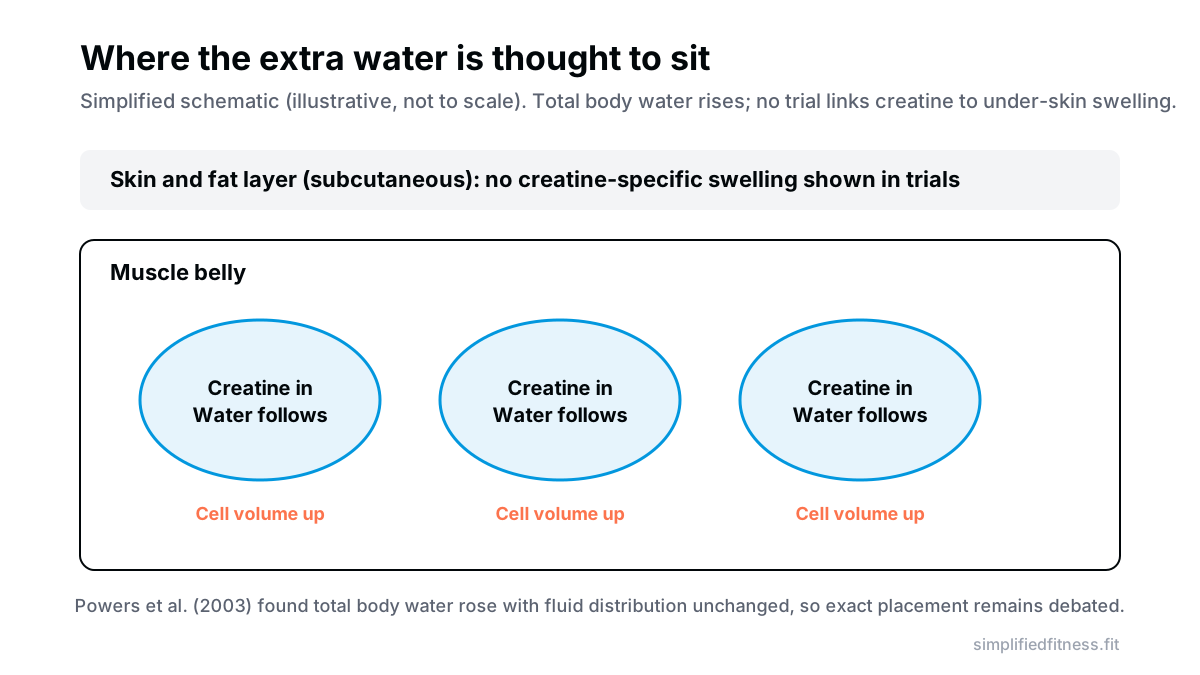
Here is the proposed mechanism. Muscle cells take up creatine, and a cell with more dissolved creatine inside it holds more water by osmosis. Water follows the solute. That swells the cell slightly and expands the muscle belly, not the layer above it.
Now the honest part. Direct measurements are not perfectly tidy.
- Powers et al. (2003) used dilution methods and found total body water rose while fluid distribution did not change. In plain terms, the extra water was spread proportionally, not obviously concentrated in one compartment (Powers et al., 2003).
- Brilla et al. (2003) used bioimpedance in 35 people over 2 weeks and saw intracellular water rise and extracellular water fall in the magnesium-creatine chelate group, but not in the other groups (Brilla et al., 2003).
Why might they differ? Different methods (dilution versus bioimpedance), different products, doses and durations, and small samples. Bioimpedance in particular is sensitive to hydration, so it is not the cleanest tool for this question.
A cautious reading: creatine raises body water, the osmotic mechanism fits intracellular water, and the best direct trial did not show a shift in distribution. “Mostly inside the muscle” is plausible, not proven to the litre.
Does creatine cause bloating in the face or under the skin?
This is the fear behind most searches. The evidence is simple to state and easy to overstate, so here is the careful version.
- No trial in the research we reviewed reports creatine causing facial swelling or soft subcutaneous puffiness at standard doses.
- That is not the same as proof of absence. Trials generally measured weight, water and lean mass, not faces.
- The International Society of Sports Nutrition position stand, covering a large body of evidence, describes supplementation (up to 30 g/day for 5 years) as safe and well tolerated in healthy individuals (Kreider et al., 2017).
If you look puffy after starting creatine, ask what else changed. New food, more salt, less sleep, alcohol, a bulk, a lower body fat that makes a fuller muscle look different. Creatine often gets blamed for what the rest of the week caused.
For daily scale swings that have nothing to do with creatine, see our article on daily scale weight fluctuations from sodium, glycogen and bowels.
Creatine weight gain timeline: what to expect
Timing depends on how you dose.
| Approach | Typical scale change | Timing |
|---|---|---|
| Loading (about 20 g/day for 5-7 days) | About 0.9-1 kg in the trials above | Within the first week |
| 3-5 g/day, no loading | Often smaller and slower | Spread over several weeks |
| After stopping | Weight drifts back down | Over several weeks as stores fall |
The loading numbers come from the trials above. The no-loading and after-stopping rows are the expected pattern based on how muscle creatine fills and empties, and the exact kilograms vary by person.
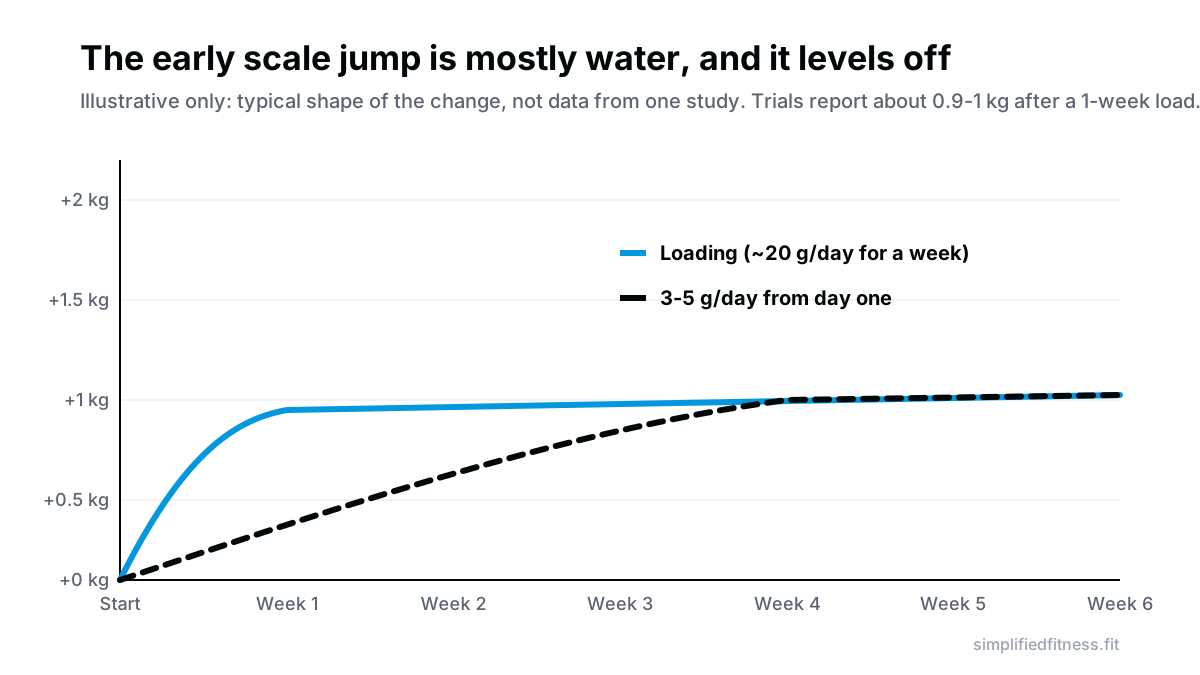
How quickly muscle fills is covered in our article on creatine loading versus daily maintenance. The practical point: if a sudden kilo bothers you, you can skip the load and accept a slower rise.
Is it muscle or bloat? What the lean mass data say
Water is not the whole story, but it is part of it.
A 2022 meta-analysis of 35 randomized trials and 1,192 participants found creatine increased lean body mass by about 0.68 kg overall. Combined with resistance training, the gain was about 1.10 kg. Without exercise, the effect was not significant (Delpino et al., 2022).
The nuance: lean mass on a scan or scale includes water. So some of that reading reflects fluid, and some probably reflects extra work done in training. Trials of a few weeks cannot cleanly separate the two. Over months, muscle growth from training harder is the part that stays.
Does creatine dehydrate you?
A common worry runs the other way: if creatine pulls water into muscle, does it leave you dry?
A systematic review of ten randomized trials found no evidence that creatine impairs heat dissipation or fluid balance in athletes exercising in the heat at recommended doses (Lopez et al., 2009). One crossover trial in 12 active men, who were deliberately dehydrated by 2% of body mass before exercise in 33.5 degrees C heat, found no differences in core temperature, heart rate or heat illness symptoms between creatine and placebo (Watson et al., 2006).
That matters if you train through an Indian summer. Drink to thirst, add a little extra when it is very hot, and do not treat creatine as a reason to cut fluids.
How to manage the scale change
The most common mistake is reading the first two weeks of the scale as a verdict on fat. It is not.
- Decide whether you need to load. If not, take 3-5 g a day.
- Take a baseline for a week before starting: morning weight, waist, and photos in the same light.
- Expect the early rise, then a plateau.
- Judge fat loss by waist, photos, gym numbers and trend weight over four or more weeks.
- If you are cutting, tell yourself the early kilo is not fat before you panic and slash calories.
Taking creatine with a meal or snack, such as curd rice, dal chawal or a protein shake, works fine. Our article on water retention and the whoosh effect explains why scale drops can lag behind real fat loss.
When creatine water weight is not the explanation
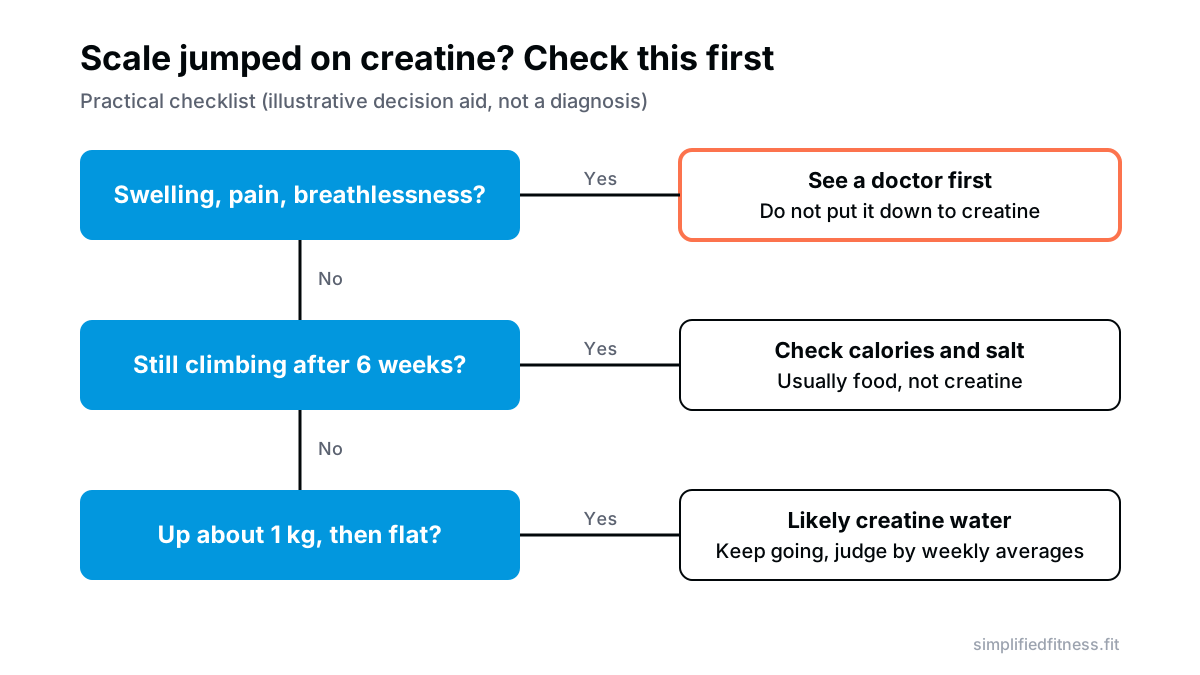
Creatine does not cause swollen ankles, a puffy face on waking that gets worse, or sudden weight gain with breathlessness. Heart, kidney, liver or thyroid problems and some medicines can cause fluid retention, and that deserves a proper check.
See a doctor if you notice swelling in your legs or around your eyes, rapid unexplained weight gain, shortness of breath, or reduced urination. If you already have kidney disease, speak to your doctor before starting creatine. This article is general information, not a diagnosis.
So is it muscle or bloat?
Mostly water, probably mostly in muscle, and temporary in the sense that it follows your creatine stores. It is not fat, and nothing in the trials suggests under-skin or facial swelling at standard doses. The location of every litre is less settled than the headlines suggest.
For how creatine works at a cellular level, read our article on how creatine supplies ATP. If the scale makes you anxious, use waist and photos alongside it, and stick with plain monohydrate. The comparison of creatine forms explains why fancier products are not needed.
Frequently Asked Questions
Is creatine water weight real fat gain?
No, creatine itself has no meaningful calories, so it cannot add fat directly. The early scale rise in trials comes from extra body water, and a 2022 meta-analysis found lean mass gains of about 1.1 kg when creatine was paired with resistance training. If your weight keeps climbing past the first month, look at your food intake rather than the tub.
How much weight do you gain on creatine?
The loading trials cited here report about 0.9-1 kg after one week, and individuals vary. In one 7-day study in young soccer players, total body water rose by about 2.3 L and body weight by about 1.0 kg versus placebo. Without loading, expect a slower and often smaller change.
How long does creatine water weight take to show up?
On a loading phase it can show within 5-7 days, because muscle stores fill quickly. With 3-5 g a day it spreads over several weeks. Weigh yourself at the same time each morning and compare weekly averages to see the trend.
Does creatine cause bloating in the face?
There is no study showing that creatine causes facial puffiness. The water retained in trials is thought to be held with creatine in muscle rather than in facial tissue, though trials did not photograph or measure faces. Facial swelling that is new or persistent deserves a medical check, because kidney, thyroid, allergy and salt intake can all be involved.
Is creatine water inside or outside the muscle cell?
The mechanism points to inside the cell, since creatine is taken up by muscle and water follows by osmosis. Direct measurement is mixed: one 2003 trial found total body water rose with intracellular and extracellular fractions unchanged, while a smaller 2003 bioimpedance study found intracellular water rose in one creatine group. Treat the exact split as unsettled and the muscle-fullness explanation as plausible.
Does creatine make you look soft or puffy?
Not in the way people fear. The fluid appears to sit in muscle, which tends to look fuller rather than soft, and no trial reports under-skin swelling from standard doses. If you look puffier, check salt intake, sleep, alcohol, calories and how much leaner you were before.
Does creatine dehydrate you?
Controlled trials do not support that. A systematic review of ten controlled trials found no adverse effect on heat tolerance or hydration status at recommended doses. Keep drinking to thirst and your usual training fluids.
Will the water weight go away if I stop creatine?
Yes, the extra weight is expected to fall as your muscle creatine stores drift back to baseline over several weeks. This is why the scale can drop around a kilo after stopping without any fat loss. Do not read that as a sign the supplement was making you fat.
Should I skip loading to avoid water weight?
Loading is optional. Muscle saturates faster on 20 g a day, but 3 g a day reaches similar levels over about a month in older work. If a quick scale jump bothers you or you are in a weight class, use 3-5 g a day from the start.
Does creatine water weight matter for weight-class sports?
It can. A change of around 1 kg on a loading phase may matter if you weigh in. Talk to your coach and test the protocol in a training block, not before a competition.
Can creatine water weight mess up my body fat reading?
It can nudge readings. In trials, creatine raised estimated lean mass partly through extra water, and impedance-based scales are sensitive to hydration. Compare body fat only under the same conditions, and use a tape measure and photos alongside it.
Why do I look bloated in the stomach on creatine?
Stomach bloating is a digestive issue, not the same thing as muscle water. Large single doses of powder, especially mixed in little fluid, are a plausible cause. Split the dose, take it with food, and see a doctor if pain or swelling persists.
Sources & References
Every claim above is checked against peer-reviewed research (PubMed, U.S. National Library of Medicine) or guidance from established health bodies. How we fact-check.
- Kreider RB, et al. International Society of Sports Nutrition position stand: safety and efficacy of creatine supplementation in exercise, sport, and medicine. J Int Soc Sports Nutr. 2017. PMID: 28615996
- Powers ME, et al. Creatine supplementation increases total body water without altering fluid distribution. J Athl Train. 2003. PMID: 12937471
- Deminice R, et al. Creatine supplementation increases total body water in soccer players: a deuterium oxide dilution study. Int J Sports Med. 2016. PMID: 26509366
- Brilla LR, et al. Magnesium-creatine supplementation effects on body water. Metabolism. 2003. PMID: 14506619
- Watson G, et al. Creatine use and exercise heat tolerance in dehydrated men. J Athl Train. 2006. PMID: 16619091
- Lopez RM, et al. Does creatine supplementation hinder exercise heat tolerance or hydration status? A systematic review with meta-analyses. J Athl Train. 2009. PMID: 19295968
- Safdar A, et al. Global and targeted gene expression and protein content in skeletal muscle of young men following short-term creatine monohydrate supplementation. Physiol Genomics. 2008. PMID: 17957000
- Delpino FM, et al. Influence of age, sex, and type of exercise on the efficacy of creatine supplementation on lean body mass: a systematic review and meta-analysis of randomized clinical trials. Nutrition. 2022. PMID: 35986981

Umair Hazrami · Founder & Head Coach, Simplified Fitness
Umair Hazrami founded Simplified Fitness and the Simplified Lifter channel to cut through fitness noise. With 4+ years of consistent training and 10+ coaching clients, he writes every guide from the peer-reviewed research and links the sources so you can check them. Our editorial standards.
Educational content only, not medical advice. If you have a medical condition, are pregnant, or take medication, talk to a qualified doctor before changing your diet, supplements or training. Full disclaimer.
Keep reading

Supplements
Alpha-GPC and Huperzine A Pre-Workout: Do Cholinergic Nootropics Help Lifting?
Does an alpha GPC pre workout add power or focus? See what small trials found, why Huperzine A is a poor lifting bet, and the safety flags to know first.
10 min read

Supplements
The Antioxidant Paradox: Can Vitamin C and E Pills Blunt Muscle Growth and Endurance?
Does vitamin C blunt muscle growth? See what trials of 1000 mg vitamin C plus E found for strength, hypertrophy and endurance, and when pills are worth taking.
8 min read

Supplements
Caffeine Powder vs Coffee Before Lifting: Does the Source Really Matter?
Caffeine anhydrous vs coffee for lifting: what research says on absorption speed, peak levels and stomach upset, and whether pills beat your daily cup.
7 min read

Supplements
Caffeine Dosing for Strength and Power: 3-6 mg/kg and When to Take It
Caffeine dosage for strength is 3-6 mg/kg, about 210-420 mg for a 70 kg lifter, taken around 60 minutes before training. Doses, timing and when to stop.
8 min read