Whey Protein Isolate vs Concentrate: Lactose, Purity and Real Value
Whey protein isolate vs concentrate: what lactose, purity and price really change, who needs isolate, and why most lifters can save money on concentrate.

TL;DR. The short answer
- For most lifters, whey concentrate works as well as isolate for muscle and strength. The extra cost of isolate buys higher protein purity and less lactose, not better gains.
- Isolate is mainly worth paying for if milk or concentrate clearly upsets your stomach. Most people with lactose intolerance tolerate about 12-15 g of lactose, and a scoop of concentrate usually contains much less.
- Concentrate is typically cheaper and tastes creamier. Isolate tends to be thinner and cleaner tasting, with a higher protein percentage per scoop.
- Hydrolysate (pre-digested whey) did not beat other whey forms for muscle or strength in an 8-week trial that compared them in trained men.
- Rashes, swelling, wheezing or vomiting after whey can point to milk allergy, not lactose intolerance. Stop and see a doctor, because isolate is not a safe fix for allergy.
Part of our complete guide: Creatine, Protein Powders, Pre-Workouts and Caffeine: The Science and Safety Guide
Table of contents
Whey protein isolate vs concentrate is mostly a question of stomach and wallet, not muscle. Isolate is filtered further, so it has more protein per scoop and very little lactose, but trials have not shown that it builds more muscle than concentrate. If milk sits fine with you, concentrate is usually the better value.
This guide is part of our complete guide to creatine, protein powders and caffeine. Here we stay on one practical decision: which tub to put in your cart.
What is the difference between whey isolate and whey concentrate?
Both come from the liquid left over when milk is turned into cheese. That liquid is filtered and dried into powder. How hard it is filtered decides what you end up with.
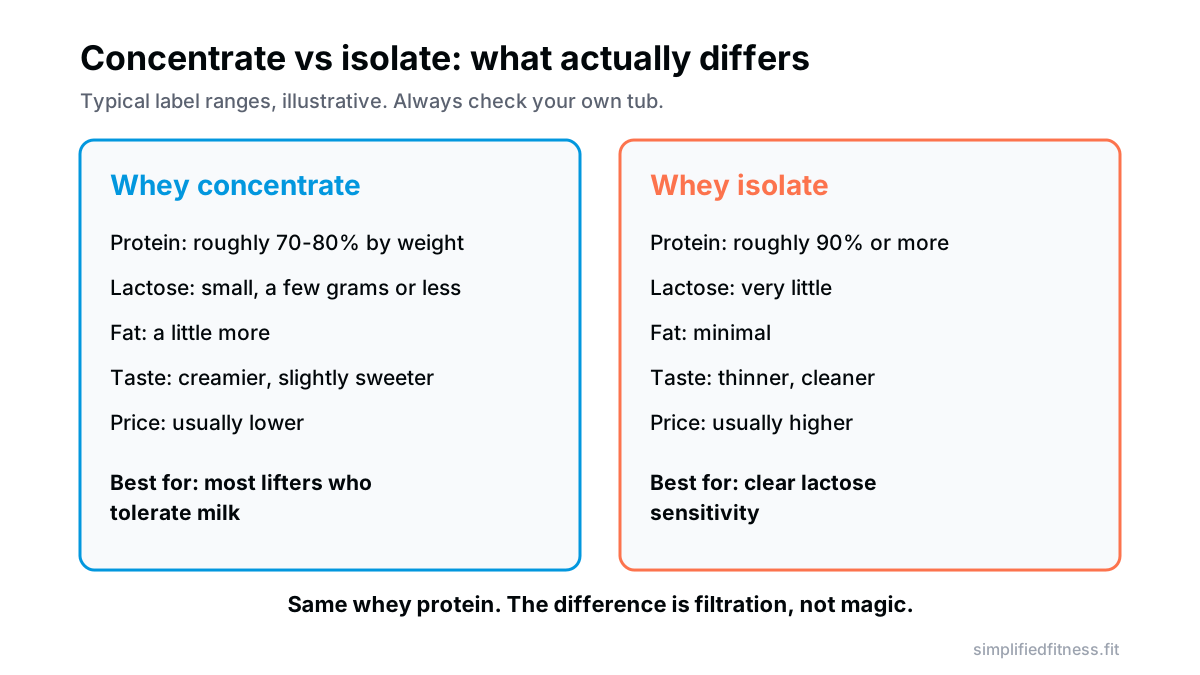
- Concentrate gets lighter filtering. It keeps more of the original milk: some lactose, some fat, and minor components like lactoferrin. Protein content varies by product, and a typical label sits somewhere around 70-80%.
- Isolate gets further processing to strip out most lactose and fat. Labels commonly show around 90% protein or more.
Those percentages are typical ranges, not guarantees. Every brand differs, so the label on your tub is the only number that counts.
Is whey isolate better than concentrate for building muscle?
On current evidence, no. There is no good trial showing isolate beating concentrate for gains in trained lifters, and the bigger picture points the other way: what matters is getting enough protein in total.
A 2018 meta-analysis of 49 randomised trials (1,863 participants) found that protein supplementation modestly increased fat-free mass (0.30 kg) and 1RM strength (2.49 kg) during resistance training, and that intakes above about 1.6 g/kg/day did not add further fat-free mass gains (Morton et al., 2018). Note that this review looked at protein supplements in general, not isolate versus concentrate, and one author disclosed support from the US National Dairy Council, which had funded some of the reviewed trials.
A 2024 network meta-analysis of 116 trials (4,711 participants) reached a similar place: milk proteins, including whey, were among the protein types effective for muscle mass and strength gains, though the authors noted that direct head-to-head trials are still needed (Zhou et al., 2024).
Whey concentrate and lactose intolerance: how much is too much?
This is the one real reason to pick isolate, so it is worth understanding the numbers.
Lactose intolerance is not all or nothing. A review in Nutrients notes that symptoms depend not just on lactase levels but on the dose of lactose, gut bacteria, gut motility and how sensitive your gut is to fermentation gas (Deng et al., 2015). So the same scoop can be fine for one person and miserable for another.
A large evidence review (Wilt et al., 2010) put dose figures on it. Most individuals with presumed lactose intolerance or malabsorption could tolerate 12-15 g of lactose, roughly one cup of milk, taken at one time. Symptoms became more prominent above 12 g, appreciable after 24 g, and 50 g caused symptoms in the vast majority. A daily divided dose of 24 g was generally tolerated (Wilt et al., 2010). The authors also stressed the studies had limits, with highly selected subjects and variable methods.
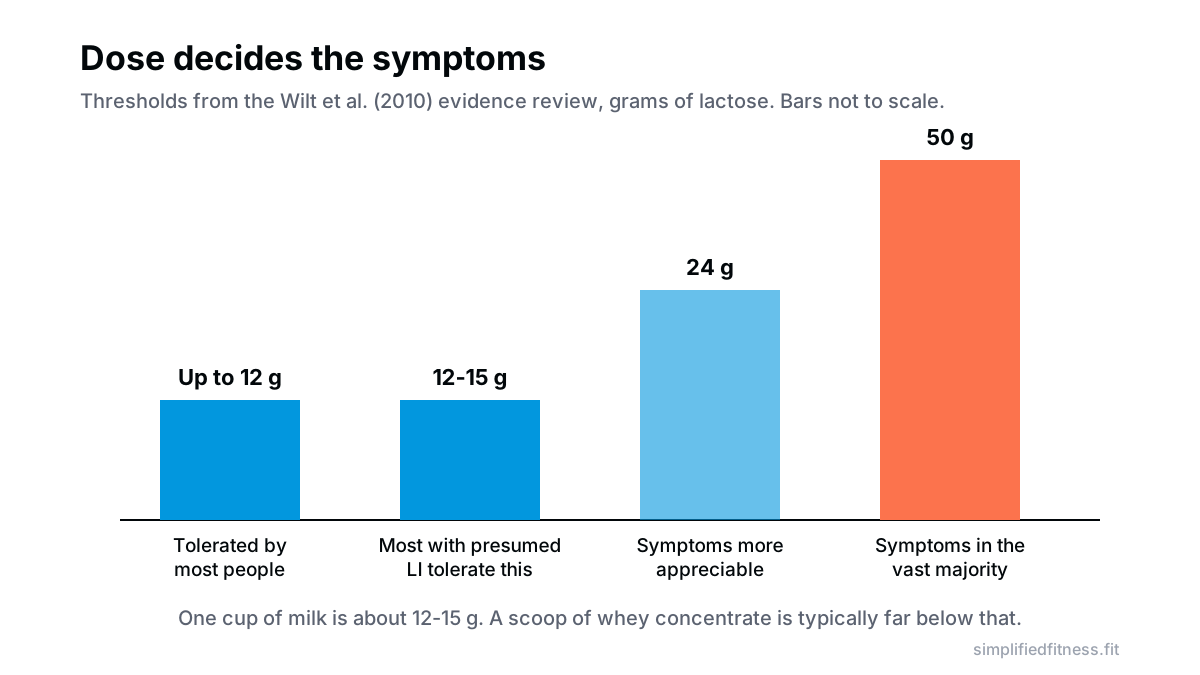
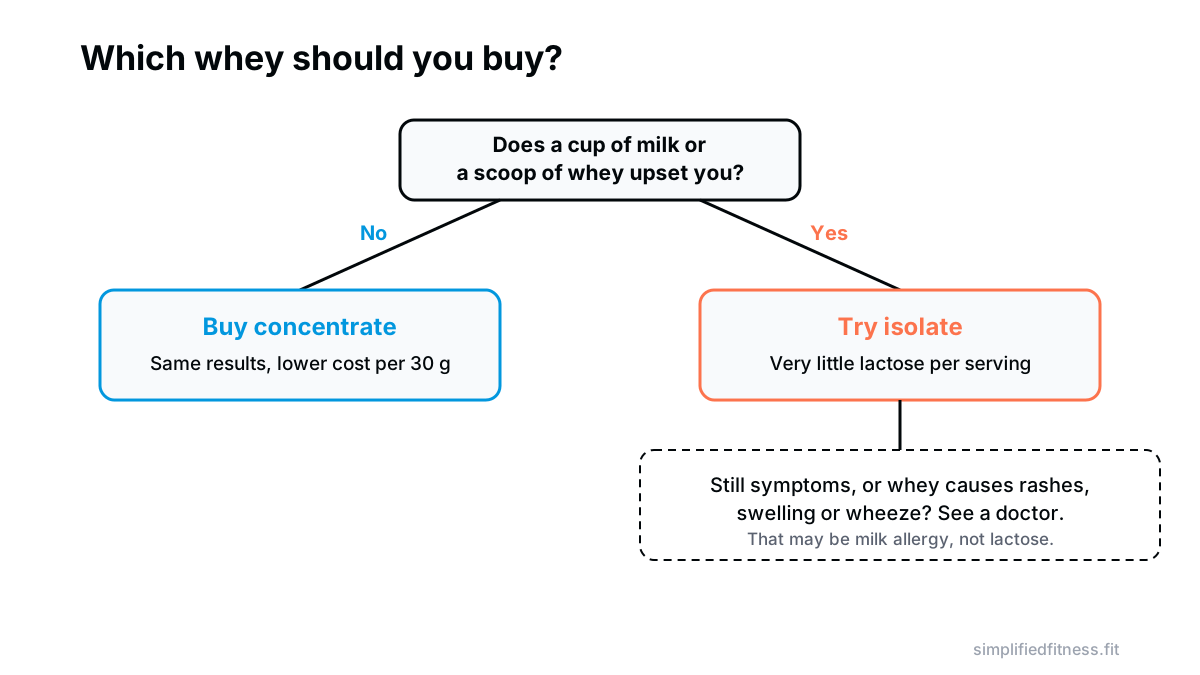
Here is what that means in the gym. If a glass of milk is fine for you, concentrate almost certainly is. If milk gives you trouble but a small amount does not, concentrate in a smaller serving, or taken with food, may still work. If even a scoop gives you gas, cramps or loose stools, isolate is a reasonable next step.
One caution. This is data from lactose studies in general, not from whey powder trials, so treat it as a guide, not a guarantee.
Lactose intolerance in India
Lactose intolerance can be common in Indian adults, but that does not mean you must avoid dairy, since tolerance depends on dose and the individual. Many people handle curd, paneer and chai without trouble. If you already eat those without problems, a standard whey concentrate serving is unlikely to be an issue. If you are unsure, our guide to convincing family that whey protein is safe covers the common worries.
Is whey isolate completely lactose free?
No. Isolate is low in lactose, not guaranteed free of it. If you react to very small amounts, look for a product that explicitly claims to be lactose free and talk to a doctor about what is going on.
Also keep milk allergy separate from lactose intolerance. Lactose intolerance is about digesting a sugar. Allergy is an immune reaction to milk proteins, and whey is a milk protein. Hives, swelling, wheezing or vomiting after whey is a reason to stop and get medically assessed, not to try a more expensive whey.
Does concentrate have more health benefits than isolate?
You will see claims that concentrate keeps immunoglobulins and lactoferrin, and that these make it healthier. Lighter filtration can retain more of these minor milk components, so the idea is not crazy. But the training evidence is not impressive.
In an 8-week trial, 56 resistance-trained men took 30 g servings twice daily of placebo, an 80% protein concentrate, a lactoferrin-rich concentrate, or an extensively hydrolyzed whey. Strength gains were similar across all groups, total body muscle mass rose in all groups, and the lactoferrin version did not do anything special for those outcomes (Lockwood et al., 2017). The lead author runs a supplement consultancy, so weigh it as one modest trial. Treat the extras as a possible bonus, not a reason to pay more.
Is whey hydrolysate worth it?
Hydrolysate is whey broken into smaller pieces, marketed as “pre-digested” and faster. It usually carries the highest price tag. For a deeper look, see our article on hydrolyzed whey and whether it is worth the cost.
Short version from the evidence. In the same Lockwood trial, hydrolyzed whey gave no strength or muscle advantage over the other whey forms. It did show a fat mass reduction of about 6% versus a 4.4% increase on placebo, and the authors said it may augment fat loss but needs more mechanistic research (Lockwood et al., 2017). That is one small trial in young men, so it is a research lead, not a buying reason.
A separate 12-week trial in 75 untrained men found that whey concentrate, whey hydrolysate and soy protein did not increase muscle mass or strength beyond a placebo. The authors noted that every group raised its calorie intake during the study and ate above the recommended protein intake throughout, which likely left little gap for a supplement to fill (Mobley et al., 2017). Again, supplements help when they fill a gap, not when your diet already covers it.
Taste, mixability and cost
These are the practical differences you will actually notice.
| Whey concentrate | Whey isolate | |
|---|---|---|
| Protein per scoop | Lower, varies by brand | Higher, varies by brand |
| Lactose | Small amount | Very little |
| Taste and texture | Creamier, thicker | Thinner, cleaner |
| Mixability | Mixes well, can foam | Mixes easily, usually less thick |
| Usual price | Lower | Higher |
| Best for | Most lifters | Lactose sensitive, strict macro counters |
Do the maths per 30 g of protein, not per kg of powder. A cheaper tub with a lower protein percentage can cost more per serving of actual protein than you expect. For a wider comparison with food, see our look at the cost per 30 g of protein.
A simple buying checklist
- Check the first ingredient. It should be whey protein concentrate or isolate, not a “proprietary blend” that hides the amounts.
- Read protein per serving, then do the cost per 30 g. This is the fair comparison.
- Look for third-party testing. Purity and label accuracy matter more than isolate versus concentrate. See how to spot fake protein in India and our piece on heavy metals in protein powders.
- Start with concentrate if milk is fine for you.
- Switch to isolate only if concentrate causes digestive trouble, and stay one change at a time.
Then fix the bigger levers. Hit your daily protein target (our optimal daily protein intake guide explains how), train hard, sleep well. If you want a structure, our free push pull legs plans are a good start.
Who should see a doctor before using whey
- Anyone with a known or suspected milk allergy, or who gets hives, swelling, wheezing or vomiting after dairy
- Anyone with kidney disease or on a medically prescribed protein limit
- Anyone with ongoing bloating, pain, diarrhoea or weight loss, which can have causes unrelated to whey
The bottom line
For most lifters, whey concentrate does the job at a lower price. Isolate earns its place when lactose gives you real symptoms or when you want slightly more protein per scoop. Hydrolysate is the hardest one to justify on current evidence. Match the product to your stomach and budget, hit your daily protein, and spend the savings on food.
Frequently Asked Questions
Is whey isolate better than concentrate?
Not for building muscle. Isolate is filtered further, so it has a higher protein percentage and less lactose and fat, but trials comparing whey forms in lifters have not shown better strength or lean mass gains. Choose isolate for tolerance or taste, not because you expect extra results.
What is the difference between whey isolate and whey concentrate?
Both are whey protein from milk, but isolate goes through extra filtration that strips out most lactose and fat. That leaves a product that is typically around 90% protein or more, while concentrate is usually lower, often 70-80%. Compare the protein per scoop and the price per 30 g of protein on the label.
Can lactose intolerant people use whey concentrate?
Many can, in normal servings. An evidence review found most people with lactose intolerance tolerate about 12-15 g of lactose, and a scoop of concentrate typically has far less than that. Start with half a scoop and see how you feel, and switch to isolate if you get gas, cramps or loose stools.
How much lactose is in a scoop of whey concentrate?
It depends on the brand and the protein percentage, but it is usually a small number of grams per scoop. Lower protein concentrates carry more lactose than higher protein ones. Check the carbohydrate and sugar lines on the label, since much of that is lactose.
Is whey isolate completely lactose free?
No, it is low in lactose rather than guaranteed lactose free. Filtration removes most of it, but trace amounts can remain unless a brand specifically labels the product lactose free. If you react to very small amounts, look for that claim and check with your doctor.
Is whey isolate worth the extra money?
Only for specific reasons: you are lactose sensitive, you want fewer carbs and fat per scoop, or you prefer the thinner taste. Otherwise the money buys no proven extra muscle. Compare the cost per 30 g of protein before you decide.
Is whey hydrolysate better than isolate or concentrate?
There is no good evidence that it builds more muscle. In an 8-week trial of 56 resistance-trained men, hydrolyzed whey matched concentrate for strength and muscle mass, with a possible fat loss edge that needs more research. Skip the premium price unless you simply like the product.
Does whey concentrate have more nutrients than isolate?
It can retain more of the minor milk components, such as lactoferrin, but that does not appear to translate into better training results. A trial that compared a lactoferrin-rich concentrate with standard concentrate in trained men found similar strength and muscle gains. Treat those extras as a bonus, not a reason to buy.
Which whey protein is best for muscle gain?
Any decent whey that hits your protein target works. A 2018 meta-analysis found protein supplements add a small amount of muscle and strength on top of training, with no extra benefit once total intake passes about 1.6 g/kg a day. Pick the one you digest well, enjoy, and can afford every day.
Why does whey make me gassy or give me stomach pain?
Lactose is a common cause, but not the only one, since sweeteners and thickeners in the powder can also upset some stomachs. If symptoms follow milk and concentrate but not isolate, lactose is the likely culprit. Try isolate, a smaller serving, or a different brand, and see a doctor if symptoms persist.
Is whey concentrate or isolate better for cutting?
Isolate has slightly fewer calories per gram of protein because it has less fat and carbohydrate. The difference is usually small, a few calories a scoop. Your total daily calories and protein matter far more than which whey you choose.
Can I just get protein from food instead of whey?
Yes, whey is a convenience, not a requirement. Dal, paneer, curd, eggs, chicken and soya can all get you to your target. A powder is useful when your diet falls short or you want a cheap, quick serving of protein.
Sources & References
Every claim above is checked against peer-reviewed research (PubMed, U.S. National Library of Medicine) or guidance from established health bodies. How we fact-check.
- Morton RW, et al. A systematic review, meta-analysis and meta-regression of the effect of protein supplementation on resistance training-induced gains in muscle mass and strength in healthy adults. Br J Sports Med. 2018. PMID: 28698222
- Wilt TJ, et al. Lactose intolerance and health. Evid Rep Technol Assess (Full Rep). 2010. PMID: 20629478
- Deng Y, et al. Lactose Intolerance in Adults: Biological Mechanism and Dietary Management. Nutrients. 2015. PMID: 26393648
- Lockwood CM, et al. Effects of Hydrolyzed Whey versus Other Whey Protein Supplements on the Physiological Response to 8 Weeks of Resistance Exercise in College-Aged Males. J Am Coll Nutr. 2017. PMID: 27710436
- Mobley CB, et al. Effects of Whey, Soy or Leucine Supplementation with 12 Weeks of Resistance Training on Strength, Body Composition, and Skeletal Muscle and Adipose Tissue Histological Attributes in College-Aged Males. Nutrients. 2017. PMID: 28869573
- Zhou HH, et al. Effects of Timing and Types of Protein Supplementation on Improving Muscle Mass, Strength, and Physical Performance in Adults Undergoing Resistance Training: A Network Meta-Analysis. Int J Sport Nutr Exerc Metab. 2024. PMID: 38039960

Umair Hazrami · Founder & Head Coach, Simplified Fitness
Umair Hazrami founded Simplified Fitness and the Simplified Lifter channel to cut through fitness noise. With 4+ years of consistent training and 10+ coaching clients, he writes every guide from the peer-reviewed research and links the sources so you can check them. Our editorial standards.
Educational content only, not medical advice. If you have a medical condition, are pregnant, or take medication, talk to a qualified doctor before changing your diet, supplements or training. Full disclaimer.
Keep reading

Supplements
Alpha-GPC and Huperzine A Pre-Workout: Do Cholinergic Nootropics Help Lifting?
Does an alpha GPC pre workout add power or focus? See what small trials found, why Huperzine A is a poor lifting bet, and the safety flags to know first.
10 min read

Supplements
The Antioxidant Paradox: Can Vitamin C and E Pills Blunt Muscle Growth and Endurance?
Does vitamin C blunt muscle growth? See what trials of 1000 mg vitamin C plus E found for strength, hypertrophy and endurance, and when pills are worth taking.
8 min read

Supplements
Caffeine Powder vs Coffee Before Lifting: Does the Source Really Matter?
Caffeine anhydrous vs coffee for lifting: what research says on absorption speed, peak levels and stomach upset, and whether pills beat your daily cup.
7 min read

Supplements
Caffeine Dosing for Strength and Power: 3-6 mg/kg and When to Take It
Caffeine dosage for strength is 3-6 mg/kg, about 210-420 mg for a 70 kg lifter, taken around 60 minutes before training. Doses, timing and when to stop.
8 min read