Calcium and Vitamin D for Lifters: Do You Need a Supplement for Strong Bones?
Is a calcium supplement for lifters worth it? See what trials say on bones, heart risk, citrate vs carbonate, and how to hit 1,000 mg from Indian foods.
TL;DR. The short answer
- Most healthy lifters do not need a calcium supplement. Around 1,000 mg a day is the usual adult target, and three or four servings of milk, curd, paneer, fortified soy, ragi or sesame can get you there.
- Barbell training loads bone, and that mechanical signal does more for bone density than extra calcium does. Calcium supplies the raw material, lifting tells the bone to use it.
- Large reviews of trials find calcium pills change bone density by only about 0.7-1.8% and reduce fractures little or not at all. Food and pills raise density by similar small amounts.
- Evidence on calcium pills and heart attacks is mixed. One 2010 meta-analysis flagged a higher heart attack risk, a 2023 trial meta-analysis found no significant excess. Food calcium has not shown that signal.
- If you do need a supplement, take 200-500 mg with a meal, and carbonate works as well as citrate when taken with food. Check with your doctor first if you have kidney stones or kidney disease.
Part of our complete guide: Creatine, Protein Powders, Pre-Workouts and Caffeine: The Science and Safety Guide
Table of contents
Most lifters do not need a calcium supplement. If you eat dairy, fortified soy, ragi or sesame most days, you are probably close to the usual adult target of about 1,000 mg, and the evidence that pills add much on top is thin.
The supplement aisle sells calcium as bone insurance for people who squat and deadlift. The research tells a more modest story. This article sits inside our guide to creatine, protein powders and caffeine, and it covers the one supplement question that matters for the long game: what a calcium supplement for lifters can and cannot do for your bones, your heart and your muscles.
What does calcium actually do for a lifter?
Two jobs, and they get mixed up all the time.
The first is structural. Nearly all the calcium in your body sits in bone, which acts as a bank. The second is signalling. Inside a muscle fibre, calcium is released from a storage network called the sarcoplasmic reticulum, binds to troponin, and lets the muscle contract. Then it gets pumped back in so the muscle can relax.
Here is the catch. That second pool is tightly controlled. Your body holds blood calcium in a narrow range, drawing on bone if it has to. So taking more calcium does not make a rep stronger, and it does not fix cramps by itself. Calcium is a requirement, not a performance booster.
Why heavy lifting matters more than a pill
Bone is living tissue. When you load it, it adapts. That idea is often called Wolff’s law, and it is why the barbell is better bone medicine than a tablet.
A review of exercise and bone mass in adults found that exercise modalities with high forces or high impacts have the greatest bone-building potential, that swimming does little, and that evidence points to a combination of impact work and weight-lifting (Guadalupe-Grau et al., 2009). In older adults, a 2022 meta-analysis of 14 studies found progressive resistance training raised femur and hip bone density by about 2.77%, though the lumbar spine change was not significant and the studies varied a lot (O’Bryan et al., 2022). That is older adults, so treat it as direction, not a promise for a 24-year-old.
The National Osteoporosis Foundation states that lifestyle choices influence 20-40% of adult peak bone mass (Weaver et al., 2016). In that review, calcium intake and physical activity were the two factors with the strongest (grade A) evidence. Note that it focused on bone building in children and teens, before peak bone mass is reached.
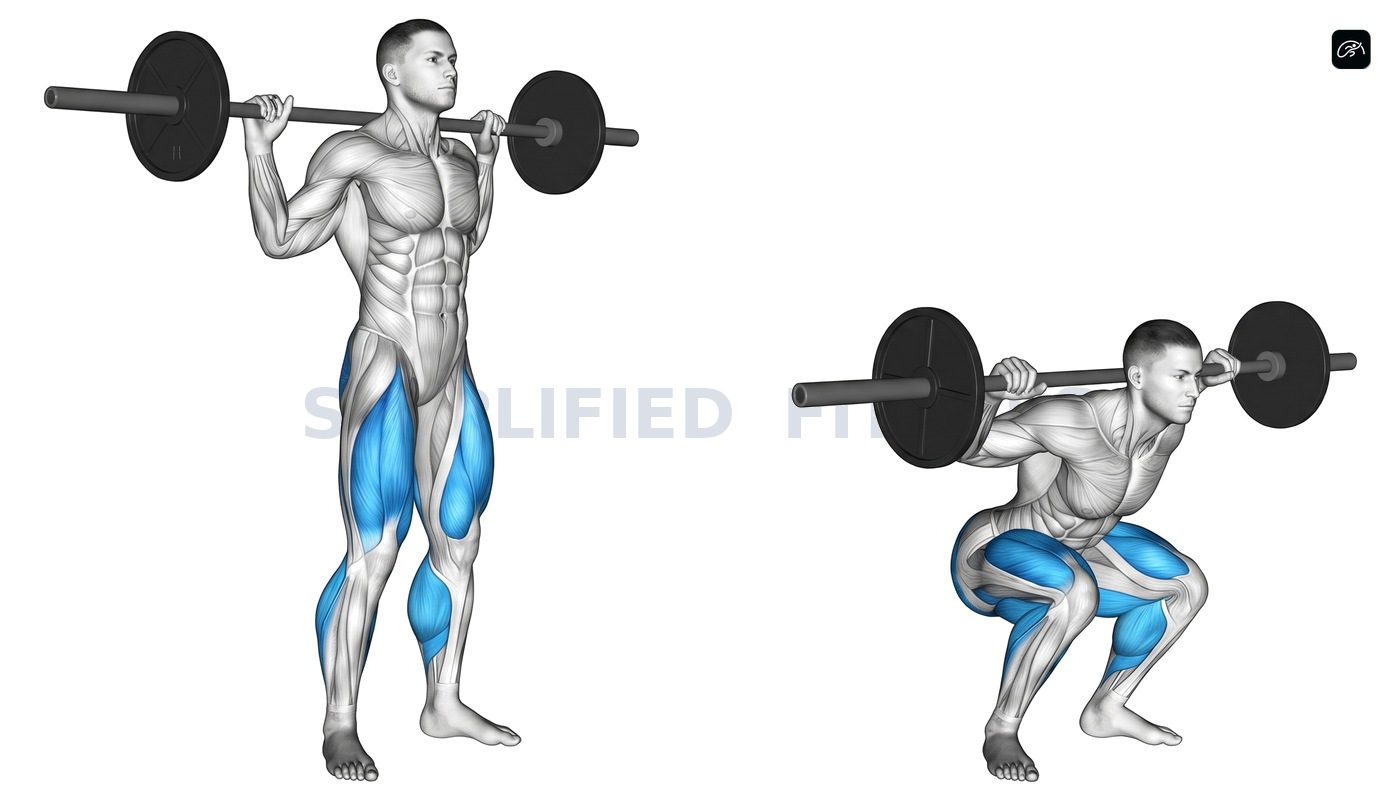
Squats, deadlifts and loaded carries are the bone work. If a lifter asked me where the first rupee for bone health should go, I would say a rack and progressive loading, not a bottle.
Dietary calcium vs supplements: what do the trials show?
This is where the headline claim (“pills are bad, food is good”) needs care.
A 2015 BMJ systematic review looked at calcium intake and fracture. Cohort studies of dietary calcium mostly found no link with fracture. In the supplement trials, calcium reduced total fractures (relative risk 0.89 across 20 trials), but in the four trials at lowest risk of bias there was no effect at any site, and the authors saw signs of bias in the published data. They concluded the evidence that supplements prevent fractures is weak and inconsistent (Bolland et al., 2015).
The companion analysis on bone density found that increasing calcium from food or from pills raised density by small amounts (roughly 0.6-1.8% for food and 0.7-1.8% for pills), similar for both, in participants over 50. With pills, the gain did not keep growing after the first year (Tai et al., 2015). The authors judged these gains unlikely to meaningfully cut fracture risk.
A newer 2026 BMJ review pooled 69 trials and 153,902 participants, mostly community-dwelling adults not at high fracture risk. It found little to no effect on any fracture for calcium alone (risk ratio 0.91, confidence interval 0.81 to 1.01), vitamin D alone (1.00) or the combination (0.91, 0.84 to 0.99), and judged on absolute risk, the authors concluded there was little to no benefit for preventing fractures or falls (Massé et al., 2026).
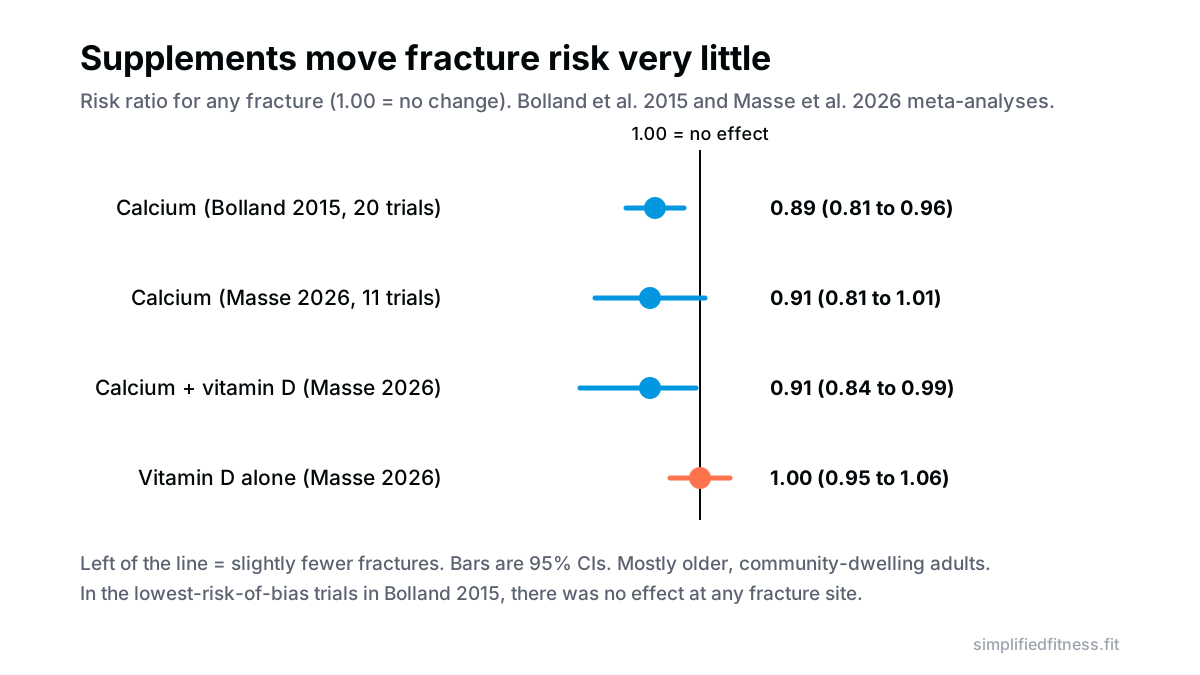
Notice what these studies cover. They are mostly about adults over 50. We do not have good trials of calcium pills in young, trained lifters, so nobody can say supplements help or harm that group with confidence.
Do calcium supplements raise heart attack risk?
This is the claim behind the “arterial plaque” warnings, and the research is genuinely split.
A 2010 BMJ meta-analysis of 15 trials of calcium supplements (500 mg a day or more, without vitamin D) found a higher heart attack risk. In the five trials with patient-level data (8,151 participants), the hazard ratio was 1.31 for heart attack, and the trial-level analysis gave a relative risk of 1.27 (Bolland et al., 2010). Stroke and death rose non-significantly.
A 2023 meta-analysis of 11 placebo-controlled trials (calcium alone, n=8,634; calcium plus vitamin D, n=46,804) found no significant excess risk of heart attack, coronary heart disease death, any coronary disease or stroke, and it excluded excess risks above 0.3-0.5% a year (Huo et al., 2023).
Why might they differ? Different trial sets, different analysis methods and different baseline participants are all candidates, and the authors of the 2023 paper themselves call for more trials. A cautious reading: a large harm has not been shown, a small one has not been fully ruled out, and the lack of a strong fracture benefit means there is little reason to take a pill you do not need.
Food looks different. A 2022 dose-response meta-analysis of cohort studies found higher total calcium intake linked with lower cardiovascular mortality (effect size 0.91) and higher dietary calcium linked with lower all-cause mortality (0.95), while supplemental calcium showed no significant association. Moderate intakes looked best, and higher intake was not linked with further benefit (Naghshi et al., 2022). These are observational data, so they cannot prove food protects. They do fit the “get it from food” advice.
How to hit about 1,000 mg from Indian foods
Think in servings, not milligrams. Roughly three servings from the main group below cover most of the day.
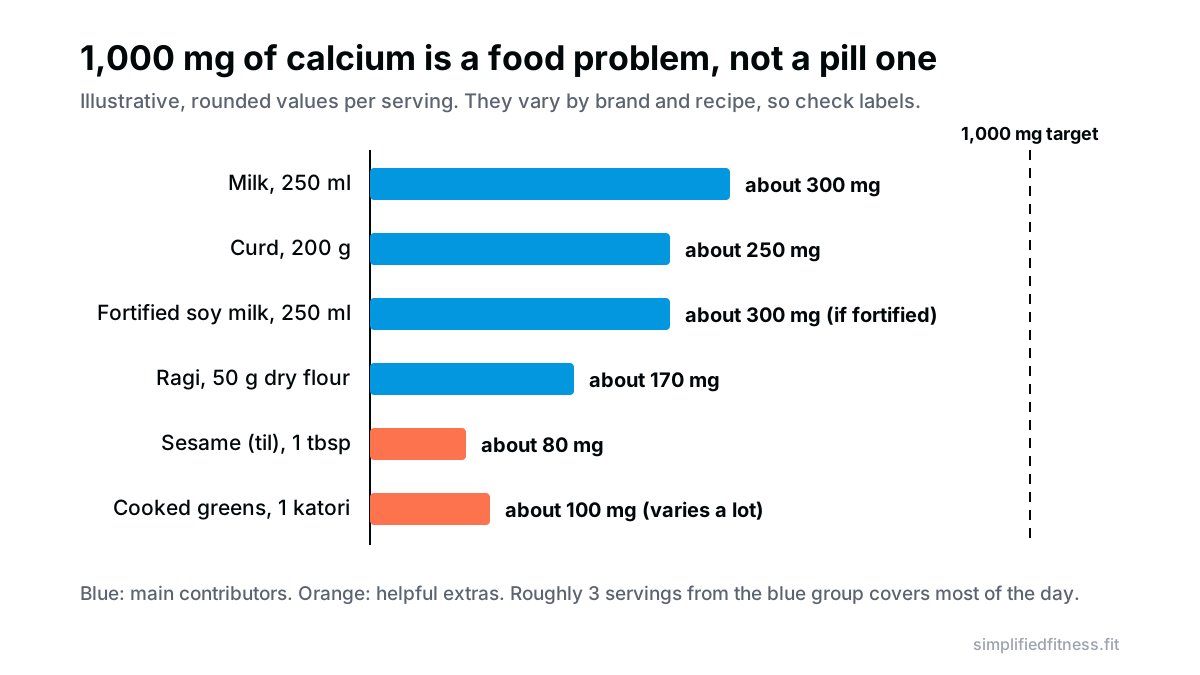
A day that works: chai made with milk and a glass of milk or lassi (roughly 400 mg together), a katori of curd with lunch (about 125 mg for 100 g), ragi roti or ragi dosa once in the day, a spoon of til in a chutney or ladoo, and paneer or tofu at dinner. Sources of protein overlap nicely here, so see our list of top high-protein vegetarian foods and the paneer vs low-fat paneer comparison for options. Our free diet plan builds the rest of the day around your calories and protein.
For lactose intolerance or vegan eating, lean on fortified soy milk, calcium-set tofu, ragi and sesame. Spinach looks high on a food label but is a weak source because oxalate binds the calcium, so do not count it as dairy.
If you train in the heat and sweat a lot, calcium is rarely the cramp culprit. Hydration, sodium and fatigue are the more common suspects. Persistent cramping is worth a doctor visit.
Calcium citrate vs carbonate: does it matter?
Mostly no, if you take it with food.
In a study of 37 healthy adults, each tested on both salts, calcium absorbed from carbonate was fully as absorbable as from citrate when taken as part of a light breakfast. Mean absorption was about 36% at a 300 mg load and 28.4% at a 1,000 mg load, and combined across the two experiments there was zero difference between salts (Heaney et al., 1999).
That gives two practical rules:
| Question | Practical answer |
|---|---|
| Carbonate or citrate? | Either with a meal. Carbonate is cheaper and needs food. Citrate is a common choice if you take it without food or have low stomach acid. |
| How much at once? | Smaller doses absorb better. Keep each dose to roughly 200-500 mg. |
| Calcium plus an iron pill? | Separate them by a few hours. We cover this in our iron deficiency guide. |
Calcium, vitamin D3 and K2: do you need all three?
Vitamin D helps your gut absorb calcium. But more D does not translate into stronger bones if the base is fine. The 2026 BMJ review found vitamin D alone had no effect on fracture risk in mostly healthy adults (risk ratio 1.00), with high certainty, and the combination with calcium gave only a borderline reduction that the authors judged too small to matter (Massé et al., 2026). The sensible approach is to test before you supplement. Our vitamin D3 guide for lifters covers deficiency, and the D3 and K2 synergy guide goes deeper on K2.
K2 is the hyped part. The theory is sound: K2 helps activate proteins that keep calcium in bone and out of arteries. The clinical trials are not so clear:
- A 2022 randomized trial in 365 older men with significant aortic valve calcification found that 720 mcg MK-7 plus vitamin D for 24 months did not slow valve calcification versus placebo, even though a blood marker of K2 status improved (Diederichsen et al., 2022).
- A 2026 trial in 180 randomized patients with symptomatic coronary disease found that 360 mcg MK-7 for 2 years was associated with slower coronary calcification, but the authors say the clinical significance is not yet known (Vossen et al., 2026).
Both trials used middle-aged or older patients who already had calcification in the heart or arteries, not healthy lifters. So the fair read is: K2 might help in specific settings, nothing shows healthy lifters need it, and anyone on blood thinners such as warfarin must speak to a doctor before taking vitamin K in any form.
Should you take a calcium supplement? A simple path
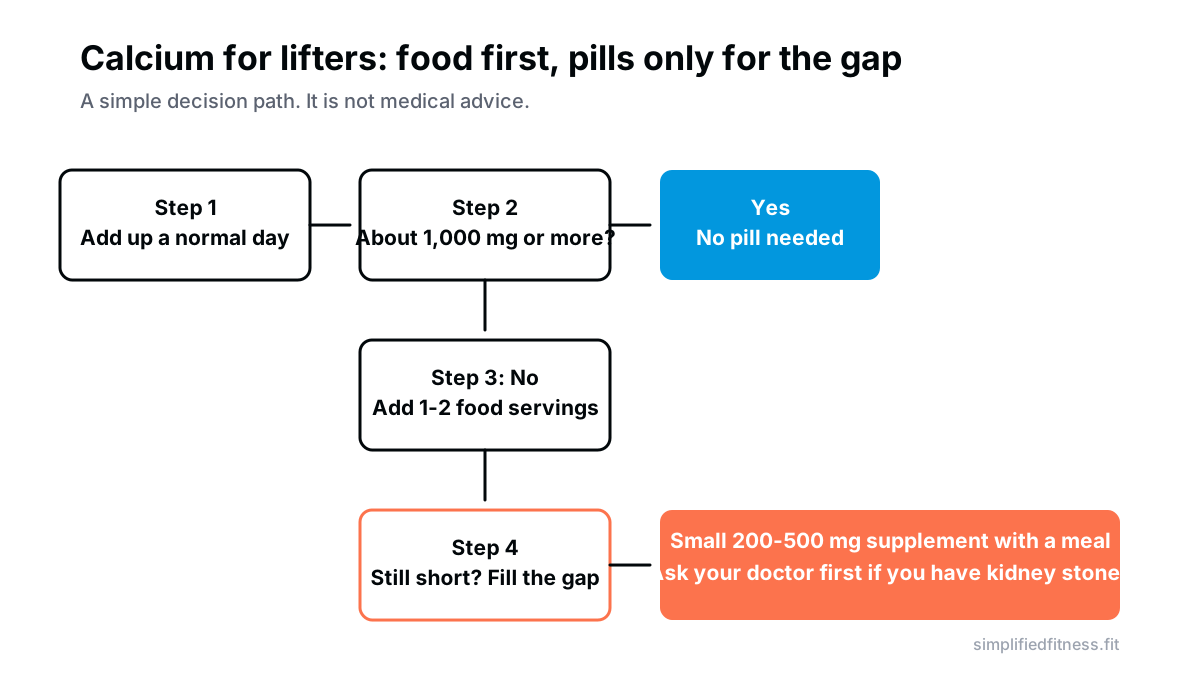
The most common mistake here is buying a 1,000 mg pill on top of a diet that already has dairy in it. You pay for it, you get diminishing returns, and you cannot even be sure it is helping.
A supplement can make sense if you are vegan or lactose-free and cannot reach the target, if a doctor has told you that you have low bone density or osteoporosis, or if you have a medical condition that affects absorption. In those cases, go with your doctor’s dose. More is not better: for most adults the commonly cited upper limit is 2,000-2,500 mg a day from food and supplements combined, and going above it raises the risk of side effects such as kidney stones.
When to see a doctor
Speak to a doctor before starting calcium pills if you have had kidney stones, have kidney disease, take thyroid medication, take blood thinners, or have a history of heart disease. Also see one if you have had a stress fracture, you are an older lifter, or you have been a long-term low-energy athlete or a lifter with a history of disordered eating, because bone loss can be silent until something breaks. A bone density scan (DXA) and a vitamin D blood test are simple first checks. This article is education, not a diagnosis.
Frequently asked questions
The FAQs below cover the most searched questions on calcium and bone health for lifters.
Frequently Asked Questions
Do lifters need a calcium supplement?
Most healthy lifters do not, because a normal day of dairy, fortified soy, ragi or sesame can reach about 1,000 mg. Trials of calcium pills show small gains in bone density and little to no fracture benefit. Add up your food first, then only fill the gap you find.
How much calcium do I need per day if I lift weights?
About 1,000 mg a day is the commonly used adult target, and lifting does not raise it in any proven way. A 2022 meta-analysis of cohort studies linked moderate total intake (roughly 1,000-1,800 mg) with lower mortality risk, with no extra benefit from going higher. Aim for the target from food rather than chasing bigger numbers.
Is calcium from food better than calcium pills?
For most people, yes, mainly because food carries no pill-related heart concerns and brings protein and other nutrients with it. Trials show food and pills raise bone density by similar small amounts, but some pill trials have raised heart attack questions that food has not. Use food as the base and pills only for a real shortfall.
Do calcium supplements cause heart attacks?
The evidence is mixed. A 2010 meta-analysis of 15 trials found a higher heart attack risk with calcium alone (relative risk about 1.27), while a 2023 meta-analysis of 11 trials found no significant excess for heart disease or stroke. Because the question is unsettled, avoid high-dose pills you do not need and talk to your doctor if you have heart disease.
Is calcium citrate better than calcium carbonate?
With food, no meaningful difference showed up in a 37-person absorption study, where carbonate was as absorbable as citrate. Carbonate is cheaper and usually needs a meal, while citrate is often suggested when stomach acid is low or the supplement is taken on an empty stomach. Take either one with food, in small doses.
What is the best time to take a calcium supplement?
With a meal, and not in one big dose. Absorption was higher at a 300 mg load (about 36%) than at a 1,000 mg load (about 28%) in one study, so smaller doses are used more efficiently. Split anything above 500 mg across meals.
Does calcium help muscle contraction and cramps?
Calcium released inside muscle cells triggers contraction, but that pool is regulated tightly and does not come from your pill. Blood calcium is held in a narrow range by your bones and hormones, so extra pills do not make muscles contract harder. If you get frequent cramps, look at hydration, sodium, magnesium and training load, and see a doctor if they persist.
Do I need vitamin K2 with calcium and vitamin D?
There is no firm proof that healthy lifters need K2. A 2022 trial in 365 older men with aortic valve calcification found no slowing of progression with 720 mcg MK-7 plus vitamin D, while a 2026 trial in patients with coronary disease found slower coronary calcification with 360 mcg MK-7. Eat your greens and fermented foods, and treat K2 pills as optional.
Does vitamin D help calcium work?
Vitamin D helps your gut absorb calcium, so a long-term deficiency can leave bones short even when intake looks fine. But a 2026 meta-analysis found vitamin D alone had no effect on fracture risk in mostly healthy adults. Get your level tested before supplementing, and see our vitamin D guide for lifters.
Does lifting weights improve bone density?
Yes, in many studies, especially when loads are high and movements involve force through the hips and spine. A 2022 meta-analysis in adults 65 or older found progressive resistance training raised femur and hip bone density by about 2.8%. Squats, deadlifts and loaded carries are good bone work, so keep them in the plan.
Can I get enough calcium on a vegan or lactose-free diet?
It is possible but takes planning. Calcium-fortified soy milk, calcium-set tofu, ragi, sesame, and some leafy greens can add up, though absorption from high-oxalate greens like spinach is poor. Read labels, and consider a small supplement if you cannot reach the target.
Can too much calcium cause kidney stones?
Calcium pills may raise stone risk in people who are prone to stones, while calcium from food is generally not the concern. Stones often come from low fluid intake, high sodium or other risk factors, not just calcium. If you have had a stone, ask your doctor before starting any supplement and drink plenty of water, especially in summer.
Do high-protein diets leach calcium from bones?
The popular claim is that protein acidifies the body and pulls calcium from bone, but this has not held up well in evidence reviews. We cover it separately in our article on high-protein diets and bone density. Eat enough calcium and train with load, and protein is not the villain.
Sources & References
Every claim above is checked against peer-reviewed research (PubMed, U.S. National Library of Medicine) or guidance from established health bodies. How we fact-check.
- Bolland MJ, et al. Calcium intake and risk of fracture: systematic review. BMJ. 2015. PMID: 26420387
- Tai V, et al. Calcium intake and bone mineral density: systematic review and meta-analysis. BMJ. 2015. PMID: 26420598
- Massé O, et al. Calcium, vitamin D, or combined supplementation to prevent fractures and falls: systematic review and meta-analysis. BMJ. 2026. PMID: 42161415
- Bolland MJ, et al. Effect of calcium supplements on risk of myocardial infarction and cardiovascular events: meta-analysis. BMJ. 2010. PMID: 20671013
- Huo X, et al. Calcium Supplements and Risk of CVD: A Meta-Analysis of Randomized Trials. Curr Dev Nutr. 2023. PMID: 37181938
- Naghshi S, et al. Total, dietary, and supplemental calcium intake and risk of all-cause cardiovascular, and cancer mortality: a systematic review and dose-response meta-analysis of prospective cohort studies. Crit Rev Food Sci Nutr. 2022. PMID: 33749376
- Heaney RP, et al. Absorption of calcium as the carbonate and citrate salts, with some observations on method. Osteoporos Int. 1999. PMID: 10367025
- Diederichsen ACP, et al. Vitamin K2 and D in Patients With Aortic Valve Calcification: A Randomized Double-Blinded Clinical Trial. Circulation. 2022. PMID: 35465686
- Vossen LM, et al. Two Years of Menaquinone-7 Supplementation and Coronary Artery Calcification: A Randomized Clinical Trial. JAMA Cardiol. 2026. PMID: 42268593
- Guadalupe-Grau A, et al. Exercise and bone mass in adults. Sports Med. 2009. PMID: 19453205
- O'Bryan SJ, et al. Progressive Resistance Training for Concomitant Increases in Muscle Strength and Bone Mineral Density in Older Adults: A Systematic Review and Meta-Analysis. Sports Med. 2022. PMID: 35608815
- Weaver CM, et al. The National Osteoporosis Foundation's position statement on peak bone mass development and lifestyle factors: a systematic review and implementation recommendations. Osteoporos Int. 2016. PMID: 26856587

Umair Hazrami · Founder & Head Coach, Simplified Fitness
Umair Hazrami founded Simplified Fitness and the Simplified Lifter channel to cut through fitness noise. With 4+ years of consistent training and 10+ coaching clients, he writes every guide from the peer-reviewed research and links the sources so you can check them. Our editorial standards.
Educational content only, not medical advice. If you have a medical condition, are pregnant, or take medication, talk to a qualified doctor before changing your diet, supplements or training. Full disclaimer.
Keep reading

Supplements
Alpha-GPC and Huperzine A Pre-Workout: Do Cholinergic Nootropics Help Lifting?
Does an alpha GPC pre workout add power or focus? See what small trials found, why Huperzine A is a poor lifting bet, and the safety flags to know first.
10 min read

Supplements
The Antioxidant Paradox: Can Vitamin C and E Pills Blunt Muscle Growth and Endurance?
Does vitamin C blunt muscle growth? See what trials of 1000 mg vitamin C plus E found for strength, hypertrophy and endurance, and when pills are worth taking.
8 min read

Supplements
Caffeine Powder vs Coffee Before Lifting: Does the Source Really Matter?
Caffeine anhydrous vs coffee for lifting: what research says on absorption speed, peak levels and stomach upset, and whether pills beat your daily cup.
7 min read

Supplements
Caffeine Dosing for Strength and Power: 3-6 mg/kg and When to Take It
Caffeine dosage for strength is 3-6 mg/kg, about 210-420 mg for a 70 kg lifter, taken around 60 minutes before training. Doses, timing and when to stop.
8 min read