Creatine Loading Phase vs Daily 3-5 g: Do You Need to Load?
Creatine loading phase vs daily 5g: both raise muscle creatine by about the same amount, loading just gets there in a week. See the timelines and pick.

TL;DR. The short answer
- You do not need a creatine loading phase. Taking 3-5 g a day raises muscle creatine to a similar level as loading, it just takes about 3-4 weeks instead of about a week.
- In the classic study of 31 men, 20 g/day for 6 days raised muscle total creatine by roughly 20%, and 3 g/day produced a similar, more gradual rise over 28 days.
- Loading is optional and mainly useful if you have a deadline, such as a competition or a short training block. It is the part most likely to upset your stomach.
- Splitting a load into 4 doses of 5 g with food, or skipping it entirely, may reduce digestive complaints. A single 10 g serving was linked to more diarrhoea than 2 x 5 g in one trial.
- After you stop, muscle creatine drifts back to baseline over roughly a month, so daily use matters more than which way you start.
Part of our complete guide: Creatine, Protein Powders, Pre-Workouts and Caffeine: The Science and Safety Guide
Table of contents
You do not need a creatine loading phase. Taking 3-5 g a day fills your muscles to about the same level as loading, it just takes roughly 3-4 weeks instead of about one. So the creatine loading phase vs daily 5g question is really a question about speed, not about results. (For the wider picture on creatine, protein powder and caffeine, see our complete guide.)
Most tubs still print a loading schedule on the label. It is not wrong. It is just not required, and for a lot of lifters it is the one part of creatine that causes trouble.
What a creatine loading phase actually is
Loading means taking a big dose for a short time to fill muscle stores quickly. The usual recipe is about 20 g a day, split into four 5 g servings, for 5-7 days. After that you drop to a maintenance dose of 3-5 g a day.
Maintenance means skipping the big dose and taking 3-5 g a day from day one. Same powder, same end point, slower start.
Why does the speed differ at all? Your muscle holds a finite amount of creatine. Each dose tops it up a little. A bigger daily input fills the tank faster. Once it is full, extra creatine just gets excreted, so more never means better in the long run. If you want the cellular mechanism behind this, our piece on how creatine recycles ATP covers it.
Creatine muscle saturation curve: what the research shows
The reference study here is a 1996 experiment in 31 men who took creatine in different amounts over different periods. Muscle total creatine rose by about 20% after 6 days at 20 g/day. That level was maintained when intake dropped to 2 g/day for another 30 days (Hultman et al., 1996).
Then the part that matters for this article. A similar but more gradual 20% rise was seen over 28 days on 3 g/day. The authors concluded that 3 g/day is likely, in the long term, to be as effective at raising tissue levels as the higher dose (Hultman et al., 1996).
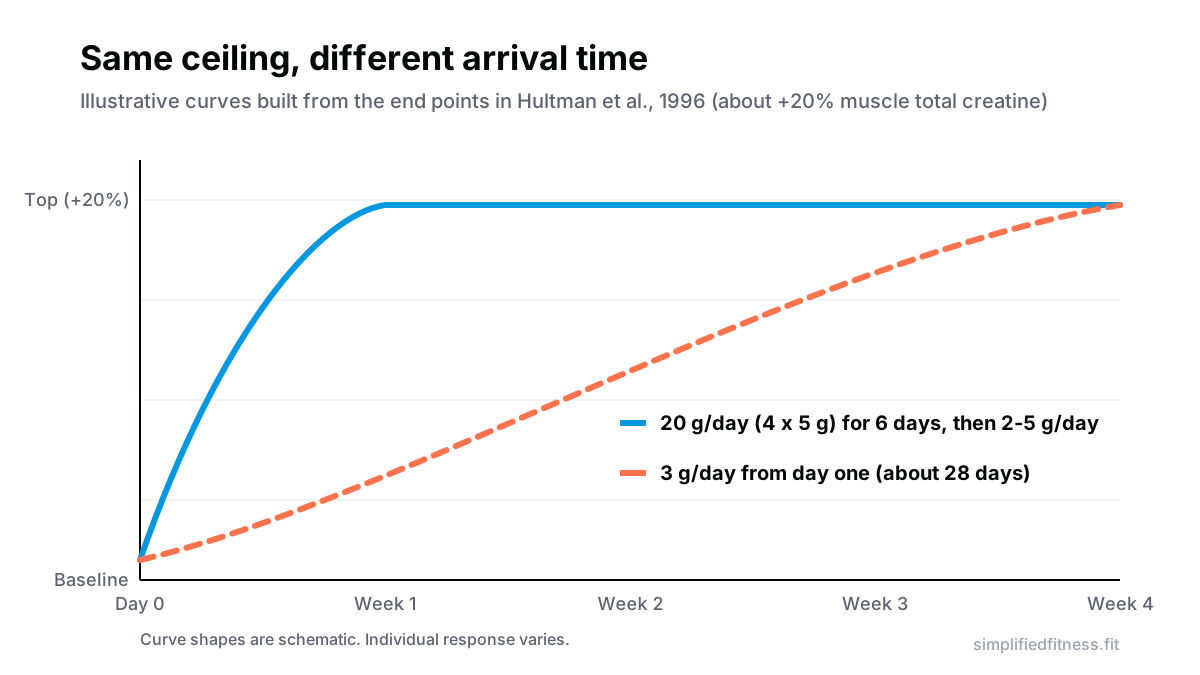
Two honest caveats. First, this was a small, older study in men, so the exact timelines are approximate and individual response varies. Second, the figure above is a schematic, not measured data points. The curves show the shape of the idea, not week-by-week muscle biopsies.
Do you need to load creatine?
No. If your goal is to be better at training over the next few months, the first three weeks barely register. Your strength is built over many sessions, and creatine’s job is helping you squeeze out extra quality reps in those sessions.
Loading starts to make sense in a few cases:
- You have a competition, test day or short training block in 7-10 days.
- You are a data person who wants stores full at the start of a 6-8 week program.
- You have tried it before and tolerate large splits well.
For everyone else, taking one scoop a day with breakfast is the stress-free choice. You reach the same place without the spreadsheet of 4 daily doses. The cost difference is also minor, but loading uses up a tub faster (20 g a day for 6 days is about 120 g), which is only worth it if the speed matters to you.
Stomach cramps and loading: the real downside
The one genuine downside of loading is digestive upset. Large single servings of creatine may pull water into the gut, and the commonly reported result is loose stools, stomach upset or cramps.
Here is the data. In a double-blind trial, 59 male soccer players took creatine as 2 x 5 g a day, 1 x 10 g a day, or placebo for 28 days. Diarrhoea was reported by 28.6% on 2 x 5 g, 55.6% on 1 x 10 g and 35.0% on placebo. The difference between 10 g in one serving and 2 x 5 g was significant, while 2 x 5 g did not differ significantly from placebo (Ostojic and Ahmetovic, 2008).
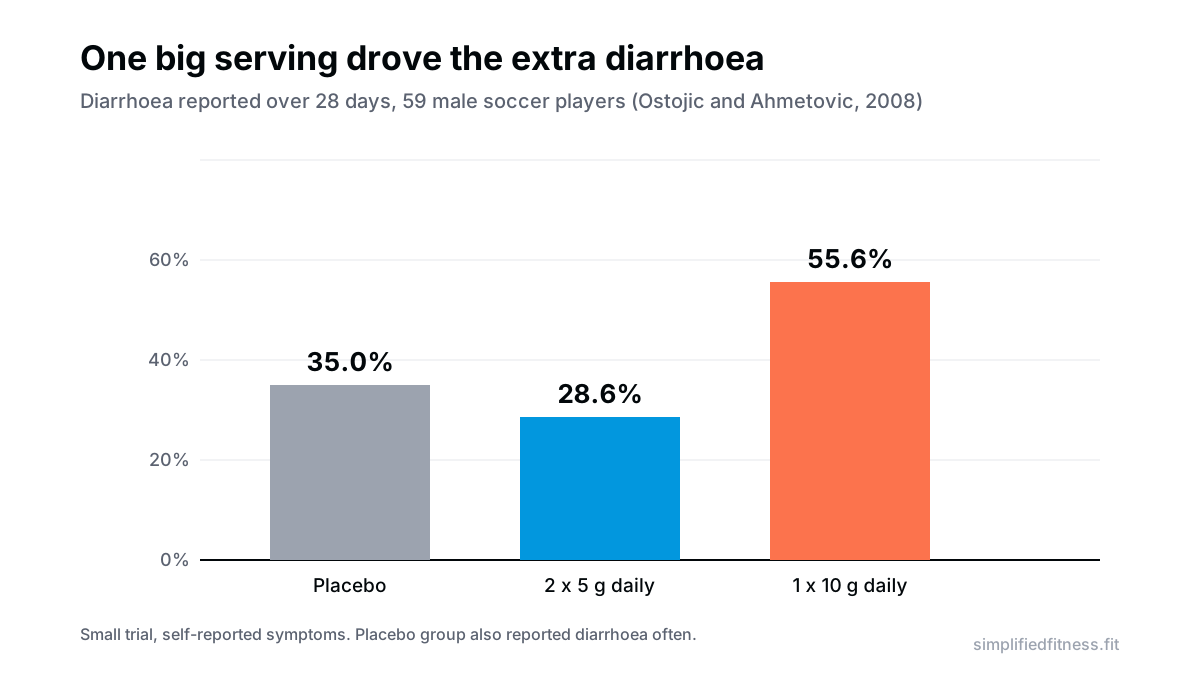
Look at the placebo bar too: 35.0% of players on placebo reported diarrhoea. This was a small trial with self-reported symptoms, so some of the stomach noise is just background life, tournament food and nerves. That is a reminder not to blame creatine for every loose stool.
Zooming out, a 2025 analysis of 685 clinical trials found side effects were reported at about the same rate in creatine and placebo groups (13.7% versus 13.2% of studies). GI issues were slightly more often reported in creatine studies at the study level (4.9% versus 4.3%), but not when counted per participant (Kreider et al., 2025). A 2026 dose-response analysis of 684 randomized trials found no consistent increase in side effects with higher dose or longer duration, with effect sizes small (Gonzalez et al., 2026). Note that several authors on both papers declare industry links and research funding in this area.
How to take creatine monohydrate: loading or not
Pick your route.
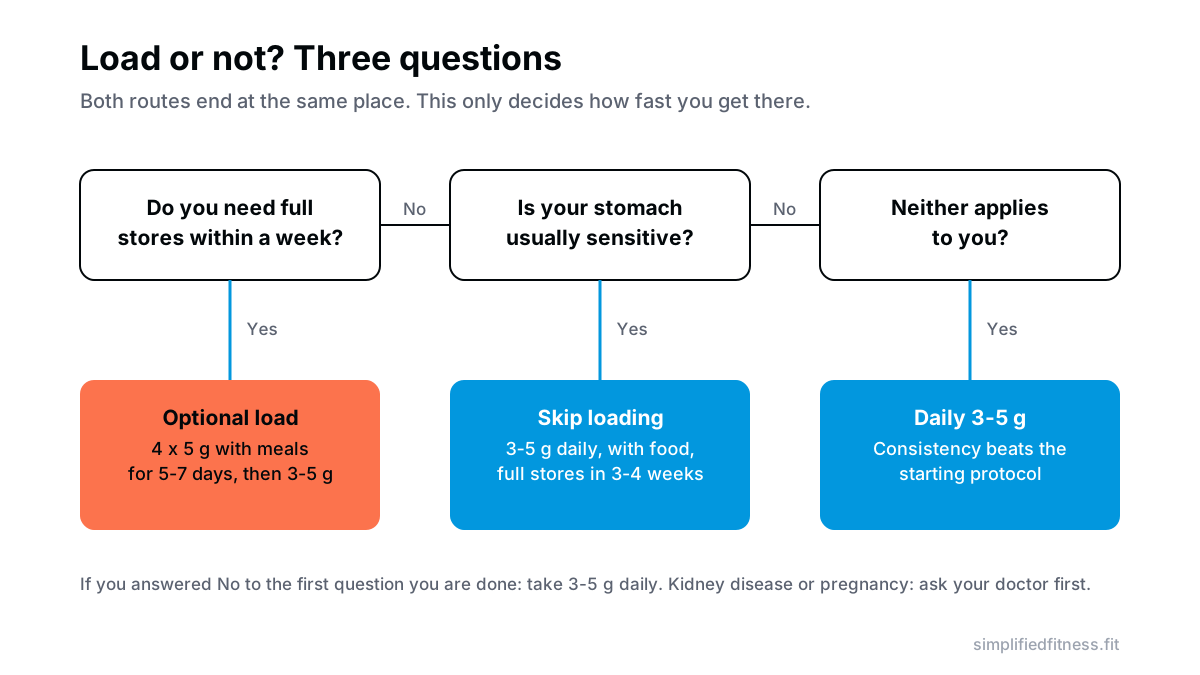
Route A: no loading (my default for most people)
- Take 3-5 g of creatine monohydrate once a day.
- Do it every day, including rest days.
- Expect your muscles to fill over 3-4 weeks. Do not judge it in week one.
Route B: optional loading
- Days 1-7: 5 g, four times a day, each with a meal.
- From day 8: 3-5 g once a day.
- Expect water weight sooner (see below).
Which form? Plain monohydrate. We compare the alternatives in creatine forms compared, and whether to take it before or after training in creatine timing. For a number tied to your body weight, use the creatine dosage calculator.
Creatine loading phase vs daily 5g: side-by-side
| Loading phase | Daily maintenance | |
|---|---|---|
| Typical dose | About 20 g/day (4 x 5 g) for 5-7 days, then 3-5 g | 3-5 g once a day |
| Time to raise muscle creatine | About 6 days (Hultman, 20 g/day) | About 28 days (Hultman, 3 g/day) |
| Where it ends up | About +20% muscle total creatine | Similar, per the same study |
| Stomach upset risk | Higher if taken in big single servings | Low |
| Water weight timing | Faster, in the first week | Slower, over weeks |
| Effort | 4 doses a day for a week | One scoop a day |
| Best for | Deadlines | Everyone else |
Water weight and the first week on the scale
Creatine draws water into muscle cells, and a loading phase makes that show up quickly. In a small 2025 trial in 15 vegans and vegetarians (7 of them on creatine), 7 days at 0.3 g/kg/day increased body mass by about 1.6 kg and fat-free mass by about 1.2 kg versus no change on placebo (Bonne et al., 2025). That sample was tiny, so treat the exact numbers loosely.
The point: a jump after loading is mostly water inside muscle, not fat. If you are cutting, track your waist measurement and gym performance, not the scale in week one. Our article on creatine water weight vs bloating goes deeper.
What happens if you stop or skip days?
In Hultman’s study, muscle total creatine stayed elevated on 2 g/day. Without that, the concentration gradually declined, and 30 days after stopping it was no different from the starting value (Hultman et al., 1996).
Practically, that means two things. A few missed days will not wipe out your progress, but they do not help it either. And if you start with the no-loading route and are patchy about taking it, you may never get to the top.
This is also why I would not obsess over cycling. The ISSN position stand reports that short and long-term supplementation (up to 30 g/day for 5 years) was safe and well tolerated in healthy individuals (Kreider et al., 2017). There is no good evidence that healthy adults need to cycle off. If you are comparing it with other myths, see the truth about creatine myths.
Creatine for vegetarians and the Indian diet
Creatine is found mostly in meat and fish. If your diet is dal, roti, rice, paneer and curd, your dietary creatine intake is naturally low, so your muscle stores may start lower. A 2020 systematic review of nine studies found creatine increased muscle total creatine in vegetarians, often to levels greater than in omnivores, though the included studies had moderate-to-high risk of bias (Kaviani et al., 2020).
So vegetarians are good candidates for creatine, and either route works. If you want faster results, loading is fine, but the simple daily scoop is enough. A few practical Indian-kitchen notes:
- Stir it into water, chaas or a protein shake, or mix it into thick curd. Dissolving fully in warm or room-temperature liquid helps. Gritty sediment at the bottom of the glass is normal for plain monohydrate.
- In hot weather, drink water through the day as you normally would. In the 2025 analysis of 685 trials above, muscle cramping was not significantly more common per participant on creatine than on placebo.
- Check the scoop size on your tub. A scoop is often about 3-5 g, but do not guess, weigh it once on a kitchen scale.
Who should check with a doctor first
Creatine is well studied in healthy adults, but speak to a doctor before starting if you have kidney disease, take medicines that affect the kidneys, or are pregnant or breastfeeding. Creatine can nudge a blood creatinine reading up without harming the kidneys, which makes the number easy to misread, so tell your doctor you take it before any blood test. Stomach pain that keeps going, or anything that worries you, deserves a proper check rather than a forum answer.
The bottom line
Do you need to load creatine? No. Loading is a speed option, not a requirement. The better protocol is the one you will actually take every day: one scoop of 3-5 g of plain monohydrate, with food. If you have a deadline in 7-10 days, load in four 5 g servings. Otherwise be patient for a month.
Once creatine is sorted, put your effort where it counts. Our free push, pull and legs plans cover the training side, and the creatine will do its small part on top.
Frequently Asked Questions
Do you need to load creatine?
No, loading is optional. Muscle creatine rises with 3 g/day too, just more slowly (about 28 days in one trial versus 6 days at 20 g/day). If you are not in a rush, start at 3-5 g a day and skip the loading phase.
How long does it take creatine to saturate muscle without loading?
About 3-4 weeks at 3-5 g a day. Hultman et al. saw a similar roughly 20% rise in muscle total creatine over 28 days on 3 g/day as on 6 days of 20 g/day. Take it every day without gaps, because missed days push the finish line back.
How much creatine is in a loading phase?
The standard loading phase is about 20 g a day for 5-7 days, usually split into 4 doses of 5 g. Splitting matters because large single servings are more likely to cause diarrhoea. After loading, drop to 3-5 g a day.
Is 5 g of creatine a day enough?
For most people, yes. A 3 g daily dose raised muscle creatine to a similar level as loading in the classic study, and the ISSN position stand describes habitual intake of about 3 g/day as potentially beneficial. Heavier or larger lifters can sit at the top of the 3-5 g range, and our creatine dosage calculator gives a body-weight-based number.
Does loading creatine work better than 5 g a day?
Not in the long run. Loading fills the store faster, but the destination appears to be similar. Any extra benefit is limited to the first few weeks, so the practical question is whether you need that speed.
Does creatine loading cause stomach problems?
It can, mainly when a lot is taken in one go. In a trial of 59 soccer players, diarrhoea was reported by 55.6% on one 10 g serving versus 28.6% on 2 x 5 g (placebo group: 35.0%). Spread doses across the day, take them with food, or skip loading.
How should I split a creatine loading phase?
Take 5 g four times a day with meals, for example breakfast, lunch, evening snack and dinner. Food and smaller servings tend to be gentler on the stomach. Keep it to 5-7 days, then move to a daily 3-5 g dose.
Do I need to take creatine every day after loading?
Yes, a small daily dose keeps muscle stores topped up. In Hultman's study, muscle creatine stayed elevated on 2 g/day but returned to pre-supplement levels about 30 days after stopping. A daily 3-5 g scoop is simpler to remember than a lower number.
Can I take creatine on rest days?
Yes, and you should if you are building up stores. Creatine works by gradually filling muscle, not by a pre-workout spike, so a rest day gap just slows the process. Take your scoop with breakfast on every day, trained or not.
Do vegetarians need to load creatine?
Not necessarily, but they often start from lower muscle stores and respond well. A systematic review found creatine raised muscle creatine in vegetarians, often to levels above omnivores, though study quality was moderate to low. A daily 3-5 g dose is still a sound starting point, and loading is an option if you want a faster start.
Will loading creatine make me gain weight faster?
Usually, yes, because water follows creatine into muscle. In a small 2025 trial of vegans and vegetarians, 7 days at 0.3 g/kg/day was followed by about 1.6 kg of body mass gain. It is mostly water inside the muscle, not fat, and it is smaller and slower on 3-5 g a day.
Do I need to cycle creatine after loading?
There is no good evidence that healthy adults need to cycle off creatine. The ISSN position stand reports that short and long-term supplementation, up to 30 g/day for 5 years, was safe and well tolerated in healthy individuals. If you stop, expect stores to fall back toward baseline over a month or so.
Who should check with a doctor before taking creatine?
Anyone with kidney disease, anyone on medicines that affect the kidneys, and pregnant or breastfeeding women. Creatine can raise a blood creatinine reading without damaging the kidneys, which makes the result easy to misread. Tell your doctor you take it before any blood test.
Sources & References
Every claim above is checked against peer-reviewed research (PubMed, U.S. National Library of Medicine) or guidance from established health bodies. How we fact-check.
- Hultman E, et al. Muscle creatine loading in men. J Appl Physiol. 1996. PMID: 8828669
- Ostojic SM, et al. Gastrointestinal distress after creatine supplementation in athletes: are side effects dose dependent? Res Sports Med. 2008. PMID: 18373286
- Kreider RB, et al. International Society of Sports Nutrition position stand: safety and efficacy of creatine supplementation in exercise, sport, and medicine. J Int Soc Sports Nutr. 2017. PMID: 28615996
- Kreider RB, et al. Safety of creatine supplementation: analysis of the prevalence of reported side effects in clinical trials and adverse event reports. J Int Soc Sports Nutr. 2025. PMID: 40198156
- Gonzalez DE, et al. Creatine supplementation dose and duration are not associated with increased side effects: a structured review and study-level dose-response analysis of randomized controlled trials. Sports (Basel). 2026. PMID: 42043069
- Kaviani M, et al. Benefits of creatine supplementation for vegetarians compared to omnivorous athletes: a systematic review. Int J Environ Res Public Health. 2020. PMID: 32349356
- Bonne TC, et al. Muscle creatine levels and sprint performance in young adult vegans and vegetarians after 7 days of creatine monohydrate supplementation. Physiol Rep. 2025. PMID: 40939139

Umair Hazrami · Founder & Head Coach, Simplified Fitness
Umair Hazrami founded Simplified Fitness and the Simplified Lifter channel to cut through fitness noise. With 4+ years of consistent training and 10+ coaching clients, he writes every guide from the peer-reviewed research and links the sources so you can check them. Our editorial standards.
Educational content only, not medical advice. If you have a medical condition, are pregnant, or take medication, talk to a qualified doctor before changing your diet, supplements or training. Full disclaimer.
Keep reading

Supplements
Alpha-GPC and Huperzine A Pre-Workout: Do Cholinergic Nootropics Help Lifting?
Does an alpha GPC pre workout add power or focus? See what small trials found, why Huperzine A is a poor lifting bet, and the safety flags to know first.
10 min read

Supplements
The Antioxidant Paradox: Can Vitamin C and E Pills Blunt Muscle Growth and Endurance?
Does vitamin C blunt muscle growth? See what trials of 1000 mg vitamin C plus E found for strength, hypertrophy and endurance, and when pills are worth taking.
8 min read

Supplements
Caffeine Powder vs Coffee Before Lifting: Does the Source Really Matter?
Caffeine anhydrous vs coffee for lifting: what research says on absorption speed, peak levels and stomach upset, and whether pills beat your daily cup.
7 min read

Supplements
Caffeine Dosing for Strength and Power: 3-6 mg/kg and When to Take It
Caffeine dosage for strength is 3-6 mg/kg, about 210-420 mg for a 70 kg lifter, taken around 60 minutes before training. Doses, timing and when to stop.
8 min read