Caffeine Powder vs Coffee Before Lifting: Does the Source Really Matter?
Caffeine anhydrous vs coffee for lifting: what research says on absorption speed, peak levels and stomach upset, and whether pills beat your daily cup.

TL;DR. The short answer
- When the caffeine dose is matched, coffee and caffeine anhydrous (capsules, powder) both improve performance in most studies. The dose (about 3-6 mg/kg) matters more than the source.
- About 60 minutes before training is the most commonly used timing for capsules and coffee. In one trial, mean capsule peaks were 84-120 minutes, so the exact peak varies more than the tidy numbers suggest.
- Chewing gum absorbs faster (mean peak 44-80 minutes in one trial) and gave a small strength benefit when chewed about 5-25 minutes before exercise, but each piece usually carries a small dose.
- Coffee stimulates stomach acid, so an empty stomach plus a large cup can cause discomfort. Capsules skip that problem but need a label you trust.
- One older review argued coffee is less effective than pure caffeine, while later trials and an ISSN coffee position stand support coffee. The evidence on coffee-specific effects is thinner than for caffeine itself.
Part of our complete guide: Creatine, Protein Powders, Pre-Workouts and Caffeine: The Science and Safety Guide
Table of contents
Does caffeine anhydrous beat coffee before lifting? Not in any way research has shown to matter. If the caffeine dose is the same, coffee, capsules, powders and most pre-workouts help performance in a broadly similar way. The real differences are speed, dose accuracy and how your stomach reacts.
This article is the source comparison inside our complete guide to creatine, protein powders and caffeine. Here we only ask one thing: does the form of caffeine change what you get from it?
What is caffeine anhydrous, and how is it different from coffee?
Caffeine anhydrous is just caffeine with the water removed. It is the same molecule that sits in coffee beans and tea leaves, sold as a fine white powder or pressed into capsules and pre-workout scoops. “Natural caffeine” is that same molecule delivered inside a drink with hundreds of other compounds.
Your body cannot tell the difference between the molecules. What changes is the package around them.
- Dose accuracy: a 200 mg capsule is 200 mg. A mug of coffee depends on the bean, the brew method, the strength and the size of your mug.
- Other compounds: coffee carries chlorogenic acids and many more. The ISSN notes coffee is a “complex matrix of hundreds of compounds” whose effects can differ from caffeine alone (Lowery et al., 2023).
- Speed and stomach feel: hot liquid, acid and volume versus a swallowed capsule.
How fast does caffeine reach peak levels in your blood?
The ISSN lists 60 minutes before exercise as the most commonly used timing, and notes that the best timing probably depends on the source, with gum needing a shorter wait (Guest et al., 2021).
You may see claims that caffeine anhydrous peaks in 30-45 minutes and coffee takes 45-60. I could not confirm those exact numbers from the studies I checked, so I will not repeat them as fact. What the data does show is wider spread than the tidy numbers suggest.
In a 2002 trial, 84 healthy men took 50, 100 or 200 mg of caffeine as capsule or chewing gum. Mean time to peak ranged from 84 to 120 minutes for capsules and 44 to 80 minutes for gum. Peak concentration and total exposure did not differ significantly between gum and capsule at the same dose (Kamimori et al., 2002).
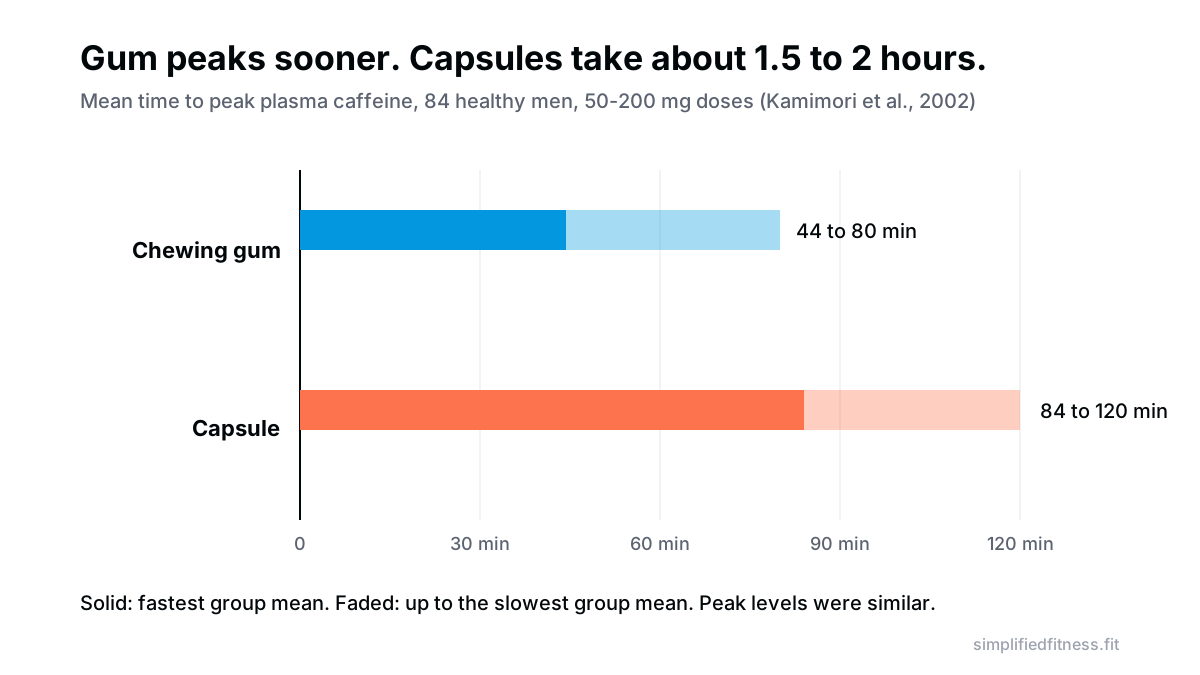
Why does this matter in the gym? Because “60 minutes before” is a guideline, not a switch. These were group averages, and individuals vary around them. With 12 men per group and no women, treat it as a reminder to learn your own timing rather than a precise clock.
Does coffee work as well as caffeine pills for lifting?
When caffeine is matched, the evidence says mostly yes, with one famous disagreement.
The skeptical view. A 2001 review by Graham concluded that caffeine taken as coffee appeared ineffective compared with pure caffeine (Graham, 2001). This is where the “coffee does not work” idea comes from.
The later evidence. In a double-blind crossover trial, 13 trained male runners raced a mile 60 minutes after coffee, decaf or placebo. Coffee was 1.9% faster than placebo and 1.3% faster than decaf, which shows caffeine in coffee was doing the work, not the ritual (Clarke et al., 2018). The 2023 ISSN position stand on coffee concludes that coffee improves performance across reaction time, brief power efforts and aerobic exercise “in most but not all studies” (Lowery et al., 2023).
Why they may differ. Differences in dose and study design are plausible reasons, though the reviews do not settle it. The coffee trial above used a measured amount, but it was a running study, not a lifting one, in a small group of trained men.
The same ISSN document also admits a “dearth of literature” on coffee-specific effects. So the honest summary is: coffee works as a caffeine vehicle, and whether its other compounds add anything is unproven.
For lifting specifically, the strongest evidence comes from caffeine broadly. The ISSN position stand lists small to moderate benefits for muscular endurance, movement velocity and strength (Guest et al., 2021). Aerobic endurance shows the most consistent benefit.
Caffeine powder vs natural caffeine: absorption, dose and cost
Here is how the main options compare for a lifter.
| Source | Typical timing before training | Dose control | Main downside |
|---|---|---|---|
| Coffee | About 60 min | Low (varies by brew) | Stomach acid, volume, inconsistent dose |
| Capsule or tablet | About 60 min | High | Need a trustworthy label |
| Pre-workout powder | Follow the label | Medium (check the label) | Added stimulants, blends |
| Chewing gum | About 5-25 min | High per piece, small total | Small dose, availability |
| Energy drink | Follow the label | Medium | Sugar, cost, other ingredients |
Gum timing comes from a meta-analysis of caffeinated gum, which found small gains for strength (SMD 0.21) and jump height (SMD 0.16) when it was consumed about 5-25 minutes before exercise, though not for muscular endurance (Varovic et al., 2026). Effects like these are small, so treat gum as a convenience tool.
Caffeine delivered as gum is absorbed faster, although total absorption over time is not different from capsules (Wickham and Spriet, 2018). That review also says energy drinks are hard to judge because studies rarely isolate caffeine, which is why we do not rank them above a plain capsule.
In India, coffee you already have at home is usually the cheapest option. A capsule or powder costs extra but gives you a number you can repeat.
Is coffee bad for your stomach before lifting?
For some people, yes. Coffee clearly stimulates gastric acid secretion, biliary and pancreatic secretion and colonic motility, according to a narrative review (Nehlig, 2022). The same review says effects on reflux and ulcers are still controversial.
In the gym, this looks like a cup on an empty stomach, followed by cramps during squats or a rushed trip to the bathroom between sets.
A common mix-up is blaming the caffeine when the trouble may be a large volume of coffee taken fasted. A capsule with water may solve it, which is the practical argument for pills.
If you want to keep coffee, try these:
- Eat a small snack first, such as a banana or a handful of oats.
- Use a smaller, stronger cup instead of a big mug.
- Switch to a capsule on heavy leg days.
Which should you pick: coffee, capsule, gum or pre-workout?
Choose based on your life, not on marketing.
- Coffee if you already drink it, tolerate it, and want something cheap. Aim for about 60 minutes before.
- Capsules if you want a precise dose, have a sensitive stomach or train somewhere you cannot brew.
- Gum if you need a fast top up shortly before a heavy set or a session, and you can get it easily.
- Pre-workout powder only if the label shows the caffeine amount per scoop. Our guide to pre-workout formulation and clinical doses covers what else is worth paying for.
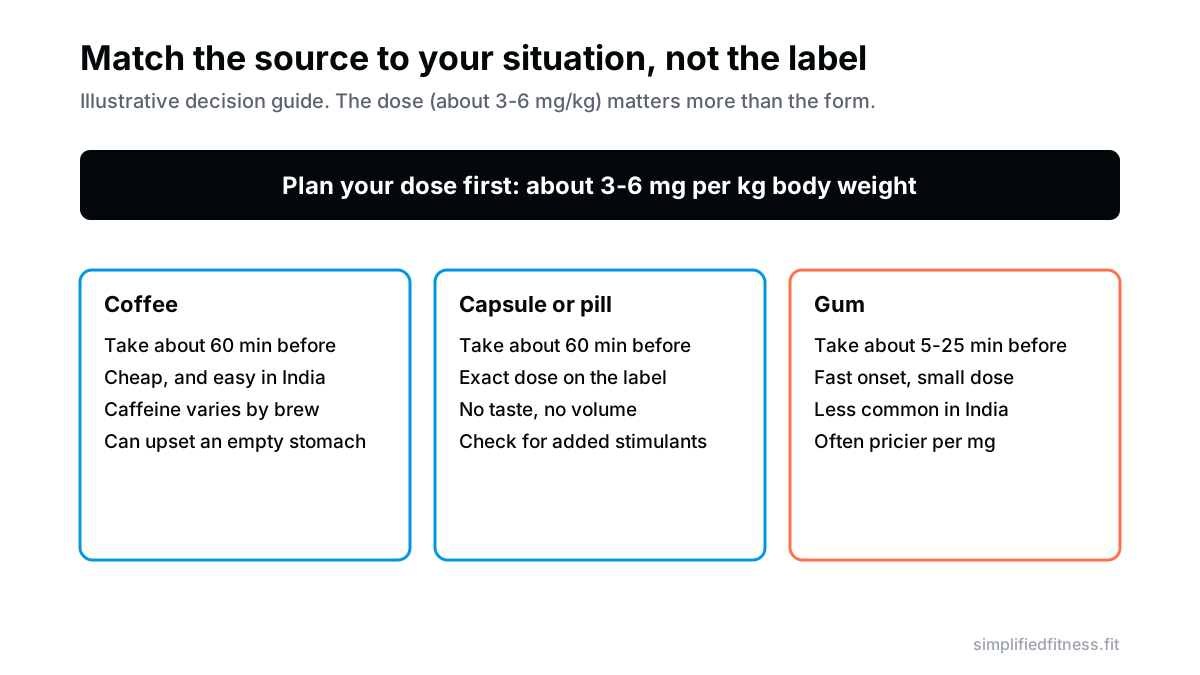
The dose is the lever. The ISSN reports consistent benefit at 3-6 mg/kg, with the minimum effective dose possibly as low as 2 mg/kg (Guest et al., 2021). Our article on caffeine dosing for strength and power goes through the numbers, and the caffeine dosage calculator gives you a figure for your body weight.
What about sleep, tolerance and individual response?
Source does not change two big issues: tolerance and sleep.
People respond very differently. Genetics, habitual intake and anxiety all affect benefit and side effects, and the ISSN notes that caffeine can disrupt sleep in some people (Guest et al., 2021). If you train in the evening, read our piece on the afternoon caffeine cutoff and sleep. Daily users should also look at caffeine tolerance and cycling, and anyone who gets jittery or palpitations will find fixes in our pre-workout side effects guide.
When to see a doctor: if you have a heart condition, high blood pressure, an anxiety disorder or are pregnant, or you take medication, check before using caffeine supplements. Chest pain, a racing heartbeat that does not settle or fainting after caffeine needs medical attention, not a lower dose.
The practical takeaway
Stop worrying about whether your caffeine is “natural” or “synthetic.” Decide on a dose near the 3-6 mg/kg range (starting lower is fine), pick the source your stomach and budget tolerate, take it about 60 minutes before training, and keep it away from your sleep.
Want a session to test it on? Try our push day workout and log how you feel.
Frequently Asked Questions
Is caffeine anhydrous better than coffee for pre-workout?
Not in any way that has been shown to matter once the dose is matched. Reviews and position stands treat caffeine from capsules, coffee and other sources as ergogenic at about 3-6 mg/kg, with small differences in speed and consistency. Pick the one that lets you hit a known dose without stomach trouble.
What is caffeine anhydrous?
It is caffeine with the water removed, sold as a white powder or pressed into capsules and pre-workout formulas. It is the same molecule found in coffee beans, just isolated, so your body handles it the same way. The advantage is a precise, repeatable dose, which coffee cannot offer.
How long does it take caffeine to peak in your blood?
It varies. Most performance protocols use a 60 minute lead time, but in a 2002 trial of 84 men, mean time to peak for the capsule groups was 84-120 minutes, and gum peaked sooner at 44-80 minutes. If you are unsure, test your own timing on a normal training day, not before a meet or max test.
How long before the gym should I drink coffee?
About 60 minutes before training is the standard recommendation in the ISSN coffee position stand. That gives the caffeine time to be absorbed and reach useful blood levels. If you train early and can only manage 30 minutes, expect a slightly weaker effect and consider a smaller cup to avoid jitters mid-session.
Does coffee work as well as a pre-workout?
For the caffeine part, yes, if you get enough of it. In most pre-workouts caffeine is the ingredient with the strongest evidence, and a large trial-style dose from coffee (two to four cups for many people, according to the ISSN) can match the caffeine in a scoop. What coffee will not give you is the other ingredients, whose benefits are less well established anyway.
Is coffee bad for your stomach before training?
It can be. Coffee stimulates gastric acid secretion and colon motility, which is why some people get cramps or an urgent bathroom trip. Eat something small first, try a lower-acid brew or switch to capsules if it keeps happening.
Do chlorogenic acids in coffee help performance?
Possibly, but the evidence is not strong enough to say. The ISSN coffee position stand notes coffee contains hundreds of compounds, including chlorogenic acids, and that coffee effects can differ from caffeine alone, while also saying more research is needed. Treat chlorogenic acids as a possible bonus, not a reason to choose coffee.
Are energy drinks as good as caffeine pills for lifting?
They can work, mainly because of the caffeine, but studies rarely isolate caffeine from the other ingredients, so conclusions are limited. Sugar, price and a variable label make them a weaker choice than a plain capsule or coffee for regular use. If you use one, check the caffeine per can and count it toward your total dose.
Is caffeinated gum better than capsules?
It is faster, not necessarily stronger. A 2026 meta-analysis found a small benefit for strength (SMD 0.21) and jump height when gum was chewed about 5-25 minutes before exercise. Gum suits a late-session top up or a short warm-up window, but the dose per piece is small.
How much caffeine should I take before lifting?
The ISSN position stand reports consistent benefit at 3-6 mg/kg body weight, with the minimum effective dose possibly as low as 2 mg/kg. For a 70 kg lifter that is about 210-420 mg, though many people do well at the lower end. Start low and see how you tolerate it, using our caffeine dosage calculator.
Will caffeine pills dehydrate me in hot weather?
Evidence in athletes has not shown that caffeine before exercise causes dehydration. A 2001 review found no evidence it leads to dehydration or ion imbalance. In Indian summers, keep your usual water and electrolytes, and do not use caffeine to replace them.
Is it safe to take caffeine every day before training?
For most healthy adults, moderate doses are considered safe, but sensitivity varies a lot. Genetics, sleep, anxiety, heart conditions and medications all change the risk. If you have a heart condition, high blood pressure, are pregnant, or get palpitations, check with your doctor before using caffeine supplements.
Sources & References
Every claim above is checked against peer-reviewed research (PubMed, U.S. National Library of Medicine) or guidance from established health bodies. How we fact-check.
- Guest NS, et al. International society of sports nutrition position stand: caffeine and exercise performance. J Int Soc Sports Nutr. 2021. PMID: 33388079
- Lowery LM, et al. International society of sports nutrition position stand: coffee and sports performance. J Int Soc Sports Nutr. 2023. PMID: 37498180
- Wickham KA, et al. Administration of caffeine in alternate forms. Sports Med. 2018. PMID: 29368182
- Kamimori GH, et al. The rate of absorption and relative bioavailability of caffeine administered in chewing gum versus capsules to normal healthy volunteers. Int J Pharm. 2002. PMID: 11839447
- Clarke ND, et al. Coffee ingestion enhances 1-mile running race performance. Int J Sports Physiol Perform. 2018. PMID: 29140142
- Graham TE. Caffeine and exercise: metabolism, endurance and performance. Sports Med. 2001. PMID: 11583104
- Nehlig A. Effects of coffee on the gastro-intestinal tract: a narrative review and literature update. Nutrients. 2022. PMID: 35057580
- Varovic D, et al. Fast-acting caffeine: does caffeinated chewing gum enhance muscular strength, endurance, and jumping performance? A systematic review and meta-analysis. J Strength Cond Res. 2026. PMID: 42228847

Umair Hazrami · Founder & Head Coach, Simplified Fitness
Umair Hazrami founded Simplified Fitness and the Simplified Lifter channel to cut through fitness noise. With 4+ years of consistent training and 10+ coaching clients, he writes every guide from the peer-reviewed research and links the sources so you can check them. Our editorial standards.
Educational content only, not medical advice. If you have a medical condition, are pregnant, or take medication, talk to a qualified doctor before changing your diet, supplements or training. Full disclaimer.
Keep reading
Supplements
Alpha-GPC and Huperzine A Pre-Workout: Do Cholinergic Nootropics Help Lifting?
Does an alpha GPC pre workout add power or focus? See what small trials found, why Huperzine A is a poor lifting bet, and the safety flags to know first.
10 min read

Supplements
The Antioxidant Paradox: Can Vitamin C and E Pills Blunt Muscle Growth and Endurance?
Does vitamin C blunt muscle growth? See what trials of 1000 mg vitamin C plus E found for strength, hypertrophy and endurance, and when pills are worth taking.
8 min read

Supplements
Caffeine Dosing for Strength and Power: 3-6 mg/kg and When to Take It
Caffeine dosage for strength is 3-6 mg/kg, about 210-420 mg for a 70 kg lifter, taken around 60 minutes before training. Doses, timing and when to stop.
8 min read

Supplements
Caffeine Tolerance and Cycling: Adenosine, Withdrawal and a Reset Without the Crash
Caffeine tolerance reset made practical: why 400 mg of pre-workout stops working, what withdrawal really looks like, and a 10-day taper to dodge headaches.
8 min read